Showing posts with label streaming. Show all posts

Wednesday, March 18, 2015

Apple joins the OTT mini-bundlers

Apple has divulged some details on the new Apple TV service that it will offer next fall.  Like the recently initiated Sling-TV, the plan is to offer a small bundle of streaming channels to consumers with Apple TV OTT boxes (actually, and iOS device).  One big difference from Sling-TV is that the Apple plan will be anchored by live streams of most of the broadcast networks (NBC is not currently listed, allegedly because of a longstanding feud between Apple and Comcast).  Apple's bundle will likely be more expensive than Sling's as a result.  Like Sling-TV, Apple's bundle will include access to a Video-on-Demand library - there's talk that Apple wants to extend VOD access to other iTunes content, if it can get licensing deals in place.

For more on the Web/OTT bundling issue, see this earlier post.

Source: Apple Plans Web TV Service in Fall, Wall Street Journal

Streaming Music Systems Performance (Infographics)

Two interesting pieces recently.  One on the relative performance of top music streaming options, the other on how those services compensate performers and writers.

Researchers at YouGov BrandIndex looked at a variety of metrics for the top 5 music streaming services in the U.S. They found Pandora to be the dominant player in the field, although Spotify has been making inroads recently.  Pandora has dominant leads in most of the metrics, from number of subscribers to awareness (from both ads and word of mouth).  Spotify's numbers were improving, but the researchers concluded that
"Perhaps the brands with the biggest challenge are iHeartRadio and iTunes Radio. They have reasonably high awareness levels, but do not seem to be getting traction with consumers. The conclusion is that these brands may need to try something different to generate excitement with consumers."
Music streaming services largely emerged as a result of major record companies eagerness to open up a second revenue stream to help cope with declining sales of physical recordings.  Initially, they were eager to license their recordings to streaming services, but faced an initial roadblock - the existing royalty systems employed two distinct approaches.  Royalties for sales were based on fixed compensation for each unit sold, while royalties for licensing music to radio stations was based on a percentage of station revenues (and not directly linked to which music was played).  Conceptually, the radio model seemed closest to how streaming services operated, as well as how audiences used them.  Thus, most of the early deals utilized royalty payments as a percentage of revenues.

As sales in the traditional music markets continued to fade, the record industry wanted more from streamers.  They started arguing that the current system (which they had eagerly negotiated) was "unfair" - largely because streaming revenues were slow to develop.  The attack came on three fronts.
First, that not enough money trickled down to artists and songwriters.  The biggest problem with that argument is the fact that the share that trickles down to the artists and composers is determined by the rights organizations (like ASCAP and BMI) and the actual rights holders (predominantly the record labels), who take their cut off the top.  So the industry argues for a larger royalty rate, of which only a small fraction would actually go to the artists and composers.
Second, streaming services differ from radio stations in that they can and do track individual consumer plays.  There's no mechanism to measure how many listeners hear a song on radio.  The current licensing deal with Spotify calls for royalties to be paid according to a formula that includes both a revenue percentage and the number of streams.  Spotify also pays an additional set of royalties to songwriters and composers for what is termed "streaming mechanical royalties".  As a consequence, Spotify pays a much higher total percentage of its revenues than Pandora.  (Pandora is currently classified as an online radio service, and radio stations are currently not required to pay mechanical royalties).
The third argument is that most streaming services offer a free streaming option, which the music industry argues "cheats" the rights holders because revenues from the ads are less than subscription-based revenues.  The fact that the free/paid proportions for Pandora is roughly 75/25, while Spotify's audience is more of a 50-50 split, also contributes to the difference in royalty payments.  As one record label executive summarized,
"Based on the free model, the payouts we're getting on streaming is so small... The problem that we're running into is Spotify is just not converting users to the paid version quick enough."
That perspective contributed to the fact that the music labels pressured Apple to raise its proposed starting subscription price for the new Beats streaming service (much like the book publishers did for iBook pricing - which the courts later ruled was an antitrust violation).  But the underlying issue is that the record companies want more money, and are using artist payments to engender sympathy.  If artist payments are the real problem, the music industry could solve that easily by granting them a bigger share of the payments they get, or changing accounting practices so that the artist share comes from gross payments, and not what's left after music industry costs (and profits) are covered.
One can look at this situation from the "level playing field" metaphor.  Spotify wants a level playing field by getting the same deal Pandora has, Pandora wants a level playing field with broadcast radio (straight percentage of revenues, and lower percentage), and the music industry wants to raise the height of the field several feet because they cut the grass (i.e. royalties to artists and composers) too short, and aren't making enough profits from their traditional business models.

The current copyright and royalty system is a mess, largely because it was designed to deal with selling physical copies of intellectual property.  The current model has never really worked well with digital reproduction, or with the growing need to replace shrinking sales revenues with licensing arrangements for emerging digital streaming channels.  Add the fact that digital markets are global and have the potential to scale much higher than physical copy sales (tens of millions for hit albums in digital, while in the physical medium heyday, hits sold hundreds of thousands).  Plus, they're now having to deal with younger audiences who care more about access to music than owning copies of music.  In addition, artists need to recognize that the scale differences should be reflected in the setting of royalty fees - and that because digital access to their recordings remain available long after labels drop them, that they'll benefit from their work much longer under digital deals.

The debate and fights over music royalties is likely to continue for a long time, in part because the music industry is trying to hold on to an increasingly problematic business model, and is hoping to find a way to maintain their control over revenues derived from their historic role as the choke point between artists and their audiences.  However, the growth of the digital economy is showing that it doesn't require multiple layers of distributors (and their growing costs) to provide access to products for potential purchasers.  There are already content creators (including musicians) who have discovered that going independent can provide them much higher levels of return, as well as more control over use of their work.  For the big labels, this is a fight for survival; but for society, it's a fight for who gets to control access to content (and who gets to benefit from that).  As for the question of whether streaming will leave artists unhappy - the answer is yes, if the big labels remain in control, and no, if we can shift focus from preserving a declining music industry to how to develop a rights and licensing regime that promotes and protects creation of, and access to, intellectual property.
 
It's time we shifted our concern from protecting the old ways to think about how to develop copyright and licensing systems that benefits the creators and users of intellectual property rather than those who merely reproduce and distribute it.

(For more background, see this post about a digital music licensing panel at the 2014 CES).


Sources: Infographic: Which Streaming Services Are Winning the Battle for Millenial Eardrums,  Adweek
Is the Music Streaming Industry Destined to Leave Artists Unhappy?, Adweek

Thursday, February 6, 2014

The State of Video Streaming: Sports

NBC and the BBC hit it big by streaming every moment of every event at the 2012 London Olympics, and currently plan on doing the same this year for the Sochi Winter Olympics (as long as the Russian government doesn't block things).  The breadth and success of those 2013 Olympic efforts prompted a lot of audience trying and sampling.
  And then there's the runaway success of Netflix and its brethren.

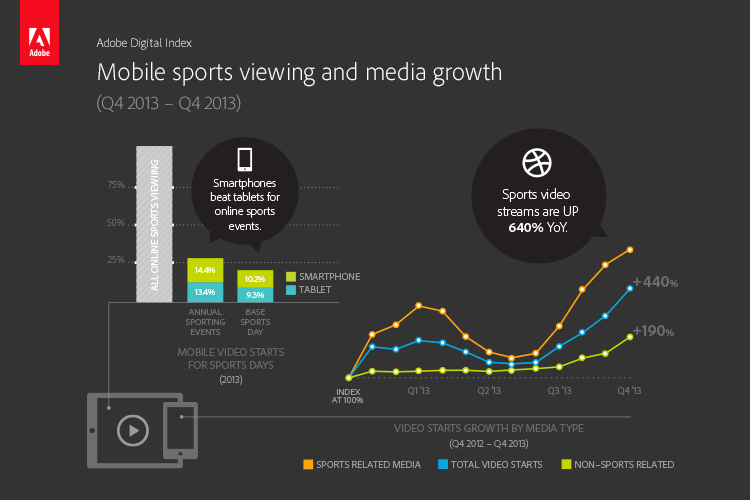
All of this showed promise of a spurt in the use of video streaming for watching sports - which is being confirmed by the latest Adobe Digital Video Benchmark report.

 The 2013 4th quarter report shows that sports video streaming has gone up 640% increase over the previous year. 


In addition:
  • 37% of TV Everywhere content streams are for sporting events
  • More than a quarter of video streaming for major annual and bi-annual events are accessed by mobile devices.
  • Such special events see twice the mobile sports streams than the average
  • Watching sports streams on mobile is up 73% over the last year
  • Most mobile viewing for big events is on smartphones
One reporter contacted Adobe, to get their take on the fact that sports is outperforming other video content in generating video streams.
Campbell Foster, director of product marketing for Adobe Primetime, the company’s TV publishing infrastructure platform for service providers, said the data back up what many other industry observers have noted about sports: It is engagement viewing that fans don’t want to miss, so they use whatever device they can to watch.
Sources -  Adobe research finds mobile sports viewing driving huge growth in digital video, Mobile Sports Report
Adobe Digital Index Benchmark Report, Q4 2013,  Adobe

Tuesday, January 21, 2014

Music licensing @CES2014


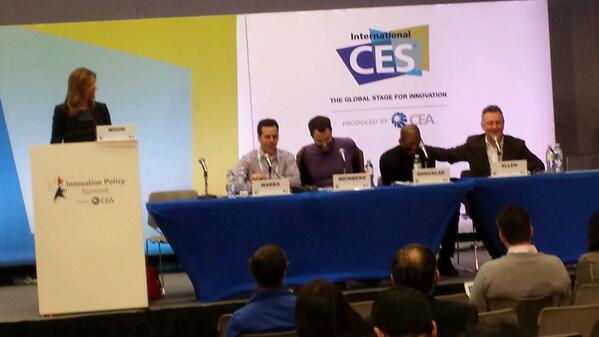
I attended what turned into a fun session on music licensing policy at CES in Las Vegas.  The paneL included a music industry rep from RIAA, the head of a public interest group, and two former musicians.

It started off on focus - acknowledging the mess that is music licensing in the US today, and some ideas for improvement.  The RIAA rep, Steven Marks, said one problem was that there was no comprehensive database of songs and performances, which could make it difficult to know whether a license was needed when using a recording, and who to contact to get it. 
[Which reminded me of a recent story that one of the nastiest of the licensers (for 'Happy Birthday to You') may actually have never filed for a legal copyright for the piece, and thus may have been illegally collecting licensing fees for decades.]
But he's right that having a central listing of licensed works would be helpful - particularly if they verify that pre-1976 works were actually copyrighted.  (Post- 1976 creations are automatically granted copyrights). He also suggested creating a basic licensing center for 'small' users.  Making things easier would arguably help those who want to be legal to do so.

Mark Weinberg, acting Co-President of Public Knowledge - a public interest group promoting wider diffusion of knowledge and content, concurred that making it easier for music users to know what licenses may or may not be needed, and making them easier to obtain would be useful - but was concerned that the industry would try to limit fair use exemptions and collect fees from those who shouldn't have to pay.  He also expressed a desire to see the industry become more flexible in dealing with new media and applications, to support innovations and the exploration of potential new music outlets.  He noted that there was a wide range of music licensing strategies (and different rates) being applied to the wide variety of digital music distribution options - and that applying a single consistent standard, regardless of what technological backend was used for delivery, would be helpful.

Next came Dave Allen, former Gang of Four member.  He made a strong point about the changes in the music industry.  Vastly more listened to radio or streaming sources today. He noted that the prime source for music with today's youth is YouTube (the RIAA guy agreed), but since most of the music content there is in the form of promotional videos, they don't pay royalties.  That led to a claim that the record industry is making deals with streamers that bypass licensing fees and cheat musicians, joined by Hank Shocklee (founder of Public Enemy), and prompting predictable objections from Steve Marks (Chief, Digital Business and General Counsel for RIAA).  The discussion of that generated a great deal of fun back and forth between the artists on the panel and the RIAA rep.

But the key point, which Dave Allen came back to later when things calmed down, was that digital and streaming music sources had the potential to scale much higher than the old record industry, again something the RIAA rep and other panel members acknowledged. Marks, from RIAA, noted that the scale of the physical recordings industry was always fairly small - people, on average, bought only 2-3 records a year, and acknowledged that the potential of digital to be significantly higher. Someone made the point that in the heyday of the old records industry, hit records were sales in the hundreds of thousands in the U.S.  Today, Spotify's paid subscribership in the U.S. is around 6 million, and Beyonce's recent digital album sales were in the millions in the first month alone. Allen suggested the digital market could easily explode - if the right model and pricing develops.

One problem delaying the scale-up is the fact that today's rights fee scales are derived from the payment schedule for vinyl records and that scale of sales.  Revising rights fees (lower) to the higher scale levels could encourage more listening, scale up music use, and benefit artists even more than the current system.  Of course, the RIAA guy wasn't about to support reducing licensing fees, but the head of Public Knowledge encouraged the idea, as a way of  encouraging exploration and development of new delivery options. 

I've been thinking about licensing fees and pricing strategies a lot lately (particularly focused on the bundling vs. a la carte debate on cable), and had a couple of proposals to offer - but the session ran out of time.  I wanted to support the notion of thinking of rescaling rights fees to the potential scale of digital systems - while it might initially reduce short-term revenue generation, it would accelerate the growth of those systems and in the long term had the potential in the long term to generate much higher revenues for the industry and the artists.  The other idea I wanted to raise was the notion of exploiting versioning.

Versioning is a strategy in marketing information goods where different versions of the product are offered at different prices, or to different market segments.  Versioning, based on sound quality, seems to have a natural potential for music.  It's already in regular use - Spotify offers free access to lower-quality streams, and lets subscribers also upgrade their subscriptions to higher-quality.  However, the current licensing system applies the same fees for all quality versions.  If the licensing fee rate schedules would similarly differentiate between quality versions, this could address many of the Public Knowledge's concerns about providing a mechanism for exploration and development of new music distribution systems.  It could also facilitate a better music promotion and sampling system - letting people to listen to low-rez versions of whole songs rather than the current method of allowing very short snippets from the start of songs.

Certainly, all the panelists, and most everyone in the audience, agreed that the current music rights and licensing scheme is massively screwed up, and the inevitable "strong debates" over major record labels handling of rights and fee reimbursements to artists just acts to delay any efforts towards solutions.  There are very reasonable proposals out there, some expressed by panelists, and multiple others being offered by academics, professionals, and policy types (including my own not-so-humble ideas).  It's time, as the panel title suggests, to "Stop Fighting and Fix It."

Sources -
Video of the Stop Fighting and Fix It music licensing session at the CEA Innovative Policy Summit, CES2014, can be found here.

Tuesday, December 3, 2013

Streaming goes Prime-Time in U.S.

Two recent industry research reports point to the growing acceptance of, and preference for, the use of online streaming sources by TV audiences.
“Viewing habits are quickly evolving and connected TV is going mainstream,” according to Eric Berger, EVP of digital networks, Sony Pictures Television and general manager, Crackle.
The research is based on a survey of 1200 younger adults (18-49) conducted by Frank N. Magid Associates.  Their key finding is that online streaming is now viewers' second choice of viewing source (still trailing live TV).  The study found that access to online video streaming was near universal (96%), and more than half (54%) had access through "connected" TVs - either smart TVs, through attached gaming consoles, separate OTT devices, or connected video players.

The trend seems to be reflected in current trends in the cable/multichannel industry. Cable companies in the U.S. are seeing a surge in broadband-only customers (foregoing the primary TV service) - to the point where many are publicly rebranding as broadband services, which can also deliver TV (see earlier post here).  Research from the Leichtman Research Group is showing a decline in pay-TV subscribers, combined with increasing broadband subscriptions.  Their recent report shows major cable operators with 48.7 million broadband subs, and telcos growing more rapidly with 35.9 million (45% of which have access through fiber).  Average broadband speeds are also on the rise, with average bandwidth for broadband connected homes in the U.S. just over 20 Mbps.


As Cablevision CEO Jimmy Dolan told the Wall Street Journal in August: “Ultimately over the long term I think that the whole video product is eventually going to go to the Internet.  I’m not willing to cede that position now, and I’ve got a lot of customers that buy my video product…[but] the handwriting is on the wall, particularly when you look at young customers.” - See more at: http://videomind.ooyala.com/blog/telcos-cable-operators-see-broadband-subscriber-numbers-skyrocket-0?mkt_tok=3RkMMJWWfF9wsRousqzNZKXonjHpfsXx7OglWK6g38431UFwdcjKPmjr1YEITcN0aPyQAgobGp5I5FEMTrfYWbFrt6cPXg%3D%3D#sthash.gsljDRjn.dpuf
Source -  Streaming goes prime time with connected TV prime destination, RapidTVNews
The U.S. now has over 83 million broadband subscribers, GigaOm
Cable Companies See Jump in Broadband-Only Customers,  DSL Reports

Tuesday, November 12, 2013

Transforming Media Habits- Kids vs. "Live"

An interesting piece in the New York Times takes a look at the changing nature of kids' TV viewing habits.  In brief, this generation of youngsters are growing up in an era of instant-access, on-demand, viewing that matches their viewing preferences much more than traditional television ever has. 
   Decades of research have shown that young kids are drawn more to characters than plots, and are comfortable with the familiar.  And anyone with regular exposure to young kids knows that they prefer being read the same story, or watching the same cartoon, time after time after time - well past adults' comfort levels.  In the traditional media era, that mean reading and re-reading favorite books and book series, and watching favorite programs (whether Sesame Street or My Little Pony) that keep recycling characters, scenes, and episodes.  With the rise of home video, this transferred to tapes and DVDs, which also allowed kids more control over when to watch, as well as control over program flow (using fast forward and reverse to focus on favorite scenes).  Disney, which initially sued to stop consumer use of videotapes, eventually found they made a mint from families regularly buying new copies to replace worn out children's videotapes.
When children are enamored of a show (or, more specifically, a character) they want to watch the same episode over and over and learn every detail. Instead of binge viewing as their parents do, they déjà view.

In the new digital entertainment marketplace, technology has expanded the user's ability to control viewing, and it is becoming increasingly driven by "on-demand" rather than traditional live schedules.  Between DVRs, On-Demand access through multichannel providers, and online streaming services, users can control their viewing to meet their needs and preferences.  Broadcast networks are finding that half or more of current prime-time series viewing is done outside of the "live" scheduled broadcast.  And that's with adults, who like original programming.

  For kids, though, traditional "live" TV is a step backwards, a relinquishing of control, a subjugation of their wants and preferences for those of another.  As the Times' lede suggests,
When Eric Nelson’s 6-year-old daughter, Charlotte, and 10-year-old son, Asa, discover that they cannot rewind or fast-forward a TV show, they are perplexed — and their father is, too. It is hard to explain the limitations of live television to children who have grown up in an on-demand world.
Add to that the expansion of personal video devices - bypassing the historical squabbling among kids over what to watch on the family TV, and you have the basis of a major transformation in viewing habits - where young viewers can finally fulfill their viewing preferences instead of settling for what others choose to make available.

These changes are showing up in the TV's industry numbers, although not so much in the regular TV ratings numbers (although it could account for Nickelodeon's recent fall in traditional ratings numbers.  A recent study by Common Sense Media found that kids' TV viewing on mobile devices has tripled since 2011 while viewing on traditional TV sets is falling.  Amazon reports that 65% of the most-replayed content on its streaming service is children's programming.  Amazon's created a special subscription streaming service for 3-8 year olds, and says that more than half of its viewing is from kids watching shows a second, third (or more) time.  Netflix is finding that most re-viewing for preschoolers is tied to learning, while older kids focus on the humor in specific episodes.  That's shown up in their programming strategy - they know they don't need all episodes of a kids program (unlike for most adult series) - just enough of the favorites to satisfy kids' interests.  (And Hulu+ insistence on ads is hindering their ability to attract kids' viewing, and their parent's willingness to subscribe).  Furthermore, traditional kids' channels like Disney, Nickelodeon are pushing access to network streams and program archives through smartphone and tablet apps, and even making new shows available online before their network premiere.
  And while the kids' share of audience and advertising may be small, they've got a strong, almost insatiable, demand for content. 
“Popular children’s programs can be a really big driver of use,” and can keep parents paying for the services, said David Tice, a GFK media analyst.
As a result, streaming services like Netflix and Amazon are working on creating their own original children's programming.  Netflix has contracted with DreamWorks for 300 hours of original children's animations, and Amazon has three new children's series scheduled for next year.

It will be interesting to see how much kids' preference for controlling access and timing of their TV viewing will carry through their adult years.  While content preferences will change as cognitive skills improve and interests shift, I think most will find giving up the control over viewing difficult - at least for most entertainment programs, movies, and short video content.  The value of live for some things (sports, etc.) may continue to overcome the loss in value resulting from the passive nature of "live" viewing - but when competition provides options and opportunity to personalize and control the media experience, it will be increasingly difficult to return to old couch potato habits.

Source -  Same Time, Same Channel? TV Woos Kids Who Can't Wait,  New York Times

Tuesday, September 24, 2013

Oops - Apple TV update pulled after crashes

Apple released its major update to the Apple TV OS Friday, following up on the fanfare promised in the latest round of product releases.  But it seems the fanfare turned nasty, as many Apple TV users reported that their Apple TV units became inoperable after having the 6.0 update installed.  In response, Apple pulled the update, advised those with problems on how to do a factory reset, and said it would try again once they'd fixed the problems. 
The update was designed to fix a number of security bugs, bring the new iRadio service to Apple TV, and shift several old networked services to iCloud.

Source - Apple TV Update Withrawn After Complaints, InformationWeek Mobility

Monday, August 19, 2013

Network Website Most Usable

A report from Web research firm Change Sciences Group suggests that major networks' websites were among the most user-friendly of video streaming sites.  CSG used their proprietary metrics to measure the ease of finding specific episodes, user engagement, and conversion.  In those measures, Hulu and Netflix rated significantly more poorly.
  (Anecdotally, as a user of both Hulu and Netflix, I'll agree that navigating their sites can be frustrating, particularly on mobile devices and through set-top boxes.  The visual interface is nice, and Netflix's recommendation system is a plus when you're looking for something to watch, but finding something specific can be a hassle.  But their real strength is the vast range of content available - something that does make search a bit more problematic.)
  On the down side for the networks, the research showed that the network websites didn't do very well when it came for finding out about new shows, show schedules, or when a new season of episodes is starting.

Surprise: Network TV sites out-web Web OTT giants, Broadcast Engineering

Tuesday, June 4, 2013

Goin' Mobile - Speeds and Content

Some quick notes on the expanding mobile broadband/online video front -

The last leg in mobile broadband for most people will be their home, office, or public WiFi loop.  Telecomm research from the Dell'Oro Group note that the wireless LAN market (i.e. WiFi) grew 17% in 2012.  But even more significantly, the new 802.11ac standard, which offers speeds up to 1 Gigabit/second data rates will be increasingly available on hardware devices this year - contributing to a convergence of wired and wireless data speeds.

There's a massive data speed war in Japan, with multiple operators offering 1 Gbps services over fiber-to-the-home (FTTH) networks, and one operator announcing the rollout of the Nuro 2Gbps FTTH residential service.  So-Net's initial pricing for 2Gbps runs around $50 a month, significantly lower than competing 1 Gpbs services. Meanwhile, Japan telco NTT is said to be working on a 10Gbps residential network, to be available in a few years. 1 Gbps networks are popping up sporadically in the U.S. and Western Europe - Google's test markets offer 1 Gbps data plus multichannel video at around $100-150, and independent 1 Gbps network operators are pricing their services at $200-250 per month.  For most potential residential subscribers, there is little noticeable difference between 2 Gbps and 1 Gbps top data speeds, or for that matter 100 Mbps (corrected  from Gbps) speeds, so there is minimal incentive to switch to ultra-broadband services - aside from bragging rights, and price.  So many analysts are cautious about the rush to ultra-fast broadband, wondering if the cost of upgrading network speeds is recoverable from residential subscription fees.

On the content front, research from ABI is predicting substantial growth in use of the movie industry's UltraViolet "content locker" initiative.  Ultraviolet offers those with accounts online access to selected movies they've purchased on home media and registered with the service.  Ultraviolet currently has 6-8 million accounts; ABI estimates that the global market is likely to reach 65 million users (100 million if several major movie distributors join the program).  What's holding up growth at the moment, the report concludes, are consumer attitudes about trust and usability.
Consumers don’t yet trust the concept, with most still opting for subscription and digital content rental services such as Netflix and Hulu. “The ease of accessing and storing digital video libraries must approach that of digital music,” noted ABI practice director Sam Rosen.

Sources -  Wireless LAN Market on Fire,  CableFAX Tech
Broadband operators must beware the dangers of FTTH 'speed race',  telecoms.com
ABI: UltraViolet Could Radiate 65 Million Accounts… or More,  CableFAX Tech

Edited to correct typo in broadband speeds in middle story.

Hulu+: 3 Bids Over $1 Billion

News reports are indicating that at least three of the bidders for video streaming service Hulu+ are offering $1 Billion or more in the current round of bids.  One is identified as DirecTV.

Hulu+ currently has more than 4 million subscribers and generates around $700 million annually from subscriptions and ad revenues.

The new bid level is certainly more welcome than those obtained in 2011 - when Hulu+ owners News Corp, Disney, and Comcast first put the service up for sale, only to back off when bids didn't approach the amount they wanted.  Of course, the problem then was the unwillingness of the owner group to guarantee long-term access to their programming.  It's not clear what kind of commitments they might be willing to give prospective bidders this time around, but the increase in bids is at least partly a reflection of the growing success of subscription video streaming services and market.

Source -  DirecTV, two others bid over $1 billion for Hulu: source,  Broadcast Newsroom

Wednesday, May 8, 2013

Google, Yahoo Interest in Pay TV?

News reports suggest that YouTube (owned by Google) is getting ready to charge for access to some of its specialty channels, and Yahoo has been in contact with Hulu about a possible bid to buy the premium video service.

Hulu has been on and off the market for the last few years.  When its owners first tried to auction off the service, deals fell through when networks wouldn't commit to continuing to license their content to Hulu.  This dropped the value of the service significantly, well below what the owners sought, so Hulu was pulled off the market.  A few months back, the network owners once again said they'd be open to selling the service, a number of groups expressed interest (including Amazon). 
  Yahoo has been seeking entry into the subscription video on demand (SVOD) market recently.  It had a deal in place to purchase a majority stake in Dailymotion (a video streaming service owned by France Telecom) - until the French government vetoed the idea of foreign majority ownership.  Reports have Yahoo's CEO Marissa Mayer, making initial contact with Hulu execs; but any talks are still in the early stages.  Yahoo's, and Mayer's, interest in online video was evident at a recent Wired conference:
“I think video is really important … video is something that we’re all innately designed and born to experience, everyone is born being able to watch and to hear,” she said. “Video is just this amazing format.”
 YouTube is already the biggest player in online video, but as a free hosting and streaming service.  What's new is a story in the Financial Times that states the service is ready to implement a pay wall for select specialty channels - possibly within a few weeks.  The official YouTube response to the story was that there was "nothing to announce" at this time - well short of a denial.  What YouTube insiders told the FT reporters was that YouTube was
“looking into creating a subscription platform that could bring even more great content to YouTube for our users to enjoy and provide our creators with another vehicle to generate revenue from their content, beyond the rental and ad-supported models we offer.”
  What that suggests is that the service is exploring, and probably already developing, a subscription / pay wall system that could be applied to specific channels/content providers.  The system might help some high-demand YouTube specialty channels with revenues, but it's more likely that YouTube wants the system in place to help attract new premium content channels such as movie studios and sports leagues.  In other words, those content creators that are now licensing content to various SVOD operators, and are thinking about cutting out the middleman and marketing direct to viewers.
  YouTube was quick to calm fears, promising that the vast bulk of user-generated videos would remain free.

I see these as reflecting the growing awareness of the importance of online video and licensing in the expanding TV viewing marketplace, and moves to help online  services position themselves to take advantage of that corner of the market as it expands.

Sources -  Yahoo's Mayer Has Met With Hulu Execs in a Preliminary Look-See at Premium Video Unit,  AllThingsD
Would Consumers Pay For YouTube Channels?,  VidBlog

Redefining U. S. TVHH Universe

When Nielsen announced it was expanding its TV household sample to include homes that had no separate TV set, but could access TV programming via computers or other devices, it was clear that there would be two follow-up changes.  First, that at some point Nielsen would include online viewing in their ratings measures.  Second, that Nielsen would redefine its definition of TV households (TVHH) to include households watching TV programs online.
  Nielsen's latest numbers on the national TV audience has taken that second step, redefining its viewing audience measures.  Specifically, Nielsen's counting you as a potential viewer if you have a working TV set, or a broadband Internet connection and a monitor/display capable of displaying TV programs.
  Under the new definition, Nielsen reported the 2013/2014 U.S. TV household Universe Estimate at 115.6 million (up 1.2%), and the total number of TV viewers (2 and older) at 294 million (up 1.6%).  The gain comes after two years of declining viewing universe numbers, but is still less than the 2010/2011 Universe Estimate of 115.9 million homes. 
  In announcing the new metrics, Nielsen indicated that three factors contributed to the gain - real changes in population; updated formula for calculating penetration across demographics; and the expanded definition of a TV household.  They did not indicate how much of a contribution each factor made.

Sources -  Nielsen Reverses Decline in U.S. TV Homes, Variety
Nielsen Estimates 115.6 Million TV Homes in the U.S., Up 1.2%,  Nielsen press release

Tuesday, May 7, 2013

Off Net to Online - Starting the Revolution

A couple of recent items in support of Friday's post on TV shows moving off broadcast networks.

Soaps - Last week saw another first, as two historic soaps renewed  their story lines online, after being cancelled by their broadcast networks.  New episodes of All My Children and One Life to Live are now being produced by Prospect Park's The Online Network, and are available on Hulu, HuluPlus, and iTunes.  Each of the shows is returning with much of its cast and creative talent intact, familiar sets (although those needed to be rebuilt in their new studio digs), and continuing many long-term storylines.  And they're maintaining their high production values.
(As) far as soap operas go, the new “AMC” and “OLTL” look like the real deal: handsomely executed television series that just happened to be produced for online viewing.

  There are some significant differences - new episodes run 30 minutes, and come out only four times a week.  Moving off broadcast has also freed the shows from the strictures of FCC "indecency" regulations, allowing them to embrace the greater latitude that cable and pay cable programs are exploiting.
Right out of the box, the kids are running around without clothes on during “AMC,” and cursing up a storm on “OLTL.” (On “OLTL,” s-bombs are dropping over Llanview like ducks from the sky during hunting season.)
Commentators suggest that the new shows are once again skating along the cutting edge of soaps, perhaps seeking to entice younger viewers who have grown up watching the less-regulated content of cable and Internet, while maintaining the familiar characters and plots that might just entice older fans and viewers online. 

Production Model -  Talking about Amazon's new political comedy series Alpha House on a cable talk show with producers Jonathan Alter and Garry Trudeau, advertising mogul and TV commentator Donny Deutsch let it slip -
“You guys are on the front line of a revolution,” Deutsch said.
The subscription video-on-demand (SVOD) model embraced by Netflix, Hulu, and Amazon (among others) could have a huge impact on the future of original content creation and distribution - not only as a new (and booming) revenue source, but in large part because it's a different business/production model.
“It feels a little bit like those folks in the early '50s at the beginning of the era of television or in the early '80s at the beginning of cable TV,” Alter said. “Online TV is coming. It’s coming really fast and it’s going to be great for viewers.”
 The historic TV program business model emphasized general-interest programs for the casual viewer (and advertisers), and high-overhead, heavily unionized, and increasingly expensive studio production. (On a per-episode basis, a half-hour sitcom can cost $1-3 million; an hour drama $2-5 million; a two-hour TV movie $7-15 million). It's a high-cost but potentially high-reward strategy.
  In contrast, the business model for SVOD emphasizes niche programming for the dedicated viewer - the kind of viewer who will pay for access to the show, and devote a weekend to watching a full season of shows, and come back again and again and again.  In other words, the engaged, dedicated, fan.  In addition, SVOD distributors (like many cable networks) are not tied to the Hollywood studio model for production, and can take advantage of declining costs of digital production and less costly locations.  As Trudeau said during the talk show -
"But now there is this perception that content can be made anywhere. Obviously, the provider has to have deep enough pockets, but TV shows are now seen as kind of the new novel. Anyone can make it. As long as it’s of a certain quality, people will go find it.”
  An emerging advantage for niche programming is the potential to use crowd-sourcing for initial funding and testing.  Amazon's testing that approach with some of its candidates for new original movies and series - with pilots airing on Amazon Instant Video to gather viewer feedback and response.  Then using that feedback to tweak content and select which go into full production
"That form of implicit feedback is as useful, or more useful sometimes, than the explicit feedback," (head of Amazon Studios Roy) Price said. "This told us something about the marketability of these ideas."
Amazon Studios recently turned "Blackburn Burrow," a movie script by screenwriter Jay Levy, into a digital comic to get more consumer input.
Between the lower costs of digital production and distribution and the higher value placed on programs by dedicated and/or engaged viewers, the threshold for success online (and on cable networks) is much lower than it is for the Big Four broadcast networks. And it doesn't hurt that niche audiences can attract premium rates for targeted markets.

  The TV program market is changing, evolving, and expanding.  Digital innovation is having a significant impact on program production costs and removing barriers to entry; digital distribution is opening new markets and revenue sources; and advertisers are taking advantage of niche programming and targeted audiences.

   Vive la Revolution!

Sources -  Are Online Versions Of 'All My Children' & 'One Life to Live' TV Game-Changers,  TV Board
Netflix, Amazon Could Impact Original Content Ecosystem, TVBlog
Crowdsourcing goes to Hollywood as Amazon makes movies,  Reuters

Friday, May 3, 2013

Expanding Channels for TV (Quality) Programming

HBO and Showtime showed that original TV-form programming could succeed on pay cable channels. SyFy, AMC, Comedy Central, A&E, and many more are creating and airing original professional-quality (on a par with major broadcast network standards) programming, and grabbing large and lucrative audiences.  And now, Netflix has had two hits with new episodes of Arrested Development and original series House of Cards - demonstrating the viability and value of original programming for streaming video-on-demand services, and driving Amazon and Hulu into creating their own original series programming.  Broadcast networks are no longer the sole, or even primary, conduits for quality original series programming.

Need proof? Last year cable networks won more Emmys than the major broadcast networks.  A&E's Duck Dynasty pulled in more viewers than all original broadcast series programming in recent weeks .  HBO's Game of Thrones is becoming the must-see standard for excellence in TV programming.  And a recent study showed that 45 million people watch "professional quality" original video programs a month through streaming services.

At the recent Digital Content NewFronts, Netflix, Hulu, and Amazon previewed 19 new original series for potential advertisers, and test audiences.  NewMediaMetrics asked a sample of 3000 people to indicate their interest in the programs (based on a description), and how much "emotional pull of the premise" they felt.  Based on their metrics, they predicted four likely successes - Zombieland (Amazon Studios); The Onion Presents: the News (Amazon Studios); Prisoners of War (Hulu); and Lilyhammer (Netflix).  Five other shows rated just below, judged to b e "on the bubble."
  If you're wondering how accurate "emotional pull" can be, NewMediaMetrics said it used the measure to accurately predict two-thirds of the flops among the major broadcast networks Fall prime-time series..

Sources -  Which NewFronts Shows Will Be Hits:  OnlineVideoInsider
The Nielsen Family Is Dead,  Wired.com

Thursday, May 2, 2013

Milestone - Hulu Plus passes 4 million subs

Hulu Plus recently announced that it had passed 4 million subscribers by the end of last quarter - a gain of around a million  subs in the last three months.
"We set new records for revenue and for the first time ever, Hulu viewers streamed more than 1 billion content videos in a single quarter," acting CEO Andy Forssell wrote on Hulu's blog.
Still, they've got a ways to go before catching up with Netflix's 29.17 million subs at the end of the first quarter.  In fact, Netflix added twice as many subs in the last quarter (2 million) as did Hulu Plus.
Premium content streamer HBO Go's 28.7 million subs at the end of 2012.

 Source -  Hulu Plus claims 4 million subscribers,  FierceOnlineVideo

Tuesday, April 30, 2013

Baseball goes live - in Europe

The U.S.'s MLB (Major League Baseball) is now streaming two games a day to Europe and other markets.  Just not to the games biggest fan markets (US, Canada, Japan, South Korea, and Taiwan).
  The games are available through MLB's YouTube channel, which will also have highlight clips from in-season games two days after they're played and a large archive of "Baseball's Best Moments."  MLB's been streaming games live for a while now, but only as part of MLB TV's premium package (available in US for around $130/yr) - the move is part of their effort to expand the sport's fan base into new markets.

Source - MLB starts to stream games live on YouTube... outside of the US and Canada,  GigaOm

Monday, April 22, 2013

More Music News

The latest NPD Group Annual Music Study is revealing big gains for Amazon's online music unit, with its share of the market up about 50% in the last year, to 22% of the market.  Apple's iTunes store still dominates the market with 63% of sales, but is finding it's share falling in the face of increased competition.  Analysts attribute much of Amazon's gain to the introduction of its Fire tablets (which offers an easy interface for users), and its aggressive pricing strategy (with special limited-time free, or heavily discounted, bargains).  I'd add Amazon's DRM-free approach (which Apple's had to adopt), it's Cloud streaming apps, and it's recent offer of free digital versions of CDs that had been bought through Amazon.  They've been making some smart moves at Amazon.

In other news, Spotify recently announced plans to expand into Asia, Latin America, and Northern Europe - a move that will advance the current global shift to digital music (and licensing for streaming services as a major revenue source for music labels).  Spotify currently operates in 28 countries, and claims 24 million "active" users (those using it in the last 30 days) and 6 million paying subscribers for its upgraded services.
"We're taking our first steps in Latin America with Mexico, and Asia with Hong Kong, Malaysia, and Singapore," the company said on its blog page on Tuesday. "Plus we're thrilled to make new friends in Estonia, Latvia, Lithuania and Iceland."
Spotify is currently trailing Pandora in reach and use.  Pandora currently claims around 70 million users.  Both are taking advantage of the booming smartphone market, and research that indicates that half of smartphone users listen to music on their devices.

Sources -  Amazon gains against Apple's iTunes in music downloads,  CEN-Web
Music streamer Spotify to expand into Asia, Latam, North Europe,  CEN-Web

Twitter Adds Music

Last week, Twitter announced a new stand-alone music streaming app, called #music.  The iPhone app will recommend and stream songs based on who users follow, as well as artists' recommendations.
 In a blog post, Twitter's engineers said the new service "uses Twitter activity, including Tweets and engagement, to detect and surface the most popular tracks and emerging artists... It also brings artists' music-related Twitter activity front and center: go to their profiles to see which music artists they follow and listen to songs by those artists."
The actual songs will come from subscription streamers Rdio and Spotify, as well as Apple's iTunes store.   The service is currently available in the U.S., Canada, the U.K, Ireland, Australia, and New Zealand.  No release date was provided for a native Android version of the app.

#music comes online four months after the launch of Twitter's video-sharing app, Vine, and is seen as part of Twitter's goal of becoming a multimedia hub for younger users.

Source -  Twitter launches music app to deepen multimedia offering, TheUSDaily

Monday, April 1, 2013

HBO Go to add live sports?

HBO Sports head Ken Hershman, speaking at the Harvard Sports Law Symposium that his network was "actively pursuing the idea of putting live streaming sporting events on HBO Go."  When is another question - one person attending the conference said the goal was to have live streaming sports by the end of this year, while other press reports have HBO indicating that they have no intentions of adding live sports to HBO Go "anytime soon."  HBO's chief executive Richard Plepler also contributed to the uncertainty of HBO Go's focus when he speculated that the streaming service might someday be offered as part of a bundle with high-speed internet access.

  Adding live sports would be the draw that could provide the demand for a higher-priced HBO Go as a stand-alone streaming service - but the long-term viability will depend more on the cost of carriage rights - and for now, the highly competitive cable sports market is driving up carriage fees.  So while live sports is something that's worth looking into for the programmers at HBO Go, it may be some time before the numbers make it a viable business decision - at least for more popular sports.

Source -  HBO Go planning to add livestreaming sports in 2013,  VentureBeat

Monday, December 3, 2012

Digital Streaming Changing Music Listening Habits

A new study by market researchers NPD Group found that half of US internet users listened to an online radio station or from an online on-demand service in the last three months. A bit more than a third (37%) listened online through a streaming service (Pandora or Internet radio). a bit less (36%) listened via a pure on-demand service.
  The shifts in listening patterns are becoming apparent - over the last year, Internet radio listening is up 27%, audiences for on-demand music streams is up 18%, listening to digital downloads is down 2%, listening to terrestrial radio is down 4%, and listening to CD's is down 16%.
“Although AM/FM radio remains America’s favorite music-listening choice, the basket of Internet radio and streaming services that are available today have, on the whole, replaced CDs for second place,” said Russ Crupnick, senior vice president of industry analysis at NPD. “We expect this pattern to continue, as consumers become more comfortable with ownership defined as a playlist, rather than as a physical CD or digital file.”
The study also looked at the changing music listening habits of Pandora users. Compared to 2009 levels, the number of Pandora users listening to terrestrial radio is down 10%, listening to digital downloads on personal media devices is down 21%, and listening to CDs (on devices other than PCs) has fallen 21%.  Similar changes were found for listeners of leading on-demand music streamers.
  Still, the biggest change in listening is the result that 34% of Pandora listeners are listening in their cars over the car's audio system (directly, or indirectly through a link to a mobile connected device).
  As for those concerned that the shift to online music listening might tend to stifle interest in new music, the study found that 64% of online music service listeners reported that they had rediscovered old favorites and music, and 51% reported learning about new music.
“AM/FM radio has traditionally played a significant role in helping consumers learn about new music from well known artists, as well as finding new ones; however, Pandora and other music services are an increasingly important part of the music-discovery process.”
  Given that last result, the music industry might want to rethink their push in Congress to place significantly higher royalty fees on online music services - between the push for more royalties from radio and online, they may just price music listening out of regular use.

Source  -  The NPD Group: Internet Radio and On-Demand Music Services Rise, Putting Pressure on Traditional Forms of Music Listening, press release from The NPD Group