While discussing their Q1 2015 earnings report, Warner Music's CEO noted that streaming revenues passed digital downloads. If you combine streaming with other rights/licensing, it suggests that the music giant is making more from music licensing than music sales.
Source: Warner Music says streaming passed downloads for first time, telecoms.com
This blog is affiliated with a course at the School of Journalism & Electronic Media at the University of Tennessee, Knoxville. I'll try to use it to share relevant news and information with the class, and anyone else who's interested.
Showing posts with label milestones. Show all posts
Tuesday, May 12, 2015
Tuesday, July 8, 2014
Milepost: 2 in 5 US Households are "cellphone-only"
The proportion of US households who only have wireless phones passed 40% in 2013, according to a report from the CDC's National Center for Health Statistics. Furthermore, it would seem that the cell phone has replaced the land line as the "lifeline" for the poor and for families with children. The report also shows that younger folks are also high adopters of the wireless-only lifestyle.
The report found that 56% of "poor" households and 46% of the "nearly poor" are cell-only; furthermore, almost half (47.1%)of all children live in wireless-only households.
Demographically, it's no surprise that older age groups are most likely to maintain their land lines even after acquiring cell phones - only 14% of those 65 or older are wireless-only, while roughly a third (31%) of those 45-64 have abandoned landlines to go wireless. In contrast, two-thirds of those 25-29 reported being wireless-only. Hispanics reported the highest level of wireless-only households, at 53.1%. Those households living in the Northeast were the least likely to be wireless-only, with just under a quarter (24.9%) without land lines.
These results fit several of the current memes on the diffusion and adoption of telephone service:
Sources: Two of every five U.S. households have only wireless phones, Pew FactTank
Wireless Substitution: Early Release of Estimates From the National Health Interview Survey, July-December 2013, CDC National Center for Health Statistics report
The report found that 56% of "poor" households and 46% of the "nearly poor" are cell-only; furthermore, almost half (47.1%)of all children live in wireless-only households.
Demographically, it's no surprise that older age groups are most likely to maintain their land lines even after acquiring cell phones - only 14% of those 65 or older are wireless-only, while roughly a third (31%) of those 45-64 have abandoned landlines to go wireless. In contrast, two-thirds of those 25-29 reported being wireless-only. Hispanics reported the highest level of wireless-only households, at 53.1%. Those households living in the Northeast were the least likely to be wireless-only, with just under a quarter (24.9%) without land lines.
These results fit several of the current memes on the diffusion and adoption of telephone service:
- mobile households are more likely to rely on mobile services, particularly those who change physical addresses.
- lower income households are less likely to maintain multiple services (the interesting note here is that cell services are becoming cheaper than land lines)
- households with multiple wireless users are more likely to go with individual mobile lines than a "family" land line
Sources: Two of every five U.S. households have only wireless phones, Pew FactTank
Wireless Substitution: Early Release of Estimates From the National Health Interview Survey, July-December 2013, CDC National Center for Health Statistics report
Friday, March 28, 2014
Milepost: 500,000,000 iPhones
Apple sold its 500 millionth iPhone recently.
When introduced in 2007, Steve Jobs predicted sales of 10 million by the end of 2008, and one senior financial analysts forecast that Apple would have "a difficult time" making it, pointing out that at that time, Nokia was selling more cellphones a week than Apple had sold iPhones. And thereby joining the gallery of famously bad predictions. In fact, Apple sold 13.8 million iPhones in 2008, and is currently selling a million iPhones a month, just in China.
While Apple is losing market share to Android in terms of mobile operating systems, their history of build quality, integration of components, and innovation suggests that iPhone's future remains positive. At the current rate, they should hit a billion units sold sometime in the next three-four years.
Source - Without Much Fanfare, Apple Has Sold Its 500 Millionth iPhone, Forbes
When introduced in 2007, Steve Jobs predicted sales of 10 million by the end of 2008, and one senior financial analysts forecast that Apple would have "a difficult time" making it, pointing out that at that time, Nokia was selling more cellphones a week than Apple had sold iPhones. And thereby joining the gallery of famously bad predictions. In fact, Apple sold 13.8 million iPhones in 2008, and is currently selling a million iPhones a month, just in China.
While Apple is losing market share to Android in terms of mobile operating systems, their history of build quality, integration of components, and innovation suggests that iPhone's future remains positive. At the current rate, they should hit a billion units sold sometime in the next three-four years.
Source - Without Much Fanfare, Apple Has Sold Its 500 Millionth iPhone, Forbes
Tuesday, January 14, 2014
Milepost: Flipboard passes 100 million users
Flipboard, founded in 2009 as a personalized digital app recently announced passing two mileposts - passing 100 million users in December 2013, and hosting more than 5 million individual online magazines.
The ability of users to individually curate online magazines with content from various net sources was added with last March's major upgrade to Flipboard 2.0. At the time, Flipboard had 50 million users. The company expects that the expanded platform and search capabilities will have Flipboard passing 150 million users within the year.
To be transparent - I've currently got five Flipboard personal magazines, one in conjunction with/ supplement to this blog JEMS, a limited-term supplement connected with my trip to CES this year JEMS@CES2014. A third service mag is Media & Audience Research Reports, which links to white papers and research reports available online. Two more personal curations are The Esoteric Bits and Serendipitous Video.
Source - Personalized digital magazine app Flipboard aims for 150 million users, The Guardian
The ability of users to individually curate online magazines with content from various net sources was added with last March's major upgrade to Flipboard 2.0. At the time, Flipboard had 50 million users. The company expects that the expanded platform and search capabilities will have Flipboard passing 150 million users within the year.
"You will see us [in 2014] start to enhance our discovery capabilities, making the discovery capabilities work with all these magazines that people are creating, so that you will be able to discover this stuff," (Flipboard founder Mark) McCue says.
To be transparent - I've currently got five Flipboard personal magazines, one in conjunction with/ supplement to this blog JEMS, a limited-term supplement connected with my trip to CES this year JEMS@CES2014. A third service mag is Media & Audience Research Reports, which links to white papers and research reports available online. Two more personal curations are The Esoteric Bits and Serendipitous Video.Source - Personalized digital magazine app Flipboard aims for 150 million users, The Guardian
Wednesday, October 9, 2013
Prospective milestone: Online video devices outnumber people by 2017
A report from the Broadband Technology Service at IHS predicts that the explosive growth in smartphone and tablet ownership will result in over 8 billion Internet-connected video devices in the world by 2017. The projected world population in 2017, in contrast, is 7.4 billion.
Source - More Internet Video Hook Ups Than People in the World by 2017, VidBlog
“In practice, ownership of Internet-connected hardware will be concentrated among users whose homes are equipped with broadband connections,” said Merrick Kingston, senior analyst for Broadband Technology Service, in a press release.The growth in 4G mobile services will fuel expansion of basic levels of broadband access, particularly in rural areas and in developing countries. That's also a key component in the expansion of online video access.
“We’re quickly approaching a world where the average broadband household contains 10 connected, video-enabled devices. This means that each TV set installed in a broadband-equipped home will be surrounded by three Internet-connected devices.”
Source - More Internet Video Hook Ups Than People in the World by 2017, VidBlog
Thursday, September 26, 2013
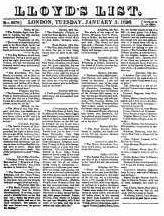
Lloyd's List to end print run after 280 years
Lloyd's List, arguably the world's oldest continuously printed newspaper, has announced plans to become totally digital by the end of the year. The paper started providing shipping news in 1734, and remains a preeminant source of shipping news, data, and analysis.
Between the rising costs of printing and mailing, a reader survey that showed that less than 2% of readers relied on the print version, and the increased opportunities for innovation offered by digital, it was an easy business decision. Even so, ending such a long tradition is difficult
In commenting on the move, Lloyd's List editor, Richard Meade, harkened back to the first days of the paper, when it was a notice pinned to the wall of a London coffee shop and noting that today its readers can still sit in coffee shops and access the paper through smartphones and tablets - in a sense maintaining tradition while expanding access, opportunity, and increasing their ability "to provide news and market intelligence for the shipping industry... in the format our customers want and need."
Source - Lloyd's List to go all-digital, Informa
Between the rising costs of printing and mailing, a reader survey that showed that less than 2% of readers relied on the print version, and the increased opportunities for innovation offered by digital, it was an easy business decision. Even so, ending such a long tradition is difficult
In commenting on the move, Lloyd's List editor, Richard Meade, harkened back to the first days of the paper, when it was a notice pinned to the wall of a London coffee shop and noting that today its readers can still sit in coffee shops and access the paper through smartphones and tablets - in a sense maintaining tradition while expanding access, opportunity, and increasing their ability "to provide news and market intelligence for the shipping industry... in the format our customers want and need."
Source - Lloyd's List to go all-digital, Informa
Wednesday, September 4, 2013
Milepost - The Economist notes 170th anniversary.
British news magazine (newspaper) The Economist is marking the 170th anniversary of the first edition, published Sept. 2, 1843. One way it's doing so is by explaining itself through a series of blog posts under the rubric of "The Economist explains."
Among the posts -
Not as big a splash as Vanity Fair, but then again it's not a centenary. But 170 years is not a milepost to ignore.
Source - How does The Economist choose what to cover?, The Economist explains
Among the posts -
- How does The Economist choose what to cover? (a fairly standard gatekeeping/editorial process)
- Why does The Economist call itself a newspaper? (they see themselves as trying to be more comprehensive in coverage than most magazines, so they call themselves a "comprehensive weekly newspaper for the world")
- Is The Economist left- or right- wing? (It claims to be neither, but is pro-free enterprise and pro-individual freedom. A sort of libertarian perspective, although they prefer the label "classically liberal")
Not as big a splash as Vanity Fair, but then again it's not a centenary. But 170 years is not a milepost to ignore.
Source - How does The Economist choose what to cover?, The Economist explains
Tuesday, September 3, 2013
Milestone - Vanity Fair turning 100
Vanity Fair's first issue (as Dress & Vanity Fair) came on October 1, 1913. The magazine's 100th anniversary issue will feature iconic images from the magazine's past and commissioned essays on each decade of the magazine's life.
In his Editor’s Letter, Vanity Fair editor Graydon Carter remarks on the magazine’s milestone: “In an age when nothing seems to last—not convictions, not even cities—a centennial, like the one Vanity Fair celebrates this year, makes me marvel at the simple fact of longevity.”
“Magazines have ‘bones’—the unchanging elements that give structure to creativity—as surely as gardens and houses do,” writes Carter. “Today’s magazine is different in countless ways from yesterday’s—as even the briefest excursion through this issue will show. But I like to think that if [Vanity Fair’s first editor] Frank Crowninshield…could see the modern Vanity Fair, stripped of its logo and other identifying marks, he’d know in an instant what he held in his hands.”
The October 2013 issue will be on newsstands in LA and NY on Sept. 5, and released for e-Readers on the 10th. The magazine will further commemorate the anniversary, vanityfair.com will launch an anniversary hub with more than 200 pieces of archival and new original content (including videos, articles, slide shows, interactive features and Spotify playlists).Making it through two World Wars, multiple Depressions, and the rise of digital online media is quite an accomplishment. Here's to the next hundred.
Source - Introducing Vanity Fair's 100th Anniversary Issue, Featuring Cover Model Kate Upton, VF Daily
Monday, January 7, 2013
Milestones: 1000 Posts
A quick aside to note that this is the 1000th post for this blog. Not bad, as the blog turns 2. (The first post occurred on Jan. 6, 2011).
At this point, we're getting around 3000 visits a month, with visitors from around the world. About a third come from the US, with Russia and France generally competing for the next highest source of visitors. The UK, Germany, and India also show up regularly in the audience metrics.
One recent post has been accessed more than 400 times, although that is admittedly an outlier.
So, happy birthday, blog!!
At this point, we're getting around 3000 visits a month, with visitors from around the world. About a third come from the US, with Russia and France generally competing for the next highest source of visitors. The UK, Germany, and India also show up regularly in the audience metrics.
One recent post has been accessed more than 400 times, although that is admittedly an outlier.
So, happy birthday, blog!!
Subscribe to:
Posts (Atom)


