Showing posts with label "TV Everywhere". Show all posts

Monday, May 11, 2015

A Survey of Research Results - Evolution of Video Marketplace

Finals are over, and there have been several rounds of industry research results to post.

From the Interactive Advertising Bureau, a survey of online video viewers. An earlier study suggested more than 85% of Internet users report having watched online video, and this 2014 study reports 59 million U.S. adults (24%) report watching online videos at least once a month.

  • The means of access is expanding - those reporting access via desktop or laptop remains steady at 72%, but use of connected TVs (56%), smartphones (56%), and tablets (48%) have doubled over the last two years.  ODV users who watch their programming on connected TVs primarily do so during Primetime hours, and half report watching considerably more ODV than they did last year.
  • Original Digital Video (ODV) is seen as having more original content, being more innovative, unique, edgy, and mobile than regular TV content, and the perception gap is increasing.  ODV is tied with Primetime TV as the preferred content type, and is significantly preferred over other regular TV genres (sports, news, daytime)
  • Young cord-cutters and cord-nevers say that having access to Original Digital Video (ODV) is an important factor in choosing not to have Pay TV. Most also report preferring ODV to conventional TV programming - including Primetime shows.
  • Social is increasingly integrated with Online Digital Video - use of social media to discover ODV has nearly doubled in the last 2 years (42% of ODV users), and ODV users are much more likely to have content-related social media interactions than Primetime viewers (55% vs. 39%).
Limelight Networks have released the 2015 edition of The State of Online Video.  Their key conclusion is that online video viewing is booming, and changing the television viewing experience. While there are a variety of demographic differences, younger viewers (Millennials) are driving the shift from traditional broadcast television to online video.
  • While most viewers report watching 4 hours or less of online video a week, the majority of Millennials watch 4 or more hours a week.
  • Cord-cutting is becoming a viable option.  Only 10% of those with a Pay service (Cable, DBS, Telco) say they'll stick with their service no matter what.  More than a third (38%), on the other hand, say that rising subscription prices could motivate them to cord-cut, and 30% indicated an interest in switching if the content they want becomes available online or over-the-air.
  • Variety in both content and viewing options are prime motivators for online video viewers. The increased availability (and use) of long-form video content online is a big factor in the increase in viewers and viewing time for online video.  Many online video users report owning and using multiple devices (beyond TV sets) for watching online videos.
  • Social media is facilitating and encouraging video sharing.  Some 15% of respondents report sharing video content via social media.

Sources -  2015 Original Digital Video Study, IAB (Interactive Advertising Bureau)
The State of Online Video, CDN Limelight report (2015)

Tuesday, March 10, 2015

The end of big bundles? Going "a la carte" via OTT

OK, first let me take care of clarifying the terminology.

Assembling big (often 50+ channels) bundles of cable networks has been the primary strategy of multichannel video service providers (cable, DBS, telco cable, etc.) for the last couple of decades. Keeping bundles big helps minimize transaction costs for the bundler, while offering maximal potential audience reach for advertisers, and maximizing the viewer's ability to browse and discover the value of channels and their content.  On the other hand, critics complain that it "forces consumers to purchase channels they aren't interested in."  That's not necessarily true, as purchase decisions are based on the aggregate perceived value of the bundle, not the "costs" of undesired channels (see here for more detailed analysis).

Still, as the networks and local stations seek to increase licensing fees from multichannel providers, those costs are passed on to the consumer in the form of higher bundle prices.  Bundle subscription costs are rising rapidly, and may be nearing a threshold point for many subscribers - the point where their perceived value of the bundle is less than the subscription price.  We're seeing the beginning of this in the rise of cord-cutters - those replacing paid multichannel access with a combination of online and free over-the-air TV sources.

However irrelevant, the claim of paying for unwanted channels is a major theme for those who would prefer to force multichannel services to unbundle channels and offer them to consumers in small focused bundles (like the various Discovery channels), or individually (i.e. "a la carte").  This may seem to be a good deal for consumers - until you realize that going a la carte will, in most cases, reduce audience reach numbers significantly.  One study (discussed here) forecast that forced unbundling could result in a loss of 60% of advertising revenues for cable networks, and result in more than 100 channels going out of business.  And since cable networks would need to significantly increase their a la carte prices to recapture some of those losses, going a la carte would also likely result in higher total costs for cable network access for most consumers.

Meanwhile, some multichannel video providers are finding that the increased licensing demands made by some networks are crossing that value threshold, and are dropping channels, or in one case offering to provide the channel - but only as an a la carte service.  The networks have so far been smart enough to realize that either option is a net loss for them, but the gleam of a licensing El Dorado of unlimited wealth keeps them trying to push licensing fees ever higher.  Viacom, and its package of networks, is the latest battleground, with their channels being dropped by a number of mid-range and smaller cable systems unwilling to cave into their licensing demands.  As one analyst noted,
“The stage is set... As consumers are less interested in large bundles, somebody is going to get hurt in the process by asking for too much.”
If multichannel service providers remained the only option for access, the impact on the industry would be bad enough.  However, they're facing rapid growth in the ability of broadband internet connections to provide access to high-quality TV streams to mobile devices and wired connected devices.  The term OTT (over-the-top) refers to these alternative sources of video and TV content. Both the diffusion and use of these technologies for TV viewing are growing rapidly (see here and here).  Combined with increased time-shifting of programs and place-shifting, audience TV viewing habits are clearly changing.  For cable networks, going online for their content distribution - either as single channels or as a part of a more limited (and much less expensive) bundle offered online - is an increasingly viable supplement, and potential substitute, for traditional delivery media.

The viability of online TV delivery has been a significant component of the "TV Everywhere" marketing push.  The initial conceptualization, though, saw "TV Everywhere" as a way of achieving multichannel services beyond the household's TV sets - and not as a substitute or replacement for those services.  That was one reason for the rapid reaction to the Aereo service.  One would think that local stations and networks would be eager to extend their range of service via mobile as a way of enhancing (or at least maintaining) audience reach.  However, it seemed that the industry hated the notion of a video service that paid no licensing fees; and the courts bought that argument.

More recently, the industry has seen several TV networks pursue the option of offering their programs and content online. The WWE initiated a very successful online subscription service last year, and many of the Pay TV networks have announced plans for providing online access channels separate from multichannel provider subscriptions.  HBO, in particular, is scheduled to provide a separate online channel called HBO Now starting April 12, 2015.  A research report released in January by Park Associates suggested that HBO Now could generate an additional 15 million subscribers.  More critically for multichannel providers, half of those interested in HBO Now said they'd not only be likely to drop HBO pay channels, they'd drop the whole multichannel pay service (about 7 million subscribers).  That's still a big win for HBO, who not only would likely net an added 8 million subscribers, but would not have to split the subscription fee with the multichannel provider.

In addition, CBS has been offering an online video service since last fall, and it is thought that ABC, NBC, and ESPN are considering taking their online video channels public (currently access is limited to subscribers of some of the largest multichannel providers).  Most cable networks provide some access to their content, but not to live streams of the channel.

Still, it's likely that the new DishTV service, Sling-TV, may unleash the deluge.  Sling-TV is an OTT service that bundles a number of the most popular cable networks as a minibundle at a very low subscription price ($20/mo. for about 20 channels), and supplements that with targeted minibundles (sports, movies, children, etc.) at $5 a pop.  The service combines live streams of the network, as well as on-demand access to the previous week's programs. Sling-TV has managed to sign up some 100,000 subscribers in its first month, despite being initially limited to those with a Roku OTT box.

The Sling-TV service could well force the big multichannel services to start unbundling.  It offers an intriguing alternative for those who would be satisfied with a lesser selection of channels.  And even for those viewers who place high value on channels not included in the Sling TV packages, the price contrast between the "big bundle" options ($50-$150+ on new subscriber deals) and Sling-TV will prompt consumers to reconsider if their demand for favorite channels will justify the price differential (and to wonder how the costs of channels they don't want inflate bundle prices).

The big multichannel providers have been shedding TV subscribers slowly, but consistently, for years.  Now that viable and less costly OTT and online video options are coming available, expect the decline in pay TV subscribers to increase, particularly for major MSOs and multichannel providers.

Sources - Updating: HBO Now The Big Test for Cord Cutters?, Online Video Daily VidBlog
Sling TV notches 100,000 users in a month, TechHive
Seventeen percent of U.S. broadband households are likely to subscribe to an OTT HBO service, Parks Associates report.
Provider's Dispute with Viacom Highlights Skirmish Over the Cable Bundle, New York Times

Infographic shows rise of online video viewing

From the fine folks at ComScore:

Some highlights:

-- Broadcast network live viewing down 30% over last 5-6 years
-- 87% of US Internet users report regular online video viewing
-- 40% of online video viewing is done on mobile devices
-- 15% of internet users report watching video on smartphones daily
-- viewing on tablets and OTT are leading a shift to online video viewing


Monday, January 6, 2014

“TV Everywhere” – Good, Bad, & Ugly


Some quick bits from the headlines about the diffusion of “TV Everywhere” –

Good – A plethora of new studies show that broadband access and speeds are continuing to grow (the backbone allowing realtime HDTV streaming).  AT&T’s telco cable systems are pushing wireless boxes.  A forecast from NPD Group predicts that connected TVs will grow by 44% over the next two hears

Bad – On the other hand, another survey is suggesting that while the technology’s connected, and content increasingly available, use may be lagging.  A survey reports that 82% of respondents didn’t know what “TV Everywhere” referred to, and only 4% know their login/account information for authentication.

Ugly – The looming problem of licensing: as networks and program creators work to push licensing fees higher and higher, there’ll be increasing push to limit access through authentication, and increased costs and burdens for audiences.  (See earlier post).  The real problem here is that while driving licensing fees up may be a short term revenue gain, it’s likely to also result in audience losses in the long term (which will harm both advertising and licensing revenue streams). 

Sources -  IP-Connected TV Devices Set For A Surge,  Multichannel News
Viewers Not Embracing TV Everywhere,  MediaPost Weekend 

Thursday, January 2, 2014

"TV Everywhere" Challenged

The concept of "TV Everywhere" - the ubiquitous access to TV programming on any device, at any time, and at any location (including while mobile) is facing a critical challenge from those seeking to control access so as to maximize licensing fees and revenues.  This can be seen in several recent trends:

  1. Lawsuits against Aereo and similar services that seek to make local broadcast station signals accessible from mobile devices (without actually putting a tuner and antenna onboard).  Almost as soon as the product started trials in several cities, networks and big station groups filed suit challenging the legality of the practice.  The broadcasters have lost at every court level so far, and have asked the Supreme Court to weigh in on the temerity of anyone helping people to watch free over-the-air TV broadcasts without paying them.  I'm hoping that the case gets cert, so that a Justice can ask the network lawyers - "So, in essence, you want to prevent people from watching free over-the-air TV signals on anything other than a TV set?" - or - "You're arguing that you deserve to be paid so people can watch your free broadcast signal?"  The whole idea that stations - who are losing audiences to competition - wouldn't want to expand their potential audience base is kind of nonsensical, until you realize that stations and networks are increasingly turning to licensing fees as a major revenue source.
  2. The drive for maximizing licensing fees through retrans fees for local stations.  CBS in particular is pushing the idea that cable MSOs need to pay $3-5/mo. per subscriber in retransmission fees for their local affiliates.  While this may seem a good short-term strategy, it's likely to lead to some MSOs (which remain - with DBS & telco cable operators - the major source for video programming for 90% of US households) dropping the local affiliates.  And if successful, it'll sure lead to sticker shock if the Big Four jacks up subscription costs $15-20 a month for watching "free" TV, and probably a lot of people selecting to not take that bundle.  The broadcasters seem to be realizing that "free" and loading up on licensing fees are incompatible, so they're resorting to classic fear-mongering of taking all the good programs (and sports) to pay cable.  
  3. In the meantime, ABC is looking to regain control of online access to its programs, by seeking to block subscribers of DirecTV, the Dish, and TWC (TimeWarnerCable) from being able to access recently aired programs online.  It's also removing access to that programming from the free version of Hulu+.  Those wanting access will have to subscribe to Hulu Plus, or purchase episodes at $2.99 a piece from iTunes or Amazon.  CBS and Fox are also said to be blocking online access to recent programs and/or looking to move access behind paywalls.  The blocking is said to be limited to systems without "authentication" deals, which assure that only paying customers get access to current programming.
"TV Everywhere" had been set to take off, with big gains in mobile and online viewing, and an increase in authentication protocols.  But a lot of that is predicated on the idea that online and mobile viewing is free, or at least included in existing subscription levels.  Behaviors that seemed designed to make such viewing more costly, such as the efforts outlined above, are not likely to be well-received by consumers.  After all, they have an exploding universe of free content alternatives that they can choose from instead.  With a few exceptions, moving network series and programming from "free" to "pay" is likely to be disastrous - particularly for an industry that still is funded predominantly by advertisers and audience size.

Thursday, December 5, 2013

More research on streaming, "TV Everywhere"

Three new industry research studies have come out further supporting the growth of alternative TV viewing and the concept of "TV Everywhere."
  • Data from FreeWheel has shown that authenticated "TV Everywhere" viewing has grown 217% over the last year.  (Authenticated viewing is viewing on displays through channel apps that authenticate viewer's subscription status)
  • The study also shows that long-form viewing is up 56%, led by scripted drama and sports.
  • The growth is being driven by mobile, with the share of online video ad viewing on mobile devices tripling over the last year.   Tablets were the fastest growing segment, with 365% increase.
  • A study released by Digitalsmiths suggests that 17% of U.S. and Canadian pay TV subscribers either trimmed or canceled pay TV services - just in the third quarter of 2013.  Another 34% said they thought about changing their pay TV service, while only 54% said they planned to keep their service.
  • A key factor in the sample's uncertainty - 39.3% said they were paying more for their pay TV service this year than last, and more than a fifth (21%) indicated that they were paying more than $150 a month for pay TV, Internet, and phone services (combined).
  • Nielsen reported that the number of viewers using alternative viewing options mostly continued to increase over the third quarter of 2013.  Those using time-shifting for at least some of their TV watching grew 11% - to 59% of the total US TVHH.  There was a 40% increase in the number watching TV through mobile devices (some 18.7% of USTVHH).  On the other hand, those who had watched TV through their computers in the past month fell slightly.

Sources -  TV Everywhere Clicks, Authenticated Video Views Soar 217%, MediaDailyNews
More TV Cord-Cutting In 2013,  MediaDailyNews
Time-Shifted TV Watching Rises, Net Use Drops,  MediaDailyNews

Wednesday, October 30, 2013

Another Shift in Viewing Habits

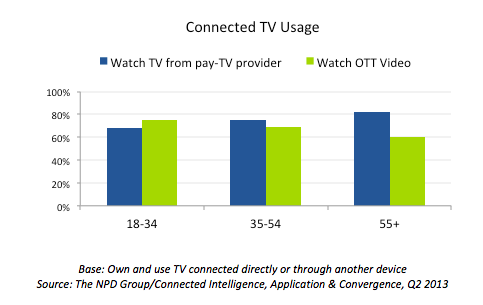
A new study from NPD Connected Intelligence shows that younger TV viewers with "connected TVs" (where the TV or other device connected to the TV can stream online video content) are shifting their viewing patterns towards more nontraditional streaming content.  In fact, among 18-34-year-olds in the study, more reported watching OTT (streaming) video on their TVs than reported watching content from multichannel video distributors (cable, DBS, telcom TV).
“The younger consumer has come to expect a broadband experience from any screen they come in contact with, and their TV is no exception,” said John Buffone, director of devices, NPD Connected Intelligence.
The big streaming content aggregators (Netflix, Amazon Instant & Prime Video, HuluPlus; in that order) are tops in use for younger viewers, along with YouTube (which now runs second to Netflix).  The results come from a survey of 5000 US online adults.

Source -  Three Quarters of 18-34 Year-Olds Use Their Connected TV To Watch OTT Video According to the NPD Group,  press release from NPD Group

Wednesday, August 7, 2013

Monday, April 23, 2012

Setting the Next-Gen Standards for TV

Thirteen broadcast engineering and standards bodies from around the world gathered at the National Association of Broadcasters convention last week to sign an agreement that would set up an initiative to develop a new global standard for broadcast television.
  Since the birth of television, countries have establ9shed a variety of technical systems, or standards, for their local terrestrial, wired, and satellite TV broadcasting.  And most of these are not compatible with one another.  Variances in power systems (50 Hz vs 60 Hz), the desire to set a more technically advanced system accounted for some of the variation, and political considerations fought against setting a single standard.  Moreover, the analog standards were significantly incompatible with one another, making translation of signals difficult and expensive.  With the transition to digital, there was once again consideration of developing a single standard, but in the digital universe, translating signals across standards is fairly easy, so the initial push for a single standard once again was waylaid by the myriad needs of different groups.  (The U.S. ATSC "standard" actually embraces a wide range of screen format/resolution/frame rate mixes).
Today, its easier (and cheaper) to build a digital receiver chip that can receive any of the world's broadcast standards, decode the digital signal, and translate the signal to any receiver output, than it is to develop separate production lines for the different standards.
  That's the difficulty facing the "Future of Broadcast Television Initiative," as it seeks to guide the world's various standards-setting organizations as they consider what will be the next generation of digital television.
“Broadcasting has to go from linear to nonlinear solutions for tomorrow,” said Lieven Vermaele, director of European Broadcasting Union’s Technology and Development Department, at the panel session. Mark Richer, the president of ATSC, said: “The first step is for broadcasters to make sure we all believe in the same goal and have the same shared vision moving forward. If we do not have that, we can’t expect other industries to make that happen. … If you want everyone to sing from the same hymn sheet, you have to write the notes first and the lyrics.”
 There are areas where standards would clearly help, but establishing a global standard is increasingly unnecessary, as well as increasingly problematic as more and more devices with different power needs, screen sizes and orientations, and resolutions, are used to watch broadcast television.  Good luck, FoBTV folks - it's going to be a rocky and difficult path to a future where the next big shift may not come from traditional broadcasters, organizations, or equipment manufacturers.

Source - Global Next-Gen TV Group Gets to WorkTV Newscheck

Friday, March 2, 2012

Goin' Mobile - Content

Some quick news items -

The Smithsonian Channel is launching an iPad app as part of an effort to "better serve existing viewers and attract new ones."  The app will provide users with access to hundreds of videos, including a rotating selection of full episodes and specials and a constantly updated archive of short-form videos.  The app will include social media integration, AirPlay integration, tools for building custom playlists, and the ability to receive notifications about the Smithsonian Channel schedule and the availability of new content.

Facebook announced that it will stream multiple FA Cup soccer matches this year.  Last year, FA Cup sponsor Budweiser streamed one match through its Facebook page.  More than 30,000 people watched the live stream of an early rounds match between Ascot United and Wembley FC.  They hope to feature five preliminary round games this year.

Google has begun a YouTube Developer Program to bridge the gap between brand channels and viewers.  The program will emphasize developing templates and applications that channels can use to facilitate video production, and help users find and access content.

The latest Nielsen Cross-Platform Report shows a 36% increase in the number of mobile video users.

A new app called Are You Watching This? constantly analyzes streams of sports data to let users know what games are on and where to find them.  Behind the app is an algorithm that rates games according to the number of exciting things going on, as well as social media ratings by fans.

ZEE Network's digital division is launching a new app that will stream TV and other video channels from India.  Ditto TV is currently available in India, the UK, Australia, New Zealand, and the UAE.  It's expected to be available in the US within several months.  The app currently offers 21 channels, and has partnered with a number of other streaming channels and content providers.

A study from Knowledge Networks finds that the online availability of TV shows increases their viewing, and likeability.  Over 40% of respondents said having programs available online makes them think "more highly of a TV network."  And 20% said that they spend more time watching a network's content after it became available online.

Sources -  Smithsonian Channel Lands on iPadBroadcasting & Cable
Facebook to broadcast more live FA Cup matches next seasonMarketingMagazine.co.uk
YouTube Begins to Form Developer Channel ProgramOnlineMediaDaily
TV Sourcing and Viewing Continues to Change, Research Brief from the Center for Media Research
How one sports geek wants to save cable TV with dataGigaOM
ZEE launches app to stream channels from IndiaBizAsia.co.uk
TV Shows With Online Access Improve ReachMediaDailyNews

Wednesday, February 22, 2012

Comcast pushes Personal Channels, Streaming

Two recent announcements from Comcast demonstrate the rise of more personalized channels and an attempt to narrow the gap between multichannel carriers and online video.
  On Tuesday, Comcast announced that it would carry new channels owned by NBA great Magic Johnson, musician Sean "Diddy" Combs, and Hollywood director Robert Rodriquez.  While a step up from YouTube's Original Channels, the three new networks continue the trend towards ever-narrower niche programming.
  Johnson's Aspire channel will target African-American family entertainment, and "will be a network that encourages and challenges African-Americans to reach for their dreams and will appeal to all generations,” Johnson said.  Combs' Revolt channel will focus on music and pop culture, with a robust social media component, fostering engagement between artists and fans. Revolt, said Combs, “is the first channel created entirely from the ground up in this new era of social media. We’re building this platform for artists to reach an extraordinary number of people in a completely different way. Revolt will be live, like all great moments in television history.”  Rodriquez' El Rey channel will be an English-language channel targeting Latino audiences.  "(W)e are passionate about creating a wildly entertaining destination that we can be proud of by appealing to both Latino and mass market audiences," Rodriguez and partner John Fogelman said in a joint press announcement.
  The networks join previously announced BabyFirst Americas network, which will focus on early childhood development of verbal, math, and motor skills, as steps in the fulfillment of a pledge Comcast made to promote minority ownership of cable networks as part of its deal to acquire NBC/Universal..
  In a separate announcement, Comcast unveiled its own streaming video service.  For now, the service, called "Streampix" will be available only to Comcast's 22.3 Xfinity cable subscribers, and will feature programs and movies from Disney, NBCUniversal, Sony, and Warner Brothers. in making the announcement, Comcast Senior VP Marcien Jenckes said, “The main reason we’re launching this product is we feel it helps provide value in our subscription service..." Starting Thursday, the service will be available to Comcast Xfinity customers as part of some higher-end packages, or as a $4.99 add-on.
  The addition of a streaming service, while not fully competitive with Netflix, Amazon's Prime streaming offerings, or Wal-Mart's Vudu, shows a concern over the rising use of these streaming services and other online video sources by viewers. (See this post, this post on shifting revenues, and this one on shifting patterns of media use).  Taken together, they suggest that Comcast is trying to keep in front of shifting audience content and media use preferences.

Sources: Comcast to Launch Networks Backed by Sean Combs, Magic Johnson and Robert RodriguezThe Hollywood Reporter
Comcast to Start 'Streampix' Video Service,  New York Times

edit track - fixed headline, added labels

Wednesday, February 1, 2012

The Pac-12's Digital Networks

Pac-12 Enterprises, a subsidiary of the Pac-12 college conference, is planning to launch a series of new sports networks that will showcase their teams.  The new channels will not directly compete with the existing Fox and ESPN game packages, but will be aligned with TV network coverage.  The plan is to use the new networks to enable the conference to distribute many more events.  They plan on featuring hundreds of live athletic events, as well as other original programming from the 12 campuses.  The network looks to be hopping on the "TV Everywhere" bandwagon, offering streaming, mobile device access, and social TV capabilities.
“We have an exciting opportunity to create a meaningful and lasting digital media platform to enrich our fans connection to the Pac-12 Conference,"stated Pac-12 Enterprises President Gary Stevenson.
The plan is for the new networks to launch this August in time for the 2012/2013 college sports seasons.

Source - Pac-12 Aligns Digital Nets With TV, Aufhauser Named Digital GMMediaDailyNews

Wednesday, January 25, 2012

Analog to Digital to IP - News about the Future of TV

The last few days have seen the release of a number of stories and studies that all point to one simple conclusion - IPTV is, or will soon become, the dominant transmission mechanism for TV programming.

  A report from  Needham & Co. suggests that in 2012, the U.S. TV ecosystem will generate more revenue from licensing and subscriptions ($85 billion) than from advertising ($80 billion).  Further, the continued rollout of "TV Everywhere" technology (using IPTV to deliver content to mobile and other devices) is likely to add $10-12 billion a year to the US TV market.  They note that these numbers currently don't include what's being earned on online video sites like YouTube.
Interest in video content will continue to grow. We'll see it in display ads and search engine queries. Brands not only want to monetize pre-recorded content for channels on YouTube and other video sites, but to stream live programming effortlessly from their YouTube Channels to mobile devices. It appears this will become Google's unofficial long-term strategy.
Most of the new IPTV revenue, the report suggests, will come from advertising - as research is beginning to suggest that that Video-on-Demand viewers are less likely to skip standard spot ads than viewers who access programs through DVRs. As the IPTV experience is much closer to VOD than DVR, this suggests that TV Everywhere content can be monetized with standard TV ad loads, pricing, and monitoring.  The report concludes by saying "We believe that TV Everywhere will be one of the primary drivers of valuation growth for today's TV ecosystem over the next five years."

  While global demand is likely to remain high, the recent news for leading U.S. telco IPTV providers is mixed.  Verizon recently announced a halt to major expansion of its IPTV service (FiOS) as well as most system upgrades for existing customers, and seems to be shifting its focus to more the profitable wireless sector.  AT&T's U-verse, on the other hand, is seeing greater-than-expected demand as it continues to build out its network - experiencing delays as it runs out of critical equipment and having to hire more installers.

  Research firm Ovum released a report suggesting that most of the early roadblocks to IPTV are disappearing as newer broadband and IPTV systems continue to diffuse and achieve scale economies.  They suggest that as these improved telco nets expand, IPTV use will shift to those platforms, as well as bringing new audiences and demand for IP-delivered digital video.  Ovum notes that for the 114 million subscribers around the globe who get TV through telcos, less than half get the TV through a telco IPTV feed.  However, demand is high, and with the next-gen systems enabling expanded (and lower-cost) delivery, Ovum predicts that by 2016, IPTV revenues will account for 60% of global telco TV revenue, and 71% of their pay-TV subscribers.


  Mobile devices lies at the heart of the TV Everywhere experience, and there's good news on that front as well.  New research from the Pew Research Center showed that ownership of two main mobile devices doubled over the holidays.  In the one month between mid-December 2011 and early January 2012, both tablet and E-book ownership nearly doubled, rising from 10% to 19% in each case.  Nearly one-third of adults in the U.S. (29%, up from 18%) own at least one of the devices.
  For TV Everywhere, Ultrabooks (fast, slim, light laptops with wireless connectivity and long battery life - like the MacBook Air) may prove to be even a better platform for mobile video viewing.  Juniper Research suggests that with the introduction of a wide range of new models at CES, Ultrabooks will become strong competition for tablets, and predicts a faster rate of adoption than experienced by tablets.  Specifically, they see ultrabook sales growing at three times the rate of tablet sales over the next five years.  Ultrabook sales, regardless of its growth rate, adds to the growing potential audience for mobile video, and is likely to contribute to its growth and diffusion.


  Meanwhile, a NATPE panel addressed the future of mobile video, and most of the panelists were strongly positive:
“The opportunity appears to be enormous by any stretch of the imagination,” said Nielsen Senior Vice President Scott L. Brown, noting the boom in smartphone penetration.
Mike Bloxham, the executive director of the Media Behavior Institute, said: “There’s a huge amount of growth yet to come in mobile-related revenues … we’re almost at a Jurassic stage of development.”
Brown added later that advertising might not even be the dominant revenue source for mobile video, reminding the audience that pay vs. ad-supported business models are still being developed.  Other panelists reported on studies that suggested that there's likely to be increasing demand for live events streamed onto mobile devices.

All said, the future of IPTV, TV Everywhere, and mobile video seems bright, as long as the industry can resolve licensing and rights issues.

Sources - YouTube: Influence TV Everywhere Will Have on SearchSearchBlog (MediaPost)
TV Everywhere Will Overshadow Hulu and YouTube,  MoBlog (MediaPost) 
Does Verizon Cable Deal Spell Death of FiOS Expansion?  DSLReports.com
Modem shortages lead to delays in Milwaukee U-verse installs,  FierceIPTV
Telco TV delivery to grow to 71% IPTV by 2016 as hurdles fallFierceIPTV
Tablet and E-book reader Ownership Nearly Double Over the Holiday Gift-Giving Period, Pew Research Center report.
Ultrabooks Growth To Outpace Tablets,  OnlineMediaDaily (MediaPost)
Mobile Video Primed, Ad Model in Early StagesOnlineMediaDaily (MediaPost)

edit track - fixed spacing issues

Monday, July 18, 2011

CNN, HLN Goes Live Online (TV Everywhere)

Time Warner has announced that it is making its CNN and Headline News channels available online to Comcast, Dish Network, and Verizon subscribers.  Part of their "TV Everywhere" efforts, the two news channels will be simulcast, along with full ad loads.  Initially, the live feeds will be available through the CNN website, and on several Apple mobile devices (iPad, iPhone, and iPod Touch).  Time Warner indicated that apps for other mobile devices will be added in coming months.

The TV Everywhere initiative, which has a goal of allowing multichannel subscribers to access programming on many devices and places, has been slowed by arguments over program rights and licensing issues.  As news channels, CNN and HLN own the rights to almost all of its programming, and thus is free to make deals to expand program access choices.

Source: "Time Warner simulcasts CNN, HLN news channels on Web," Fierce Cable

Friday, July 1, 2011

Streaming Makes Inroads into Prime Time

A Yahoo!/Interpret study of 4100 online video viewers is revealing a shift in online viewing habits.  A 2009 study, online video viewing dropped significantly in the 6-9 pm daypart, arguably as they switched to more traditional TV channels.  Now, 45% report watching some Web video during prime time "yesterday."  (the study asked about use of online video in the last 24 hours)
 The growth of Netflix, Hulu, and other streaming services certainly contributed to the shift - the number reporting watching streamed content from Netflix doubled, and those streaming from Hulu increased 67%. While the absolute numbers of online videos streamed increased, there were also a notable shift in the kinds of content streamed.  In 2009, 84% of online videos watched were short clips, while 11% were full-length TV shows, and 5% movies.  In 2011, the proportion of short clips dropped to 74% of all online videos watched, while the proportions for full-length TV shows increased to 18%, and full-length movies accounted for 8%. 
For now, the impact on traditional television viewing (broadcast, cable & DBS) is minimal, and the focus of the study was not on whether this viewing was reducing traditional viewing, so you shouldn't necessarily infer that viewers are abandoning traditional TV media for online.  At least not yet.  But the study supports the idea that audience media use habits are starting to shift and that many viewers find value in terms of being able to watch TV programs and movies when they want, rather than when stations and channels program them.

Source: "Prime Time is Web Video Time?", VidBlog
"Online video shifts to primetime viewing," Gigacom
Press release from Yahoo! Insights

Tuesday, June 28, 2011

5 Innovations changing Cable TV

Earlier this month, the cable industry held its big annual trade show (The Cable Show) in Chicago.  These shows are good places to look at the new ideas and technology that drive innovation.  Multichannel News' Todd Spangler identified five areas of innovation that are likely to impact the cable industry.
  1. Web-User Interfaces - from developing cloud-based programming guides (providing access from any device, anywhere; the capability to personalize features, including integration with social media and other Web services like Twitter), to apps allowing users to control set-top boxes and DVRs, enhanced search capabilities, to IPTV services delivering video programming to a variety of devices, look for even more choices for people to personalize and control their viewing experiences.
  2. Multiscreen Video - The goal is "TV Everywhere," the idea that program can be delivered to any screen, anywhere, at any time.  A variety of technologies are addressing the two key underlying issues: taking content designed for one screen and optimizing it for other screens and networks; and developing systems to ensure that content is delivered only to licensed users (the issue of authentication).
  3. Broadband Speed - IPTV, and all of the above services need bandwidth. Their growth, and the growth of IPTV will drive demand for higher bandwidth (Cisco forecasts average worldwide broadband speeds to grow from 7 Mps in 2010 to 28 Mps by 2015).  The Cable Show saw several innovations that could cable get higher broadband speeds from its installed network.
  4. Home Gateways - the transition from the current mix of analog and digital signals on most cable systems to fully digital will help cable expand services - although at the cost of the signals being incompatible with existing TV sets.  The current solution is to provide set-top boxes for each TV, but home gateways offer a bit of an alternative.  Combining multiple tuners with high storage capacity, a home gateway becomes the primary cable-to-broadcast conversion point, feeding channel and viewing choices direct to each set through existing inputs.
  5. Advanced Ads - talking advantage of the interactivity and the addressability of digital cable, there's long been a promise of being able to incorporate direct user responses to ads (click on an ad to receive more info, etc.) and to more narrowly target ads (having VOD operators to insert the ads most appropriate to the program and household in the delivered content, or having your box determining which of a set of ads is most appropriate for you)
 In sum, technology is pushing cable to become more of a smart digital network service, than a multichannel analog TV delivery system. Having a smart digital network means that subscribers will have more flexibility, more choice, and more control over their TV viewing experience.  And that the smart network will be able to personalize use, help to identify channels and programs of interest, and delivery ads of (supposedly) greater interest and appropriateness.  It also means that cable will become more like broadband IP networks than traditional broadcasting - and having to compete with broadband and IPTV services offered by the telecomms (such as AT&T's U-verse and Verizon's FiOS) instead of local broadcasters and DBS.

Source:  "5 Technology Innovations Changing Cable TV" Multichannel News

Tuesday, June 14, 2011

"TV Everywhere" and Advertising

"Within two years, 75% of TV Content will be on other platforms."  While that may seem to be a wild conjecture, representatives from Disney/ESPN, Comcast, and Turner Broadcasting made that statement at the Elevate Video Advertising Summit last week.  "TV Everywhere" seemed imminent, and specific distribution outlet irrelevant - at least if two issues get resolved (licensing rights, and advertising measurement).  The second issue was the focus at the conference.
There are two problems arising from the expansion of distribution and the shift in audience viewing habits.  The first is that, for now, online video advertising levels and rates are significantly lower than in traditional media.  There is concern that as viewing shifts, total ad revenue will fall. Second, and more fundamental, is that most measurement systems (ratings) actually measure exposure to the programming that ads are embedded in.  If program exposure begins to be split among a variety of options (multiple showings on multiple networks, online viewing, delayed viewing, etc.), how can all that be measured?  More importantly from the advertiser's perspective is this issue - unless the ad is embedded in the programming, or otherwise present in all the myriad viewing options, then measures of program exposure (ratings) are no longer a viable substitute for exposure to advertising. Ratings then become less useful and valuable for advertisers, and ad buying based on those measures become riskier (which would drive prices down).

Will online ad rates and revenues quickly match those of traditional broadcasters?  The consensus at the conference was, not soon, if ever - there are good economic reasons for differential rates..  But total revenues are likely to converge over time (some projections show total online ad revenues passing TV ad revenues by 2021).  Right now, TV gets $70 billion in ad dollars, while online video generates $1.5 billion.  Some of that reflects levels of viewing (audience).  But advertising isn't just one generic market - it's well-known that advertisers will pay a premium for appropriately targeted audiences.  What is discussed less, is that there is a separate (and sizable) ad market for large general audiences - just like some advertisers want targets, others want a more broad-based reach.  They may not value that more (on a per person basis), but it is a separate added demand fighting for a fixed advertising supply on a relative few TV channels that can deliver that level of exposure.  The big general-interest channels have an additional layer of demand, and the increased demand drives up the prices they can get, and thus higher revenues.  This is illustrated by the ad market for the SuperBowl.  Online video's strength is in targeting, not in reaching the large, general-interest audience.  Even now, online video ad revenues are prioritized more or less this way: Broadcasters; Internet portals (Yahoo, Google, YouTube),  followed by ad networks and video publishers..  

Finding good content and advertising exposure measures has been difficult to do (I addressed that issue earlier, here, here, and here). One fundamental problem is that as competition shrinks audience, media firms have looked to inflate the numbers by including other content distribution and use.  But, unless the same ads are included with all of the added distribution forms and uses, those measures become less and less useful for advertisers. Another concern has been accuracy, both in terms of overall numbers, and in the ability to deliver targeted advertising as promised.  A new report from Nielsen's Online Campaign Ratings service found than targeted campaigns based on an age range of less than 20 years delivered that audience only 30% of the time (for larger age ranges, it was still only 77%).  Targeting by gender and age reached the intended audience slightly more than a quarter of the time. Both media and industry has been working on coming up with new, hopefully more appropriate, measures, but getting consensus and acceptance has been difficult.

Sources: "As Video Distribution Becomes Ubiquitous, Advertising Differences Become Blurry," Online Video Insider
"Online Campaigns Miss Targets, Need Better Measurements," Online Media Daily

Wednesday, June 1, 2011

Adding value to HBO

In the face of growing competition over time - from other pay channels, videocassettes and DVD (both sales and rentals), DVRs and Video-On-Demand, and now streaming services like Netflix, Amazon, & Google - HBO has been fairly successful in developing strategies to increase the value of its core product in order to keep it competitive.  These have included producing original series, offering an expanding bundle of targeted channels, and offering much of its programming through HBO On Demand (through cable and satellite VOD offerings).  Recent estimates suggest that HBO On Demand has reduced core subscriber churn (subscribers dropping the service) by as much as 15%, adding several billion dollars to HBOs value.

HBO is poised to move into the mobile market through a new service, called HBO Go.  The new service will offer access to HBO programming (to subscribers of HBO through other delivery systems) to Internet-connected mobile devices.  While the movie creates value for its customers (offering even more flexible options for accessing and using content), it's not seen as directly entering a new market (mobile).  Rather, the move seems more defensive - a response to the streaming services like Netflix that are already accessible on a wide range of Internet-connected devices, including mobile.  Still, moves to keep subscribers from defecting to other services should help reduce churn - some analysts forecast that HBO Go will cut churn by another 10% and helping to add more than $2 billion to HBO's value.

As with other services under the TV Everywhere umbrella, the key to keeping the value of HBO Go in-house is authentication; of making sure that content goes only to subscribers.  For now, there doesn't seem to be a plan to market HBO Go directly to consumers (instead of through cable or satellite service subscriptions.  HBO is entering the direct-to-consumer market indirectly (and partially) by making deals to market HBO-produced programming through the home video market, and through digital affiliates such as Amazon, Apple, and Google (which offer streaming access).  Ultimately, HBO may need to consider tapping that market more directly, taking its service direct-to-consumers.

The key to remaining successful in the long term is finding a mix of value sources that make the service worthwhile to a sufficient consumer base.  Not only in terms of finding new ways to add value, but also to be sensitive to changes in consumer's discretionary spending levels and shifting preferences.  The monthly cost of Pay TV subscriptions has increased 29% over the last five years while net incomes have fallen.  That is a significant contributor to the declining Pay TV penetration, even with the efforts to increase the value of their services to consumers through multiplexing (multiple channels) and expanded delivery options.  HBO has been working on adding value, but may eventually also want to consider shifting distribution to the cheaper, faster, IPTV model.

Source: "HBO Poised to Reinvent Itself -- Again", MediaPost Blogs - On Media

Monday, May 23, 2011

IPTV - Expect High Growth Rates

IPTV providers around the world should continue to see rapid market expansion over the next few years, according to a recent report released by SNL Kagan.  They project that subscriptions to IPTV services will double in the next three years, reaching 70 million.
The rosy forecast results from an IPTV adoption rate that has averaged a 92.4% compound average growth rate over the last 6 years.  The also think that the current push for "TV Everywhere" and IP-based Video on Demand (VOD), and continued diffusion of broadband networks will drive demand, leading to a doubling of IPTV video service revenues in the next three years.  Currently, IPTV accounts for 6% of all global subscription-TV revenues; SNL Kagan predicts that by 2014, it will account for 11%, between IPTVs rapid growth and the slowing down of cable and satellite providers.

Expect further market expansions and realignments, as consumers embrace the choice and flexibility of IPTV video services (and the lower distribution costs, compared to older video media models).

Source: "Major IPTV Adoption Means $27B Revs by 2014," Media Daily News

Tuesday, May 10, 2011

Google I/.O Announcements - Now a medium

Google is sponsoring a big event for tech types and reporters, called Google I/O.  Among the announcements are several indicating Google is making serious moves into both the content and mobile markets.  Here's a glimpse at some of the big announcements:

Google Music (or at least "Music Beta by Google) was launched, offering users the ability to upload 20,000 of your tunes initially, providing a cloud hosting service similar to Amazon's that would allow you to stream from your library to any device supporting Flash.  The full launch of a music store was delayed by issues in getting licenses from major record labels.
Engadget has a comparison of streaming music services.

Not content with sound, Google also announced the addition of video and movie rentals to the Android Market, mirroring the recently expanded YouTube rental inventory.  Users can access the movies Via PCs and Google TV through YouTube-Movies, and will soon be able to use Android Market for play on smartphones and tablets running Android 2.2 or higher. In additions, purchases on one platform reportedly can also be accessed from the other.

Speaking of Google TV, the folks at Google announced that the Google TV platform will get an upgrade to the new Android 3.1 platform this summer.  The upgrade will provide users with access to the Android Market.  Google also confirmed that the Google TV app will be included in Sony, Samsung, and Vizio TVs offering internet access, and Logitech Google TV set-top boxes.

Sources: "Google Music Beta to stream 20,000 songs for free, official! (updated)," Engadget
"Android Market launches movie rentals, thousands of titles available to your PC, phone or tablet,"
Engadget
"Google TV getting Android 3.1 and Market this summer; Sony, Vizio, Samsung and Logitech onboard," Engadget