Some slides from WeAreSocial.sg
This blog is affiliated with a course at the School of Journalism & Electronic Media at the University of Tennessee, Knoxville. I'll try to use it to share relevant news and information with the class, and anyone else who's interested.
Showing posts with label social media. Show all posts
Monday, March 30, 2015
#utsmw15 Infographic: Social vs. Salary
Many Millennial will sacrifice salary for the freedom to use social media and technologies.
From Online Courses.com - Social Media vs. Salary
It's Social Media Week #UTSMW15 - Time for Wow
It's Social Media Week here at UTK's College of Communication and Information. And time for some timely social infographics and reports.
From Leverage and Social Times blog, some quick stats on top outlets' performance in 2014.
Monday, March 2, 2015
Monday, February 2, 2015
Wednesday, January 28, 2015
Tuesday, August 12, 2014
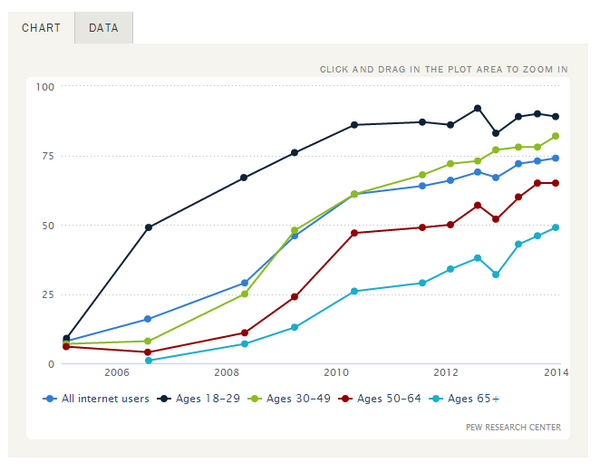
Milepost: Social networking (almost) ubiquitous.
From Pew Internet: In January, 89% of young adults (18-29) use social networking sites. By now, that's likely over 90%. And penetration likely over 50% even for those least likely to use.
Prompted by a Pew Internet tweet https://twitter.com/pewinternet
Thursday, July 24, 2014
Monday, April 28, 2014
Social Media couldn't help NBC's Sochi ratings
Oh the wishful thinking at work.
NBCUniversal's head of research, Alan Wurtzel, recently commented on his unit's analysis of their Winter Olympics coverage earlier this year. The extensive coverage of the Games (1500 hours, all told), provided a platform for investigating media behaviors. The network had expected social media to have a "dominating" effect on viewership, driving viewers to both the main primetime broadcast network shows and the sports coverage spread across a number of cable channels.
As it turned out, viewing and social media use didn't explode as planned. Only 19 percent of viewers used social media to post about the games. Some 3 million unique users posted a total of 10.6 million Olympic-related messages on Twitter. NBCU indicated that up to 23 million people saw one or more of those messages. In contrast, NBC averaged 21 million viewers for its prime time coverage. The numbers on Facebook were higher, but still only 20 million posted, commented, shared, or liked something "related to the Olympics." NBCU didn't indicate what percentage were actually focused on their coverage of the games, or were positive posts on their coverage. (I'll admit to retweeting and posting about some of their analysts' more ridiculous comments, as well as the comically unprepared venues and tourist facilities).
So out came the wishful thinking. According to Wurtzel, social media wasn't "a game changer yet."
However, there weren't a lot of U.S. athletes in those games that had active fan bases. (The most social media savvy, Shaun White, did poorly after an injury.) Similarly, winter sports don't have the huge, and social media adept, fan base of many Summer Olympic sports. From America's perspective, there wasn't much of interest to tweet about the actual sporting events, leaving social media to revel in the gaffes and general goofyness surrounding the event and its coverage. And while that may drive social media traffic, its not the kind of buzz that can drive viewing and ratings.
The numbers certainly are what they are. What's unclear is whether the numbers reflect the impotence of social media, or the impotence of NBCU's coverage of a mediocre sporting event.
Source - Social media not yet a 'game changer' for boosting TV viewership, Financial Times
NBCUniversal's head of research, Alan Wurtzel, recently commented on his unit's analysis of their Winter Olympics coverage earlier this year. The extensive coverage of the Games (1500 hours, all told), provided a platform for investigating media behaviors. The network had expected social media to have a "dominating" effect on viewership, driving viewers to both the main primetime broadcast network shows and the sports coverage spread across a number of cable channels.
As it turned out, viewing and social media use didn't explode as planned. Only 19 percent of viewers used social media to post about the games. Some 3 million unique users posted a total of 10.6 million Olympic-related messages on Twitter. NBCU indicated that up to 23 million people saw one or more of those messages. In contrast, NBC averaged 21 million viewers for its prime time coverage. The numbers on Facebook were higher, but still only 20 million posted, commented, shared, or liked something "related to the Olympics." NBCU didn't indicate what percentage were actually focused on their coverage of the games, or were positive posts on their coverage. (I'll admit to retweeting and posting about some of their analysts' more ridiculous comments, as well as the comically unprepared venues and tourist facilities).
So out came the wishful thinking. According to Wurtzel, social media wasn't "a game changer yet."
“A lot of people want to show that they are on the cutting edge... Why wouldn’t I want to say to you, ‘We have a potent new way in which we can drive ratings?’" But “it just isn’t true”, he added. “I am saying the emperor wears no clothes. It is what it is. These are the numbers.”The underlying problem, though, is that people use social media to comment on things they find interesting, particularly things they are passionate about. Social media activity is also mostly reactive. Wurtzel and the head honchos at NBCU apparently thought that the world of social media would jump at the chance to provide free promotion for its Olympic coverage, generating the social buzz that would drive up viewership. Particularly for its prime time shows, which focused more on soft stories of athletes than on sports coverage.
However, there weren't a lot of U.S. athletes in those games that had active fan bases. (The most social media savvy, Shaun White, did poorly after an injury.) Similarly, winter sports don't have the huge, and social media adept, fan base of many Summer Olympic sports. From America's perspective, there wasn't much of interest to tweet about the actual sporting events, leaving social media to revel in the gaffes and general goofyness surrounding the event and its coverage. And while that may drive social media traffic, its not the kind of buzz that can drive viewing and ratings.
The numbers certainly are what they are. What's unclear is whether the numbers reflect the impotence of social media, or the impotence of NBCU's coverage of a mediocre sporting event.
Source - Social media not yet a 'game changer' for boosting TV viewership, Financial Times
Tuesday, April 8, 2014
Brand Images of Cable News
According to YouGov's BrandIndex, the perceived brand image of the major cable news networks has remained fairly constant in recent weeks, despite the small jump in viewing linked to the missing aircraft story.. The BrandIndex Buzz Index compares consumer perceptions of brands, and looks at the net difference between positive and negative comments.
As the graph shows, only Fox News has generated a net positive "Buzz", and seems to have more consistent values (in the +4 to +6 range) in 2014. None of the other measured cable networks generated a positive Buzz value over the measured time frame. CNN's perception score seems to have bottomed out last June (hitting -17), before making it back to a -4 score in October 2013, with consistent fluctuations after that. Consumer perceptions of CNN Headline have largely tracked those of CNN. Consumer perception of MSNBC has been very consistent since the start of 2014, with scores in the -9 to -10 range. That suggests the audience has pretty much made up its mind about MSNBC, and the network hasn't been able to do much to shake that overall negative impression. Since many of the big swings seem linked to major news events, it might also suggest that MSNBC's specific coverage of news doesn't change viewers perceptions about the network.
Source - Despite disaster coverage CNN perception declines, YouGov BrandIndex report
As the graph shows, only Fox News has generated a net positive "Buzz", and seems to have more consistent values (in the +4 to +6 range) in 2014. None of the other measured cable networks generated a positive Buzz value over the measured time frame. CNN's perception score seems to have bottomed out last June (hitting -17), before making it back to a -4 score in October 2013, with consistent fluctuations after that. Consumer perceptions of CNN Headline have largely tracked those of CNN. Consumer perception of MSNBC has been very consistent since the start of 2014, with scores in the -9 to -10 range. That suggests the audience has pretty much made up its mind about MSNBC, and the network hasn't been able to do much to shake that overall negative impression. Since many of the big swings seem linked to major news events, it might also suggest that MSNBC's specific coverage of news doesn't change viewers perceptions about the network.
Source - Despite disaster coverage CNN perception declines, YouGov BrandIndex report
Thursday, April 3, 2014
Social Media Week Infographic: Impact on Job Hunt
Or, Should You Post Those Spring Break Party Blow-out Pics?
From The Role of Social Media In Pre-Employment Candidate Screening - Statistics and Trends, Go-Gulf.com
Subscribe to:
Posts (Atom)