Showing posts with label online video. Show all posts

Monday, May 11, 2015

A Survey of Research Results - Evolution of Video Marketplace

Finals are over, and there have been several rounds of industry research results to post.

From the Interactive Advertising Bureau, a survey of online video viewers. An earlier study suggested more than 85% of Internet users report having watched online video, and this 2014 study reports 59 million U.S. adults (24%) report watching online videos at least once a month.

  • The means of access is expanding - those reporting access via desktop or laptop remains steady at 72%, but use of connected TVs (56%), smartphones (56%), and tablets (48%) have doubled over the last two years.  ODV users who watch their programming on connected TVs primarily do so during Primetime hours, and half report watching considerably more ODV than they did last year.
  • Original Digital Video (ODV) is seen as having more original content, being more innovative, unique, edgy, and mobile than regular TV content, and the perception gap is increasing.  ODV is tied with Primetime TV as the preferred content type, and is significantly preferred over other regular TV genres (sports, news, daytime)
  • Young cord-cutters and cord-nevers say that having access to Original Digital Video (ODV) is an important factor in choosing not to have Pay TV. Most also report preferring ODV to conventional TV programming - including Primetime shows.
  • Social is increasingly integrated with Online Digital Video - use of social media to discover ODV has nearly doubled in the last 2 years (42% of ODV users), and ODV users are much more likely to have content-related social media interactions than Primetime viewers (55% vs. 39%).
Limelight Networks have released the 2015 edition of The State of Online Video.  Their key conclusion is that online video viewing is booming, and changing the television viewing experience. While there are a variety of demographic differences, younger viewers (Millennials) are driving the shift from traditional broadcast television to online video.
  • While most viewers report watching 4 hours or less of online video a week, the majority of Millennials watch 4 or more hours a week.
  • Cord-cutting is becoming a viable option.  Only 10% of those with a Pay service (Cable, DBS, Telco) say they'll stick with their service no matter what.  More than a third (38%), on the other hand, say that rising subscription prices could motivate them to cord-cut, and 30% indicated an interest in switching if the content they want becomes available online or over-the-air.
  • Variety in both content and viewing options are prime motivators for online video viewers. The increased availability (and use) of long-form video content online is a big factor in the increase in viewers and viewing time for online video.  Many online video users report owning and using multiple devices (beyond TV sets) for watching online videos.
  • Social media is facilitating and encouraging video sharing.  Some 15% of respondents report sharing video content via social media.

Sources -  2015 Original Digital Video Study, IAB (Interactive Advertising Bureau)
The State of Online Video, CDN Limelight report (2015)

Wednesday, March 18, 2015

Apple joins the OTT mini-bundlers

Apple has divulged some details on the new Apple TV service that it will offer next fall.  Like the recently initiated Sling-TV, the plan is to offer a small bundle of streaming channels to consumers with Apple TV OTT boxes (actually, and iOS device).  One big difference from Sling-TV is that the Apple plan will be anchored by live streams of most of the broadcast networks (NBC is not currently listed, allegedly because of a longstanding feud between Apple and Comcast).  Apple's bundle will likely be more expensive than Sling's as a result.  Like Sling-TV, Apple's bundle will include access to a Video-on-Demand library - there's talk that Apple wants to extend VOD access to other iTunes content, if it can get licensing deals in place.

For more on the Web/OTT bundling issue, see this earlier post.

Source: Apple Plans Web TV Service in Fall, Wall Street Journal

Tuesday, March 10, 2015

The end of big bundles? Going "a la carte" via OTT

OK, first let me take care of clarifying the terminology.

Assembling big (often 50+ channels) bundles of cable networks has been the primary strategy of multichannel video service providers (cable, DBS, telco cable, etc.) for the last couple of decades. Keeping bundles big helps minimize transaction costs for the bundler, while offering maximal potential audience reach for advertisers, and maximizing the viewer's ability to browse and discover the value of channels and their content.  On the other hand, critics complain that it "forces consumers to purchase channels they aren't interested in."  That's not necessarily true, as purchase decisions are based on the aggregate perceived value of the bundle, not the "costs" of undesired channels (see here for more detailed analysis).

Still, as the networks and local stations seek to increase licensing fees from multichannel providers, those costs are passed on to the consumer in the form of higher bundle prices.  Bundle subscription costs are rising rapidly, and may be nearing a threshold point for many subscribers - the point where their perceived value of the bundle is less than the subscription price.  We're seeing the beginning of this in the rise of cord-cutters - those replacing paid multichannel access with a combination of online and free over-the-air TV sources.

However irrelevant, the claim of paying for unwanted channels is a major theme for those who would prefer to force multichannel services to unbundle channels and offer them to consumers in small focused bundles (like the various Discovery channels), or individually (i.e. "a la carte").  This may seem to be a good deal for consumers - until you realize that going a la carte will, in most cases, reduce audience reach numbers significantly.  One study (discussed here) forecast that forced unbundling could result in a loss of 60% of advertising revenues for cable networks, and result in more than 100 channels going out of business.  And since cable networks would need to significantly increase their a la carte prices to recapture some of those losses, going a la carte would also likely result in higher total costs for cable network access for most consumers.

Meanwhile, some multichannel video providers are finding that the increased licensing demands made by some networks are crossing that value threshold, and are dropping channels, or in one case offering to provide the channel - but only as an a la carte service.  The networks have so far been smart enough to realize that either option is a net loss for them, but the gleam of a licensing El Dorado of unlimited wealth keeps them trying to push licensing fees ever higher.  Viacom, and its package of networks, is the latest battleground, with their channels being dropped by a number of mid-range and smaller cable systems unwilling to cave into their licensing demands.  As one analyst noted,
“The stage is set... As consumers are less interested in large bundles, somebody is going to get hurt in the process by asking for too much.”
If multichannel service providers remained the only option for access, the impact on the industry would be bad enough.  However, they're facing rapid growth in the ability of broadband internet connections to provide access to high-quality TV streams to mobile devices and wired connected devices.  The term OTT (over-the-top) refers to these alternative sources of video and TV content. Both the diffusion and use of these technologies for TV viewing are growing rapidly (see here and here).  Combined with increased time-shifting of programs and place-shifting, audience TV viewing habits are clearly changing.  For cable networks, going online for their content distribution - either as single channels or as a part of a more limited (and much less expensive) bundle offered online - is an increasingly viable supplement, and potential substitute, for traditional delivery media.

The viability of online TV delivery has been a significant component of the "TV Everywhere" marketing push.  The initial conceptualization, though, saw "TV Everywhere" as a way of achieving multichannel services beyond the household's TV sets - and not as a substitute or replacement for those services.  That was one reason for the rapid reaction to the Aereo service.  One would think that local stations and networks would be eager to extend their range of service via mobile as a way of enhancing (or at least maintaining) audience reach.  However, it seemed that the industry hated the notion of a video service that paid no licensing fees; and the courts bought that argument.

More recently, the industry has seen several TV networks pursue the option of offering their programs and content online. The WWE initiated a very successful online subscription service last year, and many of the Pay TV networks have announced plans for providing online access channels separate from multichannel provider subscriptions.  HBO, in particular, is scheduled to provide a separate online channel called HBO Now starting April 12, 2015.  A research report released in January by Park Associates suggested that HBO Now could generate an additional 15 million subscribers.  More critically for multichannel providers, half of those interested in HBO Now said they'd not only be likely to drop HBO pay channels, they'd drop the whole multichannel pay service (about 7 million subscribers).  That's still a big win for HBO, who not only would likely net an added 8 million subscribers, but would not have to split the subscription fee with the multichannel provider.

In addition, CBS has been offering an online video service since last fall, and it is thought that ABC, NBC, and ESPN are considering taking their online video channels public (currently access is limited to subscribers of some of the largest multichannel providers).  Most cable networks provide some access to their content, but not to live streams of the channel.

Still, it's likely that the new DishTV service, Sling-TV, may unleash the deluge.  Sling-TV is an OTT service that bundles a number of the most popular cable networks as a minibundle at a very low subscription price ($20/mo. for about 20 channels), and supplements that with targeted minibundles (sports, movies, children, etc.) at $5 a pop.  The service combines live streams of the network, as well as on-demand access to the previous week's programs. Sling-TV has managed to sign up some 100,000 subscribers in its first month, despite being initially limited to those with a Roku OTT box.

The Sling-TV service could well force the big multichannel services to start unbundling.  It offers an intriguing alternative for those who would be satisfied with a lesser selection of channels.  And even for those viewers who place high value on channels not included in the Sling TV packages, the price contrast between the "big bundle" options ($50-$150+ on new subscriber deals) and Sling-TV will prompt consumers to reconsider if their demand for favorite channels will justify the price differential (and to wonder how the costs of channels they don't want inflate bundle prices).

The big multichannel providers have been shedding TV subscribers slowly, but consistently, for years.  Now that viable and less costly OTT and online video options are coming available, expect the decline in pay TV subscribers to increase, particularly for major MSOs and multichannel providers.

Sources - Updating: HBO Now The Big Test for Cord Cutters?, Online Video Daily VidBlog
Sling TV notches 100,000 users in a month, TechHive
Seventeen percent of U.S. broadband households are likely to subscribe to an OTT HBO service, Parks Associates report.
Provider's Dispute with Viacom Highlights Skirmish Over the Cable Bundle, New York Times

Infographic shows rise of online video viewing

From the fine folks at ComScore:

Some highlights:

-- Broadcast network live viewing down 30% over last 5-6 years
-- 87% of US Internet users report regular online video viewing
-- 40% of online video viewing is done on mobile devices
-- 15% of internet users report watching video on smartphones daily
-- viewing on tablets and OTT are leading a shift to online video viewing


Thursday, June 26, 2014

Copyright Decision on Aereo

Aereo is a recent technology service that offered online access to local TV broadcasts in selected markets in the U.S.  For a fee, they grabbed programs that a subscriber requested, from "free" over-the-air local broadcasters, digitally converted the broadcast into a IP stream that was sent directly to the subscriber's connected device.

And when TV networks and cable systems  heard about it, they sought to pre-emptively ban it.  Cable because it was a much cheaper alternative to a service they sought to provide.  The networks' objection was pithily stated by one network CEO: "If anyone makes money from local broadcasts, we demand a share of it."  A consortium of networks and MSOs filed suit claiming that Aereo violated copyright law and seeking an immediate injunction against deploying the system; however, the judge in that case ruled against an injunction as Aereo offered a reasonable argument that its service was not a violation of copyright - but did not initially rule on the viability of that argument.  Both parties wanted to expedite matters, so they sought to bring the case to the Supreme Court to get a final ruling on the basic copyright issues.

Copyright law is fairly simple, yet complex.  The law gives the owner of the copyright the legal authority to determine the conditions under which the copyrighted material is made available to others.  It also, however, permits a "fair use" exemption under certain general conditions - allowing others to access and use the content under restricted conditions.  The rise of broadcasting created an issue, however - what counts as a "copy"?  This came to a head with the rise of cable systems, and their retransmission of over-the-air broadcast signals from local (and eventually distant) stations.  As a result, Congress amended copyright law to include "public performance" of audiovisual signals, and specifically applied that term to carriage ("retransmission") of over-the-air television broadcasts. 

Around the same time, the Supreme Court issued a ruling on what behaviors were considered "fair use" of audio and video content.  Specifically, they ruled that - for legally acquired content - individuals could record content for their later use (time-shifting), transfer and translate content for use in different locals or on different devices (place-shifting), and make a back-up (archive) copy, but only for their own use.

Aereo's service was designed to fit those "fair use" guidelines and the "free" nature of over-the-air broadcasting (stations are prohibited from charging viewers for access to public broadcasts).  Each Aereo subscriber was assigned their own antenna for receiving the free broadcasts, and unlike cable, content was not retransmitted unless specifically requested by that subscriber, and was made available only to the device the subscriber sent the request from.  Aereo argued that they were not engaging in a public performance, but a private one that essentially amounted to the time-shifting and place-shifting aspects of fair use.

The big media consortium (ABC et al.) argued that the Aereo service was simply a retransmission service, and was engaged in "public performance" because it offered its service to the public at large.  Therefore, Aereo was in violation of U.S. copyright law.

The recent Supreme Court ruling (6-3) was that Aereo's service was "substantially similar" to cable, because it offers a service that allows subscribers to watch TV programs, and that it is a "public performance" because several subscribers may be watching the same program, thus constituting a "public."

It's not terribly surprising, although it is disappointing, that the majority decision is technologically ignorant and focuses on outcomes rather than processes and behaviors.  To the majority, any technology that delivers TV programs to members of the public is essentially no different than a cable system and thus any retransmission right for that content must be granted by the copyright owner (presumably, but not necessarily, for a fee).  In addition, the majority nonsensically assumes that since the copyright act does not explicitly define "public", it is any group of individuals beyond what may be watching on a single device. The majority also finds that it makes no difference who is initiating and controlling the retransmission - an individual subscriber or a cable system; rather, they shift the focus to Aereo because it offers a "service."

There is a weird yet nonsensical example given, where the majority suggests that Aereo's problem is that it doesn't provide a service to the copyright owners, but to the public.  The majority repeatedly focuses on copyright owner's right to set the terms of "performance" or consumption.  This ignores the fact that, under law and the terms of their licenses, local broadcasters must provide their copyrighted content freely and without restriction to the public.  Not only to those watching live at home on a TV set, or through a cable system paying retransmission fees; the viewer, or Aereo subscriber, already has the legal right to view or listen to broadcast content.  The copyright owners have already been paid for that performance by the broadcaster - the majority seems to think that viewers need to pay a second time to engage in time-, place- or device-shifting.

The majority decision argues that this ruling does not prejudge future technologies, saying that it is not their intent.  It's hard, though, to see how this is possible, when the decision sets down three extremely broad definitions - 1) that any system for delivering TV content to consumers is "substantially similar" to cable and thus subject to cable's rules; 2) that any group of individuals is considered to be "the public"; and 3) that the driving purpose is not protection of a copyright owner's rights, but the networks "right" to offer a "public performance" of copyrighted material.  Combine that with the majority decision's total disregard for the specific elements of technology and service offered by Aereo - and thus not providing any hook for a narrow argument - and you set a precedence for overreach.

Further, this case offered the opportunity to re-examine which activities are covered by "fair use."  In light of the wretched quality of the decision, I'm relieved that this Court didn't take up that opportunity.

The dissent shreds the majority decision, arguing that the service provided by Aereo was not even a "performance" as defined by copyright law, much less a "public performance."  Rather than looking at the end stage of the service (providing TV programs to viewers) and making an indefensible leap to equate it with cable, the dissent treats Aereo as an Internet content delivery system.  And supports their argument by actually looking at what the service does, then examining the actual case law relevant to those actions (rather than relying on problematic anecdotes).  The dissent eviscerates the majority's "looks like" argument, noting how it conflicts with other recent decisions (including some authored by the same Justice who wrote the majority decision), and ignores both the question of the type of copyright violation being considered (primary, secondary violation, and whether Aereo is acting as an ISP and thus exempt), as well as the issue of "fair use" and the role of the subscriber (not the system) in selecting content for viewing.

The majority decision has turned a copyright case into a "performance" result, achieved only with mystical inference of Congressional intent, over-broad definitions of "public" & "performance", and a "looks like a duck" equivalence of two video delivery systems that could hardly be more polar opposites in technology and operation.  And by doing so, making the application of copyright to new technologies and content delivery systems even more problematic for the future.

And of course, the TV & cable industry hailed the decision, seeing a potential source of revenues (or a protection of current retransmission rights fees).  However, that's likely to be a short-term and low-value source for broadcasters and networks for two reasons - first, that while they think they're soaking the service operator for these revenues, eventually viewers will figure out that stations and broadcast networks are asking them to pay for "free TV"; second, that it's the content that generates the value for viewers, not their "public performance" of that content.  In fact, to the extent that the broadcast "performance" has any value for the station or network, it comes from the broadcast's ability to reach an audience; as such, any mechanism that will extend or expand their reach should be welcomed, rather than challenged.

Sources -  Supremes Rule Against Aereo, Broadcasting & Cable
ABC et al. v. Aereo, Supreme Court decision No. 13-461


Tuesday, April 1, 2014

Video's Goin' Mobile - And Sports Rule!

The latest Ooyala Global Video Index has some interesting findings.

“Widely doubted as a viable TV platform by critics less than a decade ago, mobile today is the fastest-growing segment of online video. It has been for the last two years, and will be for the next two.”
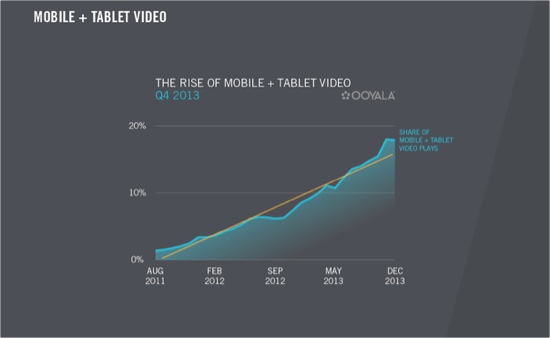
The viewing of online videos through mobile devices has grown 719% since 2011. It currently accounts for 18% of all online video usage worldwide, and Ooyala predicts mobile will account for half of all online video viewing by the end of 2016.  In a survey of publishers and broadcasters, almost all (99%) said reaching the mobile audience was "important", if not critical.  And 83% indicated they thought mobile video offered a strong potential for monetizing content and services.

And in time for March Madness, the report indicates that mobile viewers are three times as likely to watch live sports on their mobile devices than video-on-demand content.  Sports also dominates mobile viewing time, with longform sports content (10+ minutes in length) accounts for almost two-thirds of all mobile viewing time.  Turner Sports concurs, indicating in a recent press release that mobile (smartphone and tablet) viewing of its NCAA men's basketball streams was up 71% in the tournament's first two weeks.  Turner said the tournament had generated more than 64 million live video streams  - 13.5 million hours - over that period, already eclipsing the 49 million lives streams for the entire 2013 tournament. 

The Ooyala report is based on measuring the online viewing habits of more than 200 million Internet users in some 130 countries.

Sources -  Half of All Video Views Could Be  Via Mobile/Tablet By 2016, Sports Is Big Driver, Vidblog
Ooyala Gloval Video Index Q4 2013 report

Monday, March 24, 2014

Metrics - Nielsen undercounting online video?

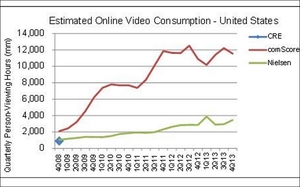
A report from Pivotal Research Group suggests a large and growing gap in measuring online video use.  The study compared metrics from Nielsen with those coming from comScore, showing a sizable and growing gap in terms of online video usage between the two metrics.  Currently, the estimates from comScore show roughly 3 times the amount of online video viewing as suggested by Nielsen's current proposed metric.

There are several reasons for the difference.  One major difference is in how each defines "online video viewing": comScore includes both streams and downloads, and counts all video streams; while Nielsen only includes streams of TV programming.  (Nielsen relies on embedded tags to measure TV viewing; Netflix, for example, strips all of those tags from the videos it streams, so Nielsen doesn't include any viewing from the dominant online video streaming service).  Then again, Nielsen is funded by TV networks, stations, and broadcast advertising industry, so might be more conservative in measuring viewing that isn't ad-supported.  comScore, on the other hand, is the primary metric used by online advertising industry, as it more directly counts viewing of online video ads.  Neither metric currently includes viewing on the full range of mobile devices, however.

Based on numbers from the last quarter of 2013, comScore put online viewing at 8.6% of all TV viewing (15% among active online video users).  Nielsen placed total online viewing at 2.6% (4.9% for active online video users).

Source -  Report Reveals Gross Disparity In Online Video Ratings, Implies Overstatement,  Online Video Daily

Thursday, February 6, 2014

The State of Video Streaming: Sports

NBC and the BBC hit it big by streaming every moment of every event at the 2012 London Olympics, and currently plan on doing the same this year for the Sochi Winter Olympics (as long as the Russian government doesn't block things).  The breadth and success of those 2013 Olympic efforts prompted a lot of audience trying and sampling.
  And then there's the runaway success of Netflix and its brethren.

All of this showed promise of a spurt in the use of video streaming for watching sports - which is being confirmed by the latest Adobe Digital Video Benchmark report.

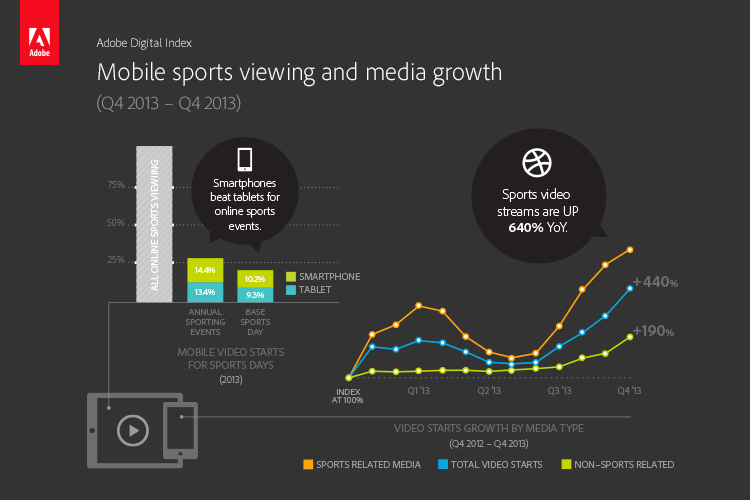
 The 2013 4th quarter report shows that sports video streaming has gone up 640% increase over the previous year. 


In addition:
  • 37% of TV Everywhere content streams are for sporting events
  • More than a quarter of video streaming for major annual and bi-annual events are accessed by mobile devices.
  • Such special events see twice the mobile sports streams than the average
  • Watching sports streams on mobile is up 73% over the last year
  • Most mobile viewing for big events is on smartphones
One reporter contacted Adobe, to get their take on the fact that sports is outperforming other video content in generating video streams.
Campbell Foster, director of product marketing for Adobe Primetime, the company’s TV publishing infrastructure platform for service providers, said the data back up what many other industry observers have noted about sports: It is engagement viewing that fans don’t want to miss, so they use whatever device they can to watch.
Sources -  Adobe research finds mobile sports viewing driving huge growth in digital video, Mobile Sports Report
Adobe Digital Index Benchmark Report, Q4 2013,  Adobe

Monday, January 6, 2014

“TV Everywhere” – Good, Bad, & Ugly


Some quick bits from the headlines about the diffusion of “TV Everywhere” –

Good – A plethora of new studies show that broadband access and speeds are continuing to grow (the backbone allowing realtime HDTV streaming).  AT&T’s telco cable systems are pushing wireless boxes.  A forecast from NPD Group predicts that connected TVs will grow by 44% over the next two hears

Bad – On the other hand, another survey is suggesting that while the technology’s connected, and content increasingly available, use may be lagging.  A survey reports that 82% of respondents didn’t know what “TV Everywhere” referred to, and only 4% know their login/account information for authentication.

Ugly – The looming problem of licensing: as networks and program creators work to push licensing fees higher and higher, there’ll be increasing push to limit access through authentication, and increased costs and burdens for audiences.  (See earlier post).  The real problem here is that while driving licensing fees up may be a short term revenue gain, it’s likely to also result in audience losses in the long term (which will harm both advertising and licensing revenue streams). 

Sources -  IP-Connected TV Devices Set For A Surge,  Multichannel News
Viewers Not Embracing TV Everywhere,  MediaPost Weekend 

IRTS - Poltrack confirms shifting audience habits

The second speaker today was David Poltrack, Chief Research Officer, CBS.  He confirmed trends he hinted at at an earlier IRTS.  With new devices and new delivery channels, people's viewing patterns are changing.  Some highlights:

  • This year, 94% of their large tracking sample are "connected."  Less than 10% of US TVHH only watch TV on home TV sets.
  • Delayed viewing is accounting for large and growing portion of viewing and ratings - not just for the big prime time series but in all day parts.
  • Streaming, VOD, and mobile are all seeing big increases in TV viewing.
  • Non-live viewing not only large share of total viewing, but showing some differentiable habits developing.
  • Broadcasters, advertisers, ratings services are trying to develop better metrics.
  • Streaming-only big series draw audiences similar to big pay-TV series, prime time broadcast series.
  • Second screen usage up to 67% for some demographics
  • Email, texting, and chatting is most frequent activity.  Gaming is second (20% of  USTVHH is playing Candy Crash while watching TV.
Basically, the audiences are becoming more active, and programmers and networks are trying to figure out how to reach them.

Thursday, January 2, 2014

"TV Everywhere" Challenged

The concept of "TV Everywhere" - the ubiquitous access to TV programming on any device, at any time, and at any location (including while mobile) is facing a critical challenge from those seeking to control access so as to maximize licensing fees and revenues.  This can be seen in several recent trends:

  1. Lawsuits against Aereo and similar services that seek to make local broadcast station signals accessible from mobile devices (without actually putting a tuner and antenna onboard).  Almost as soon as the product started trials in several cities, networks and big station groups filed suit challenging the legality of the practice.  The broadcasters have lost at every court level so far, and have asked the Supreme Court to weigh in on the temerity of anyone helping people to watch free over-the-air TV broadcasts without paying them.  I'm hoping that the case gets cert, so that a Justice can ask the network lawyers - "So, in essence, you want to prevent people from watching free over-the-air TV signals on anything other than a TV set?" - or - "You're arguing that you deserve to be paid so people can watch your free broadcast signal?"  The whole idea that stations - who are losing audiences to competition - wouldn't want to expand their potential audience base is kind of nonsensical, until you realize that stations and networks are increasingly turning to licensing fees as a major revenue source.
  2. The drive for maximizing licensing fees through retrans fees for local stations.  CBS in particular is pushing the idea that cable MSOs need to pay $3-5/mo. per subscriber in retransmission fees for their local affiliates.  While this may seem a good short-term strategy, it's likely to lead to some MSOs (which remain - with DBS & telco cable operators - the major source for video programming for 90% of US households) dropping the local affiliates.  And if successful, it'll sure lead to sticker shock if the Big Four jacks up subscription costs $15-20 a month for watching "free" TV, and probably a lot of people selecting to not take that bundle.  The broadcasters seem to be realizing that "free" and loading up on licensing fees are incompatible, so they're resorting to classic fear-mongering of taking all the good programs (and sports) to pay cable.  
  3. In the meantime, ABC is looking to regain control of online access to its programs, by seeking to block subscribers of DirecTV, the Dish, and TWC (TimeWarnerCable) from being able to access recently aired programs online.  It's also removing access to that programming from the free version of Hulu+.  Those wanting access will have to subscribe to Hulu Plus, or purchase episodes at $2.99 a piece from iTunes or Amazon.  CBS and Fox are also said to be blocking online access to recent programs and/or looking to move access behind paywalls.  The blocking is said to be limited to systems without "authentication" deals, which assure that only paying customers get access to current programming.
"TV Everywhere" had been set to take off, with big gains in mobile and online viewing, and an increase in authentication protocols.  But a lot of that is predicated on the idea that online and mobile viewing is free, or at least included in existing subscription levels.  Behaviors that seemed designed to make such viewing more costly, such as the efforts outlined above, are not likely to be well-received by consumers.  After all, they have an exploding universe of free content alternatives that they can choose from instead.  With a few exceptions, moving network series and programming from "free" to "pay" is likely to be disastrous - particularly for an industry that still is funded predominantly by advertisers and audience size.

Monday, December 9, 2013

Viva la Revolution Mobile

From CIO Insight - 10 Awesome Facts About the Mobile Revolution slideshow.

Several highlight the scale and scope of mobile, mobile data, and mobile broadband
  • There are more than 6.7 global mobile subscriptions, 30% for smartphones
  • Global subscriptions for mobile broadband will pass 2 billion this year, projected to hit 8 billion by end of 2019
  • Subscriptions for mobile PCs, tablets, and mobile routers are projected to grow from 300 million currently, to 750 million by 2019
  • In 2009, there was more voice traffic on the mobile network than data traffic.  Today, data traffic is more than 9 times higher than voice traffic.
  • Data traffic per smartphone currently averages 600 MB per month, expected to hit 2200 MB per month by 2019
  • Data traffic per tablet currently averages 1000 MB/mo; will hit 4500 MB/mo  by 2019.  Mobile PC data traffic currently averages 3300 MB/mo, projected to reach 13,000 MB/mo in 2019
  • By 2019, 95% of North American will have LTE (mobile broadband) coverage.  Globally, about 2/3 of the world's population will have LTE access.
A significant contributor to the mobile revolution is the growth of online video options and services, social media, and various entertainment/gaming options
  • By 2019, half of mobile data traffic will derive from video.
  • Smartphone owners spend, on average, 13 hours monthly on social networking, 8 hours on entertainment, and 6 hours gaming.
The impact may be greatest in Asia, where the growth of mobile broadband provides quick and relatively cheap access to the Net and its content and services to some of the world's most populous countries.
  • China alone has 1.2 mobile subscriptions, and India 742 million.  The rest of the Asia-Pacific region includes a further 1.3 billion subscriptions.  In contrast, Africa accounts for 803 million subscriptions, and Latin America 697 million.
The numbers and forecasts come from the most recent Ericsson Mobility Report.

Source -   10 Awesome Facts About the Mobile Revolution,  CIO Insight
Ericsson Mobility Report - November 2013

Tuesday, December 3, 2013

Streaming goes Prime-Time in U.S.

Two recent industry research reports point to the growing acceptance of, and preference for, the use of online streaming sources by TV audiences.
“Viewing habits are quickly evolving and connected TV is going mainstream,” according to Eric Berger, EVP of digital networks, Sony Pictures Television and general manager, Crackle.
The research is based on a survey of 1200 younger adults (18-49) conducted by Frank N. Magid Associates.  Their key finding is that online streaming is now viewers' second choice of viewing source (still trailing live TV).  The study found that access to online video streaming was near universal (96%), and more than half (54%) had access through "connected" TVs - either smart TVs, through attached gaming consoles, separate OTT devices, or connected video players.

The trend seems to be reflected in current trends in the cable/multichannel industry. Cable companies in the U.S. are seeing a surge in broadband-only customers (foregoing the primary TV service) - to the point where many are publicly rebranding as broadband services, which can also deliver TV (see earlier post here).  Research from the Leichtman Research Group is showing a decline in pay-TV subscribers, combined with increasing broadband subscriptions.  Their recent report shows major cable operators with 48.7 million broadband subs, and telcos growing more rapidly with 35.9 million (45% of which have access through fiber).  Average broadband speeds are also on the rise, with average bandwidth for broadband connected homes in the U.S. just over 20 Mbps.


As Cablevision CEO Jimmy Dolan told the Wall Street Journal in August: “Ultimately over the long term I think that the whole video product is eventually going to go to the Internet.  I’m not willing to cede that position now, and I’ve got a lot of customers that buy my video product…[but] the handwriting is on the wall, particularly when you look at young customers.” - See more at: http://videomind.ooyala.com/blog/telcos-cable-operators-see-broadband-subscriber-numbers-skyrocket-0?mkt_tok=3RkMMJWWfF9wsRousqzNZKXonjHpfsXx7OglWK6g38431UFwdcjKPmjr1YEITcN0aPyQAgobGp5I5FEMTrfYWbFrt6cPXg%3D%3D#sthash.gsljDRjn.dpuf
Source -  Streaming goes prime time with connected TV prime destination, RapidTVNews
The U.S. now has over 83 million broadband subscribers, GigaOm
Cable Companies See Jump in Broadband-Only Customers,  DSL Reports

Wednesday, October 30, 2013

Another Shift in Viewing Habits

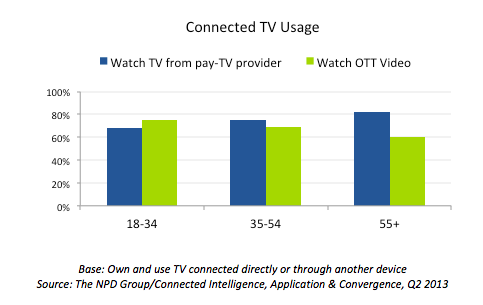
A new study from NPD Connected Intelligence shows that younger TV viewers with "connected TVs" (where the TV or other device connected to the TV can stream online video content) are shifting their viewing patterns towards more nontraditional streaming content.  In fact, among 18-34-year-olds in the study, more reported watching OTT (streaming) video on their TVs than reported watching content from multichannel video distributors (cable, DBS, telcom TV).
“The younger consumer has come to expect a broadband experience from any screen they come in contact with, and their TV is no exception,” said John Buffone, director of devices, NPD Connected Intelligence.
The big streaming content aggregators (Netflix, Amazon Instant & Prime Video, HuluPlus; in that order) are tops in use for younger viewers, along with YouTube (which now runs second to Netflix).  The results come from a survey of 5000 US online adults.

Source -  Three Quarters of 18-34 Year-Olds Use Their Connected TV To Watch OTT Video According to the NPD Group,  press release from NPD Group

Friday, October 25, 2013

Bundling vs. A la Carte - Implications

In previous posts I've explained why bundling can be a good marketing and pricing strategy, particularly for certain types of information goods, and why a la carte strategies can be appropriate for networks with certain characteristics and in markets where access can be easily restricted.  I've also made the case that in the early years of cable and multichannel video distribution, bundling was arguably the optimal marketing strategy for system operators, as well as for audiences.  Technological advances and the explosive growth in market competition over the last decade or two, on the other hand, have opened the door for the effective use of a la carte marketing of video networks.  The remaining core question is whether shifting to a la carte is a good strategy for video distributors, networks, and audiences.  I'll try to address that issue in this post.

One of the problems with much of the current discussions of forcing a shift to a la carte marketing is that it's largely based on overly simple, and occasionally inaccurate assumptions.
   The one I've already addressed is the argument that bundling forces consumers to pay for channels they don't want.  The problem with that argument is that a consumer's decision to purchase a bundle of networks from a multichannel distributor is not based on a network by network consideration of value, but on the simpler issue of whether the consumer feels that the aggregated expected value of the channels he or she does want is greater than the price of the bundle; from that perspective, whether the distributor includes unwanted "costly" channels is irrelevant. ("costly" in the sense that the distributor pays for carriage rights).
   A second major assumption (unstated but underlying most discussions) is that the a la carte price for a network would be close to what multichannel distributors pay for carriage rights as part of bundle.  The problem with that assumption is that it oversimplifies the market forces at play, and ignores the economic impact of unbundling.  For many of the 800+ cable networks available in the U.S., going a la carte is likely to lead to a pricing death spiral.
   The problem is that while cable networks in aggregate (i.e. bundled) have been quite successful in attracting audiences (gathering 50-70% of viewing overall (a bit less in primetime), all but a handful of networks attract less than 1% of audience viewing (averaged daily viewing).  Of course, some programming draws significantly higher audiences, and demand for networks may be even higher.  Still, most cable networks are likely to attract substantially smaller number of subscribers as an a la carte offering than the potential audience obtained as part of a bundle.
   For example, the total daypart audiences for ad-supported cable networks in the last quarter showed that only 8 cable networks had overall total day ratings of 1 or higher.  Weekly primetime numbers for top networks can be 2-3 times higher, and certain episodes or events (primarily but not exclusively sports) can draw ratings of 10-15.  Actual demand for a channel marketed a la carte is likely to be higher than that (as it's aggregating across shows and over time), but is also likely to be highly price-sensitive.  Even if a cable network could get a 50% buy-in rate as an a la carte offered at the current bundled carriage rate, that would result in a 50% decline in subscription revenues for the network.  (That's one reason pay-tv network subscription prices are in the $15/mo range, while carriage rates for cable networks top out around $5/mo, and most are under a dollar.)
  However, that's not the only impact of shifting to a la carte.  Most cable networks are also supported by advertising.  While a network would likely keep most of its core viewing as an a la carte offering, it would lose the occasional or drop-in viewers, which would have some negative impact on revenues.  More critically, though, is the fact that many national advertisers prefer to buy spots on networks that have a potential reach of 80-90% of the national population.  Few cable networks are likely to reach that goal as an a la carte service without significantly discounting subscription prices.

Unbundling cable networks is likely to have significant negative impact on revenues for all but a few channels.  Those where losses are small are likely to be channels with established record of high-value content, and a fairly broad audience base.   Those channels whose value lies in a narrow niche are likely to find that unbundling will drastically cut their revenues, forcing them to choose between significantly hiking a la carte prices or cutting back on programming costs.  Either of those responses put the network on a potential death spiral where demand (and revenues) continue to shrink as networks try to cope through price hikes or cost-cutting in content.

There is one additional implication of shifting from bundling to a la carte.  Multichannel video distributors face significant costs in building and maintaining their distribution infrastructure.  Those costs need to be recouped through subscription fees.  When the subscriptions are for bundles with a large number of, the per-channel distribution costs are fairly low.  If consumers shift from a large number of channels to only those they are willing to pay for separately (the goal of a la carte), then those distribution costs would have to be paid for separately, or split among the smaller number of channels subscribed to.  In the first instance, that would mean that a multichannel distributor may place a surcharge on access, regardless on how many or which networks are subscribed to.  The alternative is to split distribution costs across the channels; meaning networks would have to pay for their distribution, or add distribution costs to their a la carte prices.  In either case, that's more negative pressure on revenues and demand.

The upshot is that unbundling will result in significantly lower subscription numbers for most, if not all, cable networks.  The lower buy rates will negatively impact both subscription and advertising revenues compared to the current bundling market option.  If networks need to maintain current revenue levels, they're likely to have to significantly boost the a la carte pricing, or drastically cost the price (and consumer value of) their content.  Either strategy could easily result in a death spiral of declining audiences leading to price-highs and cost-cutting, leading to falling demand and audiences, etc. until the network proves to be no longer economically viable.

The "death spiral" problem is aggravated by the fact that there is a new TV distribution system available.  Online video delivery is becoming widely available as broadband Internet access increases.  Over 70% of Internet users already watch online videos, and streaming services like Netflix, Hulu+, and Amazon offer access to a vast archive of current and older TV and movie content.  The TV consumer faced with the issue of whether to purchase, say, Turner Classic Movies channel is not only thinking about whether that channel is worth purchasing, but the value of TCM vs. AMC vs. USA vs. CNN vs. a Netflix subscription and a plethora of free online content.

  Already several million US adults have become "cord-cutters", dropping some or all of their multichannel distribution services in favor of accessing their TV and movie content through online streaming services.  If unbundling drives channel prices up and forces consumers to be more rational in their purchasing of subscriptions to access cable networks, this could trigger a move of consumers to online video.  That move may well be followed by a move  by networks finding a less costly - and more flexible - distribution system that allows more viewer interaction, better usage metrics, and greater capacity for price differentiation.

If unbundling is bad for most cable networks, it's got to be good for consumers, right?  After all, a lot of the political push argues that it's in the consumer interest.  The reality here is that unbundling is likely to result in consumers paying higher prices for significantly fewer channels.  The problem is that bundling acts as a form of cross-subsidization as well as a form of risk aggregation.  When value is uncertain, aggregation through bundling spreads that risk - moving the the consumer from "I'm not sure that program/network is worth the price charged" to "It's likely something in the bundle is worth the price."  Bundling spreads distribution costs across more networks, reducing per-channel costs.  And from the consumer perspective, buying a bundle of channels you're not sure you want while getting those you do essentially subsidizes access to those added channels.  Previous efforts to remove subsidies in cable (the 1992 Cable Act) actually increased prices for most cable subscribers, rather than reducing them, as the politicians and interest groups pushing for the Act claimed.  In telecommunications, cross-subsidies usually are based on high-demand & high-value services subsidizing low value and low demand services.  In this case, it's ESPN subsidizing The History Channel; not the other way around.

Even if the subscription prices of channels don't increase, consumers are likely to reduce the number of channels they will subscribe to. Rather than "bundling forcing consumers to buy channels they don't want," unbundling means that consumers will be able to not buy the channels they don't want.  Audience research shows that for most consumers, almost all of their viewing is confined to 5-10 channels.  Another factor suggesting reduced channel access can come into play when there are multiple channels or networks in a content niche.  If the consumer perceives overlapping value across related niche channels, then the purchase decision is based not on the total value of the additional channel, but the added value that channel is likely to generate above that available in channels already in the a la carte subscription basket.  That makes it much less likely that the consumer will purchase complementary channels, or multiple channels within a content niche.  At least not without some significant cross-subsidy of channel prices. 
  So rather than having access to 100s of channels via bundling, it's likely that most Americans would scale back to 5-10 channels, perhaps with occasional video-on-demand purchase of high-value content.  Gone would be the opportunity for serendipity and the opportunity to sample and establish value for innovative networks and programs.  Thus, unbundling, along with the removal of possible subsidies, is likely to negatively impact general social welfare.  In fact, that's the long-established argument for public broadcasting.
  To illustrate, a consumer who has a low to moderate interest in news is much more likely to subscribe to a single news source than to subscribe separately to multiple news networks offered a la carte.  It's generally given that relying on multiple news and information sources is more valuable than relying on a single source - but a la carte models reduce the likelihood of multiple subscriptions, as the added value of additional news sources decreases as the number of sources goes up.  (When content overlaps, the consumer will base a purchase decision on the added value the additional channel will bring, rather than the full value of the channel.  Thus further decreasing demand for multiple channels within a niche).  I'm sure that most liberals would be upset if Fox News Channel was the only cable news channel subscribed to, just as most conservatives would worry if MSNBC was the only cable news network many people subscribed to.
    In addition, the impact of increased costs will hit lower income groups more than others.  Lower income groups are likely to cut off a la carte subscriptions once their separate subscriptions reach a point where the channels provide a threshold level of content, particularly if the addition of other channels provide minimal incremental value.
So, a complete unbundling and a shift to a pure a la carte marketing approach is likely to have a significant negative impact on all but the biggest high-value cable networks, and be particularly problematic for networks with content of lessor or unknown value, and those targeting small niche audiences.  It's quite likely to increase access costs to consumers (both on a per-channel and aggregate level), and result in their reducing access to networks and content of low or uncertain perceived value.  Not only is this a negative consequence for the consumer, but the reduction in access brought by a pure a la carte marketing approach is quite likely to have meaningful negative social impacts as well.
  It would hurt multichannel distributors as well, impacting the cost and profitability of their multichannel video services, and accentuating their competitive disadvantage as a TV distribution system vis-a-vis online streaming.  The eventual certainty of competitive disadvantage in that field has been recognized by the industry, and is one reason why much of their focus is shifting from multichannel video distribution to becoming a digital telecommunication access point and service provider.

Let me end by saying that a look at the likely impacts of a shift from pure bundling to pure "a la carte" model for multichannel video distribution suggests that there will be serious negative consequences for most groups in the market.  But it's not necessary to completely shift from one extreme to another.  The growth of video-on-demand (VOD) is demonstrating that a la carte can be a viable option for some networks.  The explosion of carriage fee rates for some networks - regional and nation sports networks in particular - suggests that splitting related niche networks and channels into separate mini-bundles, possibly with some a la carte options, would be appropriate and even have a positive impact on consumers and networks, letting the high costs of those channels be born more directly by those that see that value.  (And also hopefully bringing bundle prices back down to where multichannel access, and the social values associated with maximal access, are maximized.)

The market and technology is a a point where a la carte marketing of networks and channels is viable, and where it makes sense for some types of channels.  The same can be said for the intermediate strategy of offering various mini-bundle mixes of channels, programs, and services.  However, there are still a large number of channels, networks, and services where bundling remains the optimal approach, from consumer, network, distributor, and social perspectives.  It's pretty clear that rushing into a overly simplistic "bundling is corporate evil so a la carte must be consumer-friendly" assumption is not a reasonable foundation for policy in this area.  This is an area where an incremental approach that considers what marketing approach is best within a specific context; where consideration is given to the type of content and its content as well as audience interest, social welfare, and the values inherent in having the content accessible and used.  That's the approach most likely to result in positive outcomes.

Tuesday, October 22, 2013

Infographic - Online Video Taking Over

From Getty - a fun look at online video's growth and future in video and infographic.

Part of Getty's purpose is to promote the idea of the video inforgraphics as a better way of presenting data and results visually, instead of having users scroll through a vertically-oriented static infographic.

Some research data highlights:
  • Online video consumption has increased 800% over the last 6 years
  • 70% of Internet users have watched online video
  • Online video users watch 180 videos a month, on average
  • If trends continue, the 18-34 demographic will account for 90% of online video consumption by 2015
  • 6.7 million students watch videos of lectures online
  • More than 4.6 billion video ads are watched annually
Sources -  By 2015, 90% Of Web Video Consumption Will Come From 18-34 Demographic,  tubefilter

(edit- forgot to specify online video in header - now fixed.)

Tuesday, October 15, 2013

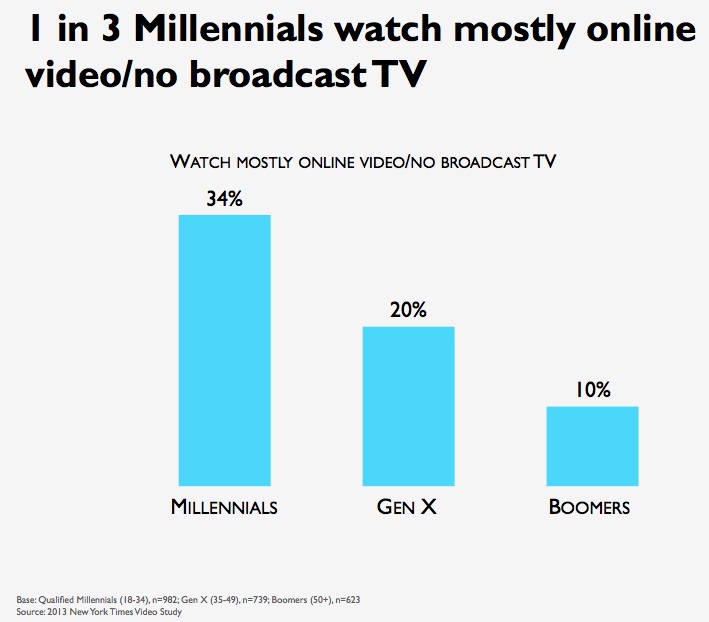
NY Times: A third of Millenials don't do "TV"

Research done by the New York Times finds that a third of young adults (aged 30 & under) "watch mostly online/no broadcast TV."  The study asked some 4000 "online video users" about their media and news consumption. Traditional TV viewing, like newspaper reading, seems to be declining across generations - the proportion of those giving the "online/no broadcast" response fell to 20% among Gen Xers, and 10% among Boomers. 

I should note that this was a nonrandom sample of a subset of US adults, and so the resulted are probably not representative, although the patterns of responses within the sample can be insightful.

The study had some other interesting news on the journalism front.  More than a quarter of the sample (28%) listed news sites as among their favorite video sites, and more than a third (35%) indicated that they had increased the amount of time spent on news/current events.  There was also a significant preference in the sample for "reading" news rather than watching news videos.

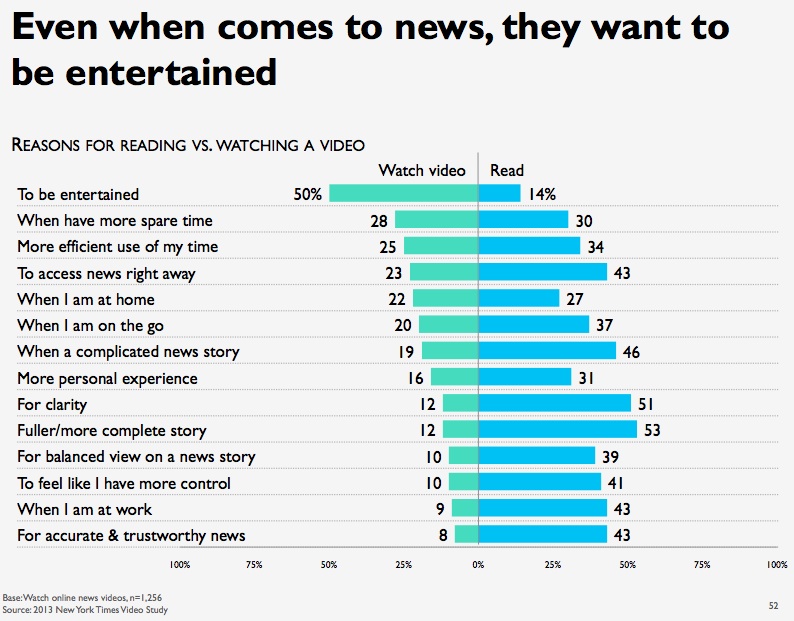
Among the various reasons offered for getting news videos or reading news stories, news videos outperformed reading in only one - "To be entertained." (50% to 14%)

In contrast, respondents preferred to read about news -

"To get news right away" (43% to 23%)
For a "complicated news story" (46% to 19%)
"For clarity" (51% to 12%)
To get "fuller/more complete story" (53% to 12%)
For a "balanced view" (39% to 10%)
For "accurate & trustworthy news" (43% to 8%)

Source -  Third of millennials watch mostly online video or no broadcast TV,  Poynter

Thursday, October 10, 2013

Latest Research on Online Video 3: Magid Connected Culture report

Three research reports on aspects of video/TV viewing and use have been released recently.

A nationwide study from Frank N. Magid Associates characterizes the role of mobile devices as "the beating heart of content and commerce."   Perhaps a bit of hyperbole, but the rapid adoption of smartphones and tablets, and the increased availability of compelling high-quality content is certainly impacting, and shifting, audience viewing behaviors.  The audience for mobile TV and video is there - the report finds 74% of U.S. "mobile consumers" have a smartphone, and 52% use tablets. 71% of tablet viewers, and 45% of smartphone viewers, now watch long-form TV, movies, and sports content on their devices.

Perhaps the most striking indication of that shift is the finding that digital and mobile devices are becoming the dominant source of entertainment for the 18-34 age group: smartphones/tablets account for 35%, PCs/laptops at 34%, while traditional television trails at 21%.
"Consumers have made the clear leap into mobile long-form," says Andrew Hare, Magid Research Director. "Beyond just TV and traditional video consumption, however, the visual culture has taken over with the growth of Instagram, Tumblr, Pinterest, Snapchat, and Vine showing consumers increasingly prefer to communicate through images and video."
Sources -  'Mobile is the new TV', finds Magid study,  Broadcast Engineering
The Heartbeat of Connected Culture - Magid Smartphone and Tablet Study 2013