Showing posts with label displays. Show all posts

Tuesday, January 15, 2013

CES: TV Goes for Wow Factor

Here's some of the TV industry highlights from CES:

UltraHDTV (UHD) & displays - The industry's settled on the name (and standards) for the next improvement in video screen resolution.  This step has actually been in use for a while in the movie industry as 4K, as older analog film stock is increasingly digitized at 4K (3840x2160 P) or 8K resolutions (7690x4320 P) prior to digital processing (cleaning, color correction, etc.) of the movie to create the digital archive version - which is then downconverted to HDTV or NTSC formats and resolutions for home video or licensing.
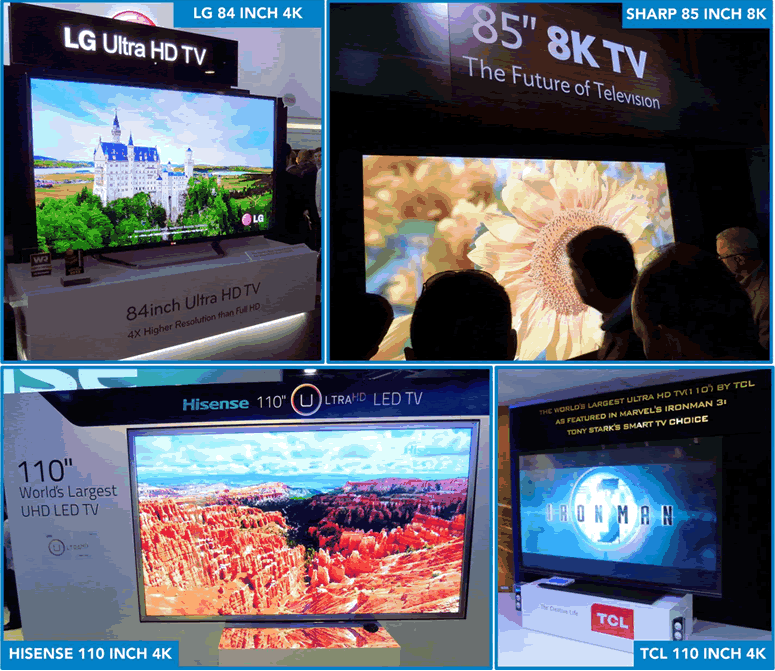
  However, until this year there were only a few 4K displays available to consumers, and those were extremely expensive.  This year, in contrast, most of the major TV set manufacturers displayed new consumer UHD displays at CES.  Along with 4K displays running from 20" to 110" were several promising 4K 3-D, and a couple of consumer 8K sets (including the 85" 8K from Sharp displayed to the side). However, there remains the problem of a lack of 4K or 8K programming sources. 
  The new 4K sets, and a few BluRay players, can upconvert current signals to 4K, but at this time there's little content available to consumers in native 4K formats.
  NHK has been experimenting with higher resolution cameras, and transmitting the resulting 4K content over the Internet for several years. South Korea reportedly has an experimental test channel for UHD, and the BBC filmed some of last summer's Olympics in 4K and distributed the content to several public 4K displays.  More recently, Red Digital Cinema Camera Company, a prominent digital film camera manufacturer, announced the availability of a player capable of sending a native 4K signal to a single 4K display.  And NHK announced it will be demonstrating 8K broadcasting (7680x4320P video format that provides 16 times more pixels than HDTV, and a 22.2 multichannel audio system that produces a 3D sound space for viewers located anywhere within a large viewing area) in a special theater at the NAB Show in a few months.  A few cable MSOs have indicated an interest in offering 4K channels, and Sony is promising a 4K movie downloading service to be launched this summer.
Organic LED (OLED) displays -  I think these have been "hot prospects" for almost a decade, and certainly the technological potential of OLED displays (environmentally friendly, high contrast, and the potential for flexible screens and unlimited sizes) is worthy of the hype.  The problem's been ramping the theoretical technology up to commercially viable manufacturing levels.  (And don't confuse true LED or OLED displays with flatscreen LCD screens using LED for backlighting - which is what most TVs marketed as "LEDs" really are).
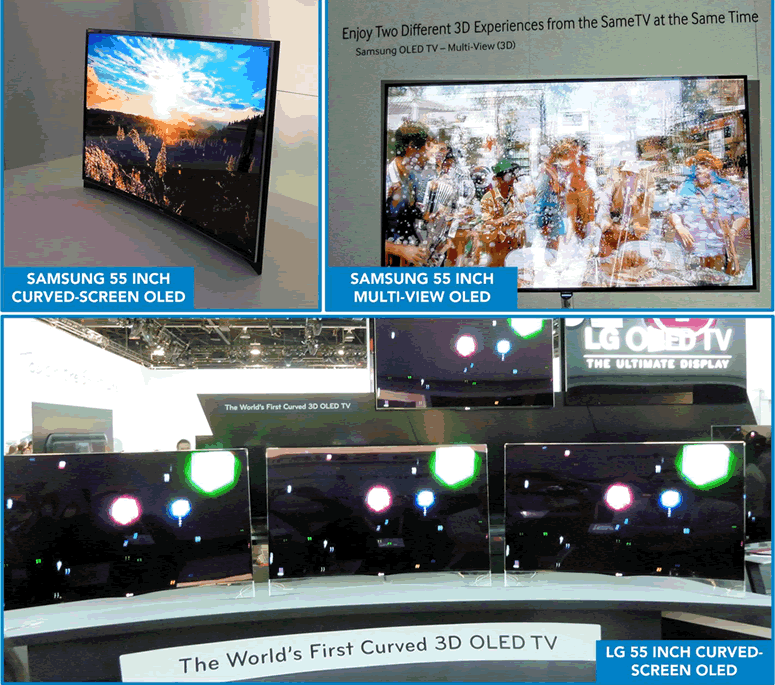
  OLED's potential as mass consumer TV displays seems to still be sometime in the future (promised availability keeps being pushed back), but there were a some leading-edge options on display at CES.  Samsung displayed a 55-inch "multiview" OLED that displayed two separate programs on the same screen (upper right in image to the side).  It builds on the 3-D approach of using active viewing glasses to distinguish the two signals, allowing the viewer to choose which one to watch.  The higher contrast and faster signal switching of OLEDs allows this to work on very different program contents (in 3-D, they're basically the same image with slight offsets in perspectives).  For it's part, LG displayed a curved OLED 3-D display.  And Panasonic offered their first 4K OLED display.  However, Sony took a hit when it's 4K OLED offering failed to work during their big press conference at CES (see story and video here), although they did get it to work later in their booth.
  The major set manufacturers once again promised that consumer OLED sets would be available within the year, but as I mentioned, they've been saying that for a long time, with little actually to show.

Touch-screen computing offerings also went for the Wow factor, with a big push from Microsoft and its Windows 8 operating system.  Samsung was there with a 24-inch touchscreen monitor, while Panasonic displayed a 20-inch tablet offering 4K resolution.  Higher resolution screens was an emphasis on most traditional tablets on display. New offerings also seemed to focus on splitting the tablet market - with many stressing computing power and compatibility, while others focus on the devices' ability to handle media content and/or gaming.

And for those not into big and beautiful, there were the Mobile DTV offerings (principally DyleTV).  These don't refer to watching TV on mobile devices through traditional TV tuners and broadcast stations, or the ability to download and watch videos from the Internet.  Several groups are experimenting with using parts of the current broadcast spectrum to broadcast specially formatted (lower resolution and reframed for smartphone screen orientations) television signals.  While DyleTV is already offering access to some local TV channels in some markets, Mobile DTV has a way to go before its consumer-ready (and consumer-friendly).


Sources  - Display Technology Takes Center Stage at 2013 International CESTV TechCheck
NHK to do First 8K U.S. Broadcast Demo at NAB Show, TV Technology
10 Best Tablets of CES 2013, Laptop Mag

Tuesday, January 8, 2013

Tech on the Edge

From a Popular Mechanics article on top tech terminology for 2013 -

Cognitive Radio - Not so much a new kind of radio, but a way of identifying and using the small bits and pieces of radio frequency available locally in order to push more data faster than current Wifi applications.  There's a test market that's using cognitive radio technology for mobile broadband and VoIP (Voice over IP) applications. 
Basically a smarter way to make more efficient use of small unused gaps in existing radio spectrum devoted to TV, radio, and other applications (known as white space) - and bypassing the problems inherent in needing to find and reserve a block of scarce spectrum for new services.  Could lead to a big boost in mobile broadband and TV Everywhere applications.

Targeted Tweets - Social media is public - and can be data mined.  This new "tech" refers to the ability of advertisers and others to automatically scan posts for key target audience elements, and then sent you highly targeted ads/offers.

IGZO Displays - replacing the flat back plane of current LCD displays with a printed iridium gallium zinc oxide (IGZO) semiconductor on a flexible surface, you can get more pixels for your screen while using less electricity - so sharper images and longer battery life for mobile devices.  They're already getting more pixels per inch than Apple's retina displays.  Expect to see them available on smartphones later this year.

Single Board Computers - not quite a computer on a chip, but with standardized interfaces you can plug it into (or build it into) a digital TV, add a keyboard/mouse, some cheap memory (SD cards) and you're good to go (for about $25).  Maybe not so big a deal in the West, but it could finally make computing affordable and ubiquitous in the rest of the world..

Source - The 10 Tech Terms to Know in 2013, Popular Mechanics

Monday, July 30, 2012

TV viewing al "Fresco" (future displays)

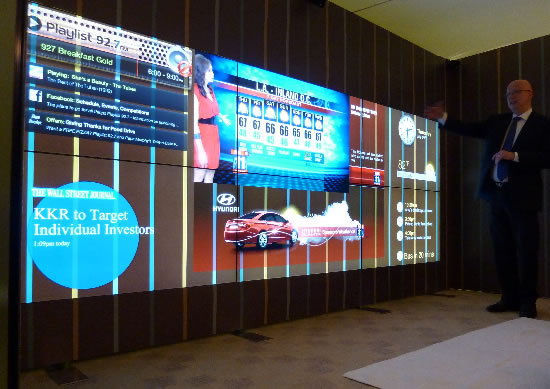
At recent TV technology meetings in Washington, DC, NDS presented a demonstration of a new way of watching TV - its "Fresco" project.
(C)onsumers of tomorrow may have expansive video screens available, perhaps covering entire walls of their homes or workplaces. NDS and others feel that this future is not far away, given the progress in OLED development that could soon lead to large display arrays assembled from smaller elements. The OLED panels could be super-thin, frameless, and either transparent when off, or coupled with electrophoretic ink (“E-Ink”) panels – as used today in many e-book readers – to provide a static background pattern. “It could be like tiling your bathroom,” as NDS’s Simon Parnall described.
 The "Fresco" project envisions future displays as unobtrusive, ultra-High Definition (at least 4K), immersive, and ambient.
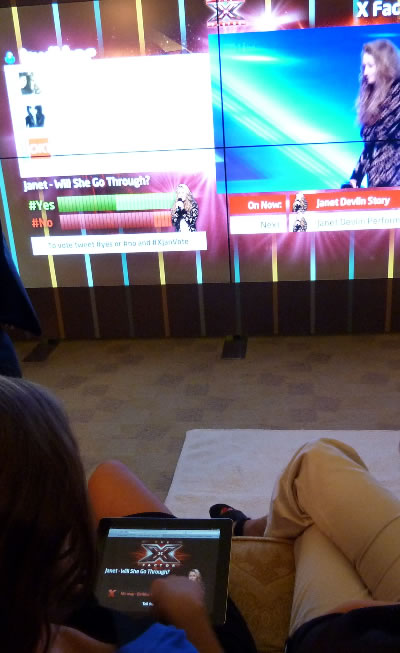
Parnall explained that such a display would “live with the viewer or family in the home,” displaying items that might today be presented by physical pictures on the wall, calendars, clocks, magnetic notes posted on the fridge, and the like. The display could also be used to present multiple simultaneous content elements (from broadcast, broadband or in-home sources), sized and arranged or the screen appropriately, or a single content element at a large size – so called “full immersion.”
 Parnall stressed the importance of including and utilizing metadata within video and data feeds, particularly in broadcast feeds.  The metadata (information about the content/app) could adjust display parameters automatically, and assist users' devices to make better choices on available viewing (or storage) options.  He also mentioned the opportunity for revenue generation from having such a large display canvas (putting ads, links, apps, etc. beside the primary broadcast feed, instead of overlaying them on top of the broadcast picture.
  What's slowing implementation is that direct-view screen sizes are nearing screen sizes that aren't viable in most consumer viewing contexts (too big for available wall space, too large to get through doors or around corners in stairs or hallways, and too heavy.  Today's largest plasma and LCD displays (and the demo in this case) use multiple smaller displays assembled together and linked to an external video driver that splits the video feeds among the component displays.  OLED technology offers the potential of thin and flexible screens that will eventually be ramped up to the kind of sizes and area coverage that "Fresco" envisions - but for now quality and manufacturing concerns have left large-screen OLEDs too expensive for general consumer use.
  Still, those attending the demo found it useful in terms of providing an idea about possible future viewing options, and the various opportunities for combining video and data in new, potentially profitable ways.

Source - NDS "Fresco" Demonstration Envisions a Bold Future of Television,  TV TechCheck

For somewhat similar visions of the future of displays, check GE's A Day Made of Glass, A Day Made of Glass 2, and Day 2 - Unpacked (discusses specifics of technology and current viability) videos.

Wednesday, April 11, 2012

Augmented Reality, with Google Style?

Post contributed by Nicholas Belitz -


  A new device from Google was teased last week, it is code-named Project Glass. The product was seen when Google’s co-founders Larry Page and Sergey Brin wore the device out in public last week. The new device is a pair of augmented realty glasses. The glasses have a HUD (heads up display) that will give wearers the same information they would receive from their smartphone and will even have capabilities to interact with the internet.
  These glasses are receiving mixed reviews according to an article on CNET.com which includes interviews from three experts in the augmented reality field. Blair MacIntyre, director of the Augmented Environments Lab at Georgia Tech has this to say about the new device, "In one simple fake video, Google has created a level of overhype and over expectation that their hardware cannot possibly live up to." It seems that many of the experts do not believe that this device (in its current state) will really amount to anything.

Source - Google's augmented-reality glasses: Is it all PR?  c/net news

Tuesday, April 10, 2012

Flexible Display Screens

Post contributed by Margo Lipscomb -


Forget touch screens, hello convenience!  Samsung plans to release new OLED technology in late 2012, with new flexible screen cellular phones.  The phone will be approximately a 7-inch screen, but will be able to roll up when you are not using it.
This technology was first addressed at the CES tech show last year by Samsung.  The new OLED technology will introduce a new era of cell phone convenience, in that the phone will be bendable, minimizing the risk for phone damage.  Some examples demonstrated were folding the phone into a bracelet to wear or a media stand.  Not only will cracked and broken screens be avoided, but this reduces the risk for cell phone damage that usually occurs when one drops their device.  Samsung said the new phone could be out as early as the end of 2012.  

Source -  The Next Big Thing(s) in TechPC World   

BJB - I changed the attached graphic to one from the original source article (for technical reasons).

Sunday, February 5, 2012

Virtual Reality contact lenses in 2014?

A U.S. firm, Innovega, recently released information about a new display system that combines a pair of lightweight glasses with a built-in translucent screen with a pair of nanoscale-engineered contact lenses to deliver a 3-D viewing experience equivalent to watching a 240-inch TV from 10 feet away.  The contacts are there to help focus the image within the eye, which allows the glasses providing the display images to be less bulky.  The contact lenses are said to wearers to simultaneously focus on the near-eye displays and more distant objects, which permits the combination of digital content with normal viewing of the real world around users..
  As such, one DARPA spokesman indicated that the system could be used as both a full "virtual reality" display that shuts out outside images, and for augmented reality images where digital information appears to be overlaid on top of what the user would normally see.
'Instead of oversized virtual reality helmets, digital images are projected onto tiny full-color displays that are very near the eye.'
The glasses that provide the actual screen and image can be paired with smartphones, tablets, or portable game devices (in consumer versions) that would deliver the video or other images.  There are also military applications for heads-up displays for targeting or other battlefield information.

As with all of these glasses-display systems, I have to wonder how well they'd adapt to people with less than perfect vision.  Somehow, these press releases don't seem to address that.

Source - Virtual reality contact lenses that beam images directly into your eyes could be on sale in 2014,  Mail Online Science & Tech blog.