Showing posts with label television. Show all posts

Tuesday, March 10, 2015

The end of big bundles? Going "a la carte" via OTT

OK, first let me take care of clarifying the terminology.

Assembling big (often 50+ channels) bundles of cable networks has been the primary strategy of multichannel video service providers (cable, DBS, telco cable, etc.) for the last couple of decades. Keeping bundles big helps minimize transaction costs for the bundler, while offering maximal potential audience reach for advertisers, and maximizing the viewer's ability to browse and discover the value of channels and their content.  On the other hand, critics complain that it "forces consumers to purchase channels they aren't interested in."  That's not necessarily true, as purchase decisions are based on the aggregate perceived value of the bundle, not the "costs" of undesired channels (see here for more detailed analysis).
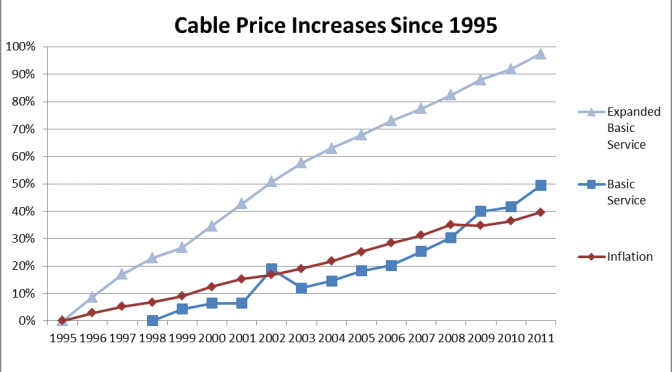
Still, as the networks and local stations seek to increase licensing fees from multichannel providers, those costs are passed on to the consumer in the form of higher bundle prices.  Bundle subscription costs are rising rapidly, and may be nearing a threshold point for many subscribers - the point where their perceived value of the bundle is less than the subscription price.  We're seeing the beginning of this in the rise of cord-cutters - those replacing paid multichannel access with a combination of online and free over-the-air TV sources.

However irrelevant, the claim of paying for unwanted channels is a major theme for those who would prefer to force multichannel services to unbundle channels and offer them to consumers in small focused bundles (like the various Discovery channels), or individually (i.e. "a la carte").  This may seem to be a good deal for consumers - until you realize that going a la carte will, in most cases, reduce audience reach numbers significantly.  One study (discussed here) forecast that forced unbundling could result in a loss of 60% of advertising revenues for cable networks, and result in more than 100 channels going out of business.  And since cable networks would need to significantly increase their a la carte prices to recapture some of those losses, going a la carte would also likely result in higher total costs for cable network access for most consumers.

Meanwhile, some multichannel video providers are finding that the increased licensing demands made by some networks are crossing that value threshold, and are dropping channels, or in one case offering to provide the channel - but only as an a la carte service.  The networks have so far been smart enough to realize that either option is a net loss for them, but the gleam of a licensing El Dorado of unlimited wealth keeps them trying to push licensing fees ever higher.  Viacom, and its package of networks, is the latest battleground, with their channels being dropped by a number of mid-range and smaller cable systems unwilling to cave into their licensing demands.  As one analyst noted,
“The stage is set... As consumers are less interested in large bundles, somebody is going to get hurt in the process by asking for too much.”
If multichannel service providers remained the only option for access, the impact on the industry would be bad enough.  However, they're facing rapid growth in the ability of broadband internet connections to provide access to high-quality TV streams to mobile devices and wired connected devices.  The term OTT (over-the-top) refers to these alternative sources of video and TV content. Both the diffusion and use of these technologies for TV viewing are growing rapidly (see here and here).  Combined with increased time-shifting of programs and place-shifting, audience TV viewing habits are clearly changing.  For cable networks, going online for their content distribution - either as single channels or as a part of a more limited (and much less expensive) bundle offered online - is an increasingly viable supplement, and potential substitute, for traditional delivery media.

The viability of online TV delivery has been a significant component of the "TV Everywhere" marketing push.  The initial conceptualization, though, saw "TV Everywhere" as a way of achieving multichannel services beyond the household's TV sets - and not as a substitute or replacement for those services.  That was one reason for the rapid reaction to the Aereo service.  One would think that local stations and networks would be eager to extend their range of service via mobile as a way of enhancing (or at least maintaining) audience reach.  However, it seemed that the industry hated the notion of a video service that paid no licensing fees; and the courts bought that argument.

More recently, the industry has seen several TV networks pursue the option of offering their programs and content online. The WWE initiated a very successful online subscription service last year, and many of the Pay TV networks have announced plans for providing online access channels separate from multichannel provider subscriptions.  HBO, in particular, is scheduled to provide a separate online channel called HBO Now starting April 12, 2015.  A research report released in January by Park Associates suggested that HBO Now could generate an additional 15 million subscribers.  More critically for multichannel providers, half of those interested in HBO Now said they'd not only be likely to drop HBO pay channels, they'd drop the whole multichannel pay service (about 7 million subscribers).  That's still a big win for HBO, who not only would likely net an added 8 million subscribers, but would not have to split the subscription fee with the multichannel provider.

In addition, CBS has been offering an online video service since last fall, and it is thought that ABC, NBC, and ESPN are considering taking their online video channels public (currently access is limited to subscribers of some of the largest multichannel providers).  Most cable networks provide some access to their content, but not to live streams of the channel.

Still, it's likely that the new DishTV service, Sling-TV, may unleash the deluge.  Sling-TV is an OTT service that bundles a number of the most popular cable networks as a minibundle at a very low subscription price ($20/mo. for about 20 channels), and supplements that with targeted minibundles (sports, movies, children, etc.) at $5 a pop.  The service combines live streams of the network, as well as on-demand access to the previous week's programs. Sling-TV has managed to sign up some 100,000 subscribers in its first month, despite being initially limited to those with a Roku OTT box.

The Sling-TV service could well force the big multichannel services to start unbundling.  It offers an intriguing alternative for those who would be satisfied with a lesser selection of channels.  And even for those viewers who place high value on channels not included in the Sling TV packages, the price contrast between the "big bundle" options ($50-$150+ on new subscriber deals) and Sling-TV will prompt consumers to reconsider if their demand for favorite channels will justify the price differential (and to wonder how the costs of channels they don't want inflate bundle prices).

The big multichannel providers have been shedding TV subscribers slowly, but consistently, for years.  Now that viable and less costly OTT and online video options are coming available, expect the decline in pay TV subscribers to increase, particularly for major MSOs and multichannel providers.

Sources - Updating: HBO Now The Big Test for Cord Cutters?, Online Video Daily VidBlog
Sling TV notches 100,000 users in a month, TechHive
Seventeen percent of U.S. broadband households are likely to subscribe to an OTT HBO service, Parks Associates report.
Provider's Dispute with Viacom Highlights Skirmish Over the Cable Bundle, New York Times

Wednesday, August 7, 2013

FCC Releases 15th Video Competition Report

Some highlights from the Executive Summary (I'll try to get back with fuller analysis later).


With this report, the FCC has distinguished three types of video channels
  1. MVPDs -Multichannel Video Programming Distributors (Cable, DBS, and Telco cable), 
  2. Broadcast Television Stations (over-the-air free broadcasting), and
  3. OVDs - Online Video Distributors (any service delivering video over the Internet)
Between the last report's data collection (Dec, 2010) and this (June, 2012), there has been a slight growth in MVPD subscribers.  However, cable has continued to lose market share to DBS and Telco cable.

The push for 'TV Everywhere" has grown in the last two years, with an estimated 5.1% of the MVPD audience using it as of Sept 2012.

MVPD systems continue to shift from analog services to digital. Among the top 8 cable MSOs, more than half of their customers receive all-digital service.  DBS and Telco cable are already all-digital.  Larger cable MSOs are also experimenting with switched digital video, where only the channels being watched are transmitted to the home.

Roughly three quarters of US homes can receive and display digital signals; 43.8% have DVR capability; and there is increasing availability of video-on-demand access of recent content.

Less than 10% of US homes rely on over-the-air broadcasting for video access.  In contrast, viewing of video content from online sources (OVDs) is growing, with estimates that more than a fifth of US homes are "Internet-connected" - that is, capable of watching online video on a TV set.  The continued growth of OVD viewing is increasing Internet traffic in peak hours, to the point where ISPs are increasingly considering imposing bandwidth caps.

Monday, November 12, 2012

Retrans Fees News

Hot on the heels of an SNL Kagan report projecting a bog hike in future revenues from Retransmission Consent fees, comes a report that U.S. broadcasters will seek retransmission payments from Canadian cable, satellite, and Internet TV providers that include their signals.

  The SNL Kagan report projects that revenues from U.S. retransmission consent fees will total $2.36 billion in 2012, or about $1 per MVPDS  subscriber (multichannel video programming delivery service - includes cable, satellite, telco-TV).  They also significantly raised their retrans revenue estimate for 2018 - $6.05 billion, or $4.86 per subscriber in aggregate.  There's two ways to look at this - that it would be only 10% of what cable operators pay for all carried programming, and that all broadcaster-based fees combined will be still be less than what ESPN earns just for its primary channel; alternatively, you can think of this as saying viewers will be paying nearly $5 per month to access "free TV" through cable or other MVPDS services.

  The money's good enough to get border-area stations to to seek payments from Canadian MVPDS services now, rather than waiting for a proposed WIPO Broadcasting Treaty that would explicitly give broadcasters the right to seek payment for carriage of their signals beyond national borders.  They argue that they should be treated the same as "distant" Canadian stations are under a new set of consent and compensation rights in Canada.  The new Canadian regulations can into effect in 2011 after Canadian authorities looked into "fee-for-service" video platforms.  The new regulations provide consent and remuneration rights to "distant" or out-of-market TV stations in Canada, that are similar to US retransmission consent rights in the U.S.
“Our channels deliver value for Canadians,” said Chris Musial, General Manager for WIVB and WNLO-TV in Buffalo, New York. “We expect the right to negotiate appropriate compensation for the full value that our signals and programming deliver to Canadian markets.”
While it may seem like a winner for these U.S. stations, it likely won't be long before non-US stations seek reciprocal rights from US MVPDS operators.  That could negatively impact carriage decisions and retrans payments in the U.S. as well as in Canada.
  Even with the additional revenues from Canada, it's likely that local stations won't be able to keep most of it.  As copyright holders for most of the broadcast content local stations transmit, networks are already grabbing significant chunks of retransmission consent revenues from stations.  Retrans consent payments are contributing to higher prices for syndicated programming.

As for TV viewers, remember that these carriage fees get passed on to subscribers; or result in denying them access to channels (if no deal is reached.

Sources  -  Kagan: Retrans to Top $6 Billion by 2018Broadcasting & Cable
US Broadcasters Seek Retransmission Fees, Broadcaster

Wednesday, October 10, 2012

Execs Identify "Mega Media Trends"

Big industry trade meetings often have panels where top executives talk about the trends they see in the industry.  The recent panel at Ad Week featured Josh Sapan (AMC Networks(, Tim Armstrong (AOL), and Laura Lang (Time Inc.). So what did they see in their future?
  • "OTT & TV: Frenemies by Necessity" - in TV's "Golden Age" if you were watching one program, that precluded you from watching whatever else was on at the time so channels were "enemies" - doing their best to capture audiences from one another.  However, with the growing range of viewing and program delivery options, it's no longer a zero-sum game.  "TV content being available outside of the ecosystem “turns things that we used to consider our foes into friends by necessity,” said Sapan. In fact, when content plays on OTT platforms like Netflix and Amazon Prime, the data indicates that ratings actually increase during the next season."
  • "It's All About Mobile" -  Tablets and mobile devices will be major game changers, allowing audiences new content access and consumption options.  Time's Lang predicts we'll see a profound shift in how people consume content, which means content needs to be able to tell their stories “with no primary platform in mind.”  In a similar vein, Dan Rosensweig of digital textbook publisher Chegg predicted that "he education field will be completely disrupted by technology, and that 'content creators and technology will come together to create interactive learning.'”
  • "Growth of Closed Networks" - AOL's Armstrong sees online media trying to create "walled gardens" - trying to keep consumers by closing off networks.  You can see some of this in the redesigned news websites discussed in a previous post.  Personally, I think they'll try, but find that consumers will gravitate to more open networks if they're available.
  • More products will incorporate digital technology that can be interfaced with media use and used to individualize marketing and advertising messages.
  • "Social TV" - with screens increasingly individualized, some consumers will seek to go social to maintain contact with others.  And that goes double for hardcore fans of programs.  For example, AMC's Sapan noted that "after realizing that viewers wanted to continue the conversation after (The Walking Dead) season ended, (AMC) created an entire show devoted to that precise theme: “The Talking Dead.”
Any other forecasts for Mega Trends out there?

Tuesday, September 25, 2012

Election 2012: Is TV Relevant?

A recent post on MediaPost's TV Board blog suggests that television is becoming increasingly irrelevant in elections.  In it, Gary Holmes points to the minimal impact of the two major party conventions on surveys of candidate preference and the large declines in audience size.  While the decline in viewing isn't good, he turns to the demographic mix of convention coverage audiences for an explanation.  On each convention's final night, more than half of the TV audience was aged 55 or older; and more critically, those 18-34 made up only 15% of Democratic primary viewers, and 11% of Republican primary viewers.  News channels and shows skew older anyway, but not as extremely as live election event coverage seems to.  TV news and political coverage of the conventions just don't seem to be reaching uncommitted or swing voters in the electorate.
  History suggests that the audiences for the coming Presidential debates won't attract many of that segment of the electorate either - the debate audiences will most likely continue to primarily attract the older, committed partisans of the candidates, looking to score the hits like a prize fight judge.  And afterwards, there's likely to be a lot of punditry about disinterested and lazy publics failing to devote their attention to these "serious" debates.  However, I'll suggest that its increasingly rational for people looking for reliable information on which to base their vote to ignore the live coverage of the upcoming Presidential debates.  History shows that modern televised Presidential Debates rarely offer rational  discussion of the issues and positions. Rather, they're all about the candidates getting their pre-scripted talking points in (rather than providing meaningful answers to the actual questions asked), and the moderators doing their best to trigger "gotcha" moments about trivialities (rather than addressing and exploring the substantial candidate differences on critically important and pressing issues).  Modern debates don't have much impact unless a candidate makes a grievous error - which will be massively covered in the following weeks.
  Well, then, what about political advertising, slated to reach stratospheric levels this year?  The trouble with having a lot of political advertising is that you have a lot of political advertising.  TV stations and networks will be awash in multiple airings of attack ads - but ads, and particularly political ads, can quickly reach a saturation point beyond which they have little, if any, positive impact.  (Personally, I identify most of them in the first few seconds and immediately change channels - particularly attack ads)
Anecdotal evidence from the last few weeks might even suggest a backlash.  In the last few weeks, mainstream news media, television in particular, have trumpeted multiple claims that Romney "gaffes" have ended his campaign, a plethora of Obama campaign attack ads (labeled misleading and dishonest by fact-checkers) and additional buys for a PAC ad blasting Romney that even the Obama campaign said was dishonest and inappropriate.  And the result of this avalanche of all this negativity from television on Romney's support and approval levels?  National tracking polls show him picking up support from voters, to the point that he's come from several percentage points down, to being tied with (or slightly leading) Obama.
  But the money's been raised, and will be spent.  Attack ads will flourish and will likely to become really dirty and dishonest as the election nears (when the folks running campaigns calculate that it's too late for preposterous claims to be challenged effectively).  But by then, one hopes, a lot of people will have already tuned them out - and perhaps even tuned out the channels, stations, and programs they appear on (I predict a big increase in delayed viewing, as DVR let you quickly skip the nastyness).  And television, in terms of news coverage and live coverage of political events will become even less relevant.
  I do think that TV could correct the trend if it wanted to - but when media think partisanship and conflict drives ratings and profits, it doesn't seem likely.  So to the American electorate - let's make TV irrelevant in elections.  Maybe then the TV's incentives will shift to providing objective reporting and analysis instead of the current incentives to uncritically repeat partisan talking points.

Source - Is Television Becoming Irrelevant to the Election?TV Board, a MediaPost blog

Thursday, August 9, 2012

Content trends and the future of Video

There's an interesting post in the Online Video Insider blog that takes a broad look at the past and future of video content.
  • 2006 saw the emergence of User-Generated Content (UGC), culminating in Google's acquisition of YouTube.  Content exploded as everyone could create and (more importantly) share content that while often trivial, was occasionally extraordinary.
  • 2007 saw a shift in focus to aggregation - of building systems to help viewers identify and find content of interest by aggregating access and developing improved search and recommendation software.  
  • March, 2008 saw Hulu go online, bringing "professional" content in the form of movies and TV programs to the Internet and greatly expanding access to high-quality content.  The move also helped both Apple's and Amazon's nascent online video marketplaces by encouraging "professional" content owners to license their product for digital access.
  • 2009 saw the impact of "Technology," in the form of infrastructure and software improvements.  Improved access to high-speed broadband allowed distribution of higher-quality video, and new content management systems (CMS) and content delivery networks (CDN) reduced costs while improving transmission reliability.
  • By 2010, online advertising revenues had expanded to the point where incremental distribution could be monetized.  That is, where distributors could profit from more than the most popular content - where specialty and narrow interest content of the "long tail" could drive further expansion of online content of all types.
  • Last year, 2011, saw a focus on Content Differentiation, with networks and aggregators starting to subsidize production of unique or distinctive content.  Some on the full professional end, seeking more traditional TV programs and films that they could have exclusive access to and thus distinguishing themselves from the growing number of outlets.  Many also supported a shift to higher production standards from major UGC creators, and the creation of separate narrowly targeted "channels", with the hope of building value and demand.
  • Will 2012 see "Madison Avenue become Wall Street"?  The post suggests that one advantage of online options for advertising agencies is the ability to monitor and shift advertising dollars on the fly.  Thus, the market model for ads becomes more of a real-time exchange model (Wall Street) than the traditional (Madison Avenue) model of upfronts and packages.
    "With an increasing number of content creators, publishers and ad networks vying for supremacy, we’ve seen the rise of ad exchanges and real-time bidding that allow marketers to effectively bypass or merge many of the steps involved with media planning and buying."
 The piece concludes that while the online video segment has certainly grown, is likely to continue expanding, and has clearly been at least somewhat successful (generating revenues of $2 billion in 2011), that the numbers remain below some earlier optimistic projections and aren't generating the same level of ad revenues per viewer that traditional broadcasting earns.
  For my view, this is neither unexpected or problematic.  Online video audiences are quite different from broadcast audiences, in both scale and scope - and on that basis should not be expected to be as valuable to most advertisers.  On the other hand, online offers a degree of targeting that is unmatched, and would be more valuable to advertisers seeking that level of targeting and focus.  In addition, online video costs are significantly lower than those of traditional media (by several orders of magnitude), and thus can be more profitable, even at lower revenues and ad rates.  There really is no need for online video providers to "match" traditional media revenue levels.  Finally, long term projections of new media are notoriously inaccurate, often because they're projections from the early stages of diffusion, where the rate of growth is often highest (and clearly unsustainable over the longer term).  So I'm not bothered that the actual revenues are significantly less than what they were projected to be based on where the market was some five years (or more) earlier.

Source - The Seesaw Effect: Trends Shaping Video's Past and FutureOnline Video Insider

Wednesday, August 1, 2012

Latest FCC Report on Video Competition available

The FCC recently released its 14th report on the status of competition in the video marketplace.  While the FCC is supposed to do this annually, it tends to be somewhat late - this just-released report is officially the 2010 report (covers 2007-2010).
  The expressed conclusion is that the level of competition in the video marketplace is "insufficient to hold down cable prices".  This despite finding that cable's market share is declining (to 60%), satellite services growing to 33% of the market, and the rise of competition to 7% market share (in 2010).  More recently, there's also been the growth of online video and mobile video systems.  And broadcast TV is becoming more of a direct competitor as stations take advantage of the ability to multiplex separate channels within their digital signals. So while video markets across the US are all more competitive from the situation examined in previous reports that concluded that there was sufficient competition, the FCC now finds there is insufficient competition.
  Part of the rationale for the change in conclusions may be a shift in what kind of competition is being considered, or a change in the threshold for "sufficient."  One change evident in the report is that the FCC now divides the video marketplace into 3 separate pieces - the Broadcast market, the Multichannel Video Programming Distributor (MVPD) market, and the Online Video Distributor (OVD) market.  The OVD market was also very narrowly defined as services offering professionally produced content previously shown in theaters or on TV.  While there may be value in differentiating the three, basing consideration of competitiveness solely on the number of outlets in each market (separately) is a narrow and problematic perspective.  From a consumer perspective, these aren't independent markets - at the very least they are very close substitutes for one another, and should be considered (at least) as interlinked markets.  There's a similar issue with the way the report considers the Broadcast market, as their analysis seems based on counting licenses rather than separate programming channels, or the programming itself.  Similarly, ignoring the huge gains in volume and use of online video (outside the retransmission of previously aired programming) sets a very narrow and unrealistically defined market.
  It would seem that the report is attempting to minimize any measurement of competition by failing to consider all competing alternatives in the video marketplace (and not merely a narrowly defined set of distribution services).  It also appears that they approach competition from a political economy perspective (how many owners) rather than a consumer perspective (available choices and options for video consumption).  And for a study purporting to look at the forces impacting cable pricing, it completely ignores the single largest contribution to costs (and thus prices) for cable services (as well as other MVPD and OVD services) - the cost of programming.  The report does not seem to consider the content side at all (other than, once again, from a political economy perspective of what channels are owned by which distributors). 
  Finally, while I have yet to closely read the whole report, there doesn't seem to be a clear standard set for what would constitute "sufficient" competition.  This allows FCC Commissioner Roger McDowell, to claim that the information presented in the report could as easily "affirmatively conclude that the video programming marketplace is competitive."  A second Commissioner, Ajit Pai, also commented that the data in the report shows that the video marketplace is "more competitive than it has ever been."
  The conclusion that the market (or markets) are not sufficiently competitive in terms of cable pricing seem to be drawn from a variety of claims made by a few commenters - based on anecdotal claims, or unrealistic comparisons to "ideal" market structures that do not exist (and can not exist in the U.S. due to FCC standards and regulations).
  While the basis for the report's conclusions are questionable (and in my view, suspect), there's still a large amount of good descriptive information in the report that is useful, if sadly outdated in age of rapidly evolving media and information markets.  It's worth a look, and I'll try to give it a more thorough look and commenting later.

Sources  - FCC Releases Video Competition ReportMultichannel News
FCC,  14th Annual Assessment of the Status of Competition in the Market for the Delivery of Video Programming
 

Tuesday, July 31, 2012

The Future of TV - 10 Things to Know

KIT Digital recently provided some thoughts on the future of TV, and some of the more immediate questions, from its Global Lead Analyst, Alan Wolk - in the form of a slideshow.  The slides are available here if you want a copy, and I'll see if I can get an embed to work.
10 Things You Need To Know About The Future of Television from Alan Wolk

Among some of the key points -
  • Transition to TV Everywhere is being slowed by "Lawyers" (really about interpreting intellectual property rights in that new context)
  • Bandwidth caps by broadband providers (setting a limit on data transfers) is slowing diffusion of TV Everywhere and "cord-cutting" (people leaving MVPD for access to TV content via the Internet)
  • Rise of Smart TV currently slowed by lack of single standard, and difficulty in upgrading programming in TVs - suggests that small set-top boxes like AppleTV and Roku may be the future, as they are easily upgradable.
  • Content producers (esp. movies) most worried about drop in DVD sales (why buy when you can get most through Netflix and its kin), and the shrinking window between primary theatrical release and availability through pay VOD.
  • There's potentially big value in second screen apps - as a way to implement "click-to-buy" online purchases for goods shown in ads or within program content; and as a source of consumer data on viewing and impacts.
  • Who has the best user interface (combining simplicity with value) goes a long way in determining winners and losers.
Source -  10 things you need to know about the future of TVLostRemote

Wednesday, June 13, 2012

Television's Digital Future (online)


  Television has already undergone one digital revolution - the shift to digital transmission systems for both terrestrial and satellite broadcasting.  It's facing another in the Internet and online video distribution.
  When the Senate held hearings of the future of television in April, however, the focus was on traditional regulation of traditional TV media (broadcasting, cable, satellite).  One commenter on GigaOm, Stacey Higginbotham, concluded that the Senate hearing had it all wrong -
 The future of TV isn’t to be found in deregulation — it’s on the Internet. We just have to let it happen. And to do that, Congress needs to look at how broadband providers control access to content, through caps, specialized offerings and deals.
The Internet has become a platform for services and TV is just one of those services. We need to start thinking about TV in terms of who can deliver it at a transport layer (the pipes), how it gets delivered (via a pay TV subscription, YouTube channels, Netflix subscriptions) and where the value is and who gets to charge for that. 


  That revolution is likely to have even greater impact on the television industry, as it exponentially expands the television programming market.  While there's been expansion in regular TV programming access via streaming and "TV Everywhere" offerings, the greatest expansion has been in the flourishing of legal (and illegal) movies and TV program access, in User Generated Content (UGC) available through YouTube and other hosting services, and other online videos marketed directly to users.
 Sandvine, an ISP equipment provider, recently released a report of mobile Internet traffic as of March, 2012.  Among its findings was that the volume of Internet traffic generated by Real-Time Entertainment (streamed audio and video entertainment) increased 55% in North America over the previous six months.  The growth was global (40% gains in Latin America and Europe, 39% in Asia-Pacific).
YouTube, on its own, generated 27% of mobile traffic in North America, and audio streaming service Pandora contributed 6% of all North American mobile traffic.
  Looking at it another way, Sandvine found that smartphones and tablets accounted for 9% of all fixed access network traffic in North America, including 16% of Real Time Entertainment, 9% of Netflix traffic, and 28% of all YouTube traffic.
  Further, improved mobile network capacity, mobile device capabilities and screen resolutions, higher resolution content and the availability of longer duration content (and live streaming), means even greater growth in traffic, as data files get larger.  In other words, online video traffic expands to match capacity - when capacity is scarce, users downscale video quality (from HD to SD), but when capacity is there, users return to the higher-quality streams and sources.
 
 A very different indicator of the shift to online can be seen in the efforts of Nielsen and other audience measurement firms in redefining many of their measures to include viewing through the Internet.  In comments to the Audience Research Foundation's ;annual Audience Measurement Conference, Nielsen officials indicated that they're considering redefining the concept of the "TV Home" - the foundation of all their measures.  What has prompted this is a unreleased study showing that the percentage of time spent watching video content on a traditional TV set has fallen to 93.7% from 99.4%.  The coming Cross-Platform Report suggests that the non-traditional viewing is about evenly split between computers online and mobile devices.  A related study found that up to 25% of all media consumption takes place while people are working, and that much of that media usage isn't currently being measured.  Some 15% of American workers report watching live TV while doing their jobs.  Nielsen is working at developing better measures for such viewing, and revising current definitions and measures to include alternative viewing options and behaviors.


Add in multiscreen viewing, social TV, "TV Everywhere", and a variety of new services looking to put local broadcasts online, and you can clearly see the shifting dimensions of TV media markets, use, and audience behaviors.  The trend is towards providing TV audiences with greater choices of video content, delivery mechanism, and viewing options.  The industry is, at least, recognizing this, and looking for better ways to deal with the changing situation, or at a minimum, being able to track changes.  But one thing seems clear, the future of TV is not likely to be decided by minor regulatory tweaks to existing TV industry models and markets.  If policy is to maximize both the public and private value of TV, it also needs to raise its head out of the sand and look at the real emerging issues, not the detritus of claimed "market failures" in traditional media models.