When instituting a price for a formerly free good, just like when raising a good's price, there is an expectation that you'll lose some consumers. So when UK's The Guardian newspaper put their Sunday tabloid The Sun's online edition behind a paywall, I'm sure they expected some decline in online readership.
With more than a month behind a paywall, independent metrics firm SimilarWeb found that monthly site visits fell from 37.3 million the month before, to 14.4 million in August - a decline of 62.4%. More critically, average time on the site also fell by two-thirds (from 3.6 minutes to just over 1 minute); and more than two-thirds of visitors to the site left without accessing any content. That later stat, called the bounce rate, suggests that those who had an interest in a topic that led them to the site were unwilling to pay the price set by The Sun for access.
Sources - Sun online's disastrous paywall start as traffic plunges by 62%, Greenslade Blog on The Guardian.co.uk
SimilarWeb's website traffic overview for The Sun.
Showing posts with label paywalls. Show all posts
Showing posts with label paywalls. Show all posts
Tuesday, September 17, 2013

Monday, April 15, 2013
Paywalls - Private Boom, Public Bust
A large-scale global survey of "high-end decision makers" suggests the end of the open Web will come quickly. The survey, from pricing consultant Simon-Kucher & Partners, found that the content executives expected that 90% of online content was likely to be behind a paywall within three years. Two-thirds of media companies indicated that they expected to introduce fees for most of their online content within the next few years. A quarter of media companies indicated that the move would significantly increase their profit margins at the expense of the public.

Paywalls, by imposing costs, deflate demand. Even if we're talking online about commercially produced content, restricting access will have a meaningful detrimental impact on access to, and use of, content. That not only impacts the media companies that create and/or distribute content, but impacts individuals, society, and the public sphere as well. In an increasingly information-driven economy and society, restricting access to information (or even information about information) is not in the public interest. And the impact of paywalls would be significantly more problematic when thinking about journalism, science, educational and cultural content. And if the fees are high enough, that will encourage individuals to shift their focus to the 10% that will likely remain free - the propaganda and unchecked and unfiltered content that critics already rail against. Shifting almost all content behind paywalls will also create a new digital divide - this one expressly between the rich and the poor. It also won't make advertisers in paywalled media happy.
If the Web had grown up behind paywalls, users may be more accepting of fees - but we've had generations used to free content, and they're likely to resist being asked to pay for things they're used to getting for free. The 'free for all" culture has already contributed to the rise of political movements in some European countries. Pushing a new digital divide for higher profits isn't likely to be widely welcomed.
Source - 90% of online content to be held behind paywalls in three years media company survey suggests, The Drum
Paywalls, by imposing costs, deflate demand. Even if we're talking online about commercially produced content, restricting access will have a meaningful detrimental impact on access to, and use of, content. That not only impacts the media companies that create and/or distribute content, but impacts individuals, society, and the public sphere as well. In an increasingly information-driven economy and society, restricting access to information (or even information about information) is not in the public interest. And the impact of paywalls would be significantly more problematic when thinking about journalism, science, educational and cultural content. And if the fees are high enough, that will encourage individuals to shift their focus to the 10% that will likely remain free - the propaganda and unchecked and unfiltered content that critics already rail against. Shifting almost all content behind paywalls will also create a new digital divide - this one expressly between the rich and the poor. It also won't make advertisers in paywalled media happy.
If the Web had grown up behind paywalls, users may be more accepting of fees - but we've had generations used to free content, and they're likely to resist being asked to pay for things they're used to getting for free. The 'free for all" culture has already contributed to the rise of political movements in some European countries. Pushing a new digital divide for higher profits isn't likely to be widely welcomed.
Source - 90% of online content to be held behind paywalls in three years media company survey suggests, The Drum
Tuesday, March 26, 2013
Online Newspapers: Paywalls vs. Advertising
Here's the issue - for the most part, people accept advertising in media because it keeps other costs down. But the more ads - or at least the more intrusive the advertising - the less valuable the media bundle, and the less people are willing to pay for access. So push ad loads, and the media bundle becomes less valuable. Conversely, install a pay wall or increase subscription costs, and you have fewer regular visitors, and your ad space become less valuable to advertisers.
Online newspapers are starting to see real revenues from online advertising. Still not enough to replace what the print version's lost - but frankly that's not coming back, as advertiser's have found better outlets. And it's starting to look like paywalls for online newspapers may be viable for some - but at what cost of online advertising? A recent presentation by Gordon Borrell of Borrell Associates looked at the issue.
More than 450 U.S. online newspapers have adopted paywalls to date, up from 300 in 2012 and 10 in 2010. On the other hand, 95% of local news websites remain free - TV and radio have largely rejected paywalls, as have local and hyperlocal alternative news sites. When paywalls first go up, web traffic falls 20-40%, but if there is a free access provision, many users eventually return (if not as frequently).
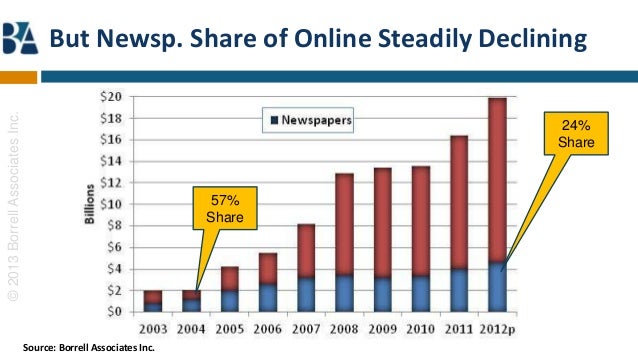 In the meantime, online advertising revenues are booming, and are now the biggest advertising segment,surpassing both newspapers and TV (which briefly supplanted newspapers). However, online newspapers get less than a quarter of online local advertising revenues (23.6% in 2012). Looking over time, though, that share is shrinking.
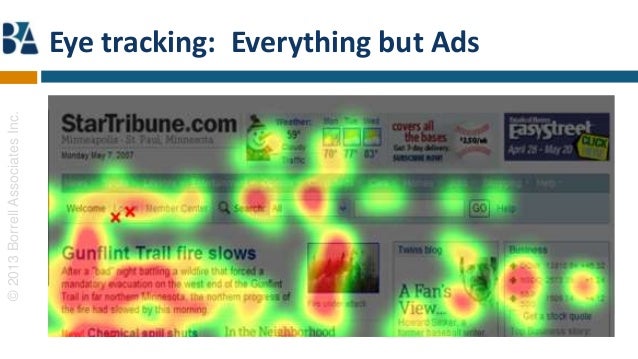 Thus, online newspaper advertising is looking less and less valuable to advertisers.
The good news for local news outlets is that people are interested. Almost three quarters (72%) say they follow local news most of the time. The bad news is that they've gotten used to getting it for free, so about three quarters of "news enthusiasts" indicate that they're unwilling to pay for local news. And the number's higher among more casual local news users. If you follow the numbers, that suggests online newspapers behind paywalls are unlikely to attract more than 15-20% of their market audiences - readership levels below what print editions are still getting. That's not likely to be a big draw for advertisers.
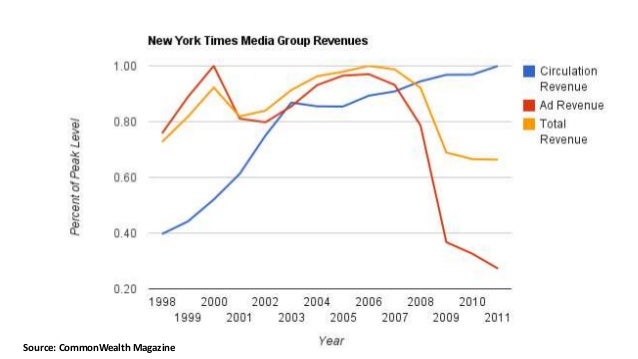 Consider the NY Times Group revenue sources, plotted against their peak values. Ad revenues peaked in 2000, showed early signs of decline before falling precipitously in 2007. While the decline's slowed in the last few years, it dropped below 30% of peak levels in 2011. On the other hand, subscription revenues have been slowly growing since 2005, so essentially it's peak is this now (or at least until it starts falling). But the gain in subscription revenues hasn't kept pace with advertising loses, so total revenues have fallen. since 2007.
Source - Will Newspaper Paywalls Kill Web Advertising? Research presentation from Borrell Associates
Online newspapers are starting to see real revenues from online advertising. Still not enough to replace what the print version's lost - but frankly that's not coming back, as advertiser's have found better outlets. And it's starting to look like paywalls for online newspapers may be viable for some - but at what cost of online advertising? A recent presentation by Gordon Borrell of Borrell Associates looked at the issue.
More than 450 U.S. online newspapers have adopted paywalls to date, up from 300 in 2012 and 10 in 2010. On the other hand, 95% of local news websites remain free - TV and radio have largely rejected paywalls, as have local and hyperlocal alternative news sites. When paywalls first go up, web traffic falls 20-40%, but if there is a free access provision, many users eventually return (if not as frequently).
In the meantime, online advertising revenues are booming, and are now the biggest advertising segment,surpassing both newspapers and TV (which briefly supplanted newspapers). However, online newspapers get less than a quarter of online local advertising revenues (23.6% in 2012). Looking over time, though, that share is shrinking.When it comes to the lean-forward medium of online, the mass-media news model doesn't work very well...In addition, eye-tracking research is showing that online readers have learned to tune out banner ads.
That's because local advertisers seek buyers in the online arena, not readers.
The good news for local news outlets is that people are interested. Almost three quarters (72%) say they follow local news most of the time. The bad news is that they've gotten used to getting it for free, so about three quarters of "news enthusiasts" indicate that they're unwilling to pay for local news. And the number's higher among more casual local news users. If you follow the numbers, that suggests online newspapers behind paywalls are unlikely to attract more than 15-20% of their market audiences - readership levels below what print editions are still getting. That's not likely to be a big draw for advertisers.
Consider the NY Times Group revenue sources, plotted against their peak values. Ad revenues peaked in 2000, showed early signs of decline before falling precipitously in 2007. While the decline's slowed in the last few years, it dropped below 30% of peak levels in 2011. On the other hand, subscription revenues have been slowly growing since 2005, so essentially it's peak is this now (or at least until it starts falling). But the gain in subscription revenues hasn't kept pace with advertising loses, so total revenues have fallen. since 2007.
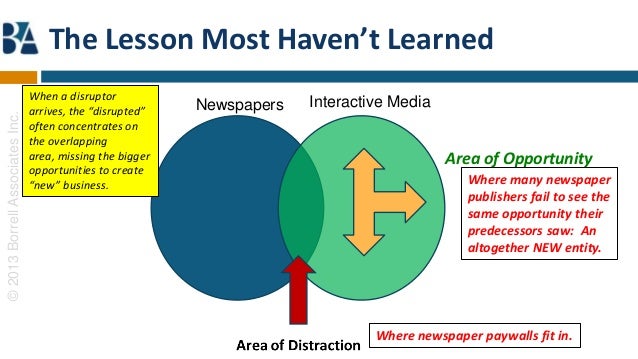
Thus, erecting paywalls is likely to further damage the ability of online newspaper sites to generate local online advertising revenues. So you might think that erecting paywalls is a bad idea. But Gene Borrell argues that it isn't:
- Ad revenue per print reader is ten times what it is for a unique visitor;
- Low value and demand for online newspaper banner ads isn't likely to increase to match
- Free online newspapers contribute to eroding print readership
- Paywall subscriptions can be a good supplemental revenue source (not a replacement)
Source - Will Newspaper Paywalls Kill Web Advertising? Research presentation from Borrell Associates
Monday, March 11, 2013
Newspapers' Online Paywalls Show Promise?
One of the metered access (paywall) platforms available for newspapers is Press+, which has released some data on the 400-plus publishers using their platform. The numbers suggest that these paywalls are modestly successful - at least to the point where publishers are increasing subscription rates and reducing the number of "free" articles they make available before users hit the pay wall. They report that the average price for a monthly subscription has risen from $6.66 in July 2011 to $9.26 at the time of the survey. The number of "free" articles averaged 13 in January 2012, but has dropped to 10 in the latest report. In addition,The company suggests that rather than seeing online readership drop, publishers are feeling confident enough to push the business model for additional revenues.
What’s more, according to Press+ co-founder Gordon Crovitz, publishers are enjoying the benefits of increased circulation revenue without sacrificing any online advertising revenue; however Press+ didn’t release any figures on this score.While this news might be encouraging, the research methodologist in me has to throw in a lot of caveats.
First, the release actually provides no numbers with respect to online ad revenues (as noted in the quote), subscription revenues, or subscription (circulation) numbers. Thus, there is no direct evidence provided in the report that online news paywalls are financially successful.
Second, there's a line in the report that the numbers are based on a survey of Press+ customers - but there's no indication that the same publishers participated in the surveys at the various times that numbers were reported from. (For example, the rise in "average" subscription may be the result of fewer responses from publishers with lower subscriptions - who might also have dropped their paywalls). As such, its not clear the comparisons over time are valid.
Following up on that, I'll also note that the comparisons are aggregate - the survey apparently didn't directly ask respondents if they changed subscription prices or where the pay wall kicked in. (Or if in fact they did, the failure to mention that might suggest that those results weren't so rosy).
Finally, I'll note that even if the sample of Press+ publishers was random, the responding publishers are limited to Press+ customers, and thus are not necessarily representative of online newspaper publishers more generally. As such, any results are not generalizable.
As such, I'd say the story jumped the gun with the headline "Paywalls Pay Off," The results reported don't justify that conclusion.
For many of the same reasons, you shouldn't infer that the issues with this report suggest that paywalls aren't successful, either. Anecdotal evidence suggests some are - for example, the NY Times seems to be doing well on their current paywall approach (after several glaring failures). On the other hand, News Corp. recently closed down their paywall online newspaper, The Daily, citing low readership and high losses.
In spite of my caveats with respect to these specific numbers (and improper conclusions), I'll take this report as being in line with my own cautiously optimistic perspectives. That is, pay walls can be successful - particularly when publishers provide unique content of clear value to some set of users - but are less likely to be successful with generic news coverage that is widely available elsewhere.
Source - Publishers Raising Digital Sub Prices, Paywalls Pay Off, MediaDaily News.
Subscribe to:
Posts (Atom)