Showing posts with label cable. Show all posts

Tuesday, March 10, 2015

The end of big bundles? Going "a la carte" via OTT

OK, first let me take care of clarifying the terminology.

Assembling big (often 50+ channels) bundles of cable networks has been the primary strategy of multichannel video service providers (cable, DBS, telco cable, etc.) for the last couple of decades. Keeping bundles big helps minimize transaction costs for the bundler, while offering maximal potential audience reach for advertisers, and maximizing the viewer's ability to browse and discover the value of channels and their content.  On the other hand, critics complain that it "forces consumers to purchase channels they aren't interested in."  That's not necessarily true, as purchase decisions are based on the aggregate perceived value of the bundle, not the "costs" of undesired channels (see here for more detailed analysis).

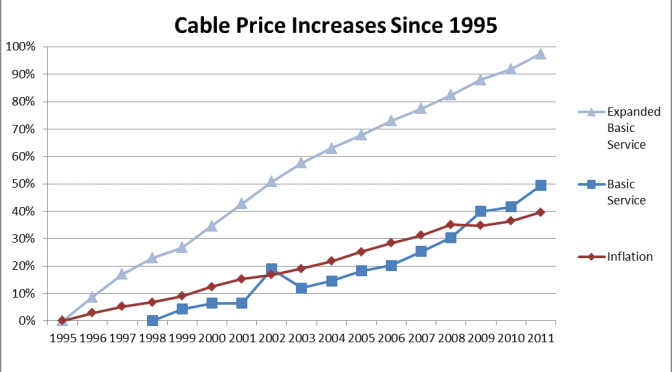
Still, as the networks and local stations seek to increase licensing fees from multichannel providers, those costs are passed on to the consumer in the form of higher bundle prices.  Bundle subscription costs are rising rapidly, and may be nearing a threshold point for many subscribers - the point where their perceived value of the bundle is less than the subscription price.  We're seeing the beginning of this in the rise of cord-cutters - those replacing paid multichannel access with a combination of online and free over-the-air TV sources.

However irrelevant, the claim of paying for unwanted channels is a major theme for those who would prefer to force multichannel services to unbundle channels and offer them to consumers in small focused bundles (like the various Discovery channels), or individually (i.e. "a la carte").  This may seem to be a good deal for consumers - until you realize that going a la carte will, in most cases, reduce audience reach numbers significantly.  One study (discussed here) forecast that forced unbundling could result in a loss of 60% of advertising revenues for cable networks, and result in more than 100 channels going out of business.  And since cable networks would need to significantly increase their a la carte prices to recapture some of those losses, going a la carte would also likely result in higher total costs for cable network access for most consumers.

Meanwhile, some multichannel video providers are finding that the increased licensing demands made by some networks are crossing that value threshold, and are dropping channels, or in one case offering to provide the channel - but only as an a la carte service.  The networks have so far been smart enough to realize that either option is a net loss for them, but the gleam of a licensing El Dorado of unlimited wealth keeps them trying to push licensing fees ever higher.  Viacom, and its package of networks, is the latest battleground, with their channels being dropped by a number of mid-range and smaller cable systems unwilling to cave into their licensing demands.  As one analyst noted,
“The stage is set... As consumers are less interested in large bundles, somebody is going to get hurt in the process by asking for too much.”
If multichannel service providers remained the only option for access, the impact on the industry would be bad enough.  However, they're facing rapid growth in the ability of broadband internet connections to provide access to high-quality TV streams to mobile devices and wired connected devices.  The term OTT (over-the-top) refers to these alternative sources of video and TV content. Both the diffusion and use of these technologies for TV viewing are growing rapidly (see here and here).  Combined with increased time-shifting of programs and place-shifting, audience TV viewing habits are clearly changing.  For cable networks, going online for their content distribution - either as single channels or as a part of a more limited (and much less expensive) bundle offered online - is an increasingly viable supplement, and potential substitute, for traditional delivery media.

The viability of online TV delivery has been a significant component of the "TV Everywhere" marketing push.  The initial conceptualization, though, saw "TV Everywhere" as a way of achieving multichannel services beyond the household's TV sets - and not as a substitute or replacement for those services.  That was one reason for the rapid reaction to the Aereo service.  One would think that local stations and networks would be eager to extend their range of service via mobile as a way of enhancing (or at least maintaining) audience reach.  However, it seemed that the industry hated the notion of a video service that paid no licensing fees; and the courts bought that argument.

More recently, the industry has seen several TV networks pursue the option of offering their programs and content online. The WWE initiated a very successful online subscription service last year, and many of the Pay TV networks have announced plans for providing online access channels separate from multichannel provider subscriptions.  HBO, in particular, is scheduled to provide a separate online channel called HBO Now starting April 12, 2015.  A research report released in January by Park Associates suggested that HBO Now could generate an additional 15 million subscribers.  More critically for multichannel providers, half of those interested in HBO Now said they'd not only be likely to drop HBO pay channels, they'd drop the whole multichannel pay service (about 7 million subscribers).  That's still a big win for HBO, who not only would likely net an added 8 million subscribers, but would not have to split the subscription fee with the multichannel provider.

In addition, CBS has been offering an online video service since last fall, and it is thought that ABC, NBC, and ESPN are considering taking their online video channels public (currently access is limited to subscribers of some of the largest multichannel providers).  Most cable networks provide some access to their content, but not to live streams of the channel.

Still, it's likely that the new DishTV service, Sling-TV, may unleash the deluge.  Sling-TV is an OTT service that bundles a number of the most popular cable networks as a minibundle at a very low subscription price ($20/mo. for about 20 channels), and supplements that with targeted minibundles (sports, movies, children, etc.) at $5 a pop.  The service combines live streams of the network, as well as on-demand access to the previous week's programs. Sling-TV has managed to sign up some 100,000 subscribers in its first month, despite being initially limited to those with a Roku OTT box.

The Sling-TV service could well force the big multichannel services to start unbundling.  It offers an intriguing alternative for those who would be satisfied with a lesser selection of channels.  And even for those viewers who place high value on channels not included in the Sling TV packages, the price contrast between the "big bundle" options ($50-$150+ on new subscriber deals) and Sling-TV will prompt consumers to reconsider if their demand for favorite channels will justify the price differential (and to wonder how the costs of channels they don't want inflate bundle prices).

The big multichannel providers have been shedding TV subscribers slowly, but consistently, for years.  Now that viable and less costly OTT and online video options are coming available, expect the decline in pay TV subscribers to increase, particularly for major MSOs and multichannel providers.

Sources - Updating: HBO Now The Big Test for Cord Cutters?, Online Video Daily VidBlog
Sling TV notches 100,000 users in a month, TechHive
Seventeen percent of U.S. broadband households are likely to subscribe to an OTT HBO service, Parks Associates report.
Provider's Dispute with Viacom Highlights Skirmish Over the Cable Bundle, New York Times

Tuesday, February 10, 2015

New challengers for Cable, Multichannel

Cable really started having trouble as it transitioned into its third stage - Cable as broadband (see Bates & Chambers, 2004).  A large consequence of this transition was the opportunities digital content and media provided for competition - first through DBS (satellite), then through telco-based broadband/video providers.  The last couple of years has continued the onslaught, with the spread of mobile devices and video streaming that's led to the growth of "cord-cutting", particularly among younger TV content consumers.

In addition to the explosion of competition, the cable/multichannel provider market (which includes DBS and telco-cable services) is having to deal with the growing demand for carriage rights for channels and content - leading to substantial increases in the cost of channels which are inevitably passed through to increased costs for multichannel customers (see Bates, 2014).  While the multichannels consider breaking their bundles, or going "a la carte" (offering single channels to viewers), the online streaming markets have been booming, offering a wealth of content choices for a fraction of the price.  Until recently, though, that has not included live carriage of major networks.

Carriage of major network content actually started a couple of years ago, when the major broadcast networks started making some of their primetime series to audiences through their own websites, multichannel on-demand services, and even some streaming video services.  Then CBS upped the ante, announcing their own subscription streaming service that would greatly expand access to network content, and both HBO and Sony have announced plans that would offer access to their channels and content online, and independent of having a multichannel subscription.  (TV Everywhere also boasts streamed access to cable channels, but require that consumers subscribe to those channels through a multichannel provider).

The degree to which these streaming efforts are impacting the TV marketplace is reflected in the FCC's recent announcement that it's considering revising its definition of multichannel service to include online sites that offer multiple channels or streams.

Still, DishTV's announcement that it will offer US consumers a SlingTV bundle of basic cable channels (without requiring a Dish subscription) for an initial price of $20/mo. is a significant new competitive challenge.  The basic package includes top channels in many niche categories (ESPN, ESPN2, TNT, TBS, Food Network, HGTV, Travel Channel, Adult Swim, AMC, Cartoon Network, Disney Channel, ABC Family, CNN, El Rey and Galavision, as well as access to Sling TV’s video-on-demand library), with three add-on bundles at $5/mo (Kids Extra, News/Info Extra, Sports Extra). And there seems to be a buzz growing about Apple assembling something similar to the SlingTV bundles for its own entry into the OTT market.

The initial problem for the big multichannels is that the basic service plus an add-on or two, provides access to much of the channels desired by a big segment of current multichannel subscribers, but at a fraction of the cost of the bigger bundles of channels that multichannels now offer.  Multichannels will have to respond with similar mini-bundles at competitive prices, or significant loss in customers to cord-shaving or cord-cutting.

Sources - Sling TV Debuts With Major Cable Channels, MediaDailyNews
Cable-TV Desperately Searches for Ways to Stop the Cord-Cutting, The Street

Editted - added pics.


Monday, February 17, 2014

Comcast pursues Time Warner

Several suitors have been pursuing Time Warner over the last few months.  It looks like Comcast is the likely winner, offering to purchase the second-largest cable operator for $45 billion.

But the deal is more about broadband than cable.  The addition of Time Warner broadband customers would give Comcast more than 33 million broadband subscribers and what amounted to $18 billion in subscription revenues in 2013.  That's about half of current broadband subscribers.  And broadband revenues are growing faster than cable video, with higher profit margins (around 90 percent).  The cable side, in fact is in trouble, losing customers and facing and increasing profit squeeze.

The deal is also about positioning Comcast for the future and the likely radical transformation of the video signal delivery business.  Local stations and cable networks keep pushing licensing fees higher and higher in search of revenues to replace stagnant (although still quite large) TV advertising dollars.  And then there's the continuing advances in IP video streaming, and changing audience habits.   Comcast is one of the few TV companies doing R&D - in fact, they have the largest R&D presence in the industry - and much of that effort is geared towards positioning the firm for the developing IP streaming, digital broadcast innovations (such as Aereo and multicasting), and mobile video explosions.

Those under 25 are spending less time watching traditional live TV - considerably less.  Delayed viewing and consumption of IP-video streams from an increasing variety of high-quality online video services (i.e. Netflix), as well as gaming, are eating up an increasing share of viewer's attention.  Advances in mobile, in the meantime, are creating new opportunities for TV viewing - although delays in implementing "TV Everywhere" has slowed cable's ability to tap into that new market.  Experts are now expecting a major transformation in TV viewing, even while unsure just what kind of TV market will eventually emerge from the growing chaos.

I'd be remiss, though, if I didn't point out the regulatory roadblocks in the way of the merger.  After all, the deal would combine the two largest cable system operators in the U.S., each of whom also owns a wide range of other media outlets, including broadcast networks, cable networks, film & video production and distribution outlets, publishing, etc.  Both are often listed among the world's 10 largest media conglomerates.  While there's not a lot of direct competition between the two cable and broadband operations (they're more local monopolies, increasingly challenged by telco and broadband operators like AT&T, Verizon, and Google), media is an area where just being large is considered problematic.  More problematic on an anti-competitive basis would be many of the other media components, which are arguably more directly competitive with one another.  And then there's the issue of Comcast's data caps and their interference with (slowing down) of unaffiliated video streaming services - the one glaring anti-competitive behavior fueling Network Neutrality debates. There's lots of reasons the deal might not be approved and consummated.

Even if the FTC doesn't knock the deal down in terms of sheer size and concentration, there will need to be a lot of negotiations and deals to meet the antitrust concerns of all the various markets and media elements in play.

(Let me also point interested readers to Ken Doctor's analysis of the deal and the fundamental issues confronting cable systems like Comcast and Time Warner Cable.  The Newsonomics of Comcast's deal and our digital wallets)

Sources -  If Comcast buys Time Warner, TV could change forever,  GigaOm
The Comcast-Time Warner Cable merger is not a marriage made to last, The Guardian

edited to add last graph and link (2/17/14)

History of US Cable Concentration: Chart

In the wake of the proposed takeover of TimeWarner Cable (#2) by Comcast (#1) -


Source:  Chart: Two Decades of Cable-TV Consolidation

Monday, January 27, 2014

Graphic - Pay TV Saturation

Chart for Today -

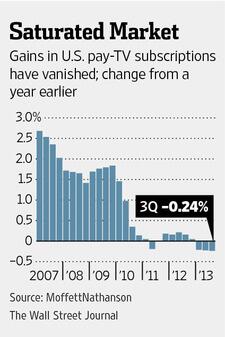
The chart, from The Wall Street Journal, looks at the change in pay-TV subscriptions from the same time a year earlier.  That is, it's examining the annual growth rate of pay TV subscriptions, which in the U.S. dropped to near zero midway through 2010, and have been relatively stable since then.

 Breaking down the numbers, cable and DBS systems are heavy losers, but most of those losses are being offset by gains from teleco cable systems.  One reason cable companies are indicating a refocus on broadband Internet access rather than multichannel TV in their current business strategies.

Source - Fewer people in the U.S. are subscribing to pay-TV,  Wall Street Journal Twitter feed.

Thursday, December 5, 2013

"Unbundling" warnings

A study by Needham & Company media analyst Laura Martin cautions that a full unbundling of cable networks could result in a loss of up to 60% of TV advertising revenues, 124 cable channels would end broadcasting, and up to 1.4 million industry jobs could be lost.  The numbers sound extreme at first, but aren't out of the range of possibility - particularly with the rapid expansion of alternative video content delivery options.

As discussed in the earlier "Bundling vs. A la Carte" series of posts, (see here, here, and here), bundling cable networks works to expand potential audience reach, encourages sampling of channels and content, and permits occasional viewing.  A consequence of full unbundling for most cable nets would be a significant decline in audience, which will result in a big drop in advertising revenues that may or may not be countered by increased subscription/licensing payoffs.  For some, it may result in a death spiral of trying to hike subscription fees to recoup lost advertising, which will further shrink audiences, advertising revenues, as well as subscription revenues.

Currently, advertising counts for about 60% of TV/cable network revenues, and unbundling will undoubtably push the shift to greater reliance on licensing and subscriptions as a mechanism for funding content creation.  How sustainable that is for the 500+ TV programming networks remains uncertain.  Some high-demand high-value content will thrive, but many low-demand, limited and variable value content may not.  And certainly, I'd expect competition to shrink as many viewers are unlikely to want to pay separately for multiple channels in a genre.

As Martin notes,
“All content companies benefit from TV bundling, as well as from new digital platforms that are driving record free cash flows from content creation globally."
I hope that she's equally correct when she concludes that "(b)ecause consumers lose so much value through unbundling, we expect no policy change in the U.S.”  However, I'm a bit more skeptical that U.S. policy is driven more by economics and consumer interests than it is by outside special interests and politics - particularly those that provide campaign talking points..

Source -  Cable Unbundling Puts Majority of TV Ad Revs,  Media Daily News

Tuesday, December 3, 2013

Streaming goes Prime-Time in U.S.

Two recent industry research reports point to the growing acceptance of, and preference for, the use of online streaming sources by TV audiences.
“Viewing habits are quickly evolving and connected TV is going mainstream,” according to Eric Berger, EVP of digital networks, Sony Pictures Television and general manager, Crackle.
The research is based on a survey of 1200 younger adults (18-49) conducted by Frank N. Magid Associates.  Their key finding is that online streaming is now viewers' second choice of viewing source (still trailing live TV).  The study found that access to online video streaming was near universal (96%), and more than half (54%) had access through "connected" TVs - either smart TVs, through attached gaming consoles, separate OTT devices, or connected video players.

The trend seems to be reflected in current trends in the cable/multichannel industry. Cable companies in the U.S. are seeing a surge in broadband-only customers (foregoing the primary TV service) - to the point where many are publicly rebranding as broadband services, which can also deliver TV (see earlier post here).  Research from the Leichtman Research Group is showing a decline in pay-TV subscribers, combined with increasing broadband subscriptions.  Their recent report shows major cable operators with 48.7 million broadband subs, and telcos growing more rapidly with 35.9 million (45% of which have access through fiber).  Average broadband speeds are also on the rise, with average bandwidth for broadband connected homes in the U.S. just over 20 Mbps.


As Cablevision CEO Jimmy Dolan told the Wall Street Journal in August: “Ultimately over the long term I think that the whole video product is eventually going to go to the Internet.  I’m not willing to cede that position now, and I’ve got a lot of customers that buy my video product…[but] the handwriting is on the wall, particularly when you look at young customers.” - See more at: http://videomind.ooyala.com/blog/telcos-cable-operators-see-broadband-subscriber-numbers-skyrocket-0?mkt_tok=3RkMMJWWfF9wsRousqzNZKXonjHpfsXx7OglWK6g38431UFwdcjKPmjr1YEITcN0aPyQAgobGp5I5FEMTrfYWbFrt6cPXg%3D%3D#sthash.gsljDRjn.dpuf
Source -  Streaming goes prime time with connected TV prime destination, RapidTVNews
The U.S. now has over 83 million broadband subscribers, GigaOm
Cable Companies See Jump in Broadband-Only Customers,  DSL Reports

Friday, October 25, 2013

Bundling vs. A la Carte - Implications

In previous posts I've explained why bundling can be a good marketing and pricing strategy, particularly for certain types of information goods, and why a la carte strategies can be appropriate for networks with certain characteristics and in markets where access can be easily restricted.  I've also made the case that in the early years of cable and multichannel video distribution, bundling was arguably the optimal marketing strategy for system operators, as well as for audiences.  Technological advances and the explosive growth in market competition over the last decade or two, on the other hand, have opened the door for the effective use of a la carte marketing of video networks.  The remaining core question is whether shifting to a la carte is a good strategy for video distributors, networks, and audiences.  I'll try to address that issue in this post.

One of the problems with much of the current discussions of forcing a shift to a la carte marketing is that it's largely based on overly simple, and occasionally inaccurate assumptions.
   The one I've already addressed is the argument that bundling forces consumers to pay for channels they don't want.  The problem with that argument is that a consumer's decision to purchase a bundle of networks from a multichannel distributor is not based on a network by network consideration of value, but on the simpler issue of whether the consumer feels that the aggregated expected value of the channels he or she does want is greater than the price of the bundle; from that perspective, whether the distributor includes unwanted "costly" channels is irrelevant. ("costly" in the sense that the distributor pays for carriage rights).
   A second major assumption (unstated but underlying most discussions) is that the a la carte price for a network would be close to what multichannel distributors pay for carriage rights as part of bundle.  The problem with that assumption is that it oversimplifies the market forces at play, and ignores the economic impact of unbundling.  For many of the 800+ cable networks available in the U.S., going a la carte is likely to lead to a pricing death spiral.
   The problem is that while cable networks in aggregate (i.e. bundled) have been quite successful in attracting audiences (gathering 50-70% of viewing overall (a bit less in primetime), all but a handful of networks attract less than 1% of audience viewing (averaged daily viewing).  Of course, some programming draws significantly higher audiences, and demand for networks may be even higher.  Still, most cable networks are likely to attract substantially smaller number of subscribers as an a la carte offering than the potential audience obtained as part of a bundle.
   For example, the total daypart audiences for ad-supported cable networks in the last quarter showed that only 8 cable networks had overall total day ratings of 1 or higher.  Weekly primetime numbers for top networks can be 2-3 times higher, and certain episodes or events (primarily but not exclusively sports) can draw ratings of 10-15.  Actual demand for a channel marketed a la carte is likely to be higher than that (as it's aggregating across shows and over time), but is also likely to be highly price-sensitive.  Even if a cable network could get a 50% buy-in rate as an a la carte offered at the current bundled carriage rate, that would result in a 50% decline in subscription revenues for the network.  (That's one reason pay-tv network subscription prices are in the $15/mo range, while carriage rates for cable networks top out around $5/mo, and most are under a dollar.)
  However, that's not the only impact of shifting to a la carte.  Most cable networks are also supported by advertising.  While a network would likely keep most of its core viewing as an a la carte offering, it would lose the occasional or drop-in viewers, which would have some negative impact on revenues.  More critically, though, is the fact that many national advertisers prefer to buy spots on networks that have a potential reach of 80-90% of the national population.  Few cable networks are likely to reach that goal as an a la carte service without significantly discounting subscription prices.

Unbundling cable networks is likely to have significant negative impact on revenues for all but a few channels.  Those where losses are small are likely to be channels with established record of high-value content, and a fairly broad audience base.   Those channels whose value lies in a narrow niche are likely to find that unbundling will drastically cut their revenues, forcing them to choose between significantly hiking a la carte prices or cutting back on programming costs.  Either of those responses put the network on a potential death spiral where demand (and revenues) continue to shrink as networks try to cope through price hikes or cost-cutting in content.

There is one additional implication of shifting from bundling to a la carte.  Multichannel video distributors face significant costs in building and maintaining their distribution infrastructure.  Those costs need to be recouped through subscription fees.  When the subscriptions are for bundles with a large number of, the per-channel distribution costs are fairly low.  If consumers shift from a large number of channels to only those they are willing to pay for separately (the goal of a la carte), then those distribution costs would have to be paid for separately, or split among the smaller number of channels subscribed to.  In the first instance, that would mean that a multichannel distributor may place a surcharge on access, regardless on how many or which networks are subscribed to.  The alternative is to split distribution costs across the channels; meaning networks would have to pay for their distribution, or add distribution costs to their a la carte prices.  In either case, that's more negative pressure on revenues and demand.

The upshot is that unbundling will result in significantly lower subscription numbers for most, if not all, cable networks.  The lower buy rates will negatively impact both subscription and advertising revenues compared to the current bundling market option.  If networks need to maintain current revenue levels, they're likely to have to significantly boost the a la carte pricing, or drastically cost the price (and consumer value of) their content.  Either strategy could easily result in a death spiral of declining audiences leading to price-highs and cost-cutting, leading to falling demand and audiences, etc. until the network proves to be no longer economically viable.

The "death spiral" problem is aggravated by the fact that there is a new TV distribution system available.  Online video delivery is becoming widely available as broadband Internet access increases.  Over 70% of Internet users already watch online videos, and streaming services like Netflix, Hulu+, and Amazon offer access to a vast archive of current and older TV and movie content.  The TV consumer faced with the issue of whether to purchase, say, Turner Classic Movies channel is not only thinking about whether that channel is worth purchasing, but the value of TCM vs. AMC vs. USA vs. CNN vs. a Netflix subscription and a plethora of free online content.

  Already several million US adults have become "cord-cutters", dropping some or all of their multichannel distribution services in favor of accessing their TV and movie content through online streaming services.  If unbundling drives channel prices up and forces consumers to be more rational in their purchasing of subscriptions to access cable networks, this could trigger a move of consumers to online video.  That move may well be followed by a move  by networks finding a less costly - and more flexible - distribution system that allows more viewer interaction, better usage metrics, and greater capacity for price differentiation.

If unbundling is bad for most cable networks, it's got to be good for consumers, right?  After all, a lot of the political push argues that it's in the consumer interest.  The reality here is that unbundling is likely to result in consumers paying higher prices for significantly fewer channels.  The problem is that bundling acts as a form of cross-subsidization as well as a form of risk aggregation.  When value is uncertain, aggregation through bundling spreads that risk - moving the the consumer from "I'm not sure that program/network is worth the price charged" to "It's likely something in the bundle is worth the price."  Bundling spreads distribution costs across more networks, reducing per-channel costs.  And from the consumer perspective, buying a bundle of channels you're not sure you want while getting those you do essentially subsidizes access to those added channels.  Previous efforts to remove subsidies in cable (the 1992 Cable Act) actually increased prices for most cable subscribers, rather than reducing them, as the politicians and interest groups pushing for the Act claimed.  In telecommunications, cross-subsidies usually are based on high-demand & high-value services subsidizing low value and low demand services.  In this case, it's ESPN subsidizing The History Channel; not the other way around.

Even if the subscription prices of channels don't increase, consumers are likely to reduce the number of channels they will subscribe to. Rather than "bundling forcing consumers to buy channels they don't want," unbundling means that consumers will be able to not buy the channels they don't want.  Audience research shows that for most consumers, almost all of their viewing is confined to 5-10 channels.  Another factor suggesting reduced channel access can come into play when there are multiple channels or networks in a content niche.  If the consumer perceives overlapping value across related niche channels, then the purchase decision is based not on the total value of the additional channel, but the added value that channel is likely to generate above that available in channels already in the a la carte subscription basket.  That makes it much less likely that the consumer will purchase complementary channels, or multiple channels within a content niche.  At least not without some significant cross-subsidy of channel prices. 
  So rather than having access to 100s of channels via bundling, it's likely that most Americans would scale back to 5-10 channels, perhaps with occasional video-on-demand purchase of high-value content.  Gone would be the opportunity for serendipity and the opportunity to sample and establish value for innovative networks and programs.  Thus, unbundling, along with the removal of possible subsidies, is likely to negatively impact general social welfare.  In fact, that's the long-established argument for public broadcasting.
  To illustrate, a consumer who has a low to moderate interest in news is much more likely to subscribe to a single news source than to subscribe separately to multiple news networks offered a la carte.  It's generally given that relying on multiple news and information sources is more valuable than relying on a single source - but a la carte models reduce the likelihood of multiple subscriptions, as the added value of additional news sources decreases as the number of sources goes up.  (When content overlaps, the consumer will base a purchase decision on the added value the additional channel will bring, rather than the full value of the channel.  Thus further decreasing demand for multiple channels within a niche).  I'm sure that most liberals would be upset if Fox News Channel was the only cable news channel subscribed to, just as most conservatives would worry if MSNBC was the only cable news network many people subscribed to.
    In addition, the impact of increased costs will hit lower income groups more than others.  Lower income groups are likely to cut off a la carte subscriptions once their separate subscriptions reach a point where the channels provide a threshold level of content, particularly if the addition of other channels provide minimal incremental value.
So, a complete unbundling and a shift to a pure a la carte marketing approach is likely to have a significant negative impact on all but the biggest high-value cable networks, and be particularly problematic for networks with content of lessor or unknown value, and those targeting small niche audiences.  It's quite likely to increase access costs to consumers (both on a per-channel and aggregate level), and result in their reducing access to networks and content of low or uncertain perceived value.  Not only is this a negative consequence for the consumer, but the reduction in access brought by a pure a la carte marketing approach is quite likely to have meaningful negative social impacts as well.
  It would hurt multichannel distributors as well, impacting the cost and profitability of their multichannel video services, and accentuating their competitive disadvantage as a TV distribution system vis-a-vis online streaming.  The eventual certainty of competitive disadvantage in that field has been recognized by the industry, and is one reason why much of their focus is shifting from multichannel video distribution to becoming a digital telecommunication access point and service provider.

Let me end by saying that a look at the likely impacts of a shift from pure bundling to pure "a la carte" model for multichannel video distribution suggests that there will be serious negative consequences for most groups in the market.  But it's not necessary to completely shift from one extreme to another.  The growth of video-on-demand (VOD) is demonstrating that a la carte can be a viable option for some networks.  The explosion of carriage fee rates for some networks - regional and nation sports networks in particular - suggests that splitting related niche networks and channels into separate mini-bundles, possibly with some a la carte options, would be appropriate and even have a positive impact on consumers and networks, letting the high costs of those channels be born more directly by those that see that value.  (And also hopefully bringing bundle prices back down to where multichannel access, and the social values associated with maximal access, are maximized.)

The market and technology is a a point where a la carte marketing of networks and channels is viable, and where it makes sense for some types of channels.  The same can be said for the intermediate strategy of offering various mini-bundle mixes of channels, programs, and services.  However, there are still a large number of channels, networks, and services where bundling remains the optimal approach, from consumer, network, distributor, and social perspectives.  It's pretty clear that rushing into a overly simplistic "bundling is corporate evil so a la carte must be consumer-friendly" assumption is not a reasonable foundation for policy in this area.  This is an area where an incremental approach that considers what marketing approach is best within a specific context; where consideration is given to the type of content and its content as well as audience interest, social welfare, and the values inherent in having the content accessible and used.  That's the approach most likely to result in positive outcomes.
Tuesday, October 22, 2013

Bundling vs. A La Carte in TV Markets - History

Yesterday, I provided some insights from economic theory of information in terms of when bundling can be preferable to "a la carte" marketing of TV channels and networks by multichannel video distributors.  The essence was that bundling is actually the optimal strategy for the context of early cable systems and consumers, and has some ancillary social benefits as well.  "A la carte" offerings (in economics terms single-use pricing), may work well in other conditions, and the TV marketplace and distribution technology is moving towards those conditions.

Today I want to explore that transition through a historical look at TV market economics, and how that has shifted over time.  Tomorrow I'll look at what going to a la carte will mean for today's networks/channels, multichannel distributors, and TV consumers, from a business/economics perspective.  To start, let's look at how networks generate revenues from a historical perspective.

  In the U.S., the predominant revenue source for stations, networks, and distributors comes from a mix of audience-based sources.  For broadcast stations and networks, the primary revenue source comes from advertising, and the amount of revenues an advertisement generates is based on the audience attracted.  Historically, broadcast stations who were network affiliates were also paid a fee for carrying network programming, but the amount was, again, based largely on the station's potential audience.  Early cable systems were basically redistributors of TV station signals, and the cable system's revenues were tied to the number of subscribers it could attract (i.e. audience size). 
  When cable networks and channels emerged, they followed one of two basic business models - looking for advertising for revenues, or a subscription-based approach.  The subscription model, Pay TV, used a strategy of offering new, and high-value, content not otherwise available to TV viewers in the market, and revenues were directly audience-based (i.e., the number of subscribers).  Ad-supported cable networks were miniatures of the broadcast network business model, with revenues based on their ability to attract and retain audiences.  These soon discovered that having a focused programming strategy (call it targeting, filling a niche, or branding) gave them a competitive advantage over broadcast networks for the audience segments that valued that type of content more highly.  The broadcast networks offered such content occasionally, but the cable network could be a place where viewers could find it all of the time.  Targeting also had an advantage in the sense that advertising on niche networks were more valuable for those advertisers who wanted to reach that audience segment.  Now there are a few cable networks where the revenues come from sources other than subscription fees or advertising (PBS, C-SPAN, shopping channels, religious networks), but those are still indirectly audience-based in the sense that the funding is based on their programming being able to reach an audience. Bundling allowed cable systems to combine and aggregate the niche audiences by taking advantage of the different mix of high-value networks across audience segments.  Bundling increased the value of, and demand for, the bundled mix of networks, allowing cable systems to increase both subscription fees and the number of subscribers.

Revenues are only one side of the business model - the other are the costs of operation.  For broadcast stations, networks (broadcast and cable), and cable systems, there are two basic costs - the cost of the programming and content, and the cost of distributing that cost to audiences.  The distribution costs for stations is tied to transmission capability, and increasing signal reach is costly.  For networks, they need to find a mix of broadcast stations and/or cable systems to distribute their content for them.  In the early stages of TV, that meant paying stations or cable systems for carriage, with the larger the potential audience pool the more valuable the distribution channel.  Distribution costs for cable systems were substantially different - cable operators face the very high fixed costs of building out the physical distribution network, with very low variable costs.  For them, the key was not building raw audience numbers, but in increasing the percentage of homes past that subscribed.  That brought the marginal costs per subscriber down to affordable levels.
  Turning back to programming costs, there is a general rule of thumb that programming costs correlate with audience popularity (i.e., are more likely to have a high value to some set of consumers).  Historically, broadcast TV markets were constrained in terms of both the number of competitors and in their ability to reach viewers in the market - so the only area open for competition within the market was in terms of the programming content offered.  Competition tended to drive programming costs up.  When cable sought entry, they needed to compete with the existing broadcasters, and the way they could was to offer signals and content that was not easily available otherwise.  In the early years, that meant paying to bring new channels, networks, and content into their market.  There was the added incentive that bringing in more valued networks and programming content increased the perceived value of the cable subscription bundle and allowed cable systems to increase subscription fees.

Things changed as technology opened markets and the newer networks began to establish their value in the TV marketplace.  As TV markets expanded in terms of viewing options, three things happened.  First, cable networks largely went niche.  They didn't have the resources to compete head-to-head with the broadcast networks for general interest programming and audiences.  Going niche let them access lower-cost programming options, yet benefit from the higher advertising value of their audience segment with some advertisers.  As multiple niche networks pulled off segments of the general interest audience, viewing of the big broadcast networks dwindled, impacting their ability to generate advertising revenue.  The third result is that some of the niche networks developed their brand identities and established their value to the point where having those networks as part of your channel bundle became essential for cable systems.  That let those channels switch from having to pay for coverage, to having cable systems pay for their network signals.  They had established such a strong expectation of value for their content among a large enough segment of audience, that carriage was mandatory.

The shift in viewing and advertising impacted revenue growth for broadcasters and networks, yet competition drove programming costs ever higher.  As a result, everyone started looking for new revenue streams - and carriage fees looked like a viable option.  However, as more stations and networks sought to take advantage of this potential revenue stream, those costs were passed on to multichannel video subscribers, increasing the costs of the bundle.  In most cases, the added revenues were not used to increase the value of the programming offered (and thus the value of the network to the viewer), but as a replacement for lost advertising revenue.  Increasing price without increasing value will inevitably reduce demand for the network, and lower demand results in smaller audiences - particularly in ever-more competitive TV markets. 
  One factor compounding this is the growth of online video options, many of which combine access to high value content with pricing models well below those available from multichannel video distributors.  Another is the fact that eventually the value of carriage fees will ultimately be captured by the owners of the content rather than its distributors (the fee depends on the ability of the copyright owner to limit access rather than any unique aspect of the distribution channel).  Finally, as competition in the marketplace advances to the point where most content is available over multiple sources and viewing options, stations, networks, and distributors are finding that having sole access to high-value content is a critical form of competitive advantage.  This is the reason why so many networks and distributors are focusing on delivering unique content (not available elsewhere), and why bidding wars are escalating for reliably high-value programming like sports and major cultural events.


From an economic perspective, what this means is that in an increasingly competitive TV marketplace, players are increasingly looking for carriage rights fees as a revenue source, and towards developing a (niche) brand that emphasizes high-value content as a way of increasing demand and value for their outlet.  The bidding wars for high-value content drive programming costs higher, and unique content increases the value of the station/network to distributors, allowing stations/networks to try to increase carriage fees collected from distributors, in part to cover the increased programming costs.
  Increasing carriage fees mean that the cost of existing bundles is increasing.  If the fee increase isn't matched by increased perceived value of the bundle, that will eventually lead to a reduced demand for the bundle.  If the multichannel distributor persists in the bundling tactic, eventually price increases will hit a point where the cost of the bundle exceeds the bundle's perceived value by a sufficient number of consumers to trigger a fall in subscriptions.  There are increasing indications that we're nearing that point in the U.S..  In particular, there's a growing awareness that the bidding wars for sports rights among a growing number of sports-niche channels is driving big jumps in carriage fees and forcing many multichannel distributors to start thinking about pulling sports networks from the basic bundle, and marketing them as a mix of mini-bundles of sports channels and/or a la carte offerings.
  Establishing a reliable brand - in other words establishing a more consistent level of expected value for content - is critical from a consumer demand perspective.  As mentioned yesterday, a key advantage of bundling for consumers is that the consumer can mitigate for highly variable and uncertain expected value for content by aggregating across multiple channels and over time.  When value is uncertain, it depresses the likelihood of purchase.  Aggregating across multiple options means that instead of wondering whether a single program or channel is worth purchasing, the consumer only needs to consider the likelihood that among the bundled options is enough value to justify the purchase.  So, if offered a la carte, the consumer's decision shifts to the question of whether they'll receive value in excess of the price they pay for that specific content or channel.  This works best when the content is known, high-value, and where such value is relatively consistent across the content offered.  That's pretty close to the goals of branding.
  Changing technologies are also enabling the other key feature needed for single-use pricing to work - the ability to collect payments and restrict access to the content/network to those purchasing. The growth in pay-per-view and video-on demand offerings from multichannel distributors amply illustrates the technological capacity to offer networks on "a la carte"basis.  The growth in niche branding and the success of many channels in building brand value among audience segments similarly demonstrates that, for some networks or channels at least, viewers may have a sufficiently developed idea of the expected value of a network and its programming options to facilitate "a la carte" purchase decisions.  The continuing evolution of the TV marketplace looks to be providing a context where single-use pricing models may be viable and practical. 

In essence, the transition from broadcast local markets for TV to global, digital, highly competitive marketplace is leading to a situation where bundling is becoming less optimal, and a la carte network marketing is becoming increasingly viable, at least for some networks and channels.  While much of the clamor for a switch is politically motivated, the reality of the current TV marketplace is that the ability of multichannel distributors to engage in "a la carte" marketing models for (some) networks is becoming increasingly practical.  Additionally, the growth in carriage rights fees is making the idea of a single basic bundle increasingly unaffordable and unsustainable as a marketing approach.  The disparity between the growing bundle price and the online video distributors' significantly lower prices is causing many TV viewers to re-evaluate their TV viewing habits and shifting their viewing preferences to lower-cost alternatives.  (A phenomenon known as cord-cutting.)

While the early technology and market structure of TV program delivery provided a viable foundation for developing and supporting bundling as a marketing and pricing strategy for cable, the evolution of the TV marketplace (and technologies) is reaching a point where a la carte marketing strategies are becoming practicable.  And for some (but by no means all) networks, a la carte marketing structure might be preferable.

But is switching to a full a la carte marketing model a good idea?  A lot of that depends on what will be the longer-term impact of a switch, particularly if competition, and programming costs, continue to escalate.  I'll address that next.

Monday, October 21, 2013

The Hidden Issues of Bundling vs A la carte marketing - theory

The presumed "debate" over bundling vs a la carte marketing and pricing models for multichannel and online video delivery seems to be heating up over the last year, and looks to become an increasiningly critical question with the rapid increase in rights fees for channels and programs. (For  those not up on the jargon, bundling refers to the approach by cable and other multichannel distributors to offer packages of channels at a set price to consumers, while "a la carte" means that channels are offered, and priced, seperately).

The problem is that some of the criticisms of bundling are misleading and problematic, and almost none have taken a look at the downstream implications of a switch to a full "a la carte" model.

Taken in extremis, the critical argument is that bundling is a nefarious (possibly illegal) strategy employed by the giant multichannel operators to force subscribers to pay for channels that they don't want.  There's several problems with that position.  First, bundling is a well-established marketing and pricing strategy in information economics that is, in some contexts, socially optimal and can maximize consumer welfare.  For example, newspapers are bundles of news stories, features, ads, etc., as are magazines, and even TV networks.  In a slightly different way, Netflix and Hulu are bundlers, offering access to a range of content offerings for a fixed monthly fee.  On the other end of the continuum is what the media industry is calling "a la carte", or in economic terms, single use pricing models. (There is actually a wide continuum of options between a single bundle and single unit pricing models, but I'll focus on the extreme cases).

The field of information economics has long indicated that bundling is a valid pricing/marketing strategy, and in fact can be socially optimal under certain conditions - when the bundled offerings have uncertain or highly variable value to consumers, and when the consumers cannot be easily differentiated.  This is important, because when the audience can be easily differentiated, then the supplier can charge some more than others for the same set of goods.  When it can't, then the social surplus (the difference between what a consumer gets in value above the price paid) goes to the consumer.  When the supplier can differentiate access, then they get to capture some or all of that consumer surplus through differential pricing.
  There are two other important social advantages with bundling - it allows consumers to sample and establish values for content (which gives unknown, low-interest, and/or low-value content the potential to establish a market), and it allows the benefit of serendipity (finding important or valuable content unexpectedly).
  As for the argument of forcing people to pay for channels they don't want, that's hogwash.  When content is bundled, consumers base their purchase decision on their individual aggregated expectation of value.  That is, consumers look at the likely content offerings, and aggregate their expected values for the content they want.  If their aggregated value is higher than the price, they buy; if not, they are free to not buy the bundle.  The advantage of bundling is that it can accommodate a wide range of value choices and ways to hit that aggregate value target - for one consumer, access to sports channels and content may create that aggregated value, to another, it may be a combination of access to news, science, and history channels; to another, it could be PBS, Nickelodeon, Cartoon Network and Disney.  In all of these cases, the consumers base their purchase decision on getting the content they want, and everything else just comes along with the bundle.  No one is forcing anyone to "pay for" channels they don't want.  Bundling can also be looked at as the high-value channels cross-subsidizing low-demand channels.

In the early days of cable and multichannel distributors, the content was pretty clearly the kinds of new channels and content that makes bundling the best strategy, for distributors as well as consumers.  It was also a good strategy for the various cable networks/channels - enough so that in the early days most paid cable operators to get into that basic bundle.  Getting into the bundle was particularly important for networks/channels that used advertising as a primary revenue source - being included in the basic bundle gave them access to the largest potential audience, while letting those in the audience sample their programming without added cost and letting networks build the demonstrable audience base that provided value to advertisers.  And the payments from channels to cable operators helped to subsidize the price of the bundle, again helping them grow the market.  Another advantage of bundling is that, in maximizing potential audience, it spread distribution fixed costs (which tend to be quit high among multichannel distributors) over larger numbers of subscribers and reducing the per-subscriber cost of distribution.

However, the cable/multichannel market has changed, increasingly moving away from the type of content that bundling is the optimal strategy for.  Most networks have now established their expected value to consumers. In addition, technology now permits greater ability to control which channels are accessible by which subscribers, allowing more differential marketing options.  Technology has also expanded video delivery options, some of which face significantly lower costs. The most significant shift, though, is in the rights fees paid for content.  Rather than subsidizing the price of the bundle, the shift to the multichannel distributor paying rights fees, and the rapid rise in the amounts of those fees, are pushing the price of the bundle to a level where consumers are taking a second look at their willingness to pay.  Particularly when the Internet is providing a range of content alternatives at substantially lower prices.

The industry and market may be approaching the point where offering a single bundle, or a few tiers with dozens of networks/channels, may not be the best marketing strategy for either the multichannel distributor or the TV consumer.  But are we at a point where a pure "a la carte" strategy is optimal for either the distributor or consumer of TV networks?

The economics of information suggests that single-unit pricing (pure "a la carte") works best when there is a group of consumers that has established a reliable, and relatively high, set of expected value for the specific set of content - and where distribution of that content can be restricted to only those consumers.  The technological capabilities for differentiation are increasingly there.  Further, some channels/networks that have done a good job of establishing a relatively high set of expected values for their content through branding (ESPN, Nickelodeon, Disney, etc.),  at least for some portions of the audience.  For those, going a la carte, or minibundling (a small group of networks with similar content or brands), may be marketing/pricing strategies worth exploring.  However, for other channels, going a la carte alone may not be a viable option.
   For example, during the recent CBS/TimeWarner rights fee squabble, TimeWarner offered to let CBS market its network "a la carte" at whatever price it wanted.  An offer that CBS rejected out of hand, suggesting that it felt that going solo might not be a great business strategy at this time.

The CBS reaction points to another issue, which I'll address more fully in a separate post; that most networks/channels get funding from multiple sources, some of which are tied to audience size.  The problem with going "a la carte" is that consumers would then apply their purchasing logic to the individual sets of channel(s) being offered separately.  That is, TV consumers will pick which channels they'd be willing to pay the market price for, and which they wouldn't - and viewing habits suggest there are few channels that wouldn't face huge drops in audience if they went a la carte, particularly if the price was more than minimal.  With  the potential of significant declines in audience-based revenue streams, that could create a pricing death spiral for many channels.

Let me close this piece by referring back to the social side-benefits of bundling.  With bundling, the consumer retains most of the consumer surplus value, instead of it going to the distributor (with minibundling) or the network (with a la carte).  Bundling maximizes consumer access to the broad range of content choices; giving new content and channels the opportunity to establish value with consumers, and allowing for viewers to benefit from serendipity or to access the occasional content a channel might present.  Finally, bundling maximizes potential audience for channels, allowing them to benefit from audience-based revenue sources, and lower per-subscriber distribution costs.

Bundling can be a reasonable and consumer-friendly pricing strategy in theory, at least in some circumstances.  Still, circumstances can change, and there are also other economic issues to consider.

Friday, October 11, 2013

Al Jazeera America viewing remains minimal

The latest cable news ratings show that Al Jazeera America's (AJAM) news programs are getting minimal viewing.  How minimal? In the latest report, the network's daytime shows garnered a rating of 0 among the key 29-54 age demographic.  (Ratings refer to the percentage of US TVHH watching, and are rounded to a single decimal point, so it doesn't necessarily mean that no one watched.  The ratings services also provide estimates of the number of homes watching, which can be more useful for cable network's hyper-competitive and fragmented audiences).  At this point, the network's ratings are so low that they don't show up in most reports.

Primetime shows did only slightly better.  Consider This, their 10 p.m. also earned a 0 rating, and averaged 9000 viewers total, with only 3000 in the 29-54 demo.  AJAM's flagship program, America Tonight at 9 p.m., averaged 18,600 total viewers, and was one of many shows to record 0 viewers in the 29-54 demo at some point during the week.  To put the AJAM numbers in context, audiences for America Tonight's 9 p.m. competitors on Wednesday night (Oct. 9, 2013) were 542,000 for CNN's Piers Morgan Tonight, 1,445,000 for MSNBC's The Rachel Maddow Show, and 2,475,000 for Fox's The Kelly FileAmerica Tonight also got outperformed by specialty shows Dr. Drew on Call (CNN Headline), with 257,000, and Secret Lives of the Super Rich (CNBC), with 131,000.

While AJAM is handicapped by the fact that it's channel isn't on all systems and only reaches about half the TVHH of the other cable news networks, the continued poor performance does not bode well for a nominally advertising-financed network; nor does it give the network much of a bargaining position to earn carriage (and licensing fees) from multichannel distributors.

Source - Al Jazeera America Had a Rough Ratings Week; Some Shows Hit Zero in Key Demo,  Mediaite
Cable News Ratings for Wednesday, October 9, 2013,  Zap2it TV by the numbers

Friday, August 30, 2013

Abysmal ratings for Al Jazeera debut & CNBC


CNBC continued its ratings fall, hitting a 20-year low last week.  Viewing is down 35% from a year ago, averaging only 37,000 viewers in the key 25-54 demographic.  The continuing decline is leading to revenue shortfalls.  CNBC is available to some 100 million US households.

Meanwhile, Al Jazeera's American news channel experienced a rough start.  AT&T's U-verse system dropped the channel on the day it launched, citing contract issues.  This cut off several million homes from access, leaving the network with a reach of only 40 million US households (out of about 115 million).  According to Nielsen's numbers, Al Jazeera America started off with just 22,000 viewers, for a 0.2 rating.  That's actually below Nielsen's threshold for reporting.  The top show for the week drew just 54,000 viewers.  Interestingly, the network has more Twitter followers, at 75,000.

To give you an idea of just how bad these numbers were, here's the daily average viewing for the major cable news networks for the same week:  Fox News - 968,000; MSNBC - 348,000; CNN - 346,000.  Both Fox and MSNBC saw slight declines from the previous week, while CNN experienced a slight increase.  Despite some media gloating (especially at CNN) over Fox News' ratings decline, it still routinely draws around 2-3 times the viewership of the second place cable news channel in virtually all time slots. 
  Current, the news channel that Al Jazeera bought to get access to major multichannel distributors, averaged only 42,000 viewers in prime time in 2012, and saw ratings drop below thresholds for carriage on many of those systems before the sale to Al Jazeera.

Sources -  Bad news: CNBC hits 20-year ratings nadir,  NY Post
Al Jazeera American off to a slow ratings start, LA Times

Thursday, August 22, 2013

CBS-TimeWarner battle continues - people notice

CBS and Time Warner Cable (TWC) have yet to reach an agreement on retransmission consent, and people are noticing.
  To recap, CBS and TimeWarner (as a cable operator) are required to regularly reach an agreement on the terms under which CBS's owned-and-operated (O&O) local broadcast stations are carried on cable systems in their broadcast areas.  During the last round of retransmission consent negotiations, reports indicate, CBS insisted on more money for carriage than Time Warner was willing to pay.  Under the 1996 Telecommunications Act, if agreement isn't reached within a certain time frame, the cable system is required to stop carrying the local station's signal.  As part of CBS's negotiating strategy, allegedly, was to also force Time Warner to pay higher carriage fees for CBS cable-only channels, Time-Warner dropped all of those channels as well.  CBS responded by cutting access to cbs.com (and the programs it provides access to) to all Time-Warner internet service customers.

The programming blackout extends to some 3.5 million homes in some of the largest TV markets in the US, and will inevitably have an impact on ratings as well as the value of the CBS and TWC brands.  CBS trumpeted that it remained in first place in Nielsen ratings for the first full week of the blackout, despite a small decline in total viewers.  But CBS shouldn't crow too much, it's top prime time show only grabbed a 1.4 rating and saw a 30% drop in viewing. (I'll note that August is traditionally a low viewing month, and that the ratings don't include the estimated 5 million people who get their programs online).

The impact on local station ratings - particularly for their local news programs - has been much more significant.  At LA's KCBS, viewership for their main local news programs fell 25-33% from the previous week; NY's WCBS saw 17% declines, and Dallas-Ft Worth O&O KTVT saw their news numbers fall 13-19% (depending on which news broadcast).  The declines are enough to trigger make-goods and is impacting last-minute ad sales.  Their is significant concern at the local level about continuing impacts, particularly if the blackout continues into the fall sweeps period (which traditionally determine local advertising rates).

That both parties are concerned about the impact of the blackout can be seen in some recent deals between CBS and TWC to temporary lifting of the blackouts - to carry the NY mayoral and comptroller campaign debates in New York, and offering the Tennis Channel during the U.S. Open Tennis championships.

This week, current FCC interim chairman Mignon Clyburn weighed in, expressing frustration that CBS and TWC haven't reached a settlement.  The FCC, though, has limited authority to intervene in negotiations or to order interim carriage of the signals in violation of current law.  Former FCC commissioner Michael Copps weighed in, arguing that CBS's actions may violate the FCC's Network Neutrality provisions.
“CBS is perpetrating an audacious violation of the FCC Open Internet ('net neutrality') rules... These rules guarantee consumer access to lawful content. They are designed to prevent just this sort of corporate censorship.”
Time Warner didn't go quite so far as to allege CBS wrongdoing, but in a filing with the FCC (which is looking into retransmission consent rules), they argued that CBS attempted to use the retransmission consent rules to "leverage the must--have nature of its broadcast network programming to force a multichannel video programming distributor (“MVPD”) to accept massive and unwarranted fee increases and oppressive carriage terms."

As I posted earlier, this ought to be fun to watch, unless you're a Time Warner customer and like CBS programming.

FCC filing on behalf of Time Warner Cable, FCC website

edited - fixed some language and grammar issues.

Wednesday, August 7, 2013

FCC Releases 15th Video Competition Report

Some highlights from the Executive Summary (I'll try to get back with fuller analysis later).


With this report, the FCC has distinguished three types of video channels
  1. MVPDs -Multichannel Video Programming Distributors (Cable, DBS, and Telco cable), 
  2. Broadcast Television Stations (over-the-air free broadcasting), and
  3. OVDs - Online Video Distributors (any service delivering video over the Internet)
Between the last report's data collection (Dec, 2010) and this (June, 2012), there has been a slight growth in MVPD subscribers.  However, cable has continued to lose market share to DBS and Telco cable.

The push for 'TV Everywhere" has grown in the last two years, with an estimated 5.1% of the MVPD audience using it as of Sept 2012.

MVPD systems continue to shift from analog services to digital. Among the top 8 cable MSOs, more than half of their customers receive all-digital service.  DBS and Telco cable are already all-digital.  Larger cable MSOs are also experimenting with switched digital video, where only the channels being watched are transmitted to the home.

Roughly three quarters of US homes can receive and display digital signals; 43.8% have DVR capability; and there is increasing availability of video-on-demand access of recent content.

Less than 10% of US homes rely on over-the-air broadcasting for video access.  In contrast, viewing of video content from online sources (OVDs) is growing, with estimates that more than a fifth of US homes are "Internet-connected" - that is, capable of watching online video on a TV set.  The continued growth of OVD viewing is increasing Internet traffic in peak hours, to the point where ISPs are increasingly considering imposing bandwidth caps.

Saturday, August 3, 2013

CBS/TimeWarner Squabble Denies Viewers - UPDATE

Apparently CBS really needs cash - otherwise the retransmission fees fight with TimeWarner would have been settled long ago.  The short version is that stations get to negotiate for compensation from cable and other multichannel video bundlers for the rights to rebroadcast the broadcast station signals every few yeats.  Last Friday was the negotiation deadline, and FCC rules require cable and multichannel systems to drop the broadcast signals if no agreement has been reached.  So TimeWarner dropped the CBS-owned local broadcast stations (mostly in large markets) from their line-ups.

  To add some spice, Time-Warner also dropped all CBS-owned cable networks (including Showtime and TMC) at the same time.

  Then CBS tried retaliating by blocking access to CBS programming through the internet to TimeWarner internet customers.

  From reports, it seems like the hang-up is that CBS wants at least $2/month per subscriber from TimeWarner - a price that is difficult to justify from an economic perspective for a network whose ratings have been falling for decades, and which has been touted as "free TV." (at least when accessed off the air).  While less than rate leader ESPN gets, its more than twice as much as other general interest cable networks are getting.

-- A quick aside - CBS approached me as an outside consultant in the late 1990s as to the retransmission value of their network.  At the time, based on primetime audience viewing share and average cable subscription rates, they thought they ought to be getting $5-7 per month per subscriber.  I had to remind them that viewing isn't the same as willingness to pay, and that pushing for any significant amount in fees would likely be an economic and PR disaster for CBS  After all, they'd be asking people to pay for access to "free" broadcast programming, and cable would gladly advise customers about how to get the programs over-the-air (or these days, offer CBS as a stand-alone a la carte channel and see how many would be willing to pay).  Apparently they didn't like my analysis, because they "forgot" to pay me the agreed stipend (that's why I feel comfortable sharing this with you now).  Still, they didn't push for cash in that round of negotiations, so I guess they felt I had a point.

Since most viewers in those markets have options for getting CBS free (over-the-air and online through CBS.com), or bundled in with other channels from alternative multichannel services, in the long term viewers will figure out how to get what few programs they really want from CBS.  Still, in the short term, lack of "normal" access is likely to hit viewing and ratings hard.  In the meantime, CBS isn't gaining any PR points from their insistence that viewers pay for access to what the network's been touting as "free TV" for years.  TimeWarner isn't helping itself either in the short-term, although they may benefit in the long term as consumers start to learn just how much they're being asked to pay for network programming (those rising fees aren't just cable company greed - they're mostly pass-throughs of retransmission fees from broadcast and cable networks).

Should be fun to watch, although I doubt it'll go on for long - there's too much to lose for both CBS and TimeWarner.

Update:
TimeWarner has made an offer to CBS to include it as an "a la carte" channel, at whatever price CBS wanted.
"Rather than our debating the point, we would allow customers to decide for themselves how much value they ascribe to CBS programming," said TimeWarner CEO Glenn Britt.
CBS dismissed the offer as a "sham" and "PR stunt." Recent statements from media analysts suggest that moving to a la carte could likely cut revenues to networks and program producers in half.  Maybe CBS does know how much value viewers place on access to CBS programming after all.

Sources -  No Deal! CBS and Showtime Go Dark on Time Warner Cable, Deadline-New York
CBS Blocks Time Warner Customers From Watching Full Episodes on CBS.com,  TechCrunch

Tuesday, March 5, 2013

Cable MSOs grow Business sector

Cable MSOs are shifting their focus to providing broadband access, as well as TV.  Between licensing costs, growing competition, and the prospect of cord-cutting, most of the big MSOs are losing subscribers and seeing shrinking profit margins on the TV side - while margins and subscribers for broadband services continue to do well.  The big MSOs are also entering the business services markets.
  They've had some hard lessons to learn along the way, from the higher expected standards for reliability and quality of service, to the different needs and focus of business customers.  In the business world, having a big data pipe wasn't enough.  So MSOs upgraded and refocused business lines, and established separate sales and service staff dedicated to business services.  Now, the big 5 MSOs offer various flavors of Gigabit Ethernet services, along with a range of other business services.  Other wholesale services for business include wireless backhaul, voice and video traffic, and leased private networking across locales.
  • Cox provides Ethernet and other wholesale services to 200,000 business customers in 38 markets, and reported earnings of $1.48 billion in 2012
  • Time Warner has announced a $25 million expansion of its fiber network in New York business districts, and offers business services in 29 states.  Q4 2012 business operations brought in $515 million
  • Charter is the only one of these five providing Layer 3 VPN services at this point, and reported business revenues of $168 million in 2012.  Its active in 11 markets
  • Cablevision's Lightpath business operations has focused on public and health sectors as well as business in the New York metro area.  It's developed distinctive service bundles for the education, healthcare, and government sectors, and reported $81.8 million in Q4 2012 revenues.
  • Comcast only launched its business services division in 2010, making a splash by purchasing two local business networking firms (Cimco & NGT Telecom). The investment's paying off, with business services being Comcast's fastest growing segment, with operations in 20 markets and a reported $660 million in Q4 2012 revenue.

Source -  Cable MSOs: A phoenix rising in the Ethernet industry,  FierceTelecom

Monday, March 4, 2013

Cable Fee Blame Games Begin

If recent news stories are any indication, it's time for The Cable Fee Blame Games to begin.

  It's no surprise that cable (and other multichannel provider) subscription rates are going up.  Programming license fees keep rising, the number of channels increase, and the last round of retransmission consent negotiations didn't go well for the multichannel industry.  And the increases look to be even higher this year - perhaps enough that the industry is looking for others to blame.  Many licensing deals require system-wide carriage of top channels, and are often sold in conjunction with new or less-valuable channels. So now some cable execs are talking about possibly breaking the basic tier into mini-bundles, even as public interest groups raise the prospect of a la carte pricing.
  It's come to the point where Cablevision launched an anti-trust suit against Viacom, accusing it of forcing the cable MSO to carry (and pay for) less popular Viacom cable networks in order to get MTV and Nickelodeon.
"Without the 'take it or leave it' requirements of bundled programming packages at a wholesale level, cable companies could tailor smaller and lower-priced packages that could offer flexibility and have great appeal to specific interests and audiences," said Charlie Schueler, spokesman for Cablevision.
   Other multichannel providers are experimenting with partial unbundling.  Verizon's offering a basic mini-bundle that drops expensive sports channels and knocks $15 off monthly fees.  Mediacomm has been advocating a hybrid model with the most expensive channels offered a la carte on top of a basic bundle.
   And now the broadcast networks are talking about wanting to get big license fees from multichannel distributors, either directly or indirectly, by grabbing a big share of increased retransmission consent fees for affiliates.  Some of the amounts I've been hearing are unreasonably and exorbitantly high - but between what the broadcast nets are talking, and sports channels passing through sky-rocketing coverage rights fees, coming jumps could be as high as $25-$50 a month, as they can't afford not to have high-demand content in an increasingly competitive environment.  Thus, cable needs to try to put the blame for big rates increases elsewhere.


Here's some other recent headlines and highlights.
Sources -  Imagining a Post-Bundle TV World, Wall Street Journal