Showing posts with label movies. Show all posts

Wednesday, April 3, 2013

Milestones: Online Movie/TV Viewing

Two milestones for online movie streaming (i.e. Netflix, Hulu+, Amazon Prime, etc.) -

A new research report from eMarketer predicts that sometime in the next year, more than half of U.S. Internet users will report regularly watching TV programs and/or movies online.  Movie and TV streaming services utilize a range of business models, from subscription (Netflix, Redbox, Hulu) to ad-supported (Crackle) to a la carte (pay per view like Apple or Wal-Mart) to inclusion with cable channel subscription (HBO, ESPN).  Or some combination of the models, as with Amazon's Prime, PPV rental, and purchase options.  And all seem to be working fairly well, leading to the other big milestone.

In 2012, TV/movie streaming revenues were greater than home video (DVDs, BluRay Discs) rentals and purchases in the U.S.  As was the number of movies viewed.  The primary revenue-generator for movies/TV is shifting again, this time to online streaming licensing and direct PPV revenues (a number of studios are creating their own online streaming service to market their movies and TV series directly to viewers).

The other recent big study number was that the mobile app global market in 2012 was $11.7 billion, more than U.S. domestic movie ticket sales.  Projections suggest that within a couple of years, the global mobile app market will generate more revenue than the global movie ticket market.

Its about time for the movie industry to shift from defining itself in terms of a physical medium of distribution, and thinking of itself primarily as a content production and distribution industry.  Many are, which is good news for the future of the industry.

Sources -  Digital TV, movie streaming reaches tipping point,  Advanced Television
Digital TV, Movie Streaming Reach A Tipping Point,  eMarketer press release
27 Leading Characters in Hollywood's Big Digital Play,  Digital Hollywood/Fast Company

Monday, February 18, 2013

Goin' Mobile: Impact on Movies

Results from the 2012 Nielsen NRG American Moviegoing report show that smartphone and tablet owners watch more movies in theaters, and spend more going to movies, than the average moviegoer.
  Tablet owners had the greatest impact, watching 20% more films over the course of a year, and spending 35% more on entertainment per month than the average U.S. consumer.  They were also 24% more likely to purchase movie tickets online, and 27% more likely to see a movie more than once.  Smartphone owners (now half of U.S. consumers) had similar, albeit smaller, impacts - watching 9% more movies.
  It's hard to attach causality to any one factor, but 30% of moviegoers said their decision to attend specific movies were influenced by comments coming from social networks.  Viewing previews remains the most-cited source of information, and mobile allows easy access to previews.
Kathy Benjamin, SVP, Nielsen NRG, noted that “As mobile connectivity continues to increase, (the film industry will) want to take advantage of the great avenue that social networks offer to connect directly with potential moviegoers.”
Mobile expands user's ability to access information, arguably making them better-informed consumers.  Or at least more accessible to marketing efforts.

  In general, the report didn't suggest a lot of shifts in the movie-going audience, which raises a central question in these kinds of research studies - did mobile cause more movie-going; or were the folks who went to more movies also likely to have and use mobile devices to find information on movies?

You can't be certain about what the actual causes are, but it's becoming clear from studies about mobile and various media, that the mobile-owning audiences are developing media use habits different from the average consumer.


Wednesday, October 31, 2012

Disney's Latest Big Deal

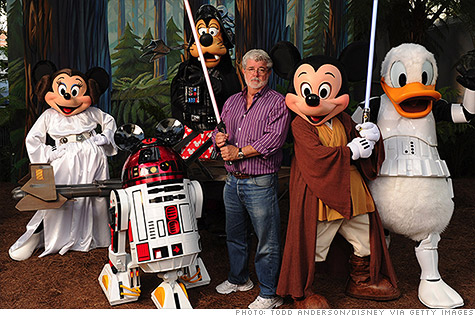
Of course, you've probably already heard about is Disney's announcement yesterday of its deal to purchase Lucasfilm Ltd. for j$4.05 billion.  About half of the purchase price will be paid in cash, half in Disney stock - and the stock component will make George Lucas, sole owner of Lucasfilm, the second largest shareholder in Disney. 
“For the past 35 years, one of my greatest pleasures has been to see Star Wars passed from one generation to the next,” Lucas, the sole shareholder of Lucasfilm, said in a press release announcing the acquisition. “It’s now time for me to pass Star Wars on to a new generation of filmmakers.”
“Lucasfilm reflects the extraordinary passion, vision and storytelling of its founder, George Lucas,” Disney chairman and CEO Bob Iger said in a statement. “This transaction combines a world-class portfolio of content including Star Wars, one of the greatest family entertainment franchises of all time, with Disney’s unique and unparalleled creativity across multiple platforms, businesses and markets to generate sustained growth and drive significant long-term value.”
   And speaking of the Star Wars franchise, Disney announced that Episode 7 of Star Wars is forthcoming (scheduled for release in 2015), with other Star Wars franchise films to follow every 2-3 years.
  The announcement was only the most recent of a number of business moves that should help cement Disney's pre-eminance in a range of creative content-based industries - the acquisition of Capital Cities/ABC through merger in 1996 (which included ESPN), comic book publisher Marvel in 2009, producers of a number of children's TV programs (Muppets, DIC, Sabane (Power Rangers)), and Pixar in 2006.  The move seems to cement Disney's preeminence in the superhero and Sci-Fi/Fantasy market.

  While the decision of George Lucas to sell Lucasfilm and withdraw from the business came as a surprise, the sale to Disney shouldn't have been.  Both Lucas and Disney are considered to be among the smartest media business operators who have consistently taken a long-term approach to growing their business rather than focusing on short-term profit maximization.  Both also shared an awareness that good creative content was exploitable beyond the initial media product release.
  Disney in particular has had a long tradition of exploitation of creative intellectual properties, epitomized by Disneyland (a theme park incorporating Disney characters), the first movie studio to use television to further promote and exploit its movies and theme park (starting with the Disneyland series in 1954), long term recognition and exploitation of licensing and merchandizing its creations, and its pioneering distribution strategy for its animated movies. Disney recognized quite early that the primary audience for many of its animated features were children, and that that market had some distinctive characteristics - mainly that children grow up, while others are born to replace them. Disney recognized that he could exploit that feature by re-releasing animated features every 7-10 years to a new audience; and until the rise of recordable media that was Disney's film distribution strategy.
  George Lucas was also known for his innovative business practices as well as his creative acumen.  Lucas' first big success came from the film American Graffiti, both as a hit film and as an innovative financial arrangement. Rather than take a big salary and/or a percentage of profits - the industry norm - Lucas got a deal that provided him less upfront money, but a smaller percentage of the film's gross revenues.  In essence, Lucas bet on his own success, and American Graffiti, produced at a cost of $775,000, went on to earn more than $200 million in box office and home video sales alone.  Lucas' earnings allowed him to create Lucasfilm in 1971, special effects powerhouse Industrial Light & Magic, and largely self-finance Star Wars; and once again Lucas struck an innovative distribution deal with Fox - once again Lucas took a smaller salary in return for keeping licensing and merchandizing rights for the Star Wars creative franchise.  Star Wars became the highest grossing film in the industry's history (until surpassed by E.T. five years later), with global earnings of more than $775 million to date.  Those earnings allowed Lucas to self-finance the rest of the Star Wars and Indiana Jones films, while insisting on retaining licensing and merchandising rights. Lucas quipped that Disney's long history of protecting, nurturing, and - yes - exploiting, of its creative content and intellectual property meant that he could trust them to take good care of his signature creative franchises.
"I really wanted to put the company somewhere in a larger entity which could protect it," (Lucas)  said.

In an interview he gave to fan magazine Empire earlier this year, Lucas had indicated he wanted to move away from the corporate side.

"I'm moving away from the company, I'm moving away from all my businesses, I'm finishing all my obligations and I'm going to retire to my garage with my saw and hammer and build hobby movies.
"I've always wanted to make movies that were more experimental in nature, and not have to worry about them showing in movie theaters."
  There's a couple of lessons here for creative content producers and media outlets in the digital age.  Both Disney and Lucas recognized that the value of creative content is not limited to its initial production and release, but can be translated into value in other markets; both were adept at innovative exploitation of that value; and both recognized the importance of keeping and protecting intellectual property rights.  All key lessons for content producers in a digital media environment.

Sources - Disney to buy "Star Wars" producer for $4.05 billion, Reuters
Disney to Buy Lucasfilm for $4.05 Billion; New 'Star Wars' Movie Set for 2015The Hollywood Reporter
Disney Buys Lucasfilm for $4B, Targets Star Wars: Episode 7 for 2015Wired.com

Tuesday, September 18, 2012

Media museum discovers it has first color film ever shot.

Staffers at the National Media Museum in Bradford, UK, opened an old tin reel box to discover what they think is a reel of test shots for the first system for capturing natural color in motion pictures.  The reel was apparently produced in 1902, but later research suggests that problems with the film's nonstandard format and projection system, and Turner's untimely death in 1903, led to the process being abandoned and largely forgotten for the last 110 years.  While film historians knew of Edward Turner's 1899 UK patent for his color process, and thought that some footage likely existed, confirmation awaited the discovery of the film tin and the development of a process for transferring the original nonstandard film onto modern film stock, then digitizing and assembling the overlying frames to produce a single color frame that could be reassembled so that the film could be displayed as shot.


Two experts in early film technologies had to create a special gate to hold the film's frames, and then match the differently colored frames individually before capturing the image digitally, restoring it, and combining it into a motion picture.  Going into the project, it wasn't clear whether the process would work.
"Then we saw it on screen. We looked at it and we were absolutely astonished with it. We never expected it to be so good... Knowing all about colour reproduction, and all the pitfalls along the way, to do something as good as that coming from 1901, 1902 was really totally unexpected. It was very exciting."

  While a number of early filmmakers produced "color" movies, those were produced by adding color to individual frames of the normal black&white film stock.  Capturing natural color on single film stock didn't make inroads into the film industry until the late 1920s and early 1930s.

Source - World's first colour film footage viewed for first timeBBC News

edit - had to correct a couple of technical steps in the restoration process.

Thursday, September 6, 2012

EPIX Shifts Content to Amazon

EPIX, a consortium of major movie studios and distributors, marked the end of its exclusive content licensing deal with Netflix by inking a content licensing deal with Amazon.  Amazon's announcement of the deal  comes on the heels of a series of content licensing arrangements with MGM and Warner Brothers.  
"We are investing hundreds of millions of dollars to expand the Prime Instant Video library for our customers. We have now more than doubled this selection of movies and TV episodes to over 25,000 titles in just under a year," (said) Bill Carr, vice president of video and music at Amazon,
As Amazon continues to expand its streaming business and content archive - and is joined by Hulu+, Blockbuster On Demand (affiliated with Dish Network), VUDU (affiliated with WalMart), Google TV (through its Android Store), Apple's iTunes Store, and YouTube movie rentals - Netflix faces an increasingly competitive content marketplace.  And one where content owners are likely to want to have their content available through multiple channels, rather than making exclusive deals.  A more competitive market can be good for consumers, but not as beneficial for firms that had virtual monopolies (and was able to use that monopoly power to its advantage.
  It's not surprising that Netflix's share prices dropped 10% with the Amazon announcement.

Source - Amazon Adds EPIX Content to Prime Instant Video, Prompting Netflix Slide, Online Video Daily

Wednesday, April 4, 2012

WalMart rides to UltraViolet's rescue

Previous posts (here and here)  have discussed UltraViolet, Hollywood's emerging rights locker system, where purchase of some home video discs also gives you access to stream online versions of the film.  Early difficulties with the streaming system initially developed by the industry - people had difficulty registering and getting reliable streams - led it to consider letting other streaming services serve as the portal to the consumer.
  WalMart's announced that it's new video streaming service, Vudu, will let people access their UltraViolet movies through their system, for a price ($2 for standard definition version, $5 for high definition) .  One difference from other streaming systems is that WalMart will let you register discs bought elsewhere - although it has to be done in store and in person.  It's a move that could help the movie industry move into online distribution, taking the WalMart move as providing a more user-friendly alternative for registering and accessing covered content.  It might also help Vudu, as it enters an already crowded streaming video marketplace.  That is, if people aren't put off by paying an additional fee for something they've already bought the rights to.

Source - WalMart to bridge online gap with disc-to-digitalBroadcast Newsroom

Thursday, March 22, 2012

RED's new digital camera a "Celluloid Killer"?

Heath McKnight posted a review and analysis of the new RED EPIC-X digital movie camera at the Digital Facility blog.  The people at RED were the first to really break into the high-end movie production field with the RED ONE, a digital camera that rivaled the resolution of the industry standard Panavision 35mm film camera, and accepted the same lenses as the Panavision (which enabled cinematographers to capture more of the traditional film effects they wanted), at what was estimated as a cost 1/50th of that of a single Panavision film camera, without lenses (Panavisions weren't available for sale, only rental).
  The specs on RED's latest camera, the EPIC-X, simply blow away both the RED ONE and Panavision.  The EPIC-X captures images at a 5K resolution (higher than the current industry standard for digitizing older 70 mm films), can capture up to 120 frames per second at full resolution (film standard is 24), and has one of the best dynamic ranges of any camera, film or digital.  It's also half the weight of the RED ONE, and records images on SSD drives that can be popped out of the camera and into an editing station.  These features also suggest that the EPIC-X offers filmmakers a new degree of flexibility in how the capture scenes.  With the associated RED STATION, you can make non-destructive tweaks down to individual frames, and output files in virtually every format and standard.  Basically, the new RED equipment seems to exceed just about every industry standard for film production, at a mere fraction of the cost. 
  All this leads to McKnight's summation - "The RED EPIC-X is truly a celluloid killer, and it's being used on everything from mega-blockbusters like the upcoming Hobbit and Spider-Man films, to independent filmmakers and video producers."
  Between advances in digital film equipment and the rising cost of traditional film stock, I expect more and more of the movie production industry to go fully digital.  As that happens, look for more and more movie distributors and theaters to shift to digital formats as well.

Source -  RED EPIC-XL Jeremy Wiles and Creative LabDigital Facility

Wednesday, January 11, 2012

UltraViolet's New Moves

Last year, Hollywood announced the creation of their own online movie system, dubbed UltraViolet, and some DVDs and Blu-Ray movie discs began including UltraViolet links last fall.  In the UltraViolet system, viewers can enter their purchases into an online content system, and then stream the movie to multiple devices.
Earlier this week, Panasonic announced that it will be the first set manufacturer to allow direct access of UltraViolet titles through its Flixster service on connected TV sets, beginning later this year,  That news was quickly trumped yesterday, when Amazon announced that it's working with movie studieos to implement UltraViolet service on its streaming media system
Amazon's EVP for Digital Media, Bill Carr, said Amazon was "very excited about the additional possibilities from a customer's point of view that UV enables.... The best movie and TV service for consumers is the one that provides them with the broadest choice possible."
The Amazon tie-in in particular should be a big boody for the UltraViolet system, bringng Amazon's user-friendly interface to a system that has been a bit of a dud following its October introduction.  While registering some 750,000  households, reports suggest many of those users were frustrated and confused in trying to get the system to work with their devices.

Tuesday, January 10, 2012

Movies, Music and Really, Really Bad Policy

Like most traditional media, the traditional movie industry (films shown in theaters) is losing market share, and has been for decades).  The movie industry's had a long and consistent approach to this problem.  First, claim that other channels for movie distribution would bankrupt the industry, and try to ban the competition (or at least keep movies from being available through these new channels).  Second, when those efforts fail, embrace the new technologies, which often generate more revenues than the old theatrical releases did.  In 2011, the movie industry made $30 billion globally from theatrical box office revenues (a third from the U.S.), and $57 billion from other distribution channels.

Steve Blank has an interesting post on why the movie and music industries can't seem to handle technological progress well, and end up resorting to ever-stricter copyright enforcement efforts.  Here's his list of their "end of the world" predictions
  • 1920s - Record and music business complained about radio, because radio was free and "you can't compete with free."  They claimed no one would ever buy music or a ticket to a performance again.
  • 1940s - Movie studios had to divest their theater chains (due to antitrust issues), and claimed "it's all over."  And if that didn't do it, TV would kill local theaters because TV was free.There are twice as many local screens today showing movies as there were in the 1940s. 
  • 1950s - After succumbing to the temptation to market films to TV, the movie industry lobbied to ban pay channels on cable, arguing that "free couldn't compete with paid"
  • 1970s - The movie industry sued to prevent home recording and VCRs, proclaiming the end of both movies and TV.  When the movie industry caved and started marketing movies for the home video market, it quickly became the largest revenue source for the industry
  • 1998 - The music and movie industry lobbied Congress and got the DMCA to enforce copy-protection schemes and prohibit consumers from copying content they already owned
  • 2000 - The movie and TV industries proclaimed that DVRs would destroy their industries.  Instead, DVRs reignite audience interest in programming
  • 2006 - Broadcasters sue to prevent MSOs from offering out-of-home DVR and on-demand content feeds.  (And lose)
  • 2011 - Movie studios and TV/cable networks sue to prevent MSOs from offering "TV Everywhere" streaming services, while licensing their own content to other streaming services.
  • 2012 - SOPA/PIPA - Movie studios, music labels, and other content producers push for legislation that would make it easier for them to disrupt (delete from DNS servers) Internet sites they suspect may have unlicensed content, or even may link to unlicensed content.(For more on SOPA, check here)
Brand suggests that much of the problem is that the movie industry dealt with a single basic technical standard (35mm film) for its first 75 years, with only ancillary improvements (sound, color) - and sound was only really disruptive for theaters. On the other hand, they have a history of manipulating regulation to their advantage, starting with the industry's roots in the Motion Picutres Trust (legally-enforced monopoly) and copyright.  As Blank opines:
"When lawyers, MBAs and financial managers run your industry and your lobbyists are ex-Senators, understanding technology and innovation is not one of your core capabilities."  With SOPA/PIPA, "(t)he studios don’t even pretend that this legislation benefits consumers. It’s all about protecting short-term profit."
"The SOPA bill (and DNS blocking) is what happens when someone with the title of anti-piracy or copyright lawyer has greater clout than your head of new technology. SOPA gives corporations unprecedented power to censor almost any site on the Internet. It’s as if someone shoplifts in your store, SOPA allows the government to shut down your store."
If you're wondering why Congress and the White House are doing ill-considered favors for the industry, consider - those industries spend more than $100 million annually in lobbying and regularly contribute to re-election efforts (President Obama got more than $1 million, and more than 20 others received between $50K and $250K, in the 2011/2012 election cycle so far), that the Justice Dept. division in charge of IP rights is staffed exclusively with former lawyers from the RIAA (music industry trade group) and MPAA (movie industry trade group), and that the latest head of the MPAA is former Senator Chris Dodd (D), who explained that the lobby was only asking for the same kind of power to censor the Internet as that held by the government of the People's Republic of China (where they arrest, imprison, and shoot people for posting critical comments - but interestingly have a largely hands-off approach to stopping online piracy of Western content).

Sources - Why the Movie Industry Can't Innovate and the Result is SOPA,  Steve Blank
MPAA Head Chris Dodd on Online Censorship Bill: China's the ModelThe Weekly Standard
TV?Movies/Music: Top RecipientsOpenSecrets.org

edit record - fixed typo and missing link

Thursday, August 25, 2011

Miramax Testing direct sales

Film company Miramax is testing a direct video rental service that may allow it to bypass larger streaming and digital media sales and rental firms.  Miramax will use Facebook for its interface, offering free streaming of trailers, and currently offers rentals on 20 films, some of which have yet to be made available to other distributors.  One distinct difference with the Miramax offerings is that it is also making some films available outside the U.S.  !0 titles are available to Facebook users in the U.K. and Turkey, and there are plans to open access to users in France and Germany. Direct sales (or rentals) to consumers can have the benefit of bypassing intermediaries in the distribution stream, letting content owners capture more of the retail revenue stream (or conversely, offer content at a lower price). In this case, not the entire stream, as Facebook takes a chunk for running the payment system.
Besides direct film rentals, the Miramax eXperience Facebook site can help with branding and promotion efforts.  The site will offer free streaming of trailers, and will host a online game that lets users cast themselves and their friends from Miramax movies, with rewards of unlocking bonus content as they play.

While the potential to capture more revenue is enticing, developing a new market and distribution system can be daunting.  In addition, the current online video services offer consumers better experiences (some early users of the Miramax Facebook site say it's not quite up to the standard of Netflix, Amazon, or Apple); a wider range of content options (Miramax only offers films it distributes); and intelligent recommendation systems that can help users find programming that they might be interested in.  It seems unlikely, at this point, that direct marketing will replace the large aggregators totally, but it can be an additional revenue stream that content producers and distributors may want to take advantage of.  And it can have considerable potential in terms of film promotion, building relationships with consumers, branding, and fan service.  It is the mix of value streams which is prompting more and more content producers/distributors to add direct sales to their revenue mix.

Source - Miramax app the Largest Streaming Deal on Facebook YetBroadcast Newsroom
Miramax, Facebook Team for Streaming AppThe Wrap

Monday, August 22, 2011

Amazon Adds to Streaming Catalog - updated

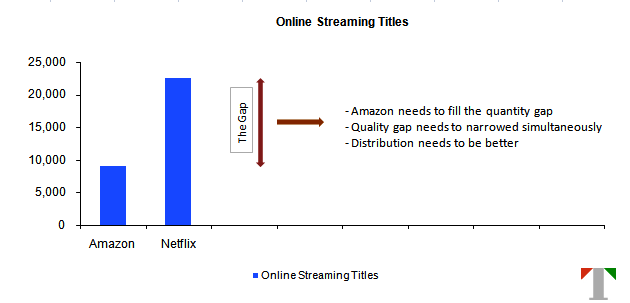
Amazon has been making deals to expand its on-demand and streaming video titles to keep pace with Netflix and new competitors Google, Apple, and WalMart.  It recently reached the 100.000 title mark, of which 9,000 are available free to Amazon prime customers.  In contrast, Netflix has more than 20,000 titles available for streaming to subscribers.
Analysts note that Amazon's Prime membership works out to about $6.60 per month, slightly below Netflix's subscription level for streaming-only service.  However, Netflix is available through many more devices, and offers not only more titles, but arguably better ones, which should keep Netflix at the head of the pack.

Apple has had limited titles available through iTunes for a while, but is also working to expand offerings, as Google is ramping up it's Android market to stream videos, and porting some 3000 titles through YouTube.  Walmart's recent purchase of video streamer Vudu has jumpstarted its newly rebranded Wal-Mart Video on Demand through Vudu service, with some 20,000 titles.  For now, only Netflix, Amazon, and IP streamer Hulu+ have subscription based offerings - the rest offer per-download short-term rental or purchase options on digital versions of films and television programs with prices in the $1-5 range for rentals.  It looks like Hulu+ is up for sale, and there's talk of interest from Apple, Google, and DirecTV - which could change things.

Look for Netflix and Amazon to hold the lead in terms of titles streamed, although the per-unit pricing of the Video on Demand services (including Amazon's) may generate strong revenues for a while.

Sources: How Much are Amazon's Streaming Efforts a Threat to Netflix?  SeekingAlpha

Update - fixed graphics size issue, some minor rewording. 
Update II - added DirecTV to possible Hulu+ bidders. DirecTV is also expected to bid for Hulu+ to help remain competitive with Dish Network (which recently acquired Blockbuster(content) and Sling Media (IP video distribution)).  Expanding online options would also help DirecTV compete against emerging "TV Everywhere" offerings.

Friday, July 29, 2011

Spreading the Wealth - Networks & Studios expand access

When the TV and movie industries made the decision to jump into digital content distribution, the initial focus was on exclusivity.  Deals were made with emerging online video providers to market their content.  Downloads were often restricted to the network's (or studio's) own website, and perhaps one of the major digital content stores (iTunes, Amazon, etc.) On the streaming side, NBC, ABC and Fox signed deals with Hulu, while CBS made content available on TV.com. 
There are benefits to exclusivity, at least to the online outlets and the content owners.  Content owners get better deals and higher per-unit returns from outlets and can, perhaps, also keep tighter control of content and distribution. Outlets drive potential consumers to their sites while minimizing competition, which gives them some ability to keep prices high, and capture all (or most) of the demand.  The downside of exclusivity is that it limits access and use - that impact is initially felt by potential users/consumers, who may pay higher prices or any entry costs to get into the "Walled Garden" that exclusivity constructs.  In the long term, though, the cost of reduced demand for product may outweigh the benefit of higher pricing when it comes to total revenues.  The history of media content sales in other formats strongly supports the idea that greater access will trump higher prices in terms of generating revenues and profits.

The last few months have seen a number of deals where content owners are working to expand the digital markets for their content.  Over the last few weeks, CBS and NBCUniversal both announced distribution deals with Amazon  Earlier, Netflix had announced a deal with NBCUniversal that expanded the movies and programs it could stream.  CBS & ABC are working on iPad apps for some of their TV shows. The content and offerings will mirror what they currently offer on their network websites, but will be.customized for the Apple tablet. BBC Worldwide has an iPad app that can provide global access to much of its current, and past, programming (For now the service is available in 12 European countries, but the BBC hopes to extend access to other countries as rights can be negotiated).   In addition, another major player has entered the online movie/video marketplace, as Walmart has repackaged online movie service Vudu (which it bought in February).
And then there's "TV Everywhere" - another expansion of accessibility from multichannel video providers.  At this point, there's some debate over rights and access - particularly whether content owners will benefit from offerings.  Those issues should get resolved fairly soon, providing additional ways for consumers to access content..

Sources: "Amazon Inks Deal with NBCUniversal To Stream 1,000 Movies & TV Shows", Mashable.com
"WSJ: CBS, ABC prepping free TV shows for Apple iPad users (with video)", Mac Daily News
"WalMart adds Streaming Video Rentals", DailyFinance
"BBC Worldwide Unveils Global iPad App", WorldScreen.com

Tuesday, July 19, 2011

UltraViolet - Movies may show the way

The movie industry has generally come to grips with media and market changes, after a while.  The typical pattern is initial resistance to innovations and new media, but fairly rapid adaptation once they found that the new media forms offered even higher revenue potential than the basic film/theater business model.  First with television, cable movie channels, videotapes and DVDs (both rentals and sales), and videogaming, the movie industry first tried to keep its content off the new media, but then found that the new media also opened up new, expanded, markets for its content.  Markets that in some cases overshadowed the revenue potential of the tradition theatrical release market.
The pattern repeated somewhat with the rise of digital networked media - initially, reactions focused on using copyright to try to keep their content off those networks.  Over the last few years, the movie & TV industries have started to embrace digital online distribution and the notion of making content available across a range of display devices.  Starting with licensing their content to online streaming services like Hulu and Netflix, providing some content in multiple formats (combining DVD, Blu-Ray (HD), and digital copy (playable on computers & digital devices) versions in a single package), and allowing online stores to sell digital copies of content.  But the adaptation that may be the most significant may be coming this Fall.

  
Sometime this fall, a group of studios will launch the UltraViolet project.  Purchasing a Blu-ray or DVD disc of a film with the UltraViolet feature will provide users not only with the physical disc, but allow them to stream or download the film forever from digital archives.  The UltraViolet project is based on the digital rights management approach called "media lockers," where rights focus on allowing licensed users to access content held online, the basis for the recent spate of media Cloud announcements for music (Amazon, iTunes, and Google).  In operation, UltraViolet is closest to what Apple plans for its iTunes-based cloud service - with users indicating what content they have rights to, and the media locker or cloud allowing users to access content directly from their archives through a variety of devices.


Perhaps most importantly for the long term, UltraViolet poses, finally, a good workable solution to the inherent conflict between intellectual property rights (copyright in particular) and digital networks and devices.  Rather than placing the focus on limiting the making of copies, UltraViolent focuses on licensing and rights to access content, recognizing that in most every digital device, multiple copies of content are made.  After all, the demand for the content is based on access and the ability to watch and/or listen, not on how many transient digital copies exist in a device.  And increasing accessibility will tend to increase value.

Source: "Buy Once, View Anywhere: UltraViolet Ready for Launch." VidBlog (MediaPost)
UltraViolet website

Tuesday, May 10, 2011

Google I/.O Announcements - Now a medium

Google is sponsoring a big event for tech types and reporters, called Google I/O.  Among the announcements are several indicating Google is making serious moves into both the content and mobile markets.  Here's a glimpse at some of the big announcements:

Google Music (or at least "Music Beta by Google) was launched, offering users the ability to upload 20,000 of your tunes initially, providing a cloud hosting service similar to Amazon's that would allow you to stream from your library to any device supporting Flash.  The full launch of a music store was delayed by issues in getting licenses from major record labels.
Engadget has a comparison of streaming music services.

Not content with sound, Google also announced the addition of video and movie rentals to the Android Market, mirroring the recently expanded YouTube rental inventory.  Users can access the movies Via PCs and Google TV through YouTube-Movies, and will soon be able to use Android Market for play on smartphones and tablets running Android 2.2 or higher. In additions, purchases on one platform reportedly can also be accessed from the other.

Speaking of Google TV, the folks at Google announced that the Google TV platform will get an upgrade to the new Android 3.1 platform this summer.  The upgrade will provide users with access to the Android Market.  Google also confirmed that the Google TV app will be included in Sony, Samsung, and Vizio TVs offering internet access, and Logitech Google TV set-top boxes.

Sources: "Google Music Beta to stream 20,000 songs for free, official! (updated)," Engadget
"Android Market launches movie rentals, thousands of titles available to your PC, phone or tablet,"
Engadget
"Google TV getting Android 3.1 and Market this summer; Sony, Vizio, Samsung and Logitech onboard," Engadget

Wednesday, April 27, 2011

YouTube Exploring Movie Rental Business

From Martin Johnson:

YouTube is prepping an expansion of its movie rental service that will include selections from major movie studios and serve as a serious competitor to Apple's iTunes, according to a report. Sony Pictures Entertainment, Warner Brothers, and Universal, as well as Lionsgate and Kino Lorber have all agreed to allow YouTube to rent their films. 
"We've steadily been adding more and more titles since launching movies for rent on YouTube over a year ago and now have thousands of titles available. Outside of that, we don't comment on rumor, or speculation," a YouTube spokesman said via email.
YouTube has been dabbling in movie rentals for more than a year, but it has not become a major focus for the Google-owned video site.

Tuesday, April 19, 2011

Digital Cameras in Film and Video Production

From Martin Johnson:

If you want to shoot video today there are many options for you to choose from. You can go the old fashioned route and stick to film. You can even shoot decent quality video from your cell phone. A big part of the music video/ movie market is slowly turning to shooting video with DSLR cameras. Some of you might ask why these cameras are being used for video and what are the benefits. Well the big benefit of shooting digitally is having the big sensors that are used in the cameras. These sensors capture so much light and detail you get amazing results. The DSLR are in no way ready to be the main cameras to shoot all your video on. They do still have a few set backs, like audio recording and focus and zooming options. There have been a few exceptions for using only digital cameras to record movies. The RED ONE camera has been used to shoot many top movies including the new Pirates of the Caribbean movie and award winning movie The Social Network. Expect to see Canon and Nikon pushing their way further into the video industry in coming years. Being able to shoot amazing video is becoming easier and easier.

The RED ONE camera. http://www.red.com/

Learning DSLR Video http://www.learningdslrvideo.com/

DSLR Film Blog http://dslrfilm.com/

DSLR University http://dslruniversity.com/

Tuesday, March 22, 2011

"Direct to Torrent"

Paramount will be releasing "The Tunnel", a faux-documentary horror movie, direct to consumers through BitTorrent.  The torrent feed will include the full basic movie, and Paramount will simultaneously release a DVD with a batch of extras (including added footage, an alternate ending, and a "making of" documentary.
Paramount sees this as not so much supporting piracy, but exploiting a peer-to-peer, word of mouth, promotion scheme for the small budget film.  It's also consistent with its user-backed financing scheme, where the producers sold "frames" from the film (and shares in potential profits) to interested parties online.  (About 30K of the 135K frames were sold at a $1 a piece).

If nothing else, it's an interesting experiment in alternative financing and marketing.

Source: "Direct-to-Torrent: Paramount Releasing 'The Tunnel' over BitTorrent," Vidblog