Showing posts with label newspapers. Show all posts

Monday, September 14, 2015

UK Newspaper News

It's been a while, but there's been a flock of articles recently about the present and future of the newspaper business in the UK that deserves a post.

  • A ZenithOptimedia forecast predicts that mobile advertising expenditures will bypass newspaper advertising revenues in the UK this year.  The study shows a 38% growth in mobile, compared to a 4% decline in newspaper advertising.
  • The same report also shows mobile advertising surpassing newspapers on a global basis, based in part on the continuing decline in print advertising expenditures across most of the world. 
The worst part of the internet advertising boom for newspapers is the fact that not all digital sectors are reaping the benefits.  In particular, display advertising is lagging, and newspapers rely primarily on display advertising for their Internet and mobile sites as well as print editions. With the growth of ad-blocking on mobile devices, one analyst predicts that display ad revenues for mobile "are going to fall through the floor."

With predicted declines in revenues, many news outlets are looking for ways to trim already tight budgets further.  The National Union of Journalists  (UK's trade union for journalists) is warning that it's members are ready to strike if news outlets look to cut costs by shrinking newsrooms.

So the tough times for newspapers and other news outlets look to continue.

Sources - Mobile adspend in UK to overtake newspapers faster than expected, predicts report.  campaign

Tuesday, February 3, 2015

Boom in online ad dollars - for some

Analyst Gordon Borrell puts the growth rate for online advertising dollars at 40% for 2014, and 42% for 2015.  Some firms could see online ad gains of 30% or more.  But for others, online dollars aren't going to be able to offset traditional advertising losses.

In particular, Borrell noted that newspaper print advertising is looking at continued advertising revenue declines of 10% annually.  Even when adding in the weak growth in online ad revenues for newspapers, total newspaper advertising revenues are predicted to fall 4.8 % in 2015.
Furthermore, the report notes that even in markets where newspapers have strong digital news content, advertisers are shifting to more targeted sites for directed and targeted advertising efforts.

With targeted ads remaining the fastest growing sector, having an audience is not enough - you need to be able to demonstrate having the right targeted audience.  Newspapers have had trouble doing that for their online editions.  In fact, Borrell predicts that online "Internet pure play" sites will grab about three-quarters of local online advertising revenues - mostly at the expense of traditional media outlets.
The report suggests that traditional media strategies towards online advertising tend to fall into one of three basic approaches:
Traditional media companies stuck in the analog world, selling a little digital stuff because it’s easy, but not really believing there’s good money in it; traditional media companies that are more excited about the prospects but still reticent (or unable) to invest more in order to grow quickly; and traditional media companies that have seen the light and are determined to grow again, investing heavily in digital by hiring people or acquiring companies.
Borrell estimates that about half of traditional media outlets fall in the first group - which explains why they're losing out in local advertising markets - which is increasingly focused on highly targeted content and audiences.

Source: Analyst Gordon Borrell sees local digital ads soaring in 2015, but not for newspapers, Poynter.org


Tuesday, August 12, 2014

Signs of the Print Holocaust

Over the last year, the newspaper industry has seen a lot of departures - with major newspaper companies getting rid of a lot of their major properties.  The Washington Post Company sold the Washington Post to media newcomer Jeff Bezos, founder of Amazon.com.  The New York Times Company sold the Boston Globe to John W. Henry, owner of the Boston Red Sox.  And Time Warner basically gave away what had been its' premier product, Time magazine (whose new owner also found itself burdened by an additional $1.3 billion in debt).  The Tribune Company has been trying to sell major papers, like the Los Angeles Times and Chicago Tribune for years (and finding limited interest).  Even Murdoch's News Corp took action last year, splitting its print operations from its broadcast, digital, and entertainment operations.

The notion of spinning off print newspapers from broadcast and digital seems to have caught the interest of other media conglomerates -, particularly those with poorly performing print operations.  Over the last few weeks more splits were announced.  The Tribune Company split off most of its newspapers into a separate company (along with $350 million in debt).  E.W. Scripps Co. announced a merger with Journal Communications, and then quickly followed that by spinning off the combined print newspaper assets into a separate company.  And most recently, Gannett announced it would spin off its broadcast and digital operations from its struggling print newspapers next year.

While these announcements tout the prospects for the new print companies, most analysts see the moves as cynical efforts to dump assets with declining value and limited futures.  The lack of serious potential purchasers for major urban dailies in recent years hasn't helped - leaving conglomerates with few alternatives for dealing with newspaper properties in decline.  Spinning print off may be their best financial option at this point - particularly if they see no profitable future for their print dailies.
  
And if companies whose beginnings were in urban print dailies, whose traditional self-image was as newspaper moguls, are at the point where they see no future in that segment anymore, it's hard to be optimistic about the industry.
“I’m very skeptical that in the long term you are going to have a hard copy daily newspaper in each market,” Mr. Huber, an analyst with Huber Research Partners, said.
Sources -   Print is Down, and Now Out,  New York Times
Gannett, Owner of USA Today, to Split Its Print and Broadcast Businesses, New York Times
Now Scripps Is Splitting, Too,  The Wall Street Journal


Case-Study- the Philadelphia Papers Long Fall

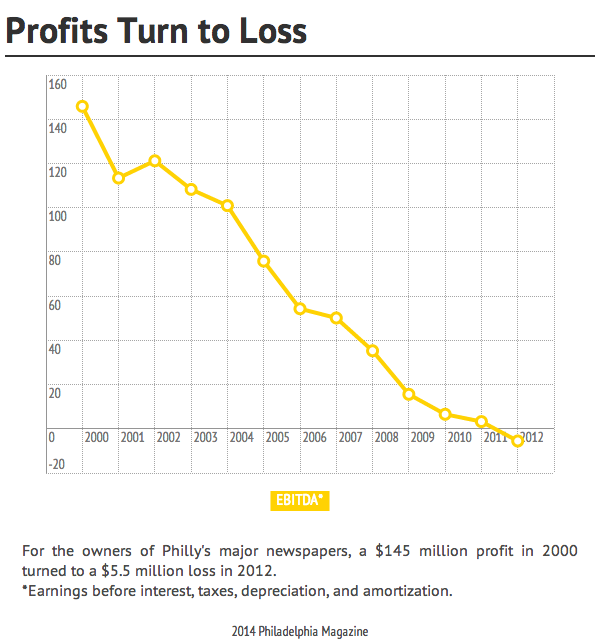
A good piece by Joel Mathis on the decline and fall of the Philadelphia Inquirer and Daily News.  Working from a financial report, he tracks the progress from being a reliable cash cow to bankruptcy in a little over a decade.

A large chunk of the problem was the same faced by most large urban dailies in the U.S. - a big drop-off in advertising revenues as one industry after another found better alternatives online.  It didn't help that this was followed by the recession - which hit all advertising revenues hard.

But when the industry started to recover after 2010, the loss of advertising continued to fall by double digits for the two Philly papers.  The fact that the papers changed ownership 4 times in 12, and the lack of consistent business strategies, didn't help either.

A look at the numbers suggests some other factors at work. 
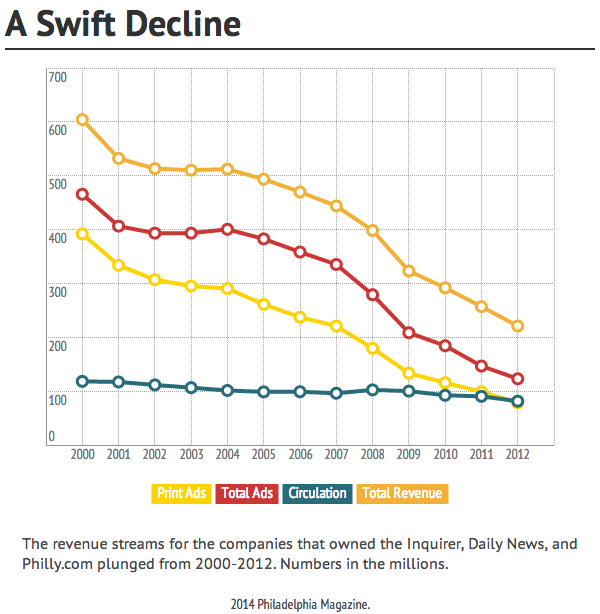
    • Like most media facing revenue declines, the papers owners tried first to just cut costs.  But in Philly, it seems, the focus was on cutting staff (labor costs went from $243 million in 2000, to $135 million in 2012).  That's more than just trimming dead wood - it's the kind of cuts that will necessarily have an impact on quality.
    • Those deep cuts can also be seen circulation losses.  Circulation fell from a high of 374,000 (2002) to 166,000 in the last audit - a loss of more than half their readership.  Such losses necessarily impact the value of advertising in the papers, accelerating ad revenue declines.
    • Circulation revenues also declined, but much more slowly than circulation losses.  This suggests that the papers tried cutting subscription discounts and/or hiking prices.  Increasing costs to readers while reducing the value of the product also feeds into the negative feedback loop for circulation.
Thus the various manager's plans created a near "perfect storm" of negative feedback.  Initial shifts in advertising categories prompted cost-cutting,  That led to a focus on cutting staffing, which impacted the value of the news product.  Declines in product value led to circulation losses, which were exacerbated by cost increases.  Massive circulation losses reduced the value of advertising, which gave advertisers even less of a reason to return to the papers as the recession ended.

There's one other interesting aspect to tease out.  Note that there's a large, but shrinking, difference between print ad revenues and total ad revenues.  That would include digital advertising, which hasn't grown much.  It also includes preprint advertising (i.e. inserts) - and for a while it seemed that the papers were doing well with that revenue category.  However, large circulation losses make inserts less valuable, and by 2012 it seems that the Philly papers had lost that advertising sector to competitors as well.

Sources -  "The Long Fall of the Philly Newspapers,"  PhillyMag.com
It turns out the 2000s were not a good decade for The Philadelphia Inquirer and Daily News,  Nieman Journalism Lab

Thursday, April 24, 2014

Mileposts: Two notable print closures

It's been a week of bad news for print media.  Newspaper revenues continue to slide, despite some upticks in digital subscriptions and advertising (see earlier post), and print's share of time spent with media has dropped more than 50% in the last four years, now accounting for a mere 3.5% of U.S. adult time spent with media (see previous post).  Now comes news that two notable print institutions are ceasing print operations.

Officials with publishing conglomerate Meredith Corp. announced today that the venerable Ladies Home Journal will no longer be published as a monthly magazine.  The title will transition to a special-interest quarterly publication sold exclusively at newsstands.  The Ladies Home Journal began publishing 131 years ago, and was the first U.S. magazine to reach a circulation of 1 million (111 years ago).  The company announced that the magazine's 3.2 million current subscribers will be shifted to other Meredith-owned publications.  Meredith indicated that its magazine division saw advertising revenue drop about 15% in the last year, while overall operating expenses rose about 8%, contributing to a 37% drop in profit levels.

The problem with the magazine was not its readers, but with advertising.  The number of ad pages had fallen 23% this year; but the problem was that that was only the latest of several years of double-digit declines.  Another of the pioneering "Seven Sisters" of women's service magazines, McCall's, closed in 2002 after years of losses that were also blamed on declining ad pages and aging audiences.  The last issue will bear a July 2014 publication date.

The announcement comes on the heels of the news that the Columbia University student newspaper, the Columbia Daily Spectator will drop its daily print edition.  Starting with the upcoming Fall term, the paper will be shifting its efforts to its online edition combined with a weekly print edition.  In fact, the new weekly edition will be folded into the Spectator's current weekly, called The Eye.  The Spectator began publishing as a student newspaper in 1877, and was the second-oldest continuously operating college newspaper in the U.S.  It began operating as a daily newspaper in 1902.

With this move, Columbia becomes the first (and so far only) Ivy League school without a daily student-run newspaper.  While stressing that it wasn't an economic decision, the paper's current Publisher did admit that the print edition was losing money this year, and hoped that the move would help free up funding to supplement a work-study program used to support staffers.

One alumnus, former managing editor Robert Hardt, Jr., commented that he had mixed feelings about the move:
“It’s the end of an era—but it probably means that Spec reporters will miss fewer classes and get better grades...”

Sources -  Ladies Home Journal to cease monthly publication, The Des Moines Register
 Ladies Home Journal to Fold After 131 Years in Print, Ad Age
Columbia student paper plans to drop daily print edition, Capital New York

Monday, April 21, 2014

US Newspapers Revenues Still Falling

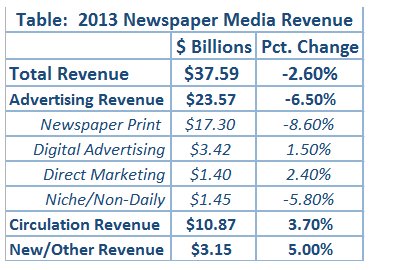
The Newspaper Association of America (NAA) has released its report on the state of newspapers in 2013.  The report trumpets "the best performance since 2006" - but that's because the overall revenue decline of -2.6% is the smallest annual percentage decline over that period.  Overall, the industry lost more than a billion dollars of revenue in 2013.  The fall in revenues was again led by a 8.6% drop in print advertising revenues.  According to the report, print advertising revenues account for less than half of total revenue.  Classified ad revenues continue to lead the decline (down 10.5%), but both national and retail advertising revenues fell by 8%.  Advertising revenues were also down (-5.8%) for weekly and niche publications.


Offsetting this was a modest 1.5% growth in digital advertising (overall, digital advertising is growing at a double-digit pace).  If there's good news in the report, it's the fact that the rapid adoption of paywalls for the online versions of print newspapers contributed to a modest gain in overall circulation revenues.  That, and the fact that the NAA managed to add $5.5 billion in additional revenues by including revenues from side ventures such as contract printing, weeklies, and a range of niche publications and services.  That really helped to slow the decline in the "total industry" numbers.  Still, revenues from all digital sources amounts to only 12% of total industry revenue, and newspapers' digital revenues continue to grow much more slowly than other forms of digital advertising.

Newspapers aren't out of the woods yet.

Sources -  Newspaper industry narrowed revenue loss in 2013 as paywall plans increased, Poynter
Business Model Evolving, Circulation Revenue Rising, NAA report\

(I made a number of edits for style and clarity after initial posting - BJB)

Monday, April 7, 2014

Recovery for World's Ad Economy

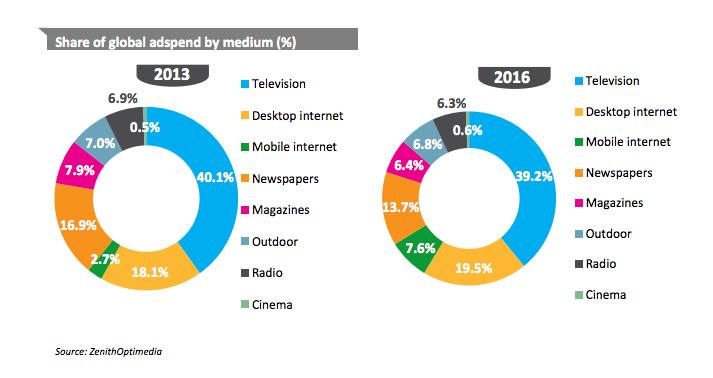
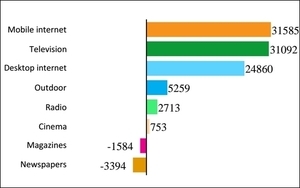
Recent estimates from ZenithOptimedia Group suggest that on a global level, at least, the advertising sector has returned to its pre-recession growth rates.  The report now forecasts a 5.5% growth in advertising spending, reaching a total of $537 billion. The news isn't uniformly positive for all media, however.
The overall growth is being driven largely by the rapid increase in online advertising.  Internet advertising is forecast to continue to grow by around 16% annually for the next few years, with online display growing at 21% and social media ad expenditures growing by 29%.   Online advertising can also be differentiated into desktop (static) and mobile sectors - and the report notes that the mobile sector is growing at 6 times the rate of desktop, hitting 50% annual growth through 2016.  The ZO researchers said, "mobile will leapfrog radio, magazines, and outdoor to be the fourth-largest sector" by 2016


While the TV sector continues to draw the lion's share of global advertising, and is forecast to continue growing, the online sector's much faster expansion is closing the gap.  The news is worst for print: both newspapers and magazines are losing ad revenues.
We predict internet  advertising will increase its share of the ad market from 20.7% in 2013 to 27.1% in 2016, while newspapers and magazines will continue to shrink at an average of 1%‐2% a year,” the report states. “Internet advertising overtook newspaper advertising for the first time in 2013, and we forecast it to exceed the combined total of newspaper and magazine advertising in 2015.”
The U.S. advertising market is forecast to continue its dominance of the global ad economy, but the report predicts that China (currently 3rd largest) will overtake Japan by 2016, while Indonesia and South Korea will overtake France and Canada among the ten largest ad markets.

Source:  Internet Ad Spend to Reach $121B In 2014, 23% Of $537B Total Ad Spend, Ad Tech Boosts Display,  TechCrunch.com

Monday, March 3, 2014

Print readership for newspapers - Half-full, or Half-empty?

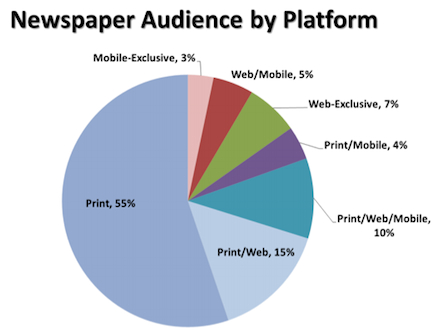
A recent study by the Newspaper Association of America (NAA) trade group reported significant growth in digital and mobile readership, yet also proudly proclaimed that 54% of newspaper audiences only read their local newspaper through its print edition.  Overall, the NAA reported circulation gains of about 3%. Also reported was the fact that print circulation has fallen to 71% of total circulation (75% of Sunday circulation), down from 85% the year before (a 20% decline).  The size of this year's shift, it should be noted, may be coming from a change in AAM reporting, which lets publishers decide whether subscribers of both the digital and print editions get counted as print subscribers or as digital subscribers.  With most ad revenue growth in digital, they may be choosing to emphasize those numbers.

One interpretation of the more than half of circulation remaining print-only is that there's still a significant role for print editions.  Another is that almost half of readers don't ever access their local newspaper digitally.  Newspaper readership is not only in general decline - it seems to be splintering, with older readers sticking with print, and younger readers shifting their news consumption to online and mobile sources.  The NAA report said that 30% of readers use a combination of print and digital sources, and 15% only use digital.  According to the NAA report,
"a closer examination of the elements, supported by readership data, does confirm a steady transition to digital reach among newspapers and a healthy print readership base for readers and advertisers."

A deeper look showed an industry in widespread decline.  Almost all of the circulation gains were by the five largest U.S. newspapers, and predominantly from increased digital circulation.  A breakdown by circulation showed aggregate circulation losses in all other segments.  The report notes that most smaller papers are posting print circulation declines smaller than seen in some of the biggest urban dailies.  Smaller, perhaps, but declines nonetheless.

From an economic perspective, it's clear that there is a strong and rapidly growing digital market for news.  News organizations, whether newspapers, broadcast networks and local stations, magazines and radio would be well-served to develop easily-accessible online delivery systems for the news they produce (mobile apps in particular).  The audience is going there, and frankly, the distribution costs are minimal compared to traditional media.  However, there remains a sizable portion of news consumers who remain loyal to traditional media formats - particularly for their traditional local news sources.  Local news organizations need to still consider that audience segment before going all-digital.

Source - NAA: 'Print only' still more than half of newspaper audience even as digital grows, Poynter

Thursday, February 6, 2014

NY Times falling

The Q4 2013 financials for the New York Times company have been released, and while the paper tries to paint a positive spin, the prospects aren't good.  Circulation revenues are down, despite a climb in digital subscriptions (attributed to heavily discounted subscription offers).  Advertising revenues in the meantime experienced the 13th consecutive quarter decline - off 6.3% over the previous year.  And more troubling is that while digital subscriptions rose, digital advertising revenues fell, suggesting that the Times isn't doing a good job of converting digital subscriptions into advertising reach.  While remaining nominally profitable, the level of operating profits fell.

If the financial news wasn't bad enough, a story in the New York Observer suggests a growing split between mainline editorial staff and the paper's leadership, particularly the editorial page editor, Andrew Rosenthal.  The piece also suggests that the Times' editorials have lost their ability to influence local and national politics.  Some selected (anonymous) quotes from the piece:
 “I think the editorials are viewed by most reporters as largely irrelevant, and there’s not a lot of respect for the editorial page. The editorials are dull, and that’s a cardinal sin."
"What strikes me about the editorial and op-ed pages is that they have become relentlessly grim... They’re horribly doctrinaire, down the line, and that goes for the couple of conservatives in the bunch."
"The fact of the matter is the Wall Street Journal editorial page just kicks our editorial page’s ass. I mean there’s just no contest, from top to bottom, and it’s disappointing. You know, we hold ourselves to incredibly high standards on the news side... to see (mediocrity) persist and persist and persist on the editorial page with nobody having the guts to retire some of the people or things that are not only not working but have become caricatures of themselves is just a huge bummer.”

Sources - New York Times Fourth-Quarter Profit Drops on Lower Ad Sales, Bloomberg News
The Tyranny and Lethargy of the Times Editorial Page, New York Observer

Monday, December 2, 2013

Another Newspaper Fire Sale?

A news report has Johnston Press trying to divest itself of its Irish newspapers.  The 14 papers, acquired in 2005 for £115m, is being offered to Malcolm Denmark, a British advertising executive, for as little as £7m.  Since Denmark's firm, Mediaforce, places advertising and inserts in newspaperss, the deal may also require approval from Ireland's competition regulators. 

In recent years, Johnston has sold off one paper and closed another as part of a continuing effort to reduce the firm's hefty debt load of £300m.  While Johnston Press has confirmed that it is holding discussions about possible sales, it was unclear whether the firm's Northern Ireland newspapers were part of the deal.

Source -  Johnston Press in talks to sell off Irish newspapers,  Greenslade Blog, The Guardian

Wednesday, November 20, 2013

Tribune reorganizing publishing, will cut 700 jobs

The Tribune Company announce in a memo to employees that it will be restructuring its publishing division to focus on digital operations and "streamlining" operations (which usually means centralizing jobs that had been done independently at its 8 daily newspapers).
"The new operational plan is going to change the company into one company with eight locations, as opposed to how we operate now which is eight individual and separate businesses," (Tribune Co. President and CEO Peter) Liguori said. 
The company hopes the move will trim costs to match the publishing division's declining revenues as it seeks to spin the publishing division into a separate company.  While remaining profitable, the publishing division's ad revenues fell by $84 million last year, and are already down another $62 million in the first nine months of this year.

The publishing division has already cut its expenses by 13% so far this year, primarily by reducing compensation costs through job cuts.  About 340 positions have already been eliminated in the division,  and the memo anticipates job cuts will double to around 700 by the end of the year.  Last year, the Tribune Co. eliminated about 800 jobs in its publishing division.

The strategy of using job eliminations to offset declining revenues, however, can only be effective if the revenue shortfalls don't continue.  In the face of continuing, industry-wide, long-term print advertising revenue declines (that aren't being replaced in full by digital revenue growth), cutting positions can only be seen as a stopgap measure.  And a risky one if the job cuts impact news content production and quality.

Source -  Tribune Co. reorganizes publishing unit, cutting nearly 700 jobsChicago Tribune

Friday, November 15, 2013

What's up at NYTimes? Staffers continue to jump ship.

Yesterday, three more high-profile editors and writers quit the New York Times.  Sunday Magazine Editor-in-Chief Hugo Lindgren, Chief Political Correspondent Matt Bai, and media columnist Brian Stelter joined the procession of senior staff leaving the New York Times in recent months.
In the words of one former Times journalist, the paper doesn't have the cachet or perks it once did -
“Nearly everyone who gets a lucrative offer will leave,” (a former Times) journalist said. “The era of the lifelong Timesman -- or lifelong Timeswoman -- is over.” 
Times executive editor Jill Abramson tried to put a positive spin on things while acknowledging the large number of departures -
"Retention is becoming a challenge," Abramson told New York magazine. "The economy has improved, whether it's Bloomberg or The Huffington Post, I can feel on any given week that I'm playing whack-a-mole keeping our most talented people."
Perhaps referring to your top talent as "whack-a-moles" is not the best phrasing for a news organization that still likes to think of itself as elite (joining the Times' recently offered replacements for "repeatedly and consistently lying" - "misspoke" & "factually incorrect statement").  It should be no surprise that staffers in the newsroom are growing concerned about managements ability to retain and nurture talent.

It should be noted that the departure frenzy was initially bolstered by the Times' multiple offers over the last five years of buy-outs to dozens senior news staffers as cost-savings measures, and continued concerns over newsroom costs.

Source -  New York Times Departures Heighten Concerns About Staff Retention,  Huffington Post


Thursday, October 31, 2013

NY Times Financials- Digital giveth and taketh

The NY Times Company third quarter financial report for 2013 suggests a mixed result from the rise of their digital paywall operations.
   First, the good news - overall revenues are up, fed by circulation increases.  Third quarter subscription revenues from all digital sources (paywalls, apps, etc.) were up 29% from a year ago, although digital circulation revenues contribute just slightly more than 10% of total revenues. 
  The not so good news comes from looking a bit deeper.  Despite adding $10 million in digital paywall revenues, total revenues were up only $6 million.  The press release did not break out print circulation revenues separately, yet the overall numbers suggest that the increased prices for print subscriptions imposed earlier this year aren't enough to fully compensate for continuing declines in print circulation.  The continued decline in print readership is also reflected in the 1.6% decline in print advertising.  What is surprising is that digital advertising revenues at the Times also fell - and at a faster rate (3.4%) despite digital circulation increases.  The release tries to attribute this to "secular trends" - but digital advertising revenues (overall) showed 18% gains in the first half of this year.  Granted, the fastest gains were in areas other than traditional display ads.  A more credible analysis is that the Times is not getting its share of a growing online advertising market, most likely because it's not pursuing more lucrative online advertising options (and the paywall does make some of those difficult, if not impossible, to implement), and the overall readership loses resulting from the paywall restrictions. 

  In the short term, the NY Times is maintaining revenues growth through expanding its digital circulation and circulation revenues.  The problem is that digital circulation gains will be increasingly less likely to keep pace with declining print circulation and advertising revenues.  That the Times is also showing declines in digital advertising revenues will exacerbate the central problem of the Times' continued focus on a traditional print daily newspaper business model.  Which is that the digital side is just not big enough to continue to make up the losses from a significantly more expensive print operation.
  The NY Times Co., by selling off most of its assets outside its core news operations, has managed to stave off the huge losses experienced by many of its peer brethren, at least for now.  But it is likely to have to eventually face the serious question of whether its current business model (and particularly its really high administrative overhead) will sustain operations over the long term.

Source -  The New York Times Company Reports 2013 Third-Quarter Results,  New York Times Companypress release

Thursday, October 10, 2013

Financial Times to cut print in favor of digital

According to a report in the New York Times, The Financial Times (FT) is planning to stop printing regional editions and produce only a single global print version of its daily newspaper.  A memo to employees calls for them to shift their primary focus to the FT's online site.
“Journalists will publish stories to meet peak viewing times on the Web rather than old print deadlines,” the memo stated. “This will require a change in mind-set for editors and reporters, but it is absolutely the right way forward in the digital age.”
The memo also indicated that the website has more people subscribing to it than all of the current print editions, and stressed the need to remain competitive as news consumption is shifting to desktops, smartphones, and tablets.  There was no immediate indication of job cuts or layoffs, but the memo did suggest that employees would need to make "informed choices" about their careers.

Source -  Financial Times to Consolidate Print Editions,  New York Times

Thursday, September 26, 2013

Lloyd's List to end print run after 280 years

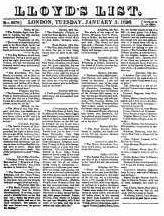
Lloyd's List, arguably the world's oldest continuously printed newspaper, has announced plans to become totally digital by the end of the year.  The paper started providing shipping news in 1734, and remains a preeminant source of shipping news, data, and analysis.

Between the rising costs of printing and mailing, a reader survey that showed that less than 2% of readers relied on the print version, and the increased opportunities for innovation offered by digital, it was an easy business decision. Even so, ending such a long tradition is difficult

In commenting on the move, Lloyd's List editor, Richard Meade, harkened back to the first days of the paper, when it was a notice pinned to the wall of a London coffee shop and noting that today its readers can still sit in coffee shops and access the paper through smartphones and tablets - in a sense maintaining tradition while expanding access, opportunity, and increasing their ability "to provide news and market intelligence for the shipping industry... in the format our customers want and need."

Source -  Lloyd's List to go all-digital,  Informa

Wednesday, September 25, 2013

Infographic: Changing News Habits

From a multinational survey of news consumers - and presented by a company marketing its own news app platform.  Still, there's some significant findings and trends on display.
  • 75% of smartphone owners and 70% of tablet owners check news through mobile devices several times a day - compared to the numbers using at least weekly for TV (74%), radio (55%), newspapers (38%), print magazines (18%) [TV includes broadcast, cable, and DBS sources]
  • Use of tablets to get news has doubled in the last year
  • The only media where half the respondents report consuming news for more than 30 minutes a day are TV and smartphones (both at 52%); 40% of tablet owners do, which is a higher share than any other medium
  • Thankfully, "accuracy" remains the most important criteria, although "fresh" (i.e. current) and "free" are cited as important by 57%.
  • 95% of news consumers get their news from aggregators (which includes traditional news outlets as well as online providers), although social media continues to make inroads. 43% report getting news from Facebook, and 28% from Twitter
  • EU news consumers report higher usage of traditional news media (newspapers, radio, TV) than USA news consumers.
“Due to mass adoption of consumer mobile devices, the access and appetite for trusted news continues to increase. People want to remain informed in a timely manner, more so now then ever before in our world’s recorded history,” said Gilles Raymond, said mobile industry veteran and CEO of Mobiles Republic. “We’ve found that reading news on tablets has more than doubled year over year. This is because the tablet allows for new trends in news consumption─ news snacking, for example, and because news syndication apps that provide all of a users favorite news sources within one app is a ready cure for information overload while increasing the user’s level of being informed on personal topics.  We believe our research can reassure the world’s primary news outlets, while also confirms they must have multiple streams of mobile news distribution in order to reach the mobile audiences and continue to thrive.”
Source - 2013 Infographic - the change in news reading habits,  Mobiles Research press release

Thursday, August 22, 2013

Battle of Las Vegas

The Las Vegas Review-Journal and Las Vegas Sun both publish daily newspapers in Las Vegas under a joint operating agreement (JOA).  Under the agreement, the two papers share printing and advertising staffs, but keep separate editorial staffs.  The current status of the JOA is unusual; instead of printing and distributing two separate newspaper editions, the Sun is published as a small advertising-free insert within the Review-Journal. The Sun, instead, has shifted its editorial focus to its online version - which has been very successful both editorially (winning several major journalism awards in recent years) and financially.  Earlier this month, the Review-Journal's owners (Stephens Media) reached an agreement with members of the Greenspun family (owners of the Sun) to "release" the Review-Journal from the JOA.

The Sun's editor and publisher, Brian Greenspun, has gone to court to challenge the proposed dissolution of the JOA.  The deal would free the Review-Journal from the burden of printing and distributing the limited insert that is the only print version of the Sun, in return for transferring ownership of the domain name www.lasvegas.com (currently leased to and run by the Las Vegas Convention and Visitors Bureau).  The cancellation of the JOA would leave the Sun without the infrastructure to print and distribute the physical edition of the paper.  The agreement also reportedly includes a non-compete clause prohibiting the production of a print newspaper or dissemination of news online, effectively killing the competition provided by the online Las Vegas Sun.  The deal was accepted by the two younger Greenspun siblings against the advice of Brian Greenspun.

Frankly, the Sun doesn't really need a print presence in Las Vegas - the current daily insert consists almost exclusively of features and is designed to minimally abide by the terms of the JOA.  Whether the JOA parties can unilaterally dissolve the agreement is debatable.  Those that have ended have done so by one of the newspapers folding.  Still, the most troubling part, and the one most likely to form the basis of a successful legal challenge, is the non-compete clause.  By its very nature, the clause is anti-competitive and flies in the face of the intent behind JOAs - maintaining competitive news presences locally.

It would be a shame to kill one of the best and most innovative online local newspapers in America.  I hope a way to let it continue operations will be found.
(And, incidentally, shifting ownership of the lasvegas.com domain name from the newspaper would increase the likelihood of a successful domain name challenge from the city or other entity like the LVCVB - so the promise of big bucks from leasing lasvegas.com may be ephemeral.)

Source -  Las Vegas Sun at Risk of Folding, Wall Street Journal
Las Vegas Sun website

Wednesday, August 14, 2013

Study Confirms: Growth of Online Classifieds Cost U.S. Newspapers $5 billion

A new academic study indicates that major US newspapers lost more than $5 billion of classified advertising to Craigslist.  The study looked at the impact of the entry of Craigslist into newspaper markets from 2000-2007, and the resulting changes in classified advertising revenues.
  The study found that those papers that relied heavily on classified advertising revenues experienced a 20% drop in classified advertising rates in response to online competition.  One consequence of the loss of classified advertising was the decline of the value of the paper to its consumers, which would impact both single copy sales and subscription levels. It also suggests that the advent of competition from online classifieds caused many newspapers to raise subscription rates to replace lost earnings, and that led to a further decline in circulation, that lead to declines in display ad rates (which are based on readership levels).  The study suggests that classified losses encouraged many newspapers to try to differentiate their content from its competitors, and less likely to make their content freely available online.
  In sum, the failure of newspapers to effectively compete with a more efficient and high-value competitor entering the market in this one sector triggered a downward spiral in both revenues and circulation.

What the study, and news report, don't bring up is that there was no reason that newspapers couldn't have entered the online classified market themselves, and captured a large share of that market.  In fact, several major newspapers had successful online classified trials in the late 1990s.  But most publishers felt that entering the online classified business might impact print circulation and sales - which it clearly did.  The problem is that rather than capturing that impact for their organization, they let somebody else grab it - and the resulting revenues and audience attention.

Sources -  Craigslist Costs Local Newspapers $5 Billion in Lost Ad Revs,  Media Daily News
"Response to Entry in Multi-Sided Markets: The Impact of Craigslist on Local Newspapers," research study by R. Seamans & F. Zhu

Tuesday, August 6, 2013

Print News Fire Sales: Post, Globe, Newsweek (again)

Three big sales over the weekend in the news field.

First was the report that the New York Times sold The Boston Globe to the owner of the Boston Red Sox baseball team, for $70 million.  Considering that the Times bought the Globe for $1.1 billion in 1993 (before the newspaper business started crashing), that's quite a loss in value.  A 93% drop in value in 20 years.  But a look at some of the details makes it look even worse.  The sale of the Globe includes a couple of small regional papers and related real estate holdings; estimates place the value of the real estate alone at nearly $70 million.  More critically, the sale did not include pension liabilities of $100 million, which the Times will retain.  As such, what the Times got won't even cover its existing pension liabilities for the Globe's employees.
   From the viewpoint of the Times, they got rid of a distraction and a drain on corporate resources.  The Globe lost about half its readership in the last ten years, and reportedly, its advertising revenue fell a further 10% in the first half of this year.  This may help the Times in their stated goal of refocusing on building the primary Times brand and growing online revenues.  And it helps a bit with those pesky pension liabilities.
   It's also been reported that the Times turned down three higher bids for the Globe.

Newsweek has another owner, as well.  The Washington Post sale of Newsweek for $1 was one of the first of the news media fire sales.  After that initial sale to Sidney Harman in 2010, ownership shifted to Barry Diller through a partnership, and the Newsweek staff and brand was integrated into online news site The Daily Beast.  Ownership later terminated the print version, refocusing Newsweek as a semi-regular focused section within the Daily Beast website.  Portents of another sale surfaced when Diller publicly indicated that acquiring Newsweek was a mistake, and its merger into the Daily Beast a failure.
   Last weekend, IBT Media, publisher of online global news site International Business Times, agreed to acquire the Newsweek brand.
"We are thrilled to welcome this iconic brand and global news property into our portfolio. We believe in the Newsweek brand and look forward to growing it, fully transformed to the digital age," said Etienne Uzac, the co-founder and CEO of IBT Media in a press release.
Terms of the deal were not announced at the time, but Newsweek was starting to tap into growing online ad revenues as a digital publication, and continued to bring in revenue from licensing its brand outside the U.S. The internationally recognized brand of Newsweek should have a positive impact on IBT brands.
Then came yesterday's unexpected blockbuster - the sale of the Washington Post to Jeff Bezos, founder and CEO of Amazon.  The announced price of $250 million certainly tops recent newspaper sales, but is also significantly less than what the Post was worth ten to twenty years ago (one analyst indicated that just 10 years ago, the Post would have been worth $2 billion).  From a financial "multiples" perspective, the announced price is less than half of the Post's 2012 revenues of $582 million; conversely, it's 5 times annual losses.  Both multiples are significantly outside industrial norms (I used to do broadcast M&A evaluations, where prices were more typically 3-5 times annual revenues, or 8-12 times annual profits).
   Furthermore, unlike most recent deals, the sale is limited to the newspaper, the Post website, some suburban papers and affiliated publications, and two printing shops.  It does not include the Post's current building or other DC area real estate, other Post Co. owned media (broadcast stations, online magazines Slate and The Root, and the international magazine Foreign Policy), or other Post Co. properties.
   As such, it does seem that Bezos may have paid a bit of a premium for the Post - for the prestige and influence of one of the U.S.'s preeminent media outlets.  As for the parent Post Co., it gets to shed that portion of its business that's been a significant drain on the company's profits and had little indication of a rapid return to profitability. As for Bezos, he announced that Post ownership will fall under a new holding company (Explore Holdings) separate from Amazon, and that current editorial and management staff will continue in place after the sale is finalized (at some point in the next two months).  Since most analysts don't see much opportunity for a quick turn-around in profits for the Post, that's probably the smart move at this time.

In all three cases, sales to innovative, accomplished, and successful businessmen may be the best move for organizations facing radical transformation of their traditional markets.  They're likely to be more willing to explore and exploit new markets, and/or developing opportunities for added revenues.  At least their focus won't be on trying to hold onto past glories.


Sources -  7 things to know about The Boston Globe's sale to John Henry, Poynter
Newsweek Magazine Sold to IBT Media, The Daily Beast
Washington Post sale: Details of Bezos deal,  Washington Post

Saturday, June 1, 2013

Chicago Sun Times dumps Photogs

The Sun Times group has fired its entire photojournalism staff - indicating that relying on candid snaps from cellphones and social media photo-sharing would appeal to an "increasingly digital-savvy" readership.  It's also been reported that all reporters will be taking mandatory iPhone workshops for photo training.

Is this validation of the shift to backpack journalism, or another short-sighted attempt to cut costs by reducing the product's value?  While I think arming all reporters with the capacity to capture photos, audio, and video can be helpful, a trained photojournalist can add value through framing and their ability to identify and capture "the moment."  And that quality is one of the few competitive advantages major news outlets have over their online competition.  Is it really one to ditch for possible short-term cost savings?

Source -  Chicago Sun Times Fires Its Entire Photo Staff