Showing posts with label WiFi. Show all posts

Tuesday, June 4, 2013

Goin' Mobile - Speeds and Content

Some quick notes on the expanding mobile broadband/online video front -

The last leg in mobile broadband for most people will be their home, office, or public WiFi loop.  Telecomm research from the Dell'Oro Group note that the wireless LAN market (i.e. WiFi) grew 17% in 2012.  But even more significantly, the new 802.11ac standard, which offers speeds up to 1 Gigabit/second data rates will be increasingly available on hardware devices this year - contributing to a convergence of wired and wireless data speeds.

There's a massive data speed war in Japan, with multiple operators offering 1 Gbps services over fiber-to-the-home (FTTH) networks, and one operator announcing the rollout of the Nuro 2Gbps FTTH residential service.  So-Net's initial pricing for 2Gbps runs around $50 a month, significantly lower than competing 1 Gpbs services. Meanwhile, Japan telco NTT is said to be working on a 10Gbps residential network, to be available in a few years. 1 Gbps networks are popping up sporadically in the U.S. and Western Europe - Google's test markets offer 1 Gbps data plus multichannel video at around $100-150, and independent 1 Gbps network operators are pricing their services at $200-250 per month.  For most potential residential subscribers, there is little noticeable difference between 2 Gbps and 1 Gbps top data speeds, or for that matter 100 Mbps (corrected  from Gbps) speeds, so there is minimal incentive to switch to ultra-broadband services - aside from bragging rights, and price.  So many analysts are cautious about the rush to ultra-fast broadband, wondering if the cost of upgrading network speeds is recoverable from residential subscription fees.

On the content front, research from ABI is predicting substantial growth in use of the movie industry's UltraViolet "content locker" initiative.  Ultraviolet offers those with accounts online access to selected movies they've purchased on home media and registered with the service.  Ultraviolet currently has 6-8 million accounts; ABI estimates that the global market is likely to reach 65 million users (100 million if several major movie distributors join the program).  What's holding up growth at the moment, the report concludes, are consumer attitudes about trust and usability.
Consumers don’t yet trust the concept, with most still opting for subscription and digital content rental services such as Netflix and Hulu. “The ease of accessing and storing digital video libraries must approach that of digital music,” noted ABI practice director Sam Rosen.

Sources -  Wireless LAN Market on Fire,  CableFAX Tech
Broadband operators must beware the dangers of FTTH 'speed race',  telecoms.com
ABI: UltraViolet Could Radiate 65 Million Accounts… or More,  CableFAX Tech

Edited to correct typo in broadband speeds in middle story.

Wednesday, February 6, 2013

Perils of Insta-News: FCC's Free WiFi?

The Internet has had a big impact on journalism, and not all of it good.  It can mean news stories breaking in seconds, lets just about anyone call themselves a journalist or a news source. And it can spread false and misleading reports rapidly and widely, as well as reveal the ignorance of journalists - even the "real", professional ones.
  We had a revealing example this week, set off by an article in the Washington Post about some FCC announcements about plans to repurpose some radio spectrum that it hopes to recover from broadcasters and older cellular systems.  This wasn't breaking news, at least for those following the issue - the FCC has had a goal of promoting wireless Internet access, and broadband access since the early days of the Obama administration.  Plans to recover spectrum have been discussed for years, and earlier this year President Obama announced plans to use part of the spectrum for a national broadband service (and part for expanding bandwidth available for public service and emergency uses).  There's also been discussions of expanding bandwidth for localized "public" WiFi uses.  And of course, broadcasters and telecomm (cellular) operators have opposed FCC proposals to grab back valuable spectrum (which would also limit their ability to expand services or offer new services in the future).
  Here's the Post lede:
The federal government wants to create super WiFi networks across the nation, so powerful and broad in reach that consumers could use them to make calls or surf the Internet without paying a cellphone bill every month. The proposal from the Federal Communications Commission has rattled the $178 billion wireless industry, which has launched a fierce lobbying effort to persuade policymakers to reconsider the idea, analysts say.
This led to an outbreak of stories about the FCC building a nationwide free WiFi network.  While the lede doesn't directly say that, you could consider that folks who don't know the difference between wireless, WiFi, WiMax, and wireless broadband, or know that the FCC only sets standards and assigns frequencies and has no specific authority to operate telecommunications systems, might jump to the wrong conclusion.  So there was a day or two of stories flying around about the FCC's "Free WiFi" plans before those who actually knew what was going on started debunking the wilder claims.
  But the problem wasn't just the jumping to wild conclusions - the basic lede is also wrong.  The government wasn't proposing to create networks; instead the reporter seems to have mixed elements of two separate proposals. One was to dedicate some (hoped-for) bandwidth to a specific use - the development of a national wireless broadband network; the other was to allow WiFi to operate in the "white spaces" of existing TV spectrum. 
  In the wireless broadband proposal, the FCC would create a new telecommunication service, national wireless broadband, and dedicate some bandwidth to be used exclusively for that service.  The FCC would set up standards, define markets, and create licenses that would be auctioned off to groups who would build the network and offer the service - most likely commercially.  There's been no serious consideration of having the FCC actually build and run the service - although there is likely to be some subsidization involved. Furthermore, the technically-inclined know that WiFi isn't a good way to provide widespread wireless broadband access - it can offer the raw bandwidth, but that bandwidth is shared with other users, and the range of the signal is fairly low.  There's a long history of cities trying free WiFi networks in neighborhoods, and educational institutions offering WiFi across campus - not with a lot of success.  Free, open-to-the-public large area WiFi is quickly overloaded, so most of those found that they needed to limit access.  In the meantime, there are alternative wireless broadband technologies available.  True 4G cellular offers wireless broadband, as do some of the newer satellite-based data services, and the new WiMax2 standard (there's a couple of others also being discussed of questionable technical viability).  Between the desire to maximize auction revenues, and the significant infrastructure costs that would be involved, there's little chance that any resulting service would be "free."  In addition, while many of the concerns being voiced are coming from big telecomm, they're more about the spectrum grab that will be used to provide the bandwidth for the new service, the need for a totally new service when viable services already exist, and whether the subsidies being talked about might not be used more effectively at expanding those into less economically-viable areas, or subsidizing service costs.
  The WiFi "white space" proposal is quite different.  Existing WiFi operates in "public" bandwidth - parts of the spectrum that the FCC has opened for the public to use on an "as available" basis.  Use of those frequencies for WiFi do not require licenses from the FCC, but they also don't guarantee availability.  Rapid diffusion of WiFi, and other authorized uses for that spectrum, has led to some overcrowding and slowed data rates in high-traffic areas.  Since the authorized uses are low-power and highly localized (20-35 meter diameter for WiFi), the FCC is considering allowing WiFi to use what is called "white space."  White space refers to areas where the primary licensee's signal is weak or doesn't reach.  Broadcasters on the same, or adjacent, channels have to be a certain distance apart so that they don't interfere with one another.  As a result, there are a lot of channels in communities where there is no existing signal.  The FCC is considering letting WiFi, which already searches for available channels within currently designated bands, to also search for available "white space" in the TV bands and use those if they were currently unused.  The TV industry, in response, has voiced concerns about their part of the spectrum grab, and the possibility that the low-power WiFi could create some signal interference for the primary licensed signal.  Opening up the white space would expand the usable bandwidth for the "public" WiFi service and expand the overall capacity of WiFi.  But it wouldn't specifically make it public in the sense of freely available or noncommercial, and it certainly wouldn't have any impact of costs.
  There's nothing in either specifically addressing IP telephony or Internet surfing in these plans.  And while the moves may help expand wireless and allow Net access via methods other than mobile cellular, at some point those wireless options connect to wired gateways, and someone is paying for that connection.  There's no free lunch implied or promised.  Even with subsidies or mandated service access, someone is paying - you're just shifting the cost burden elsewhere.
  As for lobbying, yes there's some - but it's not all that fierce or directed in the way suggested in the article.  The reporter, in fact, bases this on the concerns of "some analysts," and fails to identify any specific corporate or telecomm lobbying effort.  Even the concerns of "consumer advocates" is false - when it comes to cellphones and Internet access, the poor often have greater access and use than wealthier demographics.  (While they may not "afford it", they do end up using it).

  Journalists really should become better informed and less credulous, particularly when some group is pushing a story or meme.  All this hyperbole and jumping to conclusions isn't helping their credibility.

Source:  There Is No FCC Plan for Free Super Wi-Fi,  Slate.com
Tech, telecomm giants take sides as FCC proposes large public WiFi networks, Washington Post

Tuesday, January 8, 2013

Tech on the Edge

From a Popular Mechanics article on top tech terminology for 2013 -

Cognitive Radio - Not so much a new kind of radio, but a way of identifying and using the small bits and pieces of radio frequency available locally in order to push more data faster than current Wifi applications.  There's a test market that's using cognitive radio technology for mobile broadband and VoIP (Voice over IP) applications. 
Basically a smarter way to make more efficient use of small unused gaps in existing radio spectrum devoted to TV, radio, and other applications (known as white space) - and bypassing the problems inherent in needing to find and reserve a block of scarce spectrum for new services.  Could lead to a big boost in mobile broadband and TV Everywhere applications.

Targeted Tweets - Social media is public - and can be data mined.  This new "tech" refers to the ability of advertisers and others to automatically scan posts for key target audience elements, and then sent you highly targeted ads/offers.

IGZO Displays - replacing the flat back plane of current LCD displays with a printed iridium gallium zinc oxide (IGZO) semiconductor on a flexible surface, you can get more pixels for your screen while using less electricity - so sharper images and longer battery life for mobile devices.  They're already getting more pixels per inch than Apple's retina displays.  Expect to see them available on smartphones later this year.

Single Board Computers - not quite a computer on a chip, but with standardized interfaces you can plug it into (or build it into) a digital TV, add a keyboard/mouse, some cheap memory (SD cards) and you're good to go (for about $25).  Maybe not so big a deal in the West, but it could finally make computing affordable and ubiquitous in the rest of the world..

Source - The 10 Tech Terms to Know in 2013, Popular Mechanics

Tuesday, November 27, 2012

Verizon FiOS - (Some) TV Everywhere (at home)

Verizon first started experimenting with streaming live TV channels to tablets a couple of years ago, and had announced plans to make most of the channels on their FiOS system available to customers.  Then copyright and licensing got in the way.  Verizon argued that the multichannel licenses they held and subscribers paid for entitled them to watch the channels regardless of whether it was delivered to a TV set through a set-top box or to a tablet through WiFi.  The cable networks argued that since the licenses were made before WiFi streaming was viable, it did not include that delivery method, and they wanted extra cash to extend license coverage to streaming options.
  It appears that an agreement's been reached, at least for 75 cable networks.  Last week, Verizon debuted an updated FiOS app for the iPad that offers live streaming of 75 networks (or at least as many as subscribers are paying for).  The app also includes the ability to browse and search program listings, update set-top box (STB) settings, program DVRs, and act as a remote for the STB. 
  However, all that only works when the subscribers have paid for a video bundle that includes the channel, subscribes to FiOS Internet service, and uses a Verizon-supplied WiFi router.  In addition, the live program streaming to iPads only works over WiFi in the subscriber's home.  Finally, at least for now, it does not include local stations feed or major broadcast networks.

Not quite "TV Everywhere", but it's a welcome start.

Source  -  FiOS Tucks Into Table TV, Multichannel News

Monday, November 19, 2012

Smartphones rely on Wifi for data

A new study of smartphone use in the UK finds that almost 80% of data traffic to Android phones is carried over Wifi.  The Nielsen study used an app that recorded how data was received, on a sample of 1500 Android smartphone users.
“Wifi is on average three-and-a-half times more dominant than 3G when it comes to delivering mobile internet data services,” said David Gosen, managing director for digital at Nielsen Europe.  “It peaks around midnight as users gravitate towards social networks, driven by their desire to stay connected through all waking hours."
The big difference is pricing, I suspect.

Source - Wifi carries 78% of UK Android datatelecoms.com

edit - added headline

Monday, October 15, 2012

New Life for Phone Booths

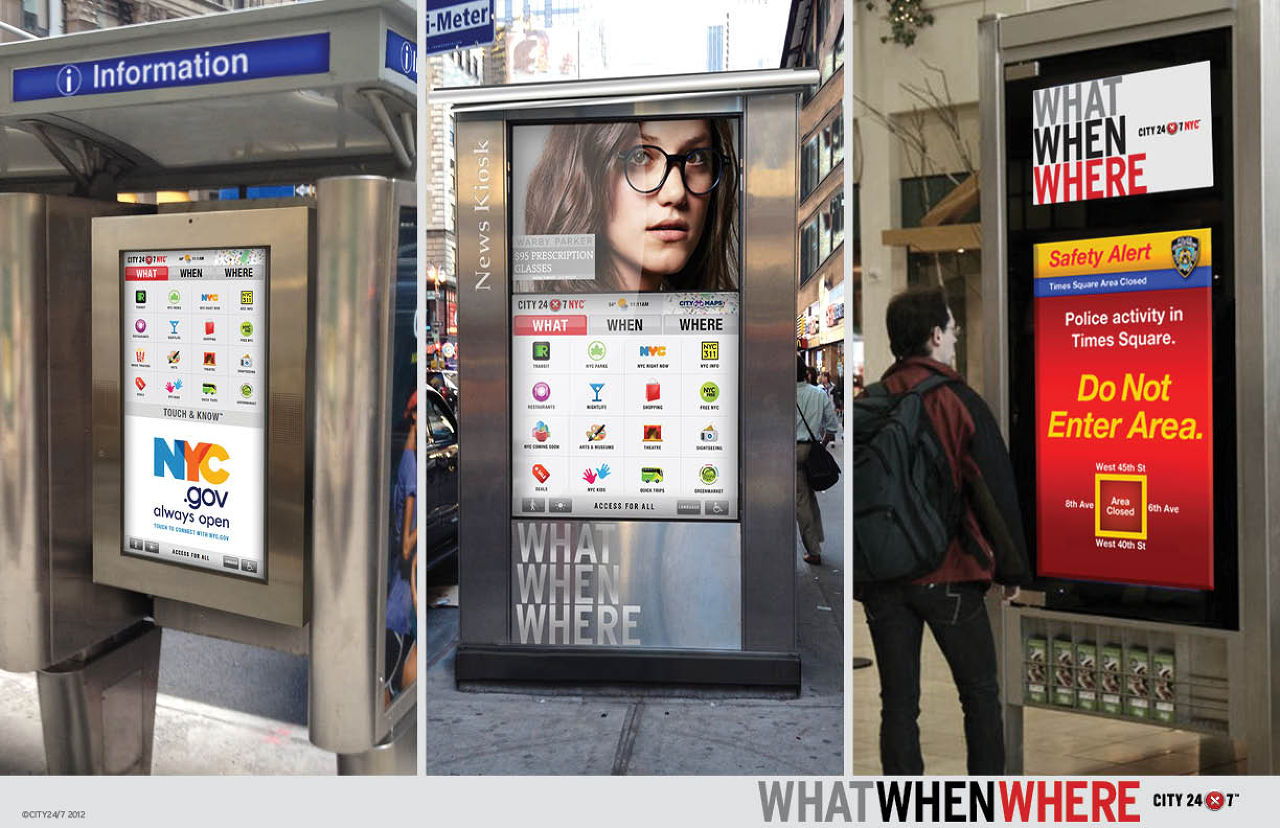
In New York, City24x7 is turning old phone booths into Information HotSpots.  Replacing the old landline phone is a large net-connected touchscreen and free Wi-Fi hotspot.  The screen displays real-time information about what's happening nearby - local news, transportation info, reviews of local merchants, bars & restaurants, warnings of weather or environmental hazards and through WiFi, notify authorities of emergencies.  Eventually they want to add Skype functionality
"We’re trying to use technology and new social media to inform, project, and revitalize cities," says City24x7 CEO Tom Touchet.
City24x7 is currently finishing a pilot test in New York, which successfully integrated existing apps social input into a screen that provides information "tailored to your exact location and available in one place."  The pilot also generated a lot of interest from potential advertisers, who can use the displays to send out highly targeted messages.  Soon, the company hopes to install 250 SmartScreens throughout New York, and is already talking about expanding the service to some 20 other cities around the globe.  Once out of pilot status, cities will receive about a third of revenues generated by the screens.

Source -  Turning Old Phone Booths Into Digital Information Hubs, FastCompany Co-Exist

Friday, September 21, 2012

No Surprise - Most Mobile Video Delivered Through WiFi

The latest report from mobile video ad network Rhythm NewMedia suggests that 70% of videos delivered to mobile devices uses WiFi for the data streams.  That's up from last year, when about half used WiFi for mobile video access.  (The numbers are for delivery of their videos, but should reflect general use patterns).  Their most recent quarterly report also indicated that half of tablet users watched videos or clips on their tablets more than once a week; the report for the previous quarter noted that people had a strong preference for tablets over smartphones for their viewing.  Rhythm NewMedia also noted that a survey indicated that more than half of tablets are shared by 2 or more users, while smartphones are rarely shared.
  Another survey result suggested that mobile news users may be starting to regularize their news consumption - about half of those who visited a news site on their mobile devices "today" had also visited that site "yesterday".   This suggests a certain stickiness that could evolve into habit.
  The report suggested several factors that contributed to the continued growth of mobile video use and the increased use of WiFi - the proliferation of WiFi networks, particularly in homes; the rapid adoption of tablets (primarily used at home); and a conscious shift to WiFi from wireless as wireless operators shift to capped data plans that can ring up heavy data charges for mobile video users.  In addition, there is a separate trend in terms of increasing use of online videos and video streaming - a report from Cisco projects continued growth in the share of all mobile traffic.  In 2011, video accounted for 52% of mobile data flow; Cisco predicted that video will have accounted for 58% of all mobile traffic in 2012.

Source - Rhythm: Wi-Fi Powering Most Mobile VideoOnline Media Daily

Wednesday, September 12, 2012

Cybercrime enters Mobile, Social Markets

Symantic has released the findings of a 2012 report on cybercrime that shows significant increases in "malicious activity" in mobile and social networks.  The report suggests that cybercrime costs consumers more than $110 billion globally ($21 billion in the U.S.) and affects roughly 1.5 million consumers daily.
Mobile vulnerabilities have doubled from 2010 to 2011, which can make consumers leery of clicking on mobile ads. Symantec notes that 31% of mobile users have received a text message from someone they didn't know requesting they click on an embedded link or dial an unknown number to retrieve voice mail. Some 44% don't know security platforms exist, and two-thirds of adults have lost their device or had it stolen.
In social, four out of 10 users have fallen victim to cybercrime, one in six users report that someone hacked into their profile, and one in 10 social users have been affected by a scam or fake link on a social network platform.
The study is based on responses from more than 13,000 online adults in 24 countries.  Two thirds of this group reported that they had been victims of cybercrime, and 31% said they had received a text message from someone they didn't know with an embedded link or unknown phone number (to get a voicemail message).
  The report suggests that a major access point for mobile cybercrime is the use of free and unsecured WiFi, particularly to access emails.  WiFi signals are easily intercepted, and many free and public WiFi access points don't use encryption between users and the WiFi node.  This can give hackers and criminals access to your keystrokes (which may include account log-ins and passwords) if the users aren't going through a secure site. Two-thirds of respondents reported regularly using free public or unsecured WiFi. Among those using unsecured WiFi for access, 67% report accessing personal emails63% reported accessing social media accounts, 31% reported shopping online, and 24$ access their bank accounts.
  Symantic suggests making sure that you use secure transmissions and sites when providing personal information - including account names and numbers, log-in IDs, and passwords.  They also indicate that having strong passwords can be a strong deterrent.  While it's tough to prevent a determined hacker, the harder you make it (strong passwords, secure systems, etc.), the less chance they'll bother with you.

Sources -  Mobile Social Registers Rise in CybercrimeOnlineMediaDaily
Slides for 2012 Norton Cybercrime Report

Thursday, July 19, 2012

FCC - Wireless broadband may take a while

Earlier this year, Congress gave the FCC part of what it wanted to set up a nationwide broadband WiFi service, setting aside a chunk of spectrum for wireless broadband from recovered TV broadcast spectrum.  However, the legislation also made the spectrum giveback voluntary for TV stations.  As a result, most experts foresaw difficulties in pulling together enough concentrated spectrum to generate the 80 megahertz sought.
  FCC Commissioner Robert McDowell outlined the problems at the Mobile Marketplace conference Monday.  Strong resistance from TV broadcasters make a quick, smooth, transition unlikely.  Likening the complexity of the situation to "three-level chess," McDowell outlined the FCC's current thinking on the process.
In the first phase, a “reverse auction"--in which multiple stations will compete to sell spectrum to the FCC -- those that want to turn over some or all of their spectrum can seek the price they want, but without any guarantee they'll get it.  If two or more stations in a market offer to sell spectrum, the FCC would be able to choose the lowest price. Then, in a regular “forward auction,” the FCC will resell the frequencies to wireless operators bidding for airwaves.
One problem with the current approach is that unless there is a rush by stations to give back valuable spectrum and/or tack on the costs of moving frequencies, there is no guarantee that the local 6 mHz TV channels returned will be either consistently available, or adjoining (to form coherent spectrum), on a national basis.  Thus, McDowell stressed the need to "design your apps as efficiently as possible," in order to provide the flexibility to deal with what is likely to be a piecemeal spectrum availability in the near term. 
“I don’t anticipate any major chunks of spectrum getting into the hands of consumers for the better part of a decade,” he concluded.

Source - FCC: Bandwidth Relief Not In Sight, Online Media Daily

Related posts - Congress approves TV Spectrum auction (sort of)
Spectrum Spat Continues - Will the Real Squatter Please Stand Up?

Tuesday, February 21, 2012

PolicyFail with a vengeance. LightSquared and the push for broadband WiFi

I've posted a couple of times before on LightSquared's effort to usurp frequencies designated for GPS in order to offer a national broadband WiFi service (here) and the debate over whether or not there was sufficient unused spectrum available to host such a service elsewhere (here).  Now, evidence is mounting that the FCC's actions were less concerned with promoting a viable alternative broadband service than with rewarding high Democratic officials with ownership stakes in LightSquared and heavy donors to political campaigns.
  First, though, let me set the stage.  The FCC, under Obama, has actively and forcefully promoted the diffusion of broadband telecommunications systems.  One perceived roadblock to those efforts is the fact that in many rural areas, land-based broadband systems are not economically viable, and in other areas, the market can support only one land-based broadband service, which then is under no real pressure to keep their prices low.  The idea of a national wireless broadband service could offer, at a minimum, added competition in the broadband marketplace, and potentially, a way to extend an economically viable broadband service to rural areas.  Mobile services are rolling out a broadband data service as 4G and 4G LTE, but the data speeds are at the low end of what is considered "broadband".
  The problem is that there is no specific frequency allocation set aside for a national high-speed broadband WiFi service. So the question became one of where could the FCC find spectrum that could be repurposed to deliver a national broadband WiFi service?  One early proposal was in grabbing some of the broadcast TV spectrum freed up with the move to digital transmissions.  There were problems with that idea - existing individual channel allocations were too small for broadband WiFi, and that those frequencies were scattered across the remaining spectrum allocated for broadcast services; that is, there was too little continuous spectrum available to offer the kind of service the FCC wanted.  So the FCC proposed a more drastic solution: they would take back a larger block of spectrum, forcing hundreds of stations to move to other frequencies and forcing others off the air, as there would be no viable alternative frequencies left for them to use (see here for details).  And even with this proposal, there would be insufficient spectrum for a broad-based consumer broadband WiFi - so the FCC proposed using it for an emergency services broadband WiFi system.
  The spectrum needed for a national consumer broadband WiFi was more likely to come from the higher frequencies reserved for satellite broadcasting.  The FCC granted three companies licenses to explore the potential of a satellite-based national wireless broadband service, but it soon became apparent that the higher costs of a satellite-based service would limit demand to the point that it was not a viable alternative.  One of those three licensees, which would later evolve into LightSquared, floated the idea of converting their satellite-based license to a ground-based license for broadband WiFi.  (In the meantime, the company had leased their satellite and spectrum for use in the Global Positioning Satellite (GPS) system.)
  It's at this point that things get interesting, and arguably political.  The FCC decided to allow the satellite operators to petition to have their grant extended from satellite-only to satellite and ground-based allocation - but the application window was opened and closed before any formal notice of the option was published - and Lightsquared was the only firm that got their petition in, and the petition was approved without any public hearing or chance for public comment (all violations of standard FCC rules and guidelines).  The other two firms with the experimental licenses also petitioned, but were told they had missed the deadline (that the FCC had not bothered to inform them of).  Analysts estimated that the shift from satellite to ground-based uses increased the value of LightSquared's license by $10 billion.
  There was a bigger potential problem, however.  The ground-based broadband WiFi system LightSquared proposed could interfere with GPS systems.  At first, LightSquared claimed there would be no interference, but early tests showed significant interference with both civilian and military GPS service.  In testimony before Congress, military and civilian experts charged with overseeing GPS indicated that LightSquared's proposed system would create problems for 80-90% of the current GPS devices (despite efforts from the White House to have them change their testimony).  LightSquared's response was that individuals could replace their GPS devices with ones less prone to interference, and then announcing they had a technical "fix".  Testing of the fix showed it didn't fix anything.  Even more troubling was that when the FCC's technical working groups finally got around to looking at LightSquared's proposal, they reported that there was conclusive evidence that "LightSquared's proposed operations defy the laws of physics, and therefore simply will not work," that going ahead with the various shifting variations of LightSquared plans "would cause such widespread harmful interference that it would severely cripple GPS," and that the only viable solution was to move the wireless broadband use "out of the MSS band altogether" (The MSS band includes both GPS and LightSquared's current frequency assignments).
  After months of mounting evidence against the system, the FCC finally revoked it's approval, leaving LightSquared with few assets to offset $1.6 billion in loans.  Monday, it defaulted on a $56.3 million payment to satellite operator Inmarsat, and last Friday a group of its investors filed suit, charging that LightSquared's managers had squandered billions in pursuing the broadband WiFi proposal.
  Meanwhile, reporters at The Daily Caller have been investigating why LightSquared received the favorable treatment it did, and why the FCC appeared to actively seek to remove potential competitors from the wireless broadband marketplace.  They've identified administration officials with investments in LightSquared, LightSquared's hiring of former officials, and patterns of political campaign donations following meetings with officials at the FCC and White House.  They've also obtained documents outlining deals and commitments the FCC provided LightSqaured well in advance of official actions - and one interesting instance of the FCC responding to a letter from Congress before it says it received the letter.  Will LightSquared become another instance of crony capitalism and poor judgement? 

Sources -  Documents: LightSquared shaping up as the FCC's Solyndra, The Daily Caller
LightSquared Bad News Keeps Coming, Wall Street Journal Deal Journal blog

Friday, September 23, 2011

Lightsquared - The Technologies, Issues, and Problems

You may have heard of the growing political scandal linked to the promotion of LightSquared, a start-up hoping to use a combination of terrestrial towers interconnected by satellites to create a new high-speed (4G) wireless network.
While the system may be conceptually interesting and viable, the history of LightSquared, the specifics of the proposed terrestrial-satellite system, and the process by which it gained initial approval and license are more problematic.  Most recently, claims of attempted White House interference and  influence of government and military figures testifying before Congress on the results of early testing of the LightSquared system, which showed a strong potential to interfere with military, government, and private GPS systems.
Lightsquared, or at least its precursor, was one of three companies given initial approval to test the viability of delivering broadband internet connectivity through a satellite-based system.  Apparently, it soon found that the costs of a satellite-only system did not generate the level of demand it felt it needed to be successful.  It asked the FCC to expand the satellite frequency grant to cover terrestrial uses as well.  Apparently, instead of going through the normal petition process, it approached the Chairman of the FCC's office for expedited approval.  The office opened a shortened petition process on the evening before Thanksgiving, and closed it before there was any formally published announcement of the petition (and allegedly, without even informing other FCC Commissioners of the action).  The petition was granted to Lightsquared (again, apparently without the knowledge or approval of other FCC Commissioners or the Office responsible for that aspect of broadcast usages.  Further, it's claimed that the other two satellite service firms petitioned for similar treatment, they were told no, that they had missed the petition window.  The extension of the bandwidth grant to terrestrial use boosted the asset value of LightSquared's satellite bandwidth by about $10 billion, which sent its stock price rising.  It's reported that a number of friends and political supporters of the FCC Chairman, including President Obama, bought stock in Lightsquared around that time.  The President has since sold his holdings, but a number of friends and supporters remain stockholders and investors, and LightSquared ownership and management continue to give heavily to various Democratic and Presidential campaigns.
While this may be somewhat sleazy, the real problem is what Lightsquared proposed to do with the terrestrial-use extension.  The bandwidth that Lightsquared and the other firms were assigned are near the frequencies used for GPS (global positioning systems).  As a satellite system, because the satellites would be in different positions, and the signals of relatively low power, there was little potential for interference between GPS and the proposed satellite-based broadband services.  What LightSquared now planned to do with its permission to use their frequencies for terrestrial services, however, was to build a nationwide system of 40,000 towers to serve as the primary wireless access point, and use the satellite system to connect the towers with Internet backbone access points.  The terrestrial system would need to operate at a much higher power level than the power levels of satellite-based systems (including GPS) at ground level.  Between the higher power and the closer proximity to ground or even air-based GPS receivers, there was, with the proposed terrestrial tower system, a significant potential for interference - that the LightSquared signals would drown out GPS signals.  Results from early tests of prototype systems showed that LightSquared signals did create interference with GPS signals, leaving "dead spots" miles in diameter near their terrestrial towers.
That's where politics arguably intrudes again.  When Congress asked the military and civilian officials charged with oversight of the GPS system to testify as to the impact of the proposed LightSquared, the officials were apparently approached by people in the White House to change their testimony, minimizing any concern about interference, and to specifically include a paragraph indicating that they felt any potential problem would likely be resolved within 90 days.  It's been charged that this was to expedite FCC action on final approval for the LightSquared system.  However, both officials not only declined to change their testimony and include the paragraph, but testified about the attempt to influence, that the concern about potential interference was real and significant, and could significantly disrupt both civilian and military GPS use.  They also characterized the idea that problems could be resolved so quickly, or without significant cost to GPS users, was, frankly, ridiculous.  Congress has now advised the FCC Chairman not to proceed with any further action on LightSquared until a number of issues (including potential securities fraud and influence-peddling charges) have been resolved.
Lightsquared has responded with a claim that it has a "simple filter" that will limit interference on "99.5%" of GPS receivers. aGoing on the offensive, it argued that it "can't believe that such a terrific national benefit as a new national wireless network" could be held up by a problem with a few hundred thousand unfixable GPS devices.  Their announcement also blames the GPS industry for using the frequencies they were assigned by the FCC, claiming the industry failed to install filters to correct for problems it didn't know about and weren't available, and suggesting that the commercial GPS industry unfairly benefits from the government's $18 billion GPS network.  Apparently, it's ok for LightSquared to benefit from a $10 billion subsidy it got from the FCC's extension of terrestrial rights (which kept it from having to bid for, and pay the government for, the terrestrial usage rights for the bandwidth it wants to use), but it's not reasonable that hundreds of millions of individuals can benefit from using a federally-provided service.  They also hope that no one correctly makes the connection that Lightsquared's solution would require replacing that "99.5%" of GPS devices with ones using their filter, and that the replacement costs, or the costs of finding ways to add the filter externally, would be borne by GPS users. 
But the response that's likely to be most problematic is from the FCC technical working groups that studied the proposed system and "fix" found conclusive evidence that "LightSquared's proposed operations defy the law of physics, and therefore simply will not work," that going ahead with the various shifting variations of LightSquared plans "would cause such widespread harmful interference that it would severely cripple GPS," and that the only viable solution was to move the wireless broadband use "out of the MSS band altogether" (The MSS band includes both GPS and LightSquared's current frequency assignments).
Physics and reason should, at a minimum, put a hold on approval for the proposed system.  You have the technical experts in the FCC, the military, and in the executive branch office responsible for maintaining the GPS system all testifying under oath that there are problems with the proposed LightSquared system - problems that are likely to create significant service disruptions in a widely-used public system, and that the disruptions could have serious consequences that could threaten public safety and military uses.
One the other hand, you  have a company in a press release claiming it has a miraculous quick fix that was rebuked by technical experts, would place the cost of the fix fully upon the users of GPS devices, and that anyway, it was all the commercial GPS industry's fault for operating in their assigned frequencies and not anticipating, years ago, the need to install "fixes" for a new proposed system - one that would be solely responsible for creating the problem, and whose technical details have only recently been made public.
It's pretty clear that LightSquared thinks we're all rubes - at least if it thought any of there arguments were reasonable or rational.  I guess the real question is whether whoever in the White House and the FCC Chairman's office is pushing this epitome of crony capitalism agrees, and continues to support this farce.

Sources: GPS industry rages: LightSquared 4G network would "defy" laws of physics, ars technica
myriad other sites

Wednesday, April 27, 2011

How the FCC can promote broadband deployment ;)

Last fall, the FCC created a Technical Advisory Committee (TAC) to look into ways the Commission could enhance innovation, create jobs, and increase competition in broadband deployment.  Monday, the TAC released a initial report that included 8 specific recommendations.
1. "Recognize" those municipalities that have expedited broadband deployment
2. Ask the White House to order the approval process to work faster.
3. Use the FCC's "leadership pulpit" to ask states to streamline their approval process
4. Offer workshops on new ways to deploy broadband
5. Create a website with content promoting deployment that local governments could stick their name on to make it look like they're actually doing something productive.
6. To redefine how we measure broadband deployment so it looks like we're deploying faster
7. Try to scare people by highlighting concerns that some devices might not work with newer systems
8. Work with other federal agencies to encourage deployment, say by putting cell and wifi towers on federal buildings and offices..

I have to say, "Wow!! What great suggestions! Praising some folks, scaring others, and creating promotional materials and "workshops" is sure going to help clear all the regulatory hurdles, raise all the capital, expand demand, and create all the technology needed for broadband deployment."  Good thing they included #6 - let's forget about actual deployment and change meanings so we can claim faster and more complete deployment.  As for #2, good luck in getting a White House that has delighted in adding regulatory hurdles in almost every other area to take seriously a suggestion to reduce and streamline regulatory oversight.  They might mouth the words, but action is likely to go the other way.

But what do you expect from a government commission?  Actual practical suggestions that might work?

Source: "Technical Advisory Committee: Eight easy ways the FCC can help fuel broadband deployment," Connected Planet.

Tuesday, April 5, 2011

The Return of Municipal Broadband (updated)

About a decade ago, there was a strong push for local communities to build and operate their own broadband networks, either as a ground-based fiber network, or through a municipal WiFi network.  At the time, the technology was perhaps a bit raw and expensive.  That, along with objections from existing public service telecomm providers (mostly telcos and cable systems), and their success in some states in getting state law to block city-owned networks, slowed development and reduced expectations of success.  And when the major initial outside players (EarthLink in WiFi and Google) dropped out, the idea of municipal nonprofit broadband faded into the background.
But apparently the idea hasn't completely disappeared.  The Institute for Local Self-Reliance, a community advocacy group, has issued a report showing that over 100 communities around the U.S. have built their own fiber-based broadband networks.  Eventually, they hope to include municipal WiFi and fiber to business networks, but for now they're concentrating on lobbying the FCC and various state legislatures to stop the spread of legislation limiting the development of municipally owned networks.

Source: "Community advocate: Muni-broadband networks top 100,Connected Planet

Also: ILSR website
         ILSR report, "Publicly Owned Broadband Networks: Averting the Looming Broadband Monopoly"
         ILSR interactive Community Broadband Network Map

Update: Found another Broadband "map" of interest, and added it to the Net Resources section.

M-Lab's Visualization of broadband performance using M-Lab data.
  This map focuses on actual performance of broadband networks, and uses a visualization process in conjunction with Google maps and data. 

Tuesday, March 8, 2011

AT&T's U-verse - Coming Soon?

As I've mentioned a couple of times in class, you can see the thick AT&T U-verse cable being laid along the river-side edge of campus, on its way to the downtown telephone hub.
It's a local reminder of U-Verse's rapid expansion, which surpassed 3 million TV customers in January.  Further promoting this expansion is the FCC's approval of a WiFi set-top-box for Pay TV, which means that you won't have to run your home computer network to all of your TVs, saving time and money.

Source: "AT&T touts U-verse TV's fast growth, as WiFi set-top box approved," Connected Planet

Monday, January 31, 2011

FCC approves "Super Wi-Fi" Initiative

The FCC has granted applications from nine firms, including Google, to begin building the databases needed to coordinate the use of broadcast "white space" to form "Super-WiFi" networks.
If you're not up with the jargon, "white space" refers to parts of the radio spectrum reserved for television broadcasting, but serve primarily as a buffer to reduce interference between TV signals, rather than carrying a usable television signal.  Because the frequencies available as white space depend on what broadcast television signals are nearby, and because WiFi is envisioned as a micro-local service (the low power reduces the chance of interference with broadcast television signals) with multiple service providers, there is a need to identify and coordinate WiFi outlets in order to provide a nationally networked "Super-WiFi" service.  This FCC ruling is just a first, and conditional, step in the process.
The future of "Super-WiFi" still faces a number of challenges.  First, two TV trade associations are suing to block the plan, arguing that there are insufficient protections against interference with local broadcast television signals.  Second, the development of "Super-WiFi" type networks in other frequency ranges has proved to be difficult and expensive when tried.  Third, with the growth in "free" WiFi access locations and the rise of 3G and 4G mobile services and their ability to handle data, there is less visible demand for pay WiFi networks - raising some questions about their ultimate commercial viability.
Information Week story on FCC action.