Showing posts with label Microsoft. Show all posts

Tuesday, September 3, 2013

Microsoft/Nokia deal reveals shifting dynamics of mobile

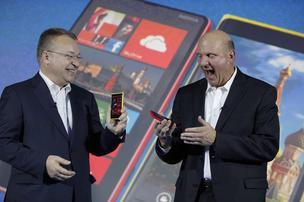
Microsoft will spend more than $7 billion to buy Nokia's cellphone manufacturing business, smartphone operations, and to license its patents - which press releases touted as "substantially all" of the Nokia business. 
  It wasn't clear in early reports just what would be left of Nokia after the deal (which includes 22.000 employees, including Nokia's CEO and other top executives, moving to Microsoft).  Nokia, which started as a paper and rubber manufacturer, moved into the production of telecommunications cables in the early 1920s, and from there started moving into electronic manufacturing in the 1960s.  Nokia moved into the cellphone business in the 1980s, growing to become the world's largest vendor of cellphones from 1998 to 2012.  Along the way, Nokia also moved into the mobile services business, and divested itself of most non-mobile related businesses in the late 1990s to focus on mobile businesses.  However, Nokia never did well in the smartphone business, and fell from the world's top vendor of mobile devices in 2011 and early 2012, to the tenth largest in 2013.  It's not clear what role Nokia's commitment to Microsoft's mobile OS for its smartphones in 2011 contributed to the decline.  But that may have been a major factor in the deal, and in the speculation that Nokia CEO Stephen Elop is among the contenders for Microsoft CEO (Microsoft's current CEO Steve Ballmer has announced plans to retire once a new CEO is named).
  The deal will provide Microsoft with immediate entry into the mobile handset business, and Nokia's mobile business and patents may help Microsoft improve it's own mobile OS - currently accounting for just 3% of the US smartphone market.  On the other hand, neither company has been very successful in recent years in keeping pace with the rapid pace of innovation in the mobile sector.  Nokia's revenues have fallen by more than half in the last few years, and the sale can be seen as Nokia's attempt to get what it can for a deteriorating business that's unsure whether it can keep up with Apple and Samsung in the smartphone and tablet business that's come to dominate mobile.
Al Hilwa, an analyst at IDC, noted the price was almost too good to pass up for Microsoft, which ended up paying less for Nokia's smartphone business than the $8.5 billion it did for the communications service Skype in 2011.
It's also, perhaps, the last best chance that Microsoft has to become a major player in the mobile market.  As part of the deal, Nokia will abandon its own Symbian OS for its cellphones in favor of Microsoft's Windows Phone 7 OS.  With Nokia's established user base, that will vault Windows into becoming a major competitor with Apple and Android - if it can keep that user base from switching.
"It's an all-or-nothing bet," (said Gartner analyst Van) Baker. "They have to be successful in the marketplace because there won't be anyone else to fall back on."
Given the two once-giant's performance lately - particularly in the mobile market - I'm not sure that the possible efficiencies of integrated mobile hardware and software development in the smartphone business will be enough.  In mobile, you also need to be quick and nimble - something Microsoft and Nokia haven't demonstrated in the last few years.

Source -  Microsoft to Buy Nokia Mobile Business in $7 Billion Deal, The Wall Street Journal
Enterprise Mobility: Microsoft, Nokia Partnership is a Major Blunder: 10 Reasons Why,  eWeek

Tuesday, July 24, 2012

Will Windows 8 be too pricy?

Microsoft is hoping to break into the tablet marketplace with the mobile version of Windows 8 (Windows 8 RT), along with its own announced tablet, called the Surface.  While the product announcement of the Surface included a couple of interesting hardware innovations, most analysts felt that that it wasn't quite up to iPad standards.  In fact, many saw the included keyboard (one of the interesting innovations) and with the announced OS being a version of the new Windows 8 operating system, the Surface would be more of a competitor for laptops and desktops, rather than pure tablets.
  This week, Microsoft made another announcement that's likely to put the Surface and other tablets running Windows 8 at a competitive disadvantage in the growing tablet market.  Microsoft has announced that when Windows 8 goes live, the minimum price for apps at the online Windows app store will be $1.49 (with Microsoft getting 30%, and forwarding payments only at $200 total sales increments).  That puts the minimum price for Windows 8 apps 50% higher than the minimum for paid apps in Apple's App Store or for Android OS apps at Google Play or Amazon's AppStore for its Kindle.  Further, studies are showing that most of the paid apps sold are at the minimum price (99 cents); that most tablet owners have dozens, if not hundreds of apps; and that which OS a tablet runs is a primary factor driving tablet purchases (often for presence of apps, or so that previously purchased apps are transferable).  Add to that the report that Microsoft is charging tablet manufacturers $80-90 a unit for the Windows 8 RT OS, compared to Android being a free OS, and Apple's iOS being effectively free, and you can see that Windows RT tablets are likely to be more costly to purchase, and more costly to stock with apps, than tablets running either of the two currently dominant mobile operating systems.  This places Windows 8 RT tablets at a considerable competitive disadvantage to start - at least in the tablet marketplace.
  Windows-based tablets might be able to overcome that disadvantage if the Windows 8 RT OS offers significant advantages over competing tablets and operating systems.  But looking at the rather dismal track record of Windows mobile operating systems, I'm doubtful that Microsoft will be able to offer anything that would give it a long-term competitive advantage for tablet users.  Windows may be the dominant OS for PCs and laptops, but that is due in large part to the huge amount of legacy software and the costs of conversion associated with shifting to another operating system.  It doesn't have that advantage in mobile.
  But it could be an advantage for those seeking a more portable replacement for desktops or laptops.


Sources -  Windows 8: No 99-cent Apps For YouInformationWeek
Windows 8 should NOT compete iPad priceWindowsMobile8.com
Making money with your apps through the Windows Store, Microsoft Developer Network document

Thursday, July 12, 2012

NBC to acquire Microsoft share of MSNBC.com

Howard Kurtz is reporting that NBC and Microsoft are planning to end their joint participation in MSNBC.
  MSNBC was originally formed in 2005 as a joint operation designed to create both a cable news channel and a major online news outlet.  Later than year, NBC took over operations of the cable channel, while MSNBC.com remained a joint venture.  MSNBC.com used content from the various NBC news operations, but also did its own original reporting as well as aggregating news content from the AP, Reuters, the NY Times and other news outlets.  Most of the aggregator content comes through Microsoft's deals with content creators in support of its search engines and various other gateways (like MSNBC.com). Currently about half of MSNBC.com's traffic from Microsoft's MSN networks.  While any deal is likely to include some effort from Microsoft to continue to steer users to MSNBC.com, the story doesn't say whether NBC will continue to have access to content created or licensed by Microsoft.
  Kurtz reported that NBC executives have been frustrated that it didn't control the online site, and thus didn't have a separate location to promoting the personalities of the cable network.  One plan would have MSNBC,com chief Charlie Tillghast would continue to run the site, but that operations would move from its current location on Microsoft's Washington state campus.  That plan would also cut the sites staff in half, with no initial indication of new hires once NBC's online news efforts are consolidated.  There are also indications that NBC wants to rename and rebrand both the online news site and the cable channel.
  Kurtz is reporting that while NBC maintains that no deal is in place, employees of MSNBC.com have already been briefed on the plan and how it will affect them.

Source  -  NBC, Microsoft Getting Online DivorceThe Daily Beast

Thursday, June 21, 2012

Microsoft Enters Tablet Market

Earlier this week, Microsoft announced its entry into the tablet marketplace with the Surface.  Microsoft will manufacture the tablet, which will come with a built-in kickstand and a magnetic cover that doubles as a keyboard, and will run a version of Windows 8 designed for use on tablets.  Microsoft's Windows president, Steve Sinofsky,called it "a tablet that's a great PC; a PC that's a great tablet." 


  Microsoft announced two versions, the Surface and the Pro Surface, both with 10.6" display.  The displays use a 16-9 format, so will be longer and narrower than its competitors.  Other than vague mentions of processor family, the announcement was weak on technical details.  The lack of technical specs contributed to Information Week's Fritz Nelson's initial thoughts on the device: "long on hype, short on details, but plenty of promise."
  Others were not as kind - ZDNet called it a "microflop"; CNet wondered why no apps (or app support) were announced;  Market analysts indicated that they felt that the announced tablet would not be competitive with Apple's iPad, and might capture 10% of the market, at most.
  Nelson also wondered why Microsoft was entering an already crowded market, particularly as it makes the company competitors in one market of what he termed "Microsoft's fragile ecosystem of partners." A report in the San Jose Mercury News said that Microsoft had not involved, or even informed, many of its partners in the development of the Surface, and that had resulted in a "sense of betrayal" in the industry.
  Whether the benefits from greater vertical integration of hardware and software operations will ultimately outweigh the potential harm to its partner relationships can't be known at this time.  But launching a product that doesn't seem to be particularly innovative (except for the cover/keyboard) and doesn't seem to be competitive either technically or in terms of functionality isn't likely to help Microsoft's image.

Sources - Microsoft Tablet Surfaces A New StrategyInformation Week
Microflops: Microsoft Surface RT and 8 tablets, ZDNet
Microsoft kept Surface tablet a secret from hardware partners, sources saySan Jose Mercury News

Monday, April 23, 2012

Issues with Microsoft's Outlook 2011 for Mac

The latest Microsoft Office 2011 release for Mac OS is creating a lot of the wrong kind of  buzz on the Net.
Apparently, the Outlook portion was not as well-integrated or as well-tested - failing to open Outlook databases without a rebuild of the full Office database.  The problem is widespread enough that Microsoft had to create and release a support document that provides step-by-step directions on how to get Outlook up and running.  In fact, the support document "fix" was released the same day as the upgrade, suggesting that this wasn't some unknown error, but a decision to release a version incompatible with previous Outlook datasets.
  Whether this was an attempt to push more computer folks to Windows, or an attempt to trim costs (or keep to a tight release schedule) by failing to include a database translator, or ensure that the software was backwards compatible, is unknown.  But it never helps your image to provide a clunky product - particularly one that makes users have to first find out what the problem was, and then have to go through a lengthy process to fix it.

Source -  Undoing the damage wrought by Microsoft's Outlook update,  Macworld Business Center