Showing posts with label data storage. Show all posts

Tuesday, April 17, 2012

No optical drive for nex-gen console?

Post contributed by Jamison Lanum -

  According to Shawn Knight, writer at techspot.com, Microsoft's next video game console may not support the world's most popular physical format:discs.
"Microsoft is reportedly telling partners that the next Xbox, tentatively dubbed the Xbox 720, will not include an optical disc drive. The briefings are said to be released under what one source claims is the strictest NDA they have ever encountered, according to an exclusive article from MCV."
While many have thought this would happen eventually, I don't think this shift was expected so soon. While this is still speculation at this point, I think it's important to take a look at a few issues that could arise if this is in fact true. Not having an optical drive presents many problems for the customer and may even drive some away. 
  • If there isn't an optical drive then games will have to be downloaded over the internet. This will require owners to also have a fast internet service. The only other option is to have a sort of download kiosk that gamers can go to with removable storage to download the games then take them back to their console. This does not sound like a solid alternative.
  • Even though 1TB drives are becoming more affordable, more storage would be needed if Microsoft kept storage local (in the device). The alternative would be to tap into the cloud. Companies Onlive and Gaikai have both proven the cloud can handle storage and also reduce the hardware requirements needed in the physical console. This, once again, would require the customer to have access to high-speed internet. In more rural parts of the country, customers would probably be out of luck. 
  • Backwards Compatibility - One thing gamers demand of consoles is the ability to play their older games on the newer one they just dropped a pretty penny on. With no optical drive, there is no feasible way to make this happen. I'm sure Microsoft and other companies would make older games available for download, but a price tag would certainly be attached. 
  • No Used Games - No physical copy of the game means you can't take it to a second-hand seller like GameStop and trade it in to get another game. No longer will these stores be able to offer customers slightly used games at discounted rates. Microsoft and others could develop a system where each game can exchange hands x-amount of times, but financially it doesn't make sense for them to do so. 
BJB - This is a continuing reflection of the continuing transition to online access for content (see prior post on streaming vs disc for movies).  Although I'll agree that it might be a bit early to drop drives and force users to go that route.
(I reformatted the above slightly).

Source -  Source claims Xbox 720 will ship without optical drive, Techspot

Monday, October 10, 2011

How Tablets and Clouds may drive Hard Drive Demand

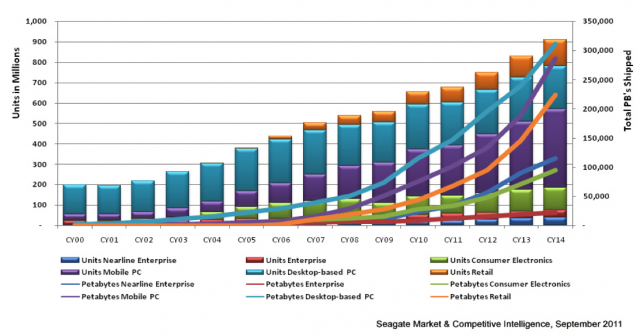
The rise of mobile devices (particularly tablets), particularly when combined with Cloud and streaming services, were supposed to be bad for the hard-drive (HDD) business.  After all, mobile devices shifted to flash memory for its size, weight, and power consumption advantages (Flash is smaller, lighter, and less of a drain on batteries).  Cloud services and widespread broadband access meant that people could store content in the Cloud rather than locally with every access device, reducing the need for add-on HDD media storage.  Streaming was supposed to substitute access for ownership, meaning there was no real need to have users store all of the content they were consuming.  While these shifts may yet come to fruition, in the short term it seems that demand for storage continues, and hard-disk drives remain the least expensive large capacity storage option.


Three factors should continue to drive demand for HDD drives.  First, both streaming and Cloud services require continued expansion of their storage capacity, to handle the increased needs for media content storage on the front end.  The growth of mobile and tablets are expected to drive increased demand for media content - and the large data files they require.
Finally, while tablets, Clouds and streaming may well shift consumer attitudes from ownership to access (and reduce perceived need for personal offline storage), that shift will take a while.  In the meantime, Clouds are new enough that many users will feel a need for back-up storage locally.  In addition, broadband speeds for many aren't sufficient for realtime HD-video streaming, so many consumers prefer streaming to local storage prior to watching.  And many of us old folks still believe in "ownership" as a means of assuring access - particularly with the current copyright system built on trying to limit access.  As for the potential of tablets as replacements for desktops - demand for local data storage is likely to overwhelm device capacity, meaning that tablet users will need to supplant desktop storage with networked storage.  So, even if consumer demand for data storage devices takes a bit of a hit, consumer demand for high-capacity local storage should remain high for some time to come.  Even if tablets come to replace desktops.
In the meantime, HDD price per capacity continues to fall, and remains significantly lower than any other data storage option.  Until existing (or some new) data storage technology can beat HDD price/capacity levels, the continually expanding demand for data storage should continue to benefit.

Source -  It's All About Content: Why Tablets Help Hard DrivesAllThingsD