Showing posts with label news. Show all posts

Monday, March 31, 2014

Pew: Key Indicators of News Use

The PewResearch American Journalism Project released its State of the News Media report for 2013 last week.  The report suggests a news industry in transition, and news audiences starting to shift their patterns of news use as they discover the value of newer news delivery options.  Here's some highlights-

The decline of print
The newspaper industry has been fighting, unsuccessfully, declining subscription and readership numbers for decades.  Even with liberalized definitions for subscribers and the growth in usage of newspapers digital offerings, they managed only a 3% increase in total readership in the last NAA report.  

The outlook's even worse for News Magazines' print editions.  Newsstand sales have dropped 43% since 2008 (although subscriptions have remained steady). Two of the major US news magazines have abandoned print for online, and even with the significantly lower costs of online are struggling to survive.

Readership also continued to decline for the top alternative weeklies, although at a slower pace.

Broadcast & Cable News
The broadcast networks tended to hang on to their aggregate news audiences, although differences continued to exist among the big three performances.  On aggregate, audiences for both the evening and morning news shows grew slightly, but remained within the range of audience numbers over the last few years.

Cable news network audiences declined slightly in 2013, but were coming off a Presidential election year (so no real surprise there).  2013 was more notable for the continuing fall of CNN, whose ratings have been hitting 20 year lows in recent weeks, leaving CNN in the cable news ratings basement.  MSNBC, lacking a significant Republican to bash, dropped a quarter of its primetime audience in 2013.  Fox News Channel retained its ratings dominance in ratings, and continue to reap the benefits, generating almost twice the revenues of CNN, and four times the revenues of MSNBC.

Local newscasts from broadcast stations started to gain audiences in 2013, building on the growing morning news programming, and greater use of mid-day and afternoon time slots for expanded news offerings.  With more stations doing news programming before the main evening newscast, and extending the time for those shows, employment opportunities in local news improved slightly - one of the few bright spots in traditional journalism.

Digital
The transformation of the news marketplace is being driven by digital. In 2013, 82% of Americans reported getting news on their desktops or laptops, and more than half (54%) reported getting news through their mobile devices.  Online is where most people go first for news.  Digital operations of newspapers saved readership numbers, and many (but not all) outlets found online subscriptions a growing source of revenues in an otherwise declining market. Digital advertising dollars remain the fastest growing segment (soon to surpass TV), although the share earned by traditional news outlets is shrinking and is unlikely to replace print and TV advertising losses.  2013, and the last few years, have seen a surge in the use of commercial online-only news outlets, other online news sources, and social media by audiences.  outlets.

More transformational has been the developing role that social media plays in the news process.  News users are increasingly involved in disseminating news (sharing reports), discussing it with others, and contributing content (primarily photos and videos) to developing stories.

Source: Key Indicators in Media & News, a report of the PewResearch Journalism Project (part of State of the News Media 2014 study)

Thursday, March 27, 2014

Pew: The State of American Journalism Revenues


It was the best of times, it was the worst of times, it was the age of wisdom, it was the age of foolishness, it was the epoch of belief, it was the epoch of incredulity, it was the season of Light, it was the season of Darkness, it was the spring of hope, it was the winter of despair, we had everything before us, we had nothing before us, we were all going direct to Heaven, we were all going direct the other way...Charles Dickens, A Tale of Two Cities
 The State of News Media 2014 report estimates that the news industry in the U.S. generated around $65 billion in 2013.  That figure combines advertising and subscription/sales revenues.  To put that in context, global video game revenues are $93 billion, and Google had revenues of $53 billion.  But is that good?  Print's future looks increasingly dismal; broadcast's holding its own; but the online news world is generating more usage and revenues - and their revenues are growing rapidly.  While online revenues are currently small compared to traditional revenue streams for news media.  However, they are growing rapidly, even as digital opens myriad opportunities to develop new revenue streams.

Key findings in the 2014 report:
  • Advertising remains the dominant source for news revenues, accounting for roughly two-thirds of the total,
  • Audience revenues is the other major source, generating about 25% of news revenues
  • Alternative revenue sources and streams account for a growing share of news revenues. However, there contribution is small, with all other sources contributing just 8% of the total.
There are, however, significant variations across media.   Print media revenues are declining (particularly print ad revenues), while radio and TV advertising remains fairly stable.  The boom is in online and mobile advertising revenues, but those remain a small piece of the pie.

On the audience side, there are signs that traditional subscription payments are starting to decline.  Traditional print circulation and subscription numbers are starting to fall, despite (or as a response to) increasing subscription costs.  And while the newspaper industry is hoping that paywalls and digital subscriptions to online versions may recoup losses, a recent NAA study found that virtually all of the digital subscription gains in recent years come from 5 major newspapers.  There are signs, on the other hand, that various media are finding revenues through content licensing, and repurposing content for distribution through alternative channels. 

Wednesday, March 26, 2014

State of the News Media 2014 - Pew's annual report

The Pew Research Journalism Project has just released its annual State of the (US) News Media report for 2014.  It's a big report with a lot of information, conclusions, and recommendations.

The report suggests that 2013 (and the early part of 2014) has seen the continuing transformation of the U.S. marketplace for news - on both the supply and demand side.  It's seen an explosion in digital news outlets, "bringing technological knowhow and new money and luring top talent."  It's seen the development of new and alternative revenue sources, the expansion of news into social media channels.  As a result, the way people seek and consume news is changing; the report suggests that "the level of new activity this past year is creating a perception that something important, perhaps even game-changing, is going on."

The reports overview identifies six major trends:
  1. The expansion of digital news outlets is creating job opportunities, particularly in the form of international reporting.
  2. The new money and digital outlets "may be more about fostering new ways of reporting and reaching audience" than developing sustainable revenue streams.
  3. Developments in social and mobile are changing the dynamics of news production and consumption.
  4. The new digital forms are fostering "new ways of storytelling," but bring both promise and challenge.
  5. Local TV underwent massive change in ownership structures in 2013, with greater use of "shared content" in local newscasts.
  6. News outlets are just beginning to recognize the shifting demographics of U.S. audiences, primarily in the expansion of Spanish-language content and outlets.
As I regularly do when these reports come out, I hope to do more focused posts on the various areas and topics covered by the report.  In a change for this year, Pew is publishing the full report in sections rather than as a single document  In the meantime, I'll post links to the report below.

Sources -  State of the News Media 2014: Overview,  report by PewResearch Journalism Project.
State of the News Media 2014 Complete Report

Tuesday, November 5, 2013

Newspapers see digital traffic growth

Online metrics provider comScore has reported that last September set new records for online traffic to newspapers' digital sites.  The tracking numbers showed that 141 million U.S. adults visited a newspaper's web site or used a newspaper mobile app.  That's 71% of online adults, and more than half of all U.S. adults.

Growth in newspaper traffic is up across all devices, with some of the most rapid growth occurring in the use of mobile devices for news.  And in what is a measure of good news for newspapers, mobile seems to be driving new readers to newspapers' digital outlets, and encouraging new patterns of online news reading.  The comScore report indicated that the number of US online adults who report using only mobile devices to get news has jumped 22% in the last three months, and now accounts for 23% of newspapers' total digital audience.  When you add in those using mobile as well desktops and laptops, 55% of total newspaper readership used newspapers' digital content.

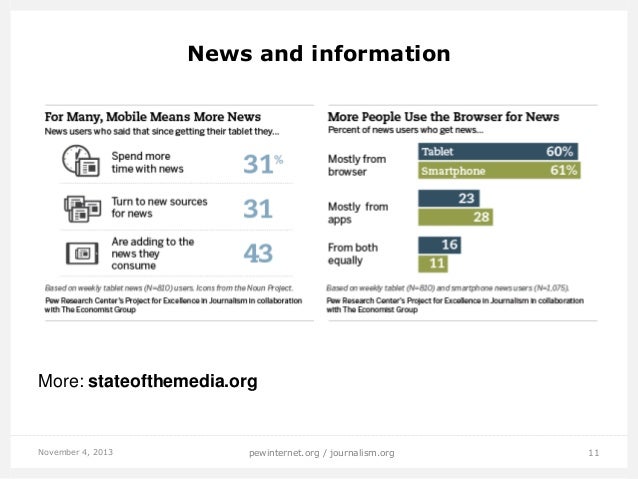
These results support some of the findings reported by the Pew Research Center's Internet & American Life Project.  They found that half of American adults cite the Internet as a main source for national and international news, and that 23% of adults report getting news on at least two mobile devices.   Mobile devices, particularly tablets, also seem to be impacting news consumption.  Since getting tablets, 31% report spending more time with news, 31% are turning to new sources for news, and 43% are adding to their news consumption.


Sources -  Newspapers Set Digital Traffic Record,  MediaDailyNews
Reading, writing, and research in the digital age, research presentation, Pew Internet & American Life Project

Tuesday, October 29, 2013

Pew: The Demographics behind ABC/Univision's Fusion

Spanish-language broadcaster Univision is working with ABC News on the development of a new cable network to be called Fusion.  Fusion will target young Latinos with a mix of news, sports, and entertainment - in English.  The folks at Pew Research Center have noted 5 demographic trends among US Hispanics that are behind the move.
  1. Latinos are increasingly native born (93% of those under 18 were born in the U.S.); Latinos increasingly prefer consuming news in English; 3. 90% of young Latinos get their news, in English, from TV (and increasingly prefer English-language entertainment and music; 4. Even so, using TV for news is declining among young Latinos; 5. A growing share of Hispanics speak only English at home.

Univision, which actually was the most watched network in the US last July among the 18-49 demographic, has seen some of that success fall as the big 4 brought out the Fall PrimeTime big guns.  It makes sense for them, looking at their trends and what's happening within their demographic, to expand their expertise with their audience and market by supplementing their Spanish-language channels with English channels targeting their audience segment.

Source -  5 demographic realities behind the creation of Univision/ABC News' "Fusion" channel,  Pew Research Center FactTank

Source -  5 demographic realities

Tuesday, October 15, 2013

NY Times: A third of Millenials don't do "TV"

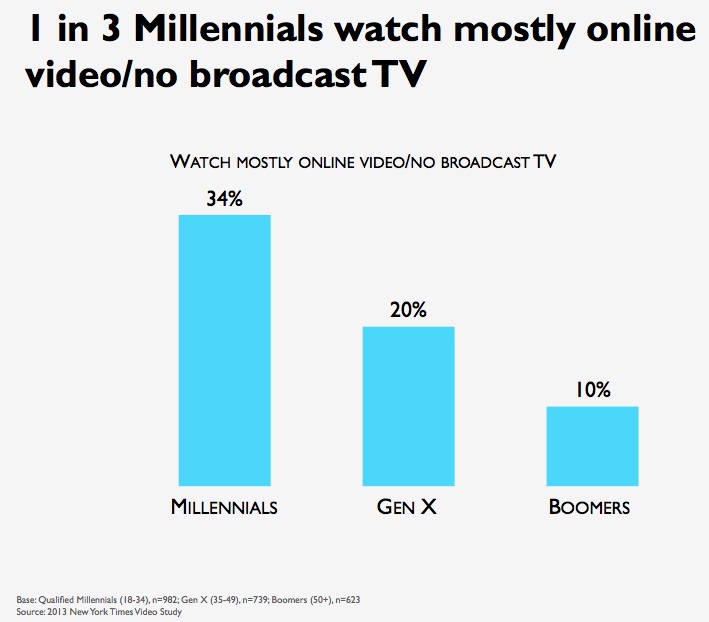
Research done by the New York Times finds that a third of young adults (aged 30 & under) "watch mostly online/no broadcast TV."  The study asked some 4000 "online video users" about their media and news consumption. Traditional TV viewing, like newspaper reading, seems to be declining across generations - the proportion of those giving the "online/no broadcast" response fell to 20% among Gen Xers, and 10% among Boomers. 

I should note that this was a nonrandom sample of a subset of US adults, and so the resulted are probably not representative, although the patterns of responses within the sample can be insightful.

The study had some other interesting news on the journalism front.  More than a quarter of the sample (28%) listed news sites as among their favorite video sites, and more than a third (35%) indicated that they had increased the amount of time spent on news/current events.  There was also a significant preference in the sample for "reading" news rather than watching news videos.

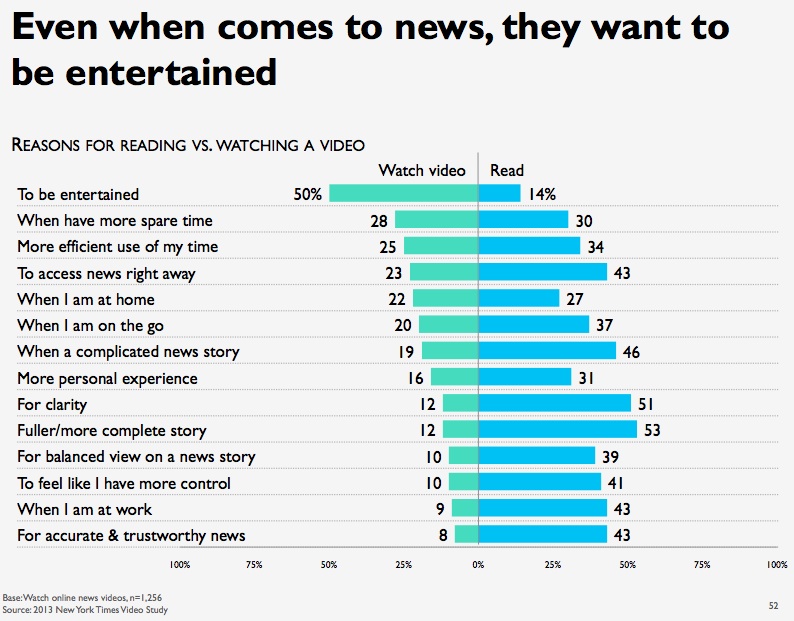
Among the various reasons offered for getting news videos or reading news stories, news videos outperformed reading in only one - "To be entertained." (50% to 14%)

In contrast, respondents preferred to read about news -

"To get news right away" (43% to 23%)
For a "complicated news story" (46% to 19%)
"For clarity" (51% to 12%)
To get "fuller/more complete story" (53% to 12%)
For a "balanced view" (39% to 10%)
For "accurate & trustworthy news" (43% to 8%)

Source -  Third of millennials watch mostly online video or no broadcast TV,  Poynter

Friday, October 11, 2013

Al Jazeera America viewing remains minimal

The latest cable news ratings show that Al Jazeera America's (AJAM) news programs are getting minimal viewing.  How minimal? In the latest report, the network's daytime shows garnered a rating of 0 among the key 29-54 age demographic.  (Ratings refer to the percentage of US TVHH watching, and are rounded to a single decimal point, so it doesn't necessarily mean that no one watched.  The ratings services also provide estimates of the number of homes watching, which can be more useful for cable network's hyper-competitive and fragmented audiences).  At this point, the network's ratings are so low that they don't show up in most reports.

Primetime shows did only slightly better.  Consider This, their 10 p.m. also earned a 0 rating, and averaged 9000 viewers total, with only 3000 in the 29-54 demo.  AJAM's flagship program, America Tonight at 9 p.m., averaged 18,600 total viewers, and was one of many shows to record 0 viewers in the 29-54 demo at some point during the week.  To put the AJAM numbers in context, audiences for America Tonight's 9 p.m. competitors on Wednesday night (Oct. 9, 2013) were 542,000 for CNN's Piers Morgan Tonight, 1,445,000 for MSNBC's The Rachel Maddow Show, and 2,475,000 for Fox's The Kelly FileAmerica Tonight also got outperformed by specialty shows Dr. Drew on Call (CNN Headline), with 257,000, and Secret Lives of the Super Rich (CNBC), with 131,000.

While AJAM is handicapped by the fact that it's channel isn't on all systems and only reaches about half the TVHH of the other cable news networks, the continued poor performance does not bode well for a nominally advertising-financed network; nor does it give the network much of a bargaining position to earn carriage (and licensing fees) from multichannel distributors.

Source - Al Jazeera America Had a Rough Ratings Week; Some Shows Hit Zero in Key Demo,  Mediaite
Cable News Ratings for Wednesday, October 9, 2013,  Zap2it TV by the numbers

Wednesday, October 9, 2013

Pew reminder: Americans don't like what their news organizations are becoming

The Pew Research Center recently released a "Fact Tank" of 20 research highlights - a couple of which suggest that Americans are losing faith in their news organizations - or at least are becoming less valued among U.S. adults.

About two-thirds (65%) say news organizations focus on unimportant things.  Even higher numbers say that news media are often inaccurate and try to cover up their mistakes.  Three-quarters say news media are often influenced by powerful people and organizations and tend to favor one side.   More than half say news organizations are politically biased (58%) and that they don't care about the people they report on (59%).

In addition, 38% say journalists are less important because there are other sources for news and information, and only 29% say journalists contribute "a lot" to society.

Nearly one-third (31%) of people say they no longer use a particular news outlet because it no longer provides the news and information they want and have grown accustomed to getting.  Those who report no longer using what had been a regular news source overwhelmingly (66.2%) indicate that the stories being less complete and valuable as a reason for their change.  Even among those who haven't yet stopped using a news organization, more than half (53%) say that news stories are less complete and valuable.

Results like these should serve as a wake-up call to U.S. news organizations that they're not doing the job that news consumers want and expect.  However, most of the major news organizations in America today seem to be pursuing goals other than journalism, so I won't be surprised to see these numbers grow, and reliance on traditional news outlets to decline.

Source -  20 facts from Pew Research Center,  Pew Research Center Report
Amid Criticism, Support for Media's 'Watchdog' Role Stands Out,  Pew Research Center for the People & the Press research report.
Americans Show Signs of Leaving a News Outlet, Citing Less Information,  Pew Research Center's Project for Excellence in Journalism report.

(edited to remove unneeded white space)

Friday, October 4, 2013

Pew: Perilous Future for News

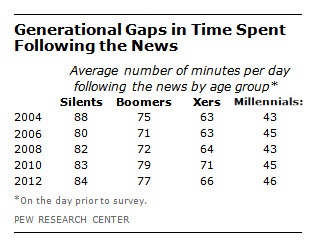
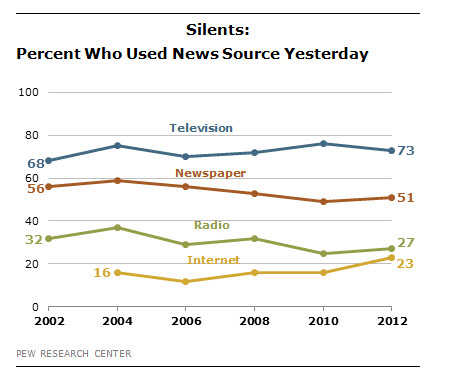
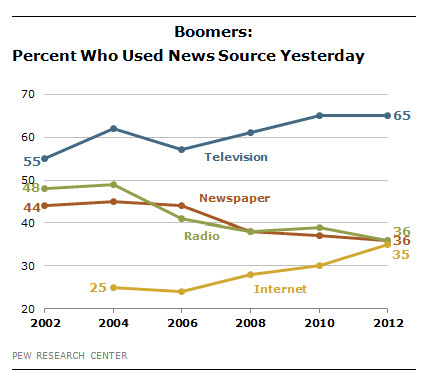
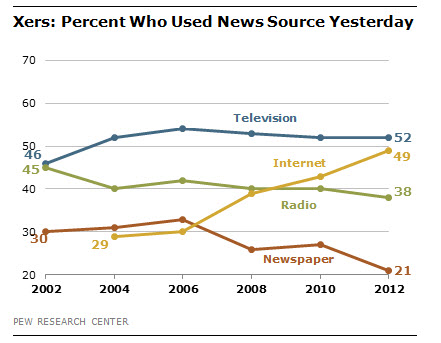
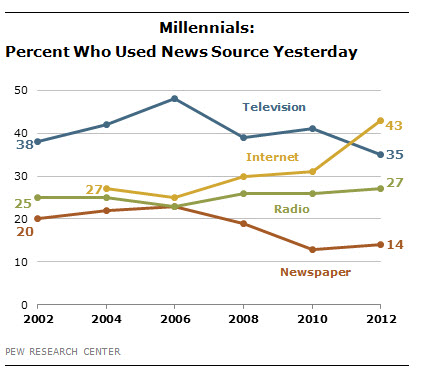
The Pew Research Center has released the results of a longitudinal study of news consumption in the U.S. that suggests "a perilous future for news."  The basis for that pessimism is the combination of two trends - declining consumption of news across generations, and within generations a decline in consuming news via radio and newspapers.

The generational decline is significant, and also fairly consistent over the last decade.  (Silents are currently 67-86; Boomers 48-66, Gen Xers 33-47, Millenials 18-31).  One reason that Pew points out is that younger generations don't enjoy following the news.  For Silents and Boomers, 58% reported that they enjoyed following news "a lot". Less than half of Gen Xers (45%) did so, and less than a third of Millenials (29%).

  Looking within generations and across media types, the Silents (67-86) were the most consistent in their patterns of news use, with only minor increases in use of TV and Internet for news, and matching slight declines in use of newspapers and radio.  This oldest generation is also the only one where a majority of respondents reported reading a newspaper "yesterday".  Yet even with this generation TV (combining broadcast and cable networks) was the most regularly used source for news.

Boomers (ages 48-66), the next generation down, also reported TV as the most frequently used news source, and has been turning to TV more often over time.  Their use of the Internet as a source has increased almost 50% over the last decade, and if trends continue, the Internet is likely to become the second most frequently used source for news in the near future.  In the latest survey, Internet use "yesterday" was at 35% with a rising trend, while both Newspaper and Radio use was at 36% and trending down.

Gen Xers (33-45) have, over the period of the study, generally preferred electronic media to print.  Over the period of this study, less than a third reported reading newspapers "yesterday."  In fact, shortly after newspaper use peaked in 2006 (at 32%), it was bypassed by the Internet as a regular source.  Online news sources are also on track to become the most widely used news source - with use increasing about 60% in the last 6 years to the point where almost half (49%) of respondents report going online for news "yesterday."  Over the same period, use of TV for news has slowly fallen from a peak of 54% to 52% in the latest survey.

For Millennials (18-32), the Internet became the most widely used source for news in the last few years, with 43% reporting that they went online for news "yesterday."  TV as a source has fallen from a peak reported use of 49% in 2006 to 36% in 2012, and Newspapers falling from a peak of 22% in 2006 to 14% in 2012.  What's interesting for this group is that use of Radio for news has remained fairly consistent, with around a quarter of Millennials reporting using Radio for news "yesterday."

Looking at the generational use patterns can also reinforce the conclusion that there is a generational gap in news consumption. Looking at the highest reported use of a medium for news "yesterday" in 2012 -
  • for Millennials, that's the Internet at 43%
  • for Gen Xers, that's TV at 52%, but also a greater percentage reported using the Internet (49%)
  • for Boomers, that's TV at 65%, with even the least used (Internet) at 35%
  • for Silents, that's TV at 73%, and Newspaper (at 51%) more widely used than any Millennial use
The Pew report suggests that the growth potential of online and digital may hold out some promise for media, but is unlikely to replace the huge penetration levels of the past.  There are also questions about news consumption patterns online and with social media.
For all the potential bad news for the traditional news media, social media looms as a potential booster of news consumption among the younger generation, albeit a modest one so far. Pew Research’s 2012 survey found a third of Millennials and 20 percent of Xers saying they regularly see news or news headlines on social-networking sites. However, only about 35 percent of those who get news from social network sites say they follow up and seek out full news stories.
We are living in interesting, and uncertain, times for media and journalism.  (So keep following this blog or the JEMS Flipboard magazine.)

 Source -  Pew surveys of audience habits suggest perilous future for news,  Poynter

Wednesday, September 25, 2013

Infographic: Changing News Habits

From a multinational survey of news consumers - and presented by a company marketing its own news app platform.  Still, there's some significant findings and trends on display.
  • 75% of smartphone owners and 70% of tablet owners check news through mobile devices several times a day - compared to the numbers using at least weekly for TV (74%), radio (55%), newspapers (38%), print magazines (18%) [TV includes broadcast, cable, and DBS sources]
  • Use of tablets to get news has doubled in the last year
  • The only media where half the respondents report consuming news for more than 30 minutes a day are TV and smartphones (both at 52%); 40% of tablet owners do, which is a higher share than any other medium
  • Thankfully, "accuracy" remains the most important criteria, although "fresh" (i.e. current) and "free" are cited as important by 57%.
  • 95% of news consumers get their news from aggregators (which includes traditional news outlets as well as online providers), although social media continues to make inroads. 43% report getting news from Facebook, and 28% from Twitter
  • EU news consumers report higher usage of traditional news media (newspapers, radio, TV) than USA news consumers.
“Due to mass adoption of consumer mobile devices, the access and appetite for trusted news continues to increase. People want to remain informed in a timely manner, more so now then ever before in our world’s recorded history,” said Gilles Raymond, said mobile industry veteran and CEO of Mobiles Republic. “We’ve found that reading news on tablets has more than doubled year over year. This is because the tablet allows for new trends in news consumption─ news snacking, for example, and because news syndication apps that provide all of a users favorite news sources within one app is a ready cure for information overload while increasing the user’s level of being informed on personal topics.  We believe our research can reassure the world’s primary news outlets, while also confirms they must have multiple streams of mobile news distribution in order to reach the mobile audiences and continue to thrive.”
Source - 2013 Infographic - the change in news reading habits,  Mobiles Research press release

Friday, August 30, 2013

Abysmal ratings for Al Jazeera debut & CNBC


CNBC continued its ratings fall, hitting a 20-year low last week.  Viewing is down 35% from a year ago, averaging only 37,000 viewers in the key 25-54 demographic.  The continuing decline is leading to revenue shortfalls.  CNBC is available to some 100 million US households.

Meanwhile, Al Jazeera's American news channel experienced a rough start.  AT&T's U-verse system dropped the channel on the day it launched, citing contract issues.  This cut off several million homes from access, leaving the network with a reach of only 40 million US households (out of about 115 million).  According to Nielsen's numbers, Al Jazeera America started off with just 22,000 viewers, for a 0.2 rating.  That's actually below Nielsen's threshold for reporting.  The top show for the week drew just 54,000 viewers.  Interestingly, the network has more Twitter followers, at 75,000.

To give you an idea of just how bad these numbers were, here's the daily average viewing for the major cable news networks for the same week:  Fox News - 968,000; MSNBC - 348,000; CNN - 346,000.  Both Fox and MSNBC saw slight declines from the previous week, while CNN experienced a slight increase.  Despite some media gloating (especially at CNN) over Fox News' ratings decline, it still routinely draws around 2-3 times the viewership of the second place cable news channel in virtually all time slots. 
  Current, the news channel that Al Jazeera bought to get access to major multichannel distributors, averaged only 42,000 viewers in prime time in 2012, and saw ratings drop below thresholds for carriage on many of those systems before the sale to Al Jazeera.

Sources -  Bad news: CNBC hits 20-year ratings nadir,  NY Post
Al Jazeera American off to a slow ratings start, LA Times

Monday, August 26, 2013

Local TV faces mobile challenge for weather and traffic

As mobile continues to expand, it's challenging two of the key foundations for local TV news: local weather and traffic reports.  Already, multiple free mobile apps offer up-to-the-minute weather information most anywhere, including weather alerts and radar maps to follow storms, zoomable to neighborhood levels.  And unlike local TV news, you can get the report any time you want, and any place (with cell coverage).
(I used weather apps this summer when Dad and I drove across the country - to check storm tracks when the clouds on the horizon looked ornery, and to know when to pull off the road, or choose an alternate route if they looked too bad.)
Almost all smartphones come with built-in weather apps, and many display weather on the opening screen.  A recent survey found that 79% of smartphone users in the 18-44 demographic have their devices with them almost all day.  More specifically, the IDC study found that 89% of 18-24 year-olds are using their smartphones within 15 minutes of waking.  And weather is among the top three categories of importance in using news apps.

Now, the globally popular Google Maps is adding real-time traffic coverage, from recent acquisition Waze.  With the addition of real-time traffic in many areas, Google Maps provides extra functionality to basic mapping and navigation.  But the critical difference here is adding local real-time value in the ability to assess the quickest routes, and avoid road construction and closures.

In the meantime, Google Now is breaking ground in terms of anticipating user wants and needs.  As users build up their profile, Google Now can pre-emptively notify users of traffic reports when they're headed out, and if there are other accidents on the route, notify travelers when they happen.  There's also reports that Google Now is experimenting with adding local news reports to the information it filters through.

The latest Pew State of the Media Report shows that local broadcasters have been increasing the proportion of air time devoted to weather and traffic (29% last year, opposed to 25% in 2005).  Still, the Pew report noted that audience demand for the topics were “ripe for replacement by any number of Web- and mobile-based outlets.”

The massive reach and prominence of mobile devices and apps are impacting how people get news and information.  The ability of major national and international apps like Google Maps and The Weather Channel to provide localized (and increasingly personalized) content makes them at least somewhat competitive with local TV newscasts.  The ability to do so at any time, at any location, and the growing ability to personalize content and delivery provides additional levels of value and service, and over time will likely lead to such apps being the place to go for weather and traffic information.  Local TV news needs to prepare for that eventuality.


Source  -  Local TV facing increasing competition in weather and traffic,  LostRemote
79% Of People 18-44 Have Their Smartphones With Them 22 Hours a Day (STUDY) All Twitter
Always Connected, IDC-Facebook research report
Local Media App Trends: Summer 2013, Stepleader Digital

Tuesday, August 13, 2013

Pew releases 2013 State of News Media report and Infographic

The Pew Research Center's Project for Excellence in Journalism has released its annual report on the state and status of News Media.  The 2013 Report is based on 2012 numbers, and shows continued declines in many traditional news areas.
  High among the issues is what Pew terms a decline in news reporting resources.  Continued newspaper newsroom cutbacks put industry employment below 40,000 full time employees (the lowest since 1978) and 30% below peak newspaper employment levels in 2000.  And this spring and summer has seen many newspapers cut their photo departments, instead telling their reporters to use their cellphones to photograph events.  This has impacted content, with Pew research showing that sports, weather, and traffic now account for 40% of newscast content, while the average length of video news stories continues to shrink.  Cable news channel live coverage shrank some 30%, while interview segments increased 31%.  As the report summarizes,
This adds up to a news industry that is more undermanned and unprepared to uncover stories, dig deep into emerging ones or to question information put into its hands. And findings from our new public opinion survey released in this report reveal that the public is taking notice. Nearly one-third of the respondents (31%) have deserted a news outlet because it no longer provides the news and information they had grown accustomed to.
The report also notes that the last few years have also seen a significant rise in newsmakers and others seeking to put information in front of people using online and social media to take their message directly to the people, without the gatekeeping and contextualizing that news organizations normally provide.  A study suggested that in 2012, that resulted in campaign reporters acting more as megaphones for the campaign than objective (and critical) reporters.  One consequence, Pew found, was that in all the coverage of the character and records of the candidates, less that a quarter originated from traditional reporting activities, while more than half originated from claims by political partisans.
  The good side of this trend is that groups and organizations with more specific interest and expertise, were using the Internet to provide coverage of topics that traditionally have not been a major component of traditional news products (for example, health, science, environment).

I'll try to get to take a look at the reports details in later posts.  Meanwhile, you can grab the infographic at http://stateofthemedia.org/files/2013/03/2013-State-of-the-News-Media-Overview-Infographic.png

Source:  The State of the News Media 2013, report from Pew Research Center's Project for Excellence in Journalism

Online News Use continues Rise

Two recent studies, one in the U.S. and one in the U.K., are indicating that at least half of adults go online for news.  The two differ in methodology and in how use is measured, so I'll discuss them separately.

The U.K. study comes from the Office for National Statistics, and looks at Internet Access by individuals, and within households.  The survey found that Internet access in Great Britain continues to grow and diffuse: 73% of adults report using the Internet daily, 53% now access the Internet from mobile phones.  83% of households report having Internet access, and 42% had land-based broadband Internet connections.
  More than half of adults (55%) reported "reading or downloading online news, newspapers or magazines" on a daily basis, more than doubling the rate reported in 2007 (20%).  That change in usage was the biggest of the services reported. 
"In 2013, with reports of decreased physical newspaper readership, there has been media interest in how people will access the news in the future," said the ONS.
The survey also found that more than half (52%) of those UK adults have purchased reading materials online had done so through digital forms such as eBooks.  A substantial number also reported buying eBooks for the readers in their family.
  Usage among young adults (16-24) was greatest for leisure or recreational activities: 93% engaged in online social networking daily, 60% accessed wikis, 55% downloaded software, and 40% made phone or video calls over the Internet.  People in the 25-34 age group, on the other hand, had the highest use of regular activities like sending emails (89%), getting information on goods and services (i.e. shopping) (77%), and engaging in online banking (76%).  The highest growth in reported Internet usage was among older users, where daily use for seniors (65+)grew from 10% in 2006 to 38% in 2013 and reported daily use among those 55-64 grew from 37% in 2006 to 68% in 2013.

The U.S. numbers come from the Pew State of the News Media 2013 report.  In a survey conducted in 2012, Pew asked U.S. adults where they had gotten news "yesterday."  Respondents were allowed to cite multiple sources.  Half (50%) of respondents reported getting news from digital sources.  The only form used more was "TV" at 55%, but that number combined local and national broadcast news with cable news.
Pew does provide some further breakdowns - in 2012, 39% of respondents reported getting news online from mobile devices "yesterday."  That would still be the second highest platform usage, but when combined with other online access portals the use jumps to 50%.  About one in five respondents (19%) reported getting news from social media, while 16% reported getting news from email feeds and 8% said they'd listened to a news podcast.  There is an age break in online news usage - only 43% of those 50-64 reported getting news from online sources "yesterday", compared with 60% daily usage from those under 50.
  The other point that the Pew report makes is that online news use is the only format that has not been consistently trending downward over the last 20 years.  "TV" daily use has dropped from a high of 71% in 1994 to 55% in 2012.  Newspaper usage has dropped from a high of 57% in 1991 to 29% in 2012.  And radio as a daily news source has dropped from 54% in 1991 to 33% in 2012.  Yes, that's right - more American adults report getting their news from radio than report getting news from newspapers.

Not so good news for legacy formats, but still somewhat optimistic about news usage overall.

Sources -  More than half of Britons access news online, The Guardian
Statistical Bulletin: Internet Access - Households and Individuals, 2013, ONS.gov.uk
Digital: As Mobile Grows Rapidly, the Pressures on News Intensify, Pew Research Center
The full Pew report on The State of the News Media 2013 is available here.

Sunday, June 9, 2013

MSNBC: "Not a News Network"

MSNBC's recent ratings tumble (down 20% from last year) brought out an interesting response from the channel's President, Phil Griffen.  He suggested that MSNBC really didn't do breaking news, saying "Our brand isn't that."

So what is the brand?  The network's tagline identifies it as "The Place for Politics," with a heavy skew towards left-wing and "progressive" political talk.  Which kind of explains why its coverage of the 2012 Presidential race went 90/10 for Obama in terms of stories, and 99% of its Romney coverage was negative (according to Pew's analysis).

Perhaps they'd do better with real news.

Source -  Devoted to Politics, MSNBC Slips on Breaking News, New York Times

Monday, April 22, 2013

CBS Twitter feeds Hacked

CBS has acknowledged that the Twitter feeds for 60 Minutes, 48 Hours, CBS Denver, and its main account were hacked over the weekend.  As a result, the accounts were suspended on Saturday night.
Earlier in the day tweets coming from the 60 Minutes account seemed farfetched, including one that claimed the US government was "hiding the real culprit of the Boston bombing."
Other Tweets contained links to virus-laden sites, and rants about government conspiracies and treatment of Syria.  The Syrian Electronic Army claimed credit; previously they have claimed credit for the hacking of Twitter accounts at the BBC, NPR, Reuters, several radio & TV stations, and the NGO Human Rights Watch.

Sources -  CBS Twitter Feeds Are Compromised,  TVNewsCheck
Syrian Electronic Army claims credit for CBS Twitter accounts hack,  SlashGear.com

Monday, April 1, 2013

Social Media & the News - Infographic


Depending on who you talk to, the Internet - and Social Media in particular - will either destroy or save journalism (as they knew it).  The growth of the Web and Net has certainly hit U.S. newspapers in the pocketbook, and journalism and social media are all abuzz about social media & news.  But we're just starting to find out why people use social media, and how they use it for news.  Here's one recent infographic -


Source -  Infographic: Social Media & the NewsSocial Media Delivered

Social Media Week Infographic: Old News

That's Old News infographic


Courtesy: Schools.com

Monday, March 18, 2013

Pew 2013 State of the News Media Report released

The Pew Research Center's Project for Excellence in Journalism has released its annual "State of the News Media" report for 2013.  I'll try to take a closer look at some of the components over the next week or two, but here's some highlights from the overview.

Resources for newsrooms continue to decline.  Estimated cuts for 2012 put full-time professional news staff numbers under 40,000 in the U.S., the lowest employment level since 1978 (and down 30% from its peak in 2000).  This contributed to shifts in news coverage - sports, weather, and traffic reports account for 40% of local news program content.  On CNN, the number of produced news packages in 2012 were half that of five years ago.  Across the cable news networks, live coverage of news events fell 30%, while interview segments rose 31%.  The sole remaining news magazine, Time, cut 5% of its staff earlier this year.

Pew interprets this as resulting in "a news industry that is more undermanned and unprepared to uncover stories, dig deep into emerging ones or to question information put into its hands."  In fact, they suggest, this fall has been noticed by news consumers.  A recent survey found that 31% of respondents had indicated that they had stopped using a news source because it no longer provided the amount and quality of news they expected and wanted.

Source - The State of The News Media 2013 Report, Pew Research Centers.

Edit - fixed some typos, phrasing (19/3/2013)

Wednesday, March 6, 2013

Infographic: Value in News

An interesting visualization of the various sources of value in news.  As we move from habitual news consumption to more active news consumption, we need to give more thought in terms of the various ways in which news can have value for consumers.  And how to shape and market news in ways that add value.