Showing posts with label mobile. Show all posts

Monday, September 14, 2015

UK Newspaper News

It's been a while, but there's been a flock of articles recently about the present and future of the newspaper business in the UK that deserves a post.

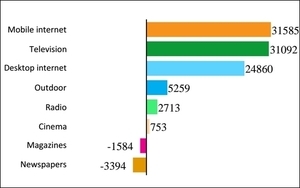
  • A ZenithOptimedia forecast predicts that mobile advertising expenditures will bypass newspaper advertising revenues in the UK this year.  The study shows a 38% growth in mobile, compared to a 4% decline in newspaper advertising.
  • The same report also shows mobile advertising surpassing newspapers on a global basis, based in part on the continuing decline in print advertising expenditures across most of the world. 
The worst part of the internet advertising boom for newspapers is the fact that not all digital sectors are reaping the benefits.  In particular, display advertising is lagging, and newspapers rely primarily on display advertising for their Internet and mobile sites as well as print editions. With the growth of ad-blocking on mobile devices, one analyst predicts that display ad revenues for mobile "are going to fall through the floor."

With predicted declines in revenues, many news outlets are looking for ways to trim already tight budgets further.  The National Union of Journalists  (UK's trade union for journalists) is warning that it's members are ready to strike if news outlets look to cut costs by shrinking newsrooms.

So the tough times for newspapers and other news outlets look to continue.

Sources - Mobile adspend in UK to overtake newspapers faster than expected, predicts report.  campaign

Friday, February 6, 2015

Infographic - The changing face of mobile

From the 2014 U.S. edition of Deloitte's Global Mobile Consumer Survey.


Mobile finally hitting TV, desktop usage

Research on smartphone penetration shows that there is a clear generational gap in smartphone penetration.  The gap shows clearly in a Nielsen report from last fall, and in recent Pew Research Center findings.

Penetration is one thing, and actual usage is another.  A number of recent reports show distinct generational differences in both frequency of use, and in the types of applications and uses.  Most of these reports, however, have yet to really establish that smartphone ownership and usage have had a serious impact on either TV viewing or Internet use on laptops or desktops.

A recent study by Millward Brown Digital (MBD) finds that 77% of Millennials (those aged 18-34) report using a smartphone on a daily basis compared to 60% of Gen Xers (aged 35-50).  While this fits in with previous research, the MBD survey also reports generational differences in other media habits. They report smaller, but still consistent, reports of daily TV viewing (77% for Millennials, 86% for Gen Xers, and 91% of Boomers), and daily use of laptops or desktops (58% for Millennials, 67% for Gen Xers, and 71% for Boomers).
The difference is enough that MBD's research director, Joline McGoldrick, indicated that online marketers are not only finding mobile as a growing segment of the advertising marketplace, but that marketers should take into account the emerging generational differences as well. Advertising placement on mobile is one of the fastest growing ad segments, with a 60% growth rate this year, and predictions that mobile will account for more than 20% of all ad revenues by 2018.

Source -  Millennials Spend More Time With Mobile, Impacts TV Time, Mobile Marketing Daily

Thursday, August 7, 2014

Visual history of US Mobile M&A

Now that the Sprint/T-Mobile deal seems to be definitively off, GigaOm took a look back at how the top 4 U.S. mobile operators got to this point.

Source -  How we got here: a visual history of US mobile companies,  GigaOm

Tuesday, July 15, 2014

Tuesday, July 8, 2014

Milepost: 2 in 5 US Households are "cellphone-only"

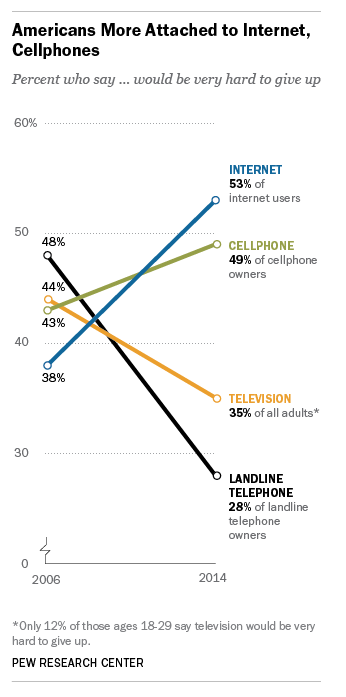
The proportion of US households who only have wireless phones passed 40% in 2013, according to a report from the CDC's National Center for Health Statistics.  Furthermore, it would seem that the cell phone has replaced the land line as the "lifeline" for the poor and for families with children.  The report also shows that younger folks are also high adopters of the wireless-only lifestyle.

  The report found that 56% of "poor" households and 46% of the "nearly poor" are cell-only; furthermore, almost half (47.1%)of all children live in wireless-only households.
  Demographically, it's no surprise that older age groups are most likely to maintain their land lines even after acquiring cell phones - only 14% of those 65 or older are wireless-only, while roughly a third (31%) of those 45-64 have abandoned landlines to go wireless.  In contrast, two-thirds of those 25-29 reported being wireless-only. Hispanics reported the highest level of wireless-only households, at 53.1%.  Those households living in the Northeast were the least likely to be wireless-only, with just under a quarter (24.9%) without land lines.

These results fit several of the current memes on the diffusion and adoption of telephone service:
  • mobile households are more likely to rely on mobile services, particularly those who change physical addresses.
  • lower income households are less likely to maintain multiple services (the interesting note here is that cell services are becoming cheaper than land lines)
  • households with multiple wireless users are more likely to go with individual mobile lines than a "family" land line
There are also policy implications of the switch.  If cell phones are increasingly becoming the telephonic lifeline for people, there should be a shift in Universal Service policy and promotion from traditional land lines to mobile services.  Or from the CDC's perspective, making sure that health campaigns embrace mobile.

Sources:   Two of every five U.S. households have only wireless phones, Pew FactTank
Wireless Substitution: Early Release of Estimates From the National Health Interview Survey, July-December 2013, CDC National Center for Health Statistics report

Thursday, April 24, 2014

eMarketer: Digital becoming most-used medium

A report from eMarketer indicates that the amount of time that U.S. Adults spend with media is increasing, and that the combined digital channels has overtaken TV as the medium that they spend the most time with.  The eMarketer report is based on a meta-analysis of some 140 studies from more than 40 research institutions.

The report indicates that U.S. adults spend an average of just over 12 hours a day with various media (the report counts each medium separately, even if the user is multitasking with other media).  If you look at individual channels, TV remains the medium adults spend the most time with (4 hrs, 31 min in 2013), but the combination of general online channels (PCs, laptops) and mobile (smartphones, tablets) is surpassing TV in time spent with media.  The report indicates that in 2012, the average total time with digital fell just shy of the average time with TV (by 7 minutes).  Print's downfall continues, with the average time spent with print media in 2014 projected to be only half of the time people spent with print in 2010, and its share of time spent with media dropping to 3.5%.  The decline is seen in both newspapers and magazines (slightly slower decline for magazines).

Interestingly, the growth in the amount of time spent with media appears driven by mobile.  According to the study, mobile is the only channel expected to consume more of users time, on average, in 2014.  The results didn't indicate whether the overall time gain was likely due to the continuing adoption of mobile media, increased usage by mobile owners, or some combination of factors.

The report also notes that in studies of time spent using media, that video consumption through digital channels remains small compared to traditional TV (in 2013, four and a half hours for TV, 44 minutes for digital).  Even there, however, all of the projected gain in usage in 2014 comes from the mobile sector, which eMarketer projects growing 50% in that year.

The report also looked at the amount of time U.S. Adults spend with social media, projecting that people will spend an average of more than an hour a day using social media.  In 2014, mobile usage overtakes online usage (average of 35 minutes a day for mobile, and 32 minutes a day for online).  Breaking down mobile, smartphones still dominate use over tablets.

Source -  Mobile Continues to Steal Share of US Adults' Daily Time Spent with Media, eMarketer

Monday, April 7, 2014

Recovery for World's Ad Economy

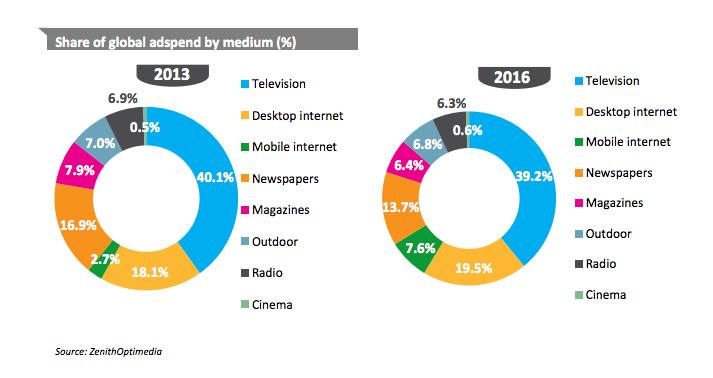
Recent estimates from ZenithOptimedia Group suggest that on a global level, at least, the advertising sector has returned to its pre-recession growth rates.  The report now forecasts a 5.5% growth in advertising spending, reaching a total of $537 billion. The news isn't uniformly positive for all media, however.
The overall growth is being driven largely by the rapid increase in online advertising.  Internet advertising is forecast to continue to grow by around 16% annually for the next few years, with online display growing at 21% and social media ad expenditures growing by 29%.   Online advertising can also be differentiated into desktop (static) and mobile sectors - and the report notes that the mobile sector is growing at 6 times the rate of desktop, hitting 50% annual growth through 2016.  The ZO researchers said, "mobile will leapfrog radio, magazines, and outdoor to be the fourth-largest sector" by 2016


While the TV sector continues to draw the lion's share of global advertising, and is forecast to continue growing, the online sector's much faster expansion is closing the gap.  The news is worst for print: both newspapers and magazines are losing ad revenues.
We predict internet  advertising will increase its share of the ad market from 20.7% in 2013 to 27.1% in 2016, while newspapers and magazines will continue to shrink at an average of 1%‐2% a year,” the report states. “Internet advertising overtook newspaper advertising for the first time in 2013, and we forecast it to exceed the combined total of newspaper and magazine advertising in 2015.”
The U.S. advertising market is forecast to continue its dominance of the global ad economy, but the report predicts that China (currently 3rd largest) will overtake Japan by 2016, while Indonesia and South Korea will overtake France and Canada among the ten largest ad markets.

Source:  Internet Ad Spend to Reach $121B In 2014, 23% Of $537B Total Ad Spend, Ad Tech Boosts Display,  TechCrunch.com

Tuesday, April 1, 2014

Video's Goin' Mobile - And Sports Rule!

The latest Ooyala Global Video Index has some interesting findings.

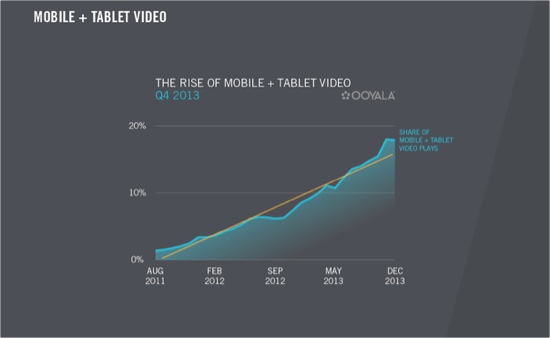
“Widely doubted as a viable TV platform by critics less than a decade ago, mobile today is the fastest-growing segment of online video. It has been for the last two years, and will be for the next two.”
The viewing of online videos through mobile devices has grown 719% since 2011. It currently accounts for 18% of all online video usage worldwide, and Ooyala predicts mobile will account for half of all online video viewing by the end of 2016.  In a survey of publishers and broadcasters, almost all (99%) said reaching the mobile audience was "important", if not critical.  And 83% indicated they thought mobile video offered a strong potential for monetizing content and services.

And in time for March Madness, the report indicates that mobile viewers are three times as likely to watch live sports on their mobile devices than video-on-demand content.  Sports also dominates mobile viewing time, with longform sports content (10+ minutes in length) accounts for almost two-thirds of all mobile viewing time.  Turner Sports concurs, indicating in a recent press release that mobile (smartphone and tablet) viewing of its NCAA men's basketball streams was up 71% in the tournament's first two weeks.  Turner said the tournament had generated more than 64 million live video streams  - 13.5 million hours - over that period, already eclipsing the 49 million lives streams for the entire 2013 tournament. 

The Ooyala report is based on measuring the online viewing habits of more than 200 million Internet users in some 130 countries.

Sources -  Half of All Video Views Could Be  Via Mobile/Tablet By 2016, Sports Is Big Driver, Vidblog
Ooyala Gloval Video Index Q4 2013 report

Friday, March 28, 2014

Social, Digital & Mobile Around the World (slideshare)

I'm hoping that this embed of the slide show works.  If not, you can access the slideshow here.


Milepost: 500,000,000 iPhones

Apple sold its 500 millionth iPhone recently.

When introduced in 2007, Steve Jobs predicted sales of 10 million by the end of 2008, and one senior financial analysts forecast that Apple would have "a difficult time" making it, pointing out that at that time, Nokia was selling more cellphones a week than Apple had sold iPhones.  And thereby joining the gallery of famously bad predictions.  In fact, Apple sold 13.8 million iPhones in 2008, and is currently selling a million iPhones a month, just in China.

While Apple is losing market share to Android in terms of mobile operating systems, their history of build quality, integration of components, and innovation suggests that iPhone's future remains positive.  At the current rate, they should hit a billion units sold sometime in the next three-four years.

Source -  Without Much Fanfare, Apple Has Sold Its 500 Millionth iPhone, Forbes

Monday, March 3, 2014

Print readership for newspapers - Half-full, or Half-empty?

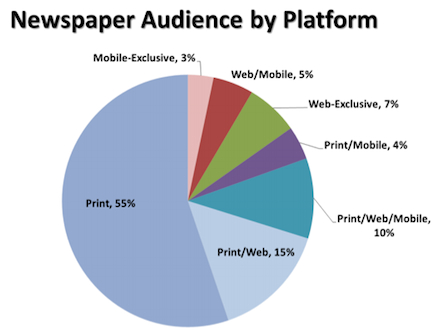
A recent study by the Newspaper Association of America (NAA) trade group reported significant growth in digital and mobile readership, yet also proudly proclaimed that 54% of newspaper audiences only read their local newspaper through its print edition.  Overall, the NAA reported circulation gains of about 3%. Also reported was the fact that print circulation has fallen to 71% of total circulation (75% of Sunday circulation), down from 85% the year before (a 20% decline).  The size of this year's shift, it should be noted, may be coming from a change in AAM reporting, which lets publishers decide whether subscribers of both the digital and print editions get counted as print subscribers or as digital subscribers.  With most ad revenue growth in digital, they may be choosing to emphasize those numbers.

One interpretation of the more than half of circulation remaining print-only is that there's still a significant role for print editions.  Another is that almost half of readers don't ever access their local newspaper digitally.  Newspaper readership is not only in general decline - it seems to be splintering, with older readers sticking with print, and younger readers shifting their news consumption to online and mobile sources.  The NAA report said that 30% of readers use a combination of print and digital sources, and 15% only use digital.  According to the NAA report,
"a closer examination of the elements, supported by readership data, does confirm a steady transition to digital reach among newspapers and a healthy print readership base for readers and advertisers."

A deeper look showed an industry in widespread decline.  Almost all of the circulation gains were by the five largest U.S. newspapers, and predominantly from increased digital circulation.  A breakdown by circulation showed aggregate circulation losses in all other segments.  The report notes that most smaller papers are posting print circulation declines smaller than seen in some of the biggest urban dailies.  Smaller, perhaps, but declines nonetheless.

From an economic perspective, it's clear that there is a strong and rapidly growing digital market for news.  News organizations, whether newspapers, broadcast networks and local stations, magazines and radio would be well-served to develop easily-accessible online delivery systems for the news they produce (mobile apps in particular).  The audience is going there, and frankly, the distribution costs are minimal compared to traditional media.  However, there remains a sizable portion of news consumers who remain loyal to traditional media formats - particularly for their traditional local news sources.  Local news organizations need to still consider that audience segment before going all-digital.

Source - NAA: 'Print only' still more than half of newspaper audience even as digital grows, Poynter