Showing posts with label networks. Show all posts

Friday, August 1, 2014

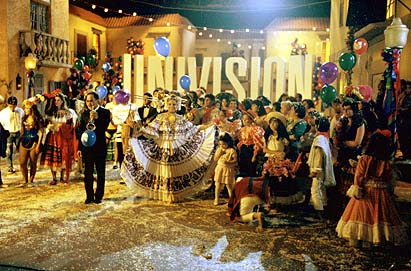
Univision bucks summer doldrums

Summer has traditionally been a slow time for the major broadcast networks in the U.S., as well as for TV audiences.  With viewing numbers down, and the key Fall sweeps coming up, summer has traditionally been a dumping ground for program repeats, a place to test new programs, and a last chance to air contracted (but unaired) episodes of canceled series.  Outside of the occasional big sporting event, there's not much to look forward to on broadcast television.

On the other hand, the lack of quality competition from the big networks gives newcomers an opportunity to counter-program with the best of new programs and episodes. When Fox started, it moved up the starts of some of its better series to the summer.  Putting original episodes of quality programs up against the dregs of big network offerings, gave viewers an incentive to sample and evaluate Fox series and build audiences.

Spanish-language network Univision has been trying to move from a niche network to a challenger to the Big 4.  It's expanded its reach beyond urban areas with high numbers of Hispanics, adding its own stations in larger markets, picking up affiliates, and making a push to get on multichannel basic service tiers.  It's worked to shift its programming focus from airing licensed series from other Latin American networks and channels, to a mix reflecting its goal of being a general-interest broadcaster. 
Among those moves has been developing a strong news presence, expanding and improving its sports coverage (including live game coverage of Latin American soccer and baseball leagues), and putting a major focus on creating original entertainment programming.  And it's starting to be successful.  In the key market demographics for broadcasting (19-34 and 18-49) it's beating monthly ratings for one or more of the Big 4 networks with increasing frequency.  And for the second straight year, its July primetime ratings have come out on top - beating the audience numbers for all of the other US broadcast networks.  It also had the youngest audience (median age 39, vs median age for the Big 4 of 56).

Of course, Univision's ability to outdraw the Big 4 is not only a result of programming acumen.  It's been helped by two long-term trends: declining ratings and shares for the broadcast network as viewers have shifted to and expanding number of viewing alternative; and the fact that Hispanics are the fastest growing demographic group in the U.S.  Still, their successes over time suggest that they've made the move from being a niche service to becoming a fully competitive general-interest network.

Source:  Univision is the #1 Network for the Second Consecutive July Sweep Among Both Adults 18-49 And Adults 18-34, TV by the Numbers.

Monday, March 31, 2014

Pew: Key Indicators of News Use

The PewResearch American Journalism Project released its State of the News Media report for 2013 last week.  The report suggests a news industry in transition, and news audiences starting to shift their patterns of news use as they discover the value of newer news delivery options.  Here's some highlights-

The decline of print
The newspaper industry has been fighting, unsuccessfully, declining subscription and readership numbers for decades.  Even with liberalized definitions for subscribers and the growth in usage of newspapers digital offerings, they managed only a 3% increase in total readership in the last NAA report.  

The outlook's even worse for News Magazines' print editions.  Newsstand sales have dropped 43% since 2008 (although subscriptions have remained steady). Two of the major US news magazines have abandoned print for online, and even with the significantly lower costs of online are struggling to survive.

Readership also continued to decline for the top alternative weeklies, although at a slower pace.

Broadcast & Cable News
The broadcast networks tended to hang on to their aggregate news audiences, although differences continued to exist among the big three performances.  On aggregate, audiences for both the evening and morning news shows grew slightly, but remained within the range of audience numbers over the last few years.

Cable news network audiences declined slightly in 2013, but were coming off a Presidential election year (so no real surprise there).  2013 was more notable for the continuing fall of CNN, whose ratings have been hitting 20 year lows in recent weeks, leaving CNN in the cable news ratings basement.  MSNBC, lacking a significant Republican to bash, dropped a quarter of its primetime audience in 2013.  Fox News Channel retained its ratings dominance in ratings, and continue to reap the benefits, generating almost twice the revenues of CNN, and four times the revenues of MSNBC.

Local newscasts from broadcast stations started to gain audiences in 2013, building on the growing morning news programming, and greater use of mid-day and afternoon time slots for expanded news offerings.  With more stations doing news programming before the main evening newscast, and extending the time for those shows, employment opportunities in local news improved slightly - one of the few bright spots in traditional journalism.

Digital
The transformation of the news marketplace is being driven by digital. In 2013, 82% of Americans reported getting news on their desktops or laptops, and more than half (54%) reported getting news through their mobile devices.  Online is where most people go first for news.  Digital operations of newspapers saved readership numbers, and many (but not all) outlets found online subscriptions a growing source of revenues in an otherwise declining market. Digital advertising dollars remain the fastest growing segment (soon to surpass TV), although the share earned by traditional news outlets is shrinking and is unlikely to replace print and TV advertising losses.  2013, and the last few years, have seen a surge in the use of commercial online-only news outlets, other online news sources, and social media by audiences.  outlets.

More transformational has been the developing role that social media plays in the news process.  News users are increasingly involved in disseminating news (sharing reports), discussing it with others, and contributing content (primarily photos and videos) to developing stories.

Source: Key Indicators in Media & News, a report of the PewResearch Journalism Project (part of State of the News Media 2014 study)

Tuesday, October 29, 2013

Pew: The Demographics behind ABC/Univision's Fusion

Spanish-language broadcaster Univision is working with ABC News on the development of a new cable network to be called Fusion.  Fusion will target young Latinos with a mix of news, sports, and entertainment - in English.  The folks at Pew Research Center have noted 5 demographic trends among US Hispanics that are behind the move.
  1. Latinos are increasingly native born (93% of those under 18 were born in the U.S.); Latinos increasingly prefer consuming news in English; 3. 90% of young Latinos get their news, in English, from TV (and increasingly prefer English-language entertainment and music; 4. Even so, using TV for news is declining among young Latinos; 5. A growing share of Hispanics speak only English at home.

Univision, which actually was the most watched network in the US last July among the 18-49 demographic, has seen some of that success fall as the big 4 brought out the Fall PrimeTime big guns.  It makes sense for them, looking at their trends and what's happening within their demographic, to expand their expertise with their audience and market by supplementing their Spanish-language channels with English channels targeting their audience segment.

Source -  5 demographic realities behind the creation of Univision/ABC News' "Fusion" channel,  Pew Research Center FactTank

Source -  5 demographic realities

Monday, August 19, 2013

Network Website Most Usable

A report from Web research firm Change Sciences Group suggests that major networks' websites were among the most user-friendly of video streaming sites.  CSG used their proprietary metrics to measure the ease of finding specific episodes, user engagement, and conversion.  In those measures, Hulu and Netflix rated significantly more poorly.
  (Anecdotally, as a user of both Hulu and Netflix, I'll agree that navigating their sites can be frustrating, particularly on mobile devices and through set-top boxes.  The visual interface is nice, and Netflix's recommendation system is a plus when you're looking for something to watch, but finding something specific can be a hassle.  But their real strength is the vast range of content available - something that does make search a bit more problematic.)
  On the down side for the networks, the research showed that the network websites didn't do very well when it came for finding out about new shows, show schedules, or when a new season of episodes is starting.

Surprise: Network TV sites out-web Web OTT giants, Broadcast Engineering

Thursday, May 30, 2013

Hacking as Cyberwarfare: China - Everyone Does It

The security chief of China's telecom giant Huawei reportedly said that using the Internet to spy and hack data is "standard practice" for all countries.  The publication of those comments yesterday indicates that the statement has the approval of state authorities.  Huawei has been the public focus of global concerns about Chinese hacking, with the U.S. Congress and Australia among those calling for bans on doing business with the firm.

The issue of hacking is gaining renewed access as the process has evolved from talented individuals exploring the potential, and weaknesses, in computer and telecommunications systems to a world where hacking is a focused and organized activity of collectives.  And in some cases government supported and directed.

Cybersecurity researcher Mikko Hypponen recently lamented the transition-
in the 1990s hackers hacked for fun, but “those happy days are behind us ... The happy hackers have disappeared.” Today “all hackers have motives for their actions.”
By 1999, the US government (Clinton, not Bush), authorized a CIA campaign of cyberwarfare against Serbia during the Kosovo War.  Since then, major hacking incidents such as Stuxnet and Red October, as well as the most recent incursions traced back to China, have raised the specter of state-supported and directed cyberwarfare.

It's also created a markets for both hacking activities and cyberwarfare defense. Freelance hackers offer distributed denial-of-service (DOS) attacks for as little as $2 an hour.  Anecdotes abound of governments using this market to target activists and journalists - including the recent hacking of the New York Times in response to a story of a retiring Chinese official's corruption.  In response, the Times hired a major cybersecurity firm, Mandiant.
After the Times discovered the intrusion, Mandiant allowed the hackers—who it quickly identified as being affiliated with the Chinese government—to skulk around the newspaper’s networks, tracking and learning from their movements before ejecting them.
“The counterintelligence model is the best one for this,” says Mandiant’s Richard Bejtlich. “In most cases, you are operating against the equivalent of a foreign intelligence agency.” 
Cybersecurity firms are increasingly going on the offensive against hacking attacks by "hacking back" - and actively seeking legal authority for their activities.

In a cover piece for Newsweek/The Daily Beast, Michael Moynihan landed an interview with one of the more notorious of the individual hackers - "th3j35t3r" ("The Jester").  The Jester claims responsibility for briefly knocking WikiLeaks offline and disabling around 200 jihadist websites, and calls himself a "patriotic hacktivist."  While he denies any direct government sponsorship or support, he did indicate that his current activities was "(merely) a continuation of [military] service."
According to security analyst T.J. O’Connor, the Jester has “proved that a single individual is very capable of waging cyberwar at a level we previously attributed only to intelligence agencies or crime syndicates.”
"The Jester" openly acknowledges that he's breaking the same laws that other hackers do, although commenting that the laws can be complex ("murky") in specifics, and he tries to take advantage of whatever loopholes and exemptions available.  But he sees himself as a soldier in an ongoing war;
“Cyberspace is fast becoming a serious battle space, everyone is now taking notice, and I am proud to be on the right side of things (kinda).”

Sources -  All governments hack secret data - Huawei, Rappler
You're Being Hacked, the Daily Beast/Newsweek

Friday, May 3, 2013

Expanding Channels for TV (Quality) Programming

HBO and Showtime showed that original TV-form programming could succeed on pay cable channels. SyFy, AMC, Comedy Central, A&E, and many more are creating and airing original professional-quality (on a par with major broadcast network standards) programming, and grabbing large and lucrative audiences.  And now, Netflix has had two hits with new episodes of Arrested Development and original series House of Cards - demonstrating the viability and value of original programming for streaming video-on-demand services, and driving Amazon and Hulu into creating their own original series programming.  Broadcast networks are no longer the sole, or even primary, conduits for quality original series programming.

Need proof? Last year cable networks won more Emmys than the major broadcast networks.  A&E's Duck Dynasty pulled in more viewers than all original broadcast series programming in recent weeks .  HBO's Game of Thrones is becoming the must-see standard for excellence in TV programming.  And a recent study showed that 45 million people watch "professional quality" original video programs a month through streaming services.

At the recent Digital Content NewFronts, Netflix, Hulu, and Amazon previewed 19 new original series for potential advertisers, and test audiences.  NewMediaMetrics asked a sample of 3000 people to indicate their interest in the programs (based on a description), and how much "emotional pull of the premise" they felt.  Based on their metrics, they predicted four likely successes - Zombieland (Amazon Studios); The Onion Presents: the News (Amazon Studios); Prisoners of War (Hulu); and Lilyhammer (Netflix).  Five other shows rated just below, judged to b e "on the bubble."
  If you're wondering how accurate "emotional pull" can be, NewMediaMetrics said it used the measure to accurately predict two-thirds of the flops among the major broadcast networks Fall prime-time series..

Sources -  Which NewFronts Shows Will Be Hits:  OnlineVideoInsider
The Nielsen Family Is Dead,  Wired.com

Thursday, March 14, 2013

CBS takes shows mobile

CBS has released an app for Apple mobile devices (using iOS) that will provide direct access to current network programming.  (The network indicates that Android and Windows 8 versions are in the works).
  The free (but ad-supported) app allows users to watch full shows streamed in HD, and includes live social feeds for fans to chat with one another.  The network indicated that most daytime and late-night programming will be available within 24 hours of initial broadcast, but prime-time programs will normally be available only after 8 days.  It also seems that for now, at least, not all programs will be available through the app.

Source -  CBS holds Big Bang Theory, The Mentalist from iPad app, FierceCable

Thursday, March 7, 2013

Ready for Fox Sports 1?

News Corp. recently announced that it will be launching a new major sports channel - Fox Sports 1 - on August 17.  The company looks to leverage its combination of 22 regional sports channels, and niche sports channels (like Speed), into a major national brand.  To do so, it is planning to start with a foundation of 4800 hours of programming, and anticipates being available to 90 million homes.  That will put it in a competitive position with ESPN, although they downplayed that goal.

“We are not trying to beat ESPN,” (News Corp. COO) Carey said. “Sports is a big, huge arena. We’ve proven we can do some interesting and exciting things. We can enlarge the category and bring a new dimension to it. The key to success for us is to build an attractive business that resonates with consumers."
Source - News Corp. To Launch Fox Sports 1, MediaDailyNews

Tuesday, February 26, 2013

Battle for Sports Rights Hits Home (Hard)

  While ESPN remains the 800-pound gorilla in sports networks, it's been challenged by major pushes over the last year by NBC, CBS, Fox, and Turner to build up their branded sports networks.  Last week, News Corp. joined the fray, announcing plans to build a major national sports network.  (Not to mention 50+ regional sports channels all looking for content.) The bidding wars have pushed sports rights fees to even more astronomical levels, and someone ends up paying.
  The other primary factor pushing the bidding wars is the fact that sports is one of the few remaining TV programming sources reliably delivering live audiences.
Simply put, sports ratings not only remain robust in the face of declining tune-in for almost everything else, but they are one of the few commodities TV viewers insist on watching live, which removes (or seriously diminishes) the impact of delayed DVR viewing.
As a result, sports is widely seen as the one thing you've got to have - as a network and as a multichannel provider.  Combine absolute demand with growing competition and the price keeps rising.
  The result? The NFL will get $2 billion a year out of its multi-network deals (a figure up 70% from the last round of deals). The Los Angeles Dodgers signed a $7 billion deal with Fox, while the Lakers got $2 billion in its latest deal. ESPN will be paying $470 million a year to air the new college football playoff games, on top of the billions it's paying for the top Bowl games. Major League Baseball's latest deal will generate $12.4 billion from three sports networks. NBC paid $1.8 billion for the London Olympics, and $4.38 billion for the US rights for the next four biennial events.  The rising cost of sports broadcasting rights is felt internationally, particularly for big events.  Telco BT (British Telecom) is making headlines with its recent deals to air matches from top soccer leagues across Europe and its purchase of ESPN's UK and Ireland channels (BT's building a telco cable service, supplemented by broadband net access, in competition with satellite service BSkyB).

  The networks push the costs down to the multichannel video providers (cable, DBS, telco cable), and they're pushing the cost through to their subscribers.  Until recently, these have been buried in the basic subscription fees along with the other programming costs.  The cost of sports channels can reach 50% of all programming costs to multichannel providers. However, recently, major providers like Cablevision, Time Warner cable, DirectTV, and Verizon FiOs are adding monthly surcharges for sports.

  Of course, skyrocketing sports rights aren't the only thing driving multichannel subscription prices higher.  A SNL Kagan study identified two other factors - the fact that broadcast stations are now getting real money for retransmission fees, and the explosion of channels now carried by digital providers.
  The surcharges and rising fees are driving another round of calls for mandating "a la carte" pricing from multichannels.  Which, while it sounds good, is actually very bad economics for subscribers as well as networks and multichannel providers (discussed briefly in this post).


Sources -  Cablevision to Inplement $2.98 Sports Surcharge, Multichannel
Rising fees for sports rights 'indispensable' and 'unsustainable', Sports Business News
BT ups ante against BSkyB with ESPN deal, The Telegraph
Kagan study outlines program cost drivers for MVPDsRBR.com
Changing the game: Outlook for the global sports market to 2015, Price Waterhouse Cooper white paper

Wednesday, February 20, 2013

How big a deal is ESPN?

An earlier post on the DISH-ESPN conflict over rights fees got me wondering... Just how big a deal is ESPN?
  Some online checking suggests its quite a big deal for corporate owner Disney.  One financial analyst called ESPN "Disney's Reliable Cash Cow."  His look at Disney's annual reports suggests that the ESPN networks represent about 43% of Disney's operating income.
  According to the annual report, Disney's Media Networks business segment contributes about 46% of total revenues.  The next biggest sector, Parks & Resorts, contributes 29%.  Media Networks also reports the highest operating margin at 38%; in contrast, Parks & Resorts posts a 10% operating margin.  So looking at operating income, 67% comes from Media Networks.
  Looking within the Media Networks segment, Broadcasting networks account for 15% of operating income, and Cable networks 85%. comments from Disney executives and notes in the 2011 annual report suggest that ESPN accounts for roughly three quarters of Cable networks revenues.  If that same proportion holds true for operating income, that means that ESPN accounts for roughly 63% of Media Networks operating income, or about $3.93 billion (43% of total operating income of $9.13 billion).  Since the Cable Networks has an operating margin of 41% (much higher than any other Disney business segment), the estimates above are likely on the low side.
  And the Cable Networks and ESPN numbers are growing, with operating margins improving year-to-year, affiliate fees growing 9%, and advertising revenues up 14% (driven mainly by higher ad rates on ESPN's channels). Not to mention growing audience numbers.
This trend should continue. ESPN has contractual agreements with the world's greatest sports events, including NFL, NBA, and MLB games, Wimbledon, the Indy 500, NASCAR, college sports, and cricket. And to put the icing on the cake, ESPN recently renewed its contract to get the rights to 17 Monday Night Football games every year between 2014 and 2021. ESPN's great live sports and unmatched coverage should continue to reward Disney investors over the next decade.
That suggests ESPN will continue to be a reliable source for revenues, even with rapidly increasing rights fees for major sports that are resulting from the increasing competition from new & emerging sports cable networks.  (Fox, NBC, and CBS are all making major investments in content for their increased number of sports cable networks.)

Source - ESPN: Disney's Reliable, Cash CowThe Motley Fool

Wednesday, November 14, 2012

What future for cable MSOs?

Today I want to look at the future of cable, considering that cable MSOs are facing a lot of the same changes and issues as the TV networks. 
  The future of cable depends on your definition.  A while ago, I coauthored a chapter on the economics of cable that found that the cable industry in the U.S. had gone through three distinct phases - cable as CATV (Community Antenna TV), cable as TV of Abundance (massively multichannel TV), and transitioning to cable as broadband over the last couple of days.  The future for cable as CATV ended officially with the 1984 Cable Act, although cable as multichannel TV had been transforming the industry since the late 1970s.  Similarly, you could argue that the future for cable as multichannel was dismal after the 1996 Telecomm Act, as the Act opened the way for multichannel competition.  (Actually, DBS started a few years earlier, but the Act removed cable's local monopoly status).  Luckily for cable, there was broadband, and Internet access has been the profitable service for cable systems for the last decade.
  Now, even the cable industry is recognizing that it is broadband digital services, not multichannel TV delivery, that is the future of the industry.
"Clearly the relative importance of the video business has declined over time. I think broadband clearly is becoming the anchor service."  Glenn Brit, CEO Time Warner Cable
You can also see it in Comcast's move with Xfinity, which is essentially a broadband service featuring lots of TV channels - a service that is more like Verizon's FiOS and AT&T's U-verse services than old-style cable over coax.
  Still, that would leave cable MSOs with expensive hybrid systems on the ground, competing with fiber-based telco broadband services on the broadband front, and with those services, DBS satellite services, and IPTV (video streaming over the Internet) for access to TV programs.  The real problem for cable as broadband, though, are two emerging services - LTE and 4G wireless broadband and Google's Giganet overbuild.  Both have the potential to provide faster broadband data service than existing services.
  Most cable as broadband providers set aside around 30 Mbs of bandwidth for data/Internet services, which is split among all online users linked to the neighborhood hub.  They've been pushing the hubs further downline, so fewer customers are sharing, but would need some significant upgrading to offer higher speeds.  Some of the big MSOs have upgraded some systems to 30-50 Mbs (Charter-30Mbs, Time Warner-35Mbs, Cablevision-50Mbs), but still split that bandwidth among active users.  And if you want to get the highest speeds you pay significantly more.
  In contrast, the telco-based services tend to use DSL-based approach, which provides each user with dedicated bandwidth.  The advertised speeds of these tend to be lower than what cable offers, but remember that cable splits that bandwidth among a number of users.  Thus, the actual speeds that telco-based services provide often can end up being faster, and the service more reliable.  Depending on what kind of DSL service is offered, between 10-30 Mbs of dedicated bandwidth is available.  Telco-based systems also charge more for higher bandwidth availability/speeds.
  The latest report from the FCC shows that the current network/ISPs are doing a good job at actually reaching advertised speeds.  Also that users are moving to higher bandwidth offerings, past the point where you have the speed to stream HD video programming in real time (that's about 10 Mbs to be safe).
  While those speeds seem high, 4G and Google's fiber networks promise significantly more. There's currently a wide variety of 4G mobile broadband systems under development. As they're emerging, here's what the technical standards call for in terms of broadband bandwidth: HSPA+ provides 20-672 Mbs download speeds; Mobile WiMax can provide 37-365 Mbs; LTE provides 100-300 Mbs (LTE-Advanced can handle up to 1 Gbs (1000 Mbs)); and even weak sister MBWA provides for 80 Mbs.  All of these are similar to cable's offerings in that these numbers reflect total bandwidth available to be shared among users.
  If you've got LTE service available, you've got twice the bandwidth/speed of the best that cable and telco-TV land-based services currently offer - at least until the local node gets clogged with users.  And most of the upgrades to 4G are building to the high end of data bandwidth standards, so 4G mobile broadband users will see access speeds 2-30 times faster than current land-based network offerings.  And then there's Google's Giganet fiber network.  Google's pilot fiber network in Kansas City promises dedicated Gigabit access speeds (1000Mbs), a Terabyte of Cloud storage, and provides a free Google Nexus 7 tablet as a remote control (in addition to a rapidly expanding range of TV networks).  That's 20 times the bandwidth / speed currently available from traditional cable and telco based ISPs, for about the same price. It's also 2-10 times the capacity that 4G mobile broadband offers.
  What 4G and Giganet services provide are the speeds that allow multiple users of the ISP account to watch separate HD-quality video streams. If 4G services can offer viable flat rate pricing, this is likely to speed up the move to Internet video streaming as a significant source of TV viewing.  Amazon's already offering flat rate pricing for LTE service on its top Kindle Fire HD model ($50/yr for 250 Mb per month) - which will encourage others to follow.
   TV watching is already shifting to Internet video delivery (as shown by most media use research, and the booming Netflix, Hulu+, and Amazon Prime subscriber base), but bandwidth and pricing become limiting concerns.  If viewers can get bandwidth capable of handling one or more HD video streams, at a price that doesn't make them pause and wonder if the program they want to watch is worth the added data fees, the transition to online delivery will speed up.  Critical to that perspective is flat rate pricing, like what cable offers - access to the programming you want for a flat monthly fee.  Viewers are less likely to shift to online delivery if they have to wait too long to start watching, or if they're worried about exceeding caps and/or the added cost of the program.

In sum, cable MSOs face increased competition, and may soon be relegated to the less valuable and attractive alternative for broadband services - the aspect they're embracing as the future of cable MSOs. A combination of technology and pricing strategies are at play. Within the next year or so, cable broadband speeds will be surpassed by mobile 4G and pure fiber networks.  Without yet another significant and costly rebuild of their systems, they're increasingly likely keep losing subscribers to alternative broadband services.  In addition, the trend among cable MSOs has been to shift from flat rate pricing (without caps) to pricing with caps and usage-based pricing.  That's not what users prefer, especially those considering shifting their viewing to online sources.
  Another key concern driving cord-cutters is the rising cost of multichannel video and pay TV.  Here, all MVPDS are hostage to rising carriage fees from cable networks and local stations.  With full bundling, these services are quickly reaching the point where subscribers are wondering if the cost of the whole bundle is worthwhile for the 6-10 channels that they actually watch.  If cable, in particular, unbundles channels, that can have a significant impact on their local advertising rates and revenues, as well as reduce subscriber revenues.  In addition, unbundling could accelerate the move online, with users finding that they can get much of what they want from a few fairly low-cost services.
  The FCC's not helping with their current investigation into Cable MSO's data caps and pricing strategies, and the push of some public interest groups for "Network Neutrality".  Analysts fear that fear of FCC action in both areas may accelerate the shift to usage-based pricing to avoid antitrust concerns, which could push broadband subscribers, particularly online video watchers, to shift to other options.

  Historically, cable's been fairly slow to innovate.  Expansion of channel capacity has often been held up due to the need to amortize existing network investment, and the cost of upgrades.  And while cable system operators were quick to offer Internet-access once the upgraded system permitted, they've been slow to add other digital Internet based services (IP telephony, home monitoring, videogaming platforms, etc.), even when projections suggested they'd be highly profitable.  Yes, a large part of the delay in offering telephone services was a section of the 1996 Telecomm Act that let local phone companies offer video services only after local cable offered telephone services (encouraging local systems to delay offering telephone services in order to keep telcos out of their market).  But that's just one case.  Most of the delay is likely due to the same line of thinking that created problems for newspapers and broadcasters as their industries evolved and changed - they saw themselves as in the "cable" business - as a multichannel TV carriage system - not as a broadband digital networking service.
  Well, as the statement from one cable MSO executive said - they recognize that broadband's the business they're in now.  Too bad they didn't realize it before they were on the way to become the more limited, more costly, and less valuable, option in that rapidly changing market.

Sources  -  I've Always Thought Cable Companies Would be Fine When TV Collapsed, But They May Actually Be Screwed..., Business Insider blog
Cable Needs to Fear Less, Innovate More, MediaPost blogs
Time Warner Cable Head Says Company Future Is Broadband, Not TV,  ReelSE
Google Fiber Goes Live, Google Enters TV (MVPD) Biz, Media Business & Future of Journalism blog
A Report on Consumer Wireline Broadband Performance in the U.S., FCC Report, July 2012
Saturday, November 3, 2012

Scripps Networks revenues up

Local media mogul Scripps Networks Interactive has posted strong 3rd quarter earnings.  Affiliate fees (what cable & other multichannel video services pay to license the channel) were up 15%, while advertising revenues grew 9.2%. Overall, Scripps revenues were up 15%, reaching $566 million, and net income increased by 20%, to $156.8 million.
  Most of the individual Scripps networks improved their fiscal performance: Food Network was up 10%; Cooking Channel up 30%; HGTV up 9%; DIY up 26%; Travel Channel up 10%; and GAC up 15%.  The Scripps online digital services also saw revenues grow more than 12%, reaching $27.7 million, though still trailing HGTV and Food Network, whose revenues approached $200 million each.
  Meanwhile, rumors of a possible sale of the company to another major media company continue - although Disney as a possible buyer dropped from its (rumored) leading contender position after buying Lucasfilm for $4 billion.

Source -  Scripps Cable Nets Record Strong Q3 ResultsMediaDailyNews

Tuesday, October 16, 2012

A New Business Model for TV programs?

  In a piece originally published in The Hollywood Reporter magazine, Lacey Rose suggests that a new program production business model is emerging in cable.  My response - sort of, but not really that new.
  Historically there have been two basic business models for television programs.  In one, the broadcaster/network finances and owns the program - and bears both the risk of failure and the benefits of success.  In the other, program production and ownership is separate, and the broadcaster/network licenses the right to air the program.  In that case, the program owner bears the risk of failure, and reaps the rewards that come from success.  While the real world allows some intermixing of the models, and certainly the production of very expensive programs may require commitments from networks or sponsors, at heart there are the two fundamental models.
  In the U.S., a series of policy moves pushed the U.S. production model to the second stream - for decades broadcast networks were prohibited from any ownership of either the programs it aired, or their distribution rights beyond the initial network license agreements.  As demand for programming grew, these rules were loosened, and networks roared back into program ownership.  There's some economic downside to the network/studio ownership model, however.  First, these large firms tend to have higher production costs (union contracts and rules, and internecine competition for top talent, push costs up).  Second, as generalists, they tend to be followers of trends rather than being able to accurately predict shifts in audience preferences.  Third, with network ownership in particular, there is a tendency to emphasize short-term success in terms of revenue potential (that is, they focus on first-run licensing revenues).  Combine these, and firms become risk-adverse.
  So if you look at the big network program production model, you'll see a mix of high-cost entertainment programs (with a sizable number owned by the network), high cost sports programs obtained through licensing arrangements; low-cost news programs owned by the network, and low-cost "reality" programs (again, mostly licensed),  The networks don't fret too much about ownership of the latter three program categories, figuring that there is no significant secondary market for news, sports, and reality programs.  The production costs for entertainment programs are highly inflated (for a number of reasons), so require substantial secondary market revenues to even have a chance at recouping production costs.  Networks need these programs to remain viable and competitive, so there is a strong incentive to obtain ownership rights - first to guarantee supply, but also in the hope that secondary market revenues can offset the initial high costs of production to some degree.
  What Rose noticed, and writes about, is the growth of made-for-cable entertainment programs.  Cable audiences and revenues aren't large enough to support entertainment programming - not using the basic business model above, anyway.  So is there a new, different business model for Cable?  Not totally new in the traditional sense; what Rose notes is that the potential to reduce costs that digital brings, and the development of new marketing channels for video programs have combined to make both the producer/owner and network ownership models financially viable for the smaller scale cable markets.
  Rose looks at the success of program production house FXP (affiliated with the FX network).  The company started with a belief that producing sitcoms for cable networks could be viable if you could produce them cheaply, and keep ownership rights (so that you could benefits from licensing the program to the growing range of distribution outlets, merchandizing, and in some cases, games and movies).
"Back then, the big traditional studios didn't think there was any money to be made from cable comedy, so they ignored the space," says one executive. What (FXP figured out was that) Half-hours could make sense if you made them cheaply and -- importantly -- if you owned them. (Comedy tends to generate lower ratings during the first run but holds up better in repeats; so if you're simply licensing a series, you're paying more to get less and aren't able to take advantage of that ancillary revenue.)
New technologies meant programs could be made cheaply, if you can get talent inexpensively (and frankly, if you can produce in a non-union environment) - and talent could be enticed to take lower initial direct compensation; particularly if you could give them creative freedom and a piece of the downstream licensing rights.
  The growth in the number and value of secondary licensing markets, though, has meant that the networks are increasingly interested in program rights ownership.
"We've just figured out a way to make comedies less expensively than almost anybody can do it," notes Schrier (VP of FXP) (discussing) a template that has them producing half-hours for $400,000 to $700,000 an episode (a network sitcom can cost four times that).
It also helps that in addition to the traditional rerun and international licensing markets, substantial new markets have emerged in licensing content for home video (DVD), on-demand, streaming video, merchandizing, videogame, and even movie rights.
For instance, if FXP wholly owned the Sony TV-produced Damages -- and thus benefited more from such ancillary revenue as the nearly $2 million an episode in international license fees -- (FX Networks President) Landgraf says he would have kept the drama on the network for more than three seasons.
  What Rose looks at isn't really a new business model in the traditional, pure sense.  What's new, and impacting programming markets, is the realization that shifting cost structures and emerging secondary licensing markets let the traditional models be viable on a much smaller scale.  It's a new cable model in the sense that now those models can work in the smaller audience/revenues scale of cable markets.  And in the sense of presenting new opportunities and impacting program production markets, that's what is important.

Source -  The New Cable Model: Why It's Better to Own Than to Rent (Analysis), The Hollywood Reporter


Monday, October 8, 2012

Big News Redesign

Remember when the focus of news was news?  Well, news may not be enough when you have competition.
  Three major news outlets seem to have redesigned their websites.  CBS seems to be chasing the "blog" look - lots of short snippets, with pictures of course, and links for commenting and posting prominently featured.  The push for social (or perhaps for relevance) on the main page includes blocks of the "most popular," "most shared," and "most commented" stories.  The site included a mix of stories from various CBS news-type outlets.
  The individual story pages shared the same black on white layout, but the story text was a little larger and easier to read. The individual story page had an "Around the Web" block of story links on websites - but you have to look at the "What's this" pop-up to learn that most are paid or sponsored links.
  The tech side (or my office computer) had some hiccups, as I wasn't able to play the "tour the new site" video.

ABC gave its flagship "World News" program an "extreme makeover" with the Oct. 1 newscast.  The change started with new theme music, a refurbished set, and a slough of new graphics (new open, bumpers, and headline crawls at the bottom).  The anchor desk is wider, so that it can accommodate more people.  While they tweaked the anchor desk, there was more extensive work on the background "working" newsroom.
  That now features a lowered anchor desk so that more of the widescreen monitor wall is visible, as well as the twin columns of monitors on one side.  I haven't been to the ABCNews website in a while, but it's not looking good - at least from a news content.  The design's clean, but for a TV news organization there's a lot of text "teasers," a few pictures, and only a few links to videos.  The site's not as social media heavy as CBS's, but it has the links and a block of "ABC News on Facebook."

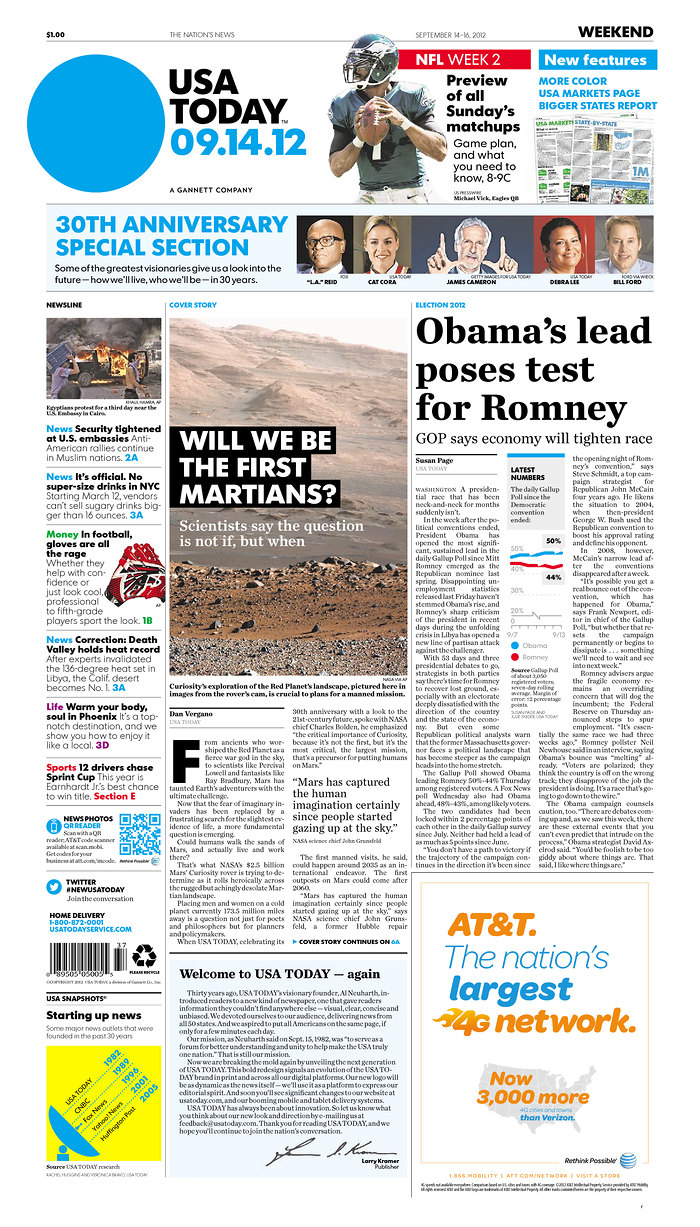
The real shocker for me was USA Today's new look.  Last month Gannett launched a redesigned USA Today newspaper  Again, it's not one I subscribe to, but the layout and design is a real break from the iconic newspaper look.  The block USA Today header is replaced by a piechart-like graphic, new sections were added, and the whole paper features more color (almost twice as many pages printed in color).
  Plus the almost obligatory front page ad in the bottom right corner. 
The reveal of the new print layout and design was followed by a new look and design for the USA Today online news site.  The web design carries through some of the same graphics, but places much more focus on visual elements.  In their own story on the new-look website, they emphasized that a key element in the new design is its ability to reformat to different screen sizes and resolutions -
"The look and functionality of all digital platforms — the website, tablet app, new Facebook app and new mobile apps — also have been overhauled to facilitate bigger images and graphic-driven stories while presenting them in “a fun, engaging” way, the company says.
The web and tablet platform will also feature live video coverage, interactive weather mapping and more instant analysis and commentary. New user-control features will make customizing the pages easier for consumers."

  The redesigned USA Today website that takes the graphics-heavy look almost to the extreme.  If the CBS redesign arguably pushed towards more non-professional, social media look, then I'd say the new USAToday website is a mix of Flipboard and Pinterest. - chunky blocks dominated by visuals.  More eye candy than food for the mind and soul.
  
   A lot of comments from the graphics/design folks are positive - each of the redesigns places a focus on cleaning up, or freshening the visual look, but to differing degrees.  The feedback and comments from journalists and heavy users of online news is not so positive - many feel that the new looks all "dumb down" the news aspect. While the designs may work at attracting casual readers/viewers, they do so at the expense of providing informative news in an easily accessible form.
  My wandering of the new news sites shows very little in the way of providing links or access to more information, or alternative perspectives.  The sites are primarily walled gardens, linking to themselves, affiliated sites within the corporate family, and, of course, advertisers.  Some (but not many) stories have links to other stories within the affiliated sites, but I didn't note any links to source materials, archives or alternative perspectives (outside of comments).  In an interview, Gannett's Chief Digital Officer David Payne, confirmed that the redesign was driven more by marketing goals than providing a better news product.
"I was pissed off and frustrated about how news sites had not evolved," Mr. Payne, former GM of CNN.com, said of the radical changes. "In a utopian world, we start migrating out of little boxes and really take advantage of the power of these things (he said pointing to his laptop). These are much more powerful than televisions."
The new design was driven largely by a desire to give advertisers a new type of digital canvas with which to work.
Mr. Kramer (USA Today's president and publisher) is also pushing for changes in how his journalists gather and publish news. In the past, USA Today has often pushed out a quick breaking-news story or wire story for big news events, and then the next story on the subject would wait for the print paper. Now, he wants reporters to fill the gap on the web between those two types of stories.
Kramer also indicated that USA Today is pushing some of its journalists to let more of their personal voice shine through in their writing, rather than the "stripped-down, just-the-facts prose" that was the hallmark of the USA Today of yore.

  Keep this in mind the next time the big news organizations try to brand themselves as being all about providing news and information. The goal is to produce stories to attract consumers so they can sell advertising - not to be the conveyors of news and information that contributes to an informed electorate or enlightened public.

Sources -  CBSNews.com redesigns, NewscastStudio blog
ABC's "World News" gets a makeover, Broadcast Engineering
In USA Today Redesign, Hope for a New Canvas for Web AdvertisersAdvertising Age
A closer look at the hints we've seen of the new USA Today redesign, Charles Apple - The Visual Side of Journalism blog, American Copy Editors Society

Thursday, September 27, 2012

"Cable" to enter Gaming markets

It's not a totally new idea - using cable systems to stream videogames.  Sega tried it with Time Warner and TCI in the 1990s with the Sega Channel - subscribers to the channel could download games into a blank cartridge to play on their game consoles.  However the cost of a monthly subscription and the reusable blank cartridge were high compared to the cost of games, which limited demand.  The addition of low cost videogame rentals at major video rental outlets effectively killed the experiment as players quickly embraced the low cost option.
   Time Warner looks to be testing the gaming market again, this time with partners AT&T and Verizon.   This time, however, instead of partnering with existing videogaming platforms, the plan is to develop a cloud-based gaming platform, with game play processing in the cloud and the display platform integrated within the cable box.  This could save the consumer the cost of purchasing stand-alone gaming platforms (and repurchasing them every 3-5 years for upgraded technology).  The new system would combine the networks high-speed data connections and cloud computing to shift most game action processing to the Cloud, removing the need for increasingly complex local processing units like Playstation, Wii, and Xbox.  Shifting processing to the cloud would also reduce the need for avid gamers to regularly upgrade to new consoles (and new versions of favorite games re-engineered for the new consoles).  The three home distribution networks hope to introduce their new gaming system next year, after upgrading data transmission, cloud-based game processing, and set-top box video processing technologies.
  The videogaming market is huge, generating an estimated $24.1 billion in sales last year.  And while hardcore gamers still focus on consoles for gaming play, a growing portion of casual gamers have been shifting their focus to gaming apps on smartphones and tablets.  This shift is reflected in a 39% drop in videogame hardware sales over the last year.  Further development of cloud-based gaming options could enable the most complex and intricate hard-core games to be played on TV screens - even on tablets and smartphones - without the need for consoles, cartridges, and discs.  That would likely significantly disrupt the current console-based business model - with hardware (consoles) being sold near cost, and profits generated from operating system royalties from sales of game discs and cartridges.
   Developing and implementing a cloud-based gaming system would seem to have benefits for consumers, content providers, and carriers.
With cloud gaming, consumers will be able to avoid buying Sony’s PlayStation 3, Microsoft’s Xbox 360 or Nintendo’s Wii, and play using generic controllers connected to their set-top box or TV. Some carriers are looking at software that turns smartphones into controllers, (representatives) said.
Working with a single online cloud-gaming operating system would have clear benefits for game producers, who could avoid excessive royalty payments to console developers, and save the costs of having to adapt games for multiple platforms.  As for cable operators and carriers,
“It makes perfect sense why they would want to go after this market,” said (Mitch) Lasky, who was previously an executive at Electronic Arts. “Streaming games use a ton of bandwidth and really benefit from good networks. But it’s a gnarly execution problem they’re trying to solve.”
  Cloud-based gaming systems are already being tested and deployed in a number of markets around the world.  Playcast, based in Israel, currently has deals with telecommunication networks in South Korea, Singapore, France and Portugal for a subscription cloud-based gaming service featuring Activision gaming titles.  Another firm, CiiNOW, is running multiple trials in Europe.  Its CEO, Ron Haberman, commented that
“If there was ever a service that fit network providers, it’s this one... 2013 is going to be when we see big commercial offerings.”
  Cable giants Comcast and Cox also indicated an interest in offering videogaming services, although declining to provide details.  Meanwhile, Sony's hedging its gaming future - purchasing cloud-gaming company Gaikai for $380 million in July.

  Cable and other multichannel operators are losing subscribers, so have been searching for new revenue sources.  Gaming is a big market; the introduction of reliable, high-quality, cloud-based gaming that would equal or surpass the gaming experience offered by dedicated consoles would likely profoundly reshape gaming markets by offering significant benefits and savings for players, game-creators, and network operators and access-points.  The only likely loser would be console manufacturers.  It's a good thing that those big conglomerates (Sony, Microsoft, Nintendo) are likely to be pitted against other big conglomerates (AT&T, Time Warner, Verizon) - with both sides having deep pockets, consumers are likely to benefit while the alternative gaming structures battle it out.
 

Sources -  Xbox Challenged as Cable Plots to Make Consoles Obsolete,  Bloomberg.
Sony buys cloud gaming company Gaikai for $380m,  the guardian

Monday, September 24, 2012

Move towards Global IPTV Cloud

A new service, called PurpleCloud, aims to provide a Cloud-based broadband IPTV service to allow Asian and Indian broadcasters access to the North American, European, and Australian markets.
  The service is a joint venture of Octoshape (provider of cloud-based streaming technology) and video content delivery specialist PurpleStream.  The combination of the two companies' cloud and streaming management technologies should allow the PurpleCloud system to optimize streams to available bandwidth and user devices, allowing users to access streamed content on any Internet-enabled device without buffering. 
Offered as a managed service for broadcasters and OTT operators, PurpleCloud is intended to deliver "stable and dependable HD quality video streams to any device, any platform, in any geography at a fraction of the cost of current delivery services," the press release added.
The two primary delivery mechanisms for broadcasters seeking to reach international audiences are satellites and dedicated Internet-based channels - both of which can be prohibitively expensive for smaller channels and networks, or even leading networks from smaller markets (countries).  The service aims to continue adding content partners and is working on getting the PurpleCloud service added to SmartTV and OTT service bundles.  The next stage will be expansion into the live events broadcast market.

Monday, July 23, 2012

Comcast-NBC Universal net moves

Comcast, the parent company of NBC-Universal has formerly purchased Microsoft's stake in MSNBC.com for a reported $300 million.  MSNBC will be rebranded as NBCNews.com.
  Comcast has signaled its intent to get out of other joint operations, whether by selling its stake, or buying out its former partners.  One of the first moves has been to sell its 15.8% stake in A&E Networks to Disney and Hearst for $3.03 billion in cash.

Sources -  Comcast Buts Microsoft's Shares in MSNBC, BroadcastNewsroom.com
Comcast Sells A&E Stake to Disney, Hearst for $3BBroadcastNewsroom.com

Monday, July 9, 2012

Univision tops some TV ratings

  According to a preliminary release of summer ratings by Nielsen, the Spanish-language network Univision attracted more viewers in the 18-34 and 18-49 demographics than any of the English-language networks.  Univision posted a 1.4 rating / 4 share in the broader 18-49 demographic, edging out ABC and CBS (with 1.3 ratings/ 4 shares), Fox (1.1 rating / 3 share), NBC (1.0/3), and CW (0.3/1).
  The week's top show managed to pull in a 2.0 rating, more than 20% fewer viewers than last summer's top rated show at that time.
  Overall, CBS's strength in older demographics helped pull in a total of 6.54 million viewers over the period (still less than 5% of US population).  Nielsen reported audiences for ABC at 4.99 million, NBC 4.33 million, Univision 3.63 million, Fox 2.61million, and the CW at 760,000.

Source - Univision Just Surpasses Net RivalsMedia Daily News

Thursday, July 5, 2012

New 3D TV network announced

  Three longtime figures in the TV and film industry recently announced plans for a new 24/7 3D TV network to be launched in the first quarter of 2013.  The channel, called A3N, has licensed technology for a glasses-free 3D transmission technology.  It is thought that programming will consist primarily of movies - one of the principles, Elvin Feltner, spent decades amassing a private collection of more than 4,000 independent films and TV shows.
  Looking into the Feltner collection, however, raises some concerns about the content and its viability for 3D.  Press reports claim that much of the Feltner collection was "rescued" in 2010 by Film Chest, a company that specializes in film storage, restoration, and digitization of films.  Film Chest claims it also owns the rights to the rescued films.  In addition, few of the independent films of the era were available in 3D, and its unclear whether the Feltner archive owns those versions or the standard versions.  It also seems unlikely that if and when Feltner acquired the rights to those films, they explicitly included the network and global licensing rights.  While he may have bought the films and "all rights", the US courts are currently considering whether licensing rights to new related distribution formats are included implicitly with more general licensing rights, or must be explicitly licensed.
  I hope that things work out for A3N - the industry needs more channels and content, as well as settling on a specific technological standard. 

Source - Plans in Place for New U.S. 3D NetworkPromaxbda daily brief

Monday, April 23, 2012

The Internationalization of News

Japanese broadcaster NHK has launched a new English-language news channel, with studio operations in New York.  Programming will focus on Japanese topics, and looks to become a gateway for Asia-wide news and trends, especially since many U. S. media outlets have closed their Tokyo bureaus.  The service is on a dedicated over-the-air as well as a number of cable systems in the New York, Philadelphia, and Washington DC markets.
   NHK joins a growing number of international and foreign language who have opened English-language channels as a means to get their perspective out to compete with the dominant US/UK news agencies and channels. 

Source -  NHK/World English-Language News Net Launches in NYCMultichannel News