Showing posts with label magazines. Show all posts

Thursday, April 24, 2014

Mileposts: Two notable print closures

It's been a week of bad news for print media.  Newspaper revenues continue to slide, despite some upticks in digital subscriptions and advertising (see earlier post), and print's share of time spent with media has dropped more than 50% in the last four years, now accounting for a mere 3.5% of U.S. adult time spent with media (see previous post).  Now comes news that two notable print institutions are ceasing print operations.

Officials with publishing conglomerate Meredith Corp. announced today that the venerable Ladies Home Journal will no longer be published as a monthly magazine.  The title will transition to a special-interest quarterly publication sold exclusively at newsstands.  The Ladies Home Journal began publishing 131 years ago, and was the first U.S. magazine to reach a circulation of 1 million (111 years ago).  The company announced that the magazine's 3.2 million current subscribers will be shifted to other Meredith-owned publications.  Meredith indicated that its magazine division saw advertising revenue drop about 15% in the last year, while overall operating expenses rose about 8%, contributing to a 37% drop in profit levels.

The problem with the magazine was not its readers, but with advertising.  The number of ad pages had fallen 23% this year; but the problem was that that was only the latest of several years of double-digit declines.  Another of the pioneering "Seven Sisters" of women's service magazines, McCall's, closed in 2002 after years of losses that were also blamed on declining ad pages and aging audiences.  The last issue will bear a July 2014 publication date.

The announcement comes on the heels of the news that the Columbia University student newspaper, the Columbia Daily Spectator will drop its daily print edition.  Starting with the upcoming Fall term, the paper will be shifting its efforts to its online edition combined with a weekly print edition.  In fact, the new weekly edition will be folded into the Spectator's current weekly, called The Eye.  The Spectator began publishing as a student newspaper in 1877, and was the second-oldest continuously operating college newspaper in the U.S.  It began operating as a daily newspaper in 1902.

With this move, Columbia becomes the first (and so far only) Ivy League school without a daily student-run newspaper.  While stressing that it wasn't an economic decision, the paper's current Publisher did admit that the print edition was losing money this year, and hoped that the move would help free up funding to supplement a work-study program used to support staffers.

One alumnus, former managing editor Robert Hardt, Jr., commented that he had mixed feelings about the move:
“It’s the end of an era—but it probably means that Spec reporters will miss fewer classes and get better grades...”

Sources -  Ladies Home Journal to cease monthly publication, The Des Moines Register
 Ladies Home Journal to Fold After 131 Years in Print, Ad Age
Columbia student paper plans to drop daily print edition, Capital New York

Monday, November 18, 2013

Forbes for sale; Is digital success fluke or future?

Forbes Media has announced that it is up for sale.  The move was first announced in a memo to employees last Friday.  Forbes CEO and President Mike Perlis said the decision to pursue a sale came after several initial "serious" offers had been made.
Forbes magazine has seen the same downturn in print advertising as its competitors, with a 12.3% decline in the number of ad pages over the first three quarters of 2013.  However, it's been more successful than most of its print competition in growing its digital side. Digital circulation at Forbes.com has more than doubled over the last three years, and digital earnings currently account for about half of total revenues for the parent firm.
One analyst indicated that potential buyers needed to ask 2 basic questions.  First, was the rapid growth in digital revenues driven by its aggressive branded-content emphasis in combination with its unpaid-blogger strategy? Second, if that's the case, why is Forbes up for sale?

Print media has been losing value in recent years, and increasing distribution costs and declining ad print ad sales have imperiled traditional print business models.  Many recent print sales (Washington Post, Boston Globe, Newsweek, Maxim) were at levels 80-90% below peak valuation.  In contrast, some of the early numbers suggest Forbes could go for only 20-25% below peak valuation.  That does suggest that Forbes Media may have been more successful in developing its digital side and business model.  That includes cost savings by ditching professional journalists in favor of unpaid bloggers (the Huffington Post model), and their pioneering "native advertising" Brandvoice program.  Native advertising is a bit controversial for its combination of interactive targeting and using ad content that mimics their editorial content.  The combination makes the Forbes.com more of a bazaar than a traditional journalistic outlet.
One critic suggests that the noise and choice of the bazaar will start to wear on the traditional passive news consumer and thus will be, in the long term, unsustainable.  And knowing that, current Forbes leadership is looking to exploit their short term success.  On the other hand, perhaps the bazaar is a much more comfortable venue for the younger Internet generations - after all, its really not that different from the Wild West of the Web.  Younger Internet users are used to having access to an abundance of content, interactivity and targeting, evaluating the value of content, and even seeking to place their own content for wider access.  If that's the case, Forbes Media may be positioning itself to take advantage of the changing audience interests and behaviors of younger media consumers.


Sources -  'Forbes' Placed On The Auction Block,  MediaDailyNews
Running For The Exit,  Garfield at Large blog, MediaPost.com

Tuesday, September 3, 2013

Milestone - Vanity Fair turning 100

Vanity Fair's first issue (as Dress & Vanity Fair) came on October 1, 1913.  The magazine's 100th anniversary issue will feature iconic images from the magazine's past and commissioned essays on each decade of the magazine's life.
In his Editor’s Letter, Vanity Fair editor Graydon Carter remarks on the magazine’s milestone: “In an age when nothing seems to last—not convictions, not even cities—a centennial, like the one Vanity Fair celebrates this year, makes me marvel at the simple fact of longevity.”
“Magazines have ‘bones’—the unchanging elements that give structure to creativity—as surely as gardens and houses do,” writes Carter. “Today’s magazine is different in countless ways from yesterday’s—as even the briefest excursion through this issue will show. But I like to think that if [Vanity Fair’s first editor] Frank Crowninshield…could see the modern Vanity Fair, stripped of its logo and other identifying marks, he’d know in an instant what he held in his hands.”

The October 2013 issue will be on newsstands in LA and NY on Sept. 5, and released for e-Readers on the 10th.  The magazine will further commemorate the anniversary, vanityfair.com will launch an anniversary hub with more than 200 pieces of archival and new original content (including videos, articles, slide shows, interactive features and Spotify playlists).

Making it through two World Wars, multiple Depressions, and the rise of digital online media is quite an accomplishment.  Here's to the next hundred.

Source -  Introducing Vanity Fair's 100th Anniversary Issue, Featuring Cover Model Kate Upton,  VF Daily

Thursday, May 9, 2013

UK's Trader Media moves from print to digital

UK's Trader Media Group, publisher of Auto Trader and related titles, has announced that it will shutter all print editions next month and focus on digital editions.
  The company's top title, Auto Trader, has scene its print edition lose more than 90% of its circulation over the last 13 years.  In contrast, the Autotrader.co.uk website has become the go-to online marketplace in the UK for buying and selling new and used vehicles, with website traffic growing 13% a year, pulling in 11 million unique visitors - 3.5 million from mobile users..
  The company's interim CEO praised the role that their print magazines played in developing the brand, but noted that
"With a marked shift by consumers and dealers to online platforms as a means of accessing information and buying and selling vehicles, we continue to innovate to ensure that we offer them the products and services they require through their channels of choice.”
Source - Auto Trader owner Trader Media Group to close print portfolio next month, The Drum

Monday, March 18, 2013

Scotland Joins Press Regs Movement

Meanwhile, to the North, the Scottish Parliament is set to consider its own recommendations for press regulation.  And in disturbing directions - by expanding its coverage, and requiring it to fund itself (presumably either by collecting fines or making publishers pay licensing fees to cover news).
"The principal difference between what we advise and what others have proposed is that the jurisdiction of the regulatory body must extend by law to all publishers of news-related material. No publisher of news-related material should be able to opt out of that jurisdiction. We have little confidence that the voluntary 'opt in or opt out' model proposed by Leveson would work - whatever incentives were devised to encourage publishers to opt in."
One industry insider was quoted as saying
"These measures are draconian and unprecedented in a parliamentary democracy. The provision that all publications are required to register with this new body is effectively newspaper licensing. There it is. In theory is could extend to everything from a parish newsletter to a fishing journal serving the north-east."
The storm clouds are gathering...  (and not just in Knoxville for this afternoon's rain).

Source -   Scottish Government publishes Leveson report press regulation recommendation and sparks newspaper licensing fearsThe Drum

UK Tries to Reign in Press

The Labour Party claims it has a deal with the other major UK parties to publish a Royal Charter, to be backed by legislation, that would set tough new standards and oversight on journalism and the press in Great Britain.  The prompt for action comes after the publication of the Leveson inquiry into the actions and ethics of the press following a series of scandals. Leveson proposed statutory changes, but balance them with enshrining into law the freedom of the press, and the government's duty to actively promote press freedom.  The shift to the device of a Royal Charter was seen as a way to impose regulation and oversight without having to actually formally commit to the principal of a free press.
  Press and free speech advocates were outraged.  From tabloid The Sun:
As they bargained overnight in talks that ended at 2.30am, newspaper industry experts appealed to MPs not to shame Britain by throwing away 318 years of Press freedom.
Tim Luckhurst, Kent University’s Professor of Journalism, said: “Popular newspapers are bold defenders of the public interest. It protects our liberties and holds power to account. MPs should search their conscience and vote for freedom of expression unlimited by state intervention.”
Nick Pickles, director of civil liberties group Big Brother Watch, said of proposals to shackle newspapers: “MPs should reject these dangerous measures that would be seen around the world as Britain abandoning its free Press.”
Secretary-General of the Council of Europe, Thorbjorn Jagland, commented, "I’m very cautious about controlling the media, because it always leads to something bad - it always leads to misuse of power."

In a perversion of language, Prime Minister David Cameron claimed
“What we wanted to avoid and we have avoided is a press law,” he said. “Nowhere will it say what this body is, what it does, what it can’t do, what the press can and can’t do. That, quite rightly, is being kept out of parliament.”
Instead, the Charter will create an "independent press regulator" that will create and enforce a strict code, including the ability to impose heavy fines and require front page "apologizes."  And instead of transparent language and judicial oversight inherent in any statute, the "independent regulator" will be under the oversight of the Privy Council (i.e. not subject to public oversight).  Sounds a lot like telling the press what it "can and can't do."  Only without the protections for the press that the Leveson Inquiry report felt were critical to maintaining press freedom and independence.
  In particular, the new regulator would draw up a code of behavior for journalists and the press, set up a bureaucratic authority to investigate complaints, adjudicate complaints, and levy fines and other punishments.  Including telling the press what it must print and where to print it.
  While the inquiry and later discussion focused on the print press, it seems the Charter proposal takes things a large step beyond.
Schedule 4, Point 1 of both the government and the opposition’s versions of the Royal Charter will bring blogs under the regulator’s control:
“relevant publisher” means a person (other than a broadcaster) who publishes in the United Kingdom: a. a newspaper or magazine containing news-related material, or b. a website containing news-related material (whether or not related to a newspaper or magazine)”
What's most bewildering to me is that this is the one thing that can unite U.K.'s three largest political parties.  They must really hate having to deal with a free, inquisitive, and at times argumentative press.


Sources -  Parties reach deal on UK press regulation,  ft.com
European Human Rights Watchdog Criticizes. U.K. Press Regulation Proposals, The Hollywood Reporter
D-Day for Press Freedom, The Sun 
Guido's Warning to Liberal & Progressive Bloggers: Royal Charter Aims for Tabloids and Guido, It'll Get You Too,  Order-Order blog

For background on the Levenson Inquiry and Report,
Leveson - New Regulator Proposed,  BBC.co.uk

Saturday, March 16, 2013

UK sees boom in digital reading - Infographic

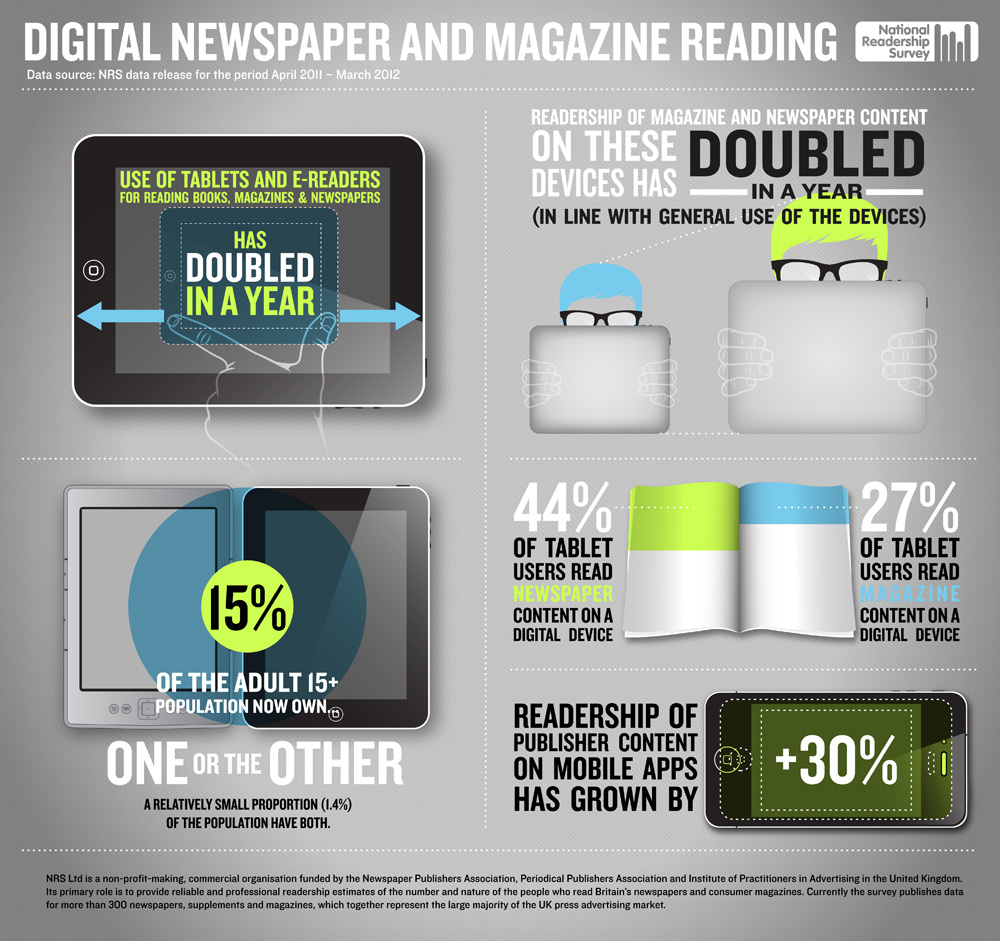
The 2012 National Readership Survey showed significant growth in the use of digital devices for reading newspaper and magazine content with use of tablets and other e-readers doubling, for both magazine and newspaper content.  While they report ownership of those devices was fairly low at the time of the survey, the results indicated that such devices are widely used by their owners for reading newspaper content (44%) and magazine content (27%).  And diffusion of tablets and e-readers continues to expand, suggesting that the importance of digital reading will continue to grow, becoming a significant means of reaching readers.


Source -  National Readership Survey infographic illustrates rise in digital magazine and newspaper readingjournalism.co.uk

Monday, January 7, 2013

Mr. Magazine on 2012

Samir Husni, a professor at the University of Mississippi who also runs the Mr.Magazine blog, recently posted his review of the magazine industry in 2012.
  2012 was a good year for magazine starts, with 870 new titles coming out.  Of those, 242 of were successful enough to maintain a regular publishing schedule.  Highly specialized niche titles dominated the list, running the gamut from Scrap Quilts to Biker Parties to English Tea & Cakes to Zombie Nation (and that's only in November & December).
The categories reflect the specificity that publishing today demands; from art to women’s interests, being a niche market was the bulls-eye to aim for. Success fairly oozed from the pointed hit almost each and every time. While the epicurean delights still ruled book-a-zine-land and special interests overall, lifestyles came in at a close second.
The range of eclectic niche titles is also reflected in Husni's list of top launches for 2012.
  1. Recoil, "an artfully-done, gun-lifestyle magazine that is selling for as much as $125 an issue on e-bay." (The mag generated a small firestorm when some journalists displayed their ignorance and bias by claiming its readers were extremists and the magazine little more than "assault weapon porn")
  2. Highlights Hello, a spin-off from the successful Highlights children's magazine.  Highlights Hello is aimed at children aged 0-2, and is highly graphic and filled with things that very young kids can grasp and play with.  Highlights Hello won the Magazine Innovation Center's inaugural award for Excellence.  (But can you really call it's target audience "readers"?).
  3. Dujour, a lifestyle magazine for the 1% (net worth over $5 million).
  4. Howler, for the soccer crowd.  "(A) completely independent project that promoted itself through social media and word-of-mouth and was publicly and crowd-funded."  A success story for entrepreneurship and social media. 
  5. Cosmopolitan for Latinas, another spin-off that "shows how important diversity and fragmentation are in our country today."
Sources -  Recoil: Read This List of 2012's Top Magazine Launches, And You Probably Will, MediaDailyNews
"Recoil" and "Highlights Hello" Top My List of Most Notable Launches of 2012; New Magazines Wrap-Up; Mr. Magazine Style,  Mr.Magazine blog
2012 Top Launches video

Tuesday, November 20, 2012

Tablets - Has Print Found Its Digital Analogue?

Traditional print media outlets didn't have a lot of success going online - at least not at first.  While poor management/judgement was a major contributing factor, I'd suggest that the lack of a convenient reading platform for digital content was just as critical.  You could bring print content to a desktop's screen, but the totality of print bundles (newspapers, magazines, etc.) didn't translate as well, and to be frank, the reading experience from desktops sucks.  You can't quickly skim contents, its not portable, and its tough to share.  News organizations did find audiences for their stories and content online - particularly among those with desktops at work (who could access stories piecemeal during breaks).  However, most news isn't unique - and the Internet also allowed a lot of competition to emerge.  Laptops added some portability, but in the early years were heavy and had low battery life - again not ideal for reading print media products.  Experiments with longer-form content, such as magazines and books, proved the viability of digital forms, but not the desirability of desktops and laptops for extended reading.
  Then came the development of eBook readers - lighter, portable, relatively inexpensive, good battery life, and with a screen size that mimics paperbacks.  The major success of the Amazon Kindle device combined with the Kindle eBook store started an explosion in digital book publishing (see earlier posts here and here).  While Amazon encouraged marketing deals with a number of magazine publishers and newspapers, neither was very successful - at least partially due to the Kindle form factor.  The smaller screen size that was fine for books didn't work as well for the larger magazine and newspaper formats.  In addition, magazines felt constrained by the lack of color and limited advertising opportunities.  Newspaper readers had to remember to download daily versions (via link to desktop or a less-than-ubiquitous Wifi connection), and the refresh delays of early e-Ink based readers proved frustrating for those wanting a quick skim of articles.
  Next came smartphones, which offered constant & widespread connectivity, was easily portable, and had decent battery life.  Amazon and other eBook sellers quickly offered free reader apps, but the tiny screen proved problematic for books and magazines.  With newspapers, however, smartphones opened a new niche market for news - as an access point for headlines and breaking news (particularly sports and weather), and with the possibility of providing apps that could push news to an interested readership.  Apps also facilitated monetization, whether through subscriptions, individualized ads, or sales (of focused apps).
  Then came the iPad.  It offered a sleek, highly-portable connected device with a large (comparably) color touchscreen.  For book publishing, it was like an eReader on steroids - larger, faster, with multimedia capabilities (audio, video, links) built-in, where the action to turn a page mimicked traditional media page-turning. (See earlier post)  Tablets weren't merely an option for reading device - they started expanding the concept of books and texts, and their markets (textbooks in particular, see here and here).  And most importantly, eBook readers weren't just reading more free books; they were buying more books (post on Harris study).  Adding tablets to the expanding eReader base has ramped up diffusion and the development of digital book publishing.
   The combination of the iPad and the Flipboard app provided an exemplary demonstration of the potential for tablets as a digital platform for magazines as well as news.  The iPad provided a high-resolution colour screen, which while smaller than most print magazine formats, was large enough to provide quality read that magazines sought.  Flipboard provided a test base for content bundling and reading experience that also came close to the magazine ideal - easily skimmed, able to integrate text and image, and to go deeper with a tap or continue to the next "page" with a swipe reminiscent of turning a page.  And the ability to seamlessly integrate advertising.  The experience is so exemplary that it passed 20 million users and 2000 content providers last summers.
   It would seem that tablets offer a viable digital platform for the consumption of traditionally print content forms, when combined with growing broadband access.  On the other hand, tablets are proving to be excellent platforms for Internet access, for delivering audio and video, as well as a good gaming platform, and a reasonable computing platform.  So the question for traditional print outlets is will readers embrace tablets, and how the rise of print through tablets will impact product demand.

  For the last year or so, a wide range of trade and academic studies suggest that tablets may provide a viable digital solution for print content delivery.  The latest study to come out is from analytics firm comScore,  They surveyed a rolling sample of U.S. tablet owners for three months, ending in August, and found that reading on tablets continues to increase.
“Tablets are fundamentally redefining how people consume news and information, with the format more conducive to reading longer form content than PCs or smartphones,” said Mark Donovan, comScore SVP of Mobile. “In the case of online newspapers, tablets are now driving 7 percent of total page views, an impressive figure considering the relative infancy of the tablet space. Publishers that understand how these devices are shifting consumption dynamics will be best positioned to leverage this platform to not only drive incremental engagement among current subscribers but also attract new readers.”
  More than a third (37.1%) of tablet owners use their device to read a newspaper at least once a month, and 11.5% report reading newspapers on their tablets daily.  Magazine readership through tablets was around the same - 39.6% read magazines on their tablets at least monthly, and 9.7% reported reading magazines on their tablets daily. Readership is highest among the 25-34 demographic.  An interesting aspect of the report was that tablet newspaper readers weren't very different from tablet magazine readers in terms of demographics, or in terms of the specific tablets that were used for reading (iPads, Android tablets, Kindle Fire, NOOK tablet). 

  The comScore study results, in terms of increasing use of tablets for media consumption, fall in line with a wealth of other studies.  And the consistency in user demographic breakdowns raises some interesting questions - is this a reflection of a audience segment of regular (heavy) readers, who use whatever platforms are available? Do they see tablets as a supplement to print outlets, a complement, or a substitute?
  At this point, I think that tablets are proving to be a valuable digital platform for the delivery of a wide range of traditional media content - and the first decent substitute for print.

Sources - Tablets Capturing Newspaper Viewers, Research Brief (MediaPost blog)
Tablets Reinvent Americans' Relationship with Print,  comScore press release

Sunday, October 21, 2012

Goin' Mobile: Newspapers, Magazines Up

New research reports from ComScore and GfK include some good news for newspaper and magazine companies.
  Tablet owners are increasingly using their devices to access content from newspapers and magazines.


Tablets used to read …
Newspapers
Magazines
daily

11.5%
9.7%
at least weekly
13.3%
1-3 times a month
14.6%
16.7%
once a month
37.1%
39.6%


Currently tablet use accounts for about 7% of all newspaper page views.
  Research is also showing strong revenue potential from tablet owners from both advertising and  subscriptions.  The two studies continue to show tablet owners who read newspapers and magazines on their devices are a valuable audience for advertising - skewing male, younger, with higher incomes.  Studies are also finding tablet advertising embedded in the newspaper or magazine content is read or noticed by tablet users, and that when those tablet ads are read or noticed, there's a high degree of reader engagement with the ad.

Source -  Mobile Rising: Newspapers, Magazine Readership, Ad Engagement UpMediaDailyNews

Thursday, October 18, 2012

Newsweek to abandon print

Many hoped that Newsweek's fire sale (price - One dollar) two years ago would rejuvenate the troubled news magazine.  Reaction when Tina Brown was named Editor-In-Chief was more mixed.  But three months ago the family of the late Sidney Harman (Newsweek's purchaser) pulled their financial support. At that point most analysts felt that the end was near for what had been a heavily subsidized print edition.
  Then came the announcement yesterday - not in the print magazine, or its online edition, but on The Daily Beast website - that Newsweek would stop publishing a print edition with the Dec. 31 2012 issue. Newsweek execs said they would rebrand the online remnants as Newsweek Global and continue to rely on subscriptions from online readers for revenues.
The new publication will be "a single, worldwide edition targeted for a highly mobile, opinion-leading audience who want to learn about world events in a sophisticated context," the statement said.

"This decision is not about the quality of the brand or the journalism--that is as powerful as ever," (Tina Brown) wrote in a statement on the Daily Beast website. "It is about the challenging economics of print publishing and distribution."

  Brown is somewhat correct in terms of the economics of print - its certainly more costly than online distribution.  But many print magazines are successful.  The more fundamental problem is on the revenue side - not enough people think the print edition and its content is worth buying to cover the editorial and print distribution costs.  While Newsweek was historically a proud and valuable brand - it's continuing decline and failure in the magazine marketplace suggests that the quality of the brand and its journalism is a major part of the outlet's decline.

Source - Newsweek to End Print EditionWall Street Journal

Wednesday, August 29, 2012

Magazine use of online Codes, Tags, widespread

The use of QR and related codes in print magazine advertisements has more than doubled it the last year - to the point where 10% of all print ads carry at least one code - at least in the top consumer mags.
  The latest quarterly survey by digital and mobile services firm Nellymoser found more than 2200 QR codes, digital watermarks, and/or Microsoft Tags in the advertisements in the 100 largest-circulation generally-available consumer magazines.  Breaking a milestone of sorts, Nellymoser researchers found at least one code or tag in each magazine examined, and 90% of the titles had more than 10 codes.  QR codes remained the most widely used technique, with embedded image recognition and augmented reality tags growing rapidly.  Around 40% of codes led to video experiences, while almost one-fifth linked to sweepstakes entries or opting-in to content requiring subscription or registration.  Another 18% linked to social media, and 14% led to online purchasing opportunities.
  It wasn't all good news, though -
And while the mobile codes are intended to link the user to mobile experiences, the scourge of the mobile misfire remains with us. According to Nellymoser’s analysis of the post-click experiences, a quarter of the landings were not optimized for smartphones. The problem of broken links and codes that simply do not scan properly persists.
Sources -  Magazine Mobile Codes Up 107%, Now On 10% Of AdsMobileMarketing Daily
Nellymoser press release (with graphics)

Thursday, February 9, 2012

Tablets and Magazine Readers

New research results from a panel of tablet owners (GfK MRI's iPanel of tablet and eReader owners), shows strong interest in reading digital magazines.
In a survey taken last month, 71% of tablet owners reported having at least some interest in reading magazines on their devices.  Some 38% had reported reading a magazine on their tablets in the last six months.  In contrast with print magazines, there was stronger interest among men, and among the younger demographic.  For the Male 18-34 segment, 85% expressed some or considerable interest in reading digital magazines. 
Risa Becker, SVP Research at GfK MRI, says "The fact that younger men who own Tablets are interested in reading digital magazines bodes well for digital magazine advertisers, since this demographic has been historically hard to reach."
Another good sign for digital magazines is that about 20% of tablet owners who read a magazine on their device also read back issues during their reading session.
   Apps remain the dominant access point for digital magazines, with two-thirds of the tablet owners saying they got to the online magazine through an app (47% accessed magazine content through the magazine's website, and 37% read a digital reproduction (both content and ads).  And yes, this adds to more than 100%, which indicates that some are reading more than one magazine on their device a month.
  GfK MRI's also put together a short video on their digital magazine results.

Source - Tablets Attract Magazine ReadersResearch Brief from the Center for Media Researh

Thursday, February 2, 2012

Go Digital, Young Magazine

New research from GfK MRI's iPanel suggests that table owners are highly interested in reading digital magazines.  (The iPanel consists of individuals who own tablets and/or eBook readers).  Overall, more than 70% of the sample expressed an interest in reading digital magazines on their devices.  Interestingly, interest was higher for younger and male users - 85% of males 18-34 (77% of all males) vs. 78% of females 18-34 (68% of all females).
Risa Becker, senior vice president of research for GfK MRI, observed: “The fact that younger men who own tablets are interested in reading digital magazines bodes well for digital magazine advertisers, since this demographic has been historically hard to reach.”
   The research also found that most tablet owners who had read a digital magazine in the last month had done so through an app (65%), while 47% accessed magazine content through the magazines website, and 37% read a stand-alone digital version.  (The percentages add to more than 100% because some tablet owners read more than 1 magazine in that time period, and accessed them via different methods).
  The research also revealed an interest in reading back issues - about one in five people who read a digital magazine also read back issues of the same title.

Source - Digital Magazines Popular, Men Hold Edge,  Online Media Daily

Thursday, December 8, 2011

Glamour goes Social

Post contributed by Krystyna Barnard -


In a November Folio article,  TJ Raphael writes how “interactive mobile tactics drove social engagement for content and advertisers.” The magazine did this by implementing Social SnapTag technology into both print and digital editions of their magazine, which enabled readers to access packaging or promotional deals they see in the magazine. It also enabled the magazine to target various consumers and increase consumer communication via social networking sites through a sense of mass marketing. Raphael writes that the Social SnapTag is similar to the QR code, however, users don’t need a QR scanner or smartphone to interact with the program.
  As a result of Social SnapTag, approximately 67 percent of consumers who used the program also “liked” the magazine, Raphael commented that "It just goes to show how prevalent social media has become in today’s technologically advanced society, not only for consumers, but for producers as well."

Source - “Glamour Gets 50,000 ‘Likes’ From Social Media Campaign,” Folio

Monday, December 5, 2011

Glamour tests interactive mobile

Post contributed by Krystyna Barnard -

In a recent Folio post, TJ Raphael wrote about how “interactive mobile tactics drove social engagement for content and advertisers.” The magazine did this by implementing Social SnapTag technology into both print and digital editions of their magazine, which enabled readers to access packaging or promotional deals they see in the magazine. It also enabled the magazine to target various consumers and increase consumer communication via social networking sites through a sense of mass marketing. Raphael writes that the Social SnapTag is similar to the QR code, however, users don’t need a QR scanner or smartphone to interact with the program. As a result of Social SnapTag, approximately 67 percent of consumers who used the program also “liked” the magazine, Raphael also wrote. It just goes to show how prevalent social media has become in today’s technologically advanced society, not only for consumers, but for producers as well. 

Source - Glamour Gets 50,000 ‘Likes’ From Social Media Campaign,  Folio.com

Tuesday, October 25, 2011

New Revs for old Media - Affiliate online stores

Post submitted by Brittney Dougherty (slight editting, BJB):

Finding new ways to keep readers interesting in print and web media has been a concern for media companies for some years now. It’s difficult to offer consumers something that they can’t get anywhere else. Garden & Gun has found a way to do just that.
   First of all, an online store is one step in the right direction to connecting with readers. The store has typical fare for the readers including koozies, shirts, hats and totes. On October 13, they added a new line called G&G exclusives. They worked with eight different designers to “craft a selection of exclusive goods.” Associate publisher Jessica Hundhausen says it was an exciting project.
   “Not only do we offer readers something special they won’t find anywhere else, it allowed us to collaborate with some of the best creative teams in the business…Our readers continually tell us they want more from Garden & Gun, this collection and the revitalized online store do just that,” she says.
   The Southern magazine has created a new way to keep readers interested in the magazine while simultaneously bringing in a new revenue source. Some of the items are upwards of $1,000. The Moore & Giles Gray Leather Campaign Chair is $1,200 and there is even a boat that costs $24,000. This creative and novel idea will surely keep Garden & Gun, as well as its readers, happy.

Source: “Garden & Gun Launches a New E-Commerce Platform with G&G Exclusives”   Magazine.org

Tuesday, August 9, 2011

Most Innovative Digital Magazines

Affinity's American Magazine Study, Spring 2011, tracked 172 digital magazine brands, their content and features on various digital platforms, and consumers perceptions about them. Digital platforms included magazine websites, social network use, mobile apps, and other digital delivery systems, as well as full digital versions.
The study came up with a number of "mosts" - "Most Trusted" (WebMD), "Most Entertaining" (Maxim), "Most Authoritative" (The Economist), "Most Enjoyable" (Playboy), and "Most Interesting" (Smithsonian), among others.
The folks at Affinity felt that the most critical criteria for online magazines was "Most Innovative", because

"magazines are now competing with all of the content and advertising available in digital form, not just their traditional set of print competitors. Only those brands that leverage the latest technologies in creative ways and offer consumers interactive and meaningful experiences will stand out among digital users."

The top 10 "most innovative" were 1. Dwell, 2. Popular Science, 3. Architectural Digest, 4. Wired, 5. Mother Earth News, 6. Fast Company, 7. Organic Gardening, 8. Elle Decor, 9. Martha Stewart Living, and 10. Popular Mechanics.

Source: "Dwell On This: Which Digital Magazine Do Readers Deem Most Innovative?" MediaDaily News

Tuesday, August 2, 2011

Goin' Mobile - Good Start for Conde Nast

Conde Nast recently announced that it's been able to attract more than 240,000 subscribers for the iPad editions of a number of its magazine titles in their first six weeks. This May, Conde Mast launched iPad editions of eight titles: Allure, Glamour, Golf Digest, GQ, Self, The New Yorker, Wired, and Vanity Fair.  The bulk of the new subscriptions (136,000) have come from print subscribers, who are allowed to add the iPad version at no extra cost.  Still, that's about 75,000 new subscribers in a fairly short period, suggesting that digital editions can be an attractive delivery alternative.
"The digital counts are increasing every day, and while this represents a small portion of our subscription circulation, we find it incredibly promising -- especially given the short time we have been marketing subscriptions," stated Monica Ray, executive vice president, consumer marketing at Conde Nast. 
This wasn't Conde Nast's initial foray into digital magazines - there have been almost 1 million paid downloads of the digital editions of their magazine titles through Apple devices, Amazon's Kindle, and Barnes & Noble's Nook Color ereader since the first digital edition of GQ released in November 2009.


Source: "Conde Nast: 242,000 iPad Subs in First Six Weeks", Online Media Daily

Thursday, June 16, 2011

Taking Content Mobile

A study of the top 100 media publications in the U.S. shows 84% reaching out to mobile readers through some combination of mobile apps or websites optimized for mobile.  Newspapers are leading the way, with 86% having a mobile site, and 92% having one or more smartphone apps.  Consumer magazines were the least likely to have mobile websites (44%), but 62% had at least one type of smartphone app.  Bloggers were more likely to have mobile versions of their websites (64%), with less than 40% having dedicated mobile apps.
On the smartphone side, iPhone apps dominated, with twice as many media having iPhone apps than Android apps (Blackberry was a close third among newspapers, but a distant third for consumer magazines and blogs.)  Interestingly, media have been somewhat slow to monetize mobile services - most blog and consumer magazine mobile websites carry no advertising, nor do a quarter of newspaper sites.
The study also looked at mobile content, finding a focus on providing current and breaking news, leaving traditional items such as features and editorials to print and online properties.

As an interesting side note, the study showed that while U.S. media outlets have been quick to embrace mobile opportunities, only 11% of some 719 UK print media titles had mobile websites.

Sources: "Mobile Media Marketing", Research Brief from the Center for Media Research
Press release on study