Showing posts with label viewing. Show all posts

Monday, March 16, 2015

Primetime ratings continue decline

The February C3 ratings averages (live + 3 days), the current advertising standard, showed a 12% decline for broadcast networks, and a 11% decline for cable networks.  In fact, only 3 of the networks measured showed an increase over their ratings for February 2014 - HGTV, Discovery, and TBS.

While the article indicated that Primetime TV ratings have seen "double digit" declines in each of the last five months, the situation isn't quite as bad as that suggests.  Looking deeper shows that the ratings since last September have been consistently down - that percentage decline is based on a comparison with the ratings for the same month the year before.  So in terms of the actual ratings, those aren't down by a third or more. It's still not good news for TV networks.

What is a more troubling indicator, following up on previous posts (here and here), is the fact that the decline over the previous year has been consistent, and its been so for both broadcast and cable networks.  That's indicative of a systemic structural change - one more likely based on audience behaviors than network programming efforts.  In the long term, that means trouble for an industry that is so heavily reliant on getting viewers for advertising.

In looking at the pattern of consistent declines, media analyst Michael Nathanson commented:
“It’s clear the downward spiral in TV ratings continues with no end in sight..." and that while changes in the ratings process might account for some overall change, “we believe these terrible ratings trends are also indicative of changing viewership habits.”
Source: TV ratings see double-digit declines for fifth straight month, New York Post


Tuesday, November 12, 2013

Transforming Media Habits- Kids vs. "Live"

An interesting piece in the New York Times takes a look at the changing nature of kids' TV viewing habits.  In brief, this generation of youngsters are growing up in an era of instant-access, on-demand, viewing that matches their viewing preferences much more than traditional television ever has. 
   Decades of research have shown that young kids are drawn more to characters than plots, and are comfortable with the familiar.  And anyone with regular exposure to young kids knows that they prefer being read the same story, or watching the same cartoon, time after time after time - well past adults' comfort levels.  In the traditional media era, that mean reading and re-reading favorite books and book series, and watching favorite programs (whether Sesame Street or My Little Pony) that keep recycling characters, scenes, and episodes.  With the rise of home video, this transferred to tapes and DVDs, which also allowed kids more control over when to watch, as well as control over program flow (using fast forward and reverse to focus on favorite scenes).  Disney, which initially sued to stop consumer use of videotapes, eventually found they made a mint from families regularly buying new copies to replace worn out children's videotapes.
When children are enamored of a show (or, more specifically, a character) they want to watch the same episode over and over and learn every detail. Instead of binge viewing as their parents do, they déjà view.

In the new digital entertainment marketplace, technology has expanded the user's ability to control viewing, and it is becoming increasingly driven by "on-demand" rather than traditional live schedules.  Between DVRs, On-Demand access through multichannel providers, and online streaming services, users can control their viewing to meet their needs and preferences.  Broadcast networks are finding that half or more of current prime-time series viewing is done outside of the "live" scheduled broadcast.  And that's with adults, who like original programming.

  For kids, though, traditional "live" TV is a step backwards, a relinquishing of control, a subjugation of their wants and preferences for those of another.  As the Times' lede suggests,
When Eric Nelson’s 6-year-old daughter, Charlotte, and 10-year-old son, Asa, discover that they cannot rewind or fast-forward a TV show, they are perplexed — and their father is, too. It is hard to explain the limitations of live television to children who have grown up in an on-demand world.
Add to that the expansion of personal video devices - bypassing the historical squabbling among kids over what to watch on the family TV, and you have the basis of a major transformation in viewing habits - where young viewers can finally fulfill their viewing preferences instead of settling for what others choose to make available.

These changes are showing up in the TV's industry numbers, although not so much in the regular TV ratings numbers (although it could account for Nickelodeon's recent fall in traditional ratings numbers.  A recent study by Common Sense Media found that kids' TV viewing on mobile devices has tripled since 2011 while viewing on traditional TV sets is falling.  Amazon reports that 65% of the most-replayed content on its streaming service is children's programming.  Amazon's created a special subscription streaming service for 3-8 year olds, and says that more than half of its viewing is from kids watching shows a second, third (or more) time.  Netflix is finding that most re-viewing for preschoolers is tied to learning, while older kids focus on the humor in specific episodes.  That's shown up in their programming strategy - they know they don't need all episodes of a kids program (unlike for most adult series) - just enough of the favorites to satisfy kids' interests.  (And Hulu+ insistence on ads is hindering their ability to attract kids' viewing, and their parent's willingness to subscribe).  Furthermore, traditional kids' channels like Disney, Nickelodeon are pushing access to network streams and program archives through smartphone and tablet apps, and even making new shows available online before their network premiere.
  And while the kids' share of audience and advertising may be small, they've got a strong, almost insatiable, demand for content. 
“Popular children’s programs can be a really big driver of use,” and can keep parents paying for the services, said David Tice, a GFK media analyst.
As a result, streaming services like Netflix and Amazon are working on creating their own original children's programming.  Netflix has contracted with DreamWorks for 300 hours of original children's animations, and Amazon has three new children's series scheduled for next year.

It will be interesting to see how much kids' preference for controlling access and timing of their TV viewing will carry through their adult years.  While content preferences will change as cognitive skills improve and interests shift, I think most will find giving up the control over viewing difficult - at least for most entertainment programs, movies, and short video content.  The value of live for some things (sports, etc.) may continue to overcome the loss in value resulting from the passive nature of "live" viewing - but when competition provides options and opportunity to personalize and control the media experience, it will be increasingly difficult to return to old couch potato habits.

Source -  Same Time, Same Channel? TV Woos Kids Who Can't Wait,  New York Times

Wednesday, August 7, 2013

Nielsen Study suggests Twitter-TV Link

A newly released study by Nielsen has found evidence of a statistical bidirectional relationship between TV viewing and Tweeting about that program.  According to Nielsen's press release,
analyzing minute-to-minute trends in Nielsen’s live TV ratings and tweets for 221 broadcast primetime program episodes using Nielsen’s SocialGuide, the study found that live TV ratings had a meaningful impact in related tweets among 48 percent of the episodes sampled. The results also showed that the volume of tweets caused significant changes in live TV ratings among 29 percent of the episodes.

The study also found that the impact of Tweets varied across program genres.  The impact was greatest for competitive reality shows (no surprise there), and also found that Twitter impact was greater for comedies than sports programs (a bit of a surprise).  Drama was least affected by concurrent Tweeting.

Source -  The Follow-Back: Understanding the two-way causal influence between Twitter activity and TV Viewership,  Nielsen newswire

Monday, April 1, 2013

For Media Use, Online tops off (Globally)

A major new study on media use from GlobalWebIndex (32,000 Internet users from 31 countries) has found that consumers spend more time with online media than is spent with more traditional (offline) media sources - at least in 23 of the 31 major media markets.  Globally, if one includes social media and mobile internet usage, 57% of daily media time is spent with online sources.  Traditional media use is highest in "mature" media markets, while online usage is highest in emerging areas such as UAE, China, Brazil, Turkey, and Malaysia.
  Before you read too much into these numbers, let me note that the sample, while large, is of Internet users only, and is not random.  Thus, you should exercise some care in generalizing from the results of this particular sample.


Other interesting findings include -
  • TV remains the most popular media, with an average of about 2 1/2 hours of viewing daily.  TV viewing is highest in the U.S. (averaging 4.7 hours of daily viewing).
  • News is the type of content most likely to be sourced online
  • Japan and South Korea users spend the least total time on daily media consumption.
  • Chinese users, on average, spent only 35% of daily media time with traditional (offline) media
  • Globally, social media use accounts for nearly half (48%) of online media time.  Consumers in the Philippines reported spending an average of 5.4 hours a day with online social media.
  • In some markets, mobile accounts for 30% of daily media use
  • The vast majority of users report multitasking with other media while watching TV
It should also be no surprise that the shift to online sources is lead by younger users.

What is a bit of a surprise is that there seems to be a link between Social Engagement (measured via a Social Engagement Benchmark measure) and the amount of time spent consuming online media.  That's something worth exploring further.


Source -  Online time now exceeds offline media consumption globally, GlobalWebIndex press release

Friday, August 24, 2012

Growth in Global Online Video Use Continues

A new research report from NPD Group shows that almost 1 in 5 consumers worldwide access online video through their TV sets on a daily basis, and 25% report watching online videos on their TVs at least several times a week.  Those numbers are based on a survey of 14,000 consumers across 14 countries that looked at online video content and how it was accessed and used.
  There were significant differences across countries in terms of the level of online video use, and in the devices used to access and display them.  In urban China, almost 40% reported watching online videos on their TVs daily.  Urban China was, in fact, heavy users of online video - "consuming more online video content than any other country across every device."
  The increase in using TV sets to watch online video is very likely to be related to a shift in content preferences - films are now the most popular online video content on TVs, overtaking TV programs, and other content forms.
  Using mobile devices to watch online videos continues to grow, but still trails the use of laptops (52%) and desktop computers (73%).

Source  -  Report: 18 Percent of Consumers Watch Online Video Content on TVs Worldwide,  Online Video Daily

Monday, July 30, 2012

TV viewing al "Fresco" (future displays)

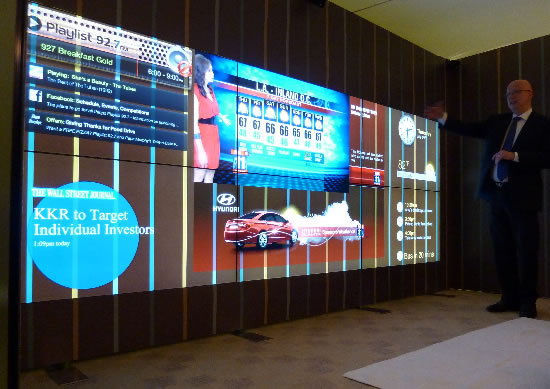
At recent TV technology meetings in Washington, DC, NDS presented a demonstration of a new way of watching TV - its "Fresco" project.
(C)onsumers of tomorrow may have expansive video screens available, perhaps covering entire walls of their homes or workplaces. NDS and others feel that this future is not far away, given the progress in OLED development that could soon lead to large display arrays assembled from smaller elements. The OLED panels could be super-thin, frameless, and either transparent when off, or coupled with electrophoretic ink (“E-Ink”) panels – as used today in many e-book readers – to provide a static background pattern. “It could be like tiling your bathroom,” as NDS’s Simon Parnall described.
 The "Fresco" project envisions future displays as unobtrusive, ultra-High Definition (at least 4K), immersive, and ambient.
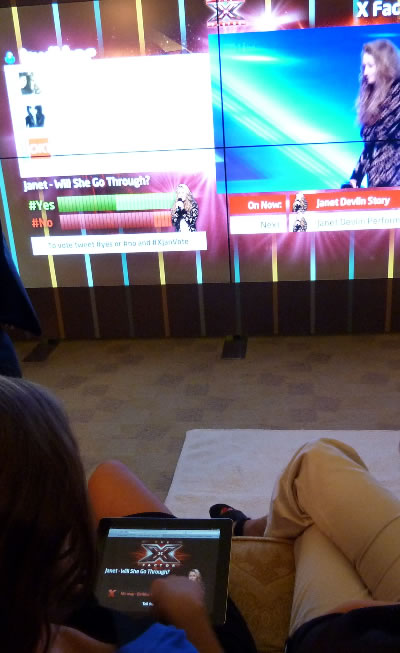
Parnall explained that such a display would “live with the viewer or family in the home,” displaying items that might today be presented by physical pictures on the wall, calendars, clocks, magnetic notes posted on the fridge, and the like. The display could also be used to present multiple simultaneous content elements (from broadcast, broadband or in-home sources), sized and arranged or the screen appropriately, or a single content element at a large size – so called “full immersion.”
 Parnall stressed the importance of including and utilizing metadata within video and data feeds, particularly in broadcast feeds.  The metadata (information about the content/app) could adjust display parameters automatically, and assist users' devices to make better choices on available viewing (or storage) options.  He also mentioned the opportunity for revenue generation from having such a large display canvas (putting ads, links, apps, etc. beside the primary broadcast feed, instead of overlaying them on top of the broadcast picture.
  What's slowing implementation is that direct-view screen sizes are nearing screen sizes that aren't viable in most consumer viewing contexts (too big for available wall space, too large to get through doors or around corners in stairs or hallways, and too heavy.  Today's largest plasma and LCD displays (and the demo in this case) use multiple smaller displays assembled together and linked to an external video driver that splits the video feeds among the component displays.  OLED technology offers the potential of thin and flexible screens that will eventually be ramped up to the kind of sizes and area coverage that "Fresco" envisions - but for now quality and manufacturing concerns have left large-screen OLEDs too expensive for general consumer use.
  Still, those attending the demo found it useful in terms of providing an idea about possible future viewing options, and the various opportunities for combining video and data in new, potentially profitable ways.

Source - NDS "Fresco" Demonstration Envisions a Bold Future of Television,  TV TechCheck

For somewhat similar visions of the future of displays, check GE's A Day Made of Glass, A Day Made of Glass 2, and Day 2 - Unpacked (discusses specifics of technology and current viability) videos.

Monday, July 9, 2012

Study: Social TV Promotes Engagement

  One of the side effects of the explosion of media choices is the new reality that unless you can keep the consumer's interest, they can easily switch their focus to alternatives.  One of the key issues for media outlets in the future will be how can they track and maintain people's interest in their product - that is, can they keep people engaged.
  It's been thought that engagement is a pressing problem for broadcasting - that viewing or listening behaviors are traditionally passive.  In an era when there were few outlets, differentiated product, and largely habitual viewing/listening, this wasn't a big issue - outlets could thrive on sharing largely habitual audiences.  But as channels and new media outlets joined the market, merely splitting that audience yielded fewer and fewer viewers and listeners and smaller revenues.  And then came online video, streaming services, connected devices, and mobile devices, which not only offered more choice, but facilitated a shift in consumption patterns from passive and habitual to a more active media content consumer.  Mobile and social media are showing themselves to be a disruptive entry in the media content marketplace, with many studies showing their widespread use during TV viewing in particular.
  The question is whether such "second screen" behavior complements TV viewing, or a substitute for it, pushing the TV signal into the viewer's background, or replaces traditional TV on the big screen.  My guess, and what early studies seem to suggest is that it's more likely to be a substitute, at least for traditional content designed for passive viewing.
  Some video broadcast channels and programmers, however, see an opportunity to take advantage of second screens and social media as complements to their programming that allow greater involvement and engagement of a growing active audience.  "Social TV" is the name for such efforts, where TV content purposely tries to incorporate added online content accessible through mobile devices or encourages viewer participation in social media related to the program.
  A new study released by the Time Warner Research Council suggested that, for Social TV programs at least, second screen and social media use while watching TV can result in a more engaged audience, augmenting their use of TV rather than distracting from it.
"The most important overall finding is to understand that people use media to optimize their levels of interest and excitement," said Jack Wakshlag, chief research officer at Turner Broadcasting, a Time Warner unit that collaborated with the research council, sibling Warner Bros. and the research companies Innerscope and Ipsos. "When they find something engaging on the TV, they pay attention. When their interest wanes, in the absence of a second screen they could change the channel, get up, read a magazine, etc. With a second screen that allows live social engagement, they have more reason to stay on-channel with their friend."
 The study used biometric monitoring and eye-tracking to look at viewing interest and behaviors of a sample of 128 young adults in an experimental setting.  The experiment asked participants to watch specific TV programs under various viewing conditions (alone, watching with a friend, using various social media.  The study found a statistically significant increase (30%) in the level of viewer engagement when using social media or watching with a friend, than under the condition of watching alone with no access to social media.  The study also found a smaller, but still statistically significant, increase (20%) in engagement when people used connected devices to access co-viewing apps designed to deliver added content or a platform for real-time conversation.  The study also found that viewers tended to respond to audio cues in the TV program or commercials, even while online. This suggests a level of cognitive engagement with TV content even when viewers' primary focus is elsewhere.  There was also some evidence that study participants "appreciated" advertisers associated with co-viewing apps.

  The study and its results, while very limited, does suggest that TV outlets, channels, and programming sources can take some proactive steps to build audience involvement and engagement in an increasingly competitive media marketplace.  Steps that could make their content and channel more valuable to a potential audience, as well as to advertisers. 

Source -  Social TV Keeps Viewers Engaged When Minds Might Wander, Study Says, AdAge Media News

Saturday, September 24, 2011

'Reality' and Sports Top Viewing

Nielsen recently released some summary numbers from last year's TV prime-time viewing.
'Reality' shows accounted for more than half of all viewing, gathering 56.4%, up from 49.4% for the previous year (but down from its high of 77% for the 2007-2008 season).  Scripted dramas account for 23%.  Sports programming accounted for the next highest proportion of viewing, at 20% of prime-time viewing.  Nielsen reported that total primetime audience numbers remained high, just short of 200 million.

Source - Reality TV Grabs Most Viewers, Sports Nabs 20%,  MediaDailyNews

Friday, July 1, 2011

Streaming Makes Inroads into Prime Time

A Yahoo!/Interpret study of 4100 online video viewers is revealing a shift in online viewing habits.  A 2009 study, online video viewing dropped significantly in the 6-9 pm daypart, arguably as they switched to more traditional TV channels.  Now, 45% report watching some Web video during prime time "yesterday."  (the study asked about use of online video in the last 24 hours)
 The growth of Netflix, Hulu, and other streaming services certainly contributed to the shift - the number reporting watching streamed content from Netflix doubled, and those streaming from Hulu increased 67%. While the absolute numbers of online videos streamed increased, there were also a notable shift in the kinds of content streamed.  In 2009, 84% of online videos watched were short clips, while 11% were full-length TV shows, and 5% movies.  In 2011, the proportion of short clips dropped to 74% of all online videos watched, while the proportions for full-length TV shows increased to 18%, and full-length movies accounted for 8%. 
For now, the impact on traditional television viewing (broadcast, cable & DBS) is minimal, and the focus of the study was not on whether this viewing was reducing traditional viewing, so you shouldn't necessarily infer that viewers are abandoning traditional TV media for online.  At least not yet.  But the study supports the idea that audience media use habits are starting to shift and that many viewers find value in terms of being able to watch TV programs and movies when they want, rather than when stations and channels program them.

Source: "Prime Time is Web Video Time?", VidBlog
"Online video shifts to primetime viewing," Gigacom
Press release from Yahoo! Insights

Wednesday, April 6, 2011

More thinking of 'Cutting the Cord'

A recent survey by Consumer Reports showed that about 7% of pay-TV subscribers are thinking of canceling their service and relying on broadcast and Internet-delivery services for their TV watching.  That's of the 90% of respondents who report subscribing to pay-TV of one sort or another.  Not a huge number, but growing as pay service costs continue to rise and the technology to run IP video on TV screens continues to become more and more user-friendly.

Source: "Study: 7% of Pay-TV Subs Pondering Pulling the Plug," Multichannel News

Tuesday, February 8, 2011

Online video cuts into TV time

A new study from Frank N. Magid Associates suggests the shifting habits of video viewing.  Some quick stats:
  • 49% watch online video daily
  • 48% plan to increase their use of online video this year
  • 66% of online video viewers report this has cut into their TV time
  • While 58% indicate that they do other things around the house when TV ads come on, only 26% turn away from online ads.
"Online Viewers Decrease TV Time, Up Video Watching," Online Media Daily

Tuesday, January 18, 2011

What to Count?

Arbitron, the principle ratings service for television, has been struggling with how to count viewing in the new digital media environment.  With viewers now having the opportunity to watch the initial broadcast live, often with a repeat broadcast on the same or related channel shortly afterward, the later viewing from DVRs, on Video-On-Demand, and off Internet sites, there has been increasing concern over the validity of ratings numbers.  That, combined with the networks concerns about continuing decline of their ratings and what impact that has on advertising dollars, has the industry trying to find ways to inflate ratings (or better count viewing).
However, there's been disagreement brewing between advertisers (who want to know who watched a particular ad at a particular time) and networks eager to increase ratings, if not viewing.
Anyway, the prompt for this thought was an announcement from Arbitron that they're once again delaying implementation of a new ratings system.  The article doesn't indicate whether this is because of problems with the new data, or because of disagreements on how to count or what to include in the new numbers.  Both have been issues in the past.
Arbitron delays new ratings

Thursday, January 6, 2011

Web changing TV viewing

A report from research group SNL Kagan suggests the rise of Net-ready TVs and devices are likely to change viewing habits.  (Report from USA Today)USA Today Story