Showing posts with label ratings. Show all posts

Monday, March 16, 2015

Primetime ratings continue decline

The February C3 ratings averages (live + 3 days), the current advertising standard, showed a 12% decline for broadcast networks, and a 11% decline for cable networks.  In fact, only 3 of the networks measured showed an increase over their ratings for February 2014 - HGTV, Discovery, and TBS.

While the article indicated that Primetime TV ratings have seen "double digit" declines in each of the last five months, the situation isn't quite as bad as that suggests.  Looking deeper shows that the ratings since last September have been consistently down - that percentage decline is based on a comparison with the ratings for the same month the year before.  So in terms of the actual ratings, those aren't down by a third or more. It's still not good news for TV networks.

What is a more troubling indicator, following up on previous posts (here and here), is the fact that the decline over the previous year has been consistent, and its been so for both broadcast and cable networks.  That's indicative of a systemic structural change - one more likely based on audience behaviors than network programming efforts.  In the long term, that means trouble for an industry that is so heavily reliant on getting viewers for advertising.

In looking at the pattern of consistent declines, media analyst Michael Nathanson commented:
“It’s clear the downward spiral in TV ratings continues with no end in sight..." and that while changes in the ratings process might account for some overall change, “we believe these terrible ratings trends are also indicative of changing viewership habits.”
Source: TV ratings see double-digit declines for fifth straight month, New York Post


Thursday, October 2, 2014

What's going on with US cable news? Fox soars, MSNBC tanks

In one sense, tracking cable news program ratings is predictable - at the top.  The ratings for the third quarter of the 2013-2014 season is out.  Despite a fairly heavy news load (war and conflict in the Ukraine, Gaza/Israel, Iraq/Syria (ISIS/ISIL), saber-rattling by Russia and China, a number of celebrity deaths (Robin Williams, Joan Rivers), and new and continuing scandals in Washington, the border crossings, Ferguson MO, to name just a few) ratings for most of the cable news networks continue their freefall.
MSNBC saw prime-time average ratings drop 2 percent from the same period last year, but the really bad news is that viewing in the key 25-54 demo dropped 21% over the same time frame.  Ratings for its prime-time line-up experienced all-time lows in the key demo.  Which meant that reruns of Shark Tank on CNBC beat out every MSNBC prime-time show for the quarter.  The rest of MSNBC's programs didn't help much.  Total Day viewing was the lowest since 2007, falling 12% from the previous year.  The drop-off was worse in the adult 25-54 demo, where MSNBC lost a quarter of its total day audience from last year's performance.
CNN's new mix of news and reality/documentary programs experienced modest gains in prime-time viewing from the previous year (up 2% among all adults, and up 4% among adults (23-54).  Despite an initial modest rating spike for Anderson Cooper's live reporting from Ferguson, the news show fell back to its normal mediocre numbers, letting CNN's Sixties documentary series beat it out for the channel's most-watched show of the quarter.
The exception is Fox News Channel, which continued its domination of cable news.  This report marks FNC's 51st consecutive at the top of cable news channels ratings, and it did so with 12% increases in both total adult and adult 25-54 viewing.  This made Fox News not only the top cable news channel, but the most-watched of all cable channels (beating both USA and ESPN).
Another way of looking at the state of cable news is to consider each show's performance. Looking at individual shows, the 14 highest-rated were on Fox News Channel. MSNBC's Rachel Maddow Show was their top performer, coming in at 15, and Anderson Cooper came in at 18th, and Nancy Grace made an appearance for HLN at #36.

Sources -  Fox News Nabs Historic Cable Ratings Victory, The Hollywood Reporter
The Top Cable News Shows in Q3 were...,  TVNewser

Friday, August 1, 2014

Cable News Nets: MSNBC stumbles

The July 2014 cable network news ratings are out, and the big news is MSNBC's tumble.  MSNBC had a firm hold on the number two slot for months, over a faltering CNN.  Last month, however, their mumbers slipped to #4 in terms of Total Day Viewing in the key 25-54 demo, and to third place in prime time viewers. On the morning front, MSNBC's Morning Show fell behind CNN's New Day, and Rachel Maddow had her second worst ratings ever.

While this was going on, Fox quietly extended its streak of being the most watched cable news network in America. And Fox's The Five was not only the top news program during its time slot, it grabbed the most viewers of any cable program at that time slot for the third time (beating the pants off of Spongebob).

  There was more bad news from the July numbers.  Even with all of the big breaking news during the month, CNN, HLN, and MSNBC experienced significant declines in viewing from July 2013.  MSNBC lost a full third of its total day audience from where it had been a year ago. Fox managed a slight increase (2%) in the prime time audience from its July 2013 numbers.   And Fox's The Five was not only the top news program during its slot, it grabbed the most viewers of any cable program at that time slot for the third time (and beating the pants off of Spongebob).

Source:  CNN Overtakes MSNBC in July as Ratings Take a Hit, The Hollywood Reporter

Univision bucks summer doldrums

Summer has traditionally been a slow time for the major broadcast networks in the U.S., as well as for TV audiences.  With viewing numbers down, and the key Fall sweeps coming up, summer has traditionally been a dumping ground for program repeats, a place to test new programs, and a last chance to air contracted (but unaired) episodes of canceled series.  Outside of the occasional big sporting event, there's not much to look forward to on broadcast television.

On the other hand, the lack of quality competition from the big networks gives newcomers an opportunity to counter-program with the best of new programs and episodes. When Fox started, it moved up the starts of some of its better series to the summer.  Putting original episodes of quality programs up against the dregs of big network offerings, gave viewers an incentive to sample and evaluate Fox series and build audiences.

Spanish-language network Univision has been trying to move from a niche network to a challenger to the Big 4.  It's expanded its reach beyond urban areas with high numbers of Hispanics, adding its own stations in larger markets, picking up affiliates, and making a push to get on multichannel basic service tiers.  It's worked to shift its programming focus from airing licensed series from other Latin American networks and channels, to a mix reflecting its goal of being a general-interest broadcaster. 
Among those moves has been developing a strong news presence, expanding and improving its sports coverage (including live game coverage of Latin American soccer and baseball leagues), and putting a major focus on creating original entertainment programming.  And it's starting to be successful.  In the key market demographics for broadcasting (19-34 and 18-49) it's beating monthly ratings for one or more of the Big 4 networks with increasing frequency.  And for the second straight year, its July primetime ratings have come out on top - beating the audience numbers for all of the other US broadcast networks.  It also had the youngest audience (median age 39, vs median age for the Big 4 of 56).

Of course, Univision's ability to outdraw the Big 4 is not only a result of programming acumen.  It's been helped by two long-term trends: declining ratings and shares for the broadcast network as viewers have shifted to and expanding number of viewing alternative; and the fact that Hispanics are the fastest growing demographic group in the U.S.  Still, their successes over time suggest that they've made the move from being a niche service to becoming a fully competitive general-interest network.

Source:  Univision is the #1 Network for the Second Consecutive July Sweep Among Both Adults 18-49 And Adults 18-34, TV by the Numbers.

Monday, April 28, 2014

Social Media couldn't help NBC's Sochi ratings

Oh the wishful thinking at work.

NBCUniversal's head of research, Alan Wurtzel, recently commented on his unit's analysis of their Winter Olympics coverage earlier this year.  The extensive coverage of the Games (1500 hours, all told), provided a platform for investigating media behaviors.  The network had expected social media to have a "dominating" effect on viewership, driving viewers to both the main primetime broadcast network shows and the sports coverage spread across a number of cable channels.

As it turned out, viewing and social media use didn't explode as planned.  Only 19 percent of viewers used social media to post about the games.  Some 3 million unique users posted a total of 10.6 million Olympic-related messages on Twitter.  NBCU indicated that up to 23 million people saw one or more of those messages.  In contrast, NBC averaged 21 million viewers for its prime time coverage.  The numbers on Facebook were higher, but still only 20 million posted, commented, shared, or liked something "related to the Olympics."  NBCU didn't indicate what percentage were actually focused on their coverage of the games, or were positive posts on their coverage.  (I'll admit to retweeting and posting about some of their analysts' more ridiculous comments, as well as the comically unprepared venues and tourist facilities).

So out came the wishful thinking.  According to Wurtzel, social media wasn't "a game changer yet."
“A lot of people want to show that they are on the cutting edge... Why wouldn’t I want to say to you, ‘We have a potent new way in which we can drive ratings?’" But “it just isn’t true”, he added. “I am saying the emperor wears no clothes. It is what it is. These are the numbers.”
The underlying problem, though, is that people use social media to comment on things they find interesting, particularly things they are passionate about.  Social media activity is also mostly reactive.  Wurtzel and the head honchos at NBCU apparently thought that the world of social media would jump at the chance to provide free promotion for its Olympic coverage, generating the social buzz that would drive up viewership.  Particularly for its prime time shows, which focused more on soft stories of athletes than on sports coverage. 

However, there weren't a lot of U.S. athletes in those games that had active fan bases.  (The most social media savvy, Shaun White, did poorly after an injury.) Similarly, winter sports don't have the huge, and social media adept, fan base of many Summer Olympic sports.  From America's perspective, there wasn't much of interest to tweet about the actual sporting events, leaving social media to revel in the gaffes and general goofyness surrounding the event and its coverage.  And while that may drive social media traffic, its not the kind of buzz that can drive viewing and ratings.

The numbers certainly are what they are.  What's unclear is whether the numbers reflect the impotence of social media, or the impotence of NBCU's coverage of a mediocre sporting event.

Source -  Social media not yet a 'game changer' for boosting TV viewership,  Financial Times

Monday, March 24, 2014

Metrics - Nielsen undercounting online video?

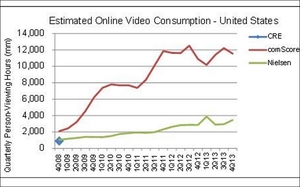
A report from Pivotal Research Group suggests a large and growing gap in measuring online video use.  The study compared metrics from Nielsen with those coming from comScore, showing a sizable and growing gap in terms of online video usage between the two metrics.  Currently, the estimates from comScore show roughly 3 times the amount of online video viewing as suggested by Nielsen's current proposed metric.

There are several reasons for the difference.  One major difference is in how each defines "online video viewing": comScore includes both streams and downloads, and counts all video streams; while Nielsen only includes streams of TV programming.  (Nielsen relies on embedded tags to measure TV viewing; Netflix, for example, strips all of those tags from the videos it streams, so Nielsen doesn't include any viewing from the dominant online video streaming service).  Then again, Nielsen is funded by TV networks, stations, and broadcast advertising industry, so might be more conservative in measuring viewing that isn't ad-supported.  comScore, on the other hand, is the primary metric used by online advertising industry, as it more directly counts viewing of online video ads.  Neither metric currently includes viewing on the full range of mobile devices, however.

Based on numbers from the last quarter of 2013, comScore put online viewing at 8.6% of all TV viewing (15% among active online video users).  Nielsen placed total online viewing at 2.6% (4.9% for active online video users).

Source -  Report Reveals Gross Disparity In Online Video Ratings, Implies Overstatement,  Online Video Daily

Wednesday, February 26, 2014

Cable News Numbers - CNN's continuing implosion

One sign of CNN's continued ratings fall was last weekend's cancelling of their premiere prime time show, Piers Morgan Live.  The newly reported Feb 2014 viewing numbers provide ample support. CNN's prime time viewership last month was down 47% (from Feb 2013) at the 8 pm slot, and down 46% at 9 pm.  The 7pm lead-in was down 39%.  The situation with the desired news demographic of adults 25-54 was not quite as dismal - down 32% at 7pm, down 46% at 8pm, and down 38% at 9pm.  The full-day numbers are also down significantly, with CNN losing more than a quarter of its viewers from Feb 2013, averaging just 307,000 total viewers, and just 96,000 in the 25-54 demo.  The monthly numbers were the lowest ever for Piers Morgan Live, Crossfire saw its lowest ratings ever for total audience, and CNN hit a 22-year low in total viewing for the 7pm time slot.

As for its competition, Fox News continued its dominance in total viewing (146 consecutive months as the top-rated cable news network).  Total day viewers averaged more than a million viewers, and almost 1.9 million total viewers in prime time.  FNC saw modest gains of 2% in total average viewers from Feb 2013, and primetime viewing saw a 6% gain in overall viewing, and 3% in the 25-54 demo.  Total day viewing in the desirable 25-54 demo was down 2%.  O'Rielly and Hannity saw slight gains, while the The Kelly File at 9pm saw viewership gains of 23% overall, and 11% in the key demo.

MSNBC saw slight drops in total day (-5% overall) and prime time (down 9% in overall viewing, and down 2% in the 25-54 viewing), while also seeing a small increase (3%) in total day viewing averages for the 25-54 demo viewership.  Hardball with Chris Matthews (live) saw big gains (+22% overall, and +27% in the 25-54 demo) from Feb 2013 in the 7pm slot (when MSNBC did a repeat airing of the 5pm Hardball show in that time slot).

The numbers were enough to put Fox News as the third highest prime time viewership among all cable networks (fifth in total day); in comparison MSNBC ranked 26th in prime time and 27th in total day, while CNN came in 39th (prime time) and 34th (total day).  CNN was able, however, to return to beating Headline News.
Fox dominated the top-ranked programs list, with the top 13 shows in total day, and 8 of the top 10 in prime time. Four Fox programs registered more than 2 million average monthly viewers, with several others just under than threshold.  MSNBC's top show was The Rachel Maddow Show, with just under a million viewers on average (14th overall).  CNN's top show was Anderson Cooper 360, whose average total audience of 421,000 made it the 23rd most-watched cable news network program (behind CNBC's Shark Tank).

Sources - February Cable News Numbers: CNN Tumbles as Fox News Channel Logs 146th Consecutive Win; MSNBC Hangs On,  Deadline Hollywood
The Top Cable News Shows in February Were..., TV Newser
Cable Network Ranker: February 2014, TV Newser

Thursday, January 23, 2014

CNN's fall continues

CNN, arguably the originator of 24-hour news network, and its once predominant purveyor, is seeing its ratings falling by 33% in the key 25-54 demographic over the last year under the leadership of Jeff Zucker.  Total viewing (all demos) wasn't much better, with a fall of 28% in the last year.  Nielsen reports that last week's key audience (adults 25-54) for CNN averaged only 78,000 over the day and 98,000 in primetime.  The overall viewing numbers weren't much better, with only 277,000 average in primetime. 

In contrast, the numbers for the same demo (adults 25-54) for MSNBC were 148,000 total day and 235,000 in primetime.  MSNBC's numbers were down 5% from same time last year for that demo, but down 11% in overall viewing.  Fox News Channel continued their recent dominance, with 218,000 total day average and 261,000 primetime average for the 25-54 demo.  In contrast to CNN and MSNBC's long term ratings declines, Fox's ratings were up 3% in the 25-54 demo, and 6% in total viewing over the same time last year.

CNN's frontline primetime programs were no help:  Anderson Cooper's AC360 posted its lowest ratings since moving to the 8pm primetime slot, and Piers Morgan Live had its second-lowest ratings in the last year.  Total viewing for AC360 was just 252,000 (Fox's O'Rielly led the time slot with 2.43 million viewers and MSNBC's All In With Chris Hayes pulled 557,000 total viewers).

Monday's overnight ratings weren't much better.  At 8pm. CNN's AC360 pulled in 457,000 viewers, still a distant third behind Fox's O'Rielly (with 2,662,000) and MSNBC's All In with Chris Hayes (with 903,000).  O'Rielly's audience, in fact, was almost twice that of CNN and MSNBC combined).  At the 9pm slot, CNN's Piers Morgan pulled in 445,000 viewers, still a distant third to MSNBC's Rachel Maddow (1,047,000) and Fox's Kelly File (2,241,000).
Sources -  CNN Falls to Lowest Ratings Yet Under Jeff Zucker,  Variety
CNN Ratings Decline Stirs Worry, New York Times
Cable News Ratings for Monday, January 20, 2014,  TV by the Numbers

Monday, December 2, 2013

Cable News News: Big drops

Considering that last November was a Presidential election year, its hardly surprising that this years cable news network ratings are down.  The actual numbers though, are somewhat shocking - both in isolation and as trends.  They can even serve as a guide to reporting bias.
  • Left-leaning coverage will gloat over Fox News Channel's drop of 21% in total viewing.
  • Right-leaning coverage will trumpet CNN and MSNBC losing half their primetime audience.
  • Interesting, in looking over news reports, there's a lot of a third tack - discussing the CNN - MSNBC battle (for a very distant second) and ignoring or burying the Fox News numbers.
This year's numbers for November had FNC (Fox News) attracting more than 2 million viewers in primetime over the November ratings period (down 18%), with MSNBC pulling in 752,000 (down 50%) and CNN with 488,000 (down 54%).  In terms of total viewing, Fox was down 21% from last year's numbers, MSNBC fell by 45%, and CNN by 48%.

For CNN, that's 15 straight months of declining audience numbers.  And while Fox was also down, it ended the month coming in second (to ESPN) in primetime viewing, and still pulled in more viewers than all the other cable news networks combined.  November 2013 marked the 143rd straight month with Fox News as the top cable news network.


Sources: Nov. 2013 Ratings: CNN Hits Year Low,  TVNewser
November 2013 Cable News Ratings: MSNBC Tops CNN; Numbers Down From Last Year,  Huffington Post
Cable News Ratings: Fox News Channel Leads November As Nets Drop Sans Election Coverage, Multichannel News

(edited 10/2/2013 to add keywords)

Monday, November 18, 2013

Al Jazeera America ratings continue fall

Last month, cable news network Al Jazeera America earned abysmal ratings from Nielsen. 
Then, as now, the numbers of estimated viewers fell below the threshold Nielsen has established for its main ratings service for overall network ratings.  Still, the latest numbers suggest the network has averaged only 13,000 viewers a day since the news service launched on Aug. 20, 2013 (and only 5,000 viewers in the coveted 25-54 demographic sought by news organizations).  That puts it's viewership less than half of the failed network it purchased (Current TV, at 31,000).

In contrast, average daily viewing for Fox News Channel was 353,000; CNN 174,000, and MSNBC 121,000.

Source -  Al Jazeera America fails to attract US audience,  NY Post

Friday, October 11, 2013

Al Jazeera America viewing remains minimal

The latest cable news ratings show that Al Jazeera America's (AJAM) news programs are getting minimal viewing.  How minimal? In the latest report, the network's daytime shows garnered a rating of 0 among the key 29-54 age demographic.  (Ratings refer to the percentage of US TVHH watching, and are rounded to a single decimal point, so it doesn't necessarily mean that no one watched.  The ratings services also provide estimates of the number of homes watching, which can be more useful for cable network's hyper-competitive and fragmented audiences).  At this point, the network's ratings are so low that they don't show up in most reports.

Primetime shows did only slightly better.  Consider This, their 10 p.m. also earned a 0 rating, and averaged 9000 viewers total, with only 3000 in the 29-54 demo.  AJAM's flagship program, America Tonight at 9 p.m., averaged 18,600 total viewers, and was one of many shows to record 0 viewers in the 29-54 demo at some point during the week.  To put the AJAM numbers in context, audiences for America Tonight's 9 p.m. competitors on Wednesday night (Oct. 9, 2013) were 542,000 for CNN's Piers Morgan Tonight, 1,445,000 for MSNBC's The Rachel Maddow Show, and 2,475,000 for Fox's The Kelly FileAmerica Tonight also got outperformed by specialty shows Dr. Drew on Call (CNN Headline), with 257,000, and Secret Lives of the Super Rich (CNBC), with 131,000.

While AJAM is handicapped by the fact that it's channel isn't on all systems and only reaches about half the TVHH of the other cable news networks, the continued poor performance does not bode well for a nominally advertising-financed network; nor does it give the network much of a bargaining position to earn carriage (and licensing fees) from multichannel distributors.

Source - Al Jazeera America Had a Rough Ratings Week; Some Shows Hit Zero in Key Demo,  Mediaite
Cable News Ratings for Wednesday, October 9, 2013,  Zap2it TV by the numbers

Tuesday, September 24, 2013

New ratings low in sports

Even in a world of 500 channels it really takes something to pull a 0.0 rating - where not a single ratings sample household watched the program.  Particularly if you're a hometown sports team.  But last Sunday, the Houston Astros pulled the feat, in an away game against the Cleveland Indians.  Specifically,
not a single, solitary Nielsen household tuned in for as long as a few minutes in any given quarter-hour to watch the Astros lose to the Indians for their 105th defeat of the year.
Sure, there were excuses - the NFL's Houston Texans were on TV at the same time, the game was carried only on a regional cable sports network, it was against Cleveland, who isn't doing all that well this year, and the Astros are really, really bad this year (Sunday's game was the 9th loss in a row, and the 105th of the season).  The ratings were also from the Houston overnights, which are based on a fairly small sample of homes (Nielsen reports having 851 metered households in the Houston market).  But even against the Texas A&M/Alabama college football game, they pulled a few viewers, earning a 0.04 rating.

Apparently, turnout in Cleveland wasn't that great either.  (The Cleveland Indians has the lowest percentage of tickets sold in Major League Baseball - the pic is from that Sunday game).


Not the kind of record any sports team wants to set.

Source -  New low for Astros: 0.0 TV Rating,  Houston Chronicle

Monday, September 23, 2013

FTC clears Nielsen-Arbitron deal

The FTC has approved Nielsen's acquisition of former audience metrics rival Arbitron, after securing an agreement that Nielsen will continue the "Portable People Meter" (PPM) project, and license its use to others (notably competitor comScore).  The PPM project was originally a joint project of Nielsen, Arbitron, and comScore, and there was some concern that Nielsen would try to freeze out comScore.  ComScore and Nielsen are also involved in the competition to develop industry standards for online video metrics.
“In the event that an FTC-approved third-party elects to agree to licensing terms and other requirements, Nielsen would make available for license Arbitron PPM and related data as well as software and technology currently being used in the ESPN project for the sole purpose of cross-platform measurement for up to eight years,” Nielsen said in its statement.
While that wording sounds awfully restrictive, other language from the FTC indicated that comScore would clearly get that initial license.

With the FTC's approval, Nielsen's acquisition of Arbitron is expected to close Sept. 30.

Source -  FTC Clears Nielsen-Arbitron Deal, comScore Retains PPM License,  MediaDailyNews


Friday, August 30, 2013

Abysmal ratings for Al Jazeera debut & CNBC


CNBC continued its ratings fall, hitting a 20-year low last week.  Viewing is down 35% from a year ago, averaging only 37,000 viewers in the key 25-54 demographic.  The continuing decline is leading to revenue shortfalls.  CNBC is available to some 100 million US households.

Meanwhile, Al Jazeera's American news channel experienced a rough start.  AT&T's U-verse system dropped the channel on the day it launched, citing contract issues.  This cut off several million homes from access, leaving the network with a reach of only 40 million US households (out of about 115 million).  According to Nielsen's numbers, Al Jazeera America started off with just 22,000 viewers, for a 0.2 rating.  That's actually below Nielsen's threshold for reporting.  The top show for the week drew just 54,000 viewers.  Interestingly, the network has more Twitter followers, at 75,000.

To give you an idea of just how bad these numbers were, here's the daily average viewing for the major cable news networks for the same week:  Fox News - 968,000; MSNBC - 348,000; CNN - 346,000.  Both Fox and MSNBC saw slight declines from the previous week, while CNN experienced a slight increase.  Despite some media gloating (especially at CNN) over Fox News' ratings decline, it still routinely draws around 2-3 times the viewership of the second place cable news channel in virtually all time slots. 
  Current, the news channel that Al Jazeera bought to get access to major multichannel distributors, averaged only 42,000 viewers in prime time in 2012, and saw ratings drop below thresholds for carriage on many of those systems before the sale to Al Jazeera.

Sources -  Bad news: CNBC hits 20-year ratings nadir,  NY Post
Al Jazeera American off to a slow ratings start, LA Times

Wednesday, May 8, 2013

Redefining U. S. TVHH Universe

When Nielsen announced it was expanding its TV household sample to include homes that had no separate TV set, but could access TV programming via computers or other devices, it was clear that there would be two follow-up changes.  First, that at some point Nielsen would include online viewing in their ratings measures.  Second, that Nielsen would redefine its definition of TV households (TVHH) to include households watching TV programs online.
  Nielsen's latest numbers on the national TV audience has taken that second step, redefining its viewing audience measures.  Specifically, Nielsen's counting you as a potential viewer if you have a working TV set, or a broadband Internet connection and a monitor/display capable of displaying TV programs.
  Under the new definition, Nielsen reported the 2013/2014 U.S. TV household Universe Estimate at 115.6 million (up 1.2%), and the total number of TV viewers (2 and older) at 294 million (up 1.6%).  The gain comes after two years of declining viewing universe numbers, but is still less than the 2010/2011 Universe Estimate of 115.9 million homes. 
  In announcing the new metrics, Nielsen indicated that three factors contributed to the gain - real changes in population; updated formula for calculating penetration across demographics; and the expanded definition of a TV household.  They did not indicate how much of a contribution each factor made.

Sources -  Nielsen Reverses Decline in U.S. TV Homes, Variety
Nielsen Estimates 115.6 Million TV Homes in the U.S., Up 1.2%,  Nielsen press release

Thursday, May 2, 2013

US Newspapers Circulation Report

The Alliance for Audited Media (AAM) - formerly known as the Audit Bureau of Circulation (ABC) - has just released its report on newspaper circulation as of last March.
  Overall, digital circulation continues to rise, as print circulation stagnates or falls.  Total daily circulation numbers were down 0.7% over the last year, and Sunday circulation fell 1.4%.  In contrast, digital circulation was up 36%, and now accounts for 19.2% of all newspaper circulation.
  The Wall Street Journal remains as the circulation leader, with a total average circulation of just under 2.4 million (with a circulation increase of 12.3%). (I'm going to round to the nearest tenth of a million).  The New York Times moved up a spot to second, with a total average circulation of 1.9 million, posting an increase of 17.6% to move past USA Today, whose average circulation fell 7.9%, to 1.7 million.  The New York Times was also the only newspaper in the Top 25 where digital circulation was higher than print circulation, with digital accounting for 60% of total circulation.  Rounding out the top five are the Los Angeles Times, with average daily circulation at 0.6 million, and the New York Daily News at 0.5 million.
  For most of the rest of the Top 25, average daily circulation was more or less stagnant.  A few papers showed big increases in total average circulation, but most of that seemed to come from the inclusion of "branded editions" (defined as "newspaper-owned products such as commuter, community, alternative-language or Sunday-Select type newspapers") in the total average circulation counts.

Source -  Paywalls Boost Some Newspaper Circs, MediaDailyNews
Top 25 Newspapers For March 2013,  report from Alliance for Audited Media

Thursday, March 7, 2013

Nielsen/Arbitron deal edges closer

Nielsen's purchase of Arbitron is still not official - the FTC has yet to formally sign off on whether the merger would be anti-competitive.
  But the deal edged a bit closer as a Federal Court 2011 ruling in an anti-trust suit brought against Nielsen was upheld in appeal.  The 2011 decision found that while Nielsen was a monopoly in the US TV ratings business, it wasn't behaving in an anti-competitive manner.  That finding was just confirmed on appeal.

“Neither party disputes that Nielsen exercises monopoly power over the television audience measurement services industry, both nationally, for the United States as a whole, and for all 210 markets.”
However, the court ruled that on the specific allegations of the suit - that Nielsen had acted to prohibit other audience measurement services from entering the Miami market - that there was no evidence of specific anti-competitive behavior.  If such evidence had been forthcoming, it would likely have had a significant impact on the FTC's ruling of whether the Nielsen-Arbitron deal would be anti-competitive.

  Another factor in Nielsen's favor is that while Nielsen and Arbitron had once been fierce competitors in the U.S. TV and Radio ratings business, there is limited direct competition between the two today.

From 1978-1989 as Arbitron went head-to-head with Nielsen in the local TV ratings business, 60% to 80% of clients subscribed to both, the appeals court said. Those days are long gone -- Arbitron pulled out of that arena in 1993 -- much to the dismay of many in the advertising business.
As such, the purchase of Arbitron is seen primarily as a way for Nielsen to expand into additional areas of audience behavior measurements, and not as a means to remove a rival.  If that perception holds true, the FTC could still approve the deal, even if Nielsen is technically a monopoly.


Source -  Confirmed: Nielsen Is A Monopoly -- But Court OK With ItTVBlog

Monday, February 25, 2013

US TV Networks Falter in Feb Sweeps

After a slow start this fall, the audience numbers for America's Top Broadcast Networks just keeps getting worse. Numbers from the February sweeps are at historic lows.
  The Biggest Loser - NBC, which moved from #1 in the Fall Sweeps, to fifth place for the February sweeps - falling well behind Univision with a 4 share.  In fact, Univision outdrew NBC almost every night of sweeps among the key 19-49 demographic.  NBC also earned the lowest ratings ever for an in-season scripted series premiers with Do No Harm, a 0.9 rating and 3 share.  And then lost a third of that audience with the second episode (0.7 rating/ 2 share), before being quickly cancelled.  Season 2 of Smash debuted with audiences 79% below its Season 1 debut, and 39% below the Season 1 finale - a rating of 1.1 / 3 share.  And then dropped another 25% to a series low of 0.9/2 last week.  Only two NBC series were able to average a 2+ ratings this sweeps period among the 18-49 demographic: The Biggest Loser and The Office.
  And its not that the other networks were doing that well, either.  For the last week of sweeps, audiences for the Big Four networks were down 23% from the same period last year. In that week, only one network was able to average a 2.0 rating - Fox managed to get a 2.1 rating, for a 6 share.
CBS, which leads the sweeps period in every demographic, has seen series-low openers for reality shows “Survivor” and “The Amazing Race,” and yesterday it yanked the new unscripted series “The Job” after just two weeks.
ABC’s “Zero Hour” and NBC’s “Do No Harm” both premiered to the networks’ lowest-ever in-season drama debut ratings. Several of their veteran shows, including “Smash” and “Revenge,” have hit series lows this month.
And Fox’s one-time juggernaut “American Idol” has dipped to ratings not seen since season one. Meanwhile, its plan to relocate “Touch” to Fridays has been a huge bust, with the drama drawing just a 0.7 last week.
So what's up?  For one thing, the quality of cable network original programming - AMC's The Walking Dead outperformed every Big Four network show in the 18-49 demographic. Another culprit is the DVR, whose use by audiences continues to climb.  And then there's the streaming options of Netflix and the like, ensuring viewers that they don't have to settle for the least bad program when they sit down to watch a little TV.

For a guy who grew up when the Big Three would regularly pull prime time shares in the 30s - and ratings in the 20s, rejoicing over a 6 share is a glaring reminder that the TV market has changed, and of how far the once-mighty have fallen.
On the other hand, though, it's also a reminder of how much better things are for TV viewers. 

Sources - Behind the great broadcast ratings dipMedialife Magazine
NBC To Finish 5th In Sweeps For First Time; Network Falls Behind UnivsionDeadline Hollywood

Neilsen Redefines "TV"

If you've been paying attention to the evolving media landscape, changing audience behaviors, and debates over measuring viewing (or listening, reading, etc.), you knew this was coming.
  According to press reports, Nielsen's been telling it's clients that it's changing its definition of TV.  Since it's beginning, the Nielsen ratings universe has been based on TVHH - households with a working TV set, and measured viewing as occurring on TV sets.  Certainly definitions that made sense when the only way to watch TV programming (and ads) was through a television set tuned to a broadcast.  The definitions endured through the rise of cable (and DBS), VCRs, DVDs, etc.  While greatly expanding viewing options, you still needed the TV set as the display. 
  The digital revolution started changing that - you could connect TV tuners to computers and watch on the computer's display; TV content went online, and broadband diffusion made high quality streaming viable; DVRs fulfilled the VCR's promise of time-shifting, and mobile looks to fulfill the promise of place-shifting.  Time-shifting increased to the point where Nielsen and the networks had to find a way to count that audience, and continued growth of time-shifting ignited the current debates over what time period gets added in to the live viewing.  Still, however, the feeling was that the key component of TV was the larger TV screen - and that remained the foundational definition.
  For now, the TV set remains the foundation, but Nielsen will start looking at internet-connected TVs and viewing via internet streaming.  Nielsen's basic shift is that they will start including internet-only TV households in its sample, and start tracking viewing via streaming.  At this point, the proportion of (zero TV profile) households - those that don't watch TV over traditional (terrestrial broadcast, multichannel bundlers) channels - is small, but growing.  Nielsen estimates that when the new sample ratings kick in this coming fall (2013), the impact will initially be small (around half a ratings point), but as the "zero TV" segment grows, Nielsen wanted to be in a position to capture shifting behaviors.
   For advertisers concerned that these new delivery systems aren't carrying the original broadcast commercials - inflating the numbers reached and their costs - Nielsen indicated that, for now, the extra viewing will be captured separately, and specifically won't be included in the C3 ratings that form the basic currency in network/advertising rate-setting.  (C3 counts live viewing plus time-shifted viewing within three days).

The move should be welcomed as a step in coming to grips with the shifting media-audience ecosystem.  And help foster recognition of shifting media usage patterns, and the need to distinguish between viewing of content and viewing of ads.  It's been apparent that DVRs and new distribution channels have made it difficult to sustain the assumption that viewing a program equates with viewing the ad.  That's always been a questionable assumption, but now, viewing on other channels, through VOD, through streaming - all of which don't necessarily carry the same set of embedded advertising - is at the point where advertisers are pushing back at the networks and Nielsen.  This latest move should help solidify the distinction, and push for multiple metrics to met various needs.
  Still, there's a potentially bigger evolutionary force out there - the impact of mobile and the facilitation of place-shifting.  This move doesn't address that issue - the metrics still focus on content consumed on the TV set.  According to Brian Fuhrer, senior vice president-national & cross-platform product leader at Nielsen, wireless broadband is enabling new viewing alternatives - smartphones, tablets, even wireless gadgets connected to TVs.  Nielsen's looking at that, and how that would further redefine "TV."  I'd like to see that come quickly, but dealing with how to best measure and greatly expanded set of viewing options, as well as the continuing explosion in available "TV" content, poses a number of issues that will need to be resolved.  Nielsen indicates it's working towards that, as are a number of Internet-metrics players.  It'll be an interesting race - and one that shouldn't necessarily go to the quickest, the biggest, or the traditional dominant force.  Getting it right is critical to get a true reflection of changing patterns.

Source - Nielsen Redefines 'Television,' Will Include Internet-Only Connected Sets, HouseholdsMediaDail News
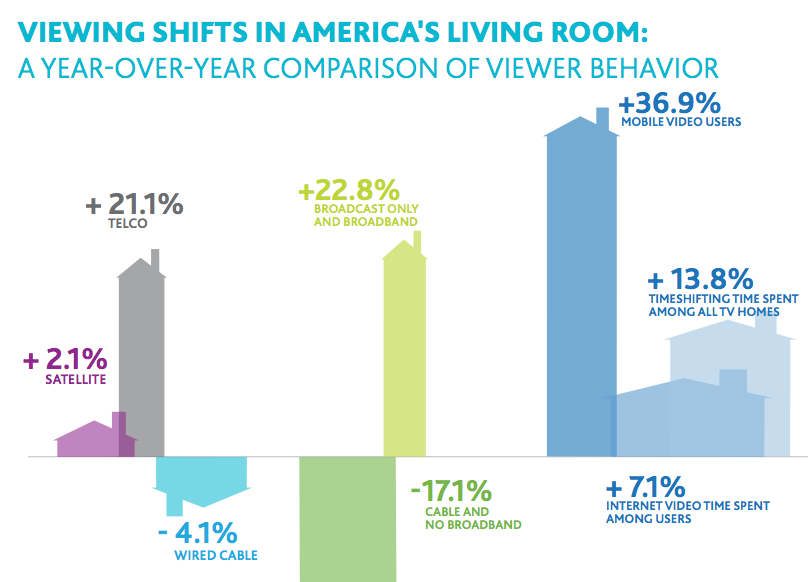
America's Living room: More Internet, less wired cable, VatorNews (older story, source of graphics)

Friday, January 4, 2013

Ready for the New Year?

I'm back from a bit of a break, but the ever-evolving world of journalism and media just kept piling up those changes.

Here's some highlights -

Nielsen bought out Arbitron (pending DOJ approval), further consolidating the broadcast ratings world.
 - Nielsen/Arbitron Deal Sparks Concerns Over Competition, Supply of Ad Market 'Currencies'MediaDailyNews

The latest ITU meeting ended without a formal Internet Governance treaty (see earlier posts), but it still seems on a rather contentious track.
  -  WCIT and Internet Governance: Harmless Resolution or Trojan Horse?CircleID

A Gannett paper in New York made the wrong kind of headlines by publishing gun permit owners names and addresses in an online searchable map, then doubled down after a wave of criticism from citizens and more ethical journalists.
 -  Where The Journal News went wrong in publishing names, addresses of gun ownersPoynter

Some digging by the Wall Street Journal found that one of the big Times Square digital billboards rents for $3.6 million a year, and the digital billboards for just one building (One Times Square) generates more than $20 million annually.
  -  Times Square Billboard Costs $3.6 Million a YearDigital Outsider

Several major cable MSOs are moving broadband data subscribers to usage-based pricing - putting data limits on standard subscription options and charging users for overages.  Expect heavy opposition from consumers (who increasingly have other service options) and streaming services.
  -  2012 Year In Review: Usage-based broadband launched by Comcast, Time Warner Cable, SuddenlinkFierceCable

One consumer survey found that 70% of gift-givers planned to purchase tablets for Xmas 2012, helping to feed the rapidly expanding mobile, e-content, and apps markets.
  -  Burn the Books: Make Way for E-Content, IGI-Global

The Season's Re-purposing Idea - The Seattle Times, which has a tradition of publishing "Pictures of the Year" in its weekly print magazine (and as a feature in its online photo galleries), is also making it available as an e-book for iPads.

  -  How the Seattle Times made an iPad book from its best photos of the year,  Poynter

I'll try to expand on a few of these and other news and changes that have piled up.