Showing posts with label revenues. Show all posts

Tuesday, February 3, 2015

Boom in online ad dollars - for some

Analyst Gordon Borrell puts the growth rate for online advertising dollars at 40% for 2014, and 42% for 2015.  Some firms could see online ad gains of 30% or more.  But for others, online dollars aren't going to be able to offset traditional advertising losses.

In particular, Borrell noted that newspaper print advertising is looking at continued advertising revenue declines of 10% annually.  Even when adding in the weak growth in online ad revenues for newspapers, total newspaper advertising revenues are predicted to fall 4.8 % in 2015.
Furthermore, the report notes that even in markets where newspapers have strong digital news content, advertisers are shifting to more targeted sites for directed and targeted advertising efforts.

With targeted ads remaining the fastest growing sector, having an audience is not enough - you need to be able to demonstrate having the right targeted audience.  Newspapers have had trouble doing that for their online editions.  In fact, Borrell predicts that online "Internet pure play" sites will grab about three-quarters of local online advertising revenues - mostly at the expense of traditional media outlets.
The report suggests that traditional media strategies towards online advertising tend to fall into one of three basic approaches:
Traditional media companies stuck in the analog world, selling a little digital stuff because it’s easy, but not really believing there’s good money in it; traditional media companies that are more excited about the prospects but still reticent (or unable) to invest more in order to grow quickly; and traditional media companies that have seen the light and are determined to grow again, investing heavily in digital by hiring people or acquiring companies.
Borrell estimates that about half of traditional media outlets fall in the first group - which explains why they're losing out in local advertising markets - which is increasingly focused on highly targeted content and audiences.

Source: Analyst Gordon Borrell sees local digital ads soaring in 2015, but not for newspapers, Poynter.org


Monday, April 21, 2014

US Newspapers Revenues Still Falling

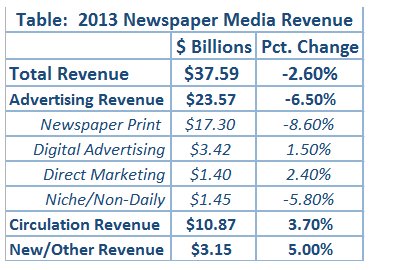
The Newspaper Association of America (NAA) has released its report on the state of newspapers in 2013.  The report trumpets "the best performance since 2006" - but that's because the overall revenue decline of -2.6% is the smallest annual percentage decline over that period.  Overall, the industry lost more than a billion dollars of revenue in 2013.  The fall in revenues was again led by a 8.6% drop in print advertising revenues.  According to the report, print advertising revenues account for less than half of total revenue.  Classified ad revenues continue to lead the decline (down 10.5%), but both national and retail advertising revenues fell by 8%.  Advertising revenues were also down (-5.8%) for weekly and niche publications.


Offsetting this was a modest 1.5% growth in digital advertising (overall, digital advertising is growing at a double-digit pace).  If there's good news in the report, it's the fact that the rapid adoption of paywalls for the online versions of print newspapers contributed to a modest gain in overall circulation revenues.  That, and the fact that the NAA managed to add $5.5 billion in additional revenues by including revenues from side ventures such as contract printing, weeklies, and a range of niche publications and services.  That really helped to slow the decline in the "total industry" numbers.  Still, revenues from all digital sources amounts to only 12% of total industry revenue, and newspapers' digital revenues continue to grow much more slowly than other forms of digital advertising.

Newspapers aren't out of the woods yet.

Sources -  Newspaper industry narrowed revenue loss in 2013 as paywall plans increased, Poynter
Business Model Evolving, Circulation Revenue Rising, NAA report\

(I made a number of edits for style and clarity after initial posting - BJB)

Monday, April 7, 2014

Recovery for World's Ad Economy

Recent estimates from ZenithOptimedia Group suggest that on a global level, at least, the advertising sector has returned to its pre-recession growth rates.  The report now forecasts a 5.5% growth in advertising spending, reaching a total of $537 billion. The news isn't uniformly positive for all media, however.
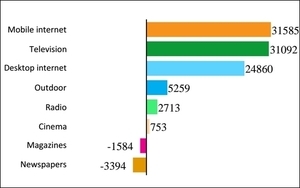
The overall growth is being driven largely by the rapid increase in online advertising.  Internet advertising is forecast to continue to grow by around 16% annually for the next few years, with online display growing at 21% and social media ad expenditures growing by 29%.   Online advertising can also be differentiated into desktop (static) and mobile sectors - and the report notes that the mobile sector is growing at 6 times the rate of desktop, hitting 50% annual growth through 2016.  The ZO researchers said, "mobile will leapfrog radio, magazines, and outdoor to be the fourth-largest sector" by 2016


While the TV sector continues to draw the lion's share of global advertising, and is forecast to continue growing, the online sector's much faster expansion is closing the gap.  The news is worst for print: both newspapers and magazines are losing ad revenues.
We predict internet  advertising will increase its share of the ad market from 20.7% in 2013 to 27.1% in 2016, while newspapers and magazines will continue to shrink at an average of 1%‐2% a year,” the report states. “Internet advertising overtook newspaper advertising for the first time in 2013, and we forecast it to exceed the combined total of newspaper and magazine advertising in 2015.”
The U.S. advertising market is forecast to continue its dominance of the global ad economy, but the report predicts that China (currently 3rd largest) will overtake Japan by 2016, while Indonesia and South Korea will overtake France and Canada among the ten largest ad markets.

Source:  Internet Ad Spend to Reach $121B In 2014, 23% Of $537B Total Ad Spend, Ad Tech Boosts Display,  TechCrunch.com

Thursday, December 5, 2013

"Unbundling" warnings

A study by Needham & Company media analyst Laura Martin cautions that a full unbundling of cable networks could result in a loss of up to 60% of TV advertising revenues, 124 cable channels would end broadcasting, and up to 1.4 million industry jobs could be lost.  The numbers sound extreme at first, but aren't out of the range of possibility - particularly with the rapid expansion of alternative video content delivery options.

As discussed in the earlier "Bundling vs. A la Carte" series of posts, (see here, here, and here), bundling cable networks works to expand potential audience reach, encourages sampling of channels and content, and permits occasional viewing.  A consequence of full unbundling for most cable nets would be a significant decline in audience, which will result in a big drop in advertising revenues that may or may not be countered by increased subscription/licensing payoffs.  For some, it may result in a death spiral of trying to hike subscription fees to recoup lost advertising, which will further shrink audiences, advertising revenues, as well as subscription revenues.

Currently, advertising counts for about 60% of TV/cable network revenues, and unbundling will undoubtably push the shift to greater reliance on licensing and subscriptions as a mechanism for funding content creation.  How sustainable that is for the 500+ TV programming networks remains uncertain.  Some high-demand high-value content will thrive, but many low-demand, limited and variable value content may not.  And certainly, I'd expect competition to shrink as many viewers are unlikely to want to pay separately for multiple channels in a genre.

As Martin notes,
“All content companies benefit from TV bundling, as well as from new digital platforms that are driving record free cash flows from content creation globally."
I hope that she's equally correct when she concludes that "(b)ecause consumers lose so much value through unbundling, we expect no policy change in the U.S.”  However, I'm a bit more skeptical that U.S. policy is driven more by economics and consumer interests than it is by outside special interests and politics - particularly those that provide campaign talking points..

Source -  Cable Unbundling Puts Majority of TV Ad Revs,  Media Daily News

Monday, December 2, 2013

Media Businesses on the Plus Side

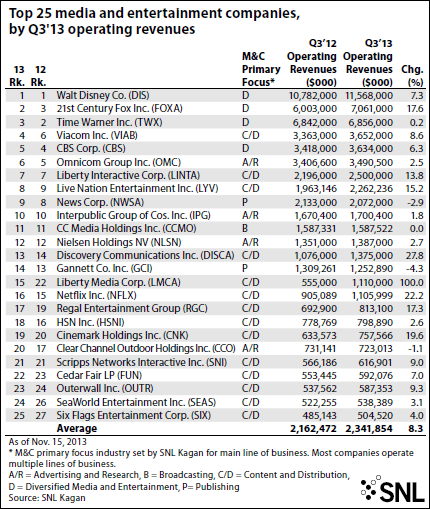
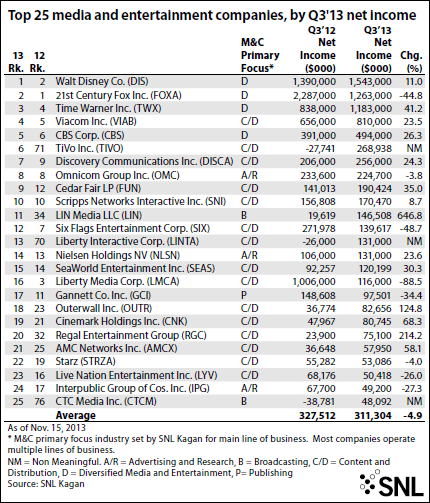
Courtesy of SNL Data Dispatch comes a report of the top earners of media companies for the third quarter of 2013.  Some highlights:
  • Disney continued its reign of top earner, reporting revenues of $11.57 billion for the quarter, up 7% from the previous year, with a net income of $1.54 billion (up 11%)
  • 21st Century Fox moved into second on the revenues list as revenues rose nearly 18%, even though its net income dropped by 44%.  (The 2012 numbers had included Newscorp, which has since split off into a separate company
  • Completing the top 5 in revenues and income were TimeWarner, Viacom, and CBS (in that order)
  • Newscorp  retained a top 10 spot in revenues, despite nearly a 3% revenue decline
  • Discovery Communications saw revenues gain over 27%

Source -  Disney still No. 1 among media earners but 21st Century Fox making gains,   SNL Data Dispatch report.

Monday, September 30, 2013

Half of ad gains from mobile

The latest quarterly forecast of the U.S. advertising economy from ZenithOptimedia Group predicts that spending on advertising in the U.S. will show a 3.4% growth for 2013.  That's a slight downturn in the previous prediction of 3.5% growth.  The future looks a bit better - predictions of 4.5-4.5% growth in 2014-2015.  However, this remains significantly lower (20%) than what is predicted for global ad growth over the same period.  And on a global perspective, growth in advertising expenditures will continue to trail growth in GDP.

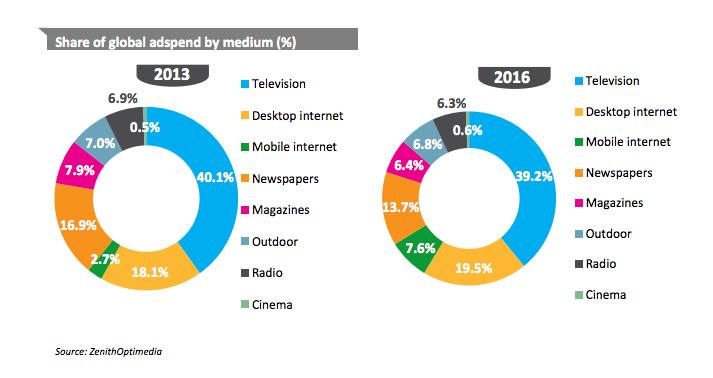
The problem for traditional media is that almost all of the growth is driven by digital advertising formats.  ZenithOptimedia forecasts that digital advertising will account for 21.8% of all US ad expenditures this year, and continue to grow to 28% of ad revenues in 2015.  And the fastest growing segment in digital is mobile.  (The figure shows global ad spending)
“Mobile advertising is still relatively small,” the Publicis media shop notes in its report, adding: “we expect it to total $6.2 billion this year, or 3.7% of total ad expenditure – but it is growing extremely rapidly.”
Another way of putting things is that the 2013 growth in mobile advertising accounts for about half of the total gains in US ad spending, and more than a third of global ad gains.  Total digital ad growth will account for two-thirds of total global growth in

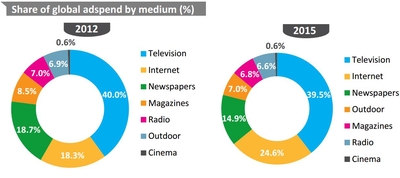
In contrast, the study predicts that TV global ad share will peak in 2013 at about 40%, while newspaper's share will continue to fall, reaching 15% by 2015.  The shares for magazines, radio, and outdoor will also continue to decline.

Sources -  Upward Mobility: Hand-Held Web Accounts For Half of U.S. Ad Expansion, MediaPost Agency Daily
Executive summary: Advertising Expenditure Forecasts, September 2013,  ZenithOptima press release

Thursday, August 22, 2013

WatchESPN earning "tens of millions" in ad revenues

A spokesman for Disney has indicated that while multiplatform (mobile) advertising remains a relatively small portion of Disney's overall business, the WatchESPN app is already generating significant revenues.
"The [WatchESPN] app is an opportunity for [ESPN] to generate more advertising revenue, and they are in fact selling ads for the watch app, but the numbers, even though they are in the probably tens of millions of dollars at this point, they are still relatively small when compared to their total, both advertising revenue and their total revenue," Disney CEO Bob Iger told analysts on the company's second-quarter earnings call. "But we believe that they will continue to grow," he added.
 Disney also indicated that the upcoming WatchABC app could add a new revenue stream for ABC's owned & operated broadcast stations.

Overall, Disney reported earning $11.6 billion overall in the second quarter of 2013, up 4% from the same time last year.  The various cable networks accounted for $2.1 billion of that amount, a gain of more than 10%.  ESPN and A&E networks reported big increases in affiliate (carriage) fees and ad revenues, which offset declines in ABC Family networks.

Source -  Disney: WatchESPN generating "tens of millions" in ad revenues,  FierceCable

Wednesday, August 7, 2013

Nielsen Study suggests Twitter-TV Link

A newly released study by Nielsen has found evidence of a statistical bidirectional relationship between TV viewing and Tweeting about that program.  According to Nielsen's press release,
analyzing minute-to-minute trends in Nielsen’s live TV ratings and tweets for 221 broadcast primetime program episodes using Nielsen’s SocialGuide, the study found that live TV ratings had a meaningful impact in related tweets among 48 percent of the episodes sampled. The results also showed that the volume of tweets caused significant changes in live TV ratings among 29 percent of the episodes.

The study also found that the impact of Tweets varied across program genres.  The impact was greatest for competitive reality shows (no surprise there), and also found that Twitter impact was greater for comedies than sports programs (a bit of a surprise).  Drama was least affected by concurrent Tweeting.

Source -  The Follow-Back: Understanding the two-way causal influence between Twitter activity and TV Viewership,  Nielsen newswire

Monday, May 6, 2013

Fading at the Washigton Post

On Friday. the Washington Post Co. reported its First Quarter, 2013 net earnings of $4.7 million.  That's a drop of 85% from the first quarter of 2012.
  The newspaper division was a major contributor to the decline.  Newspaper operations generated $127.3 million in revenues for the last quarter - off 4% from the previous year.  More problematic was the net operating loss of $34.5 million.  The newspaper losses were 67% higher than for the same period in 2012  Daily circulation at the Washington Post declined 7.2%, and average circulation of the Sunday edition fell 7.7%.  Print advertising revenues were down 8%.  Print expenses declined 12%, but was attributed "to a decline in newsprint consumption.”
  On the other hand, the electronic media divisions continued to counterbalance newspaper losses.  Online publishing revenues were up 8%, and online display advertising revenues gained 16%.  Revenues and operating results improved for both the TV broadcasting and cable TV divisions.
  Revenues were also down at the company's education division, although operating results improved.

The company blamed much of the big spike in newspaper losses on pension, early retirement, and severance expenses - although still noting that operating results for the newspaper division - even after shedding staff - continued to decline.

Source -  Washington Post suffers 85% earnings drop,  Politico

Monday, April 29, 2013

Downgrading 2013 Ad Outlook

Two of the top industry analysts have had to issue revised forecasts for 2013 as revenues, based on the year's slow start.  Publicis' ZenithOptimedia dropped its forecast for global ad revenue growth to 3.9% (down 5%), and US ad growth to 3.4% (down 3%).  Pivotal Research Group wasn't as optimistic, lowering its US ad growth rate to 1.2% this year.

The Zenith Optimedia report projected that global online ad revenues will continue its hot pace, growing 14% annually through 2015.
“Some broadcasters are starting to trade packages that include both online video and television spots,” (Publicis' Jonathan Barnard said), adding: “Advertisers are now recognizing the value of social media for brand building and purchase consideration purposes.”
Pivotal Research Group also forecast that digital will continue to grow faster than analog. Analyst Brian Wieser noted that growth is being driven by new brands seeking to differentiate themselves from competitors:
"(Those) advertisers can and will allocate significant shares of their budgets to digital advertising, as this has become the dominant ‘engagement’ medium for most advertisers, effectively replacing the role that print-based advertising served for so many years.”
Still, TV advertising dominates, although experiencing some shifts among subsectors -
“Cable will probably gain share of national TV budgets at a slightly faster pace in 2013 than occurred last year,” (Wieser) writes, adding: “On this basis, we forecast cable advertising growing by 5%, with broadcast networks down by 2% for all of 2013.”

Source -   Forecasters Downgrade 2013 Ad Outlook: Remain Bullish On Future, Especially For Digital, TV,  MediaDailyNews

Tuesday, April 23, 2013

Digital Now 25% of Ad Revenues

The advertising marketplace continues to evolve, according to a new study that examined actual expenditures from some of the world's largest advertising holding companies.   The new measures, from Standard Media Index, is claimed to be the most accurate view of actual media spending.
“Television spend continues to slow -- at a rate of -2% during the first quarter of 2013 -- driven by March’s year-over-year decline of 5%,”explains SMI analyst Kristina Luland.
TV, despite the weak performance, remains the largest target of ad dollars, accounting for 60.3% of all ad expenditures.  Within that sector, ad revenues fell 6.2% for broadcast networks, while ad revenues for cable networks rose 1%, making cable networks the largest contributor to total TV revenues at 25.6%.
  In contrast, ad expenditures for digital media were up 15% over the last year and now accounts for 24.6% of the advertising marketplace.  In fact, every segment of the digital ad market saw double-digit growth in ad revenues, led by mobile (up 92%) and exchange-based ad buys (up 46%).

Source -  Digital Now 25 Cents Of Every Ad Dollar: Display, Search Still DominateOnlineMediaDaily

Monday, April 15, 2013

Ad "Upfronts" for Online News

TV in the U.S. has had "upfronts" - where networks host previews of upcoming seasons for big advertisers, agencies, and news media, and start advance selling of premium ad spots - for decades.
The Interactive Advertising Bureau now hosts Digital Content Newfronts - an upfront event showcasing online content and advertising opportunities.
  The initial reaction was skeptical - after all there's no scarcity in the display ads market.  However, the last year or so has seen the growth of high-quality video ads, sponsorship opportunities for high-profile sites and content.  More importantly, audience research is showing that online video ads and exclusive sponsorships can have significant impacts - in fact, they may just be more valuable than many traditional media opportunities.  Add to that the fact that the TV and cable networks keep hiking rates even as viewing falls, and we're starting to see advertisers thinking about other outlets.
"The only way to reverse that trend is think about video in a different way and move dollars across screens," said Universal McCann Chief Media Officer David Cohen. "Is this the year we see a billion moving into the (online ad) market? Could be."
With premium online opportunities limited, the Newfronts are getting interest and involvement from top content producers and advertisers and agencies - and opening the events to a range of online advertising formats.  The events are also producing deals - deals totally in the hundreds of millions (US dollars) were reportedly made at this year's Newfronts - a sizable share of an online advertising market expected to exceed $1 billion.
YouTube sales chief Suzie Reider said it's important to present an organized, united front to the buying community. "This is about "We've grown up,'" she said. "We're not a ragtag group of digital sites."

Source -  Digital Newfronts Poised to Rake in $1 Billion in Ad DealsAdvertising Age

Thursday, April 11, 2013

Mobile Ad Spending Doubles in UK

Analysts predicted that mobile-directed advertising expenditures would increase as penetration of smartphones and tablets continued, and 4G cellular service - with its high-speed broadband data connections - was implemented.  What they didn't expect was the pace of the increase.  A new report by PwC for the UK Internet Advertising Bureau indicates that mobile ad revenues increased 148% in 2012.
  The report indicates that online advertising by UK firms increased 12.5% last year, to £5.42bn.  Mobile ads were first separated out in 2009, and accounted for about 1% of online advertising at that time.  In 2012, mobile ad revenues accounted for nearly 10% of all online ad expenditures.
"In the last 6 months, 20 more of the UK's top 100 advertisers have produced mobile-optimised websites; 4G mobile ultra-broadband is enabling a new era of richer content consumption with tablets predicted to outsell PCs in 2013," (Internet Advertising Bureau Research & Strategy director Tim) Elkington said.
In 2012, mobile video ads brought in £13 million, and mobile display contributed £150 million.  Overall, however, the display ad share of digital advertising revenues fell to 24% - and analysts suggest display's share will continue to fall as advertisers start taking advantage of rich media, interactivity, and targeting:
PwC Senior Manager Anna Bartz said the advertising market is shifting toward story telling and integrated campaigns which give greater prominence to video and display formats with a higher degree of interactivity with the target audience.  "Over the past two years, the digital advertising revenue model has also changed from an emphasis on direct response to being more about branding and awareness."
   It's good to see the advertising industry starting to take advantage of the new opportunities that the Internet, social media, and mobile systems provide.

Source -  UK mobile ad spending more than doubles in 2012: report, CBR


.

Wednesday, April 3, 2013

Milestones: Online Movie/TV Viewing

Two milestones for online movie streaming (i.e. Netflix, Hulu+, Amazon Prime, etc.) -

A new research report from eMarketer predicts that sometime in the next year, more than half of U.S. Internet users will report regularly watching TV programs and/or movies online.  Movie and TV streaming services utilize a range of business models, from subscription (Netflix, Redbox, Hulu) to ad-supported (Crackle) to a la carte (pay per view like Apple or Wal-Mart) to inclusion with cable channel subscription (HBO, ESPN).  Or some combination of the models, as with Amazon's Prime, PPV rental, and purchase options.  And all seem to be working fairly well, leading to the other big milestone.

In 2012, TV/movie streaming revenues were greater than home video (DVDs, BluRay Discs) rentals and purchases in the U.S.  As was the number of movies viewed.  The primary revenue-generator for movies/TV is shifting again, this time to online streaming licensing and direct PPV revenues (a number of studios are creating their own online streaming service to market their movies and TV series directly to viewers).

The other recent big study number was that the mobile app global market in 2012 was $11.7 billion, more than U.S. domestic movie ticket sales.  Projections suggest that within a couple of years, the global mobile app market will generate more revenue than the global movie ticket market.

Its about time for the movie industry to shift from defining itself in terms of a physical medium of distribution, and thinking of itself primarily as a content production and distribution industry.  Many are, which is good news for the future of the industry.

Sources -  Digital TV, movie streaming reaches tipping point,  Advanced Television
Digital TV, Movie Streaming Reach A Tipping Point,  eMarketer press release
27 Leading Characters in Hollywood's Big Digital Play,  Digital Hollywood/Fast Company

Friday, March 22, 2013

Scary Graphic for Newspapers

From The Atlantic:

Since 2003, print advertising revenues for newspapers has fallen from $45 billion to $19 billion, while online digital advertising has grown from $1.2 billion to $3.3 billion.  In other words, over the last ten years, the average annual decrease in print advertising revenues for newspapers is larger than the total increase over that decade in online advertising revenues.

Source -  This Is the Scariest Statistic About the Newspaper Business TodayThe Atlantic

Friday, March 1, 2013

Milepost: Global Music Sales Actually Rise

On the heels of the news of iTunes' sales of songs surpassing 25 billion (6 Feb, 2013), comes a report that total global music sales actually increased in 2012 - the first increase since 1999.

  Global music industry trade group IFPI released their annual report earlier this week, showing a very modest increase in total sales revenues of 0.3%, to US$16.5 billion.  While the increase isn't huge, it is the first year-to-year gain seen in the 21st century.  In addition, while the industry has long blamed their decline on digital music, the latest report from the IFPI touts the growing contribution of digital music sector as the driving force behind the (hoped-for) recovery of the music industry.
“Digital is saving music,” said Edgar Berger, Sony Music’s international chief.
  The report puts annual growth of the digital music sector at 9 %, and being driven by a variety of revenue streams - sales of downloads, licensing to both subscription-based and advertising-based online streaming services, music video downloads and streaming.  In addition, there's been a huge increase in the expansion of digital music markets around the world.  While only 23 nations had viable (and legal) digital music marketplaces at the start of 2011, the end of 2012 saw more than a 100 nations where major digital music outlets operated.  Some quick supporting stats -
  • Digital sources now account for more than a third of all global music sales.  Downloads currently account for 70% of the total.
  • Licensed music streaming services saw a 44% increase in the number of subscribers.  The success of subscription music streaming services has opened up licensing fees as a major new revenue source for music labels.
  • Social media is becoming an important channel for music promotion and fan engagement, as well as digital sales.
  • Digital sources account for more than half of all revenues in a number of markets, including the U.S., India, Norway, and Sweden.
  • Acceptance and use of digital music sources is expanding globally.  More than 100 countries have legal markets for digital music, and surveys suggest more than 60% of all Internet users have used a music subscription service in the previous six months - a number than jumps to 80% among young adults (16-24 age group).
  • iTunes song sales generate about a quarter of all global music industry sales ($4.3 billion in sales generating $3.4 billion in licensing to music labels for 2012).
  The IFPI argues that this year's results, and the continuing expansion of digital music into markets around the globe, signal the return of the industry.  The report goes so far as to argue that digital music will be a major driver of the digital economy.

  It may be a bit early for for a victory lap.  The global total sales are still well below the industry's sales peak of $29 billion, as well as being well below revenues for other forms of media and digital gaming.  Still, it is a positive sign for an industry that's been having hard times.  I'm also glad to see the belated embrace of digital music and the range of new revenue streams it's been creating.

Sources -   History Shadows an Upbeat Music Sales Forecast, New York Times
IFPI publishes Digital Music Report 2013,  IFPI press release
Wednesday Apple Rumors: iTunes Music Revenue Up 10% in 2012,  Investorplace.com
IFPI Digital Music Report 2013, study report
The Digital Music Consumer - A Global Perspective, February 2013, slides for research report from Ipsos MediaCT


Tuesday, February 26, 2013

Radio and Local Online Ads

A new study from Borrell is predicting that radio's "turning the corner" in digital ad sales, with a forecast of $420 million in total local online ad revenues for 2013.  In a survey of 1075 stations, 17% indicated that the expected their local online revenues to grow more than 30% this year.
  The gains, however, are not evenly distributed.  Over half of the radio stations and clusters reported online revenues of less than $250,000 in 2012, while the upper 3.4% reported online ad revenues of at least $3 million.  And while hopeful, the growth in online ads revenues in radio (14%) fall well below the overall growth rate for local online advertising (30.8%).  And local online remains a minor revenue source for radio, reaching 2.5% of radio ad revenues in 2013.

Source -  Radio's Local Online Ad Revs Rocket 14%MediaDailyNews

Thursday, February 21, 2013

ESPN Rates and Revenues Update

Terms of Time Warner Cable's 2010 deal with ESPN are coming out, and are reaffirming it's dominance among cable network revenue producers.  The information came to light when revealed in court earlier this week as part of the Dish vs. ESPN lawsuit, and reflect the contract terms from September, 2010.  While the terms may have changed or been renegotiated, it's unlikely that the rates have been reduced.
  Under the 2010 agreement, the affiliation fee for ESPN would reach $5.40 per Time Warner subscriber per month by the middle of 2013, reaching $7 per subscriber (per month) in 2017, and $8 around 2020.  Looked at in terms of annual fee inflation, ESPN's price would increase about 6.5% annually.  Dish sought information about Time Warner's deal with ESPN because it's supposedly the lowest rates for ESPN carriage rights.  In other words, that's the minimum and the costs for other multichannel providers may well be higher.
  ESPN currently reaches about 100 million U.S. TV households, almost all through some multichannel service that's paying for the rights to carry ESPN.  Applying those per sub monthly fees over a year for 100 million subs, and you quickly generate some serious cash.  The math suggests that ESPN will earn at least $6.5 billion from subscription fees this year, at least $8.4 billion in 2017, and around $9.6 billion by the end of the decade.  And those numbers don't include earnings from advertising or what's generated by the other ESPN brands.  ESPN clearly generates a lot of revenues and cash flow, even within the huge Disney empire.  In fact, these suggest that the analyst's assumption in the previous post (2011 revenues just under $4 billion) are on the low side.
  ESPN is the golden goose of TV, the gift that keeps on giving, the stock you wish you'd bought 40 years ago.  (Pardon the cliches). 

  At this point, the only thing that seems likely to dramatically change ESPN's revenues track is if the FCC mandated that multichannel video program distributors offer access only through a la carte pricing - that is, consumers would have to order and pay for each network/channel separately.  At $5.40 per month, that would push ESPN's price to $64.80 a year - but if ESPN wanted to keep their revenues level, the subscription price under a la carte would need to be much higher, to compensate for those choosing not to subscribe to ESPN, and to make up for lower advertising revenues resulting from the smaller audience reach.  That's the downside to a la carte pricing - you wouldn't have to "pay" for channels and networks you don't want, but you'd have to pay a lot more for the channels you do want.  Not even ESPN is that valuable - so such a move would almost certainly result in a sizable and significant decline in revenues.

Source -  ESPN Set To Pass $7 Sub Fee In 2017, TVBlog