Showing posts with label coverage. Show all posts

Friday, January 30, 2015

FCC sets new "Broadband" standard at 25 Mbps

Yesterday the FCC formally approved a long-awaited increase in its definition of what counts as "Broadband" Internet connectivity.  The Commission, in giving formal approval to release its annual report on the status of broadband, gave implicit approval to that reports change in what it considers to be broadband service.  The old standard was 4 Mbps downstream and 1 Mbps upstream - while the new standard is 25 Mbs downstream and 3 Mbps upstream.
Critics have long argued that the FCC's 4 Mbps standard was outdated - it was established well before video streaming usage exploded, and 4 Mbps isn't sufficient bandwidth to stream a TV signal uninterrupted by delays.  The industry itself established an informal standard of 20 Mbps as needed for broadband connectivity to homes years ago.  That level of bandwidth was based on the ability to live stream 2-3 separate video streams to multiple devices, while leaving enough capacity for second screen data and other Internet usage.  The EU is using the 20 Mbps standard for its policy goal of achieving universal broadband access.
The definition of minimum broadband standards is critical to determination of access and availability of broadband to consumers, as well as determining whether there is effective competition in broadband markets.  Its been thought that the FCC continued to use its 4 Mbps standard to inflate national availability numbers to seem more on a par with availability numbers in other countries.  While that may have been a minor concern, its more likely that they stuck with 4 Mbps because that was the data capabilities of 3G cellular services and the small satellite-based data services.  Inclusion of 3G cellular and satellite data coverage provided both near-universal accessibility, and competition to wired (land-based) cable and telecomm providers for about 90% of Americans.
 The new 25 Mbps standard basically excludes those (but is within 4G cellular standards), and reflects the reality that 17% of the U.S. population doesn't have access to data services meeting the new standard.  More critically, from a policy perspective, is that exclusion of satellite data services (which currently don't provide services at that speed yet) leaves large swaths of rural America without "broadband" access.  The new report determines that 53% of rural population (63% of those living on tribal lands) won't have access to data services meeting the new standard for broadband.  Similarly, applying the new standard in considering whether there is effective competition for broadband service providers means that only 37% of Americans have access to two or more broadband services.  Excluding 3G service providers is the primary cause for the drop in "competition." Also, not all of the "4G" services being offered in the U.S. meet the formal international standards - some peak out at 21 Mbps downstream, which qualifies as broadband under EU standards (20 Mbps) but not the new US standard (25 Mbps).
 While the standard for "broadband" in the U.S. certainly needed changing, whether it should be at 20 or 25 Mbps is somewhat debatable in the short term.  In the long term, there's already discussion of what the next standard should be (mostly centered for now at 50-100 Mbps).  Give it a few years, and we'll need to redefine "broadband" again anyway.

Sources -  FCC Says Broadband Now Means Speeds Of 25 Mbps,  OnlineMediaDaily

Monday, September 23, 2013

Admitting Bias (at last)

The fall ratings season is nigh, and with it the new network schedules.  Fox is tinkering with its prime time talkers line-up, and it looks like MSNBC will be getting the "relaunch" promised by Executive Editor Richard Wolffe.  A visit to their website at msnbc.com gives you an initial choice between nbc.com, and msnbc.com - "It's what progressives have been waiting for."

I do have to congratulate the whole Comcast-NBCUniversal conglomerate for its (almost) honesty.  The (almost) part comes from the implication in the announcement that this is a new focus, with the implication that they were just another honest and impartial news agency before that.  That fiction was pretty well demolished by the network's performance in the last U.S. Presidential election campaign. 

According to the Pew Research Center, 85% of MSNBC's "news hole" was opinion or commentary, a stark contrast with the roughly 50/50 split of CNN and Fox.  (That it's so high for the others is another problem altogether). And in the last week before the election, MSNBC had not a single positive storyline about Mitt Romney (R), and not a single negative storyline about President Barack Obama (D).  As one conservative critic quipped at the time "MSNBC is everything Progressives imagine Fox to be."

One of the problems you face when addressing "bias" in news and journalism is that most people define bias in coverage as perspectives that don't match their own, rather than objectivity or fairness in coverage, so it will be interesting to see how the industry treats MSNBC's going public with it's focus/slant/bias.  It will also be interesting to see if there will be a call for a now admittedly non-news channel to be denied the standard "news" exemption, so that it will be considered to be providing in-kind contributions to the Democrat Party.  Democrats have tried that argument with several conservative talk radio programs recently (thankfully unsuccessfully so far - the First Amendment should protect all political speech, not just the speech you agree with).  Conservatives might be tempted to try it - after all, they do tend to believe in equal treatment under the law - but shouldn't (that news exemption is really broad). 

On the other hand, I'd welcome such a move, not to silence MSNBC, but as a starting point for some serious reconsideration of just how broadly we've come in expanding what is considered as "news" in terms of the exemption, and how narrowly some propose to define it in other aspects (such as in the proposed journalist shield law). 
That would be a discussion worth having.

Source -  The new MSNBC.com: It's 'what Progressives have been waiting for',  Washington Times

Monday, April 8, 2013

The State of (US) Newspapers

When speaking of newspapers, the focus generally is on major metro dailies - and they've been in trouble recently.  Advertising revenues have fallen dramatically, readership is on the decline, and more than a few have folded or ceased print operations and gone online.  So the recent Pew Research Center State of the News Media 2013 report tried finding some good news.  
  • There are some buyers for newspaper companies and/or their stock. 
    The big newspaper buyer was Warren Buffet's Berkshire Hathaway, which acquired a sizable number of small- and mid-market newspapers.  But the big urban dailies up for sale aren't finding much buyer interest, and their newspaper operations are dragging down their corporate stock prices.
  • Circulation revenues are holding steady, and for some increasing slightly.
    Total circulation revenues are steady in the face of increased subscription prices, and with the supplement of daily sales and digital (paywall) subscriptions.
  • The economy is maybe looking up, with the hope of more ad revenues to follow.
    There's been a rise in auto ad revenues, but real estate and recruitment (ads for jobs) ad revenues continue to plummet.
  • Newspapers' online efforts are starting to generate revenues.
    Newspapers continue to experiment with a range of online efforts - and seeing gains in local online revenues, and in paywall subscriptions.  Total online advertising revenues now exceeds those of newspapers, but the newspapers' share is small and has been decreasing in recent years.
  • Mobile and Tablets are building new news consumption habits and audiences.
    Adoption is growing, and studies of mobile use suggest that strong news consumers are using their devices to keep in touch, and even consuming more news of interest.
On the other hand, there's a number of bad news indicators as well.
  • As mentioned, print advertising revenues are still falling - down 7.3% in 2012.
    More critically, newspapers have largely lost whole segments - classifieds are down more than 90%, real estate down 75%, automotive down 80% (even with slight recovery).  National ads are falling most rapidly, with indications that the big national firms are shifting their ad campaigns to other media.
  • Digital advertising accounts for only 15% of total ad revenues, and while growing, isn't replacing print losses.  In 2012, newspapers lost, on average, $16 in print ads for every $1 in digital advertising.  And its starting to look like display ads won't be a major revenue source in mobile.
  • While most newspapers remain profitable, margins are down, and many will continue to struggle with debt and pension obligations.  For an industry that had become used to 20-30% profit margins, large chains saw margins well below 10% (Scripps, Gannett, A.H. Belo).  Major dailies New York Times, Washington Post, Chicago Tribune, Los Angeles Times  and News Corp. all experienced significant losses in newspaper operations.
  • Newspapers continue to trim print news staff, and many are trading the once-grand downtown headquarters for smaller and more spartan offices.  Some are experimenting with publishing print editions only 3-4 times a week.
That's all on the business side - What about the news content?  The Pew report didn't look directly at newspaper content in this report - but noted that newsroom staffing continues to fall, and that is impacting the quality of news being produced.  (They were particularly critical of political news, which too often acted as megaphones rather than investigators - too frequently just repeating favored talking points, even if they were demonstrably false).
For news organizations, distinguishing between high-quality information of public value and agenda-driven news has become an increasingly complicated task, made no easier in an era of economic churn.
The report also notes that news consumers are beginning to notice the decline in the quality and quantity of news coverage.  While the report doesn't break this information by medium, a recent Pew survey found that 31% of news consumers reported that they had "stopped turning to a particular news outlet because ... (news outlets) were no longer providing them with the news and information (they) were accustomed to getting."  In addition, those with the most awareness of the news industry's financial problems were the most likely to drop a particular outlet (43%).  Of those leaving an outlet, two-thirds did so because they felt that coverage was incomplete - and nearly a quarter noted there was less coverage overall (there is some overlap in the two responses). 
Furthermore, the decline in coverage is more widely noticed - and that the quality and thoroughness of coverage was the bigger problem.  In the wider sample of those who had at least some awareness of media's financial problems, two-thirds noted a decline in the completeness of stories, and two-fifths noted a decline in the number of stories.  The study notes that the impression that thoroughness was the bigger problem carried across all demographic groups.
It is clear from these data that much of the country recognizes little if anything about the economic challenges the industry is grappling with—and that much of the knowledge and concern about the economics and the future of the news business may be largely confined to the industry itself. But the news consumers who are more aware of the problems and their impact on news are more likely to act on those concerns by abandoning a news organization. And, based on demographics, they also are likely to be more ardent news consumers who are willing to invest in a product they value. They appear to be making informed choices. The job of news organizations is to come to terms with the fact that, as they search for economic stability, their financial future may well hinge on their ability to provide high quality reporting.
  These perceptions aren't helping with newspapers' long-term problem with declining readership.  The generational drop in readership remains, and even within generations, readership is falling.  And that's even with changes in how readership is measured that was designed to include online and occasional reader (i.e., counts those who read a newspaper of visits a newspaper online site at least once a week).

 For our students, here's the bad news.  The number of newspapers continue to decline, as does the number of editorial staff on the print side.  Total editorial staff employment is at the lowest level since 1978.  There is some growth in employment for newspapers' digital operations, but as with ad revenues, the gains from digital remain far from replacing print losses.


Source -  State of the News Media 2013, Pew Research Center's Project for Excellence in Journalism report.

Tuesday, February 26, 2013

Transparency and the Value of the White House Press Corps.

Obama: “This is the most transparent administration in history, and I can document that is the case.”

Obama: “And with that, what I want to do is clear out the press so we can take some questions.”

Poynter:  It’s easy to claim the title of most transparent administration in history, if you define “transparency” as “releasing 100 percent of the things you want to release.”


  With all this transparency, one might excuse David Weigel's column in Slate questioning the need for a White House Press Corps.  He starts with the pool report from earlier this month, detailing negotiations to have pool coverage of an event.
“All we're asking for is a brief exception, quick access, a quick photo-op on the 18th green,” Henry told Politico’s Dylan Byers. “It's not about golf—it's about transparency and access in a broader sense.”
And yes, they're talking about the President's golf date with Tiger Woods.

It's not just lack of access (Obama has held 35 press conferences and taken questions after 107 events - his predecessor held more than 100 press conferences and took questions after 355 events in his first term), but the lack of tough questions from the White House Press corps in the daily briefings. 
Weigel looked at the questions the White House Press Corps asked after the State of the Union Address, and found, basically, three general queries in the weeks since.
  1. "How will you pass this?"
  2. "How do you respond to this?"
  3. "Remember when you said this?
Tough questions, all.

And covering a President full-time is expensive.  Reporters in the pool for the golf outing with Tiger paid around $3500 for the privilege of reporting... nothing. (The only interaction with the President was off-the-record).  Costs can be as high as $33,000 per person for a three day domestic trip (to California), and the President's three-nation trip to Asia last fall ran an estimated $35,000 a head.
  It's gotten to the point where major news organizations are wondering if traveling with the President, or even having a credentialed White House Correspondent, is worth it.
“It costs some of our [news] organizations millions of dollars a year to cover the president,” said Ed Henry, head of the (White House Correspondents Association).... “Would we like to find ways to make it more economical and efficient? Yes, we would.”
“All of these trips are important because you don’t know what hasn’t happened yet,” said Cameron Barr, The Post’s national editor. News organizations “have to balance the cost of not being with the president and missing something important.”
The Wall Street Journal's Gerald Seib commented - “when the president is doing the president’s business, our inclination is to be there... You do wonder at times, is this worth it?”

  Is it worth it?  Probably not, if you're not bothering to get real news, or even something that's not already in the pool reports or wire service feeds. The real question is will the press make it worthwhile and valuable by actually doing real journalism?


Sources -  Who Needs the White House Press Corps?Slate
Traveling reporters get bill, but little news, when Obama's on the RoadThe Washington Post
Is the Obama administration really the 'most transparent' ever?Poynter

Monday, November 5, 2012

Pew on US Election Coverage, Social Media

One of the things that the Pew Center for Excellence in Journalism does is to track news coverage of major events, such as the U.S. Presidential election. Their recent report tracks coverage from the two conventions up to the last Presidential Campaign debate (Oct. 21).
  Slightly more than half of mainstream media coverage for Obama (D) was "mixed" - with stories having some combination of positive and negative elements.  For the rest, 19% were rated as positive and 30% rated as negative, for a difference of -11 points.  Mainstream coverage of Romney was more partisan - 47% classified as mixed, 15% positive, and 38% negative (for a partisan difference of 23%).  Now there's a lot that could be spun from the numbers, and the way that Pew categorized coverage. 
  Pew generally does a good job with research, and the report they released provides far more description and detail than news stories tend to report.
  For example, Pew broke down coverage before and after the first debate.  Prior to the first debate, coverage of Romney was pretty consistently negative (11% of stories were coded as clearly favorable) - arguably following the NY Times editorial written prior to the Republican convention that branded everything that Republicans would say during their convention as lies (without bothering to wait for them to speak - now that's truly "responsible" journalism).  In contrast, coverage of Obama was twice as likely to be positive (22%) during that period.  After the first debate, though, the coverage was somewhat reversed - Romney getting positive treatment in 20% of stories, and Obama 13%.
  Pew also differentiated "horserace" stories - those primarily discussing who is leading - from all others, and interestingly, found that in more substantive stories, coverage was more equal, although still overwhelmingly negative - for Romney, 14% of stories were positive, 55% negative; for Obama, 15% of stories was positive, 53% negative.  Pew also looked at how some specific media outlets covered the candidates.  Liberals tend to label Fox news as partisan; conservatives tend to find mainstream media uniformly liberal, with MSNBC an extreme case.  Pew looked separately at the two cable networks, as well as CNN.  On CNN's coverage of Obama, 18% was positive, 21% negative; for Romney,11% of CNN coverage was positive, 36% negative.  Compared to the overall coverage,  that was slightly more favorable towards Obama.  Presidential campaign coverage on Fox was substantially different - only 6% of Obama coverage was favorable vs. 46% negative; for Romney, 28% was favorable while only 12% was negative.  Still, the greatest outlier was MSNBC, whose coverage of Obama was 39% favorable and 15% unfavorable; but that paled by comparison to their coverage of Romney, which was only 3% positive and 71% negative.

  One can clearly make the case that Fox's coverage differs from most of the media coverage examined in the Pew study - and that is part of their programming strategy.  That alone, though, isn't enough to label them as "objectively" partisan, only in contrast to other media outlets.  The most prevalent story tone of the coverage on the three cable networks was "mixed."  Where tone was present, Fox clearly differed from CNN and MSNBC in being more likely to carry a positive Romney story (and a negative Obama story) while the others were more likely to carry a positive Obama story (and negative Romney story).  One could understandably spin that as partisan (at least relative to most coverage).  Still, I'd argue that for rabid partisanship, Fox pales in comparison to MSNBC- which overwhelmingly spun Romney coverage as negative (a whopping 71% of all coverage) and only managed to treat Romney favorably in 3% of their coverage of him and his campaign.  And the network wasn't just overtly and overwhelmingly anti-Romney - they were twice as likely to put a positive spin on their coverage of Obama and his campaign as CNN and the rest of the media included in the Pew study.
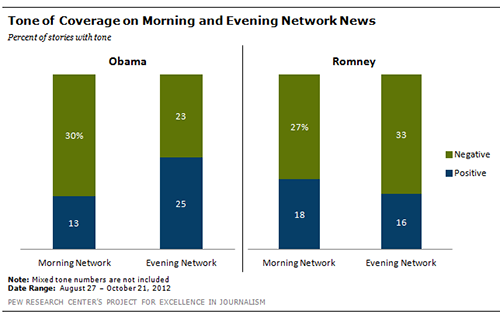
  Pew also looked at coverage of the candidates by the major broadcast networks, and found a significant difference in the tone of their coverage between their morning news-talk programs and their evening newscasts. Coverage on the morning shows was mostly mixed, but when there was a tone, it was more negative for Obama (13% positive vs. 30% negative) than it was for Romney (18% positive, 27% negative).  The evening newscasts, in comparison, gave Obama much more favorable coverage (25% positive, 23% negative) than it gave Romney (16% positive, 33% negative).  Among the three broadcast networks newscasts, ABC provided significantly more positive Obama coverage (27%) than the other networks (CBS 17%, NBC 16%) or was provided to Romney (ABC 18%, CBS 15%, NBC 18%).
  Pew found that newspaper coverage of Obama in this election cycle was much more positive than what newspapers provided in the 2008 race.  In 2008, Pew found newspaper coverage to be somewhat balanced - 70% mixed, 12% positive, 18% negative.  This time around, newspaper coverage is much more positive - with 45% of Obama coverage positive, 28% mixed, and 28% negative.  Newspaper coverage of Republican candidates, in contrast, was overwhelmingly negative this cycle - 69% of Romney coverage was negative, while 25% was mixed and only 6% positive.
  As for social media, the tone is overwhelmingly negative.  On Twitter, more than half of political tweets are negative (and a higher percentage of Romney comments being negative than Obama comments), while positive candidate tweets hovering around 20% over this period.  Negative comments also dominate on Facebook, but Facebook does have a somewhat higher percentage of positive comments (rising from 20% to around 30%).
  The Pew study found that both campaigns had similar amounts of coverage - Obama was a significant in 69% of the political stories included in the sample, and Romney was a significant figure in 61%.  They also found that there's been less focus on "horserace" coverage in this election (compared to 2008) - which would be a good sign if that meant that there would be more coverage of issues.  However, there wasn't - coverage of policy & issues (22%), the candidates' public record (6%), and even personal matters (4%) remained about the same.  Instead, two new types of political coverage gained prominence in 2012 - non-election coverage (coverage related to a candidate's existing duties), and coverage of voting issues (voter fraud, voter ID law coverage, absentee voting for the military, etc.) - each category accounting for 9% of campaign coverage.
  And yes, the economy is still the predominant issue in this election - when policy issues were covered.  Overall, 9.8% of all campaign coverage was focused on the economy (although down from 15.2% of coverage in 2008).  Within the 22% of issue coverage, the economy accounted for about half.  Two thirds of issue coverage focused on domestic policy issues, and one-third on foreign policy issues.  Interestingly, many of what media often framed as "hot-button social issues" - abortion, same-sex marriage, immigration, energy, religion, and race - ended up with very little coverage, or traction within the electorate.  The same was true in coverage of foreign policy issues.  Despite a lack of coverage by many of the major media outlets, the Benghazi attack and related issues dominated foreign policy political coverage (about three-quarters of it- 5% of all coverage, making it the second most covered issue in this election cycle).  Iran, Iraq, China, Afghanistan, Syria - even the continuing Israeli-Palestinian conflict - received minimal coverage as political issues.

  Partisans from each side can find things in this report that they can use to support claims of media bias.  That's likely to be true whenever "media" are diverse rather than monolithic.  Democracies are supposed to like diversity in media voices, so one of my personal disappointments in this election cycle is the increased efforts both in the political world and the media world, to try to silence alternative voices and perspectives.  Another disappointment is what I see as a continuing decline in the quality of "political" coverage - where only 1 in 5 stories address "issues" at all, and probably less than half of those address serious issues seriously.
  Journalism used to proudly proclaim its role as the "fifth estate" - the purveyors of critical information about government and political activities that citizens and voters need in a democracy.  They also proudly proclaimed their role as agenda-setters - providing a focus on important issues, as well as the information the public needed to take a stand.  I'm not seeing a lot of support for either in this report.

Sources -  Winning the Media Campaign 2012, press release from Pew
Winning the Media Campaign 2012,  full Pew Center for Excellence in Journalism report