Large scale telegraph systems will end next month, as India terminates its state-run telegraph system. The actual use of the telegraph as a technology has been minimal for decades, replaced by more efficient telecommunications technologies, but the provision of "telegraph service" lingered for cultural/legal reasons; but at a large cost. As nations privatized telecommunication providers, cost began to trump tradition. Telegraph service ended in 2006 in the US, and only lasted 2 years after British Telecom was privatized in 1980.
Source - Telegram system ends. Stop. Replaced by text messages. Stop., the Telegraph
Showing posts with label tech. Show all posts
Showing posts with label tech. Show all posts
Tuesday, June 18, 2013

Tuesday, April 30, 2013
Global Digital Radio on a Chip

I remember when the first digital global TV on a chip came out in 1994, and basically transformed the multistandard consumer electronics market - and made translating programs from one standard to another simple and easy.
I don't know if this chip will do the same for digital radio, which has had a slower-than expected growth rate, in large part due to the relatively high cost of digital radio receivers. A cheap chip that can be integrated into a wide range of consumer electronics can help speed up diffusion and adoption around the world.
Source - Silicon Labs Announces Single IC Supporting Global Digital Radio Standards, Radio TechCheck
Wednesday, April 3, 2013
TV Stinks - literally
Some folks at the Tokyo University of Agriculture and Technology (probably with a bit too much time on their hands) have developed a TV set that can generate aromas to go along with the TV programming being watched.
This extra-sensory element could change the way you watch cooking shows forever, the smell of a biriani curry filling your nostrils as it’s cooked on the screen. That and countless other opportunities to enhance your viewing experience.

Imagine, now you can not only experience that T-Rex's gaping mouth primed to make you its next morsel in 3D, you get to smell its rancid breath as well.
Source - Watching a movie isn't just a visual feast anymore, now more of the viewer's senses can be stimulated, psfk.com
Social Media Week Infographic: Travel
From Expedia Media Solutions: What Social Media and Tech Use say about your Travel Style?

Source - Traveler types based on social media and technology habits (Infographic), tnooz.com
Source - Traveler types based on social media and technology habits (Infographic), tnooz.com
Monday, March 18, 2013
Thoughts on SXSW
Not mine, regrettably - I've never managed to make that shindig. Anne Czernek from Online Media Daily, though, offers her thoughts on the top trends for 2013, as seen at SXSW-Interactive.
Source - SXSW Interactive: 8 Top Trends of 2013, Online Media Daily
- Democratization of hardware. Not only is the tech for producing quality media content affordably available and nearly omnipresent, but 3D printing is showing the same potential for physical goods.
- No breakout app - the focus this year was more on what the new hardware made possible, rather than new ideas for using old(er) tech.
- Social media's impact on technology. Technology made social media possible, then feasible, and finally practical. This year, it was social media through crowd-funding that returned the investment.
- Inspiration from outside - This year's big inspiration was Elon Musk, who talked of space and reusable rockets, not digital payments.
- Convergence as a good thing - Increasingly, talent and content is being shared across old industry boundaries. Ideas flowing from journalism to health care to aeronautics are demonstrating that synergies can develop in unexpected ways.
- It's a global world - SXSW, which started as a showcase for Austin bands, is attracting vendors, entrepreneurs, participants and visitors from around the world.
- More focus on content - and going viral - Both publishers and marketers seem more comfortable with digital and social strategies, and realize that you need content to draw audiences in and get them active.
- Some trends refuse to die - A few keep breaking out, generating buzz and potential, yet somehow haven't crossed that critical mass point. In recent years, NFC, RFID, QR (codes), and AR (augmented reality) have gotten attention, and found success in niche applications, yet haven't found that mass appeal value.

Source - SXSW Interactive: 8 Top Trends of 2013, Online Media Daily
Tuesday, January 15, 2013
CES: TV Goes for Wow Factor
Here's some of the TV industry highlights from CES:
UltraHDTV (UHD) & displays - The industry's settled on the name (and standards) for the next improvement in video screen resolution. This step has actually been in use for a while in the movie industry as 4K, as older analog film stock is increasingly digitized at 4K (3840x2160 P) or 8K resolutions (7690x4320 P) prior to digital processing (cleaning, color correction, etc.) of the movie to create the digital archive version - which is then downconverted to HDTV or NTSC formats and resolutions for home video or licensing.
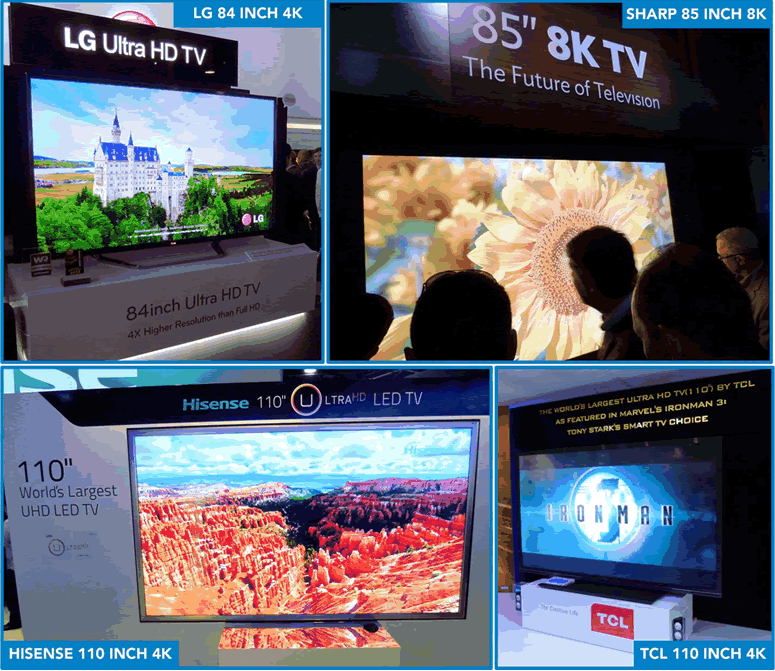 However, until this year there were only a few 4K displays available to consumers, and those were extremely expensive. This year, in contrast, most of the major TV set manufacturers displayed new consumer UHD displays at CES. Along with 4K displays running from 20" to 110" were several promising 4K 3-D, and a couple of consumer 8K sets (including the 85" 8K from Sharp displayed to the side). However, there remains the problem of a lack of 4K or 8K programming sources.
The new 4K sets, and a few BluRay players, can upconvert current signals to 4K, but at this time there's little content available to consumers in native 4K formats.
NHK has been experimenting with higher resolution cameras, and transmitting the resulting 4K content over the Internet for several years. South Korea reportedly has an experimental test channel for UHD, and the BBC filmed some of last summer's Olympics in 4K and distributed the content to several public 4K displays. More recently, Red Digital Cinema Camera Company, a prominent digital film camera manufacturer, announced the availability of a player capable of sending a native 4K signal to a single 4K display. And NHK announced it will be demonstrating 8K broadcasting (7680x4320P video format that provides 16 times more pixels than HDTV, and a 22.2 multichannel audio system that produces a 3D sound space for viewers located anywhere within a large viewing area) in a special theater at the NAB Show in a few months. A few cable MSOs have indicated an interest in offering 4K channels, and Sony is promising a 4K movie downloading service to be launched this summer.
 Organic LED (OLED) displays - I think these have been "hot prospects" for almost a decade, and certainly the technological potential of OLED displays (environmentally friendly, high contrast, and the potential for flexible screens and unlimited sizes) is worthy of the hype. The problem's been ramping the theoretical technology up to commercially viable manufacturing levels. (And don't confuse true LED or OLED displays with flatscreen LCD screens using LED for backlighting - which is what most TVs marketed as "LEDs" really are).
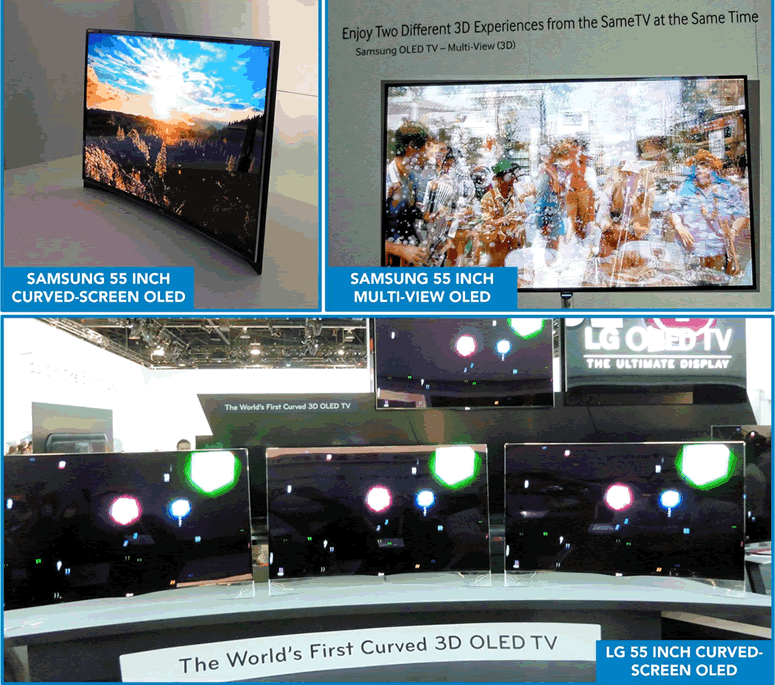
OLED's potential as mass consumer TV displays seems to still be sometime in the future (promised availability keeps being pushed back), but there were a some leading-edge options on display at CES. Samsung displayed a 55-inch "multiview" OLED that displayed two separate programs on the same screen (upper right in image to the side). It builds on the 3-D approach of using active viewing glasses to distinguish the two signals, allowing the viewer to choose which one to watch. The higher contrast and faster signal switching of OLEDs allows this to work on very different program contents (in 3-D, they're basically the same image with slight offsets in perspectives). For it's part, LG displayed a curved OLED 3-D display. And Panasonic offered their first 4K OLED display. However, Sony took a hit when it's 4K OLED offering failed to work during their big press conference at CES (see story and video here), although they did get it to work later in their booth.
The major set manufacturers once again promised that consumer OLED sets would be available within the year, but as I mentioned, they've been saying that for a long time, with little actually to show.
 Touch-screen computing offerings also went for the Wow factor, with a big push from Microsoft and its Windows 8 operating system. Samsung was there with a 24-inch touchscreen monitor, while Panasonic displayed a 20-inch tablet offering 4K resolution. Higher resolution screens was an emphasis on most traditional tablets on display. New offerings also seemed to focus on splitting the tablet market - with many stressing computing power and compatibility, while others focus on the devices' ability to handle media content and/or gaming.

And for those not into big and beautiful, there were the Mobile DTV offerings (principally DyleTV). These don't refer to watching TV on mobile devices through traditional TV tuners and broadcast stations, or the ability to download and watch videos from the Internet. Several groups are experimenting with using parts of the current broadcast spectrum to broadcast specially formatted (lower resolution and reframed for smartphone screen orientations) television signals. While DyleTV is already offering access to some local TV channels in some markets, Mobile DTV has a way to go before its consumer-ready (and consumer-friendly).
Sources - Display Technology Takes Center Stage at 2013 International CES, TV TechCheck
NHK to do First 8K U.S. Broadcast Demo at NAB Show, TV Technology
10 Best Tablets of CES 2013, Laptop Mag
UltraHDTV (UHD) & displays - The industry's settled on the name (and standards) for the next improvement in video screen resolution. This step has actually been in use for a while in the movie industry as 4K, as older analog film stock is increasingly digitized at 4K (3840x2160 P) or 8K resolutions (7690x4320 P) prior to digital processing (cleaning, color correction, etc.) of the movie to create the digital archive version - which is then downconverted to HDTV or NTSC formats and resolutions for home video or licensing.
The new 4K sets, and a few BluRay players, can upconvert current signals to 4K, but at this time there's little content available to consumers in native 4K formats.
NHK has been experimenting with higher resolution cameras, and transmitting the resulting 4K content over the Internet for several years. South Korea reportedly has an experimental test channel for UHD, and the BBC filmed some of last summer's Olympics in 4K and distributed the content to several public 4K displays. More recently, Red Digital Cinema Camera Company, a prominent digital film camera manufacturer, announced the availability of a player capable of sending a native 4K signal to a single 4K display. And NHK announced it will be demonstrating 8K broadcasting (7680x4320P video format that provides 16 times more pixels than HDTV, and a 22.2 multichannel audio system that produces a 3D sound space for viewers located anywhere within a large viewing area) in a special theater at the NAB Show in a few months. A few cable MSOs have indicated an interest in offering 4K channels, and Sony is promising a 4K movie downloading service to be launched this summer.
OLED's potential as mass consumer TV displays seems to still be sometime in the future (promised availability keeps being pushed back), but there were a some leading-edge options on display at CES. Samsung displayed a 55-inch "multiview" OLED that displayed two separate programs on the same screen (upper right in image to the side). It builds on the 3-D approach of using active viewing glasses to distinguish the two signals, allowing the viewer to choose which one to watch. The higher contrast and faster signal switching of OLEDs allows this to work on very different program contents (in 3-D, they're basically the same image with slight offsets in perspectives). For it's part, LG displayed a curved OLED 3-D display. And Panasonic offered their first 4K OLED display. However, Sony took a hit when it's 4K OLED offering failed to work during their big press conference at CES (see story and video here), although they did get it to work later in their booth.
The major set manufacturers once again promised that consumer OLED sets would be available within the year, but as I mentioned, they've been saying that for a long time, with little actually to show.
And for those not into big and beautiful, there were the Mobile DTV offerings (principally DyleTV). These don't refer to watching TV on mobile devices through traditional TV tuners and broadcast stations, or the ability to download and watch videos from the Internet. Several groups are experimenting with using parts of the current broadcast spectrum to broadcast specially formatted (lower resolution and reframed for smartphone screen orientations) television signals. While DyleTV is already offering access to some local TV channels in some markets, Mobile DTV has a way to go before its consumer-ready (and consumer-friendly).
Sources - Display Technology Takes Center Stage at 2013 International CES, TV TechCheck
NHK to do First 8K U.S. Broadcast Demo at NAB Show, TV Technology
10 Best Tablets of CES 2013, Laptop Mag
Tuesday, September 18, 2012
Media museum discovers it has first color film ever shot.
Staffers at the National Media Museum in Bradford, UK, opened an old tin reel box to discover what they think is a reel of test shots for the first system for capturing natural color in motion pictures. The reel was apparently produced in 1902, but later research suggests that problems with the film's nonstandard format and projection system, and Turner's untimely death in 1903, led to the process being abandoned and largely forgotten for the last 110 years. While film historians knew of Edward Turner's 1899 UK patent for his color process, and thought that some footage likely existed, confirmation awaited the discovery of the film tin and the development of a process for transferring the original nonstandard film onto modern film stock, then digitizing and assembling the overlying frames to produce a single color frame that could be reassembled so that the film could be displayed as shot.
Two experts in early film technologies had to create a special gate to hold the film's frames, and then match the differently colored frames individually before capturing the image digitally, restoring it, and combining it into a motion picture. Going into the project, it wasn't clear whether the process would work.
While a number of early filmmakers produced "color" movies, those were produced by adding color to individual frames of the normal black&white film stock. Capturing natural color on single film stock didn't make inroads into the film industry until the late 1920s and early 1930s.
Source - World's first colour film footage viewed for first time, BBC News
edit - had to correct a couple of technical steps in the restoration process.
Two experts in early film technologies had to create a special gate to hold the film's frames, and then match the differently colored frames individually before capturing the image digitally, restoring it, and combining it into a motion picture. Going into the project, it wasn't clear whether the process would work.
"Then we saw it on screen. We looked at it and we were absolutely astonished with it. We never expected it to be so good... Knowing all about colour reproduction, and all the pitfalls along the way, to do something as good as that coming from 1901, 1902 was really totally unexpected. It was very exciting."
While a number of early filmmakers produced "color" movies, those were produced by adding color to individual frames of the normal black&white film stock. Capturing natural color on single film stock didn't make inroads into the film industry until the late 1920s and early 1930s.
Source - World's first colour film footage viewed for first time, BBC News
edit - had to correct a couple of technical steps in the restoration process.
Friday, September 7, 2012
Tech Trends in Marketing for Media to Consider
Darren Herman has an interesting post on the promaxbda daily brief blog giving his thoughts on five developing trends in technology that will impact marketing. Since many embrace tech trends in media, those outlets relying on advertising or marketing dollars in their business model should pay attention.
Herman identifies and discusses five "big top-level" trends that will impact digital marketing in the next year or so.
It seems unlikely that there's a new, largely untapped, source of revenue to replace the growing losses in traditional media operations - or that traditional media will be successful in grabbing that new source for themselves. It's an increasingly competitive market out there, and success is more likely to come from exploiting the myriad new opportunities and niches - in looking for the many different ways to package and add value to content, in pushing content across multiple venues and platforms. I get the feeling that the industry is recognizing this - the question is whether they'll be able to embrace the opportunities for innovation that rapid technological advance creates.
Sources - Meet the Five Big Tech Trends Changing Marketing, promaxbda daily brief
Slideshow and full presentation on the topic (to be made at the upcoming Ad Age Digital Conference)
Herman identifies and discusses five "big top-level" trends that will impact digital marketing in the next year or so.
- Seamless social media management - The social media world is booming and shows little sign of slowing down. One problematic outcome has been sharing content across different social media platforms. We're seeing more cooperation among platforms in this area, particularly among platforms with a common corporate owner. But there looks to be a need for a social media management system that can cross corporate boundaries - and Herman notes that there are some new start-ups with promising services.
While such systems can simplify users' ability to manage multiple sites, they can also be very helpful in terms of launching media-driven campaigns, and in simplifying media efforts to make content available across multiple platforms and systems. - Location, location, location - The growth of GPS-equipped mobile devices has opened up a new targeting dimension - location. The ability to target content to specific locations can be quite helpful - assuring that localized marketing dollars aren't wasted on out-of-location audiences. It can also open up marketing opportunities for smaller local businesses.
The ability of digital outlets to locally target can also be quite helpful for traditional media. Historically, their rise as mass media pushed an emphasis on content of broader, more general, interest. While some media could develop regional editions, there was little opportunity to really pursue truly local content. In addition, a lot of online data is now searchable by location, and media outlets can automate content delivery (nearby home sales, restaurants, crime, etc.). - Data will drive cross-platform marketing - As Herman explains, "One of our clients told us to stop building cruise ships and focus on speedboats. What he meant was to stop focusing on big ideas that take months to plan and are hard to course correct if they turn out wrong. He pushed us towards planning speedboats, essentially microplans for different platforms that could then be optimized in market based on whether or not it was resonating." As platforms create more choices and fragment audiences, you can take advantage of that opportunity to reach the audience you want - if the data is there to identify where they are and what they're looking for.
There are two take-aways for media here - the first is the value of quality metrics; the second is that there is value in distributing your content and brand across digital platforms and services to take advantage of the various targeted niches. - Content is marketing - With stand-alone ads losing some of their glamour, and the industry shifting towards a more organic approach towards monetization, remember that content is what drives audiences. The good news is that new technologies facilitate the integration of marketing and content - whether creating content to draw attention and audiences to your marketing campaign, or embedding marketing messages within outside content. Integrating marketing and content creation, if done well and in the right situation, can be quite successful (and doing it wrong can be almost as disastrous).
Content is the primary focus for media outlets, and historically there's been a wall between advertising and content. Starting to tear down that wall and considering how content and campaigns might create positive synergies for both is likely to be beneficial in the long run. - Experiences and devices will be increasingly linked - The newest mobile devices are not only aware of where they are, but what other devices are nearby. And they can link with some, allowing users to share experiences, content, and thoughts. New technology is opening new opportunities for integrated cross-media marketing. (For example, as the Pizza Hut ad plays on your TV, your tablet brings up the website for the nearest one, along with a coupon that's highly targeted for that context - for example shifting from a deal on a medium to a deal for 4 larges when the system notes there are 15 other smartphones or tablets in the room).
Traditional media were truly mass media, because of the nature of their delivery system. One of the hard lessons of the last decade is that media don't have to only be that - going digital can open up opportunities for targeting, individualizing, linking, and soliciting and integrating user feedback. Media that can open themselves to consider, and take advantage of, those opportunities are the ones that are most likely to be successful in the emerging digital network economy.
It seems unlikely that there's a new, largely untapped, source of revenue to replace the growing losses in traditional media operations - or that traditional media will be successful in grabbing that new source for themselves. It's an increasingly competitive market out there, and success is more likely to come from exploiting the myriad new opportunities and niches - in looking for the many different ways to package and add value to content, in pushing content across multiple venues and platforms. I get the feeling that the industry is recognizing this - the question is whether they'll be able to embrace the opportunities for innovation that rapid technological advance creates.
Sources - Meet the Five Big Tech Trends Changing Marketing, promaxbda daily brief
Slideshow and full presentation on the topic (to be made at the upcoming Ad Age Digital Conference)
Sunday, April 29, 2012
Black Magic Design's new Camera
Post contributed by Stuart Hohl -
Is The New Black Magic Design Cinema Camera All It Appears To Be?
Filmmakers have had an exciting time as more and more information about the new BMD Cinema Camera has come out in the past month. We’re slowly starting to see some images produced on some of their prototype cameras and preorders have gone through the roof.
First off, what’s so exciting about this camera? Well, the tech specs are pretty impressive:
Well, that depends on what you’re using it for. It may not be very effective for production companies but for an indie filmmaker then it may be a great choice. There are some cons that may make a competitor like the Red Scarlet more attractive: first, it has an internal battery. This is an issue because on long shoot you have to be tethered to some sort of power supply - also, replacing an aging battery will become more difficult; second, there's o reference or time code input available (This becomes an issue on multi-cam shoots where you would want to synchronize footage to make life easier in postproduction. Also, it may make life harder if you want to synchronize audio as even one frame off can be a pain to fix and half a frame would be a nightmare); third, no XLR input for audio (It does have ports for similar cables, but that’s either new cables or an adapter for many filmmakers).
So, how does it compare to say the Canon 7d, a favorite of indie-filmmakers? It’s twice the price but the bonus with the BMD is that you can shoot RAW footage and don’t have to deal with the h.264 compression codec and 4:2:0 color of the 7d. It means that your video is suddenly more true and versatile than a Canon 7d. However, functionality is about the same in that a multicam shoot with a BMD is just as difficult as with a 7d. Also the BMD has 13 stops of dynamic range as compared to the ~8 of the 7d which means that your depth of field will always be better with the BMD.
The verdict? To buy or not to buy? I say that if you are trying to make compelling, gorgeous video without needing a multicam shoot and are willing to ignore the internal battery issue, then go with the BMD. For $3,000 no one can compete with the price point and provide uncompressed video. If you are not worried about compression or portability is key to you then the 7d (or similar camera) may be a better or choice for you. Right now, the BMD looks great and I’m excited to see what this level of competition does to the DSLR and RAW video markets.
For some initial footage with a BMD prototype go here.
Sources - BlackMagic Design product info
BJB - some minor editing
Is The New Black Magic Design Cinema Camera All It Appears To Be?
Filmmakers have had an exciting time as more and more information about the new BMD Cinema Camera has come out in the past month. We’re slowly starting to see some images produced on some of their prototype cameras and preorders have gone through the roof.
First off, what’s so exciting about this camera? Well, the tech specs are pretty impressive:
- Raw Resolution: 12-bit RAW files recorded at 2432 x 1366
- Shooting Resolution2.5K RAW at 2432 x 1366. ProRes and DNxHD at 1920 x 1080
- Frame Rates: 23.98p, 24p, 25p, 29.97p, 30p
- Sensor Size: 16.64 mm x 14.04 mm
- Dynamic Range: 13 stops
Well, that depends on what you’re using it for. It may not be very effective for production companies but for an indie filmmaker then it may be a great choice. There are some cons that may make a competitor like the Red Scarlet more attractive: first, it has an internal battery. This is an issue because on long shoot you have to be tethered to some sort of power supply - also, replacing an aging battery will become more difficult; second, there's o reference or time code input available (This becomes an issue on multi-cam shoots where you would want to synchronize footage to make life easier in postproduction. Also, it may make life harder if you want to synchronize audio as even one frame off can be a pain to fix and half a frame would be a nightmare); third, no XLR input for audio (It does have ports for similar cables, but that’s either new cables or an adapter for many filmmakers).
So, how does it compare to say the Canon 7d, a favorite of indie-filmmakers? It’s twice the price but the bonus with the BMD is that you can shoot RAW footage and don’t have to deal with the h.264 compression codec and 4:2:0 color of the 7d. It means that your video is suddenly more true and versatile than a Canon 7d. However, functionality is about the same in that a multicam shoot with a BMD is just as difficult as with a 7d. Also the BMD has 13 stops of dynamic range as compared to the ~8 of the 7d which means that your depth of field will always be better with the BMD.
The verdict? To buy or not to buy? I say that if you are trying to make compelling, gorgeous video without needing a multicam shoot and are willing to ignore the internal battery issue, then go with the BMD. For $3,000 no one can compete with the price point and provide uncompressed video. If you are not worried about compression or portability is key to you then the 7d (or similar camera) may be a better or choice for you. Right now, the BMD looks great and I’m excited to see what this level of competition does to the DSLR and RAW video markets.
For some initial footage with a BMD prototype go here.
Sources - BlackMagic Design product info
BJB - some minor editing
Saturday, April 28, 2012
Test Driving the Red Epic & Ultra-HD
Post contributed by Stuart Hohl -
Ultra High Definition Video is an emerging format of video that takes pixels to a much larger level than traditional digital HD. Formats such as 4K, 5K and 8K (still in development) may have up to 16 times the number of pixels as traditional 1080p. It is a format that is slowly starting to catch on with only a few companies stepping up the creation of cameras that can shoot at those resolutions.
One of these companies is Red Cinema Digital Camera Company (colloquially known as Red). Red has had several Cameras out that can shoot in these formats but with different levels of performance. The Red Scarlet-X can only get 12 frames per second at 5k, but the older Red-Epic and Red-One can reach higher fps at 5K resolution. These cameras were recently used for the upcoming blockbuster “The Hobbit,” but the University of Tennessee used a Red Epic to shoot their Vols' Baseball and Softball TV spots.
One issue with these cameras is the sheer amount of data that these cameras can produce, particularly at the Ultra HD levels. For the 30 second Baseball spot Athletics Broadcasting shot over 500 GB of Footage. A shoot can get very expensive very quickly when shooting in Ultra High Definition because of the money you have to put into storage systems. One of the things the industry will have to do is to bring data storage up to speed with data creation.
UT Athletics Broadcasting was shooting with 64 GB cards and could get only about 30 minutes of footage onto each one. That means that you need multiple expensive cards and a storage system to get the footage off of them so you can reuse them. One quick fix for some productions has been to write it directly to hard drives, but that can be extremely cumbersome for some shoots and very expensive. That’s just a stopgap until new storage methods are developed to make shooting at such a high resolution and/or frame rate convenient.
Why shoot UHD, if it requires so much storage space? It is for the quality of the image. You can look at a camera like the Canon 7d, which has been a favorite of many young and freelance filmmakers. The Canon 7d shoots with a highly compressed 4:2:0 h264 codec, 1080p, with approximately 8 stops of dynamic range. A camera like a Red can shoot with various degrees of compression (or in some cases uncompressed), 5k resolution, with 13+ stops of dynamic range. You get more to work with and you have the raw, uncompressed footage to work with. However, there is a massive difference in price. For most filmmakers (especially amateurs) the Canon 7d is more than enough to get the picture they need (for around $3,000 for the camera and appropriate lenses). However for production companies and the like a Red camera can cost $25,000 and lenses can cost tens of thousands of dollars. Obviously, it’s not for everyone.
Film has been the traditional quality standard of Hollywood for some time now. As we move into a digital age, film is finally being challenged by new digital systems that can match the quality and versatility of film that photographers and filmmakers have enjoyed for 100 years. It will be interesting to see if storage systems can advance an keep up to make it cost effective for even smaller productions. Director Peter Jackson talks about his experience with Red UHD cameras and 3-D in this clip. At 4:30 in the video there is a quick and simple explanation of 1080p versus 4k and 5k. Definitely check that out and even watch the entire video because it’s very interesting.
Sources - www.reduser.net
www.red.com
www.canon.com
BJB - edited for style.
Ultra High Definition Video is an emerging format of video that takes pixels to a much larger level than traditional digital HD. Formats such as 4K, 5K and 8K (still in development) may have up to 16 times the number of pixels as traditional 1080p. It is a format that is slowly starting to catch on with only a few companies stepping up the creation of cameras that can shoot at those resolutions.
One of these companies is Red Cinema Digital Camera Company (colloquially known as Red). Red has had several Cameras out that can shoot in these formats but with different levels of performance. The Red Scarlet-X can only get 12 frames per second at 5k, but the older Red-Epic and Red-One can reach higher fps at 5K resolution. These cameras were recently used for the upcoming blockbuster “The Hobbit,” but the University of Tennessee used a Red Epic to shoot their Vols' Baseball and Softball TV spots.
One issue with these cameras is the sheer amount of data that these cameras can produce, particularly at the Ultra HD levels. For the 30 second Baseball spot Athletics Broadcasting shot over 500 GB of Footage. A shoot can get very expensive very quickly when shooting in Ultra High Definition because of the money you have to put into storage systems. One of the things the industry will have to do is to bring data storage up to speed with data creation.
UT Athletics Broadcasting was shooting with 64 GB cards and could get only about 30 minutes of footage onto each one. That means that you need multiple expensive cards and a storage system to get the footage off of them so you can reuse them. One quick fix for some productions has been to write it directly to hard drives, but that can be extremely cumbersome for some shoots and very expensive. That’s just a stopgap until new storage methods are developed to make shooting at such a high resolution and/or frame rate convenient.
Why shoot UHD, if it requires so much storage space? It is for the quality of the image. You can look at a camera like the Canon 7d, which has been a favorite of many young and freelance filmmakers. The Canon 7d shoots with a highly compressed 4:2:0 h264 codec, 1080p, with approximately 8 stops of dynamic range. A camera like a Red can shoot with various degrees of compression (or in some cases uncompressed), 5k resolution, with 13+ stops of dynamic range. You get more to work with and you have the raw, uncompressed footage to work with. However, there is a massive difference in price. For most filmmakers (especially amateurs) the Canon 7d is more than enough to get the picture they need (for around $3,000 for the camera and appropriate lenses). However for production companies and the like a Red camera can cost $25,000 and lenses can cost tens of thousands of dollars. Obviously, it’s not for everyone.
Film has been the traditional quality standard of Hollywood for some time now. As we move into a digital age, film is finally being challenged by new digital systems that can match the quality and versatility of film that photographers and filmmakers have enjoyed for 100 years. It will be interesting to see if storage systems can advance an keep up to make it cost effective for even smaller productions. Director Peter Jackson talks about his experience with Red UHD cameras and 3-D in this clip. At 4:30 in the video there is a quick and simple explanation of 1080p versus 4k and 5k. Definitely check that out and even watch the entire video because it’s very interesting.
Sources - www.reduser.net
www.red.com
www.canon.com
BJB - edited for style.
Wednesday, April 25, 2012
Ideas for iPhone 5?
Post contributed by Michael Culpepper -
While we have all experienced the fact that concept designs for new technology rarely are incorporated in that specific generation, Apple has announced some interesting features about the new IPhone that we may want to keep an eye on. What they are proposing is an interactive holographic keyboard and display. All of the information come from a video created by a San Francisco-based 3D animation and digital content shop called Aatma Studio, which imagines the integration of Pico projection for holographic keyboards and displays on future iPhones.
During the video, the virtual keyboard is shown projected onto a surface by swiping it off the screen. The projected keyboard can then be scaled to a more comfortable size using a pinch-to-zoom gesture directly on the surface of the projection. This is very similar to the track-pad function of their Macbook series. It appears that sensors are able to detect your key strokes as a combination of light and shadows
Slashgear.com then reports, “But Aatma takes this idea further to show a holographic display. While Apple has filed patents for pico projection systems for their iPhones and iPads, as well as a feature that can read and react to the silhouettes of gestures in front of the projections, the concept shown in the video projects an image in mid-air.”
While admittingly, this technology probably won’t make it to the IPhone 5, it is something to really consider. We are now opening the doors to a much more interactive version of entertainment. We may not be too far off from things like the Microsoft Kennect being able to be utilized on an Android phone. Not only that but it now offers the availability of multiple people using programs on the same phone without having to crowd around each other.
If you would like to see the video of the concept, you can find it here.
(BJB - A bit off format, but I've got a backload to push out)
While we have all experienced the fact that concept designs for new technology rarely are incorporated in that specific generation, Apple has announced some interesting features about the new IPhone that we may want to keep an eye on. What they are proposing is an interactive holographic keyboard and display. All of the information come from a video created by a San Francisco-based 3D animation and digital content shop called Aatma Studio, which imagines the integration of Pico projection for holographic keyboards and displays on future iPhones.
During the video, the virtual keyboard is shown projected onto a surface by swiping it off the screen. The projected keyboard can then be scaled to a more comfortable size using a pinch-to-zoom gesture directly on the surface of the projection. This is very similar to the track-pad function of their Macbook series. It appears that sensors are able to detect your key strokes as a combination of light and shadows
Slashgear.com then reports, “But Aatma takes this idea further to show a holographic display. While Apple has filed patents for pico projection systems for their iPhones and iPads, as well as a feature that can read and react to the silhouettes of gestures in front of the projections, the concept shown in the video projects an image in mid-air.”
While admittingly, this technology probably won’t make it to the IPhone 5, it is something to really consider. We are now opening the doors to a much more interactive version of entertainment. We may not be too far off from things like the Microsoft Kennect being able to be utilized on an Android phone. Not only that but it now offers the availability of multiple people using programs on the same phone without having to crowd around each other.
If you would like to see the video of the concept, you can find it here.
(BJB - A bit off format, but I've got a backload to push out)
Future of mobile - Nokia Human Form
There's a lot of people envisioning what the future holds for mobile technology and mobile devices. Here's a report on Nokia's vision, contributed by David Comm -
Recently the engineers at Nokia have been working on a concept of a phone that could revolutionize the world of mobile phones…it’s called the Nokia Human Form. Of course, this is still just a concept…not yet a phone. However, it is based off of the Nokia Kinetic Device which IS real, so the Human Form is not complete fiction.
The Kinetic Device is a concept phone that Nokia developed that is flexible…yes, flexible. Instead of buttons, the Kinetic Device is controlled by bending, twisting, and squeezing. It was unveiled at Nokia World 2011 at London’s Excel Centre. The phone was unveiled by Tapani Jokinen, Nokia’s Head of Design, Technology Insights. Tapani said that while there is a touch screen on the phone it goes “beyond it.”
 This is the technology that will be used in the Human Form, plus a little. The Human Form will look like no other phone…it looks like a min surfboard, it is thin, transparent, and flexible. Not only that but it can mold to your ear when you talk and can mold to you leg while in your pocket. If that wasn’t enough, a particularly cool feature is the tactile sensory touch that accompanies a photograph, so when you look at a picture, your skin can interpret the surface of that particular object by simply touching it, as if they were virtually right there in front of you.
Again, this is still just a concept, so it will be years before this could even be possible, but you can still see a really cool video of Nokia’s vision of the Human Form here. From Nokia PR comes this description:
Recently the engineers at Nokia have been working on a concept of a phone that could revolutionize the world of mobile phones…it’s called the Nokia Human Form. Of course, this is still just a concept…not yet a phone. However, it is based off of the Nokia Kinetic Device which IS real, so the Human Form is not complete fiction.
The Kinetic Device is a concept phone that Nokia developed that is flexible…yes, flexible. Instead of buttons, the Kinetic Device is controlled by bending, twisting, and squeezing. It was unveiled at Nokia World 2011 at London’s Excel Centre. The phone was unveiled by Tapani Jokinen, Nokia’s Head of Design, Technology Insights. Tapani said that while there is a touch screen on the phone it goes “beyond it.”
Again, this is still just a concept, so it will be years before this could even be possible, but you can still see a really cool video of Nokia’s vision of the Human Form here. From Nokia PR comes this description:
“Human Form…a visionary solution beyond touch screen and voice communication where technology becomes invisible and intuition takes over. The solution is a redefined phone where interactions become natural and convey human emotions.”Sources – Nokia Research Center and Nokia Connects
Tuesday, April 24, 2012
Newsrooms Revamp to Stay Local
As the news market gets ever more competitive, many traditional media outlets are looking to refocus on coverage where they have a competitive advantage. Several sessions at the NAB Broadcast Management Summit explored the topic, with a focus on the options for local broadcast TV stations.
Highlights -

Source - Newsrooms Revamp to Stay Local, NABShow Daily News
Highlights -
- "It wasn't too long ago that all of our workflow was focused on the evening news at 6 and 11 p.m.," notes Brian Bracco, vice president of News at Hearst Television. "But now that we are competing with all these platforms, we've had to change our workflows so that we can be more agile and deliver the news in all formats and platforms the way consumers want it."
- "(Local TV news stations) are facing an aging demo and a declining demo for TV news at a time when the revenue dollars are increasingly being diluted and spread out over more outlets," notes Bill Hendler, chief technology officer at Chyron. Finding a way to connect with younger demographics may be critical - Hendler continued, "You are seeing a lot of energy focused around social [media] and social TV integration and second- screen platforms."
- TV News operations are being transformed by the development of smaller, lighter cameras and new remote access technologies. "Stations are taking steps to cut costs while increasing the content they create, so more and more stations are investing in lower-cost devices to bring news back to the studio over cheaper 3G and 4G networks," said Streambox CEO Bob Hildeman.
- Some speakers spoke of other cutting edge technology, such as robotic cameras and virtual set systems. "We think that augmented reality is a great way to differentiate yourself from the lower-end webcasters or online news and to offer viewers a much more immersive, higher-quality experience," explains Jeff Moore, executive vice president of Marketing and Sales at Ross Video.
- Hearst's Bracco says they have already implemented a number of these technologies at Hearst stations, including the widespread use of smaller cameras and iPhones for ENG, and that these efforts are beginning to pay off in terms of larger audiences. "We had record traffic on our Web and mobile last year," he reports. "Some of that could have been associated with the terrible weather, but I think changing our operations to get more video onto the site and making it a more robust experience played a key role."
Source - Newsrooms Revamp to Stay Local, NABShow Daily News
Thursday, April 12, 2012
Living Room Tech
Post contributed by Margo Lipscomb -
Having a TV dinner may never be the same again. Now, with your Microsoft Kinect for your Xbox, your living room will now be able to open up a whole new realm of entertainment.
Now, in addition to your Netflix subscription, you will be able to access such programs like Microsoft, Sony and Apple all from your own television. Apple has recently emerged with new technology allowing you to stream content from your MAC to your television with an “Apple TV.”
This being said, there is speculation about Apple actually launching a complete television set itself. In Steve Jobs’ biography it is mentioned that he “finally cracked” the challenge of building an integrated television experience that’s easy to use for consumers. Whether or not consumers will actually be interested in such a product is a question that can only be answered by the future.
Sources - The Next Big Thing(s) in Tech, PC World
Will the next Apple TV be launched with Dish or DirecTV? GigaOm
Having a TV dinner may never be the same again. Now, with your Microsoft Kinect for your Xbox, your living room will now be able to open up a whole new realm of entertainment.
Now, in addition to your Netflix subscription, you will be able to access such programs like Microsoft, Sony and Apple all from your own television. Apple has recently emerged with new technology allowing you to stream content from your MAC to your television with an “Apple TV.”
This being said, there is speculation about Apple actually launching a complete television set itself. In Steve Jobs’ biography it is mentioned that he “finally cracked” the challenge of building an integrated television experience that’s easy to use for consumers. Whether or not consumers will actually be interested in such a product is a question that can only be answered by the future.
Sources - The Next Big Thing(s) in Tech, PC World
Will the next Apple TV be launched with Dish or DirecTV? GigaOm
Wednesday, February 8, 2012
Top Tech Predictions: A View from Broadcasting/Gaming
Matt Ployhar's posted his list of Top Technology Predictions for 2012 on the Broadcast Newsroom blog.
Source - Top Technology Predictions for 2012, BroadcastNewsroom.com
- Voice and Artificial Intelligence - from cars to smartphones to games to TVs - look for voice-controlled systems to move to more and more digital systems.
- Cloud Services - look for more and more content to be stored in, and delivered through, Clouds.
- Tablet Mania Wears Off - here I disagree - Ployhar doesn't see tablets as replacements for PC, and thus diffusion will slow. I agree that they aren't a full PC/laptop replacement, but a supplement - but that's why I see tablet adoption to continue to boom, as a basic tool for surfing, media consumption, and gaming.
- Smarter TVs - Ployhar hopes for an integrated TV/PC/Gaming platform with input devices built-in. I see smarter, in terms of integrating WiFi and Internet connectivity, but Ployhar's forgetting that all-in-one systems lock you into the system, and limit piecemeal replacement as technology advances. (Also, what about all that legacy hardware/software, and who gets to win the gaming platform battle?)
- China lifts it's ban on gaming consoles - who wouldn't want access to the world's largest market?
- E3 News - isn't it time for a new generation of consoles and gaming platforms?
- Google goes Big in 2012 - look for continued integration of Google's various platforms and services.
- Time for that Big Deal in Gaming - Will 2012 see one leader buying out another?
- The World's Still Flat - Globalization & Economic Climate remain mostly stable
Source - Top Technology Predictions for 2012, BroadcastNewsroom.com
Monday, December 19, 2011
Deloitte's Tech Trends for 2012
Deloitte Consulting LLP recently released a list of what it feels will be the ten emerging technology trends with the greatest potential for impacting business innovation and how people access and use information. There seem to be five driving forces behind these: Mobility, Social Networking, Cloud Services, Analytics and "Cyber". They feel each of these offers the opportunity for further innovation and the potential to create new value for users and businesses. Here's the list of the top 10 trends, along with some comments on the applicability within media and journalism.
- Geo-Spatial Visualization takes advantage of the explosion of geographical, location-aware data. Combining the GPS tagging of mobile with the ability of Social Networking to tag and connect, the Cloud to store and access, and new visualization techniques that allow info to be overlaid live camera feeds, this trend encompasses a wide range of new uses, from sharing recommendations to locating friends, to advertising targeted to user and location, to sending news (traffic, weather) updates or warnings to those in affected areas.
- Digital Identities follows an effort to create unique identifiers that can follow users across the multiple devices we use. Digital identities would benefit e-commerce and online advertising, and provide a single access point for restricted content subscriptions and services.
- Data Goes to Work reflects the increasing ability to analyze and use the huge amounts of data generated online. This is a trend that journalism can really benefit from, from data-based reporting, to better understanding of what online readers want, to what formatting and layout options work best. Unlike past media measurement options, analytics can be used in real-time, and can use all responses rather than a sample. As media continue to become more competitive, both advertisers and media firms need to pay more and better attention to audiences, and one way is to track how they actually use media.
- Measured Innovation reflects the idea that analytics can also help focus and target your efforts to innovate, showing where the best potential for creating value lies.
- Outside-In Architecture reflects the idea that our need to know is colliding with our need to share. Deloitte sees this in a transition from siloed, enterprise-out design to operating in rapidly evolving ecosystems. Traditional media epitomize the siloed, enterprise-out design of the media firm delivering what they choose to a medium-specific market. As this trend continues, media need to abandon that model and the idea that they control content and its use - they need to welcome and utilize what others create and want to share, and to be willing to share themselves.
- Social Business. Deloitte sees 2012 as the year that social moves from media to the business. That's more than using social marketing - it's embracing social as a way of getting things done, leading to a fundamental reshaping of business operations. Some news organizations are taking baby steps in this direction, soliciting contributions from readers and viewers (a very small step in that direction).
- Hyper-Hybrid Cloud. As Cloud applications continue to evolve, they enable a degree of integration across devices, enhance the value of mobile, and offer access to data, content, and programs to an unprecedented degree. They also have the potential to help reshape how people view content and usage - in particular, in shifting focus from the value laying in the ownership of content, to the value coming from the ability to access content. It also ties in well with the increased emphasis on sharing. As this shift occurs, it will have significant implications for how content is marketed and for how intellectual property rights are framed.
- Enterprise Mobility Unleashed - Mobility is helping many firms rethink their operations. From a general business perspective, this means organizations "should make sure solutions are enterprise class - secure, reliable, maintainable and integrated." For media, mobility reflects the continuing disaggregation of the mass audience - and the idea that there may be more value in allowing audiences more choice and control in their media use, than in maintaining control over a consistent media use experience.
- Gamification - Not only are games a growing market, but aspects of gaming (simulations, game mechanics like tracking achievement, and skill-based learning) are increasingly recognized as having value in business processes. Advertising and PR has learned the value of gaming as a means of attracting users, and as a medium for messages. Media can also find better ways to use aspects of social networking and gaming to find new ways to engage users.
- User empowerment - the primary source for added value these days is in consumerization, and in the customization of consumption. In media and journalism, technology is giving users greater choice and control over what, where, how, and when media content is consumed. Technology continues to enable new forms of competition and new sources of news, entertainment, and information. Not only is there added value in providing consumers greater choice and control, but if media organizations can find ways to actively encourage interaction and engagement, they can build up brand image and reliance among users. And in this new media environment, it's not just the numbers of the audience, but the level of their engagement and commitment that has value for the media organization. Empowered users are more valuable users.
So, technology is likely to continue shaping the world generally, and I look for more significant shifts coming to media and journalism in the short term. Many will be disruptive, but will also offer significant opportunities to those media and news organizations that try to embrace and exploit them. At the very least, media need to be open to new ways of doing business in order to exploit the potential opportunities for value and revenues.
Source: Deloitte's Tech Trends Picks for 2012, CIO Insight
Sunday, October 23, 2011
Recharging AND Going Green All In One
Post submitted by Whitney Wilson -
Nousal Energy Systems is proposing a new kind of charger that charges electronics with by using the sun. It can charge items such as digital cameras, cell phones, mp3s, mp4s, radios and much more. It is made of a High efficiency Silicon monocrystalline cell encapsulated in temperate glass high transparency. In short, these materials make up the solar panel that is able to soak up the energy to charge these electrical devices. It also has a plastic covering that protects it from the UV rays so it does not wear out quickly (it comes equipped with a two year warranty).Basically the only danger is that once out in the sun if the glass becomes too hot it can be somewhat hazardous.
Although the Solar Charger has environmental benefits, It also has its inconveniences. The time it takes to charge a device depends on the kind of battery it is and most importantly, the weather! Also, it can only charge one device at a time. It is a unique device so that should not be surprising. This device will have an effect on the world of media because with the growing concern of “going green” this is a great way to not feel guilty about staying current with technology because charging technological devices will no longer leave a carbon footprint on the world. It is a product that people will feel confident, and a sense of good will about buying. There is so much emphasis on how to save the environment, conserve energy, and people can do both of these by tapping into the resources that the world is already equipped them with i.e. solar power.
Even though the Solar Charger is relatively new and not much is known about it here, I think that this is a huge step in the process of going green for the technological industry because if this business can make a solar powered phone charger, the next invention following may be a solar powered cellular device. It is apparent that there are some unresolved issues with this product, such as what to do in a period where there is not enough sun to be able to fully charge devices. But as with every innovative technology there will be bugs that will hopefully eventually be worked out. The catch is, this device is not available in the United States yet, but if the expansion of the market continues as is, it will soon make it to the states. The Solar Charger is primarily available in Europe, some parts of Africa, and a single location in Asia. This only goes to show that the market for this product is growing, and that the products uniqueness is something that is catching on around the world and will probably eventually make it here.
Source - ¿Qué es el Cargador Solar Universal? Nousol.com
BJB Note - Small solar chargers are fairly widely available, and a boon for journalists, hikers, and travelers that may find themselves without a functioning plug nearby to charge all their gadgets. Prices have been falling lately due to increased production of the solar film used in these devices.

Nousal Energy Systems is proposing a new kind of charger that charges electronics with by using the sun. It can charge items such as digital cameras, cell phones, mp3s, mp4s, radios and much more. It is made of a High efficiency Silicon monocrystalline cell encapsulated in temperate glass high transparency. In short, these materials make up the solar panel that is able to soak up the energy to charge these electrical devices. It also has a plastic covering that protects it from the UV rays so it does not wear out quickly (it comes equipped with a two year warranty).Basically the only danger is that once out in the sun if the glass becomes too hot it can be somewhat hazardous.
Although the Solar Charger has environmental benefits, It also has its inconveniences. The time it takes to charge a device depends on the kind of battery it is and most importantly, the weather! Also, it can only charge one device at a time. It is a unique device so that should not be surprising. This device will have an effect on the world of media because with the growing concern of “going green” this is a great way to not feel guilty about staying current with technology because charging technological devices will no longer leave a carbon footprint on the world. It is a product that people will feel confident, and a sense of good will about buying. There is so much emphasis on how to save the environment, conserve energy, and people can do both of these by tapping into the resources that the world is already equipped them with i.e. solar power.
Even though the Solar Charger is relatively new and not much is known about it here, I think that this is a huge step in the process of going green for the technological industry because if this business can make a solar powered phone charger, the next invention following may be a solar powered cellular device. It is apparent that there are some unresolved issues with this product, such as what to do in a period where there is not enough sun to be able to fully charge devices. But as with every innovative technology there will be bugs that will hopefully eventually be worked out. The catch is, this device is not available in the United States yet, but if the expansion of the market continues as is, it will soon make it to the states. The Solar Charger is primarily available in Europe, some parts of Africa, and a single location in Asia. This only goes to show that the market for this product is growing, and that the products uniqueness is something that is catching on around the world and will probably eventually make it here.
Source - ¿Qué es el Cargador Solar Universal? Nousol.com
BJB Note - Small solar chargers are fairly widely available, and a boon for journalists, hikers, and travelers that may find themselves without a functioning plug nearby to charge all their gadgets. Prices have been falling lately due to increased production of the solar film used in these devices.
Friday, April 29, 2011
Remote Cameras - Inside the Drone Missions
From Jennifer Sprouse -
A really cool article on the use of drones going inside Fukushima Dai-ichi reactor complex in Japan. These flying drones are making short trips of 40 minutes in-and-out of the plant, taking pictures and video of what's happening inside the reactors to try to fix what went wrong during the natural disaster. While the footage taken inside the complex is going to be mostly used for research, this kind of drone technology could expand and could be another way of shooting footage for news content.
Source: "Inside the Drone Missions to Fukushima," The Atlantic
Tuesday, April 26, 2011
3-D on the move (literally)
From Brittney Goo:
3D Technology to Expand to Automobiles and AirplanesIt seems like everything is going 3D nowadays. From movies to televisions to hand-held video game devices, 3D has taken the world by storm. As if that were not enough, it appears as though media consumers will soon be able to experience 3D images while traveling. MasterImage, a 3D technology company, is currently in the process of securing deals with automobile manufacturers and airlines. In addition to being able to watch movies in 3D, travelers would no longer have to worry about wearing bulky, dorky-looking glasses in order to gain the complete 3D experience. This is because MasterImage plans to install glasses-free 3D screens in luxury cars and passenger airplanes. The glasses-free technology will not only change the way people travel, but it will also change the way people watch television and movies. For individuals who wear glasses to correct their vision, this will relieve the burden of wearing two pairs of glasses that likely do not fit together comfortably. Furthermore, this shows that the possibilities for 3D technology are no longer limited to the home or movie theater. Travelers will be able to download 3D movies via Wifi to watch in their cars, which will definitely make long road trips more bearable for the entire family.
Check out this article to learn more:
"MasterImage Eyeing Glasses-Free 3D Deals with Airlines, Auto Makers" the Hollywood Reporter
3D Technology to Expand to Automobiles and AirplanesIt seems like everything is going 3D nowadays. From movies to televisions to hand-held video game devices, 3D has taken the world by storm. As if that were not enough, it appears as though media consumers will soon be able to experience 3D images while traveling. MasterImage, a 3D technology company, is currently in the process of securing deals with automobile manufacturers and airlines. In addition to being able to watch movies in 3D, travelers would no longer have to worry about wearing bulky, dorky-looking glasses in order to gain the complete 3D experience. This is because MasterImage plans to install glasses-free 3D screens in luxury cars and passenger airplanes. The glasses-free technology will not only change the way people travel, but it will also change the way people watch television and movies. For individuals who wear glasses to correct their vision, this will relieve the burden of wearing two pairs of glasses that likely do not fit together comfortably. Furthermore, this shows that the possibilities for 3D technology are no longer limited to the home or movie theater. Travelers will be able to download 3D movies via Wifi to watch in their cars, which will definitely make long road trips more bearable for the entire family.
Check out this article to learn more:
"MasterImage Eyeing Glasses-Free 3D Deals with Airlines, Auto Makers" the Hollywood Reporter
Taps for Typewriters
From Jennifer Sprouse:
An article from The Atlantic looks at how the last typewriter factory in the world has shut down. It was a pretty interesting piece about this, now, ancient machine, and the lack of use for typewriter manufacturers now that newer technology has inevitably taken over. It's almost sad how these machines that we once used as a main tool of communication are slowly making their way to the trash.
An article from The Atlantic looks at how the last typewriter factory in the world has shut down. It was a pretty interesting piece about this, now, ancient machine, and the lack of use for typewriter manufacturers now that newer technology has inevitably taken over. It's almost sad how these machines that we once used as a main tool of communication are slowly making their way to the trash.
Source: "Last Typewriter Factory in the World Shuts Its Doors," the Atlantic
Subscribe to:
Posts (Atom)