Showing posts with label innovations. Show all posts

Wednesday, July 23, 2014

Droning On, or Not

So we got our first drone/videocamera system a while back (at UTK's School of Journalism & Electronic Media), just before the FAA came out with its restrictions on drone use.  And checking with the University's legal office, they initially said we should limit use to over University property; then said better not use it until FAA figures out rules.  And so it's been on a shelf in our equipment room for the last year.

It's not that we, and other journalism programs, don't see the potential of drones to gather information and images.  One early application of drone journalism was its use to cover the aftermath of Alabama tornadoes in 2011. [The FAA started an investigation of that "unauthorized" drone usage, arguing that it violated its regulations (as yet, no public announcement of actions)].

On the international front, the Bangkok Post used drones to cover the political protests last year, Meanwhile, drones are finding widespread applications in filmmaking - especially documentaries (where drones offer significant cost savings over renting helicopters) - and other uses related to imaging (real estate) and monitoring (disaster relief, agriculture, etc.).   Drones are proving to be potentially very useful tools, albeit with real concerns about potential loss of privacy, or damages from drones hitting things (power lines, other aerial vehicles, even people). There's certainly enough to keep a few academic drone journalism centers occupied.
In the meantime, the FAA has banned most commercial drone use, while it works out its concerns and develops drone-specific rules.
In the meantime, this summer's seen an emergence of interest in drone journalism - based on some really good examples internationally, and a spate of horrified reactions when a (thankfully false) report surfaced that celebrity-news outfit TMZ had applied for a license to operate drones (to peek into celebrity homes and back yards).  The report was false, but the renewed interest in the ability to use drones in news gathering isn't.
 A number of "drone journalism" programs and centers have developed at University journalism programs. The initial problem they all face is getting permission to actually use drones for news gathering and news reporting.  Initially, many thought they could get waivers in the form of FAA "Certificate of Authorization" (COA) program designed for unmanned aircraft systems (UAS).  That program allowed UAS use for research purposes, by "public operators (i.e. government agencies) of a specific drone within a specified geographic location for a limited period of time."  Even if the program was appropriate, the regulations require advance notice and approvals for each use, and severely limits the area and times of use - conditions that curtail the utility of drones for spot or breaking news coverage.
We profs would probably try sneaking drones into our journalism curriculum anyway, as we could identify specific times and places for class demonstrations.  However, the FAA indicated quite early on that "drones" were not the kind of "unmanned aircraft system" their current regulations covered, and until they could come up with new rules specifically for drones, most commercial drone usage (including for news coverage) was banned. So for now, the ability of most programs to use drones in journalism coverage and education is effectively curtailed.
That hasn't stopped some "drone journalism" centers and programs from partnering with news organizations to "research" drone journalism.  One, a joint project by Georgia Tech and CNN, to “investigate technologies, operating procedures, and crew skill requirements that will enable the safe and effective use of UASs for news coverage”, seems willing to continue despite FAA limits (part of that project is looking at aeronautical control systems, which the FAA considers UAS research).  Many others (Nebraska, Missouri, South Florida) have tried applying for COAs, despite the limitations.  But those approvals have not been coming.
Just as the FAA quickly decided that drones weren't UAS and thus able to operate within those guidelines, the FAA seem to have decided that drone journalism and other drone applications aren't what they meant by UAS research and were unlikely to get COAs.  Last month, the FAA said so explicitly, releasing a Memorandum that indicated that the only allowed use covered by a COA was for aeronautical research, which was restricted to research on airplane and aeronautical control systems.  The memorandum also indicated that the use of off-the-shelf drones for other research purposes (including journalism) would not be eligible for COAs.  The FAA suggested that public universities looking at drone applications wouldn't qualify as "public operators," either.

“The public aircraft statute exists to free governments from regulation, not to confer a benefit on government entities that is unavailable to civil operators. ... The public aircraft statute and UAS COAs do not exist to create a loophole of exclusive operation, or to allow state universities to become exclusive providers of certain aircraft operations by any entity willing to fund them as ‘research.’ ”
This certainly has slowed development of drone journalism here in the US; at least until 2015, when the FAA hopes to have new rules in place for drone operation.  Still, that delay hasn't slowed discussion of potential ethical issues, and consideration of whether the news industry should develop  normative guidelines for the use of drones in news reporting. Among the top ethical issues is the question of privacy (the TMZ/paparazzi issue), public concern that news organizations could be contributing to the growth of surveillance in public life, and the likelihood that drone coverage of criminal activities is likely to be subpoenaed by police (conflicts of interest).  Then there's the strong possibility of unanticipated effects, like drones hitting people or remote operators losing control. 

It's going to be an interesting new world with drone journalism, if and when the FAA allows it.

Sources: The Debate on Drones: Navigation for Journalists, PBS Mediashift, EducationShift
Ethics Aloft: The Pros and Cons of Journalists Using Drones,  PBS Mediashift, EducationShift.
University Hopes To Lend Drones To Students, May Face FAA Challenge, Forbes.com
Unmanned Aircraft Systems Alert: FAA memorandum may jeopardize certain state university research projects involving unmanned aircraft, Legal Alert from Kramer Leving Naftalis & Frankel laaw firm.

Tuesday, October 29, 2013

Knight on Nonprofit News- Stumbling to viability

The Knight Foundation has just released a study of 18 nonprofit news organizations, looking at what progress has been made in terms of creating a viable economic model.  They looked at the news outlets' ability ability to serve their audience by creating unique and relevant content that held value for both readers and communities (social value creation); their ability to convert social value to economic value by growing multiple revenue streams; and whether they were developing a organizational capacity that would allow the continued adaptation and innovation required in an ever-evolving news marketplace.

While perhaps (and understandably) overly optimistic, the report suggests that the most successful nonprofit news organizations share certain traits:
  • Keep questioning assumptions - don't assume you know what your audience wants and needs. Keep track of who your audience is, and what they care about - they're changing, and your organization needs to follow.
  • Pursue both niche and need - successful organizations identify underserved niches in their market and target them; while balancing those with more general news and informational needs.  "(The) answer to 'who is your audience?' is never 'everyone.'"
  • Serve, don't just publish - they realize that their business isn't publishing news and advertising, but developing relationships with their audience that are rich in information and connections.
  • Invest beyond content - follows the previous point - to be successful they need to be more than just a source for news stories, and have that a core component of their business plan and operations.
  • Measure what matters - and it's not the traditional news metrics of readership.  Exploit the data-rich environment of online metrics.
  • Move to where your audience is - how people obtain and consume news is changing. The sustainable news organization needs to recognize that, and follow.  Don't expect the audience to conform to your preferences.
  • Strive for diversity in funding, and build partnerships.  News alone won't keep news organizations economically viable over the long term.  Look for ways to build relationships with readers and sponsors that can lead to revenue streams into the future.  Having multiple revenue streams also helps to keep the organization independent and flexible.
Actually, this is good advice for all news organizations.  The media environment is changing, news consumption patterns are shifted, and the news biz today is hyper-competitive.   Those who continue old patterns and habits will find the market and audiences passing them by.

Sources -  Finding a Foothold: How NonProfit News Ventures Seek Sustainability,  Knight Foundation Report.

Wednesday, April 3, 2013

TV Stinks - literally

Some folks at the Tokyo University of Agriculture and Technology (probably with a bit too much time on their hands) have developed a TV set that can generate aromas to go along with the TV programming being watched.
This extra-sensory element could change the way you watch cooking shows forever, the smell of a biriani curry filling your nostrils as it’s cooked on the screen. That and countless other opportunities to enhance your viewing experience.
The scents are generated by mixing various scent elements as needed, and then distributing them through four small fans at the corners of the TV set.

Imagine, now you can not only experience that T-Rex's gaping mouth primed to make you its next morsel in 3D, you get to smell its rancid breath as well.

Source -  Watching a movie isn't just a visual feast anymore, now more of the viewer's senses can be stimulated, psfk.com

Tuesday, January 8, 2013

Tech on the Edge

From a Popular Mechanics article on top tech terminology for 2013 -

Cognitive Radio - Not so much a new kind of radio, but a way of identifying and using the small bits and pieces of radio frequency available locally in order to push more data faster than current Wifi applications.  There's a test market that's using cognitive radio technology for mobile broadband and VoIP (Voice over IP) applications. 
Basically a smarter way to make more efficient use of small unused gaps in existing radio spectrum devoted to TV, radio, and other applications (known as white space) - and bypassing the problems inherent in needing to find and reserve a block of scarce spectrum for new services.  Could lead to a big boost in mobile broadband and TV Everywhere applications.

Targeted Tweets - Social media is public - and can be data mined.  This new "tech" refers to the ability of advertisers and others to automatically scan posts for key target audience elements, and then sent you highly targeted ads/offers.

IGZO Displays - replacing the flat back plane of current LCD displays with a printed iridium gallium zinc oxide (IGZO) semiconductor on a flexible surface, you can get more pixels for your screen while using less electricity - so sharper images and longer battery life for mobile devices.  They're already getting more pixels per inch than Apple's retina displays.  Expect to see them available on smartphones later this year.

Single Board Computers - not quite a computer on a chip, but with standardized interfaces you can plug it into (or build it into) a digital TV, add a keyboard/mouse, some cheap memory (SD cards) and you're good to go (for about $25).  Maybe not so big a deal in the West, but it could finally make computing affordable and ubiquitous in the rest of the world..

Source - The 10 Tech Terms to Know in 2013, Popular Mechanics

Monday, October 15, 2012

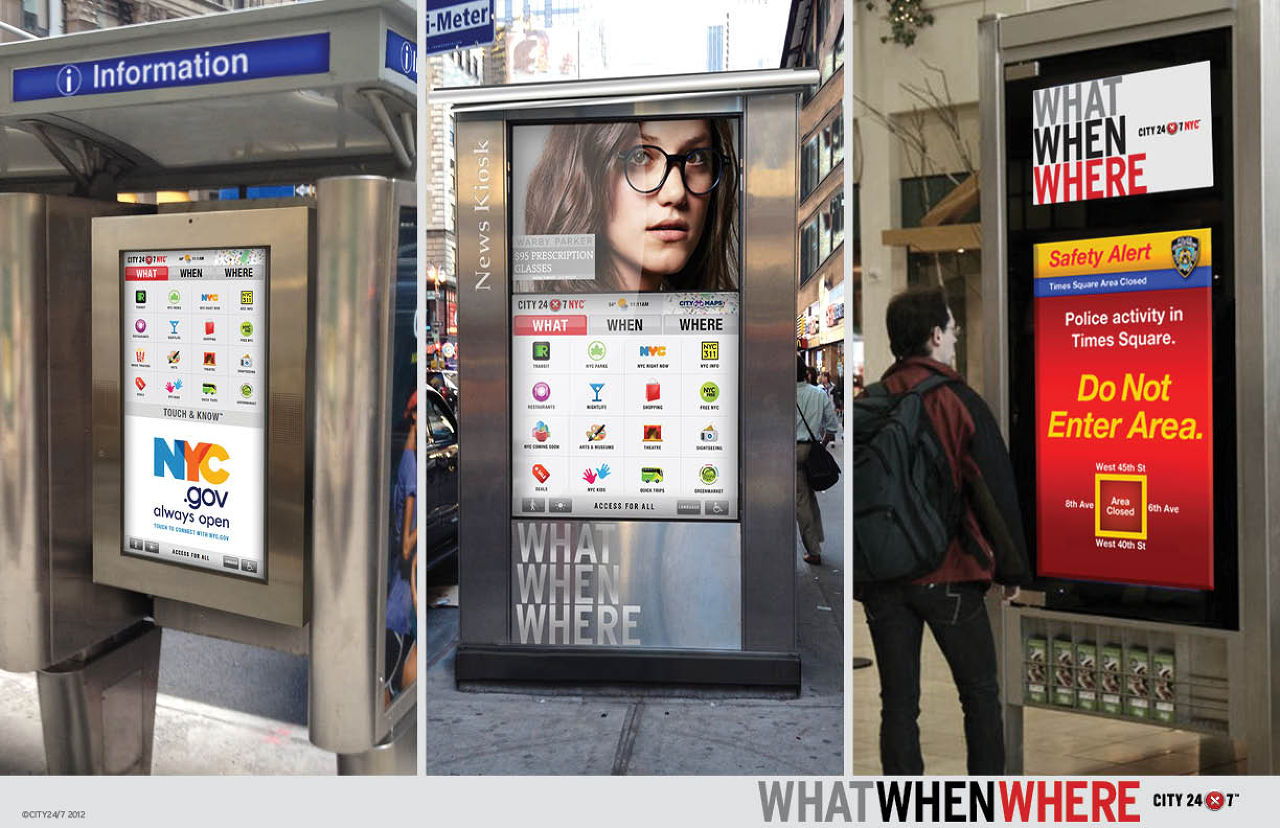
New Life for Phone Booths

In New York, City24x7 is turning old phone booths into Information HotSpots.  Replacing the old landline phone is a large net-connected touchscreen and free Wi-Fi hotspot.  The screen displays real-time information about what's happening nearby - local news, transportation info, reviews of local merchants, bars & restaurants, warnings of weather or environmental hazards and through WiFi, notify authorities of emergencies.  Eventually they want to add Skype functionality
"We’re trying to use technology and new social media to inform, project, and revitalize cities," says City24x7 CEO Tom Touchet.
City24x7 is currently finishing a pilot test in New York, which successfully integrated existing apps social input into a screen that provides information "tailored to your exact location and available in one place."  The pilot also generated a lot of interest from potential advertisers, who can use the displays to send out highly targeted messages.  Soon, the company hopes to install 250 SmartScreens throughout New York, and is already talking about expanding the service to some 20 other cities around the globe.  Once out of pilot status, cities will receive about a third of revenues generated by the screens.

Source -  Turning Old Phone Booths Into Digital Information Hubs, FastCompany Co-Exist

Monday, August 6, 2012

Media for Rent Or New Business Model? Big Grants to Major News Outlets.

The Ford Foundation recently made its second large grant to shore up a major newspaper.  The Ford Foundation has provided the Washington Post with a $500,000 grant for to "expand" its government accountability coverage.  The Post indicated that the grant will help fund "four new newsroom positions to work on special projects related to money, politics and government."  The initial grant provides one year of funding, with the possibility of two additional years.
The Ford Foundation had earlier announced a $1 million grant to the Los Angeles Times, to expand its coverage of ethnic immigrant communities, border issues, the California Penal system, and Brazil.
“These are vital coverage areas that have been affected by our need to make tough choices in the past decade,” Times Editor Davan Maharaj said.
He also argued that this grant would avoid any potential conflict of interest because the money was coming from a different fund than other Ford Foundation grants.  Frankly, that doesn't seem to make sense, logically - particularly for a paper whose editorials have argued that all money is fungible and thus are "blatant" attempts to manipulate news, when the grants come from more conservative foundations.  Pretty much everyone in the news-editorial side knows that the Ford Foundation provided an economically failing newspaper a million dollars, and is likely to give another million next year if it likes the results. 
  At least the Times has at least considered the possibility of a conflict of interests.  The initial coverage of the Post's grant doesn't seem to have considered that - despite the type of coverage funded - "government-accountability" would seem to be rife with potential for conflicts of interest and bias.

  While these would seem to be the first big grants to major newspapers to support coverage, the Ford Foundation has a long history of funding specific targeted research and reporting efforts.  In addition, George Soros's Open Society Foundation provided a $1.8 million grant to NPR to fund an "Impact of Government" initiative to cover local and state government success stories by local NPR affiliates.  David Brauer, of the nonprofit online news site MinnPost, commented:
(A)t the very least, Soros's involvement raises conflict-of-interest questions...  donor entanglements — like advertiser entanglements — are fair game, especially in a profession that writes about political conflicts of interest all the time.
According to a post on the NPR Ombudsman blog, editorial staff were initially concerned about the grant's source -
(A) deep current of concern has run through the newsroom about taking money from someone with a well-known, documented political agenda supporting Democrats and Democratic causes. Soros has been increasingly partisan since he announced his determination to defeat then-President George W. Bush in 2004.
"I do have problems with it precisely because he is so left wing and were he on the other side I would still have problems with it," said a long-time NPR producer. "I don't have a problem with people supporting particular causes but I do have a problem when obvious partisanship spills over into your support of those causes."
CPB's CEO at the time said she wasn't concerned about "perceptions" (on the same day she fired Juan Williams for expressing his personal opinion while a guest on a Fox News Channel program).
NPR executives say they gave a lot of consideration to taking Soros' money, determining that it would be wrong to turn down money because of someone's political beliefs and based on how it looked.
Various Soros groups have given a number of grants to the Corporation for Public Broadcasting, NPR, and affiliated stations over the years (reported totaling around $4 million since 2001).  Soros affiliated and funded foundations and groups have provided a reported $48 million to various news and journalism groups, including the Organization of News Ombudsmen.

  A variety of academics and journalism organizations have considered recommending grants and private donor funding as possible sources for news organizations in an era of declining revenues.  However, such funding sources are likely to be temporary - better used as stopgaps during the transition from print and analog media to digital operations, or as supplements as online revenues grow.  And for an industry that trumpets its independence, there is going to be at least the appearance of potential conflicts of interest and bias.  And the more partisan the funding source, the greater risk there is.  That's something for news organizations to think about - and ignoring it or denying the potential is not likely to help the fading credibility of news and news organizations.


Sources - Ford Foundation gives Washington Post $500,000 grant for government-accountability reporting,  Poynter.org
Ford Foundation gives Lost Angeles Times $1 million grant,  Poynter.org
NPR offering Soros money for political coverage; will MPR take it?MinnPost
Worthy Cause, Controversial Funding Source,  NPR Ombudsman
Report: Liberal Soros's Cash Funds 'Nonpartisan' Media Watchdogs, US News & World Report

Tuesday, June 26, 2012

Planned Obsolescene at Apple?

There's a serious marketing decision when implementing innovations - do you try to maintain backwards compatibility with earlier versions, or do focus on maximizing the new, at the cost of limiting compatibility.  There are advantages in just moving forward - it can open up new opportunities, and allow for maximizing the impact of the innovation, and usually helps to keep the direct costs of innovation low.  On the other hand, abandoning backwards compatibility means that all of the ancillary devices or products designed for the earlier systems are no longer usable with the new.  This can impose additional costs for innovation, as shifting to the new version also means that you need to replace some or all of the related products that are no longer compatible with the new version.  And that can also backfire somewhat on the innovator, as making adoption more costly will slow adoption. 
  More problematic is when the innovator purposely makes the new version of the technology incompatible with existing standards, or with their prior standards.  Then you have something called planned obsolesence.
  Apple has a long history of choosing to push their own standards rather than adopting more general industry standards.  As an equipment manufacturer, they've designed hardware that requires Apple operating systems to operate, and major upgrades in their operating systems are often incompatible with earlier versions of software (and in some cases hardware).  Sometimes, when Apple is an early and dominant innovator in the field, they can establish their standard as an industry standard - for example, the iPod/iPhone/iPad docking connector.  That's become a default component of associated hardware and accessories like speaker systems.  One of the aspects of Apple's success in that market is that myriad Apple mobile devices (and latter upgrades) all used the same connector, making the purchase of related equipment or upgraded devices relatively simple - consumers knew that they would also work with prior accessories.
  However, several recent announcements by Apple suggest that the company is planning for some major obsolesence.
  First came the announcement that Apple was closing its MobileMe webhosting service, in favor of its new iCloud service.  One of the main values of MobileMe was its ability to backup and synchronize contact and calendar files across multiple user devices.  Those same features will work in iCloud - but only if you have the newer Apple OS, and the new OS won't work on many older devices, so you might also have to buy new hardware if you want to continue keeping your contacts list and calendar in the iCloud.
  Then came the news that the newest iPhone5 (to be introduced later this year) will abandon the old 30-pin connector and replace it with a new 19-pin version.  For Apple, the stated concern is that as they seek to make smaller and sleeker devices, the old connector just takes up too much space.  Anyway, the consequence is that the iPhone5 won't be able to directly dock with any current accessory or power source that uses the 30-pin dock, and it's quite likely that the same change in docking connectors will likely occur with subsequent major upgrades in other mobile devices.  And that means that newer accessories are likely to start including the new docking connector as well, and most will replace the older with the new rather than try to engineer multiple docking options - meaning that newer accessories won't work with older devices.  Making things worse, or at least more expensive, are the reports that the new docking connector will include a proprietary chip that will prevent its use with unlicensed accessories.
  Some analysts wonder if this is the time to make such a move - raising the costs of switching to the newer devices just as Android OS based smartphones are becoming increasingly competitive (some arguably better and cheaper than the current iPhone).  If you're going to have to replace all accessories anyway, consumers might chose to shift to an Android-based device rather than stick with Apple.  As one analyst concluded:
You feel that, Apple? Those are the winds of change. It may be temporarily profitable for you to force your customers into spending on upgrades, but a little thing that we call customer lifetime value means that it's stupid to annoy your customers in an increasingly competitive marketplace.

Sources -  iPhone5: Every iPhone Accessory You Own Just Became ObsoleteForbes
Apple's Planned Obsolescence: Customer Revolt Brews,  InformationWeek
 

Thursday, March 8, 2012

Contemplating the Future Through "Design Fiction"

Futurists like Bruce Sterling are talking about the importance of "design fiction" as a way of thinking about the future and the possible impacts of emerging technologies and ideas.  So what is design fiction?
  The term basically refers to the idea of using storytelling to speculate about new ideas, and then apply those insights into the design of prototypes and applications of  new ideas and technologies.  The underlying idea of design fiction has been an integral part of science fiction for decades - in books like John Brunner's Shockwave Rider (1975), which looked at a world where some had wider access to information than others, and computer worms and viruses were significant plot devices, Neal Stephenson's The Diamond Age (1995), in which a personalized interactive data device becomes a tutor and mentor to a young girl, William Gibson's Neuromancer (1984), where much of the action takes place within a globalized virtual world, Isaac Asimov's Robot novels (particularly The Naked Sun (1957)), which often explored societies where technology replaced human interactions, and Bruce Sterling's Islands in the Net (1988), which explored the implications of a global information system much like today's Internet amidst growing efforts by states to control the system.
  In a recent interview for Slate, Bruce Sterling said he felt that the most effective design fictions to date have been videos imagining how technologies that are becoming feasible today could be used.  In some cases it's peripheral to the main story, such as the tablet used in the 1969 film 2001: A Space Odyssey that audiences today would recognize as an iPad.  In others, like Corning's A Day Made of Glass, it might be a vignette exploring what a w world of ubiquitous computers and screens (using Corning glass products) might look like.  It might even be more illustrative than speculatve, like Timo's Robot Readable World, which shows what "robot" eyes (really, any computer analysis of video input) can look at, and how it can analyze actions from video feeds.  In that case, it's the viewer who creates the fiction as they watch, thinking about how such systems might be used.
  Design fiction is increasingly useful, Sterling concludes, because
It’s really a new set of tools that, I think they’re giving futurism a second wind in some ways. Instead of talking about grand, overarching things like futurism in the 1960s—we need a new consciousness—it suits the tenor of our own period. What kind of business model would that work in? That’s the question people of our time can engage in. I’m not saying design fiction’s going to resolve our economic problems. On the other hand, if you’re an unemployed designer, it’s one of the coolest things you can do now.
  I'll add that I also think that it can be important because it can get us to actually think about how technologies and services might be used, and what might be the implications and ramifications of such use.  To often, today, we don't think about the later consequences of actions and choices.

Source -  Sci-Fi Writer Bruce Sterling Explains the Intriguing New Concept of Design FictionSlate Future Tense blog

Sunday, February 26, 2012

Financial Reports - Mixed Media

It's getting to be the time when a lot of company report their numbers for 4th quarter, 2011.

  The Bad - the Washington Post Company reported total revenues declined 10% in the last quarter.  The WaPo saw declines in their newspaper publishing, broadcast TV, and education divisions, while revenues were flat for the cable division.  Newspaper division losses were attributed primarily to a continuing fall in print advertising revenues at The Washington Post (down 6%).  Broadcast TV ad revenues fell 7%.  Annual revenue numbers were similar, with 2011 total annual revenues of $4.21 billion falling 10% below 2010 numbers.
  Mixed - the financial numbers for E. W. Scripps Company fourth quarter were more of a mixed bag.  Total revenues from Scripps newspapers fell 3.3% in the 4th quarter of 2011 - the third consecutive quarter of falling revenues.  Circulation revenues were stable, but print advertising revenue was down 5.1%.  Revenues from the television station division as a whole were up some 15% from 2009.  That gain was driven primarily by gains in local advertising (14%); a drop of almost 90% in political advertising in 2011 (compared to 2010) contributed to a drop in revenues and profits for 2011, compared to 2010. The overall TV division picture was also buoyed by significant growth in non-advertising revenues - revenues from renegotiated retransmission consent agreements were 30% higher, and revenues from digital businesses grew by 21%.  (However, retrans and digital totals were only about 10% of local ad revenues - so while growing, they are not yet significant revenue streams).  Still, growing such nontraditional revenue sources appear to be a focus for Scripps -
Rich Boehne, president and CEO of E. W. Scripps, stated that late last year, the company "launched a series of paid news and weather apps that represent the next generation of market-defining digital products," believing they will be a "valuable digital marketplace for services, built upon high-quality local news content."
  The Good - the idea to work on paid apps would seem to be supported by a report on the Android apps market by analytics firm Distimo.  The study found that Amazon's Appstore for Android is emerging as a challenger for Google's Android market - and that both app downloads and app revenues were exploding.  Distimo noted that there were more than 100 apps generating at least $200 in revenue daily from one or another of the two stores.  Downloads for top apps increased 14-fold in the new Amazon Appstore, and it generated more than a quarter of app revenues.

In sum, the increasingly diverse and competitive media world seems to still be hampering media firms' ability to rely on a few traditional revenue streams.  In the meantime, other revenue opportunities seem to be opening up for those firms with the foresight and flexibility to take advantage.


Sources -  WaPo Dives 10%, Hits Across DivisionsMediaDailyNews
Scripps Reports TV Gains, Newspapers Slide,  MediaDailyNews 
Distimo: Amazon Appstore developer revenues exploding,  FierceMobileContent

Wednesday, February 22, 2012

Facial Recognition Billboards in London

  One of last year's "Next  Big Things" reported by students in the class was Facial Recognition Billboards.  These combine digital display billboards with a camera tied to a processor with a fairly simple facial recognition program, that would allow the billboard content to be targeted to basic demographics.  At the time, the system was being tested in several train stations in Japan, and linked to vending machines - the type of drink promoted would vary by gender and age of the person stopping in front of the vending machine and display.
  A billboard-only version has been installed at several points along London's Oxford Street by Plan UK, a nonprofit organization helping children in third-world countries.
Female passersby will be shown the full 40-second video of its ‘Because I’m a Girl’ campaign that promotes sponsoring a girl to receive proper education in a developing country. Males won’t be able to see the full ad and will be directed to Plan UK’s website instead. The purpose of this was to show men “a glimpse of what it’s like to have basic choices taken away.”
 This version of the system costs about $50,000 per display, and is said to be 90% accurate in identifying gender.

Source -  Facial Recognition Billboard Only Lets Women See The Full Ad, psfk.com

Wednesday, February 1, 2012

News from the WiFi front

There's been a couple of news stories this week dealing with advances in WiFi technology.

A new technology called WiGig hopes to provide a complement to basic WiFi, at least for certain types of data sharing.  WiGig will use  a much higher set of frequencies, in a part of the frequency spectrum that is currently underutilized.  Using the 60GHz band, rather than the 2.4 and 5 GHz bands currently used by WiFi (and a lot of other devices), will allow WiGig to transfer data at much higher speeds - up to 7Gbps compared to WiFi top speeds of 100 Mbps.  The trade-off is that the WiGig signal doesn't go as far - about  5 meters instead of WiFi's 25 meter range.  But there's an advantage to the short range - there's less likelihood that there will be interference from other devices.
  Samples of WiGig chip sets are being tested and evaluated by a number of equipment manufacturers, and WiGig-enabled devices are expected to start showing up later this year in notebooks and tablets.  Mark Grodzinsky, VP of marketing for Wilocity (supplier of WiGig chips), envisions one application
"You can imagine an Ultrabook that you put on your desk, and you've got a dock that`s got connections to high-performance storage and a high-definition monitor."
Ali Sadri, head of the WiGig Alliance and Director of Intel's Mobile Wireless Group, also sees major benefits in using WiGig to complement WiFi for companies and other organizations.
"They can say: `All of the infrastructure access technologies are going to be 2.4 or 5 Gig. All of the peer-to-peer (P2P) applications and display applications will go over WiGig... I think there`s a huge opportunity for IT to clean up the mess, perhaps even disallowing 2.4 GHz and 5 GHz from being used for P2P applications."
Another possible application for WiGig's high speeds is the transmission of high bandwidth applications, such as HDTV, or even 3-D 1080p HD video.  In testing by Panasonic, WiGig was able to transfer a compressed 30-minute HD video in about 10 seconds.  This opens the way for wireless connectivity of TV sets and related devices.

On the video production end, other technologies are being developed to use the 60MHz band for HD and 3-D HD signals to be transmitted over longer distances (up to 500 meters).  The GigaLink HD system offered by Renaissance Electronics and subsidiary HXI is designed specifically for the HD and 3D-HD motion picture, television, and broadcast industries.  The system can transmit uncompressed raw HD video at 1.485 Gbps with a range of about 500 meters.  A dual-channel model transmit signals from two independent HD cameras, or a single 3-D HD raw feed, in perfect synchronization.
  The potential on the production side is tremendous - live ENG without the need to string cables back to the truck, placing HD cameras in remote locations, enabling camera movement without having to worry about dragging cables.
  For those of you wondering why GigaLink HD has a 500 meter range while WiGig has a 5 meter range - the main reason is power.  WiGig needs to be light and be able to rely on tablet or laptop power supplies.  The increased power needs for GigaLink HD result in transmitters and receivers that weigh about 11 pounds each, which is clearly not optimal (or even viable) for mobile consumer devices.

What these both suggest is that the higher speeds available in the higher frequency bands (like the 60MHz band) are enabling greater use of wireless systems for HD video, and whatever new standards emerge.

Sources -  WiGig: More than WiFi on Steroids,  Digital Producer Magazine
High Bandwidth Wireless for HD and 3D/HD Digital Video Cameras,  Audio Video Producer

Sunday, January 29, 2012

Coming Next Big Thing? Better Compression

Researchers at MIT have developed a way to speed up digital data compression.  The MIT group has developed a new algorithm that relies on two ideas - first, dividing the bandwidth into narrower pieces, which can then take advantage of a more efficient signal-processing strategy.
  This can provide a better, more efficient compression system for large digital files (such as digital video).  When adopted, this can enhance the delivery of digital video through various media, expanding the available market and encouraging demand.

Source - The faster-than-fast Fourier transformMIT News

Tuesday, January 17, 2012

CES: A Peek at the Future of TV

Art Wittman gives his view of what the CES show indicates about the future of TV in a post on Information Week blog, accompanied by a number of pretty pictures.  In a nutshell, here's what he sees:
  • Size matters - from ultradef displays (4K, or 3840x2160 pixels) to 85" displays, CES abounds with big and bigger screens
  • Thin is in - a new glasses-free 3D 55" OLED screen from LG is 4 mm thick
  • Stay connected - Panasonic promises a full Web browser in connected TVs
  • Improved contrast - getting LCDs closer to giving real blacks
  • Wider widescreens - demos of 21-9 widescreens (HDTV is 16-9)
  • Game thrones - all in one sound, video, gaming, and motion chair

Monday, January 9, 2012

CES 2012 Preview - Hot Gadgets

From InformationWeek, their selection of 16 Hot Gadgets being introduced at this year's Consumer Electronics Show (CES).  From digital recorders to external storage to cameras, audio, and more.

CES 2012 Preview: 16 Hot Gadgets,  InformationWeek

Tuesday, December 20, 2011

IBM Predicts: 5 Transformative Innovations

The thing is, innovation just keeps on coming.  Much is incremental, but sometimes a new idea comes along that is transformative (or at least has the potential to be).  IBM's been trying to predict what's next for about a hundred years, from its earliest days as a builder of punch card readers to it's more recent habit of producing annual lists of what it thinks tech innovation will bring.  Sometimes the predictions miss, like when the 1950s era CEO predicted that total global demand for that new product of theirs, the computer, would be 5.  Other predictions, like computers could become personal devices, paid off big time.
  The most recent list makes 5 predictions about potentially game-changing innovations that could occur within the next five years:

  1. Technology will be able to capture, store, and use common human movements as a significant power source.  Hybrid technology in cars is beginning to recapture power from motion changes - can technology be scaled down to capture human motions like walking or riding a bike?
  2. Speech and facial recognition technologies can aid in creating unique identifiers for people, and a seamlessly interconnected network can use these instead of multiple sets of log-ins and passwords. "Each person has a unique biological identity and behind all that is data," IBM said. "Smarter systems will be able to use this information in real-time to make sure whenever someone is attempting to access your information, it matches your unique biometric profile."
  3. Mind reading moves from fiction to fact.  Advances in the ability to monitor and record electrical brain activity are already revolutionizing cognitive research and aid those with spinal injuries.  As we learn to interpret the brain's signals, the human brain could become a direct input device.
  4. The Digital Divide closes.  In the West, the Divide's pretty much gone, at least in terms of basic access.  Smartphones, tablets, and other connected devices will help shrink remaining gaps in use faster, and on a wider scale than relying on computers alone.
  5. Junk mail becomes smart mail.  If you think of junk mail as unsolicited offers for random goods and services, then the connected net's ability to collect, store, and utilize individual preferences and behaviors allows smarter marketing.  You'll still be bombarded by unsolicited offers of goods and services, but in the future you're likely to actually be interested in them.  In addition, spam filters can also use that information to be more precise and effective, and help ensure that what you see is of at least potential interest or relevance.
Source -  5 Innovations IBM Says Will Change Your Life,  Information Week

Monday, December 5, 2011

Google and Apple offer Mobile Wallets

Post contributed by Lauren Loy -
 
When credit cards were introduced to the global economy, people everywhere were enthralled. How could small pieces of plastic operate on such a scale that one could pay for goods with them? Well, it seems a new payment method is in the works that may be much easier than even credit cards. 
  Mobile wallets are new payment systems that consumers can use to pay for goods with their smartphones. These systems are still in their early stages, but Apple has announced that it will be a player in this monetary evolution, most probably claiming market shares from other carriers like Verizon Wireless who offer similar services. These mobile payment programs will not launch until 2012, but ABI says that users will grow to 594 million by 2016. Not only will carriers like Google, Apple, and Microsoft overwhelm the market with mobile wallet-capable smartphones, but merchants will offer deals that will cater to consumers with this mobile wallet service. Google and Apple will cause a drop in carriers' market shares from 75 percent to 63 percent by 2016, due to the strong branding both Google and Apple have created with their customers. 
  Google Wallet lets consumers in San Francisco and New York City buy goods from places like Macy's and Toys R Us by tapping the phones against check-out terminals. Google is also offering its Google Offers daily deals service, which provides more incentive for carriers who do not want to contribute money to develop mobile wallet infrastructure. Apple has not launched a mobile wallet system yet, but rumors in the industry say that they will add this feature to their smartphones in 2012.

Sunday, November 27, 2011

A Digital Rubber Stamp - Printbrush

Post contributed by Zuri Walker -

In 2000, Alex Breton was approached to create an invention by Europe’s largest rubber-stamp company seeking a way to link with the digital world. Rather than creating a new rubber-stamp, Breton produced what is now the world’s smallest handheld printer, the PrintBrush. The device is capable of printing on any surface, does not require paper and weighs less than nine ounces.  It achieves the function of a rubber stamp - replicating content on multiple surfaces anywhere, anytime - while allowing the image or message to be changed instantly.
  While it took ten years to perfect the original model, it quickly provoked interest in Europe. A newer model, A4, which will print color and contain a camera for better printing of images, is set to release 2012.

Wednesday, November 23, 2011

Photo Tech - Liquid Lens

Post contributed by Summer Johnson -

Technology has broken another barrier in photography with the design of the liquid lens. Although the liquid lens has been around for some time, the technology was produced only on a high-power scale. Recently, researchers at Rensselaer Polytechnic Institute, in Troy, NY, have developed a low-power liquid lens for small point and shoot cameras with only two drops of water that change shape by use of sound waves.
  The use of a liquid lens benefits small cameras because it allows them to focus without any moving parts (like the zoom on a camera) or repositioning.
  Researchers test the lens by a long method involving filling the lens with water, locking it in a pressure chamber, and generating sound waves into the chamber.  The sound waves reform the surface of the liquid in the lens to create an image. Their findings lead researchers to believe cameras that use liquid lenses “could take tens of pictures at the press of a button and let software sort out the one that’s most in focus.”
  Although researchers at Rensselaer Polytechnic Institute have only produced low quality images, they plan on upping their quality by using a different liquid in the lens. Some companies, like Phillips and Varioptic, have already produced these lenses for small cameras and camera phone; however the same liquid lens technology has been used in a high-power form for biomedicine device that finds lesions underneath skin. 

Sources -   Low-Power Liquid Lens, Technology Review

Wednesday, November 16, 2011

Using CGI Players in Sportscasts


Post submitted by Austin Moyers -

   The days of using chalk boards and drawing circles on the screen to break down a team or player’s game is fading away to new technology. A few years back, researchers at the Innovation Lab at Disney World's recently revamped ESPN Wide World of Sports Complex have developed an easy way for ESPN's on-air basketball analysts to go over plays and interact with virtual versions of NBA players.
   Machinima artists have been using video game engines as cheap and easy ways to animate films. ESPN's tech follows the same principles, using an Xbox 360 and characters rendered from EA Sports' games to create on-air avatars that real-life broadcasters interact with to demonstrate plays and strategies.Now, the same technology is being used by the guys on NFL Live, College Gameday, and various other shows. It is the same basic structure of a video game, but the players are being added onto the screen with the analysts. This gives the audience more of an interactive feel than they have ever had before. Also, in this day and age, video game players being on the screen is sure to attract more attention than a chalk board.

Source - High-Tech Sports Broadcast Technology Uses CG Players for ESPN AnalysisPopular Mechanics

Lytro offers light-field camera - A new approach to photography?

Post submitted by Summer Johnson - 

    With every new technology, the world of communication changes. Photography has changed dramatically in the last ten years with innovative technology introduced to the masses like digital cameras and photo altering software. Photography will change again in 2012 with the introduction of the first light-field camera, the Lytro Camera.
    Stanford University captured the first light fields 15 years ago by using an advanced supercomputer with multiple cameras attached to it. They have finally condensed the technology into a portable camera that will be produced for the masses in 2012. The Lytro Camera is special because it captures an entire light field whereas normal cameras only catch a single light plane. A light field is “all the light traveling in every direction in every point in space.” (lytro.com) The Lytro camera catches these light fields with a Light Field Sensor and a Light Field Engine 1.0. The Light Field Sensor captures 11 million light rays in a single picture. The Light Field Engine 1.0, created by algorithms, mimics the original supercomputer Stanford used in its research labs, and replaces many small camera parts in traditional cameras with powerful software that records the color, intensity and vector direction of the light rays.
    These two pieces of technology will allow users to focus there photos “after-the-fact” on their camera screens or on their computers later. Because this camera focuses photos later, it eliminates the need for an auto-focus motor most cameras have. The auto-focus motor usually causes delays in the shutter speed, which can cause the “perfect moment” to slip away in a thousandth of a second. The elimination of shutter lag can also improve the quality of photos in low light setting. Lytro Inc. also claims that capturing light fields instead of planes will allow users to switch between 2D and 3D views.
    This new technology will change the way photographers are viewed forever. Before the Lytro camera, when cameras were first developed, it took several hours to get one exposure of a photo that eventually faded off the page. New technology led to a permanent photo that still took multiple hours to create. (Think of all the old black and white photos of people not smiling and staring at the camera. They couldn’t hold their smiles for the time it took to create an exposure.) Long story short, technology led to cameras that required consideration to lighting, shutter speeds, aperture and focus. These key elements are what photographers spent so many years learning and perfecting to produce a “good picture”. When the public has access to a camera that does it all for them, it lessens the need for professional photographers. Society will no longer need the knowledge or experience from the professional photographers; they will have at their finger tips with a single-button light-field camera and their computer. 
    The technology will revolutionize picture taking. Imagine an iconic photo, Dorothea Lange's Migrant Mother, for example. What if Lange had accidentally had her camera out of focus just a little bit? The focal length was just a little short. It would not matter if she had a Lytro camera. She would have just snapped the picture and gone about her merry way. There would have been no consideration, no skill and no passion behind the photo--just another snap shot.  Or what about the photo of Jack Ruby shooting JFK’s alleged shooter Lee Harvey Oswald in the alleyway? What if the photographer had his camera focused on the bricks of the alley instead of Ruby shooting Oswald? The Lytro camera could fix that without any the knowledge and skill required to take such a picture at such an unexpected event.
    The Lytro camera is a disgrace to professional photographers, all their years of knowledge, skill, training and experience they use each time they create beautiful and shocking images remembered by all, forever. It celebrates amateur photography by sprucing it up with some powerful software, and disregarding the passion the real photographer expresses when behind the camera. The Lytro Camera debuts in early 2012 in three vibrant colors starting at $399, and the software is included.

Source - Lytro unveils radical new camera designcNet News

Ed. - The Lytro is a new means of capturing images as a 3-D field rather than a focused plane.  It allows the photographer the ability to also extract 2-D focus planes (i.e. normal photography) from the 3-D image.  And it still requires a photographer's eye to frame and select what points of time to capture a picture.  I see it more as extending a photographer's toolbox rather than being dismissive of professional photographers.  For a more significant impact of technology on photojournalism, check this earlier post. -BJBates
I left the title off of first version - now added.