Showing posts with label careers. Show all posts

Monday, January 20, 2014

We're Number One! - but that's not good

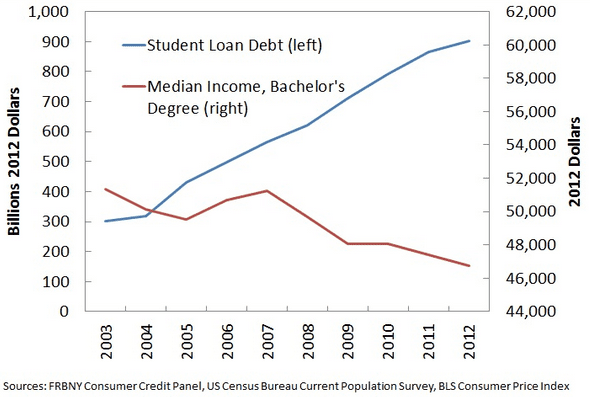
A recent study of the Return on Investment (ROI) of college degrees by Salary.com has some bad news for many college graduates.  With student loans in the U.S. now passing $1 trillion, median incomes falling, and unemployment levels for recent liberal arts graduates running 2-3 times national average, its a good time to re-examine college education as an investment in future earnings.  Of course, there's a lot of other reasons to go to college and to choose a particular career - primarily that you love working in that field - but it's smart to also consider the economics as well.

To calculate the ROI of degrees, they calculated the average cost of liberal arts degrees from public universities ($37,343) and private four-year colleges ($121,930), and then used their data on 30 years of salary data to calculate the median (half above, half below) salary for jobs requiring that degree and compared it to the median salaries for those with only a high school education.  They then looked at how much of the costs would be repaid from the salary gains from having the degree, over 30 years (discounted for inflation, etc.).  Of course, these estimates are projections (educated guesses) and averages (medians), meaning half will do better, but half will do worse.  As the ads say, "your mileage may vary."

The report lists 8 liberal arts majors whose earnings gains typically won't surpass the costs of education, even after 30 years - particularly if you go to a private college or university.  Included are sociology, fine arts, education, religious studies/theology, hospitality/tourism, nutrition, and psychology.

Ranked #1 in the report is Communications.  The post lists three typical job tracks: News Reporter with a median salary of $37,393 (ROI public college 58%, private college 17%); Marketing Coordinator with a median salary of $50,355 (ROI public 79%, private 23%); and Copywriter with median salary of $52,549 (ROI public 82%, private 24%).  Of course, that's all if you work in the field.  Job surveys consistently show only half of media and journalism majors working in the field within several years after graduation.  And job opportunities for editors are plummeting (see previous post).  Opportunities are better, and salaries higher, in fields such as advertising, public relations/marketing, and corporate communications, but not by a lot.

The main point of this is that these are fields you shouldn't go into for the money.  Yes, there are always those that reach the top and grab the big bucks - but most don't.  If you're going to major in communications or any of the other listed fields, do it because it's something you enjoy and are good at.  If so, and you put in the hard work to get ahead, you may just pay off your student loans and the full cost of your education.
[It's interesting to note that many of what are regularly considered the "best" journalism programs in the U.S. are at private universities and/or are graduate programs (Masters-level) that add to the costs of education.  Most of their students aren't likely to come remotely close to recouping those costs - at least not if they stay in the field.]

Source -  8 College Degrees with the Worst Return on Investment,  Salary.com


Monday, April 29, 2013

Newspaper Reporter - 2013's Worst Job?

The annual Jobs Ratedreport from Career Cast is out.
The best job - actuary.  The top twenty are notable as all requiring math, engineering, biomedical/health, or advanced degrees.
The worst job - Newspaper Reporter.  And it's the only one in the bottom 10 that expects a college and/or graduate degree.  It's a career with a negative job growth rate (-6%), and where half of full-time reporters earn $36,000/yr or less.
Ever-shrinking newsrooms, dwindling budgets and competition from Internet businesses have created very difficult conditions for newspaper reporters.
Consumers can access online news outlets almost anywhere thanks to technological advancements, which are threatening the existence of traditional print newspapers. As a result, the number of reporter jobs is projected to fall 6% by 2020, according to the U.S. Bureau of Labor Statistics (BLS), while average pay is expected to continue its decline.
And its not only the decline in available jobs and the low pay.  Much of the industry's job losses have been in the bigger papers - severely limiting opportunities for career advancement.  In addition, it's also a high-stress career, with tight deadlines and the need to work in all conditions.
"I covered crime, so when breaking news happened, I had to be there. And when editors called at night with questions, I had to take the calls," says Rochelle Gilken (who traded her job as reporter for a position in media relations for a local utility).
Lest you think that Career Cast's rating is a fluke, Kiplinger listed three news-related jobs among its "Ten Worst Jobs for the Future": Printing Press Operator (10-year job growth -16%); Desktop Publisher (Job growth -15%); Journalism Reporter (Job Growth -7%).  For reporters, they recommend possible alternative careers in public relations (more demand, higher salaries, better hours) or broadcast news analyst (better pay and projected 10-year job growth is +10%).
  The Jobs Rated report does have other media related jobs among the 200 they related.
  • Web Developer comes in at #24.
  • Technical Writer, #60
  • Film/Video Editor, #138
  • Author (fiction or non-fiction). #156
  • Publication Editor, #168
  • Photographer, #172
  • Broadcaster, #184
  • Photojournalist, #188

Slate's Will Oremus puts an interesting spin on the situation:
The only thing I can say in defense of my beleaguered profession is that, for a certain sort of person—a cynical yet stubbornly idealistic person who holds facts dear and simply can’t abide bullshit—all the trade-offs can be worth it, at least until the bills pile up so high that it’s no longer tenable.

Sources -  Newspaper Reporter Beats Out Lumberjack, Soldier as "Worst Job of 2013",  Slate
Jobs Rated 2013: Raaking 200 Jobs From Best to Worst, Career Cast
10 of the Worst Jobs for the Future, Kiplinger

Thursday, November 29, 2012

Guess which Major has the worst Return on Investment

Ok, so I do a post on Broadcast News salaries, and then one on rising student debt.  Wouldn't you know that right after, I'd run across a link to "8 College Degrees with the Worst Return on Investment."  So I wander over to the Salary.com site with more than a little fear and trepidation.  And guess who comes in at #1: Communications.

  Here's what they had to say -
You'd think the ink-stained newsrooms and TV studios are full of wealthy and famous journalists. Not quite. Although these skills require lots of education and training, they buried the lead regarding the lack of payoff.
Return on Investment (ROI) is a standard measure of how much an investment (say, in your college education) will generate from increased earnings in the future.  The folks at Salary.com calculated costs based on averages in a recent College Board study for a four-year liberal arts degree at a public institution ($37,343) and at a private college ($121,930).  Returns were based on median salaries for a set of "typical jobs" requiring that degree, assuming a 30 year career with average salary boosts covering inflation and productivity increases (i.e. improved skills coming from experience).  The three jobs they listed for communication are
  • News Reporter -  Median salary: $37,393; 30-year earnings: $2,205, 438; ROI if Public College: 58%;  ROI if Private College: 17%.
  • Copywriter (our upstairs neighbors in Ad/PR) -  Median salary: $52, 549; 30-year Earnings: $3,099,338; ROI if Public College: 82%; ROI if Private College: 24%
  • Marketing Coordinator (our downstairs neighbors in Comm Studies) -  Median salary: $50.455; 30-year earnings: $2,975,834; ROI if Public College: 79%; ROI if Private College: 23%.
So who did we "beat" to earn the top spot? Retail/Tourism, Nutrition, Religious Studies, Fine Arts, Sociology, Psychology, and Education.

One might ask, then, what degrees provide the best ROI?  Math, Information Technology, Human Resources, Economics, Biology, Engineering, Marketing, English (writing).  All have their "typical" jobs with ROI for Public College over 100%; some over 225%.
  I will note that some of the jobs considered in this set of majors (PR manager in Marketing, Communication Manager and Web Content Manager in English) are also typical jobs for people with communication degrees. 
  • Public Relations Manager - Median salary: $86,127; 30-year earnings: $5,079,767; ROI if Public College: 135%; ROI if Private College: 41%
  • Communications Manager - Median salary: $88,498; 30-year earnings: $5,219,609; ROI if Public College: 139%; ROI if Private College: 42%
  • Content Manager - Web - Median salary: $79, 674; 30-year earnings: $4,699,170; ROI if Public College: 125%; ROI if Private College: 38%
So perhaps it's not quite as bad a major as this study makes it out to be.

And we all do this stuff because we love what we do anyway.

Sources - 8 College Degrees with the Worst Return on Investment. Salary.com
8 Degrees That Will Earn Your Money Back, Salary.com

Revised to add specifics for PR Manager, Communications Manager, and Web Content Manager (11/30/2012)

Wednesday, February 8, 2012

How to Get a Freelance Gig

Susannah Breslin has a new post on Freelancing that's worth a look.  Basic thrust - be positive and assertive and keep at it.

Source - How to get a Freelance JobForbes.com

Monday, May 9, 2011

Journalism degrees "most worthless" - Newsweek

From Emma Thomas -

In a timely manner, Newsweek Magazine published the "most worthless degrees" for recent college graduates. They examined available jobs in the overall market and starting salaries for graduates of all majors offered for undergraduates.  Topping the list at No. 1 is Journalism.  Newsweek found the average starting salary to be $35,800, and that between 2008 to 2018, the overall change in the number of jobs will be -4,400, with the percentage change in the number of jobs during that same time is -6.32%.
Even a major considered a safe haven to make a profit in the field of communications made the list --coming in at the No. 4 spot was advertising, with an average starting salary of $37,800, the overall change in the number of jobs will be -800 from 2008-2018, and percentage change in number of jobs in that time will be -1.71%.

For other top "worthless" college degrees, visit "Media Gallery: 20 Most Useless Degrees," The Daily Beast

Also I found a variety of news networks and local college sites commenting on this report:
Fox News story, "Journalism Tops List of the Most Useless College Degrees"
Huffington Post slide show and story, "The 20 Most Useless Degrees"
Diary of a Media Junkie blog "Journalism: Most Useless College Degree?"


And this from Newsweek, recently sold for a record $1 - Ben Bates