Showing posts with label IP rights. Show all posts

Wednesday, March 18, 2015

Streaming Music Systems Performance (Infographics)

Two interesting pieces recently.  One on the relative performance of top music streaming options, the other on how those services compensate performers and writers.

Researchers at YouGov BrandIndex looked at a variety of metrics for the top 5 music streaming services in the U.S. They found Pandora to be the dominant player in the field, although Spotify has been making inroads recently.  Pandora has dominant leads in most of the metrics, from number of subscribers to awareness (from both ads and word of mouth).  Spotify's numbers were improving, but the researchers concluded that
"Perhaps the brands with the biggest challenge are iHeartRadio and iTunes Radio. They have reasonably high awareness levels, but do not seem to be getting traction with consumers. The conclusion is that these brands may need to try something different to generate excitement with consumers."
Music streaming services largely emerged as a result of major record companies eagerness to open up a second revenue stream to help cope with declining sales of physical recordings.  Initially, they were eager to license their recordings to streaming services, but faced an initial roadblock - the existing royalty systems employed two distinct approaches.  Royalties for sales were based on fixed compensation for each unit sold, while royalties for licensing music to radio stations was based on a percentage of station revenues (and not directly linked to which music was played).  Conceptually, the radio model seemed closest to how streaming services operated, as well as how audiences used them.  Thus, most of the early deals utilized royalty payments as a percentage of revenues.

As sales in the traditional music markets continued to fade, the record industry wanted more from streamers.  They started arguing that the current system (which they had eagerly negotiated) was "unfair" - largely because streaming revenues were slow to develop.  The attack came on three fronts.
First, that not enough money trickled down to artists and songwriters.  The biggest problem with that argument is the fact that the share that trickles down to the artists and composers is determined by the rights organizations (like ASCAP and BMI) and the actual rights holders (predominantly the record labels), who take their cut off the top.  So the industry argues for a larger royalty rate, of which only a small fraction would actually go to the artists and composers.
Second, streaming services differ from radio stations in that they can and do track individual consumer plays.  There's no mechanism to measure how many listeners hear a song on radio.  The current licensing deal with Spotify calls for royalties to be paid according to a formula that includes both a revenue percentage and the number of streams.  Spotify also pays an additional set of royalties to songwriters and composers for what is termed "streaming mechanical royalties".  As a consequence, Spotify pays a much higher total percentage of its revenues than Pandora.  (Pandora is currently classified as an online radio service, and radio stations are currently not required to pay mechanical royalties).
The third argument is that most streaming services offer a free streaming option, which the music industry argues "cheats" the rights holders because revenues from the ads are less than subscription-based revenues.  The fact that the free/paid proportions for Pandora is roughly 75/25, while Spotify's audience is more of a 50-50 split, also contributes to the difference in royalty payments.  As one record label executive summarized,
"Based on the free model, the payouts we're getting on streaming is so small... The problem that we're running into is Spotify is just not converting users to the paid version quick enough."
That perspective contributed to the fact that the music labels pressured Apple to raise its proposed starting subscription price for the new Beats streaming service (much like the book publishers did for iBook pricing - which the courts later ruled was an antitrust violation).  But the underlying issue is that the record companies want more money, and are using artist payments to engender sympathy.  If artist payments are the real problem, the music industry could solve that easily by granting them a bigger share of the payments they get, or changing accounting practices so that the artist share comes from gross payments, and not what's left after music industry costs (and profits) are covered.

One can look at this situation from the "level playing field" metaphor.  Spotify wants a level playing field by getting the same deal Pandora has, Pandora wants a level playing field with broadcast radio (straight percentage of revenues, and lower percentage), and the music industry wants to raise the height of the field several feet because they cut the grass (i.e. royalties to artists and composers) too short, and aren't making enough profits from their traditional business models.

The current copyright and royalty system is a mess, largely because it was designed to deal with selling physical copies of intellectual property.  The current model has never really worked well with digital reproduction, or with the growing need to replace shrinking sales revenues with licensing arrangements for emerging digital streaming channels.  Add the fact that digital markets are global and have the potential to scale much higher than physical copy sales (tens of millions for hit albums in digital, while in the physical medium heyday, hits sold hundreds of thousands).  Plus, they're now having to deal with younger audiences who care more about access to music than owning copies of music.  In addition, artists need to recognize that the scale differences should be reflected in the setting of royalty fees - and that because digital access to their recordings remain available long after labels drop them, that they'll benefit from their work much longer under digital deals.

The debate and fights over music royalties is likely to continue for a long time, in part because the music industry is trying to hold on to an increasingly problematic business model, and is hoping to find a way to maintain their control over revenues derived from their historic role as the choke point between artists and their audiences.  However, the growth of the digital economy is showing that it doesn't require multiple layers of distributors (and their growing costs) to provide access to products for potential purchasers.  There are already content creators (including musicians) who have discovered that going independent can provide them much higher levels of return, as well as more control over use of their work.  For the big labels, this is a fight for survival; but for society, it's a fight for who gets to control access to content (and who gets to benefit from that).  As for the question of whether streaming will leave artists unhappy - the answer is yes, if the big labels remain in control, and no, if we can shift focus from preserving a declining music industry to how to develop a rights and licensing regime that promotes and protects creation of, and access to, intellectual property.
 
It's time we shifted our concern from protecting the old ways to think about how to develop copyright and licensing systems that benefits the creators and users of intellectual property rather than those who merely reproduce and distribute it.

(For more background, see this post about a digital music licensing panel at the 2014 CES).


Sources: Infographic: Which Streaming Services Are Winning the Battle for Millenial Eardrums,  Adweek
Is the Music Streaming Industry Destined to Leave Artists Unhappy?, Adweek

Tuesday, January 21, 2014

Music licensing @CES2014


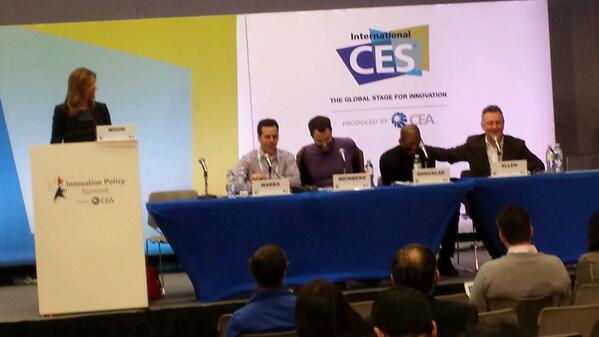
I attended what turned into a fun session on music licensing policy at CES in Las Vegas.  The paneL included a music industry rep from RIAA, the head of a public interest group, and two former musicians.

It started off on focus - acknowledging the mess that is music licensing in the US today, and some ideas for improvement.  The RIAA rep, Steven Marks, said one problem was that there was no comprehensive database of songs and performances, which could make it difficult to know whether a license was needed when using a recording, and who to contact to get it. 
[Which reminded me of a recent story that one of the nastiest of the licensers (for 'Happy Birthday to You') may actually have never filed for a legal copyright for the piece, and thus may have been illegally collecting licensing fees for decades.]
But he's right that having a central listing of licensed works would be helpful - particularly if they verify that pre-1976 works were actually copyrighted.  (Post- 1976 creations are automatically granted copyrights). He also suggested creating a basic licensing center for 'small' users.  Making things easier would arguably help those who want to be legal to do so.

Mark Weinberg, acting Co-President of Public Knowledge - a public interest group promoting wider diffusion of knowledge and content, concurred that making it easier for music users to know what licenses may or may not be needed, and making them easier to obtain would be useful - but was concerned that the industry would try to limit fair use exemptions and collect fees from those who shouldn't have to pay.  He also expressed a desire to see the industry become more flexible in dealing with new media and applications, to support innovations and the exploration of potential new music outlets.  He noted that there was a wide range of music licensing strategies (and different rates) being applied to the wide variety of digital music distribution options - and that applying a single consistent standard, regardless of what technological backend was used for delivery, would be helpful.

Next came Dave Allen, former Gang of Four member.  He made a strong point about the changes in the music industry.  Vastly more listened to radio or streaming sources today. He noted that the prime source for music with today's youth is YouTube (the RIAA guy agreed), but since most of the music content there is in the form of promotional videos, they don't pay royalties.  That led to a claim that the record industry is making deals with streamers that bypass licensing fees and cheat musicians, joined by Hank Shocklee (founder of Public Enemy), and prompting predictable objections from Steve Marks (Chief, Digital Business and General Counsel for RIAA).  The discussion of that generated a great deal of fun back and forth between the artists on the panel and the RIAA rep.

But the key point, which Dave Allen came back to later when things calmed down, was that digital and streaming music sources had the potential to scale much higher than the old record industry, again something the RIAA rep and other panel members acknowledged. Marks, from RIAA, noted that the scale of the physical recordings industry was always fairly small - people, on average, bought only 2-3 records a year, and acknowledged that the potential of digital to be significantly higher. Someone made the point that in the heyday of the old records industry, hit records were sales in the hundreds of thousands in the U.S.  Today, Spotify's paid subscribership in the U.S. is around 6 million, and Beyonce's recent digital album sales were in the millions in the first month alone. Allen suggested the digital market could easily explode - if the right model and pricing develops.

One problem delaying the scale-up is the fact that today's rights fee scales are derived from the payment schedule for vinyl records and that scale of sales.  Revising rights fees (lower) to the higher scale levels could encourage more listening, scale up music use, and benefit artists even more than the current system.  Of course, the RIAA guy wasn't about to support reducing licensing fees, but the head of Public Knowledge encouraged the idea, as a way of  encouraging exploration and development of new delivery options. 

I've been thinking about licensing fees and pricing strategies a lot lately (particularly focused on the bundling vs. a la carte debate on cable), and had a couple of proposals to offer - but the session ran out of time.  I wanted to support the notion of thinking of rescaling rights fees to the potential scale of digital systems - while it might initially reduce short-term revenue generation, it would accelerate the growth of those systems and in the long term had the potential in the long term to generate much higher revenues for the industry and the artists.  The other idea I wanted to raise was the notion of exploiting versioning.

Versioning is a strategy in marketing information goods where different versions of the product are offered at different prices, or to different market segments.  Versioning, based on sound quality, seems to have a natural potential for music.  It's already in regular use - Spotify offers free access to lower-quality streams, and lets subscribers also upgrade their subscriptions to higher-quality.  However, the current licensing system applies the same fees for all quality versions.  If the licensing fee rate schedules would similarly differentiate between quality versions, this could address many of the Public Knowledge's concerns about providing a mechanism for exploration and development of new music distribution systems.  It could also facilitate a better music promotion and sampling system - letting people to listen to low-rez versions of whole songs rather than the current method of allowing very short snippets from the start of songs.

Certainly, all the panelists, and most everyone in the audience, agreed that the current music rights and licensing scheme is massively screwed up, and the inevitable "strong debates" over major record labels handling of rights and fee reimbursements to artists just acts to delay any efforts towards solutions.  There are very reasonable proposals out there, some expressed by panelists, and multiple others being offered by academics, professionals, and policy types (including my own not-so-humble ideas).  It's time, as the panel title suggests, to "Stop Fighting and Fix It."

Sources -
Video of the Stop Fighting and Fix It music licensing session at the CEA Innovative Policy Summit, CES2014, can be found here.

Wednesday, April 3, 2013

Is TV Everywhere Legal? For now, maybe...

The last year has seen several new start-up services that seek to provide users access to programs they legally receive at home when they aren't in front of the TV.  And that's part of the goal of TV Everywhere - being able to access and view programming regardless of time, location, or type of screen.
  Aereo is a new start-up that offers subscribers access to their local TV stations through the internet, particularly via mobile devices.  It works by providing subscribers with a small antenna/tuner connected to their home Internet connection portal; allowing subscribers to take their free broadcast TV signals beyond the home.  As soon as the Areo started its service, they were sued by a consortium of networks and broadcasters for copyright infringement.  Part of the suit asked the courts to ban the service while their suit was in litigation - i.e., they wanted to kill the service while the challenge dragged out in court for years.
  An appeals court has now affirmed the trial court ruling against an injunction, allowing Aereo to continue operating through the litigation process.  Normally, such an injunction banning some behavior or service is awarded only if the party asking for the injunction is considered likely to win the case on its own merits.  As such, it's not a clear indication that Areo's service is legal, although judges indicated that Areo had a viable legal precedent for their system falling under "fair use" guidelines (as place-shifting of an otherwise legal signal).  That was enough to suggest that the challenge wasn't a cut-and-dried winner.

While I'm not a lawyer, the economist in me does wonder why broadcasters would object to a service that would make their signals more widely available and more valuable to viewers.  Perhaps it's not TV Everywhere access they object to, but not being offered a cut of Aereo's subscription revenues.

Source -  Appeals court denies broadcaster request to shut AereoConsumer Electronics Net

Tuesday, February 26, 2013

Battle for Sports Rights Hits Home (Hard)

  While ESPN remains the 800-pound gorilla in sports networks, it's been challenged by major pushes over the last year by NBC, CBS, Fox, and Turner to build up their branded sports networks.  Last week, News Corp. joined the fray, announcing plans to build a major national sports network.  (Not to mention 50+ regional sports channels all looking for content.) The bidding wars have pushed sports rights fees to even more astronomical levels, and someone ends up paying.
  The other primary factor pushing the bidding wars is the fact that sports is one of the few remaining TV programming sources reliably delivering live audiences.
Simply put, sports ratings not only remain robust in the face of declining tune-in for almost everything else, but they are one of the few commodities TV viewers insist on watching live, which removes (or seriously diminishes) the impact of delayed DVR viewing.
As a result, sports is widely seen as the one thing you've got to have - as a network and as a multichannel provider.  Combine absolute demand with growing competition and the price keeps rising.
  The result? The NFL will get $2 billion a year out of its multi-network deals (a figure up 70% from the last round of deals). The Los Angeles Dodgers signed a $7 billion deal with Fox, while the Lakers got $2 billion in its latest deal. ESPN will be paying $470 million a year to air the new college football playoff games, on top of the billions it's paying for the top Bowl games. Major League Baseball's latest deal will generate $12.4 billion from three sports networks. NBC paid $1.8 billion for the London Olympics, and $4.38 billion for the US rights for the next four biennial events.  The rising cost of sports broadcasting rights is felt internationally, particularly for big events.  Telco BT (British Telecom) is making headlines with its recent deals to air matches from top soccer leagues across Europe and its purchase of ESPN's UK and Ireland channels (BT's building a telco cable service, supplemented by broadband net access, in competition with satellite service BSkyB).

  The networks push the costs down to the multichannel video providers (cable, DBS, telco cable), and they're pushing the cost through to their subscribers.  Until recently, these have been buried in the basic subscription fees along with the other programming costs.  The cost of sports channels can reach 50% of all programming costs to multichannel providers. However, recently, major providers like Cablevision, Time Warner cable, DirectTV, and Verizon FiOs are adding monthly surcharges for sports.

  Of course, skyrocketing sports rights aren't the only thing driving multichannel subscription prices higher.  A SNL Kagan study identified two other factors - the fact that broadcast stations are now getting real money for retransmission fees, and the explosion of channels now carried by digital providers.
  The surcharges and rising fees are driving another round of calls for mandating "a la carte" pricing from multichannels.  Which, while it sounds good, is actually very bad economics for subscribers as well as networks and multichannel providers (discussed briefly in this post).


Sources -  Cablevision to Inplement $2.98 Sports Surcharge, Multichannel
Rising fees for sports rights 'indispensable' and 'unsustainable', Sports Business News
BT ups ante against BSkyB with ESPN deal, The Telegraph
Kagan study outlines program cost drivers for MVPDsRBR.com
Changing the game: Outlook for the global sports market to 2015, Price Waterhouse Cooper white paper

Thursday, January 17, 2013

Using Social Media Images

In what looks to be an interesting case, a Federal judge ruled in a summary judgement that the Washington Post, press agency Agence France-Press (AFP), and Getty Images (which AFP uses to market its photos, and which it used to license the images in question to other media outlets and publications) improperly and illegally used images that a photojournalist had posted on Twitter. 
Daniel Morel, a photojournalist whose photos (of the immediate aftermath of the Haiti earthquake) were placed on the AFP newswire without payment, turned to the courts in March 2010, claiming AFP had violated his copyright. AFP responded with a few different defenses; its boldest, almost shocking defense was that the Twitter terms of service actually granted it a license to use whatever photos it could grab off the micro-blogging service.
 AFP had argued that once posted on Twitter, the images became public - specifically that since the photographer had granted Twitter a license to post and share the picture, that meant that he had granted permission for everybody else to use the photos freely, without permission or royalty.  In this case, the judge ruled that such an argument was dead wrong now, just as it was when it was pointed out to the AFP in a copyright infringement case years earlier.  And it's certainly not an argument that AFP and other media outlets would extend to their own photos and content, or when they sought payment from others for licensing the Morel photographs to other outlets.
  So it was no surprise that the judge knocked down that defense in a summary judgement.  (Judges use summary judgements when the allegations are so silly and/or inappropriate that there's no point in even going to trial).  The judge also ruled in a separate summary judgement to limit potential damages.  Morel's attorneys had argued for damages as set forth in U.S. Copyright Law, which allows for damages of up to $150,000 per instance if infringers did so willfully, and $200 if infringers can prove they didn't know they were infringing; the kicker, though, is that each the damages apply separately to each separate instance of infringement.  That let plaintiff's attorneys to ask for damages for each infringement, for each copy of the photo printed in newspapers, or each time a webpage with the image was accessed online - which could lead to hundreds of millions of dollars in statutory damages).  The judge, in summarily ruling that any damages would be limited to the initial infringement of each image (and not later reuse), essentially indicated that the current legal language on damages was "ridiculous" - at least when applied to online circumstances like this specific case.
  A number of other arguments and aspects of the case, such as whether the infringement was willing, and whether Getty Images acted in the role of purely a middleman passing images and covered by the ISP exemption, will continue on to a full trial, or whether AFP & Getty violated the DMCA by providing false copyright information (in this case claiming ownership by AFP for licensing purposes through Getty).

  I've posted on a similar situation emerging from secondhand use of photos and images on Pinterest.  The main point coming from that situation and this case, is that content creators need to be aware that availability on the net does not equate with being in the public domain.  If you do reuse content, you need to consider the nature of that use, whether permission is likely to be needed, and that proper credit and attribution is provided - particularly if you're commercial operation.
  The one thing I'll disagree with in terms of the judge's summary judgements relates to the damages.  I'll agree that the current copyright law language overdoes damages (mostly to maximize potential deterrence), but rather than limiting damages to the single instance (per image), I'd also argue that Morel should be able to recover a hefty multiple of the revenues that AFP and Getty earned by (illegally) licensing his photographs.  But that's the result of fraud as well as copyright infringement, so I hope Morel's attorneys can still make that case.

Sources - News flash for the media: You can't sell photos grabbed from Twitterarstechnica
More than $120,000,000 at stake in AFP vs. Morel caseBritish Journal of Photography

Thursday, December 13, 2012

What counts as Fair Use?

Keeping up with Copyright and Fair Use exemptions is critical for media generally, and digital media in particular.  In a post on the OnlineVideoInsider blog, Ashkan Karbasfrooshan takes a look at some recent Fair Use cases in the U.S. courts.
  Fair use exemptions are not explicitly provided in U.S. copyright law - rather, the law sets up a set of criteria that are to be used in determining whether a specific use is likely to significantly impact the value of copyrighted material.  Specifically, courts are asked to consider:
  1. The purpose and character of the use, including whether such use is of commercial nature or is for nonprofit educational purposes
  2. The nature of the copyrighted work
  3. The amount and substantiality of the portion used in relation to the copyrighted work as a whole
  4. The effect of the use upon the potential market for, or value of, the copyrighted work
 The post goes through the specific cases (and I recommend reading them through).  I'll end my own "Fair Use" exemption by providing his conclusions:
  • Dealing for commercial purposes may be fair.
  • Commercial use does not nullify fair use.
  • The availability of a license is irrelevant in considering alternatives to the deal.
  • It is not advisable to circumvent the underlying work, it is much better to transform, summarize and/or add to the underlying work.
  • A plaintiff must bring evidence of any detrimental impact upon the market for its work if it wishes to have it considered. After all, to quote a CBS executive: “3 minutes of a Beyonce song might potentially hurt an entire album of Beyonce, but two minutes of ‘CSI' might be the greatest thing that could ever to the 44 minutes of ‘CSI’ that we put out weeknight on [CBS] or our affiliate partners.” 

Source -   Fair-Use Cases That Have Shaped Copyright LawOnlineVideoInsider

update - added header

Sunday, November 25, 2012

Online music royalties tidbits

A couple of interesting items, as a bill to restructure online music royalties in the U.S. makes its way through Congress.

  At GigaOm, a piece discusses a blog post from cellist Zoe Keating, who posted
"The law only demands I be paid in money, which at this point in my career is not as valuable as information. I'd rather be paid in data," Keating says, referring to listener data that could be gleaned from online services, which she in turn could use to boost ticket and CD sales.
The current rate (about a tenth of a cent per play) means that only the most popular artists can count on substantive revenues from web plays.  For most artists, revenues come predominantly from touring and merchandise sales.  Ms. Keating notes that data on her fans can be much more helpful - she already uses basic postal code information from iTunes sales to help plan her tours.
Keating understands that in order to prosper in a world of digital music — just like in the world of e-commerce, digital publishing, you name it — information is power. 
 Meanwhile, a Billboard story addresses a recent report from an economist at Washington and Lee University.  He looked at what broadcasters would end up paying, if the proposed online royalty rates were applied to them.  His analysis is a bit seat-of-the-pants, relying on some rather simplistic assumptions to equate the "per play/stream" online rate to an estimate of songs played times aggregate radio audience (12+) (total songs per year x listening audience x royalty rate) - and comes up with a total of $2.47 billion.  The article tweaks the numbers a bit (adjusting for what it says is the 17% of radio programming that is non-music), but still reaches a total over $2 billion, which would be about 20% of total radio revenues.  The Billboard piece also notes another study by the same academic that suggested that if radio had to pay the same royalty rates for their broadcast signal as they do for their online stream, it would amount to $4.7 billion (or 37.8% of total revenues).
  A lot of the people advocating for raising online royalty rates argue that it's a matter of fairness.  I'll note that online music streamers are already paying royalties, both directly and/or indirectly (through licensing fees), so it isn't that online music streamers aren't "stealing" anything.  The bill's about increasing royalties and setting vastly different royalty rates depending on how the music is accessed or sent - and about making people pay extra to stream music they own from the cloud or their digital content lockers) for their personal use (but that's a different post).  The research being reported in Billboard shows that it's not as much about fairness as about privileging one music distribution system over another - and where's the fairness in that?

Source -  Data isn't just the new oil, it's the new money. Ask Zoe Keating,  GigaOm
Business Matters: If Big Radio Had Pandora's Royalty Rate, It Would Owe Billions,  Billboard.biz


Wednesday, October 31, 2012

Disney's Latest Big Deal

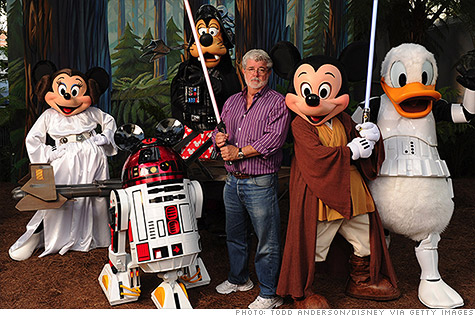
Of course, you've probably already heard about is Disney's announcement yesterday of its deal to purchase Lucasfilm Ltd. for j$4.05 billion.  About half of the purchase price will be paid in cash, half in Disney stock - and the stock component will make George Lucas, sole owner of Lucasfilm, the second largest shareholder in Disney. 
“For the past 35 years, one of my greatest pleasures has been to see Star Wars passed from one generation to the next,” Lucas, the sole shareholder of Lucasfilm, said in a press release announcing the acquisition. “It’s now time for me to pass Star Wars on to a new generation of filmmakers.”
“Lucasfilm reflects the extraordinary passion, vision and storytelling of its founder, George Lucas,” Disney chairman and CEO Bob Iger said in a statement. “This transaction combines a world-class portfolio of content including Star Wars, one of the greatest family entertainment franchises of all time, with Disney’s unique and unparalleled creativity across multiple platforms, businesses and markets to generate sustained growth and drive significant long-term value.”
   And speaking of the Star Wars franchise, Disney announced that Episode 7 of Star Wars is forthcoming (scheduled for release in 2015), with other Star Wars franchise films to follow every 2-3 years.
  The announcement was only the most recent of a number of business moves that should help cement Disney's pre-eminance in a range of creative content-based industries - the acquisition of Capital Cities/ABC through merger in 1996 (which included ESPN), comic book publisher Marvel in 2009, producers of a number of children's TV programs (Muppets, DIC, Sabane (Power Rangers)), and Pixar in 2006.  The move seems to cement Disney's preeminence in the superhero and Sci-Fi/Fantasy market.

  While the decision of George Lucas to sell Lucasfilm and withdraw from the business came as a surprise, the sale to Disney shouldn't have been.  Both Lucas and Disney are considered to be among the smartest media business operators who have consistently taken a long-term approach to growing their business rather than focusing on short-term profit maximization.  Both also shared an awareness that good creative content was exploitable beyond the initial media product release.
  Disney in particular has had a long tradition of exploitation of creative intellectual properties, epitomized by Disneyland (a theme park incorporating Disney characters), the first movie studio to use television to further promote and exploit its movies and theme park (starting with the Disneyland series in 1954), long term recognition and exploitation of licensing and merchandizing its creations, and its pioneering distribution strategy for its animated movies. Disney recognized quite early that the primary audience for many of its animated features were children, and that that market had some distinctive characteristics - mainly that children grow up, while others are born to replace them. Disney recognized that he could exploit that feature by re-releasing animated features every 7-10 years to a new audience; and until the rise of recordable media that was Disney's film distribution strategy.
  George Lucas was also known for his innovative business practices as well as his creative acumen.  Lucas' first big success came from the film American Graffiti, both as a hit film and as an innovative financial arrangement. Rather than take a big salary and/or a percentage of profits - the industry norm - Lucas got a deal that provided him less upfront money, but a smaller percentage of the film's gross revenues.  In essence, Lucas bet on his own success, and American Graffiti, produced at a cost of $775,000, went on to earn more than $200 million in box office and home video sales alone.  Lucas' earnings allowed him to create Lucasfilm in 1971, special effects powerhouse Industrial Light & Magic, and largely self-finance Star Wars; and once again Lucas struck an innovative distribution deal with Fox - once again Lucas took a smaller salary in return for keeping licensing and merchandizing rights for the Star Wars creative franchise.  Star Wars became the highest grossing film in the industry's history (until surpassed by E.T. five years later), with global earnings of more than $775 million to date.  Those earnings allowed Lucas to self-finance the rest of the Star Wars and Indiana Jones films, while insisting on retaining licensing and merchandising rights. Lucas quipped that Disney's long history of protecting, nurturing, and - yes - exploiting, of its creative content and intellectual property meant that he could trust them to take good care of his signature creative franchises.
"I really wanted to put the company somewhere in a larger entity which could protect it," (Lucas)  said.

In an interview he gave to fan magazine Empire earlier this year, Lucas had indicated he wanted to move away from the corporate side.

"I'm moving away from the company, I'm moving away from all my businesses, I'm finishing all my obligations and I'm going to retire to my garage with my saw and hammer and build hobby movies.
"I've always wanted to make movies that were more experimental in nature, and not have to worry about them showing in movie theaters."
  There's a couple of lessons here for creative content producers and media outlets in the digital age.  Both Disney and Lucas recognized that the value of creative content is not limited to its initial production and release, but can be translated into value in other markets; both were adept at innovative exploitation of that value; and both recognized the importance of keeping and protecting intellectual property rights.  All key lessons for content producers in a digital media environment.

Sources - Disney to buy "Star Wars" producer for $4.05 billion, Reuters
Disney to Buy Lucasfilm for $4.05 Billion; New 'Star Wars' Movie Set for 2015The Hollywood Reporter
Disney Buys Lucasfilm for $4B, Targets Star Wars: Episode 7 for 2015Wired.com

Monday, October 1, 2012

Royalty Rates for Internet Radio

For now, copyright royalty fees for "Internet radio" in the U.S. are determined by the Copyright Royalty Tribunal (CRT), which is supposed to use the "willing buyer, willing seller" standard in determining the appropriate fee structure. I'm sure that the CRT talked to the "willing sellers" - the music industry.  But who represented the supposedly "willing buyers" those who stream music over the Internet?  (The music license for Internet is compulsory - the only "willing" choice is to pay or not stream music)
   When the current fee structure was announced last April, the music industry was the clear winner.  Not only were rates set significantly higher for "Internet Radio" than for any other medium, but it significantly expanded the definition of Internet "radio."  Internet radio, from a copyright royalty perspective, was expanded from covering streaming broadcast services, to cover interactive streaming services (such as Pandora), music that was bundled with other services (music blogs, sharing through social media), and streaming from Cloud storage systems.  The last seems particularly egregious, as now individuals who put music they've purchased already and stored in one of the myriad Cloud-based storage services will be asked to pay royalty fees for music they already own.  As I noted in April's post on this issue, the fees are likely to increase the price of music streaming and Cloud services 10-25%, and kill or delay implementation of many innovative online services.
  Concerns about the reasonableness of the CRT's last rates findings have led to the introduction of the Internet Radio Fairness Act in Congress.  The Act would direct the CRT to apply the same rate-setting standard for "Internet Radio" that it applies to setting rates for satellite radio and older media.  That standard would require the Copyright Royalty Tribunal to consider the impacts of proposed rates - the promotional value of playing the music, the impact on the music industry, and the impact on innovation and growth in the services playing music.
  To give you an idea about the difference in the two standards - streaming music service Pandora is required to pay a minimum of 25% of its annual revenues in royalties, while satellite radio service Sirius pays 8% of its total annual revenues.  Cable music channels pay around 15%.
"If Pandora was not burdened with these punitive royalties, the company could introduce music services that could grow the industry and grow royalties," said John Villasenor, a senior fellow at the Brookings Institution and a professor of electrical engineering at UCLA. "This will mean more music choices for consumers, a thriving Internet radio industry and more royalties for musicians."
  The music industry trotted out its usual over-the-top statement.  The executive director of music lobbying group MusicFirst, trotted out the standard strawmen -
“There’s nothing fair about pampering Pandora, with its $1.8 billion market cap, at the expense of music creators,” Mr. Kalo said in a statement. “Going from a fair market, ‘willing buyer, willing seller,’ rate to a government-mandated subsidy will break the backs of artists, while Pandora executives pad their pockets.”
  A different rate structure would help a lot of online music services, not only Pandora.  As for who represents the greedy big corporations, I'll note that Pandora has yet to turn an annual profit and pays out about half of its revenues in various rights and fees that go back to the music industry.  A music industry whose labels are so concerned about its artists that it typically pays them 10-25%, while retaining 30-50%.  (And the artist/label split increases with digital distribution).

  The music labels' rear-guard position appears to seek to maximize current label profits at the expense of promoting development of new online markets.  No wonder artists and others are exploring other business models - most of which give the artists greater control and a bigger cut of revenues.

Source - Proposed Bill Could Change Royalty Rates for Internet RadioNY Times
House bill would cut fees for Pandora, other Internet radio servicesLA Times
Also, 
Pandora - Can You Make Money In Online Radio?  Seeking Alpha blog

Update - John Villasenor send me a link to his research paper on the subject - you can find it here.

Tuesday, September 18, 2012

CBS threatens to pull stations off Dish

Les Moonves, the President of CBS has publicly threatened to pull CBS-owned stations from Dish Network carriage if Dish continues with plans to offer an option that would remove commercials from its new Hopper DVR service.  A key feature of the Hopper service is that it will automatically record all prime-time programming from the Big Four networks and offers subscribers the option to activate the AutoHop feature, which will automatically drop ads and other non-programming content from the playback.
"Hopper cannot exist," Moonves said Wednesday at the Bank of America Merrill Lynch Media, Communications & Entertainment Conference in Beverly Hills, Calif. "We cannot produce episodes for $3.5 million apiece and have the people at Dish say they will pull out the commercials. We will not be on Dish. We will go elsewhere," he added.
CBS is also part of the Big Four networks' legal challenge that charges Dish with copyright infringement.  The case joins a number of others that question whether a number of new digital services operate under "fair use" guidelines or run afoul of one or more intellectual property rights.

  The move could impact on CBS audiences and ratings, if its viewers don't have alternative ways of receiving the signals of the pulled stations.  It could also encourage Dish viewers who want to keep access to CBS programming to shift to an alternative service.  CBS-owned stations tend to be in the largest markets, where competition for multichannel video services is high, so viewers should have options.  Both CBS and Dish are likely to experience some negative impact in the short run, while the legal case is in the early stages.  The real impact will come if another major network or station owner follows CBS' lead.

Read more: CBS threatens to pull stations from Dish over Hopper dispute - FierceCable

Wednesday, August 29, 2012

Licensing Photos for/from Social Media

  The copyright for a photograph belongs to the person who took it, and for most photo-sharing sites, you retain the copyright while licensing the site to post and share it.  However, without a definitive indication of downstream licensing, the consequent use of the photo may be problematic.  (And no, the fact that a photo is shared online does not mean its licensed to use by everyone under all conditions).
  If you're a professional, or want to be one, you'll need to explore the various options for licensing.  The American Society of Media Photographers has a good online Licensing Guide that outlines copyrights for photos and the various licensing options.
  On the other hand, if you just want to share your photos with others without having to develop specific licensing language, there's Creative Commons licensing language.  Creative Commons (CC) is a nonprofit organization which has developed a set of standard licensing statements that indicate what uses you want to allow others to make of your content, while confirming your ownership of the copyright..  They basically outline three aspects of downstream use to license - whether you want the work to be attributed to you; whether you want others to be able to manipulate (change) the work; and whether you want to allow your work to be used for commercial purposes.
  The photo-sharing site Flickr allows you to set a basic (default) Creative Commons license for all your photos uploaded to Flickr.  It also allows you to change the license for specific photos through the "Owner Settings" option.  More than 200 million photos on Flickr bear Creative Commons licenses.
  There's also a way to easily attach Creative Commons licenses to photos uploaded to Instagram. I am CC is an add-on service that allows Instagram users to sign up under their Instagram account, select the CC license they prefer, and then every photo uploaded to Instagram for the next three months will carry that license.  In a nice move, I am CC asks you to renew the service every three months as a reminder of the license choice.

  If you're looking for photos to use, there are several sites that aggregate images by Creative Commons license type.  There's also a number of useful online guides for how to properly use and reference those images.
  Regardless of whether or not you're a professional, it's smart to get into the habit of thinking about whether you want others to be able to use your work, and under what conditions.  So why not start with the vacation photos you're sharing with friends and family.
  And if you see a great photo online you want to use, save yourself from the possibility of a copyright violation take-down notice, and pay attention to an image's licensing and follow them.

Sources & Resources
How to License Your Instagram Photos on Creative Commons, Wired
I-Am-CC website
Creative Commons images and you: a quick guide for image users, Ars Technica
Using Creative Commons Images from FlickrSquidooHQ
American Society of Media Photographers Licensing Guide
Creative Commons website

Monday, August 27, 2012

Winning News on the Apple Front

First off, congratulations to Apple for becoming the sort of richest company on Earth, sort of.  When Apple set a new high stock price on the morning of Aug. 20, it surpassed the market cap of Microsoft before the dot.com bubble burst - making it the most valuable company ever (using that metric).  However, if you adjust Microsoft's previous high cap evaluation in 1999 for inflation, it still comes out on top.
  And if Apple's not yet on top, many analysts think it will soon be.  There are predictions that the iPhone 5 release will be the "biggest handset launch in history" (see below) - and with a new iPad Mini rumored to be in production, and predictions of iTV, a smart TV with gesture controls and content deals with AT&T and Verizon.  And then there's the Apple-Samsung patent fight over smartphone features and services.

The other big win of the day was in US Court, where Apple won its patent infringement suit against Samsung over various "look & feel" patents for smartphones.  The jury found that Samsung had infringed on four design patents and three utility ("use") patents held by Apple, and rejected Samsung's counterclaim that Apple had infringed on five patents owned by Samsung.  Apple was awarded $1.05 billion in damages - but had been seeking between $2.5 and $2.75 billion.
"This is a resounding victory, not for only Apple and its intellectual property portfolio, but also designers and design rights in general. This verdict strengthens strengthens Apple's design identity, which has arguably has been watered down as each new Apple-like device hit the market," said attorney Christopher Carani, chairman of the American Bar Association's design rights committee.
Rather than face the prospect of another Apple suit, rival phone makers will give the iPhone design a wide berth--yielding more space around its design elements than perhaps necessary, Carani predicted.
The case considered a total of 24 smartphone models from Samsung - and only three models escaped some or all of the infringement claims (the Galaxy Ace, the Intercept, and the Replenish).  The hot-selling Galaxy S models were found to have infringed the most, and Apple is said to be asking the court for an injunction that would prevent Samsung from selling infringing models in the U.S.  With Samsung a leader in the booming Android-OS smartphone marketplace, the case is expected to significantly impact on smartphone markets in the near term.

In the meantime, the IT rumor mills have been flourishing with talk of the iPhone 5 (expected to be released next month) and how it would stack up against the Samsung Galaxy S III.  With the patent case settled, the point may be moot - that is, there may be no Galaxy S III to compete with in the U.S.
   Anyway, various analysts expect the next iPhone to have:  a thinner, larger, screen - reportedly a 4 inch screen instead of the current 3.5 inch; a different docking pin (thinner and narrower); support for LTE (4G variant) networks on AT&T, and later Sprint (who's just now building out their LTE network); possible extension to T-Mobile networks; and NFC (near field communications) - which allows for services like digital wallets and sharing files between nearby iPhones or other devices.

Sources -   Apple becomes most valuable company in history - sort ofSNL Marketweek
Apple Wins $1.05 Billion in Samsung Patent CaseInformation Week Mobile.
The top 5 iPhone 5 rumours: From plausible to outlandish,  FierceWireless

Friday, August 24, 2012

Germany Ponders New Copyright for News

There's a new intellectual property right being considered by the German legislature.  While precise language is still being developed, proponents have talked about new type of copyright as indicating that the use of any published content online, no matter how small the snippet, would require payments to publishers, at least if the use was commercial or generated value associated with the use.  One scenario discussed was online news aggregators who have advertising on their site.  Another would seem to extend to any use where someone along the line obtained some value.
"The example that was given at the hearing was: a bank employee reads his morning newspaper online and sees something about the steel industry, and then advises his clients to invest in certain markets," Mathias Schindler, who helped found Wikimedia Deutschland, told Al Jazeera.
"The publishers argued that the bank consultant was only able to advise his clients because of the journalistic work in the published article," said Schindler, who's been attending recent government hearings into the proposed copyright amendments. "So that means the publisher deserves a fair share of any money made from that scenario. This was the proposal from the start."
The Federation of German Newspaper Publishers understandably applauded the idea -
"In the digital age, such a right is essential to protect the joint efforts of journalists and publishers," it said in a statement, noting that such revenues were "an essential measure for the maintenance of an independent, privately financed news media."
Like other recent proposals to find new revenue streams for traditional media, this is a proposal that looks good at first (at least to the rights holders).  However, if you start considering the downstream implications of the proposal a lot of problems emerge. A researcher at the Bureau for Information Law Expertise in Germany argued that this kind of copyright expansion being pushed by publishers was likely to lead to significant "collateral damage to fundamental freedoms like the freedom of the press, the freedom of expression, the freedom of science and education as well as the communication and publication practices on the Web."  At the very least, it revokes any kind of fair use/fair dealing principle.

  Another problem mentioned by critics is the inherent difficulty in determining and tracking whether information going through multiple intermediaries leads to some eventual commercial value that would trigger the licensing payments, or (using the above example) determining which specific publisher was the source of the information whose consequent use created commercial value.  And following that logic a bit further, if reading a local German newspaper online would be more costly (because of the licensing fees), wouldn't the online user go to a non-local news source in a country that didn't have this enhanced copyright?  Would information sites and sources flee German jurisdiction to avoid the costs and enforcement requirements of such an extension of copyright?  And then there's the enforcement issues related to dealing with all the small blogs, social media, emails, and other digital sources that might post a snippet of news - particularly those located outside Germany.  Turning the simple idea of creators of news and information sharing in any rewards from other people's use of that information into a viable and functional system for identifying, determining the values and appropriate "share," tracking, collecting, and distributing licensing fees equitably could easily become a operational nightmare, if not outright disaster.

  But the real problem will turn out to be that such moves aren't really likely to generate much added revenue in the first place.  Newspaper publishers think: sure, I get paid for people's use of my online content - that's great.  But they tend to forget that newspapers are news aggregators themselves - studies show that only 5-10% of a newspaper's news content is produced entirely in-house (where they would be the sole owner of copyright).  So if these kind of copyright extensions are enacted, the newspapers might well be receiving licensing fees for 10% of their content, but would be required to pay licensing fees for the remaining 90% of their total output.  On average, and in the long run, these new licensing schemes are likely to cost news organizations dearly, rather than be their salvation.

Source -  Germany Wants To Charge Google For News SnippetsInformation Week

Online piracy - and enforcement - hits apps

It was bound to happen at some point, given the rapid diffusion of smartphones and tablets, and the popularity of apps.
  The U.S. Justice Departments IP Task Force, in conjunction with French and Dutch authorities have seized three website domains for allegedly trafficking in pirated Android apps.  What happens with a domain seizure is that U.S. authorities work with Internet domain name servers to block access to the websites (replacing original content with a home page announcing the seizure), and where they can, they also seize website content on the servers that host them and try to arrest the site operators.  However, due to the nature of the Internet, site owners and operators are often outside US jurisdiction, or are hidden behind layers of fake names or companies.  Domain seizures have had a somewhat mixed record in terms of actually doing anything to slow down piracy or trafficking in counterfeit goods, and have at time seized websites in error.
  Still, this seems to be the first anti-piracy action directed at the unauthorized copying and sale of apps.  App developers have been worried for some time about the potential piracy of Android apps.
A 2011 survey of 75 Android developers by the Yankee Group and Skyhook Wireless found that more than half believed Google wasn't doing enough to prevent app piracy. Last month, developer Matt Gemmell also laid the blame at Google's feet: "People pirate Android apps because it's easy."
Google has implemented some additional security and encryption measures in newer Android licensing system and for apps sold through Google Play, but developers are concerned that these efforts aren't extended to all app developers and purchase platforms.  There is also some concern over whether Google's measures will be sufficiently hamper piracy and unauthorized copying of their apps.

Source -  Android App Piracy Leads Feds To Seize Websites,  Information Week

Wednesday, August 22, 2012

Legislative Moves by Broadcasters

American broadcasters and their trade group, the National Association of Broadcasters (NAB) are actively lobbying Congress and the FCC on two current issues with possible economic impact.
  In one case, radio broadcasters are lobbying against some possible changes in intellectual property law.  Recorded music embodies several separate intellectual property rights - copyright, which covers the authors/composers of music, performance rights, which covers the artist's performance of that music, and mechanical reproduction rights, which address the right to make and sell copies of performances.  The last, mechanical reproduction, are held by the record companies.  And broadcasting has always had to pay for copyright permissions.  However, in the early days of radio, there was an informal quid pro quo on performance rights and radio that became formalized in copyright law - since radio was (and still remains) the ore-eminant promotional tool for music, artists and labels waived performance rights fees to maximize radio's capabillity to play new artists.  The logic behind this is solid - adding performance rights fees to copyright fees raises the costs of music to stations.  This may be less of a problem with music that has an established value, as long as that value is higher than the rights costs - but it will discourage playing of lower valued (special interest or limited interest) recordings, whose value is less than the costs of rights fees, and new music whose value is uncertain.  Positive costs in terms of rights fees will discourage broadcasters from serving minority tastes, and reduce stations' interest in airing new music from new artists (where the value of that music is unknown and uncertain. 
   On the other media, most other media channels, where music is often more peripheral to their main service value, has been paying performance rights.
  The music industry, who short-sightly sees this as a new revenue stream for existing music catalogs, has been pushing Congress to overturn what amounts to radio's waiver from paying performance rights.  It may be "fair" to treat all media the same, but not all media have served as a primary (and free) promotional tool for the industry.  Adding costs through adding rights fees may generate more revenues for the performances that artists have already recorded.  However the vast bulk of revenues for music companies and artists comes from reproduction rights, not copyright or performance rights.  And the added costs of performance rights will likely have a negative impact on the demand for new performances and recordings - as radio outlets reduce the amount of new recordings played, and as artists and labels would likely have to pay more to get new music out in front of potential audiences and consumers.
  There are two competing bills circulating in the House. A draft of the proposed "Interim FIRST Act" authored by Democrat Jerrold Nadler was released this week, and would force cable and satellite radio stations to pay performance rights, and would require online streams from broadcast radio stations and other Internet radio services to pay performance rights at an even higher rate.  While proclaiming that it would level the playing field and treat all players equitably, it would embody three different sets of rates - broadcast radio, which would still be exempt; cable and satellite radio, which would pay one rate for performance rights, and online and Internet radio (including streams of broadcast stations) which would have to pay a still higher rate.  Republican Jason Chaffetz is working on a bill that would impose the same performance rights fees on all digital music sources - cable and satellite radio, Internet radio stations, and music streaming services.  It would also call for the rates to be negotiated between music outlets and the music industry, rather than being set by a Federal tribunal.
  While broadcasters would prefer to avoid paying performance rights fees altogether, they are more supportive of the Chaffetz approach rather than the Interim FIRST Act - and the latter's attempt to make broadcast radio stations pay more for their digital streams that other digital music outlets.

  The NAB and broadcasters are simultaneously continuing to lobby for legislation that would require smartphones to be capable of receiving and playing FM radio broadcasts.  Most smartphones already have a chip built into their devices that would do that, but that application is turned off by virtually all U.S. wireless operators.  The initial arguments were phrased as a trade-off for reintroducing performance rights fees.  Broadcasters are adding a new argument - public safety.  They point to the role that radio plays as the primary means of distributing information to the public during natural disasters or other emergencies, when normal information services are interrupted.  In filings to the FCC, the NAB argued that most broadcasters have built-in redundancy in case of emergency, and that the broadcast nature of their service and the widespread availability of receivers make radio particularly well-suited for emergency communications.  Besides, it's already the designated government Emergency Broadcast System.
"It is time to seriously consider steps needed to improve consumer access to free, over-the-air radio via smartphones and other mobile devices,"  (the) NAB said.
While analysts generally doubt that activating FM chips in smartphones will dramatically change radio and music listening behavior, it at least expands the options for consumers.  And its likely that it could prove useful when traditional communication channels (and wireless service in particular) is interrupted.

Sources -  Nadler circulates draft legislation on music royaltiesThe Hill
NAB: Broadcasters Are Answering Call for Reliable Emergency InfoBroadcasting & Cable

Wednesday, July 11, 2012

Court Rules Copyright Royalty Board Unconstitutional

A Federal Appeals Court has ruled that the basic structure of the U.S. Copyright Royalty Board (CRB) - which sets default royalty rates for webcasters, college radio stations, and a range of other media outlets - was unconstitutional. 
  Specifically, webcaster Intercollegiate Broadcasting System (IBS) challenged the legitimacy of the CRB structure and authority, as the process for appointing the judges comprising the board violated the Appointments Clause of the U.S. Constitution.  The authorizing statute called for the board's three permanent copyright royalty judges to be appointed by the Librarian of Congress.  IBS argued in its appeal that since the judges "exercise significant authority with limited supervision" they qualified as "principal officers" which the Appointment Clause says must be appointed by the President with Senate confirmation.  The appeals court panel agreed -
"Billions of dollars and the fates of entire industries can ride on the Copyright Royalty Board's decisions," Senior Circuit Judge Stephen Williams wrote for panel.
Rather than nullifying the whole CRB structure and opening its previous actions to challenge, the panel struck down the section of the authorizing statute that said that the Librarian of Congress could only remove the CRB judges "for cause." That would allow the appointed judges to be considered "inferior officers" rather than "principal officers," and thus for the CRB to be considered constitutional - at least going forward. This still leaves previous CRB actions in doubt, but at least allows future decisions and actions to be considered as constitutional.

Source - Appeals court rejects Copyright Royalty Board structure, redefines judges' roles, Fierce Online Video

Thursday, July 5, 2012

EU Dumps ACTA

  ACTA is a highly controversial anti-piracy trade agreement pushed by the music and movie industries, pretty much under the cover of darkness.  When scholars and public interest groups asked the US government to share the draft treaty and the government's negotiating positions, they were refused under the claim of national security.  The US assured them that their concerns were unfounded, and the things they feared were in the treaty weren't.  When parliaments in a number of European states were asked to vote on the treaty, they were told that they would not be allowed to see or read it in advance.  Still, leaders managed to ram ratification through 22 EU nations. Once again, assurances were given that public concerns were unfounded.
  Just before a meeting to ratify ACTA, a copy of the draft proposal was leaked, and it turned out that every single concern raised was in fact embodied in the treaty, in many cases in more egregious forms than initially thought.  This didn't stop the meeting last October, or stop President Obama from committing the US to this international treaty, without the normally necessary step of getting the Senate's ratification.  At the time he claimed that since the treaty doesn't directly change US law, it was an "executive agreement" rather than a treaty and didn't need ratification.  So how bad was ACTA? - think the anti-piracy SOPA and PIPA bills on steroids, applied internationally.
  While there was a growing anti-ACTA movement in Europe, the popular criticism of PIPA and SOPA and their eventual defeat in Congress encouraged European critics and activists, and prompted hundreds of protests throughout the EU (see earlier post for map).  The anti-ACTA movement helped start a new political party (the Pirate Party), and other political parties (notably the Greens) adopted stances in opposition.  Yesterday, the European Parliament rejected the ACTA treaty by a vote of 478-39.  As a result of the vote, no country in the EU can be part of ACTA.
"The European Parliament vote is a triumph of democracy over special interests and shady back-room deals," (UK Pirate Party leader Loz Kaye) told the BBC. "It is becoming increasingly politically poisonous to be 'anti-Internet.'"
  Many credit the widespread protests, many of which were organized and coordinated online, for catching the attention of European politicians.  Another early Pirate Party leader contributed this take -
But the key takeaway here is that it was us, the activists, that made this happen. Everyone in the European Parliament are taking turns to praise all the activists across Europe and the world for drawing their attention to what utter garbage this really was, not some run-of-the-mill rubberstamp paper, but actually a really dangerous piece of proposed legislation. Everybody thanks the activists for that. Yes, that’s you. You should lean back, smile, and pat yourself on the back here.
  Or as several members of Parliament tweeted -  “your protesting won it” and “you may stop sending anti-‪#ACTA emails now, thank you,”

 The EU Parliament vote makes it difficult for proponents to keep arguing that the treaty's provisions have widespread support, and is likely to impact upcoming votes in other countries.  But one of the more egregious provisions of ACTA, in my opinion, is the language that says ACTA will go into effect globally as soon as six countries (out of nearly 200 around the world) ratify it.  If the ACTA supporters try to enforce that provision, it should provoke both political and public resistance, and even more bad PR for Hollywood's heavy-handed approach to what is a serious issue.  Not a good strategy.
  Like SOPA and PIPA, ACTA needs to be reworked - but in a more public and transparent way that takes into consideration the interests of the public and the myriad transmission channels as well as the interests of copyright-holders.  Rather than lawyers for one industry writing legislation that pet legislators try to introduce and pass before anyone knows what's in the bill and how it will impact others, copyright industries should consider and address the concerns of their customers, and the impact of proposed legislation on the public weal.

Sources -  Europe declares independence from Hollywood with ACTA vote, arstechnica
European Parliament's Rejection of ACTA Demonstrates Again the Power of Digital Activism, Slate's Future Tense blog
Europe reacts to ACTA - The Other Problematic Anti-Online Piracy Policy, Media Business and the Future of Journalism blog