Tuesday, October 22, 2013

Infographic - Online Video Taking Over

From Getty - a fun look at online video's growth and future in video and infographic.

Part of Getty's purpose is to promote the idea of the video inforgraphics as a better way of presenting data and results visually, instead of having users scroll through a vertically-oriented static infographic.

Some research data highlights:
  • Online video consumption has increased 800% over the last 6 years
  • 70% of Internet users have watched online video
  • Online video users watch 180 videos a month, on average
  • If trends continue, the 18-34 demographic will account for 90% of online video consumption by 2015
  • 6.7 million students watch videos of lectures online
  • More than 4.6 billion video ads are watched annually
Sources -  By 2015, 90% Of Web Video Consumption Will Come From 18-34 Demographic,  tubefilter

(edit- forgot to specify online video in header - now fixed.)

Monday, October 21, 2013

The Hidden Issues of Bundling vs A la carte marketing - theory

The presumed "debate" over bundling vs a la carte marketing and pricing models for multichannel and online video delivery seems to be heating up over the last year, and looks to become an increasiningly critical question with the rapid increase in rights fees for channels and programs. (For  those not up on the jargon, bundling refers to the approach by cable and other multichannel distributors to offer packages of channels at a set price to consumers, while "a la carte" means that channels are offered, and priced, seperately).

The problem is that some of the criticisms of bundling are misleading and problematic, and almost none have taken a look at the downstream implications of a switch to a full "a la carte" model.

Taken in extremis, the critical argument is that bundling is a nefarious (possibly illegal) strategy employed by the giant multichannel operators to force subscribers to pay for channels that they don't want.  There's several problems with that position.  First, bundling is a well-established marketing and pricing strategy in information economics that is, in some contexts, socially optimal and can maximize consumer welfare.  For example, newspapers are bundles of news stories, features, ads, etc., as are magazines, and even TV networks.  In a slightly different way, Netflix and Hulu are bundlers, offering access to a range of content offerings for a fixed monthly fee.  On the other end of the continuum is what the media industry is calling "a la carte", or in economic terms, single use pricing models. (There is actually a wide continuum of options between a single bundle and single unit pricing models, but I'll focus on the extreme cases).

The field of information economics has long indicated that bundling is a valid pricing/marketing strategy, and in fact can be socially optimal under certain conditions - when the bundled offerings have uncertain or highly variable value to consumers, and when the consumers cannot be easily differentiated.  This is important, because when the audience can be easily differentiated, then the supplier can charge some more than others for the same set of goods.  When it can't, then the social surplus (the difference between what a consumer gets in value above the price paid) goes to the consumer.  When the supplier can differentiate access, then they get to capture some or all of that consumer surplus through differential pricing.
  There are two other important social advantages with bundling - it allows consumers to sample and establish values for content (which gives unknown, low-interest, and/or low-value content the potential to establish a market), and it allows the benefit of serendipity (finding important or valuable content unexpectedly).
  As for the argument of forcing people to pay for channels they don't want, that's hogwash.  When content is bundled, consumers base their purchase decision on their individual aggregated expectation of value.  That is, consumers look at the likely content offerings, and aggregate their expected values for the content they want.  If their aggregated value is higher than the price, they buy; if not, they are free to not buy the bundle.  The advantage of bundling is that it can accommodate a wide range of value choices and ways to hit that aggregate value target - for one consumer, access to sports channels and content may create that aggregated value, to another, it may be a combination of access to news, science, and history channels; to another, it could be PBS, Nickelodeon, Cartoon Network and Disney.  In all of these cases, the consumers base their purchase decision on getting the content they want, and everything else just comes along with the bundle.  No one is forcing anyone to "pay for" channels they don't want.  Bundling can also be looked at as the high-value channels cross-subsidizing low-demand channels.

In the early days of cable and multichannel distributors, the content was pretty clearly the kinds of new channels and content that makes bundling the best strategy, for distributors as well as consumers.  It was also a good strategy for the various cable networks/channels - enough so that in the early days most paid cable operators to get into that basic bundle.  Getting into the bundle was particularly important for networks/channels that used advertising as a primary revenue source - being included in the basic bundle gave them access to the largest potential audience, while letting those in the audience sample their programming without added cost and letting networks build the demonstrable audience base that provided value to advertisers.  And the payments from channels to cable operators helped to subsidize the price of the bundle, again helping them grow the market.  Another advantage of bundling is that, in maximizing potential audience, it spread distribution fixed costs (which tend to be quit high among multichannel distributors) over larger numbers of subscribers and reducing the per-subscriber cost of distribution.

However, the cable/multichannel market has changed, increasingly moving away from the type of content that bundling is the optimal strategy for.  Most networks have now established their expected value to consumers. In addition, technology now permits greater ability to control which channels are accessible by which subscribers, allowing more differential marketing options.  Technology has also expanded video delivery options, some of which face significantly lower costs. The most significant shift, though, is in the rights fees paid for content.  Rather than subsidizing the price of the bundle, the shift to the multichannel distributor paying rights fees, and the rapid rise in the amounts of those fees, are pushing the price of the bundle to a level where consumers are taking a second look at their willingness to pay.  Particularly when the Internet is providing a range of content alternatives at substantially lower prices.

The industry and market may be approaching the point where offering a single bundle, or a few tiers with dozens of networks/channels, may not be the best marketing strategy for either the multichannel distributor or the TV consumer.  But are we at a point where a pure "a la carte" strategy is optimal for either the distributor or consumer of TV networks?

The economics of information suggests that single-unit pricing (pure "a la carte") works best when there is a group of consumers that has established a reliable, and relatively high, set of expected value for the specific set of content - and where distribution of that content can be restricted to only those consumers.  The technological capabilities for differentiation are increasingly there.  Further, some channels/networks that have done a good job of establishing a relatively high set of expected values for their content through branding (ESPN, Nickelodeon, Disney, etc.),  at least for some portions of the audience.  For those, going a la carte, or minibundling (a small group of networks with similar content or brands), may be marketing/pricing strategies worth exploring.  However, for other channels, going a la carte alone may not be a viable option.
   For example, during the recent CBS/TimeWarner rights fee squabble, TimeWarner offered to let CBS market its network "a la carte" at whatever price it wanted.  An offer that CBS rejected out of hand, suggesting that it felt that going solo might not be a great business strategy at this time.

The CBS reaction points to another issue, which I'll address more fully in a separate post; that most networks/channels get funding from multiple sources, some of which are tied to audience size.  The problem with going "a la carte" is that consumers would then apply their purchasing logic to the individual sets of channel(s) being offered separately.  That is, TV consumers will pick which channels they'd be willing to pay the market price for, and which they wouldn't - and viewing habits suggest there are few channels that wouldn't face huge drops in audience if they went a la carte, particularly if the price was more than minimal.  With  the potential of significant declines in audience-based revenue streams, that could create a pricing death spiral for many channels.

Let me close this piece by referring back to the social side-benefits of bundling.  With bundling, the consumer retains most of the consumer surplus value, instead of it going to the distributor (with minibundling) or the network (with a la carte).  Bundling maximizes consumer access to the broad range of content choices; giving new content and channels the opportunity to establish value with consumers, and allowing for viewers to benefit from serendipity or to access the occasional content a channel might present.  Finally, bundling maximizes potential audience for channels, allowing them to benefit from audience-based revenue sources, and lower per-subscriber distribution costs.

Bundling can be a reasonable and consumer-friendly pricing strategy in theory, at least in some circumstances.  Still, circumstances can change, and there are also other economic issues to consider.

Tuesday, October 15, 2013

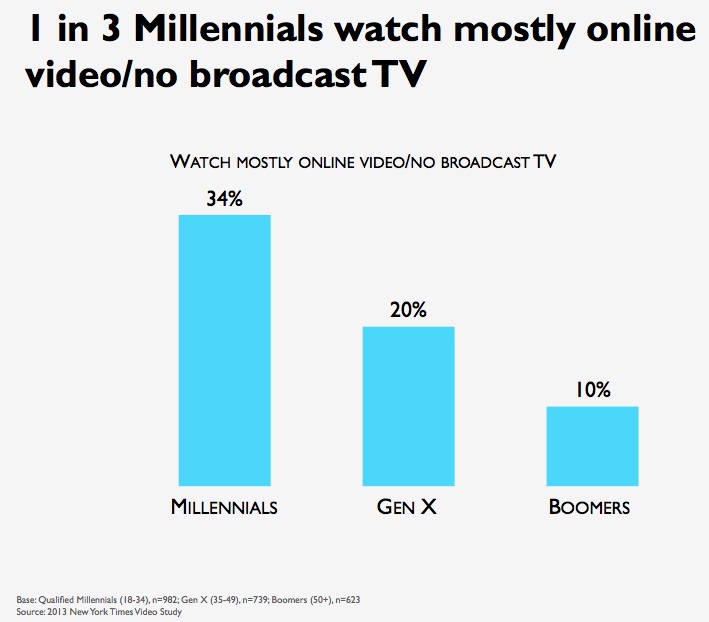
NY Times: A third of Millenials don't do "TV"

Research done by the New York Times finds that a third of young adults (aged 30 & under) "watch mostly online/no broadcast TV."  The study asked some 4000 "online video users" about their media and news consumption. Traditional TV viewing, like newspaper reading, seems to be declining across generations - the proportion of those giving the "online/no broadcast" response fell to 20% among Gen Xers, and 10% among Boomers. 

I should note that this was a nonrandom sample of a subset of US adults, and so the resulted are probably not representative, although the patterns of responses within the sample can be insightful.

The study had some other interesting news on the journalism front.  More than a quarter of the sample (28%) listed news sites as among their favorite video sites, and more than a third (35%) indicated that they had increased the amount of time spent on news/current events.  There was also a significant preference in the sample for "reading" news rather than watching news videos.

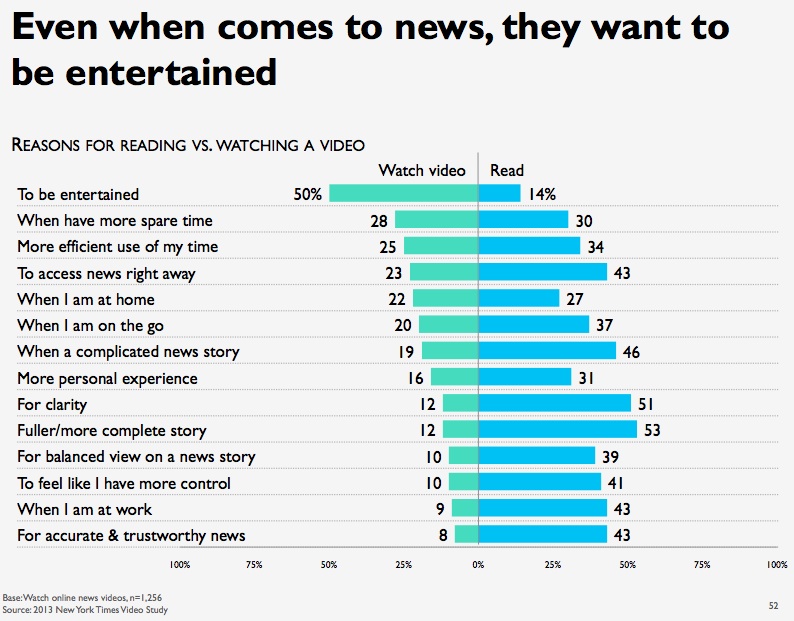
Among the various reasons offered for getting news videos or reading news stories, news videos outperformed reading in only one - "To be entertained." (50% to 14%)

In contrast, respondents preferred to read about news -

"To get news right away" (43% to 23%)
For a "complicated news story" (46% to 19%)
"For clarity" (51% to 12%)
To get "fuller/more complete story" (53% to 12%)
For a "balanced view" (39% to 10%)
For "accurate & trustworthy news" (43% to 8%)

Source -  Third of millennials watch mostly online video or no broadcast TV,  Poynter

Friday, October 11, 2013

Al Jazeera America viewing remains minimal

The latest cable news ratings show that Al Jazeera America's (AJAM) news programs are getting minimal viewing.  How minimal? In the latest report, the network's daytime shows garnered a rating of 0 among the key 29-54 age demographic.  (Ratings refer to the percentage of US TVHH watching, and are rounded to a single decimal point, so it doesn't necessarily mean that no one watched.  The ratings services also provide estimates of the number of homes watching, which can be more useful for cable network's hyper-competitive and fragmented audiences).  At this point, the network's ratings are so low that they don't show up in most reports.

Primetime shows did only slightly better.  Consider This, their 10 p.m. also earned a 0 rating, and averaged 9000 viewers total, with only 3000 in the 29-54 demo.  AJAM's flagship program, America Tonight at 9 p.m., averaged 18,600 total viewers, and was one of many shows to record 0 viewers in the 29-54 demo at some point during the week.  To put the AJAM numbers in context, audiences for America Tonight's 9 p.m. competitors on Wednesday night (Oct. 9, 2013) were 542,000 for CNN's Piers Morgan Tonight, 1,445,000 for MSNBC's The Rachel Maddow Show, and 2,475,000 for Fox's The Kelly FileAmerica Tonight also got outperformed by specialty shows Dr. Drew on Call (CNN Headline), with 257,000, and Secret Lives of the Super Rich (CNBC), with 131,000.

While AJAM is handicapped by the fact that it's channel isn't on all systems and only reaches about half the TVHH of the other cable news networks, the continued poor performance does not bode well for a nominally advertising-financed network; nor does it give the network much of a bargaining position to earn carriage (and licensing fees) from multichannel distributors.

Source - Al Jazeera America Had a Rough Ratings Week; Some Shows Hit Zero in Key Demo,  Mediaite
Cable News Ratings for Wednesday, October 9, 2013,  Zap2it TV by the numbers

Thursday, October 10, 2013

Latest Research on Online Video 3: Magid Connected Culture report

Three research reports on aspects of video/TV viewing and use have been released recently.

A nationwide study from Frank N. Magid Associates characterizes the role of mobile devices as "the beating heart of content and commerce."   Perhaps a bit of hyperbole, but the rapid adoption of smartphones and tablets, and the increased availability of compelling high-quality content is certainly impacting, and shifting, audience viewing behaviors.  The audience for mobile TV and video is there - the report finds 74% of U.S. "mobile consumers" have a smartphone, and 52% use tablets. 71% of tablet viewers, and 45% of smartphone viewers, now watch long-form TV, movies, and sports content on their devices.

Perhaps the most striking indication of that shift is the finding that digital and mobile devices are becoming the dominant source of entertainment for the 18-34 age group: smartphones/tablets account for 35%, PCs/laptops at 34%, while traditional television trails at 21%.
"Consumers have made the clear leap into mobile long-form," says Andrew Hare, Magid Research Director. "Beyond just TV and traditional video consumption, however, the visual culture has taken over with the growth of Instagram, Tumblr, Pinterest, Snapchat, and Vine showing consumers increasingly prefer to communicate through images and video."
Sources -  'Mobile is the new TV', finds Magid study,  Broadcast Engineering
The Heartbeat of Connected Culture - Magid Smartphone and Tablet Study 2013

Latest Research on Online Video 2: Avid/Ovum Consumer Trend study

Three research reports on aspects of video/TV viewing and use have been released recently.

The Avid/Ovum white paper - Consumer Trend Research: Quality, Connection, and Context in TV Viewing - takes a different research approach.  The study surveys industry professionals about the trends and shifts they see in their fields, along with a cross-national web survey of consumers.  Some of the reported results from the survey of industry professionals -
  • 71.5% of those interviewed felt that at least 19% of audience TV viewing will be delivered by web-based services by the end of 2017.  More than a quarter felt that at least 30% of viewing will be web-based by that time.
  • 91% felt that web-delivered video and TV will be a key area for revenue growth
The consumer survey resulted in what they termed "5 key insights"
  1. Quality is a primary concern for consumers that drives their use of online video.  65% identify the audio and visual experience as a key factor in their enjoyment and use of online video.  About the same percentage (66%) indicated that they would watch ads if the content was "high quality."
  2. Quality also drives engagement and ad recall.  47% said they remember ads if they're funny, 32% indicate that they recall ads with good, engaging, storylines, and 31% recall ads with well-developed characters.
  3. Multi-platform delivery drives value and extends viewing lifecycle.  While consumers report that they're most likely to hear about new shows through network promos, 14% report testing out new shows via mobile viewing. 30% say if they like what they see they'll shift to more normal appointment-based viewing.
  4. There is profit potential in media archives.  More than a third of the sample (37%) said they were prepared to pay for access to old episodes of favourite shows.  That's more than indicated they'd be willing to pay for access to news or current shows.  However, a lot of older material is not currently accessible.
  5. Second screens create opportunity in mass media events.  When watching the last Olympics, 63% of those consumers with PCs, smartphones, or tablets reported using them to find other scores, seek more match information, or watch other events or highlights.
The survey also asked consumers how they like to sample or experiment with new shows, to see whether they liked them.  About a third (30.2) said they just stumbled upon the program because it came on a channel they were already watching, but almost as many (29.5%)indicated that they'd record the new show for later viewing, or that they'd make a point of being home to watch new shows they might be interested in (26.4%).  A smaller number indicated they'd look for the programs online, and watch them on their TVs (7.5%) or on a mobile device (6.4%).  As for continued viewing of programs, about the same number indicated they'd make a point of watching live at home on their TV (29.8%) as indicated they'd record the show for later viewing (29.2%).  Interestingly, a small number (4%) indicated that they'd record all the episodes and then watch them all at one time - what's called binge viewing.

The survey also asked those who expressed a willingness to pay for TV and video content just how much they'd be willing to spend.  They highest average was for "the latest Hollywood movie" ($3.62 avg) and watching a "favorite sports event on demand in HD" ($2.37).  The averaged amounts for comedy and reality shows, old episodes of favorite series, episodes of current drama programs, and favorite news programs were all in the $1 - $1.50 range.

Source - Consumer Trend Research: Quality, Connection, and Context in TV Viewing, Avid/Ovum white paper

Latest Research on Online Video 1: Pew Online Video 2013

Three research reports on aspects of video/TV viewing and use have been released recently.

The Pew Internet & American Life Online Video 2013 report is out, and shows not only increased viewing of online videos, but increased and more widespread posting of videos.  They also released a video discussing their findings.
For text lovers, here's some highlights:
  • The proportion of US adult internet users who have uploaded or posted videos has doubled in the last four years (to 31%).  27% report they did so to share the video with others, and 18% said they have posted videos that they created.  Posting videos online is more widespread among younger users (41% of 18-29 age group, 36% of 30-49, 18% of those 50 or older)
  • The proportion of US adult internet users who watch or download videos continues to increase, with 78% reporting they do so.  72% have used video-sharing sites like YouTube or Vimeo, 56% watch videos from social networking sites or on mobile apps, and 36% have downloaded videos onto a computer or mobile device for later viewing.
  • Comedy and educational videos remain among the most widely-viewed genres (57% have watched comedy/humorous videos, 50% have watched educational vids) but gains in viewing have brought how-to videos (56%) and music videos (50%) to similar levels.
  • There are demographically based differences in online video use.  Young adults are heavy users of music videos (80%), comedy videos (82%), and animation (47%).  Men are much more likely than women to watch sports videos (49% to 20%), political clips (40% to 30%), and porn (25% to 8%).
  • Social media sites and the proliferation of phones with video capabilities have spurred the increase in video uploading by making it easy to shoot and post videos.  71% of those who post online have done so on a social media site, and 40% report they have used their phones to record videos.  Specialized apps for recording and sharing videos, such as Vine, are starting to make inroads, with 23% of those posting videos indicating that they have used such apps.
Source  - Online Video 2013, a report from the Pew Internet & American Life Project

Financial Times to cut print in favor of digital

According to a report in the New York Times, The Financial Times (FT) is planning to stop printing regional editions and produce only a single global print version of its daily newspaper.  A memo to employees calls for them to shift their primary focus to the FT's online site.
“Journalists will publish stories to meet peak viewing times on the Web rather than old print deadlines,” the memo stated. “This will require a change in mind-set for editors and reporters, but it is absolutely the right way forward in the digital age.”
The memo also indicated that the website has more people subscribing to it than all of the current print editions, and stressed the need to remain competitive as news consumption is shifting to desktops, smartphones, and tablets.  There was no immediate indication of job cuts or layoffs, but the memo did suggest that employees would need to make "informed choices" about their careers.

Source -  Financial Times to Consolidate Print Editions,  New York Times

Wednesday, October 9, 2013

Prospective milestone: Online video devices outnumber people by 2017

A report from the Broadband Technology Service at IHS predicts that the explosive growth in smartphone and tablet ownership will result in over 8 billion Internet-connected video devices in the world by 2017.  The projected world population in 2017, in contrast, is 7.4 billion.
“In practice, ownership of Internet-connected hardware will be concentrated among users whose homes are equipped with broadband connections,” said Merrick Kingston, senior analyst for Broadband Technology Service, in a press release.
“We’re quickly approaching a world where the average broadband household contains 10 connected, video-enabled devices. This means that each TV set installed in a broadband-equipped home will be surrounded by three Internet-connected devices.”
The growth in 4G mobile services will fuel expansion of basic levels of broadband access, particularly in rural areas and in developing countries.  That's also a key component in the expansion of online video access.

Source - More Internet Video Hook Ups Than People in the World by 2017, VidBlog

UK: Newspaper Regulation "Will Be Imposed"

After politicians rejected a UK newspaper industry proposal for self-regulation, the government is poised to impose the first state regulation of the press in 300 years.
Lest you think that the industry's proposals were weak or self-serving, their proposal has been described at the toughest regulatory regime in the world, capable of imposing £1 million fines.  The main differences cited in the two proposals was that under the industry proposal, participation by news organizations was voluntary, that there would be someone with news experience on the main oversight panel, and that the government could not block or change regulations.  Officials, in rejecting the industry proposal would make news organization participation mandatory, have the industry fund the regulatory authority, prohibit anyone with news experience from serving on the oversight panel while allowing former MPs to serve, and provide a mechanism for political "involvement" in setting regulations and determining violations.  (Another concern was the overly broad definition of news outlet and the impact on small organizations, nonprofits, and bloggers).

As one might expect, the industry raised concerns about the action, and the fact that industry representatives were not involved in the decision-making process, while critics were.  Press opponents (who were involved in the initial late-night deal-making that resulted in the government's initial proposal) predictably indicated that rejection of news industry concerns was "long overdue." 

And one Labour member of Parliament, Tom Harris, expressed his concern eloquently in an opinion piece published in The Telegraph -
I sympathise with Ed Miliband’s call for “decency” from Fleet Street, especially in the wake of last week’s unedifying row between him and the Daily Mail over his late father. But the state should have no role in forcing its definition of “decency” on a free press. The British press is intrusive, arrogant, vicious, unfair, unbalanced and generally infuriating. What a relief! That is as it should be. Politicians and those in positions of power should be wary of journalists. We should worry about what will be reported about us and our actions. We should shudder on a Friday night when a reporter from a Sunday tabloid calls us at home to ask for “your side of the story”. 
By supporting Parliament’s Royal Charter for press regulation, to be agreed by the Privy Council at the end of this month, my party is turning its back on a core tenet of progressive politics: that a genuinely free press, however infuriating, is an indispensable foundation stone of democracy.
Even if the goal is worthy, the way the UK government has proceeded in this matter doesn't give much indication of a concern for fairness or the social, economic, and political value of a free press.  While there is no constitutional protection of a press free from government influence and control in the U.K. (such as the First Amendment in the U.S.), they are members of the EU and UN, both of which support the role of a free press as a fundamental human right.  Should these be disregarded because of the occasional bad act or embarrassing story?  I'd hope not, but I expect that they will.  It's one reason politicians are generally seen as even less ethical than the press.

Sources -  Regulation will be imposed on press as politicians reject self-regulation, The Telegraph
Labour should not be muzzling free speech with its support of the Royal Charter, The Telegraph