Aereo is a recent technology service that offered online access to local TV broadcasts in selected markets in the U.S. For a fee, they grabbed programs that a subscriber requested, from "free" over-the-air local broadcasters, digitally converted the broadcast into a IP stream that was sent directly to the subscriber's connected device.
And when TV networks and cable systems heard about it, they sought to pre-emptively ban it. Cable because it was a much cheaper alternative to a service they sought to provide. The networks' objection was pithily stated by one network CEO: "If anyone makes money from local broadcasts, we demand a share of it." A consortium of networks and MSOs filed suit claiming that Aereo violated copyright law and seeking an immediate injunction against deploying the system; however, the judge in that case ruled against an injunction as Aereo offered a reasonable argument that its service was not a violation of copyright - but did not initially rule on the viability of that argument. Both parties wanted to expedite matters, so they sought to bring the case to the Supreme Court to get a final ruling on the basic copyright issues.
Copyright law is fairly simple, yet complex. The law gives the owner of the copyright the legal authority to determine the conditions under which the copyrighted material is made available to others. It also, however, permits a "fair use" exemption under certain general conditions - allowing others to access and use the content under restricted conditions. The rise of broadcasting created an issue, however - what counts as a "copy"? This came to a head with the rise of cable systems, and their retransmission of over-the-air broadcast signals from local (and eventually distant) stations. As a result, Congress amended copyright law to include "public performance" of audiovisual signals, and specifically applied that term to carriage ("retransmission") of over-the-air television broadcasts.
Around the same time, the Supreme Court issued a ruling on what behaviors were considered "fair use" of audio and video content. Specifically, they ruled that - for legally acquired content - individuals could record content for their later use (time-shifting), transfer and translate content for use in different locals or on different devices (place-shifting), and make a back-up (archive) copy, but only for their own use.
Aereo's service was designed to fit those "fair use" guidelines and the "free" nature of over-the-air broadcasting (stations are prohibited from charging viewers for access to public broadcasts). Each Aereo subscriber was assigned their own antenna for receiving the free broadcasts, and unlike cable, content was not retransmitted unless specifically requested by that subscriber, and was made available only to the device the subscriber sent the request from. Aereo argued that they were not engaging in a public performance, but a private one that essentially amounted to the time-shifting and place-shifting aspects of fair use.
The big media consortium (ABC et al.) argued that the Aereo service was simply a retransmission service, and was engaged in "public performance" because it offered its service to the public at large. Therefore, Aereo was in violation of U.S. copyright law.
The recent Supreme Court ruling (6-3) was that Aereo's service was "substantially similar" to cable, because it offers a service that allows subscribers to watch TV programs, and that it is a "public performance" because several subscribers may be watching the same program, thus constituting a "public."
It's not terribly surprising, although it is disappointing, that the majority decision is technologically ignorant and focuses on outcomes rather than processes and behaviors. To the majority, any technology that delivers TV programs to members of the public is essentially no different than a cable system and thus any retransmission right for that content must be granted by the copyright owner (presumably, but not necessarily, for a fee). In addition, the majority nonsensically assumes that since the copyright act does not explicitly define "public", it is any group of individuals beyond what may be watching on a single device. The majority also finds that it makes no difference who is initiating and controlling the retransmission - an individual subscriber or a cable system; rather, they shift the focus to Aereo because it offers a "service."
There is a weird yet nonsensical example given, where the majority suggests that Aereo's problem is that it doesn't provide a service to the copyright owners, but to the public. The majority repeatedly focuses on copyright owner's right to set the terms of "performance" or consumption. This ignores the fact that, under law and the terms of their licenses, local broadcasters must provide their copyrighted content freely and without restriction to the public. Not only to those watching live at home on a TV set, or through a cable system paying retransmission fees; the viewer, or Aereo subscriber, already has the legal right to view or listen to broadcast content. The copyright owners have already been paid for that performance by the broadcaster - the majority seems to think that viewers need to pay a second time to engage in time-, place- or device-shifting.
The majority decision argues that this ruling does not prejudge future technologies, saying that it is not their intent. It's hard, though, to see how this is possible, when the decision sets down three extremely broad definitions - 1) that any system for delivering TV content to consumers is "substantially similar" to cable and thus subject to cable's rules; 2) that any group of individuals is considered to be "the public"; and 3) that the driving purpose is not protection of a copyright owner's rights, but the networks "right" to offer a "public performance" of copyrighted material. Combine that with the majority decision's total disregard for the specific elements of technology and service offered by Aereo - and thus not providing any hook for a narrow argument - and you set a precedence for overreach.
Further, this case offered the opportunity to re-examine which activities are covered by "fair use." In light of the wretched quality of the decision, I'm relieved that this Court didn't take up that opportunity.
The dissent shreds the majority decision, arguing that the service provided by Aereo was not even a "performance" as defined by copyright law, much less a "public performance." Rather than looking at the end stage of the service (providing TV programs to viewers) and making an indefensible leap to equate it with cable, the dissent treats Aereo as an Internet content delivery system. And supports their argument by actually looking at what the service does, then examining the actual case law relevant to those actions (rather than relying on problematic anecdotes). The dissent eviscerates the majority's "looks like" argument, noting how it conflicts with other recent decisions (including some authored by the same Justice who wrote the majority decision), and ignores both the question of the type of copyright violation being considered (primary, secondary violation, and whether Aereo is acting as an ISP and thus exempt), as well as the issue of "fair use" and the role of the subscriber (not the system) in selecting content for viewing.
The majority decision has turned a copyright case into a "performance" result, achieved only with mystical inference of Congressional intent, over-broad definitions of "public" & "performance", and a "looks like a duck" equivalence of two video delivery systems that could hardly be more polar opposites in technology and operation. And by doing so, making the application of copyright to new technologies and content delivery systems even more problematic for the future.
And of course, the TV & cable industry hailed the decision, seeing a potential source of revenues (or a protection of current retransmission rights fees). However, that's likely to be a short-term and low-value source for broadcasters and networks for two reasons - first, that while they think they're soaking the service operator for these revenues, eventually viewers will figure out that stations and broadcast networks are asking them to pay for "free TV"; second, that it's the content that generates the value for viewers, not their "public performance" of that content. In fact, to the extent that the broadcast "performance" has any value for the station or network, it comes from the broadcast's ability to reach an audience; as such, any mechanism that will extend or expand their reach should be welcomed, rather than challenged.
Sources - Supremes Rule Against Aereo, Broadcasting & Cable
ABC et al. v. Aereo, Supreme Court decision No. 13-461
Thursday, June 26, 2014

Wednesday, June 11, 2014
MSNBC remains as least trusted
Tacked onto a recent poll about immigration were some simple questions on which TV news sources were the most, and least trusted.

 That people's trust in news outlets is generally low is nothing new. Pew and Gallup both regularly ask about the public's trust in news media in their polling, and find trust declining, and also becoming more partisan - suggesting a perceived bias (check earlier posts here and here).
Source: Brookings Survey: The Most Trusted Name in Television News Is . . . Fox News, National Review Online
Overall, Fox News was viewed as most trustworthy by a quarter of the June 2014 sample, just beating off the combined total for the 3 broadcast networks (23%). CNN came in at 17%, PBS at 12 %. MSNBC fell below the satirical "faux-news" Daily Show, at just 5%. There were significant differences in trust among those with different political ideologies and party identifications, particularly when it came to Fox News. But MSNBC still couldn't garner support from more than 10% of Democrats or liberals.
That people's trust in news outlets is generally low is nothing new. Pew and Gallup both regularly ask about the public's trust in news media in their polling, and find trust declining, and also becoming more partisan - suggesting a perceived bias (check earlier posts here and here).
And the American left must be shocked and appalled that "rabid, extremist, right-wing Fox News" (their terms) remains the most trusted news outlet among news consumers - and remains the most-watched of the cable news outlets by huge margins. And that reliably leftist MSNBC remains among the least trusted sources for "accurate information about politics and current events," although it has managed to capture second place in viewership from CNN.
Source: Brookings Survey: The Most Trusted Name in Television News Is . . . Fox News, National Review Online
Wednesday, June 4, 2014
Media Sports Consumption - Infographic
From PERFORM and Kantar Media: Global Sports Consumption 2014

Thursday, May 1, 2014
Globally, Press Freedom down in 2014 reports

“We see declines in media freedom on a global level, driven by governments’ efforts to control the message and punish the messenger,” said Karin Karlekar, project director of the report. “In every region of the world last year, we found both governments and private actors attacking reporters, blocking their physical access to newsworthy events, censoring content, and ordering politically motivated firings of journalists.”Overall, the report concurs with the Reporters Without Borders recently released World Press Freedom Index 2014 report. Levels of press freedom are declining in many cases, due to spreading conflict and "a tendency to interpret national security needs in an overly broad and abusive manner to the detriment of the right to inform and be informed."

It's been a tough few years for the press.
Sources - "Freedom House report cites lowest global press freedom in a decade," Poynter.org
Freedom of the Press 2014 report, Freedom House
World Press Freedom Index 2014 report, Reporters Without Borders
edited to add Freedom House 2014 map, and reposition other graphic (2 May, 11:30 a.m. EDT)
Monday, April 28, 2014
Social Media couldn't help NBC's Sochi ratings
Oh the wishful thinking at work.
 NBCUniversal's head of research, Alan Wurtzel, recently commented on his unit's analysis of their Winter Olympics coverage earlier this year. The extensive coverage of the Games (1500 hours, all told), provided a platform for investigating media behaviors. The network had expected social media to have a "dominating" effect on viewership, driving viewers to both the main primetime broadcast network shows and the sports coverage spread across a number of cable channels.
As it turned out, viewing and social media use didn't explode as planned. Only 19 percent of viewers used social media to post about the games. Some 3 million unique users posted a total of 10.6 million Olympic-related messages on Twitter. NBCU indicated that up to 23 million people saw one or more of those messages. In contrast, NBC averaged 21 million viewers for its prime time coverage. The numbers on Facebook were higher, but still only 20 million posted, commented, shared, or liked something "related to the Olympics." NBCU didn't indicate what percentage were actually focused on their coverage of the games, or were positive posts on their coverage. (I'll admit to retweeting and posting about some of their analysts' more ridiculous comments, as well as the comically unprepared venues and tourist facilities).
So out came the wishful thinking. According to Wurtzel, social media wasn't "a game changer yet."
However, there weren't a lot of U.S. athletes in those games that had active fan bases. (The most social media savvy, Shaun White, did poorly after an injury.) Similarly, winter sports don't have the huge, and social media adept, fan base of many Summer Olympic sports. From America's perspective, there wasn't much of interest to tweet about the actual sporting events, leaving social media to revel in the gaffes and general goofyness surrounding the event and its coverage. And while that may drive social media traffic, its not the kind of buzz that can drive viewing and ratings.
The numbers certainly are what they are. What's unclear is whether the numbers reflect the impotence of social media, or the impotence of NBCU's coverage of a mediocre sporting event.
Source - Social media not yet a 'game changer' for boosting TV viewership, Financial Times
As it turned out, viewing and social media use didn't explode as planned. Only 19 percent of viewers used social media to post about the games. Some 3 million unique users posted a total of 10.6 million Olympic-related messages on Twitter. NBCU indicated that up to 23 million people saw one or more of those messages. In contrast, NBC averaged 21 million viewers for its prime time coverage. The numbers on Facebook were higher, but still only 20 million posted, commented, shared, or liked something "related to the Olympics." NBCU didn't indicate what percentage were actually focused on their coverage of the games, or were positive posts on their coverage. (I'll admit to retweeting and posting about some of their analysts' more ridiculous comments, as well as the comically unprepared venues and tourist facilities).
So out came the wishful thinking. According to Wurtzel, social media wasn't "a game changer yet."
“A lot of people want to show that they are on the cutting edge... Why wouldn’t I want to say to you, ‘We have a potent new way in which we can drive ratings?’" But “it just isn’t true”, he added. “I am saying the emperor wears no clothes. It is what it is. These are the numbers.”The underlying problem, though, is that people use social media to comment on things they find interesting, particularly things they are passionate about. Social media activity is also mostly reactive. Wurtzel and the head honchos at NBCU apparently thought that the world of social media would jump at the chance to provide free promotion for its Olympic coverage, generating the social buzz that would drive up viewership. Particularly for its prime time shows, which focused more on soft stories of athletes than on sports coverage.
However, there weren't a lot of U.S. athletes in those games that had active fan bases. (The most social media savvy, Shaun White, did poorly after an injury.) Similarly, winter sports don't have the huge, and social media adept, fan base of many Summer Olympic sports. From America's perspective, there wasn't much of interest to tweet about the actual sporting events, leaving social media to revel in the gaffes and general goofyness surrounding the event and its coverage. And while that may drive social media traffic, its not the kind of buzz that can drive viewing and ratings.
The numbers certainly are what they are. What's unclear is whether the numbers reflect the impotence of social media, or the impotence of NBCU's coverage of a mediocre sporting event.
Source - Social media not yet a 'game changer' for boosting TV viewership, Financial Times
Thursday, April 24, 2014
Mileposts: Two notable print closures
It's been a week of bad news for print media. Newspaper revenues continue to slide, despite some upticks in digital subscriptions and advertising (see earlier post), and print's share of time spent with media has dropped more than 50% in the last four years, now accounting for a mere 3.5% of U.S. adult time spent with media (see previous post). Now comes news that two notable print institutions are ceasing print operations.
 Officials with publishing conglomerate Meredith Corp. announced today that the venerable Ladies Home Journal will no longer be published as a monthly magazine. The title will transition to a special-interest quarterly publication sold exclusively at newsstands. The Ladies Home Journal began publishing 131 years ago, and was the first U.S. magazine to reach a circulation of 1 million (111 years ago). The company announced that the magazine's 3.2 million current subscribers will be shifted to other Meredith-owned publications. Meredith indicated that its magazine division saw advertising revenue drop about 15% in the last year, while overall operating expenses rose about 8%, contributing to a 37% drop in profit levels.
 The problem with the magazine was not its readers, but with advertising. The number of ad pages had fallen 23% this year; but the problem was that that was only the latest of several years of double-digit declines. Another of the pioneering "Seven Sisters" of women's service magazines, McCall's, closed in 2002 after years of losses that were also blamed on declining ad pages and aging audiences. The last issue will bear a July 2014 publication date.
 The announcement comes on the heels of the news that the Columbia University student newspaper, the Columbia Daily Spectator will drop its daily print edition. Starting with the upcoming Fall term, the paper will be shifting its efforts to its online edition combined with a weekly print edition. In fact, the new weekly edition will be folded into the Spectator's current weekly, called The Eye. The Spectator began publishing as a student newspaper in 1877, and was the second-oldest continuously operating college newspaper in the U.S. It began operating as a daily newspaper in 1902.
With this move, Columbia becomes the first (and so far only) Ivy League school without a daily student-run newspaper. While stressing that it wasn't an economic decision, the paper's current Publisher did admit that the print edition was losing money this year, and hoped that the move would help free up funding to supplement a work-study program used to support staffers.
One alumnus, former managing editor Robert Hardt, Jr., commented that he had mixed feelings about the move:
Sources - Ladies Home Journal to cease monthly publication, The Des Moines Register
Ladies Home Journal to Fold After 131 Years in Print, Ad Age
Columbia student paper plans to drop daily print edition, Capital New York
The announcement comes on the heels of the news that the Columbia University student newspaper, the Columbia Daily Spectator will drop its daily print edition. Starting with the upcoming Fall term, the paper will be shifting its efforts to its online edition combined with a weekly print edition. In fact, the new weekly edition will be folded into the Spectator's current weekly, called The Eye. The Spectator began publishing as a student newspaper in 1877, and was the second-oldest continuously operating college newspaper in the U.S. It began operating as a daily newspaper in 1902.With this move, Columbia becomes the first (and so far only) Ivy League school without a daily student-run newspaper. While stressing that it wasn't an economic decision, the paper's current Publisher did admit that the print edition was losing money this year, and hoped that the move would help free up funding to supplement a work-study program used to support staffers.
One alumnus, former managing editor Robert Hardt, Jr., commented that he had mixed feelings about the move:
“It’s the end of an era—but it probably means that Spec reporters will miss fewer classes and get better grades...”
Sources - Ladies Home Journal to cease monthly publication, The Des Moines Register
Ladies Home Journal to Fold After 131 Years in Print, Ad Age
Columbia student paper plans to drop daily print edition, Capital New York
eMarketer: Digital becoming most-used medium

The report indicates that U.S. adults spend an average of just over 12 hours a day with various media (the report counts each medium separately, even if the user is multitasking with other media). If you look at individual channels, TV remains the medium adults spend the most time with (4 hrs, 31 min in 2013), but the combination of general online channels (PCs, laptops) and mobile (smartphones, tablets) is surpassing TV in time spent with media. The report indicates that in 2012, the average total time with digital fell just shy of the average time with TV (by 7 minutes). Print's downfall continues, with the average time spent with print media in 2014 projected to be only half of the time people spent with print in 2010, and its share of time spent with media dropping to 3.5%. The decline is seen in both newspapers and magazines (slightly slower decline for magazines).

The report also notes that in studies of time spent using media, that video consumption through digital channels remains small compared to traditional TV (in 2013, four and a half hours for TV, 44 minutes for digital). Even there, however, all of the projected gain in usage in 2014 comes from the mobile sector, which eMarketer projects growing 50% in that year.

Source - Mobile Continues to Steal Share of US Adults' Daily Time Spent with Media, eMarketer
Tuesday, April 22, 2014

Monday, April 21, 2014
US Newspapers Revenues Still Falling
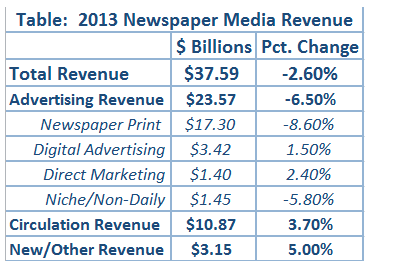

Offsetting this was a modest 1.5% growth in digital advertising (overall, digital advertising is growing at a double-digit pace). If there's good news in the report, it's the fact that the rapid adoption of paywalls for the online versions of print newspapers contributed to a modest gain in overall circulation revenues. That, and the fact that the NAA managed to add $5.5 billion in additional revenues by including revenues from side ventures such as contract printing, weeklies, and a range of niche publications and services. That really helped to slow the decline in the "total industry" numbers. Still, revenues from all digital sources amounts to only 12% of total industry revenue, and newspapers' digital revenues continue to grow much more slowly than other forms of digital advertising.
Newspapers aren't out of the woods yet.
Sources - Newspaper industry narrowed revenue loss in 2013 as paywall plans increased, Poynter
Business Model Evolving, Circulation Revenue Rising, NAA report\
(I made a number of edits for style and clarity after initial posting - BJB)
Tuesday, April 8, 2014
Brand Images of Cable News
According to YouGov's BrandIndex, the perceived brand image of the major cable news networks has remained fairly constant in recent weeks, despite the small jump in viewing linked to the missing aircraft story.. The BrandIndex Buzz Index compares consumer perceptions of brands, and looks at the net difference between positive and negative comments.

As the graph shows, only Fox News has generated a net positive "Buzz", and seems to have more consistent values (in the +4 to +6 range) in 2014. None of the other measured cable networks generated a positive Buzz value over the measured time frame. CNN's perception score seems to have bottomed out last June (hitting -17), before making it back to a -4 score in October 2013, with consistent fluctuations after that. Consumer perceptions of CNN Headline have largely tracked those of CNN. Consumer perception of MSNBC has been very consistent since the start of 2014, with scores in the -9 to -10 range. That suggests the audience has pretty much made up its mind about MSNBC, and the network hasn't been able to do much to shake that overall negative impression. Since many of the big swings seem linked to major news events, it might also suggest that MSNBC's specific coverage of news doesn't change viewers perceptions about the network.
Source - Despite disaster coverage CNN perception declines, YouGov BrandIndex report
Subscribe to:
Posts (Atom)