Showing posts with label publishing. Show all posts

Tuesday, January 14, 2014

Jobs Trend - Editor Out, Content Marketing In

The publishing industry is among the latest feeling the impact of the digital transformation tsunami.  This has a lot of industry professionals thinking about changing careers.  Max Kalehoff, writing in OnlineSPIN, suggests that the growing demand for people with writing and editing skills in the marketing industry is attracting interest from those in the print publishing world.
These career-changers are coming from all sides of publishing, including editorial, sales, research and circulation, and from all levels of experience, from the C-suite down to college students whose only internships were in publishing. Some of them work at the world’s largest publishers facing restructuring, while others are in relatively stable roles at niche publishers and see an opportunity to redeploy their talents.
The change is also being seen in the job postings on job websites and retrieved through search engines.  The number of postings containing the key words "Publishing" or "Editor" has plummeted to half the level of four years ago. 
On the other hand, postings using "Content Manager" keywords have doubled over the same time period, and currently outnumber postings using either "Publishing" or "Editor".
Use of the "Content Strategist" keyword was negligible four years ago, but today there are more job postings for "Content Strategist" than "Editor."

With more conduits for content, there is an increasing need for those who find creative ways to identify, publicize, and promote new uses for content.  In other words, "content strategists" and "content managers."  Kalehoff suggests there's growing opportunity within the marketing field for people who "command written words and storytelling," and with "skills in syndication and audience building."  As the media world becomes increasingly multiplatform, there will be opportunity for those who can develop and exploit these new channels for content distribution, whether within traditional publishing, or within marketing.

Source -  Publishing Industry's Turbulence Create Surge of Talent for Marketers,  OnlineSPIN

Wednesday, November 6, 2013

Reading in the Digital Age

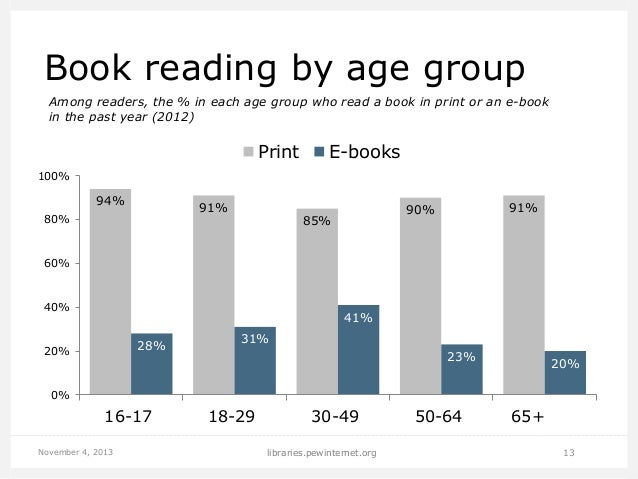
A recent presentation posted by the Pew Internet & American Life Project has some interesting slides on ways that ebooks and readers are having on book reading.  E-reader capabilities have dramatically improved in the last few years, as prices have fallen, and the e-book market once dominated  by Amazon is facing increased competition from Apple's iBooks and Google Play.  And major publishers have expanded their ebook offerings.  Ebook adoption exploded in each of the last two holiday seasons through gift-giving and purchasing, and seems poised for another big jump this year.

One of the interesting aspects of ebooks is that adoption and use hasn't been dominated by young males.  Ebook reading in the U.S., at least, is fairly widespread, with a small peak in the 30-49 age group.  Where age does matter is with regard to which devices are used for reading ebooks. Those under 30 are much heavier users of smartphones, laptops, and desktops for reading (mobile phones 41% v. 25%; PCs 55% v. 38%), while those 30 or older are heavier users of Ereaders (46% v. 23%) and tablets (26% v. 16%).

As we're also starting to see with online video usage across devices, people are starting to develop preferred practices.  People overwhelmingly prefer reading print books when sharing (81% feel printed books are best when reading to a child),  Ebook advantages seem to be tied to practicality: 83% prefer ebooks for getting books quickly; 73% prefer ebooks for reading while traveling; and 53% note the wide selection available.  (I'll personally attest to the advantage of ereaders and ebooks when engaged in lengthy travels and semesters abroad).
Previous studies have also shown that ebook adoption and use is highest among heavy readers, and particularly among genre-fiction readers.  (I ran a used paperback store for a while, and our best customers would show up weekly with a grocery bag of genre fiction, and leave with another (romance, mystery, science fiction were top genres).

Another Pew study found that leading-edge librarians report that the rise of ebooks has induced a major shift in book searching and borrowing at their libraries.  Avid readers are using branch libraries less, shifting their borrowing to downloads from the main library website.  Browsing and searching for titles has similarly shifted from catalogs to websites.  Many of the librarians report that they're excited about the role ebooks are playing for their patrons, and for the future of reading and libraries.  On the other hand, ebooks have joined other media in competing for limited acquisition funds.  They're also finding that librarians find themselves providing "tech support" more than traditional reference services.

The Book Industry Research Group has released findings from its recent study of the impact of ebooks.  The key result is the conclusion that ebooks are now considered a normal means of consuming written content, accounting for roughly 30% of the market.  Some of the results suggest continuing industry transformations, however.
  The study found that readers don't differentiate between traditional big publishing houses and self-publishing alternatives when purchasing books. Content, author reputation, and user reviews on ebook sales sites is replacing the gatekeeping and brand functions that book publishers have relied on.  This could create problems for traditional publishers who can't adapt to a shifting market.  A number of small publishers have gone under as their authors discover that self-publishing can be much more rewarding to authors than traditional contract splits.  Others, such as HarperCollins, are experimenting with direct sales models for prominent authors' lists (and saving themselves the retailers' cut).
  The BISG study also found considerable and continuing interest in print books as well.  Almost a third of their sample indicated that they purchase print and ebooks interchangeably.  Consumers also expressed strong interest in bundling print and digital versions of books, and almost half indicated a willingness to pay a bit more for the bundle.  (Amazon's starting an experimental program offering access to ebook versions of books purchased through their site).  They also found that more than half of their sample expressed a willingness to pay more for ebooks with traditional print attributes of being able to resell or give away the digital versions.

All told, it seems that like digital audio and digital video, digital books have become a permanent part of the market for content.  The distinctive attributes of digital are transforming how consumers access, purchase, and use content.  The fact that digital distribution offers significant cost reductions, and opens up new ways of marketing content, are having their impact on traditional content industries as well.  The good news for traditional formats is that consumers see the advantage in all of the various form factors, and if traditional outlets can adapt their traditional models to become competitive with the new, they're likely to find ways to survive and possibly even thrive.

Sources -  Reading, writing, and research in the digital age,  research presentation, Pew Internet & American Life Project.
Libraries, patrons, and e-books,  Pew Internet & American Life Project research report
Study: E-books Settle In,  Publishers Weekly
Ebooks and discounts drive 98 publishers out of business,  The Guardian

Tuesday, November 20, 2012

Tablets - Has Print Found Its Digital Analogue?

Traditional print media outlets didn't have a lot of success going online - at least not at first.  While poor management/judgement was a major contributing factor, I'd suggest that the lack of a convenient reading platform for digital content was just as critical.  You could bring print content to a desktop's screen, but the totality of print bundles (newspapers, magazines, etc.) didn't translate as well, and to be frank, the reading experience from desktops sucks.  You can't quickly skim contents, its not portable, and its tough to share.  News organizations did find audiences for their stories and content online - particularly among those with desktops at work (who could access stories piecemeal during breaks).  However, most news isn't unique - and the Internet also allowed a lot of competition to emerge.  Laptops added some portability, but in the early years were heavy and had low battery life - again not ideal for reading print media products.  Experiments with longer-form content, such as magazines and books, proved the viability of digital forms, but not the desirability of desktops and laptops for extended reading.
  Then came the development of eBook readers - lighter, portable, relatively inexpensive, good battery life, and with a screen size that mimics paperbacks.  The major success of the Amazon Kindle device combined with the Kindle eBook store started an explosion in digital book publishing (see earlier posts here and here).  While Amazon encouraged marketing deals with a number of magazine publishers and newspapers, neither was very successful - at least partially due to the Kindle form factor.  The smaller screen size that was fine for books didn't work as well for the larger magazine and newspaper formats.  In addition, magazines felt constrained by the lack of color and limited advertising opportunities.  Newspaper readers had to remember to download daily versions (via link to desktop or a less-than-ubiquitous Wifi connection), and the refresh delays of early e-Ink based readers proved frustrating for those wanting a quick skim of articles.
  Next came smartphones, which offered constant & widespread connectivity, was easily portable, and had decent battery life.  Amazon and other eBook sellers quickly offered free reader apps, but the tiny screen proved problematic for books and magazines.  With newspapers, however, smartphones opened a new niche market for news - as an access point for headlines and breaking news (particularly sports and weather), and with the possibility of providing apps that could push news to an interested readership.  Apps also facilitated monetization, whether through subscriptions, individualized ads, or sales (of focused apps).
  Then came the iPad.  It offered a sleek, highly-portable connected device with a large (comparably) color touchscreen.  For book publishing, it was like an eReader on steroids - larger, faster, with multimedia capabilities (audio, video, links) built-in, where the action to turn a page mimicked traditional media page-turning. (See earlier post)  Tablets weren't merely an option for reading device - they started expanding the concept of books and texts, and their markets (textbooks in particular, see here and here).  And most importantly, eBook readers weren't just reading more free books; they were buying more books (post on Harris study).  Adding tablets to the expanding eReader base has ramped up diffusion and the development of digital book publishing.
   The combination of the iPad and the Flipboard app provided an exemplary demonstration of the potential for tablets as a digital platform for magazines as well as news.  The iPad provided a high-resolution colour screen, which while smaller than most print magazine formats, was large enough to provide quality read that magazines sought.  Flipboard provided a test base for content bundling and reading experience that also came close to the magazine ideal - easily skimmed, able to integrate text and image, and to go deeper with a tap or continue to the next "page" with a swipe reminiscent of turning a page.  And the ability to seamlessly integrate advertising.  The experience is so exemplary that it passed 20 million users and 2000 content providers last summers.
   It would seem that tablets offer a viable digital platform for the consumption of traditionally print content forms, when combined with growing broadband access.  On the other hand, tablets are proving to be excellent platforms for Internet access, for delivering audio and video, as well as a good gaming platform, and a reasonable computing platform.  So the question for traditional print outlets is will readers embrace tablets, and how the rise of print through tablets will impact product demand.

  For the last year or so, a wide range of trade and academic studies suggest that tablets may provide a viable digital solution for print content delivery.  The latest study to come out is from analytics firm comScore,  They surveyed a rolling sample of U.S. tablet owners for three months, ending in August, and found that reading on tablets continues to increase.
“Tablets are fundamentally redefining how people consume news and information, with the format more conducive to reading longer form content than PCs or smartphones,” said Mark Donovan, comScore SVP of Mobile. “In the case of online newspapers, tablets are now driving 7 percent of total page views, an impressive figure considering the relative infancy of the tablet space. Publishers that understand how these devices are shifting consumption dynamics will be best positioned to leverage this platform to not only drive incremental engagement among current subscribers but also attract new readers.”
  More than a third (37.1%) of tablet owners use their device to read a newspaper at least once a month, and 11.5% report reading newspapers on their tablets daily.  Magazine readership through tablets was around the same - 39.6% read magazines on their tablets at least monthly, and 9.7% reported reading magazines on their tablets daily. Readership is highest among the 25-34 demographic.  An interesting aspect of the report was that tablet newspaper readers weren't very different from tablet magazine readers in terms of demographics, or in terms of the specific tablets that were used for reading (iPads, Android tablets, Kindle Fire, NOOK tablet). 

  The comScore study results, in terms of increasing use of tablets for media consumption, fall in line with a wealth of other studies.  And the consistency in user demographic breakdowns raises some interesting questions - is this a reflection of a audience segment of regular (heavy) readers, who use whatever platforms are available? Do they see tablets as a supplement to print outlets, a complement, or a substitute?
  At this point, I think that tablets are proving to be a valuable digital platform for the delivery of a wide range of traditional media content - and the first decent substitute for print.

Sources - Tablets Capturing Newspaper Viewers, Research Brief (MediaPost blog)
Tablets Reinvent Americans' Relationship with Print,  comScore press release

Tuesday, September 4, 2012

Publisher Moves in Digital Advertising

Recent moves by several big newspaper and magazine publishers have greatly expanded their ability to deliver digital advertising, and suggests further expansion of online and digital platforms for their content.  The latest deals continue a long-term trend of investing in technology and agency firms to help them leverage their traditional print assets.
  Magazine publisher Conde Nast announced it had invested in Flite, a cloud-based ad platform system.  Flite had developed a series of ad tools designed to turn traditional display ads into a more interactive, app-like experience by integrating social media, e-commerce, live chat, and video features - all within a system that also allows ads to be updated in real time.  Flite had already attracted a number of big brands (L'Oreal, CBS, General Mills, Microsoft, P&G), and Conde Nast plans to use Flite to enhance rich media advertising across its 27 online titles.
  Gannett announced its purchase of BLiNQ Media shortly afterwards.  BLiNQ specializes in "social engagement advertising," and one of the first to get access to the Facebook Ads system.  The company was running social marketing campaigns for more than 600 advertisers.  Gannett plans to integrate BLiNQ with local newspaper websites and its ShopLocal system.
  Hearst is pursuing a number of partnerships with social media and personalized e-commerce firms.  It has a deal in place with Sprinklr to manage Hearst's various social media programs (Hearst has separate programs for more than 20 of its major brands).  Hearst's Seventeen.com has developed a partnership with mulu that will facilitate linking editorial content with e-commerce.
In the new feature, a “muluBox” appears alongside Seventeen.com’s online content with recommended products based on content the user had already viewed, including videos, slide shows or articles.
 The various moves will help publishers develop online assets that take advantage of the unique opportunities that online and mobile systems offer, and should also push them to seeing and developing online versions as distinctive companions to traditional print offerings.  The integration of social aspects and individualized product recommendations should also foster greater user involvement with their brands and content. That can only help their transition to, and integration with, online content delivery.

Source -  Publishers Beef Up Digital DealsMediaDailyNews

Thursday, July 28, 2011

Sarah Hoyt on Authors, Agents, and Publishing

Award-winning fiction author Sarah Hoyt recently wrote a post on some of the changes she's seeing in the publishing business.  It's interesting from several perspectives, not the least of which is offering an author's perspective.  And well worth a read in full, including the comments (where she gives added thoughts and advice on getting published).
The post is motivated by her decision to drop her agent, and go without one, at the end of her current contract.  Praising her current agent, her decision is based on changes she's seeing on the agency and publisher side of the book business. First, she noticed that the responses by publishers to work submitted by her agent were "slow and often rude, not just to me but to my agent." As she continues,
"Now publishers don’t seem to care. Mostly they’re publishing bestsellers. It’s the only way they think they can survive the next two or three years."
While bestsellers are good, the foundation for both publishers and agencies are the "midlisters" - established authors with steady sales (often in genre fiction).  They aren't always the most profitable, but their sales tend to be steady, there are a lot more of them, and in aggregate, they generate most of the income for most publishers and agencies.  Letting that segment slip away, whether intentionally or through shifting shrinking resources to other areas, isn't likely to be a good long-term strategy.  Given their perception that the big publishers aren't interested in midlist authors' work, several agencies (including the one she currently works for) are responding by developing their own digital publishing arm.
Its a logical move in digital publishing, Hoyt suggests; agents and agencies already act as first-stage gatekeepers, sifting through submissions from their authors and from those seeking an agent.  They also handle initial editing and much of the promotion for writers and books.  And in digital publishing they can bypass the other major services that traditional print book publishers provide (printing and distribution) as well as avoiding a major risk factor (predicting demand).  Having agents linked to specific publishers, regardless of whether it's in-house or exclusive deals with an external publisher, does have one drawback - without competition, they may not be able to get the best deals for authors.
The problem Hoyt has is that her agency isn't making a straightforward transition to digital publisher - they want to remain agents as well, which will allow them to get two cuts of the revenue stream, first as agent, then as publisher.  In addition, Hoyt argues that her agency is pushing up-front costs.  In her case, it doesn't make a lot of sense.  Especially since the current digital book sales models out there allow authors to make more money self-publishing or through using a micro-press than for going through a traditional publisher. For digital versions anyway, and for those best-selling authors and midlist writers who have built a following and don't really need a lot of marketing.
Until on-demand printing system costs fall to competitive levels, there will be a role for traditional publishers. However, as has happened previously in magazines and television, the dominance of big, general interest, publishers is likely to be replaced by more narrowly targeted and focused imprints that can build a brand and a loyal community of readers.  And if they're smart, those focused imprints will offer established authors digital publishing terms close to those they can get themselves, and save the upfront charges for marketing et al. for the less-established writers that still need to build their brands and fan base.

Sources: "The (Publishing) Times They Are Achanging", madgeniusclub blog
"The (Publishing) Times They Are Achanging", Pajamas Media  (a shorter version cutting details of her dealings with agents).

Wednesday, July 6, 2011

Pottermore - one future for publishing

A couple of weeks ago, J. K. Rowling announced the Fall debut of Pottermore, a free website based on the further development, and exploitation, of the Harry Potter books.  For now, fans are limited to registering their interest, but come fall, the site will be the sole source for the ebook releases of the book series.  Controlling her own ebook publication will allow Rowling to avoid the fees collected by other online book sellers, and controlling how the ebooks are used.  Rowling's indicated that she'll release the e-book versions in multiple formats, and DRM-Free.  (DRM, or Digital Rights Management, is a system that lets copyright owners place limits on use of content).  Instead, ebook copies will use a digital watermarking system that will identify both authorship and ownership of copies.  This could be the start of an important shift in digital publishing.  Much like how Amazon's shift to DRM-Free digital copies of music has prompted other digital music sellers to follow suit, the success in offering such a potentially valuable franchise without DRM could encourage other publishers to follow suit.  (In Amazon's negotiations with major publishers for it's Kindle bookstore, the publishers insisted on integration of a DRM system, with publisher control over limiting use). 
There's promise of the site also making available background information, and shorter stories and tales set in the Potter Universe. The goal is to create an immersive and potentially interactive experience.  Rowling indicated that one motivation for the site was the idea that: "We can guarantee that people everywhere are getting the same experience at the same time."  Rowling indicated that each chapter in the e-book versions will contain interactive "moments" that integrate new illustrations with elements of game play.
There are hints of social media aspects as well, with the potential of Pottermore serving as a central site for the hundreds of fan groups and thousands of fan-generated content set in the virtual world of Harry Potter.

Pottermore also seems set to exploit the potential for multiple revenue streams.  The site already has a corporate sponsor in Sony, and major revenue potential in selling the digital versions of the seven Harry Potter books.  But publishing revenue need not be limited to the existing volumes.  Even if the various stories and tales are offered free on the website, Rowling can always repackage them as new volumes for sale, potentially in both digital and print versions.  Pottermore will help in establishing and maintaining the Potter brand, and the Sony sponsorship is only the tip of the potential advertising iceberg.  Then consider the potential for merchandizing the brand, both directly by creating new products, and indirectly by recommendation links to outside stores and products.
Admittedly, Rowling is starting with one of the most valuable publishing brands.  Still, it's an interesting model, and one that could well set some precedents for the future of digital publishing.

Sources: "Is Pottermore The Future of Publishing?" Online Spin
"What Publishers Should Learn from J.K. Rowling's Pottermore," Forbes

For details and speculation about Pottermore, check:
"JK Rowling's 'Pottermore' details revealed: Harry Potter e-books and more," Wired.co.uk
"Pottermore: What's in Store for Harry Potter Fans?" Wired