Showing posts with label wireless. Show all posts

Tuesday, February 19, 2013

Traffic updates from Cisco

Cisco's Global mobile and visual data traffic reports and forecasts are out for 2012 and beyond, and the key finding is that they've significantly lowered their forecast data traffic growth rates in some key areas from their 2011 forecasts.  They attribute the revision to several fundamental shifts in usage patterns in 2012.
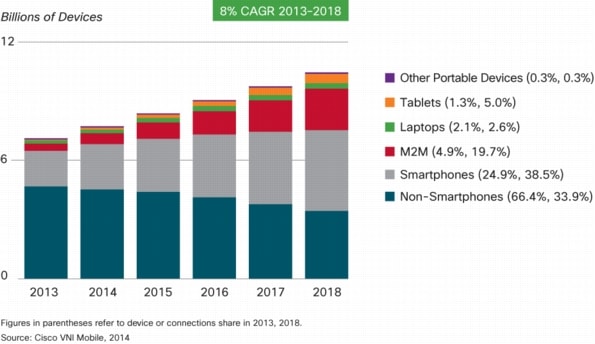
  Now data traffic is still growing rapidly across the globe, and mobile data traffic grew 70% in 2012.  In fact, Cisco notes, last year's mobile data traffic (885 petabytes per month) was twelve times the entire global data traffic in 2000 (75 petabytes per month).  Last year was also the first that saw mobile video traffic account for half of all mobile data traffic.  Last year also saw mobile data connection speeds doubled - avg. download speeds for smartphones were just above 2 Mbps, for tablets, average connection speeds were near 3.7 Mbps.  And data traffic is still projected to grow exponentially, just at a slightly lower rate.
  2012 also saw the number of mobile-connected tablets increase 250%, reaching 36 million, and the number of 4G mobile subscribers approached one percent of all mobile connections.  Still, even with that low early penetration, 4G mobile subscribers generated 14% of all mobile data traffic.  These high-end mobile devices all push mobile data traffic higher, so that continued diffusion will continue to drive continued rapid growth in mobile data traffic.
  As for the changes, they're attributable to shifts in usage patterns driven by pricing strategies interacting with improved mobile devices.  The report notes that the growth rate for mobile-connected laptops has slowed, as users move to smartphones and tablets as their primary mobile devices.  The report also notes that the rise of mobile devices has shifted some use from wired connections to mobile, and particularly WiFi wireless connections.  In particular, Cisco indicated that 2012 saw "higher than expected tablet usage on WiFi."  Finally, 2012 saw the widespread implementation of tiered and capped mobile data plans from mobile operators.  The new plans and caps also pushed a lot of mobile traffic to WiFi home nets connected to fixed network providers.  The report suggested that about a third of all data traffic generated by mobile devices was offloaded to the fixed network, rather than remaining on the user's mobile service.  To the extent that shifting data usage was a strategic goal (to prevent overloading of older, low bandwidth mobile services, this can be interpreted as attempts to make more efficient use of the current mix of data services and access technologies.
  Another way of looking at this is that consumers are becoming smarter - shifting some uses to mobile devices for convenience and 24/7 accessibility, shifting high-data-traffic usage to cheaper and free access points, and shifting emerging usage patterns as mobile service plans evolve to usage-based pricing.

  Lost in all this is the transformation of mobile service business model.  The foundational services of voice and SMS are experiencing declining revenues as users shift to free IP Voice and conferencing services, and the fact of declining costs continues to drive price competition among competitors. 
Swisscom’s CEO believes that the company’s voice and SMS revenue will be gone within three years. If we strip away these declining revenue streams, we’re left with the future of an operator’s business, namely internet/data connectivity.
  Thus, finding the best options for monetizing data carriage is becoming critical for mobile and wireless operators.  The growing number of Internet users and rapidly rising demand for a wide range of Internet services and content suggests that there's a growing market for online content and services that can be tapped.  The still rapid growth in mobile and mobile video data traffic, as seen in the latest Cisco report amply reflects continuing demand.  The report also suggests that usage patterns are still evolving, and can be influenced by pricing strategy.  Understanding the motives and behaviors of users, particularly in response to pricing changes and strategies, will be vital for long-term business success, either as a access provider or content and service provider.

Sources -  Improved traffic distribution indicates that operators are managing assets more effectivelytelecoms.com
Cisco Visual Networking Index: Global Mobile Data Traffic Forecast Update, 2012-1027, Cisco press release.
Cisco Visual Networking Indes: Global Mobile Data Traffic Forecast Update, 2012-2017.  Full report from Cisco.

Thursday, November 1, 2012

Infographic: The Borderless Lifestyle

Verizon has released results from a study of "borderless customers" - those owning laptops or desktop PCs, mobile devices, and say that they "usually" have a device with Internet service at hand.  Verizon projects that 40% of US adults now fit that description, and the study looks at their attitudes, preferences, and behaviors.  (The report notes the sample was non-random and not necessarily representative of the general U.S. population).  Selected results were presented in the form of an infographic..

  Verizon's news release provides this rational:
Verizon believes the Borderless Lifestyle is a result of the convergence of wired and wireless broadband networks, and the unique user flexibility and personal empowerment that converged services enable. The Borderless Lifestyle is about eliminating the old technology boundaries that used to separate networks and service platforms, home and work, allowing customers to connect and accomplish what they want or need to do, whenever they wish, wherever they are, using the device that they prefer.
The study suggests that over half their sample felt that Internet service was their home's most important utility - more people than the 39% identified as having a "Borderless Lifestyle."
  Still, as a whole, while the Borderless were equipped for anywhere-anytime media consumption and engagement, their digital activities remained tied to their physical homes, at least for now.  They still prefer to watch TV at home on traditional TV sets, and many online program access points remain clustered in their homes.  Where they differ from other folks is their eagerness for the potential of the "Borderless Lifestyle" to be realized.
  • 90% look forward to having all home electronics interconnected, with access to the Internet, compared to 64% of the Non-Borderless.
  • 82% would like all media content, and all of their digital files, available anytime-anywhere (46% of NB)
  • 61% look forward to using smartphones or tablets to control their TV sets (23% of NB)
Source -  More Than Half of U.S. Consumers Regard Internet Service as Most Important Utility in the Home, According to New Verizon Survey,  Verizon news release

Wednesday, September 12, 2012

Spectrum, Auctions & Broadband Policy

The FCC plans to vote this month on its plans to auction off spectrum currently held by local TV broadcasters to support development of a national wireless broadband system.  That despite concern that few broadcasters will volunteer to give back their licensed spectrum. (Authorizing legislation requires that any spectrum return be voluntary, and that stations who do must share in auction returns).  It remains unclear how much spectrum will become available, and how quickly.
  Several recent reports from Europe also suggest that a rush to auction might not be a good idea, for different reasons. 
  In one, the Dutch government agency responsible for telecom and spectrum use announced that only five companies had registered to participate in the auction.  The agency didn't divulge the entrants, but those following the auction expressed doubts that the group included any new entrants (some of the spectrum to be auctioned is reserved for new entrants only).  Also, a recent auction of 4G spectrum by France generated only $3.45 billion, significantly below early expectations, and barely above what it indicated would be the minimum target.  Recently, spectrum auctions have rarely approached stated expectations and goals in terms of revenue generation.  Operators are finding that the increased competition and unexpected costs in building the infrastructure (mostly from local opposition to tower construction) are cutting profit potential, particularly when economies aren't performing well.  This has kept bids low.
  There are other issues reflected in a recent announcement from the UK government that it will be scrapping its initial plans for a fast national broadband wireless service similar to that envisioned by the FCC.  While there were strong initial bids for licenses in urban and suburban areas, there was minimal interest in serving the more rural third of the country, despite heavy subsidies.  In addition, they found that service roll-out was taking much longer than expected in urban areas, largely due (again) to local concerns and "red tape".  One approach being considered is to rewrite the regulations so that operators don't need to go through any local planning process, a proposal that is, not surprisingly, generating a lot of concern politically.  Further, many of those supporting broadband access are concerned that the rural systems may be subpar, using older cheaper equipment and lines, and that even in urban areas delays can mean that designs and projects may not utilize the most current technologies in a rapidly changing field.

  What's happening in Europe and elsewhere raises the possibility that if the FCC rushes to set standards and undertakes auctions before the actual spectrum has been secured, it could well result in both reduced auction revenues and poorer system design and infrastructure once implemented.  In uncertain economic times, the potential value of spectrum falls - and is further devalued if the spectrum you're buying won't be available for several years.  On the other hand, the history and tradition of telecomm innovation is that technological capabilities increase rapidly, while also becoming less expensive.  If auction plans include commitments to design, delays between auction and implementation can lock operators into older, less capable and more expensive systems.

  So let's hold off on the auction until the spectrum is in hand.

Sources - FCC to vote on auction of unused broadcasting spectrumTelecomEngine
Dutch spectrum auction attracts five participantsTelecom Engine
French government rasies $3.45 billion in 4G auction,  Telecom Engine
UK government scraps planning regulations for superfast broadbandTelecom Engine

Saturday, August 25, 2012

Biggest Blunders in Mobile Broadcast TV

Fierce Wireless has an interesting series of posts on the worst wireless blunders.  I'll focus on one that's right on the money - the failure of U.S. mobile broadcast TV to find or develop a market.  The post focuses on is the various efforts to launch a nationwide network dedicated to mobile TV, as distinct from using existing mobile networks to stream TV, whether through dedicated channels (MobiTV) or streaming apps for smartphones or tablets.
  There's already been three major failures in mobile TV - the most widely known is probably Qualcomm's MediaFLO, which actually had some buzz at NAB conventions and had several test markets going for a while.
  In addition, Crown Castle (known for building and operating broadcast towers) tried to push its Modeo service beginning in 2004, using the international Digital Video Broadcasting - Handheld (DVB-H) technology.  It offered the network to operators on a wholesale basis, but never secured major carrier cooperation.  It even ran a beta test in New York, starting in January 2007.  By July Crown Castle had pulled the plug, and leased its nationwide wireless spectrum to other telecomm operators.
  A second company, Aloha Partners, also tried to develop a nationwide service using the DVB-H technology, beginning in 2006.  Aloha managed to at least interest a major wireless carrier (T-Mobile USA) in testing their system in 2007, which they claimed could offer up to 24 channels of programming.  The test evidently didn't go so well, as Aloha sold its wireless spectrum to AT&T in October 2007.
  Qualcomm's MediaFLO service was launched across the U.S. in mid-2009, with deals with both Verizon and AT&T to sell phones capable of receiving the approximately 12 channels of content that FLO offered.  Subscriptions to the FLO service through the carriers ran about $15 a month.  In October 2009, Qualcomm supplemented the carrier service by marketing a personal FLO device for $249 and offering subscriptions to channels starting at $8.99 a month.  Even after several price cuts, the number of subscribers never approached the number needed for long-term viability, and Qualcomm closed down the FLO service in the spring of 2011, selling the wireless bandwidth to AT&T.
  Many of the problems of these systems were that they only offered a fraction of the channels available, and often mixed content from multiple channels (often time-delayed and time-shifted) to the point where consumers couldn't rely on finding the programming they wanted.  But the biggest problem was the fact that these early systems relied heavily on cellphone technology - which at the time, meant very small screens, and severely shortened battery life (processing and displaying video uses much more power than voice calls.)  But the primary issue was that there wasn't much (if any) demand for mobile TV, and the various systems certainly didn't do much to try to build up demand.

  That's not to say that mobile TV will never succeed - handset and device improvements have kindled new interest in watching video content on phones and tablets; wireless broadband and "TV Everywhere" are helping consumers determine the value of mobile TV; and a new transmission technology using local TV broadcasters' excess bandwidth may provide more channels - and the potential for simulcasting the local station's programming gives consumers more insight into the possible value of mobile TV.  There's a new proposal for mobile TV (Dyle) being developed as a joint-venture of 12 major broadcast groups (including Fox, NBC, and Ion station groups) that seems promising. The first handsets are entering the market, so there should be some indications in the next year or so as to whether this iteration of mobile TV will have any better luck attracting consumers.

Source  -  The failure of mobile broadcast TV to capture consumer attention - worst wireless blunders,  Fierce Wireless

Thursday, July 12, 2012

Wireless Surveillance On Rise

In response to a Congressional inquiry, nine US wireless carriers indicated that they had received more than 1.3 million requests for user data from U.S. law enforcement agencies in 2011.

  Most carriers provided only a aggregated total of requests, although there was enough information to suggest that the number of requests had been increasing between 12% and 16% per year.  MetroPCS, a small carrier emphasizing prepaid service, revealed it received about 12,000 requests a month between the start of 2006 and May, 2012.  AT&T provided more details on the requests they had received -
Of the 131,400 subpoenas and 49,700 warrants it received in 2011, only 965 were rejected. (For reference: AT&T had 103,200,000 customers that year. On average, that makes more than one subpoena for every thousand AT&T customers (although it's just possible that one very naughty customer got all the subpoenas.))
AT&T indicated that it has a staff of 100 people dedicated full-time to dealing with such requests.  Other carriers indicated that while federal law indicates that should reimburse carriers for the cost of collecting the requested user data, law enforcement agencies rarely do.
  While most requests require a warrant or subpoena, there is also a class of requests that can be classed as emergency (for example, getting address for a customer calling 911 but unable to provide their location).  The study also revealed another class of requests that worry privacy advocates - cell tower dumps.  Instead of focusing on a particular user or phone number, a tower dump requests information from all users whose calls passes through a particular tower over some period of time.  Tower dumps can include hundreds or even thousands of users, most of whom would not be the target of investigations, and whose private information would still end up in the hands of authorities.

Look for this to continue to be an issue.

Sources - In First U.S. Accounting of Wireless Phone Surveillance, Carriers Reveal 1.3 Million Requests for User Data, PopSci
More Demand on Cell Carriers in SurveillanceNY Times
Congressman Markey's office has posted the Carrier responses (reports).

Thursday, June 14, 2012

Verizon Wireless shifts to Data-based pricing

Verizon Wireless has shifted it's pricing focus.  Rather than the traditional pricing cap limits on voice calls and/or texting, bundled with unlimited data, Verizon will now offer free unlimited voice and text, while charging for data.  The shift is significant, and reflects the continuing decline in the costs of voice and texting services, and the exploding
  Verizon had earlier been the second major wireless provider to end unlimited data and institute plans that provide customers with alternative pricing/monthly caps on data usage.  With this announcement, Verizon also announced that it was doubling the price on its popular 2-gigabyte monthly cap plan.  In addition, Verizon announced a new "family" data plan, with monthly fees of $50 for 1-Gigabyte to $100 for 10-Gigabytes, along with a $40 fee for every smartphone associated with the plan, and $10 for every tablet.
Under the new plan, a family of four could easily spend $200 a month for three smartphones and a tablet with a shared data limit of 6 gigabytes. One user with a 2-gigabyte plan for $60 would blow through the limit by streaming 30 minutes of video and five minutes of music and visiting five Web sites each day for a month.
 The new plans are being criticized by a number of consumer groups, and big content providers like Netflix, who complain that the higher prices might limit people's ability to take advantage of their services.  And other wireless and broadband operators are looking towards Verizon and the impact of this change in pricing strategy as they consider data caps and pricing plans.
  Verizon noted that the new plans apply primarily to new customers, and that existing customers may opt to stay with their current pricing/service plans.

Source - Verizon Wireless to offer free voice and texting, boost cost for data useWashington Post

Thursday, May 17, 2012

LightSquared goes bust

In another blow to the supposed wisdom of crony-capitalism, LightSquared has filed for Chapter 11 bankruptcy protection as science and reality trumped political pull, at least for now.
  As you may recall from earlier posts (notably this and this), LightSquared was at the heart of several controversial moves by the FCC, who proposed shifting the company's license to use radio spectrum it had licensed for satellite broadcasting for terrestrial services, and violating standard administrative procedures in closing that rule making process immediately afterwards (normal process is a 3-12 month process of announcements, opportunity for public comment and competitive filings).  Analysts speculated that the FCC action added billions to the company's value, and critics noted that many leading Democrats had invested in the company, and that its CEO was a heavy contributor to campaign funds and a regular visitor to Capitol Hill and the White House.
  The technical side of the problem was that those particular frequencies were widely used for GPS systems (an estimated 80-90% of civilian and military GPS devices used those frequencies), and that terrestrially based services were likely to interfere with their operation.  After first responding to concerns with a virtual shrug and suggestion that all those GPS users would just have to buy new devices that operated using other frequencies.  After the inevitable public relations disaster of that move, they announced that a series of proposed quick fixes, only to have leading experts (as well as FCC engineering staff) declare that they wouldn't work.
  Eventually, the FCC had to recognize that the current LightSquared plans were not viable, and they shelved their application.  In the meantime, LightSquared is appealing the decision, and trying to find a solution to the GPS dilemma - the Chapter 11 move will give it more time to find a solution, if not to its proposed frequency move, then at least to pay off creditors.

Source - LightSquared files for bankruptcy protection,  Telecoms.com

Sunday, February 26, 2012

BBC goes full mobile for Olympic Torch

The BBC has announced that it will be providing live continuous video coverage of the Olympic Torch relay as it travels around the UK beginning on May 19.  The signal will be carried full-time live on the Internet, as well as being picked up by different regional and national BBC channels.
  The coverage will come from the inclusion of a Wireless Multiplex Terminal systems in certain relay support vehicles.  The WMT uses a mix of 4-8 SIM cards from different 3G operators to transmit video through 3G's expanded data channel.  Having multiple cards, along with a software-based parsing system (called Continuous Picture Technology), provides a reliable and stable video connection, even while on the move.  Mixing cards from various 3G service providers also allows coverage to be maintained throughout varying mobile coverage conditions. While the article doesn't mention specifics, the WMT device can accept video through cables from cameras, or can be connected to other systems accepting wireless video feeds.
WMT and similar systems are becoming the preferred solution for live remote news coverage, as they offer a more flexible and increasingly more cost-efficient alternative to satellites or microwave uplinks.

Wednesday, February 1, 2012

News from the WiFi front

There's been a couple of news stories this week dealing with advances in WiFi technology.

A new technology called WiGig hopes to provide a complement to basic WiFi, at least for certain types of data sharing.  WiGig will use  a much higher set of frequencies, in a part of the frequency spectrum that is currently underutilized.  Using the 60GHz band, rather than the 2.4 and 5 GHz bands currently used by WiFi (and a lot of other devices), will allow WiGig to transfer data at much higher speeds - up to 7Gbps compared to WiFi top speeds of 100 Mbps.  The trade-off is that the WiGig signal doesn't go as far - about  5 meters instead of WiFi's 25 meter range.  But there's an advantage to the short range - there's less likelihood that there will be interference from other devices.
  Samples of WiGig chip sets are being tested and evaluated by a number of equipment manufacturers, and WiGig-enabled devices are expected to start showing up later this year in notebooks and tablets.  Mark Grodzinsky, VP of marketing for Wilocity (supplier of WiGig chips), envisions one application
"You can imagine an Ultrabook that you put on your desk, and you've got a dock that`s got connections to high-performance storage and a high-definition monitor."
Ali Sadri, head of the WiGig Alliance and Director of Intel's Mobile Wireless Group, also sees major benefits in using WiGig to complement WiFi for companies and other organizations.
"They can say: `All of the infrastructure access technologies are going to be 2.4 or 5 Gig. All of the peer-to-peer (P2P) applications and display applications will go over WiGig... I think there`s a huge opportunity for IT to clean up the mess, perhaps even disallowing 2.4 GHz and 5 GHz from being used for P2P applications."
Another possible application for WiGig's high speeds is the transmission of high bandwidth applications, such as HDTV, or even 3-D 1080p HD video.  In testing by Panasonic, WiGig was able to transfer a compressed 30-minute HD video in about 10 seconds.  This opens the way for wireless connectivity of TV sets and related devices.

On the video production end, other technologies are being developed to use the 60MHz band for HD and 3-D HD signals to be transmitted over longer distances (up to 500 meters).  The GigaLink HD system offered by Renaissance Electronics and subsidiary HXI is designed specifically for the HD and 3D-HD motion picture, television, and broadcast industries.  The system can transmit uncompressed raw HD video at 1.485 Gbps with a range of about 500 meters.  A dual-channel model transmit signals from two independent HD cameras, or a single 3-D HD raw feed, in perfect synchronization.
  The potential on the production side is tremendous - live ENG without the need to string cables back to the truck, placing HD cameras in remote locations, enabling camera movement without having to worry about dragging cables.
  For those of you wondering why GigaLink HD has a 500 meter range while WiGig has a 5 meter range - the main reason is power.  WiGig needs to be light and be able to rely on tablet or laptop power supplies.  The increased power needs for GigaLink HD result in transmitters and receivers that weigh about 11 pounds each, which is clearly not optimal (or even viable) for mobile consumer devices.

What these both suggest is that the higher speeds available in the higher frequency bands (like the 60MHz band) are enabling greater use of wireless systems for HD video, and whatever new standards emerge.

Sources -  WiGig: More than WiFi on Steroids,  Digital Producer Magazine
High Bandwidth Wireless for HD and 3D/HD Digital Video Cameras,  Audio Video Producer

Wednesday, October 19, 2011

Wireless Industry, FCC, Address Billing Shock

  Hoping to preempt a move by the FCC to further regulate billing practices, the trade group representing wireless carriers (CTIA) have introduced a set of guidelines aimed at providing customers with warning notices as they near monthly limits, or other unexpected charges such as international roaming fees.  The joint announcement from CTIA and the FCC indicated that the voluntary guidelines should make it easier for customers to monitor and control their usage.  The FCC added that they will keep their billing practice proceedings open, until they see how effective the voluntary guidelines are.
  Under the CTIA initiative, wireless carriers are to provide alert systems for at least 2 of the four different billing areas (voice, text, data, roaming) within the next 12 months, and have alert systems in place for all four billing areas within 18 months.

Source - U.S. wireless initiative stalls new FCC billing rulesTelecomEngine

Wednesday, September 28, 2011

Where's the Scarcity in Wireless Spectrum?

edited to add title

Various groups, including the FCC, have been arguing that there is a serious shortage of viable spectrum available for 4G and mobile broadband services in the U.S.  The arguments have been used to support two otherwise questionable spectrum transfer proposals (see posts on TV spectrum auction and LightSquared for more info).
An analysis of current spectrum allocations and use by Citigroup Global Markets suggests that while wireless providers face some challenges, lack of spectrum is not one of them.  Rather, they suggest that too much spectrum that's been allocated remains largely unused, held by firms who are currently not able or willing to make use of their allocations.  Here's how they summarized their results -
* Mixed Signals — Robust Smartphone and tablet sales suggest wireless demand is growing rapidly. And, the FCC suggests the US faces a long-term spectrum shortage. However, several new wireless carriers - Clearwire, LightSquared and Dish - have been slow to light-up their spectrum suggesting excess supply. So, who's right? Is there a spectrum shortage or not?
* Spectrum Availability High, Use Low — Today, US carriers have 538MHz of spectrum. And, additional 300MHz of additional spectrum waiting in the wings. But, only 192MHz is in use today. And 90% of this in-use spectrum is allocated to 2G, 3G and 3.5G services. As such, we estimate carriers can only offer average wireless speeds of 0.5-1 mbps during the peak busy hour.
* But, Spectrum Is in the Wrong Hands — Too much spectrum is controlled by companies that are not planning on rolling out services or face business and financial challenges. And, larger carriers cannot readily convert a substantial portion of their spectrum to 4G services, because most existing spectrum provides 2G-3.5G services to current users.
* Full 4G Can Deliver 5Mbps — 100% conversion of 538MHz allows carriers to offer 5Mbps with 10% simultaneous usage during peak busy-hour. This speed allows for very robust mobile use and limited home use. However, it is not sufficient for in-home replacement capable of large screen HD video streaming.
* Bottom Lines — We do not believe the US faces a spectrum shortage. However, unless incumbent carriers accelerate their 4G migration plans, or acquire more underutilized spectrum, upstart networks – like Clearwire, LightSquared and Dish – could have a material speed advantage over incumbent carriers provided that they can clear meaningful hurdles for funding and distribution.
At a minimum, the report would challenge the argument that the need is so dire that proposed allocation shifts need to be made without analysis of the consequences.

Source -  Spectrum Shortage? What Spectrum Shortage?  RBR.com

Monday, May 23, 2011

LTE: On the path of wireless broadband

LTE is the latest mobile wireless standard being widely adopted in cellular network upgrades.  LTE (formally, the 3GPP Long Term Evolution standard), while often marketed as "4G", is really more of a stepping stone towards LTE advanced, which will meet all of the 4G standards for high speed, high capacity, mobile telephone networks.
Last week, during LTE World Summit 2011, there were a number of reports on the roll out of the new standard. Sweden's Ericsson, an early adopter of LTE (in 2009), continued it's general support of the standard, although noting that assuring interoperability with other networks and having a IP infrastructure to handle the higher loads in place before opening markets were critical to success.  Ericsson is also planning to build on its experience in the U.S. market, where adoption of LTE is being pushed by Verizon and AT&T.
Meanwhile, Verizon announced its expansion of LTE coverage to nine additional market, bringing its current coverage to a total of 55 markets in the U.S. Verizon's chief technical officer, David Small, says their goal is to bring 4G LTE to their current 3G coverage area by the end of 2013.  He indicated that current implementation is providing download speeds between 5-12 Mbs, with 2-5 Mbs speeds on the uplink, comparable to most cable modem networks (but well below the 4G promise of up to 1 Gbs).
AT&T, which has lagged in the actual introduction of LTE, did provide a demo of their LTE network, which they say will be significantly faster than Verizon's, and seven times faster than its current high speed network (HSPA).  During the demo, download speeds reached 28.7 Mbs, with upload speeds of 10.4 Mbs, although engineers acknowledged that actual consumer speeds are likely to be lower, particularly once cell towers reach capacity.  While AT&T has not yet officially set a date for the introduction of its LTE network, a June launch is widely expected.  Initial rumors suggested the introduction was to be tied to the introduction of Apple's iPhone 5, which would be LTE-compatible.  However, delays in LTE chipset availability is said to likely delay the introduction of the iPhone 5, with Apple offering a tweaked iPhone 4S in June instead.

The expansion and introduction of LTE and subsequent true 4G networks won't do much in terms of enhancing telephony and voice services, but will support further expansion of data-heavy mobile systems and services, such as video and interactive gaming.  The big question remaining, though, is how data-driven services are to be priced, as the expansion of tablets and smartphones have led some carriers to impose new pricing schemes based on levels of data usage, rather than the older "unlimited" plans.  Too heavy a "per-bit" pricing level might drive users back to land-line based networks.

Sources: "Arun with a View," telecoms.com
"Verizon Wireless expands into nine additional markets," telecoms.com
"AT&T looks to outpace Verizon with 28.7 Mbs LTE network demo," telecoms.com

Wednesday, April 27, 2011

Is There a Spectrum Crisis? NAB thinks not...

One of the issues discussed by our guest speaker yesterday, George DeVault of Holston Valley Broadcasting, was the current debate over the best use of spectrum.  The FCC and wireless industry look to grab some arguably underused TV spectrum (which has already been mined three times in previous spectrum grabs).  A recent report by NAB (National Association of Broadcasters) argues that while there are spectrum needs, "crisis" isn't an appropriate term, and that the FCC could address most anticipated needs within its existing regulatory authority without grabbing serious chunks of the remaining TV spectrum.
While challenging the notion of crisis, the study notes that most existing demand for new mobile spectrum could be met through existing technological improvements, using non-TV spectrum already identified by the NTIA as being underutilized, and allowing spectrum holders to shift to alternative usages.
At the very least, the FCC should begin by acting on these alternative options, and not rely on scares about "crises" to grab large chunks of an already crowded TV spectrum (Earlier spectrum grabs have already significantly reduced the potential for future growth in local TV broadcasting, and some of the plans being talked about would largely close off any potential for future expansion as well as force existing stations off-air, or limited to sharing a channel allocation with other broadcasters.)

Sources:  "Solving the Capacity Crunch," NAB Report
               "NAB-Commisioned Study Offers Alternatives For Spectrum Crunch," Broadcasting & Cable

Monday, March 21, 2011

AT&T to acquire T-Mobile

T-Mobile USA has been looking for a merger/purchase partner for a while - as #4 in wireless, it's not in a good long-term position to continue to finance periodic network upgrades.  Still, it seemed to be a surprise to industry analysts that the buyer looks to be AT&T (now #2 in the market)
The deal makes a lot of sense for AT&T - both it and T-Mobile use the same basic cell technology, so there shouldn't be any interface problems, and T-Mobile holds some 4G spectrum licenses in areas where AT&T is weak.  It should facilitate AT&T's "Long Term Evolution" build-out that will eventually cover 95% of the US population.
Because the combined subscribers will give AT&T a little more than half of all wireless customers in the U.S., the deal is sure to undergo intense regulatory and anti-trust scrutiny.  Already, critics are suggesting a number of reasons to reject the bid - mostly the same old anti-monopoly rhetoric about big, bad, Ma Bell.  But wireless is inherently different from the old wire-line - instead of local monopolies, wireless is locally competitive in all US markets.  And the old AT&T was never anti-innovation (that's how it achieved and maintained its dominant position in the old telephone marketplace). 
Still, as they say, interesting times...

Sources: "AT&T to Buy T-Mobile for $39 Billion", Information Week
"Meet The Old Ma, Same as The Old Ma," Information Week

Tuesday, January 25, 2011

Top 11 Mobile Predictions for 2011

Information Week's Eric Zeman assembles his list of predictions for wireless (cell & WiFi) for the coming year.
Among them:
  • The diffusion and rise of 4G
  • Smartphone dominance
  • Shift to metered data, prepaid plans
  • Video chat and tablets take off

Full article