Showing posts with label carriage rights. Show all posts

Tuesday, March 10, 2015

The end of big bundles? Going "a la carte" via OTT

OK, first let me take care of clarifying the terminology.

Assembling big (often 50+ channels) bundles of cable networks has been the primary strategy of multichannel video service providers (cable, DBS, telco cable, etc.) for the last couple of decades. Keeping bundles big helps minimize transaction costs for the bundler, while offering maximal potential audience reach for advertisers, and maximizing the viewer's ability to browse and discover the value of channels and their content.  On the other hand, critics complain that it "forces consumers to purchase channels they aren't interested in."  That's not necessarily true, as purchase decisions are based on the aggregate perceived value of the bundle, not the "costs" of undesired channels (see here for more detailed analysis).
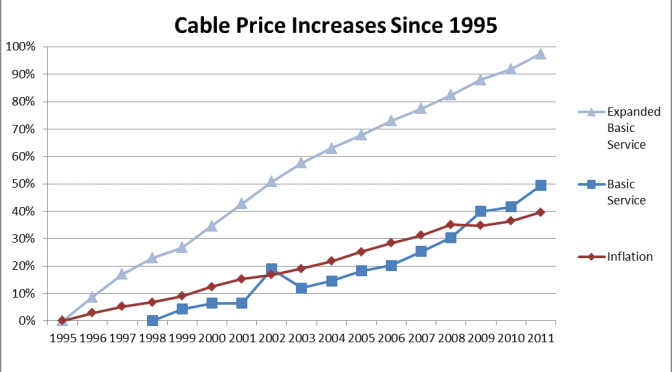
Still, as the networks and local stations seek to increase licensing fees from multichannel providers, those costs are passed on to the consumer in the form of higher bundle prices.  Bundle subscription costs are rising rapidly, and may be nearing a threshold point for many subscribers - the point where their perceived value of the bundle is less than the subscription price.  We're seeing the beginning of this in the rise of cord-cutters - those replacing paid multichannel access with a combination of online and free over-the-air TV sources.

However irrelevant, the claim of paying for unwanted channels is a major theme for those who would prefer to force multichannel services to unbundle channels and offer them to consumers in small focused bundles (like the various Discovery channels), or individually (i.e. "a la carte").  This may seem to be a good deal for consumers - until you realize that going a la carte will, in most cases, reduce audience reach numbers significantly.  One study (discussed here) forecast that forced unbundling could result in a loss of 60% of advertising revenues for cable networks, and result in more than 100 channels going out of business.  And since cable networks would need to significantly increase their a la carte prices to recapture some of those losses, going a la carte would also likely result in higher total costs for cable network access for most consumers.

Meanwhile, some multichannel video providers are finding that the increased licensing demands made by some networks are crossing that value threshold, and are dropping channels, or in one case offering to provide the channel - but only as an a la carte service.  The networks have so far been smart enough to realize that either option is a net loss for them, but the gleam of a licensing El Dorado of unlimited wealth keeps them trying to push licensing fees ever higher.  Viacom, and its package of networks, is the latest battleground, with their channels being dropped by a number of mid-range and smaller cable systems unwilling to cave into their licensing demands.  As one analyst noted,
“The stage is set... As consumers are less interested in large bundles, somebody is going to get hurt in the process by asking for too much.”
If multichannel service providers remained the only option for access, the impact on the industry would be bad enough.  However, they're facing rapid growth in the ability of broadband internet connections to provide access to high-quality TV streams to mobile devices and wired connected devices.  The term OTT (over-the-top) refers to these alternative sources of video and TV content. Both the diffusion and use of these technologies for TV viewing are growing rapidly (see here and here).  Combined with increased time-shifting of programs and place-shifting, audience TV viewing habits are clearly changing.  For cable networks, going online for their content distribution - either as single channels or as a part of a more limited (and much less expensive) bundle offered online - is an increasingly viable supplement, and potential substitute, for traditional delivery media.

The viability of online TV delivery has been a significant component of the "TV Everywhere" marketing push.  The initial conceptualization, though, saw "TV Everywhere" as a way of achieving multichannel services beyond the household's TV sets - and not as a substitute or replacement for those services.  That was one reason for the rapid reaction to the Aereo service.  One would think that local stations and networks would be eager to extend their range of service via mobile as a way of enhancing (or at least maintaining) audience reach.  However, it seemed that the industry hated the notion of a video service that paid no licensing fees; and the courts bought that argument.

More recently, the industry has seen several TV networks pursue the option of offering their programs and content online. The WWE initiated a very successful online subscription service last year, and many of the Pay TV networks have announced plans for providing online access channels separate from multichannel provider subscriptions.  HBO, in particular, is scheduled to provide a separate online channel called HBO Now starting April 12, 2015.  A research report released in January by Park Associates suggested that HBO Now could generate an additional 15 million subscribers.  More critically for multichannel providers, half of those interested in HBO Now said they'd not only be likely to drop HBO pay channels, they'd drop the whole multichannel pay service (about 7 million subscribers).  That's still a big win for HBO, who not only would likely net an added 8 million subscribers, but would not have to split the subscription fee with the multichannel provider.

In addition, CBS has been offering an online video service since last fall, and it is thought that ABC, NBC, and ESPN are considering taking their online video channels public (currently access is limited to subscribers of some of the largest multichannel providers).  Most cable networks provide some access to their content, but not to live streams of the channel.

Still, it's likely that the new DishTV service, Sling-TV, may unleash the deluge.  Sling-TV is an OTT service that bundles a number of the most popular cable networks as a minibundle at a very low subscription price ($20/mo. for about 20 channels), and supplements that with targeted minibundles (sports, movies, children, etc.) at $5 a pop.  The service combines live streams of the network, as well as on-demand access to the previous week's programs. Sling-TV has managed to sign up some 100,000 subscribers in its first month, despite being initially limited to those with a Roku OTT box.

The Sling-TV service could well force the big multichannel services to start unbundling.  It offers an intriguing alternative for those who would be satisfied with a lesser selection of channels.  And even for those viewers who place high value on channels not included in the Sling TV packages, the price contrast between the "big bundle" options ($50-$150+ on new subscriber deals) and Sling-TV will prompt consumers to reconsider if their demand for favorite channels will justify the price differential (and to wonder how the costs of channels they don't want inflate bundle prices).

The big multichannel providers have been shedding TV subscribers slowly, but consistently, for years.  Now that viable and less costly OTT and online video options are coming available, expect the decline in pay TV subscribers to increase, particularly for major MSOs and multichannel providers.

Sources - Updating: HBO Now The Big Test for Cord Cutters?, Online Video Daily VidBlog
Sling TV notches 100,000 users in a month, TechHive
Seventeen percent of U.S. broadband households are likely to subscribe to an OTT HBO service, Parks Associates report.
Provider's Dispute with Viacom Highlights Skirmish Over the Cable Bundle, New York Times

Saturday, August 3, 2013

CBS/TimeWarner Squabble Denies Viewers - UPDATE

Apparently CBS really needs cash - otherwise the retransmission fees fight with TimeWarner would have been settled long ago.  The short version is that stations get to negotiate for compensation from cable and other multichannel video bundlers for the rights to rebroadcast the broadcast station signals every few yeats.  Last Friday was the negotiation deadline, and FCC rules require cable and multichannel systems to drop the broadcast signals if no agreement has been reached.  So TimeWarner dropped the CBS-owned local broadcast stations (mostly in large markets) from their line-ups.

  To add some spice, Time-Warner also dropped all CBS-owned cable networks (including Showtime and TMC) at the same time.

  Then CBS tried retaliating by blocking access to CBS programming through the internet to TimeWarner internet customers.

  From reports, it seems like the hang-up is that CBS wants at least $2/month per subscriber from TimeWarner - a price that is difficult to justify from an economic perspective for a network whose ratings have been falling for decades, and which has been touted as "free TV." (at least when accessed off the air).  While less than rate leader ESPN gets, its more than twice as much as other general interest cable networks are getting.

-- A quick aside - CBS approached me as an outside consultant in the late 1990s as to the retransmission value of their network.  At the time, based on primetime audience viewing share and average cable subscription rates, they thought they ought to be getting $5-7 per month per subscriber.  I had to remind them that viewing isn't the same as willingness to pay, and that pushing for any significant amount in fees would likely be an economic and PR disaster for CBS  After all, they'd be asking people to pay for access to "free" broadcast programming, and cable would gladly advise customers about how to get the programs over-the-air (or these days, offer CBS as a stand-alone a la carte channel and see how many would be willing to pay).  Apparently they didn't like my analysis, because they "forgot" to pay me the agreed stipend (that's why I feel comfortable sharing this with you now).  Still, they didn't push for cash in that round of negotiations, so I guess they felt I had a point.

Since most viewers in those markets have options for getting CBS free (over-the-air and online through CBS.com), or bundled in with other channels from alternative multichannel services, in the long term viewers will figure out how to get what few programs they really want from CBS.  Still, in the short term, lack of "normal" access is likely to hit viewing and ratings hard.  In the meantime, CBS isn't gaining any PR points from their insistence that viewers pay for access to what the network's been touting as "free TV" for years.  TimeWarner isn't helping itself either in the short-term, although they may benefit in the long term as consumers start to learn just how much they're being asked to pay for network programming (those rising fees aren't just cable company greed - they're mostly pass-throughs of retransmission fees from broadcast and cable networks).

Should be fun to watch, although I doubt it'll go on for long - there's too much to lose for both CBS and TimeWarner.

Update:
TimeWarner has made an offer to CBS to include it as an "a la carte" channel, at whatever price CBS wanted.
"Rather than our debating the point, we would allow customers to decide for themselves how much value they ascribe to CBS programming," said TimeWarner CEO Glenn Britt.
CBS dismissed the offer as a "sham" and "PR stunt." Recent statements from media analysts suggest that moving to a la carte could likely cut revenues to networks and program producers in half.  Maybe CBS does know how much value viewers place on access to CBS programming after all.

Sources -  No Deal! CBS and Showtime Go Dark on Time Warner Cable, Deadline-New York
CBS Blocks Time Warner Customers From Watching Full Episodes on CBS.com,  TechCrunch

Monday, February 18, 2013

Dish vs. ESPN over fees

Dish is alleging in a recently-filed lawsuit that ESPN violated a provision in its current carriage deal that Dish says requires ESPN to offer the "same terms" for carriage fees that it offered other major competitors.  In other words, Dish thought it was getting a lowest-cost guarantee.  Instead, they allege that ESPN gave Time Warner Cable a better deal on "ESPN Desportes", and allowed Comcast to drop some carriage (thus fees) of ESPN Classic channel in some of its cable systems.
  ESPN argues that the clause applies to the whole carriage package, and it shouldn't be held to minor differences in terms offered for specific network offerings, or where specific market factors create different marketing foci.  And anyway, as one writer quipped -
One key bit information that hasn't been disclosed: How does one TV distributor know the specific details of another TV distributor’s deal? Aren’t those private contracts?
  The significant growth in network carriage fees (and retrans fees) are having a growing impact on cable, DBS, and other MVPD basic subscription fees - and meaningful differences among the competing multichannel providers can significantly impact on the public's preference among providers. I can see why one (DISH) would want to ensure that their competition couldn't undercut their prices by getting a better rate, just as another (Times Warner) would try to get a better deal.  And of course, why ESPN would want to get the highest carriage fees they can get away with.

  I'm not confident that Dish will win this, but they do provide a glimpse at the level of intense competition among multichannel video program distributors.

Source -  Looking To Combat Sports Network Leverage -- Or At Least, High FeesTV Watch