Showing posts with label online magazines. Show all posts

Tuesday, January 14, 2014

Milepost: Flipboard passes 100 million users

Flipboard, founded in 2009 as a personalized digital app recently announced passing two mileposts - passing 100 million users in December 2013, and hosting more than 5 million individual online magazines.

The ability of users to individually curate online magazines with content from various net sources was added with last March's major upgrade to Flipboard 2.0.  At the time, Flipboard had 50 million users.  The company expects that the expanded platform and search capabilities will have Flipboard passing 150 million users within the year.
"You will see us [in 2014] start to enhance our discovery capabilities, making the discovery capabilities work with all these magazines that people are creating, so that you will be able to discover this stuff,"  (Flipboard founder Mark) McCue says.
To be transparent - I've currently got five Flipboard personal magazines, one in conjunction with/ supplement to this blog JEMS, a limited-term supplement connected with my trip to CES this year JEMS@CES2014.  A third service mag is Media & Audience Research Reports, which links to white papers and research reports available online.  Two more personal curations are The Esoteric Bits and Serendipitous Video.

Source -  Personalized digital magazine app Flipboard aims for 150 million users, The Guardian

Monday, October 7, 2013

Tablets and Magazines - Apps not the solution?

In an article in GigaOm, Jon Lund discusses some not-so-good signs for the long-term viability of tablet magazines: 
I fear the app-based tablet approach to magazines leads straight to oblivion, at least for individual magazine titles.
The problem is that dedicated magazine apps may be getting lost among the multitude of apps on smartphones and tablets.  
Last year, Nielsen estimated the average mobile user has 41 apps on his or her smartphone. In April, a Flurry study showed the average smartphone user opens only eight apps a day, with the most popular being Facebook, YouTube and game apps. And according to a 2012 report from Localytics, 22 percent of all apps are only opened once.
Getting lost in the flood of online information is a problem for all online content - but offset somewhat by the ability to find content through search engines.  But there's a problem with stand-alone magazine apps - search engines don't access apps, so that a magazine's app content isn't indexed, and won't show up on searches.  Similarly, social features within magazine apps are constrained to the app - which really limits connectivity that is at the heart of the social media experience.  And if the app is only updated with new issues, it's up to the reader to remember when to check the app for new content. 

Lund's point is that distributing the magazine online through an app, rather than as a website or other open access platform, lessens its value to online readers.  And that can be reflected in the willingness to pay for a "digital replica" subscription.  Lund looks at the 25 bestselling digital replication editions as measured by the Alliance for Audited Media.  Of the top 25, the digital replication shares of total circulation are in the single digits for 16 titles; the average share of digital replication is 12%.

He also notes that a lot of the reported online reading of magazines is coming from aggregating and curating services like Flipbook and Zite, or from referrals to website content shared through Twitter and Facebook.  Those seem to be the online future for magazines, not as "digital replicas" of print versions.
I believe the future for producing quality content for niches is both bright and promising. But it has to be presented openly, socially, in flow — not in closed tablet apps.
Source -  Why tablet magazines are a failure,  GigaOm

Tuesday, May 14, 2013

Goin' Mobile - Device Differentiation

I've mentioned in a few previous posts that studies are starting to show that mobile device users are starting to differentiate their use and consumption patterns based on the characteristics of the particular mobile devices being used.  A newly released industry analysis b y Adobe Digital Index is providing more insight and support for mobile differentiation.
   To start, the study supports the rapid expansion of mobile and tablet diffusion and use.  The explosion in tablets and their use has been phenomenal - the number of tablets shipped worldwide more than doubled over the last twelve months.  More importantly, in their three years in the market, tablets are already generating more online traffic than smartphones (on a global basis).  A large part of that is the finding that people tend to visit 70% more pages when browsing the internet on tablets than when the browse on their smartphones.  Both tablets and smartphones are each closing in on accounting for 10% of all page views through browsers.
  Traffic using mobile apps is also booming.  In what is a good sign for print media, there was a 200% growth in readers of digital publishing apps from August 2012 to February 2013.  More readers of digital magazines access through tablets than all other media combined.  And tablet use tends to be more frequent and more in-depth than smartphone use.  Specifically, compared to smartphone usage, tablet users open digital publication apps twice as often per month, and read three times as many pages per session.  Tablets account for three-fourths of all online reading sessions.
  Online video use is rapidly going mobile, although the bulk of online video viewing occurs on PCs, or through devices connected to TV sets.  Still, mobile video consumption tripled over the last year, and now accounts for over 10% of all online video viewing.  Here again, despite the much higher penetration rates for smartphones, tablets account for most of the mobile digital video consumption.
  On the retail side, the study found that tablet users are a lot like PC users - they use their devices to compare products and make online purchases.  In contrast, smartphones are used more for quick reference - for price checks, locating stores, restaurants, etc.

Sources - Smartphones and Tablets, Though Mobile, Require Separate Ad Approaches,  Research Brief
State of Mobile Benchmark, Adobe Digital Index research report

Tuesday, November 20, 2012

Tablets - Has Print Found Its Digital Analogue?

Traditional print media outlets didn't have a lot of success going online - at least not at first.  While poor management/judgement was a major contributing factor, I'd suggest that the lack of a convenient reading platform for digital content was just as critical.  You could bring print content to a desktop's screen, but the totality of print bundles (newspapers, magazines, etc.) didn't translate as well, and to be frank, the reading experience from desktops sucks.  You can't quickly skim contents, its not portable, and its tough to share.  News organizations did find audiences for their stories and content online - particularly among those with desktops at work (who could access stories piecemeal during breaks).  However, most news isn't unique - and the Internet also allowed a lot of competition to emerge.  Laptops added some portability, but in the early years were heavy and had low battery life - again not ideal for reading print media products.  Experiments with longer-form content, such as magazines and books, proved the viability of digital forms, but not the desirability of desktops and laptops for extended reading.
  Then came the development of eBook readers - lighter, portable, relatively inexpensive, good battery life, and with a screen size that mimics paperbacks.  The major success of the Amazon Kindle device combined with the Kindle eBook store started an explosion in digital book publishing (see earlier posts here and here).  While Amazon encouraged marketing deals with a number of magazine publishers and newspapers, neither was very successful - at least partially due to the Kindle form factor.  The smaller screen size that was fine for books didn't work as well for the larger magazine and newspaper formats.  In addition, magazines felt constrained by the lack of color and limited advertising opportunities.  Newspaper readers had to remember to download daily versions (via link to desktop or a less-than-ubiquitous Wifi connection), and the refresh delays of early e-Ink based readers proved frustrating for those wanting a quick skim of articles.
  Next came smartphones, which offered constant & widespread connectivity, was easily portable, and had decent battery life.  Amazon and other eBook sellers quickly offered free reader apps, but the tiny screen proved problematic for books and magazines.  With newspapers, however, smartphones opened a new niche market for news - as an access point for headlines and breaking news (particularly sports and weather), and with the possibility of providing apps that could push news to an interested readership.  Apps also facilitated monetization, whether through subscriptions, individualized ads, or sales (of focused apps).
  Then came the iPad.  It offered a sleek, highly-portable connected device with a large (comparably) color touchscreen.  For book publishing, it was like an eReader on steroids - larger, faster, with multimedia capabilities (audio, video, links) built-in, where the action to turn a page mimicked traditional media page-turning. (See earlier post)  Tablets weren't merely an option for reading device - they started expanding the concept of books and texts, and their markets (textbooks in particular, see here and here).  And most importantly, eBook readers weren't just reading more free books; they were buying more books (post on Harris study).  Adding tablets to the expanding eReader base has ramped up diffusion and the development of digital book publishing.
   The combination of the iPad and the Flipboard app provided an exemplary demonstration of the potential for tablets as a digital platform for magazines as well as news.  The iPad provided a high-resolution colour screen, which while smaller than most print magazine formats, was large enough to provide quality read that magazines sought.  Flipboard provided a test base for content bundling and reading experience that also came close to the magazine ideal - easily skimmed, able to integrate text and image, and to go deeper with a tap or continue to the next "page" with a swipe reminiscent of turning a page.  And the ability to seamlessly integrate advertising.  The experience is so exemplary that it passed 20 million users and 2000 content providers last summers.
   It would seem that tablets offer a viable digital platform for the consumption of traditionally print content forms, when combined with growing broadband access.  On the other hand, tablets are proving to be excellent platforms for Internet access, for delivering audio and video, as well as a good gaming platform, and a reasonable computing platform.  So the question for traditional print outlets is will readers embrace tablets, and how the rise of print through tablets will impact product demand.

  For the last year or so, a wide range of trade and academic studies suggest that tablets may provide a viable digital solution for print content delivery.  The latest study to come out is from analytics firm comScore,  They surveyed a rolling sample of U.S. tablet owners for three months, ending in August, and found that reading on tablets continues to increase.
“Tablets are fundamentally redefining how people consume news and information, with the format more conducive to reading longer form content than PCs or smartphones,” said Mark Donovan, comScore SVP of Mobile. “In the case of online newspapers, tablets are now driving 7 percent of total page views, an impressive figure considering the relative infancy of the tablet space. Publishers that understand how these devices are shifting consumption dynamics will be best positioned to leverage this platform to not only drive incremental engagement among current subscribers but also attract new readers.”
  More than a third (37.1%) of tablet owners use their device to read a newspaper at least once a month, and 11.5% report reading newspapers on their tablets daily.  Magazine readership through tablets was around the same - 39.6% read magazines on their tablets at least monthly, and 9.7% reported reading magazines on their tablets daily. Readership is highest among the 25-34 demographic.  An interesting aspect of the report was that tablet newspaper readers weren't very different from tablet magazine readers in terms of demographics, or in terms of the specific tablets that were used for reading (iPads, Android tablets, Kindle Fire, NOOK tablet). 

  The comScore study results, in terms of increasing use of tablets for media consumption, fall in line with a wealth of other studies.  And the consistency in user demographic breakdowns raises some interesting questions - is this a reflection of a audience segment of regular (heavy) readers, who use whatever platforms are available? Do they see tablets as a supplement to print outlets, a complement, or a substitute?
  At this point, I think that tablets are proving to be a valuable digital platform for the delivery of a wide range of traditional media content - and the first decent substitute for print.

Sources - Tablets Capturing Newspaper Viewers, Research Brief (MediaPost blog)
Tablets Reinvent Americans' Relationship with Print,  comScore press release

Thursday, October 18, 2012

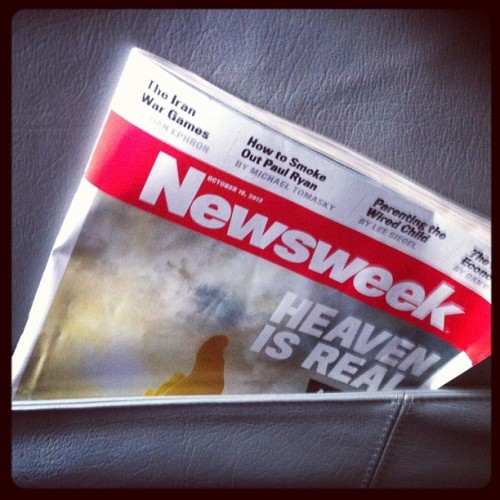
Newsweek to abandon print

Many hoped that Newsweek's fire sale (price - One dollar) two years ago would rejuvenate the troubled news magazine.  Reaction when Tina Brown was named Editor-In-Chief was more mixed.  But three months ago the family of the late Sidney Harman (Newsweek's purchaser) pulled their financial support. At that point most analysts felt that the end was near for what had been a heavily subsidized print edition.
  Then came the announcement yesterday - not in the print magazine, or its online edition, but on The Daily Beast website - that Newsweek would stop publishing a print edition with the Dec. 31 2012 issue. Newsweek execs said they would rebrand the online remnants as Newsweek Global and continue to rely on subscriptions from online readers for revenues.
The new publication will be "a single, worldwide edition targeted for a highly mobile, opinion-leading audience who want to learn about world events in a sophisticated context," the statement said.

"This decision is not about the quality of the brand or the journalism--that is as powerful as ever," (Tina Brown) wrote in a statement on the Daily Beast website. "It is about the challenging economics of print publishing and distribution."

  Brown is somewhat correct in terms of the economics of print - its certainly more costly than online distribution.  But many print magazines are successful.  The more fundamental problem is on the revenue side - not enough people think the print edition and its content is worth buying to cover the editorial and print distribution costs.  While Newsweek was historically a proud and valuable brand - it's continuing decline and failure in the magazine marketplace suggests that the quality of the brand and its journalism is a major part of the outlet's decline.

Source - Newsweek to End Print EditionWall Street Journal

Wednesday, August 29, 2012

Milestone: Flipboard passes 20 Million, Adds Video

Flipboard is a tablet must-have app - it's a combination content aggregator and specialized display system that sets the standard for online magazine/print content display on touch-screen tablets.Flipbook lets you choose to integrate content from multiple content platforms and social networks to create individualized online "social magazine."
Flipboard first launched on Apple's iPad in July 2010. Two years later, the app now boasts 20 million total users and 1.5 million daily users, adding a new user every second of the day. In addition, Flipboard averages 86 minutes per user per month, generating 3 billion page flips every 30 days.
Flipboard currently can access content from more than 2000 content partners, including a number of major news outlets (The New York Times, the Associated Press, ABC News, CBS News, and NPR).  It's also expanded to Android-based mobile platforms.
  And it's now adding video pages powered by YouTube channels, including channels focusing on music, fashion, cooking, science, news, and one featuring "Influencers."

If you don't have Flipboard on your mobile device, you're missing out on something special.

Source -  Flipboard unveils curated mobile video features, tops 20M usersFierce Mobile Content

Friday, April 27, 2012

Vis-a-Vis for Free (Forever)

Post contributed by Clara Reed -


Traditionally, magazines have been printed and sold on the stands at grocery stores, bookstores and street corners. With the emergence of the digital age, the magazine industry is looking to revamp their style and translate formats for the tablet.
  While many magazines contemplate how to do this, some start-ups have jumped int the mobile tablet market.  One example is Vis à Vis, a digital, interactive magazine from Spain. They designed the magazine with the iPad in mind, and now seven journalists work together in a small office to bring this magazine to life.
"Journalism is going through a phase in which either you undertake your own idea or you have to conform to the reality of market," said Laura Blanco, the magazine's editor in chief.
The name Vis à Vis means “face to face,” and the content of the magazine contains just that; face to face interviews of prominent figures in television, sports, fashion and gastronomy.
  With this venture, Vis à Vis looks to “reinvent” magazine journalism, using the features and capabilities of the digital tablet form.  And perhaps providing some lessons for other magazines as they seek to “digitalize.” The Vis à Vis team hasn't stopped there - they use social networks for getting word out about their magazine, and them credit for helping to quickly build an audience. They are working on the third edition, in which “the team has already secured the first advertisements that will finance the project.”
From the audience perspective, interest is fueled by their motto of “Free Forever,” meaning that it’s free of charge to online readers.


Source: Spain’s iPad Mag, Vis a Vis, Shows Growth, Points to New Path, PBS MediaShift blog

BJB - edited for style

Wednesday, April 25, 2012

App for UGC online magazines

Post contributed by Clara Reed -


“Create Your Own Magazine”
  Adding another innovation to the Web 2.0 world, YouTube founders Chad Hurley and Steven Chen are working on a new project known as “Zeen.” This app will allow users to “discover & create beautiful magazines.” Not much is known yet about Hurley and Chen’s latest venture, but it is rumored that an announcement about the site will be made at The Next Web Conference later this month.
  With hits like Pinterest, Zeen is believed to be a sort of creative “sharing site with a DIY twist.” Those of us with a creative mind will be able to make our own virtual magazine tailored to individual preferences.
  As of now, Zeen’s website features a box where you can request a username and reads “Coming soon” below the name and phrase stating the purpose of the site. '
  While websites like Pinterest, Flickr and Tumblr have been successful, it’s hard to say if the launch of Zeen will be as ground breaking, but with more and more people wanting to produce original content, it could provide another outlet for people to do so.

Source: Zeen: New Magazine-Creating AppBangstyle blog

BJB - some editing for style

Friday, April 13, 2012

Taking Magazines Mobile - a first step

Post contributed by Nicholas Belitz -


Magazines ON-Demand
  There is a new way to read your favorite magazines. A new service was launched in the first week of April, this service is called Next Issue Media. There is a new app available to Android users running Honeycomb, the iPad version is still in the works according to tech news site Gizmodo. The app is free, but it requires a subscription that ranges from $10 t0 $15 depending on whether the readers want access to weekly magazines or just want monthly magazines. There are 35 titles available now including “Popular Mechanics” and “Car and Driver”. There are more titles that are expected to become available in the coming weeks. The subscription includes unlimited access to as many magazines as users want.
"You download the Next Issue Media reader once, and all the magazines will be presented there in single format," Morgan Guenther, CEO of Next Issue Media said. "We think we'll have a compelling proposition."
Source:  Major Publishing Consortium Ready to Launch "Hulu for Magazines," Gizmodo

BJB -  This is more than an app, but a new marketing strategy - instead of paying for individual issues or magazine subscriptions, subscribers would pay a monthly fee for access to a range of magazines offered by a number of different publishers.  The move from sales to bundled access is new to the magazine industry as well as magazine readers.  It's an interesting extension of the rights-locker / Cloud approach and coming at a time when print magazines are exploring their digital options.  Still, for now, the app is available only on one operating system, and it's not the one that dominates the tablet market - so it's potential as a transformative application seems limited at this point. 

Thursday, February 9, 2012

Tablets and Magazine Readers

New research results from a panel of tablet owners (GfK MRI's iPanel of tablet and eReader owners), shows strong interest in reading digital magazines.
In a survey taken last month, 71% of tablet owners reported having at least some interest in reading magazines on their devices.  Some 38% had reported reading a magazine on their tablets in the last six months.  In contrast with print magazines, there was stronger interest among men, and among the younger demographic.  For the Male 18-34 segment, 85% expressed some or considerable interest in reading digital magazines. 
Risa Becker, SVP Research at GfK MRI, says "The fact that younger men who own Tablets are interested in reading digital magazines bodes well for digital magazine advertisers, since this demographic has been historically hard to reach."
Another good sign for digital magazines is that about 20% of tablet owners who read a magazine on their device also read back issues during their reading session.
   Apps remain the dominant access point for digital magazines, with two-thirds of the tablet owners saying they got to the online magazine through an app (47% accessed magazine content through the magazine's website, and 37% read a digital reproduction (both content and ads).  And yes, this adds to more than 100%, which indicates that some are reading more than one magazine on their device a month.
  GfK MRI's also put together a short video on their digital magazine results.

Source - Tablets Attract Magazine ReadersResearch Brief from the Center for Media Researh

Thursday, February 2, 2012

Go Digital, Young Magazine

New research from GfK MRI's iPanel suggests that table owners are highly interested in reading digital magazines.  (The iPanel consists of individuals who own tablets and/or eBook readers).  Overall, more than 70% of the sample expressed an interest in reading digital magazines on their devices.  Interestingly, interest was higher for younger and male users - 85% of males 18-34 (77% of all males) vs. 78% of females 18-34 (68% of all females).
Risa Becker, senior vice president of research for GfK MRI, observed: “The fact that younger men who own tablets are interested in reading digital magazines bodes well for digital magazine advertisers, since this demographic has been historically hard to reach.”
   The research also found that most tablet owners who had read a digital magazine in the last month had done so through an app (65%), while 47% accessed magazine content through the magazines website, and 37% read a stand-alone digital version.  (The percentages add to more than 100% because some tablet owners read more than 1 magazine in that time period, and accessed them via different methods).
  The research also revealed an interest in reading back issues - about one in five people who read a digital magazine also read back issues of the same title.

Source - Digital Magazines Popular, Men Hold Edge,  Online Media Daily

Monday, December 5, 2011

Glamour tests interactive mobile

Post contributed by Krystyna Barnard -

In a recent Folio post, TJ Raphael wrote about how “interactive mobile tactics drove social engagement for content and advertisers.” The magazine did this by implementing Social SnapTag technology into both print and digital editions of their magazine, which enabled readers to access packaging or promotional deals they see in the magazine. It also enabled the magazine to target various consumers and increase consumer communication via social networking sites through a sense of mass marketing. Raphael writes that the Social SnapTag is similar to the QR code, however, users don’t need a QR scanner or smartphone to interact with the program. As a result of Social SnapTag, approximately 67 percent of consumers who used the program also “liked” the magazine, Raphael also wrote. It just goes to show how prevalent social media has become in today’s technologically advanced society, not only for consumers, but for producers as well. 

Source - Glamour Gets 50,000 ‘Likes’ From Social Media Campaign,  Folio.com

Tuesday, November 29, 2011

Fire's Focus on Print

Blog contributed by Krystyna Barnard -

MinOnline, a sister site of Folio, recently posted an article on the much anticipated launch of Amazon's Kindle Fire tablet.  In that article, Steve Smith wrote about the increasing competition between tablets  from Amazon and Barnes & Noble. Smith discusses the Kindle Fire and how it will include a “Newsstand,” similar to that of the Apple iOS 5, in which they will also sell subscriptions and issues of various magazines and newspapers. Major publishers were to include Condé Nast, Hearst, National Geographic, Meredith, Wenner, Reader’s Digest, etc. Amazon is working with many of these publishers to optimize their online offerings for the Kindle.
The recently released Kindle Fire includes a 7-inch screen that’s perfect for browsing full-color pages of magazines with 169 DPI graphics, a dual-core processor to enhance processing speed, and Wi-Fi. The current listing price for the Kindle Fire is $199.

Source - “Kindle Fire to Launch with 400 Magazines and Newspapers.”,  MinOnline

Glossy Fashion moves Online

Post contributed by Rachel Cobb -

The senior accessories editor of Vogue, Filipa Fino,  resigned last June to start an online fashion magazine devoted to accessories, Fino File  (a holiday preview issue is available here).  She is focusing a lot of fashion bloggers, a huge trend that is emerging.  It is a bit bittersweet, because it is yet again another sign that print media is failing, but it is still exciting news to watch this new realm of blogging take control of the magazine industry too.  It is inspiring for young writers to know that they are being noticed and that they can make an impact that even the big dogs like Vogue notice.

Source -  Filipa Fino Tells Us Why Her New Online Mag Fino File Won't Be Like Vogue,  Fashionista.com

Wednesday, October 5, 2011

One approach for online paid content

From Britney Dourgherty -

Producing online content for profit has been a growing headache for many media companies. Many consumers no longer purchase or read print media and expect to be able to get their information online at any time. They also seem to expect to do it for free.

Some companies have begun requiring people to pay for their online content. Sometimes consumers have to subscribe to the print publication or to the website itself. Another way to do it is to have them buy each issue online or individual articles. Interweave, a company that produces magazines about various crafts, has successfully done this and taken it a step further. They now have magazines strictly available on the iPad. They use a system where users can download the app for free then buy individual issues of the magazines for $9.99.

Vice president John Bolton says, “More than 90% of our eMag revenue comes for single issue sales, while less than 10% comes from sponsorship revenue. We do not currently sell subscriptions to our eMags, but we plan to have a subscription product launched by January 2012." My bet is that many companies will be following Interweave’s example and change their online and tablet content to make them more money.

Source: “Interweave Brings Successful Paid eMag Model to iPadMinOnline.com

Monday, September 26, 2011

Design online

Post submitted by Britney Dougherty -

We are all very familiar with e-commerce. Almost every website we visit contains at least some advertising. One of the challenges media companies and advertisers are currently facing is how to make the transition from the web on a computer to the web on a tablet. There are questions like how much should there be, where will it fit and how do we make it jump out at users. Stefanie Botelho for FOLIO magazine spoke with Alex Schmelkin. Schmelkin is president at Alexander Interactions, a company that provides solutions for e-commerce. He has plans for these new problems with the move to the tablet.

“It’s important to minimize the navigation, and the clutter…with media sites like NYT or TIME magazine, there could be literally hundreds of links above the fold. This doesn’t work when it comes to the tablet. We need to prioritize to keep the truly most important info on top.”

He is not sure how to easily excite consumers with the ads. One of the most used ways is now ineffective.

“Over the years, web designers like us have overused the concept of when you hover over a certain part of the page, something big happens,” Schmelkin says.

During the next few years, we will surely see new ideas and methods of e-commerce on tablets, or t-commerce.

Source: “E-Commerce Solutions for The Tablet Transition,” FOLIOmag.com

editted to add headline, address some formatting issues.

Friday, August 26, 2011

Flipboard to add TV, and ads

If you have an iPad and don't have the Flipboard app, you really need to get it.  Sometimes labeled as a "social media magazine", Flipboard works as a personalized aggregator of various information and content feeds, reformatting content from user-selected information feeds into a very user-friendly and multiple media-friendly interactive display reminiscent of a digital magazine. It is also highly integrated with social media, letting you share content and comments with friends and followers.  The basic app is free, but limited to the iPad for now (there are rumours of an iPhone version being available in the near future)  It recently launched its first advertising program, partnering with magazine publisher Conde Nast.  The program will insert targeted ad pages into the content from affiliated content feeds.

Flipboard is a great example of how the innovative exploitation of the potential of new devices and systems can add value to content.  At this point, Flipboard has featured ties to more traditional media sources (for example, The Economist and The New Yorker), social media (Facebook and Twitter), news (BBC News, ABC News) and a variety of focused information services (National Geographic photography, Lonely Planet on travel).  It's been named iPad app of the year by Apple, and one of Time Magazines top 50 innovations in 2010.

While the application has fully integrated audio and video capabilities from the beginning, the early focus on print-based resources relegated that capacity to playing an occasional clip.  Now Flipboard is working to make deals with movie and TV producers and distributors to make more video content available through their app by the end of the year.  A greater inclusion of video and audio content should bring in whole new user demos, and expand its reach.

I wouldn't be surprised if Flipboard becomes one of the next huge-dollar Internet acquisitions.

Source - Flipboard's New Ads Aren't Just for Magazines, ReadWriteWeb
Flipboard to add films and TV to iPad app,  The Telegraph

Sunday, August 21, 2011

Interactive Ads better for Digital Mags

Research from Affinity's VISTA Digital service (which tracks digital magazine use on iPads and other mobile devices) show that readers prefer interactive ads to static ads.  Looking at use of interactive ads with video, those who tapped through to the ad content gained from the effort - 88% said they enjoyed the experience, 87% said it enhanced the magazine experience, 88% said they learned more about the product, and 89% saw the brand as innovative.  The numbers were even higher for photo galleries (scores in the 91-93% range.  This supports other research from GfK MRI that reported that 55% of consumers reading magazines on tablets "noted" ads, compared to 41% of digital magazine readers using the less interactive e-readers.

Exploiting the potential for interactivity in systems and technology, in a meaningful way, looks to be a benefit that other media can also explore.

Source - Interactive Ads Pay Off for Digital MagsMediaDailyNews

Tuesday, August 9, 2011

Most Innovative Digital Magazines

Affinity's American Magazine Study, Spring 2011, tracked 172 digital magazine brands, their content and features on various digital platforms, and consumers perceptions about them. Digital platforms included magazine websites, social network use, mobile apps, and other digital delivery systems, as well as full digital versions.
The study came up with a number of "mosts" - "Most Trusted" (WebMD), "Most Entertaining" (Maxim), "Most Authoritative" (The Economist), "Most Enjoyable" (Playboy), and "Most Interesting" (Smithsonian), among others.
The folks at Affinity felt that the most critical criteria for online magazines was "Most Innovative", because

"magazines are now competing with all of the content and advertising available in digital form, not just their traditional set of print competitors. Only those brands that leverage the latest technologies in creative ways and offer consumers interactive and meaningful experiences will stand out among digital users."

The top 10 "most innovative" were 1. Dwell, 2. Popular Science, 3. Architectural Digest, 4. Wired, 5. Mother Earth News, 6. Fast Company, 7. Organic Gardening, 8. Elle Decor, 9. Martha Stewart Living, and 10. Popular Mechanics.

Source: "Dwell On This: Which Digital Magazine Do Readers Deem Most Innovative?" MediaDaily News

Tuesday, May 17, 2011

Android's Nook features Magazines

Barnes & Noble has updated its Nook e-reader app for Android, offering access to tablet magazines through a free reader for the first time.  The new app promises to provide access "to more than 140 magazines and newspapers, including ESPN The Magazine, The Economist, Rolling Stone, Travel + Leisure and Us Weekly." (Access was previously restricted to users of their Nook Color device).  This follows last month's introduction of a Kindle app for Android devices.
Several of the larger publishers (Nearst, Time Inc., Conde Nast) have been working with Apple to offer subscriptions (or free access to print subscribers) on the iPad.  One of the sticking points at the moment is the level of compensation Apple is seeking as developer/distributor of apps and online versions.


Source: "Upgraded Nook: Android App Carries 140+ Publications," Online Media Daily