Chart for Today -
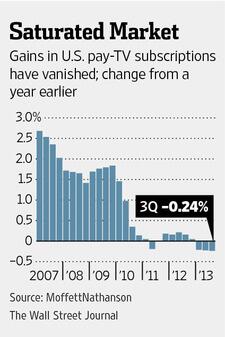
The chart, from The Wall Street Journal, looks at the change in pay-TV subscriptions from the same time a year earlier. That is, it's examining the annual growth rate of pay TV subscriptions, which in the U.S. dropped to near zero midway through 2010, and have been relatively stable since then.
Breaking down the numbers, cable and DBS systems are heavy losers, but most of those losses are being offset by gains from teleco cable systems. One reason cable companies are indicating a refocus on broadband Internet access rather than multichannel TV in their current business strategies.
Source - Fewer people in the U.S. are subscribing to pay-TV, Wall Street Journal Twitter feed.
This blog is affiliated with a course at the School of Journalism & Electronic Media at the University of Tennessee, Knoxville. I'll try to use it to share relevant news and information with the class, and anyone else who's interested.
Showing posts with label IPTV. Show all posts
Monday, January 27, 2014
Sunday, November 11, 2012
Hulu Kids - It's Ad-Free
Hulu has launched a special ad-free Kids Section on its website and its PS3 app. The site may be ad-free, but it isn't free - all of the 43 currently available shows are only accessible by Hulu Plus subscribers. Including Spongebob Squarepants.
Source - Hulu Debuts Ad-Free Kids Section, OnlineMediaDaily
Wednesday, September 26, 2012
TV, Media Execs Embrace Multi-Platform Distribution
A recent survey of broadcasters and media executives found that three out of four believe that online, social, and mobile platforms are driving audiences to watch more television content.
The Avid broadcast survey interviewed more than 200 "executives and decision-makers from leading broadcast and post and professional organizations in Europe and North America," who were asked questions about where they thought their businesses were headed, and the role and impact of a variety of digital delivery platforms.
Two thirds of the media organizations indicated that they were optimistic about their future, despite declining audiences and revenues in many traditional media operations. The optimism was more than wishful thinking - it was linked to the belief that new digital distribution platforms would offer "unprecedented" opportunity for business growth. The researchers identified three drivers for continued growth - increased audiences, multiplatform distribution (MPD), and revenues growth potential from both advertising and audience payments.
As noted above, 74% of respondents agreed with the statement that the Internet (digital video delivery) will also drive viewers to more traditional linear media (Broadcast, Cable, Satellite). As for fears of digital options further fragmenting their markets, more than half (55%) of the executives felt that current economic uncertainty was a bigger threat. They also felt that current and emerging digital video delivery options gave them entry into new and expanded markets - an entry that could be exploited in a variety of ways. 85% of respondents said that multiplatform distribution was critical to capturing new markets and their growth potential.
One largely undeveloped opportunity is the ability to access and exploit existing content archives. Respondents felt that, on average, 40% of existing archives could be monetized (potentially profitable) - but at this point they felt that only a fourth of their archives were accessible. Expanding access could make more valuable content readily available. The survey found that 83% of respondents felt that all premium video services would be available online, as a means of increasing accessibility and market size. Almost tw0-thirds (63%) also felt that MPD opened a new market for professional content. But most critically, the media executives seemed to be recognizing the full range of opportunities that multiple digital platforms offer - not only access new and expanded markets, but potential to add value to their content streams by customizing them to specific platforms and individual customers. Adding value increases demand generally, and if high enough, it can justify direct payments from consumers.
Survey participants also thought that moving towards an emphasis on exploiting content assets, by expanding accessibility or adding value through customization, could also be beneficial on the operations/cost side. When asked about the potential effects of an increased emphasis on asset-based workflows, 75% felt it would increase business efficiency and the bottom line, and two-thirds (67%) felt it would enable new business models. More specifically, 79% felt that implementing asset-based workflows would enhance operational agility, 69% indicated it would enable better automation, and 62% thought it would largely solve the problem of increasing content volume.
Exploring new business models and markets opens the way for new growth opportunities at a time when the traditional broadcast model appears static or in decline. The media executives recognize this, and are looking for their future growth to occur in other areas: 85% see growth potential in multi-platform services; 78% look to new markets and increased audiences for growth; 71% feel those increased channels and audiences will lead to increased advertising revenues; and 70% see growth from audience direct revenues (fees/sales). There's also a general recognition of the potential of the Cloud; almost all respondents indicated they were already using the Cloud (24%) or exploring how to use the Cloud in their future operations (75%)
For me, the survey results confirm that today's broadcasting and media executives now recognize the fundamental market transformation that digital has brought - they no longer see themselves as monolithic "broadcasters" relying on long-established revenue streams. They have recognized that they're primarily purveyors of content in an increasingly competitive market; that the source of their value is content and not merely a signal; and they should seek and embrace multiple mechanisms for exploiting their content and the multiple revenue streams available. While the various MPD options have yet to show they can fully replace losses in traditional revenue streams, early efforts suggest that when fully developed, the added revenues from multiple streams and operational savings could provide the basis for broadcaster survival into the future.
Sources - Multiple Digital Platforms Boost TV Viewing, Research Brief blog
To request research results, go to Avid/Ovum The Future of Digital Media Survey
The Avid broadcast survey interviewed more than 200 "executives and decision-makers from leading broadcast and post and professional organizations in Europe and North America," who were asked questions about where they thought their businesses were headed, and the role and impact of a variety of digital delivery platforms.
Two thirds of the media organizations indicated that they were optimistic about their future, despite declining audiences and revenues in many traditional media operations. The optimism was more than wishful thinking - it was linked to the belief that new digital distribution platforms would offer "unprecedented" opportunity for business growth. The researchers identified three drivers for continued growth - increased audiences, multiplatform distribution (MPD), and revenues growth potential from both advertising and audience payments.
As noted above, 74% of respondents agreed with the statement that the Internet (digital video delivery) will also drive viewers to more traditional linear media (Broadcast, Cable, Satellite). As for fears of digital options further fragmenting their markets, more than half (55%) of the executives felt that current economic uncertainty was a bigger threat. They also felt that current and emerging digital video delivery options gave them entry into new and expanded markets - an entry that could be exploited in a variety of ways. 85% of respondents said that multiplatform distribution was critical to capturing new markets and their growth potential.
One largely undeveloped opportunity is the ability to access and exploit existing content archives. Respondents felt that, on average, 40% of existing archives could be monetized (potentially profitable) - but at this point they felt that only a fourth of their archives were accessible. Expanding access could make more valuable content readily available. The survey found that 83% of respondents felt that all premium video services would be available online, as a means of increasing accessibility and market size. Almost tw0-thirds (63%) also felt that MPD opened a new market for professional content. But most critically, the media executives seemed to be recognizing the full range of opportunities that multiple digital platforms offer - not only access new and expanded markets, but potential to add value to their content streams by customizing them to specific platforms and individual customers. Adding value increases demand generally, and if high enough, it can justify direct payments from consumers.
Gary Greenfield, CEO and chairman of Avid, says "... media organizations worldwide are moving from addressing homogenous audiences to delivering personalized experiences... this change in the relationship between broadcasters and their audiences... forces a change in business models... “More than three-quarters of those surveyed (78%) thought that within the next ten years, most of the content delivered would be customized for individual viewer preferences. 70% felt that most content would also be optimized for the particular device viewers are watching the content on.
Survey participants also thought that moving towards an emphasis on exploiting content assets, by expanding accessibility or adding value through customization, could also be beneficial on the operations/cost side. When asked about the potential effects of an increased emphasis on asset-based workflows, 75% felt it would increase business efficiency and the bottom line, and two-thirds (67%) felt it would enable new business models. More specifically, 79% felt that implementing asset-based workflows would enhance operational agility, 69% indicated it would enable better automation, and 62% thought it would largely solve the problem of increasing content volume.
Exploring new business models and markets opens the way for new growth opportunities at a time when the traditional broadcast model appears static or in decline. The media executives recognize this, and are looking for their future growth to occur in other areas: 85% see growth potential in multi-platform services; 78% look to new markets and increased audiences for growth; 71% feel those increased channels and audiences will lead to increased advertising revenues; and 70% see growth from audience direct revenues (fees/sales). There's also a general recognition of the potential of the Cloud; almost all respondents indicated they were already using the Cloud (24%) or exploring how to use the Cloud in their future operations (75%)
For me, the survey results confirm that today's broadcasting and media executives now recognize the fundamental market transformation that digital has brought - they no longer see themselves as monolithic "broadcasters" relying on long-established revenue streams. They have recognized that they're primarily purveyors of content in an increasingly competitive market; that the source of their value is content and not merely a signal; and they should seek and embrace multiple mechanisms for exploiting their content and the multiple revenue streams available. While the various MPD options have yet to show they can fully replace losses in traditional revenue streams, early efforts suggest that when fully developed, the added revenues from multiple streams and operational savings could provide the basis for broadcaster survival into the future.
Sources - Multiple Digital Platforms Boost TV Viewing, Research Brief blog
To request research results, go to Avid/Ovum The Future of Digital Media Survey
Monday, September 24, 2012
Move towards Global IPTV Cloud
A new service, called PurpleCloud, aims to provide a Cloud-based broadband IPTV service to allow Asian and Indian broadcasters access to the North American, European, and Australian markets.
The service is a joint venture of Octoshape (provider of cloud-based streaming technology) and video content delivery specialist PurpleStream. The combination of the two companies' cloud and streaming management technologies should allow the PurpleCloud system to optimize streams to available bandwidth and user devices, allowing users to access streamed content on any Internet-enabled device without buffering. Offered as a managed service for broadcasters and OTT operators, PurpleCloud is intended to deliver "stable and dependable HD quality video streams to any device, any platform, in any geography at a fraction of the cost of current delivery services," the press release added.
The two primary delivery mechanisms for broadcasters seeking to reach international audiences are satellites and dedicated Internet-based channels - both of which can be prohibitively expensive for smaller channels and networks, or even leading networks from smaller markets (countries). The service aims to continue adding content partners and is working on getting the PurpleCloud service added to SmartTV and OTT service bundles. The next stage will be expansion into the live events broadcast market.
Source - PurpleStream and Octoshape team to create PurpleCloud global IPTV service, FierceIPTV
Monday, August 20, 2012
Apple's TV interest in Cable Rebuffed
A couple of weeks ago, it was reported that Apple was approaching several large cable MSOs about the possibility of providing set-top boxes that would integrate Apple TV interfaces and services. It's become fairly clear that cable operators have not exactly embraced the idea. The Wall Street Journal has a good story on the cable industry's reaction, suggesting that Apple's seems to be focused more on delivering its software and services than providing hardware.
Moreover, a new report from Bernstein Research suggests that there are meaningful differences between the mobile world, where Apple has been quite successful, and the market for multichannel TV services.
Sources - Apple: High Hurdles to Working with Cable Guys, Bernstein Says, Barron's
Apple's New Front in Battle for TV, Wall Street Journal
Moreover, a new report from Bernstein Research suggests that there are meaningful differences between the mobile world, where Apple has been quite successful, and the market for multichannel TV services.
Not only does the cable TV market, unlike mobile, feature network distributors that also own content, it does not subsidize end user devices, and it is heavily involved in determining the capabilities of those end user set-top box. That final point, in particular, is something that service providers in the mobile market pretty much ceded to Apple.Bernstein's report suggests that Apple might find the differences difficult to overcome. More critically, the primary focus of multichannel has been to provide the widest range of choices to subscribers, and Apple has been insistent on providing what's called a "walled garden" - a limited set of services that conform to Apple's standards. I think that that's going to stand in the way of their move into TV, if they continue to insist on that approach.
Sources - Apple: High Hurdles to Working with Cable Guys, Bernstein Says, Barron's
Apple's New Front in Battle for TV, Wall Street Journal
Friday, August 3, 2012
PwC - IPTV Key for Australian Media
Global analyst firm PricewaterhouseCooper (PwC) released its Australian Entertainment & Media Outlook report for 2012-2016. The report predicted that IPTV and other online television subscription services would lead the way in growing the Australian media & entertainment market 18% over the next five years. The report suggests that by 2017, more than a quarter of Australians will have switched to IPTV subscription services, concluding that the shift "makes IPTV a strong market contender among the boxes vying to control content shown in Australian living rooms."
The study forecast an overall annual growth rate of 4.1 percent for Australia's media $ entertainment industries, despite continuing declines in the print sectors. The report predicts that newspapers will see circulation declines average 7.6 percent annually, and drops in advertising revenues of 5.1 percent per year.The report recommended patience as emerging new online business models will take some time to fully develop. It also had some recommendations for policy, warning that
"some types of Australian content--drama, documentary and children's programming-- would all but disappear if it were not regulated, due to the high costs of production."Content, in fact, was a critical concern in terms of the future success of media and entertainment industries, firms, and markets. PwC analyst David Wiadrowski warned that content "cannot be taken for granted. Popular professional content that crosses platforms, aggregates viewers, prompts recommendation and lights up social media, becomes increasingly valuable."
Source - IPTV seen as important piece of Australian media and entertainment industry future FierceIPTV
Thursday, August 2, 2012
Time for TV Everywhere Critical Mass?
Jeff Heynen, directing analyst for broadband access and video at Infonetics Research thinks 2012 will be a watershed year for 'TV Everywhere', predicting that cable giants Comcast and Time-Warner will push implementation and diffusion of the service. The question will then be what impact will 'TV Everywhere' services have on subscriber churn and revenue.
The prediction is based on two Infonetics Research reports on sales and orders for MVPD equipment and set-top boxes. Taken together, the two reports suggest that the global video infrastructure market will grow by 8% this year, with sales of more than $875 million. Much of the growth is expected to be in Asia, with China outspending both the North American and European markets in investment in Video on Demand and video streaming hardware. The reports also suggested that IPTV growth pushes streaming equipment demand - predicting that IPTV subscriber base doubling in the next four years.Infonetics projects set-top box growth to be somewhat slower, generating about $14.7 billion in 2012. They also see a shift from basic cable and satellite STBs to hybrid models that include IP video capabilities.
"TV Everywhere and other multi-screen video initiatives are fundamentally changing the TV business model, which apps streaming live TV to iPads and telcos and cable companies offering home automation security and video conferencing to subscribers in an effort to make the TV the hub of the digital home," Heynen said. "Demand for digital, HD and premium video content and services will continue to drive revenue growth in the VoD and encoder market."
Source - Infonetics: 2012 a 'watershed year' for TV Everywhere services, FierceOnlineVideo
Wednesday, June 13, 2012
Television's Digital Future (online)
Television has already undergone one digital revolution - the shift to digital transmission systems for both terrestrial and satellite broadcasting. It's facing another in the Internet and online video distribution.
When the Senate held hearings of the future of television in April, however, the focus was on traditional regulation of traditional TV media (broadcasting, cable, satellite). One commenter on GigaOm, Stacey Higginbotham, concluded that the Senate hearing had it all wrong -
The future of TV isn’t to be found in deregulation — it’s on the Internet. We just have to let it happen. And to do that, Congress needs to look at how broadband providers control access to content, through caps, specialized offerings and deals.
The Internet has become a platform for services and TV is just one of those services. We need to start thinking about TV in terms of who can deliver it at a transport layer (the pipes), how it gets delivered (via a pay TV subscription, YouTube channels, Netflix subscriptions) and where the value is and who gets to charge for that.
That revolution is likely to have even greater impact on the television industry, as it exponentially expands the television programming market. While there's been expansion in regular TV programming access via streaming and "TV Everywhere" offerings, the greatest expansion has been in the flourishing of legal (and illegal) movies and TV program access, in User Generated Content (UGC) available through YouTube and other hosting services, and other online videos marketed directly to users.
Sandvine, an ISP equipment provider, recently released a report of mobile Internet traffic as of March, 2012. Among its findings was that the volume of Internet traffic generated by Real-Time Entertainment (streamed audio and video entertainment) increased 55% in North America over the previous six months. The growth was global (40% gains in Latin America and Europe, 39% in Asia-Pacific).
YouTube, on its own, generated 27% of mobile traffic in North America, and audio streaming service Pandora contributed 6% of all North American mobile traffic.
Looking at it another way, Sandvine found that smartphones and tablets accounted for 9% of all fixed access network traffic in North America, including 16% of Real Time Entertainment, 9% of Netflix traffic, and 28% of all YouTube traffic.
Further, improved mobile network capacity, mobile device capabilities and screen resolutions, higher resolution content and the availability of longer duration content (and live streaming), means even greater growth in traffic, as data files get larger. In other words, online video traffic expands to match capacity - when capacity is scarce, users downscale video quality (from HD to SD), but when capacity is there, users return to the higher-quality streams and sources.
A very different indicator of the shift to online can be seen in the efforts of Nielsen and other audience measurement firms in redefining many of their measures to include viewing through the Internet. In comments to the Audience Research Foundation's ;annual Audience Measurement Conference, Nielsen officials indicated that they're considering redefining the concept of the "TV Home" - the foundation of all their measures. What has prompted this is a unreleased study showing that the percentage of time spent watching video content on a traditional TV set has fallen to 93.7% from 99.4%. The coming Cross-Platform Report suggests that the non-traditional viewing is about evenly split between computers online and mobile devices. A related study found that up to 25% of all media consumption takes place while people are working, and that much of that media usage isn't currently being measured. Some 15% of American workers report watching live TV while doing their jobs. Nielsen is working at developing better measures for such viewing, and revising current definitions and measures to include alternative viewing options and behaviors.
Add in multiscreen viewing, social TV, "TV Everywhere", and a variety of new services looking to put local broadcasts online, and you can clearly see the shifting dimensions of TV media markets, use, and audience behaviors. The trend is towards providing TV audiences with greater choices of video content, delivery mechanism, and viewing options. The industry is, at least, recognizing this, and looking for better ways to deal with the changing situation, or at a minimum, being able to track changes. But one thing seems clear, the future of TV is not likely to be decided by minor regulatory tweaks to existing TV industry models and markets. If policy is to maximize both the public and private value of TV, it also needs to raise its head out of the sand and look at the real emerging issues, not the detritus of claimed "market failures" in traditional media models.
Sources - The future of TV isn't TV, it's broadband, GigaOm
TV Begins Eroding As Primary Video Device: Forcing Redefinitions of 'Households,' Work Vs. Leisure Time, MediaDailyNews
Subscribe to:
Posts (Atom)
