
Showing posts with label content. Show all posts
Showing posts with label content. Show all posts
Wednesday, January 28, 2015
Infographic: Storytelling in the Age of Social News Consumption (Edelman)
From the Edelman Media Network:

Saturday, March 9, 2013
Infographic: Online Content Creation
It's always a bit overwhelming to think about how much information is added to, and available through, the Internet.
This infographic provides numbers per minute.

From Pinfographics page on Pinterest.
This infographic provides numbers per minute.

From Pinfographics page on Pinterest.
Tuesday, March 5, 2013
Scripps - Amazon Licensing Deal
The recent success of audio and video streaming services is opening up a new source of licensing revenues for content producers and owners. Scripps Networks is testing the waters with its first online-only licensing deal, with Amazon's subscription-based video streaming service. By the end of this week, shows from Scripps' top channels - HGTV, Travel Channel, and Food Network - will be available through Amazon's Instant Video service. For now, access will be limited to shows from previous years will be available.
Source - Scripps Networks signs content licensing deal with Amazon, Broadcast Newsroom
"The risk Scripps wants to be careful about is to make sure that it (online subscription deal) doesn't take away viewers from its current shows. The advertising dollars are from its current programming on pay TV, that's the main source of their revenue," (Morningstar Inc analyst Michael Corty) said.Comments in earlier announcements suggest a similar deal with Netflix may be in the works.
Source - Scripps Networks signs content licensing deal with Amazon, Broadcast Newsroom
Tuesday, November 20, 2012
Online Video: Going Long(er), Better
“Online video distribution continues to redefine television around the world,” said Bismarck Lepe, cofounder and president of products for Ooyala.


For those users that have a TV set connected to the Net (via connected TV (CTV), game console (GC), or other OTT device), 94% of their online video viewing time was with long-form videos. More than 40% of viewing time was for videos an hour or longer. Tablets are rapidly becoming the mobile device of choice for watching long-form videos, passing smartphones and desktops in the last few months in terms of the time spent watching online videos. More than 70% of tablet viewing was of long-form programming, up from 46% of viewing time in Q1 2012. A full 30% of tablet viewing time was of videos at least an hour long.

"Break engagement down by device and content length, and the same engagement patterns emerge. The most engaged viewers are watching on tablets and connected TVs and gaming consoles."The results suggest a promising future for online delivery of "high-end" video content. Diffusion of connected devices that can bring streamed high quality content to your TV (CTV/GC) or your lap (tablets), along with improved high-speed broadband connectivity, are providing audiences with increased options. Studies like this are showing that use of those viewing options is growing, and becoming a viable alternative or substitute for traditional content delivery media. There's also suggestions here that the connected/tablet options can be as engaging to the viewer - and valued enough that 1 in 4 tablet owners subscribe to a premium content service while online video advertising revenues are growing around 50% annually. This suggests that there's money to be made in promoting connected devices and putting your content online.
Sources - Tablets Become Second TV, Viewers Watch Longer Videos More Frequently, VidBlog
Tablet TV Takes Off, VideoMind
(Ooyala blog)
Ooyala Releases Global Video Index, VideoMind (Ooyala blog)
Access the report at Ooyala Global Video Index site, and grab the infographic here
Monday, November 5, 2012
Pew on US Election Coverage, Social Media
One of the things that the Pew Center for Excellence in Journalism does is to track news coverage of major events, such as the U.S. Presidential election. Their recent report tracks coverage from the two conventions up to the last Presidential Campaign debate (Oct. 21).
Slightly more than half of mainstream media coverage for Obama (D) was "mixed" - with stories having some combination of positive and negative elements. For the rest, 19% were rated as positive and 30% rated as negative, for a difference of -11 points. Mainstream coverage of Romney was more partisan - 47% classified as mixed, 15% positive, and 38% negative (for a partisan difference of 23%). Now there's a lot that could be spun from the numbers, and the way that Pew categorized coverage.
Pew generally does a good job with research, and the report they released provides far more description and detail than news stories tend to report.
 For example, Pew broke down coverage before and after the first debate. Prior to the first debate, coverage of Romney was pretty consistently negative (11% of stories were coded as clearly favorable) - arguably following the NY Times editorial written prior to the Republican convention that branded everything that Republicans would say during their convention as lies (without bothering to wait for them to speak - now that's truly "responsible" journalism). In contrast, coverage of Obama was twice as likely to be positive (22%) during that period. After the first debate, though, the coverage was somewhat reversed - Romney getting positive treatment in 20% of stories, and Obama 13%.
Pew also differentiated "horserace" stories - those primarily discussing who is leading - from all others, and interestingly, found that in more substantive stories, coverage was more equal, although still overwhelmingly negative - for Romney, 14% of stories were positive, 55% negative; for Obama, 15% of stories was positive, 53% negative. Pew also looked at how some specific media outlets covered the candidates. Liberals tend to label Fox news as partisan; conservatives tend to find mainstream media uniformly liberal, with MSNBC an extreme case. Pew looked separately at the two cable networks, as well as CNN. On CNN's coverage of Obama, 18% was positive, 21% negative; for Romney,11% of CNN coverage was positive, 36% negative. Compared to the overall coverage, that was slightly more favorable towards Obama. Presidential campaign coverage on Fox was substantially different - only 6% of Obama coverage was favorable vs. 46% negative; for Romney, 28% was favorable while only 12% was negative. Still, the greatest outlier was MSNBC, whose coverage of Obama was 39% favorable and 15% unfavorable; but that paled by comparison to their coverage of Romney, which was only 3% positive and 71% negative.

One can clearly make the case that Fox's coverage differs from most of the media coverage examined in the Pew study - and that is part of their programming strategy. That alone, though, isn't enough to label them as "objectively" partisan, only in contrast to other media outlets. The most prevalent story tone of the coverage on the three cable networks was "mixed." Where tone was present, Fox clearly differed from CNN and MSNBC in being more likely to carry a positive Romney story (and a negative Obama story) while the others were more likely to carry a positive Obama story (and negative Romney story). One could understandably spin that as partisan (at least relative to most coverage). Still, I'd argue that for rabid partisanship, Fox pales in comparison to MSNBC- which overwhelmingly spun Romney coverage as negative (a whopping 71% of all coverage) and only managed to treat Romney favorably in 3% of their coverage of him and his campaign. And the network wasn't just overtly and overwhelmingly anti-Romney - they were twice as likely to put a positive spin on their coverage of Obama and his campaign as CNN and the rest of the media included in the Pew study.
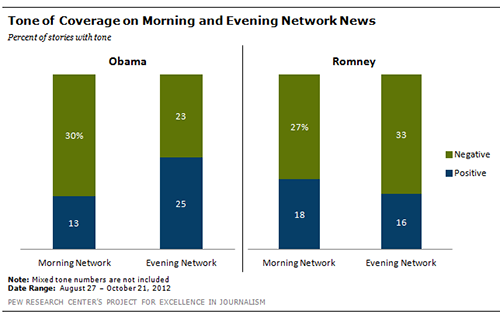
 Pew also looked at coverage of the candidates by the major broadcast networks, and found a significant difference in the tone of their coverage between their morning news-talk programs and their evening newscasts. Coverage on the morning shows was mostly mixed, but when there was a tone, it was more negative for Obama (13% positive vs. 30% negative) than it was for Romney (18% positive, 27% negative). The evening newscasts, in comparison, gave Obama much more favorable coverage (25% positive, 23% negative) than it gave Romney (16% positive, 33% negative). Among the three broadcast networks newscasts, ABC provided significantly more positive Obama coverage (27%) than the other networks (CBS 17%, NBC 16%) or was provided to Romney (ABC 18%, CBS 15%, NBC 18%).
Pew found that newspaper coverage of Obama in this election cycle was much more positive than what newspapers provided in the 2008 race. In 2008, Pew found newspaper coverage to be somewhat balanced - 70% mixed, 12% positive, 18% negative. This time around, newspaper coverage is much more positive - with 45% of Obama coverage positive, 28% mixed, and 28% negative. Newspaper coverage of Republican candidates, in contrast, was overwhelmingly negative this cycle - 69% of Romney coverage was negative, while 25% was mixed and only 6% positive.
 As for social media, the tone is overwhelmingly negative. On Twitter, more than half of political tweets are negative (and a higher percentage of Romney comments being negative than Obama comments), while positive candidate tweets hovering around 20% over this period. Negative comments also dominate on Facebook, but Facebook does have a somewhat higher percentage of positive comments (rising from 20% to around 30%).
The Pew study found that both campaigns had similar amounts of coverage - Obama was a significant in 69% of the political stories included in the sample, and Romney was a significant figure in 61%. They also found that there's been less focus on "horserace" coverage in this election (compared to 2008) - which would be a good sign if that meant that there would be more coverage of issues. However, there wasn't - coverage of policy & issues (22%), the candidates' public record (6%), and even personal matters (4%) remained about the same. Instead, two new types of political coverage gained prominence in 2012 - non-election coverage (coverage related to a candidate's existing duties), and coverage of voting issues (voter fraud, voter ID law coverage, absentee voting for the military, etc.) - each category accounting for 9% of campaign coverage.
 And yes, the economy is still the predominant issue in this election - when policy issues were covered. Overall, 9.8% of all campaign coverage was focused on the economy (although down from 15.2% of coverage in 2008). Within the 22% of issue coverage, the economy accounted for about half. Two thirds of issue coverage focused on domestic policy issues, and one-third on foreign policy issues. Interestingly, many of what media often framed as "hot-button social issues" - abortion, same-sex marriage, immigration, energy, religion, and race - ended up with very little coverage, or traction within the electorate. The same was true in coverage of foreign policy issues. Despite a lack of coverage by many of the major media outlets, the Benghazi attack and related issues dominated foreign policy political coverage (about three-quarters of it- 5% of all coverage, making it the second most covered issue in this election cycle). Iran, Iraq, China, Afghanistan, Syria - even the continuing Israeli-Palestinian conflict - received minimal coverage as political issues.
Partisans from each side can find things in this report that they can use to support claims of media bias. That's likely to be true whenever "media" are diverse rather than monolithic. Democracies are supposed to like diversity in media voices, so one of my personal disappointments in this election cycle is the increased efforts both in the political world and the media world, to try to silence alternative voices and perspectives. Another disappointment is what I see as a continuing decline in the quality of "political" coverage - where only 1 in 5 stories address "issues" at all, and probably less than half of those address serious issues seriously.
Journalism used to proudly proclaim its role as the "fifth estate" - the purveyors of critical information about government and political activities that citizens and voters need in a democracy. They also proudly proclaimed their role as agenda-setters - providing a focus on important issues, as well as the information the public needed to take a stand. I'm not seeing a lot of support for either in this report.
Sources - Winning the Media Campaign 2012, press release from Pew
Winning the Media Campaign 2012, full Pew Center for Excellence in Journalism report
Slightly more than half of mainstream media coverage for Obama (D) was "mixed" - with stories having some combination of positive and negative elements. For the rest, 19% were rated as positive and 30% rated as negative, for a difference of -11 points. Mainstream coverage of Romney was more partisan - 47% classified as mixed, 15% positive, and 38% negative (for a partisan difference of 23%). Now there's a lot that could be spun from the numbers, and the way that Pew categorized coverage.
Pew generally does a good job with research, and the report they released provides far more description and detail than news stories tend to report.

Pew also differentiated "horserace" stories - those primarily discussing who is leading - from all others, and interestingly, found that in more substantive stories, coverage was more equal, although still overwhelmingly negative - for Romney, 14% of stories were positive, 55% negative; for Obama, 15% of stories was positive, 53% negative. Pew also looked at how some specific media outlets covered the candidates. Liberals tend to label Fox news as partisan; conservatives tend to find mainstream media uniformly liberal, with MSNBC an extreme case. Pew looked separately at the two cable networks, as well as CNN. On CNN's coverage of Obama, 18% was positive, 21% negative; for Romney,11% of CNN coverage was positive, 36% negative. Compared to the overall coverage, that was slightly more favorable towards Obama. Presidential campaign coverage on Fox was substantially different - only 6% of Obama coverage was favorable vs. 46% negative; for Romney, 28% was favorable while only 12% was negative. Still, the greatest outlier was MSNBC, whose coverage of Obama was 39% favorable and 15% unfavorable; but that paled by comparison to their coverage of Romney, which was only 3% positive and 71% negative.

One can clearly make the case that Fox's coverage differs from most of the media coverage examined in the Pew study - and that is part of their programming strategy. That alone, though, isn't enough to label them as "objectively" partisan, only in contrast to other media outlets. The most prevalent story tone of the coverage on the three cable networks was "mixed." Where tone was present, Fox clearly differed from CNN and MSNBC in being more likely to carry a positive Romney story (and a negative Obama story) while the others were more likely to carry a positive Obama story (and negative Romney story). One could understandably spin that as partisan (at least relative to most coverage). Still, I'd argue that for rabid partisanship, Fox pales in comparison to MSNBC- which overwhelmingly spun Romney coverage as negative (a whopping 71% of all coverage) and only managed to treat Romney favorably in 3% of their coverage of him and his campaign. And the network wasn't just overtly and overwhelmingly anti-Romney - they were twice as likely to put a positive spin on their coverage of Obama and his campaign as CNN and the rest of the media included in the Pew study.
Pew found that newspaper coverage of Obama in this election cycle was much more positive than what newspapers provided in the 2008 race. In 2008, Pew found newspaper coverage to be somewhat balanced - 70% mixed, 12% positive, 18% negative. This time around, newspaper coverage is much more positive - with 45% of Obama coverage positive, 28% mixed, and 28% negative. Newspaper coverage of Republican candidates, in contrast, was overwhelmingly negative this cycle - 69% of Romney coverage was negative, while 25% was mixed and only 6% positive.

The Pew study found that both campaigns had similar amounts of coverage - Obama was a significant in 69% of the political stories included in the sample, and Romney was a significant figure in 61%. They also found that there's been less focus on "horserace" coverage in this election (compared to 2008) - which would be a good sign if that meant that there would be more coverage of issues. However, there wasn't - coverage of policy & issues (22%), the candidates' public record (6%), and even personal matters (4%) remained about the same. Instead, two new types of political coverage gained prominence in 2012 - non-election coverage (coverage related to a candidate's existing duties), and coverage of voting issues (voter fraud, voter ID law coverage, absentee voting for the military, etc.) - each category accounting for 9% of campaign coverage.

Partisans from each side can find things in this report that they can use to support claims of media bias. That's likely to be true whenever "media" are diverse rather than monolithic. Democracies are supposed to like diversity in media voices, so one of my personal disappointments in this election cycle is the increased efforts both in the political world and the media world, to try to silence alternative voices and perspectives. Another disappointment is what I see as a continuing decline in the quality of "political" coverage - where only 1 in 5 stories address "issues" at all, and probably less than half of those address serious issues seriously.
Journalism used to proudly proclaim its role as the "fifth estate" - the purveyors of critical information about government and political activities that citizens and voters need in a democracy. They also proudly proclaimed their role as agenda-setters - providing a focus on important issues, as well as the information the public needed to take a stand. I'm not seeing a lot of support for either in this report.
Sources - Winning the Media Campaign 2012, press release from Pew
Winning the Media Campaign 2012, full Pew Center for Excellence in Journalism report
Monday, September 17, 2012
Pew: Visuals as Social Currency
A new Pew research study suggests that photos and videos are becoming key online social currencies.
Almost half (46%) of adult Internet users post original photos and videos online (that they themselves have created). Pew identified this group as creators. Almost all in this group have posted and shared photos (45% of all adults, 98% of creators); what was more surprising was that more than a third of them created and posted videos (18% of all Internet users, 39% of creators).
 The study also found that 41% of adults using the Internet were curators - people who have taken photos or videos they found online and posting them on a site used for sharing them with others. Over a third (35%) of adult Internet users have done that with photos (85% of curators), and a quarter (25%) of adult Internet users have done so with videos (61% of curators). There is a large overlap in the creator and curator groups - almost a third (32%) of all adult Internet users are both creators and curators, and 56% of all Internet users have engaged in at least one of the creating or curating activities.
The rise and diffusion of social visuals-sharing systems have certainly contributed to the growth of these activities. Clearly YouTube has made video sharing (whether your own or someone else's) quite easy, and most basic social media systems have incorporated the capacity to share images and videos. The Pew study focused on several of the newer social media-sharing services - Pinterest, Instagram, and Tumblr. They found Pinterest was predominantly used by women (1 in 5 women, 12% of all Internet users). Instagram had a similar overall penetration (12% of all Internet users), but was dominated by younger users - more than 1 in 4 people in the 18-29 age group (27%) have used Instagram. Only 5% of adults using the Internet reported using Tumblr to share images. The report provides additional demographic breakdowns.
As indicated above, if there was a real surprise in this study, it was the numbers on creating and sharing videos. While the development of social media systems for sharing photos and videos is likely the most immediate factor contributing to video creation and curation, I'd add two other enabling factors - first, the expansion of video capabilities into most digital cameras and many mobile devices, which has given many more people the capacity to shoot video; and second, the expansion of broadband Internet access, which has boosted the ability to watch, and share, online videos of increasing quality.
What makes creation and curation activities social currency is the notion that the content provided drives a lot of the increased attention to, and use of, social media and the Internet. They provide the value that guides audience actions.
Source - Photos and Videos as Social Currency Online, report from the Pew Research Center's Internet & American Life Project.
Almost half (46%) of adult Internet users post original photos and videos online (that they themselves have created). Pew identified this group as creators. Almost all in this group have posted and shared photos (45% of all adults, 98% of creators); what was more surprising was that more than a third of them created and posted videos (18% of all Internet users, 39% of creators).

The rise and diffusion of social visuals-sharing systems have certainly contributed to the growth of these activities. Clearly YouTube has made video sharing (whether your own or someone else's) quite easy, and most basic social media systems have incorporated the capacity to share images and videos. The Pew study focused on several of the newer social media-sharing services - Pinterest, Instagram, and Tumblr. They found Pinterest was predominantly used by women (1 in 5 women, 12% of all Internet users). Instagram had a similar overall penetration (12% of all Internet users), but was dominated by younger users - more than 1 in 4 people in the 18-29 age group (27%) have used Instagram. Only 5% of adults using the Internet reported using Tumblr to share images. The report provides additional demographic breakdowns.
As indicated above, if there was a real surprise in this study, it was the numbers on creating and sharing videos. While the development of social media systems for sharing photos and videos is likely the most immediate factor contributing to video creation and curation, I'd add two other enabling factors - first, the expansion of video capabilities into most digital cameras and many mobile devices, which has given many more people the capacity to shoot video; and second, the expansion of broadband Internet access, which has boosted the ability to watch, and share, online videos of increasing quality.
What makes creation and curation activities social currency is the notion that the content provided drives a lot of the increased attention to, and use of, social media and the Internet. They provide the value that guides audience actions.
Source - Photos and Videos as Social Currency Online, report from the Pew Research Center's Internet & American Life Project.
Tuesday, September 11, 2012
Martha Stewart moves to Online Digital
As her deal with the Hallmark Channel expires, Martha Stewart has decided to move from Cable Channels to online distribution for both new and archival video. The move comes as the industry is finding that DIY content is better suited to an on-demand distribution system. As Cameron Yuill of AdGent Digital indicated, "How-to content lives better digitally ... because you want to access it when you need it."
Martha Stewart Living Omnimedia (MSLO) has already inked non-exclusive deals with Hulu and AOL to distribute MSLO video programs. Hulu indicated that they will launch at least three channels using MSLO content - Martha's Kitchen, Emeril's Table, and DIY Crafts. For now, short form videos will be culled from the current long-form TV episodes, but MSLO plans to start creating new short-form content featuring Ms. Stewart.
Those are likely competitive advantages, but its unclear how important those attributes are in the online marketplace, or how quickly online advertising will grow to the levels earned on cable. Too much of a delay in replacing current cable-based revenues could pose real fiscal problems for a firm that's reported losses in 8 of the last 9 years.
Still, it's a mark of maturity (and critical mass) when strong brands make the move to online video.
Source - Hallmark Deal Over, Martha Stewart Shifts to Digital Video, AdAge
Martha Stewart Living Omnimedia (MSLO) has already inked non-exclusive deals with Hulu and AOL to distribute MSLO video programs. Hulu indicated that they will launch at least three channels using MSLO content - Martha's Kitchen, Emeril's Table, and DIY Crafts. For now, short form videos will be culled from the current long-form TV episodes, but MSLO plans to start creating new short-form content featuring Ms. Stewart.
The shift seemed logical to Ms. Stewart, 71, who has adopted mobile technology for both her personal and professional life. "I'm constantly using my three handheld devices/smartphones to talk, look up information and tweet," she said via email. "I love social media because I can get great, instant feedback and stay in touch with a broad audience."The move could be risky for MSLO, as it will be competing in a larger and much more competitive online marketplace, in a format (short-form video) that it has little experience with. Some question whether Martha Stewart's penchant for perfection will translate well online.
"The internet thrives on imperfection and improvisation," said marketing expert Adam Hanft. With Martha, he continued, "every petal of every rose needs to sit perfectly. Julia Child would have been better on the internet... The classic moment when she drops the chicken on the floor fits perfectly with the internet's idea of approachability."Still, MSLO points to reports that Martha's 18-34 digital audience is up 40% in the last year, and suggests there is a place for the expert, trusted, and high production quality content that is MSLO's strength.
Those are likely competitive advantages, but its unclear how important those attributes are in the online marketplace, or how quickly online advertising will grow to the levels earned on cable. Too much of a delay in replacing current cable-based revenues could pose real fiscal problems for a firm that's reported losses in 8 of the last 9 years.
Still, it's a mark of maturity (and critical mass) when strong brands make the move to online video.
Source - Hallmark Deal Over, Martha Stewart Shifts to Digital Video, AdAge
Thursday, August 9, 2012
Content trends and the future of Video
There's an interesting post in the Online Video Insider blog that takes a broad look at the past and future of video content.
For my view, this is neither unexpected or problematic. Online video audiences are quite different from broadcast audiences, in both scale and scope - and on that basis should not be expected to be as valuable to most advertisers. On the other hand, online offers a degree of targeting that is unmatched, and would be more valuable to advertisers seeking that level of targeting and focus. In addition, online video costs are significantly lower than those of traditional media (by several orders of magnitude), and thus can be more profitable, even at lower revenues and ad rates. There really is no need for online video providers to "match" traditional media revenue levels. Finally, long term projections of new media are notoriously inaccurate, often because they're projections from the early stages of diffusion, where the rate of growth is often highest (and clearly unsustainable over the longer term). So I'm not bothered that the actual revenues are significantly less than what they were projected to be based on where the market was some five years (or more) earlier.
Source - The Seesaw Effect: Trends Shaping Video's Past and Future, Online Video Insider
- 2006 saw the emergence of User-Generated Content (UGC), culminating in Google's acquisition of YouTube. Content exploded as everyone could create and (more importantly) share content that while often trivial, was occasionally extraordinary.
- 2007 saw a shift in focus to aggregation - of building systems to help viewers identify and find content of interest by aggregating access and developing improved search and recommendation software.
- March, 2008 saw Hulu go online, bringing "professional" content in the form of movies and TV programs to the Internet and greatly expanding access to high-quality content. The move also helped both Apple's and Amazon's nascent online video marketplaces by encouraging "professional" content owners to license their product for digital access.
- 2009 saw the impact of "Technology," in the form of infrastructure and software improvements. Improved access to high-speed broadband allowed distribution of higher-quality video, and new content management systems (CMS) and content delivery networks (CDN) reduced costs while improving transmission reliability.
- By 2010, online advertising revenues had expanded to the point where incremental distribution could be monetized. That is, where distributors could profit from more than the most popular content - where specialty and narrow interest content of the "long tail" could drive further expansion of online content of all types.
- Last year, 2011, saw a focus on Content Differentiation, with networks and aggregators starting to subsidize production of unique or distinctive content. Some on the full professional end, seeking more traditional TV programs and films that they could have exclusive access to and thus distinguishing themselves from the growing number of outlets. Many also supported a shift to higher production standards from major UGC creators, and the creation of separate narrowly targeted "channels", with the hope of building value and demand.
- Will 2012 see "Madison Avenue become Wall Street"? The post suggests that one advantage of online options for advertising agencies is the ability to monitor and shift advertising dollars on the fly. Thus, the market model for ads becomes more of a real-time exchange model (Wall Street) than the traditional (Madison Avenue) model of upfronts and packages.
"With an increasing number of content creators, publishers and ad networks vying for supremacy, we’ve seen the rise of ad exchanges and real-time bidding that allow marketers to effectively bypass or merge many of the steps involved with media planning and buying."
For my view, this is neither unexpected or problematic. Online video audiences are quite different from broadcast audiences, in both scale and scope - and on that basis should not be expected to be as valuable to most advertisers. On the other hand, online offers a degree of targeting that is unmatched, and would be more valuable to advertisers seeking that level of targeting and focus. In addition, online video costs are significantly lower than those of traditional media (by several orders of magnitude), and thus can be more profitable, even at lower revenues and ad rates. There really is no need for online video providers to "match" traditional media revenue levels. Finally, long term projections of new media are notoriously inaccurate, often because they're projections from the early stages of diffusion, where the rate of growth is often highest (and clearly unsustainable over the longer term). So I'm not bothered that the actual revenues are significantly less than what they were projected to be based on where the market was some five years (or more) earlier.
Source - The Seesaw Effect: Trends Shaping Video's Past and Future, Online Video Insider
Tuesday, May 15, 2012
NAB Review - Content in a TV Everywhere World
The NAB Show is over, and it's time for the reviews and commentaries to come out. Miles Weston, writing in the Broadcast Newsroom blog, found the good news of the Show came in the growing recognition that the media and broadcast market has changed, and that broadcasters need to evolve as well. He opens the column by writing
 There was recognition of shifting viewing habits, brought about in large part as a result of the growth in the ways people can receive and view video content, particularly over the Internet. Perhaps more importantly for the future of broadcasting, was the (sometimes) grudging recognition that limiting yourself to your traditional single channel would inevitably lead to smaller and smaller audiences - and that it made sense to have your content available in as many channels, formats, and times as possible. Particularly if you could find ways to make money from them.
One of the highlights of the conference, for Weston, was finding that many of the video technology vendors were not offering just hardware, but integrated business models to help broadcasters protect, repurpose, recycle, and most importantly make money from their content - offering potential solutions and approaches.
Another was the increasing presence of non-traditional broadcasters - particularly big firms like Lowe's, Safeway, Target, McDonald's, and Starbucks. These firms face many of the same challenges as broadcasters, and are perhaps even more innovative in finding ways to connect with their audiences and provide them with attention-holding content across a variety of outlets and devices.
 Also impressive were the vendors who were trying to make sense of the immense amount of personal and viewing information generated by digital channels. There were content management systems that can use your Web and viewing history to select the right mix of news and entertainment for you, at that time, at your viewing location, and for your viewing device. There were systems that recognized the shift in viewing habits and the increase in viewing options, and provide the most appropriate mix of content and ads to keep you, the audience, viewing and wanting more.
There were also lots of ideas about possible pricing models for online video advertising; despite all those metrics, there's no settled industry standard for measuring online video viewing or its value to advertisers. Nielsen has a proposed solution, but it's got a way to go to prove itself the successor to ratings and CPM.
There was, as there is at almost any technologically-oriented conference, a lot of talk about the cloud. At NAB, a lot of this was focused on the potential of using the cloud as a way to connect broadcasters with the myriad freelance teams that produce a lot of their content. But Weston wasn't convinced that the industry had figured out how, exactly, this would happen. In the meantime, he advised that broadcasters invest in their own off-line storage and archives, not just for posterity but on the chance that archived content may become valuable again.
As Weston notes, it all comes down to this -
Source - Content Insider 228 - NAB Wrap: Content Anywhere, Anytime Needs to be Monetized, Saved. Broadcast Newsroom
Today, we're overwhelmed with news, information and entertainment options.
Whether you're at home or away, broadcasters are all vying for your attention, your time, your money.
That's the evolutionary shift the NAB (National Association of Broadcasters) show participants and attendees struggle with these days.
It isn't easy to move into new, uncharted areas.
It used to be it was big studios, big iron, and big cigars.
Now, it's less about being vertically integrated than knowing how to loosely, flexibly integrate and leverage resources.

One of the highlights of the conference, for Weston, was finding that many of the video technology vendors were not offering just hardware, but integrated business models to help broadcasters protect, repurpose, recycle, and most importantly make money from their content - offering potential solutions and approaches.
Another was the increasing presence of non-traditional broadcasters - particularly big firms like Lowe's, Safeway, Target, McDonald's, and Starbucks. These firms face many of the same challenges as broadcasters, and are perhaps even more innovative in finding ways to connect with their audiences and provide them with attention-holding content across a variety of outlets and devices.

There were also lots of ideas about possible pricing models for online video advertising; despite all those metrics, there's no settled industry standard for measuring online video viewing or its value to advertisers. Nielsen has a proposed solution, but it's got a way to go to prove itself the successor to ratings and CPM.
There was, as there is at almost any technologically-oriented conference, a lot of talk about the cloud. At NAB, a lot of this was focused on the potential of using the cloud as a way to connect broadcasters with the myriad freelance teams that produce a lot of their content. But Weston wasn't convinced that the industry had figured out how, exactly, this would happen. In the meantime, he advised that broadcasters invest in their own off-line storage and archives, not just for posterity but on the chance that archived content may become valuable again.
As Weston notes, it all comes down to this -
The heart and soul of NAB isn't about you (being a broadcaster); it's about leveraging content for the maximum ROI (return on investment).
Source - Content Insider 228 - NAB Wrap: Content Anywhere, Anytime Needs to be Monetized, Saved. Broadcast Newsroom
Friday, March 2, 2012
Thoughts on Content Strategy
Ashkan Karbasfrooshan, CEO of WatchMojo.com, shared some thoughts on whether a Horizontal or Vertical content strategy was more valuable in a post on the OnlineVideoInsider blog. A horizontal strategy is one that emphasizes multiple categories or multiple outlets. A vertical strategy is one that emphasizes a focus on providing multiple levels or stages within a specific category. Horizontal is breadth, vertical depth - in terms of networks, major general-interest broadcast networks like NBC or CBS are horizontal, niche networks like ESPN, SyFy, or the Military Channel are vertical. In some cases, like Disney, you have both horizontal and vertical strategies within a firm.
Karbasfrooshan makes the point that the question of what strategy to pursue is becoming more important as a variety of tech firms, distribution channels, and ad networks are beginning to actively move into content creation. Should they pursue a more horizontal strategy to broaden their reach, or should they go vertical in hopes of developing more focused, engaged, and passionate audiences?
In terms of producing video content, he suggests that there are three things to consider in today's media environment - the challenge of scale, the problem with passionate audiences, and the challenge of video.
The Challenge of Scale - Karbasfrooshan argues that the scale in content that's important doesn't come from producing more content, but from distributing it in more places. Today, scale economies in video kick in very, very quickly, so scale in terms of multiple simultaneous productions isn't critical. But scale, in terms of maintaining IP ownership and gaining multiple revenue streams from distributing in multiple outlets, is increasingly critical.
The Problem with Passionate Audiences is that they keep wanting more. Karbasfrooshan argues that "if you decide to produce videos with a vertical strategy, you run the risk of hitting a wall by running out of topics to produce." If your vertical is something that is continually renewing, such as sports, or lifestyle, or if your audience is just as happy watching reruns (Kids and cartoons), it may work. Otherwise, as with Star Trek franchise, you'll often find yourself recycling storylines.
The Challenge of Video is that it's not always the best format for content. Karbasfrooshan states that "you cannot produce a video on any topic; it boils down to visuals," and notes that search engines still aren't doing a good job indexing video. Noting that very few video producers maintain their own sites for direct distribution to audiences, he suggests video is focused more on distribution than "destination." And that to maximize distribution, "you need to have as many content pieces in as many categories" as possible, because the largest aggregators and distributors are all horizontally-focused.
In the end, Karbasfrooshan notes that both strategies have advantages and disadvantages, and that producers, distributors, audiences, and advertisers are all looking for different things - "Ultimately what advertisers prefer is different from what users like and distributors need."
For a video producer, it really boils down to what your purpose is, where your strengths are, and what you're interested in. And in reality, what your opportunities are. Let the strategies develop over time, to meet circumstances and opportunities - and always remember that you can integrate aspects of either or both, and change as needed.
Source - Is A Horizontal Or Vertical Content Strategy More Valuable?, OnlineVideo Insider
Karbasfrooshan makes the point that the question of what strategy to pursue is becoming more important as a variety of tech firms, distribution channels, and ad networks are beginning to actively move into content creation. Should they pursue a more horizontal strategy to broaden their reach, or should they go vertical in hopes of developing more focused, engaged, and passionate audiences?
In terms of producing video content, he suggests that there are three things to consider in today's media environment - the challenge of scale, the problem with passionate audiences, and the challenge of video.
The Challenge of Scale - Karbasfrooshan argues that the scale in content that's important doesn't come from producing more content, but from distributing it in more places. Today, scale economies in video kick in very, very quickly, so scale in terms of multiple simultaneous productions isn't critical. But scale, in terms of maintaining IP ownership and gaining multiple revenue streams from distributing in multiple outlets, is increasingly critical.
The Problem with Passionate Audiences is that they keep wanting more. Karbasfrooshan argues that "if you decide to produce videos with a vertical strategy, you run the risk of hitting a wall by running out of topics to produce." If your vertical is something that is continually renewing, such as sports, or lifestyle, or if your audience is just as happy watching reruns (Kids and cartoons), it may work. Otherwise, as with Star Trek franchise, you'll often find yourself recycling storylines.
The Challenge of Video is that it's not always the best format for content. Karbasfrooshan states that "you cannot produce a video on any topic; it boils down to visuals," and notes that search engines still aren't doing a good job indexing video. Noting that very few video producers maintain their own sites for direct distribution to audiences, he suggests video is focused more on distribution than "destination." And that to maximize distribution, "you need to have as many content pieces in as many categories" as possible, because the largest aggregators and distributors are all horizontally-focused.
In the end, Karbasfrooshan notes that both strategies have advantages and disadvantages, and that producers, distributors, audiences, and advertisers are all looking for different things - "Ultimately what advertisers prefer is different from what users like and distributors need."
For a video producer, it really boils down to what your purpose is, where your strengths are, and what you're interested in. And in reality, what your opportunities are. Let the strategies develop over time, to meet circumstances and opportunities - and always remember that you can integrate aspects of either or both, and change as needed.
Source - Is A Horizontal Or Vertical Content Strategy More Valuable?, OnlineVideo Insider
Thursday, February 2, 2012
Content and Value
One indicator of the continuing "content is king" meme is the movement of a number of major Internet firms into the content business.
Major social media services are working to integrate media content into their social media platforms. Facebook is making deals to stream movies and music concerts through its service. Twitter is making sponsored deals with high-profile figures to create Tweet streams at big events like the Consumer Electronics Show.
In the last year, Google has made significant moves into content services, with the addition of the Google Music cloud service, and the addition of content sales and rentals to the Android Marketplace. Google's YouTube operations have not been ignored, with Google spending $200 miliion (so far) to acquire high quality, high demand, content, and content creators, to supplement the user-generated videos on YouTube. Google's been working with US studios on a movie rental service. Outside the U.S., they've made deals to stream movies and sporting events.
Amazon is making the move from just selling books to publishing them. Amazon's Kindle books service has encouraged and provided a market for self-published works since its introduction, but Amazon took the move into content further with the creation of its own publishing house, releasing titles in both print and online editions. Apple's followed suit in promoting self-publishing, even to the extent of offering a free iPublisher software tool to facilitate book creation.
In addition, numerous traditional and new media outlets that started as content aggregators and distributors are making deals to create new content for their services. This started long ago with pay TV and cable channels, but in the last year, AOL purchased the Huffington Post collection of blogs to boost its original content offerings, and Netflix is commissioning original series for its streaming service. And, as noted briefly earlier, YouTube is pushing professional-quality content, with new dedicated channels and investment in production houses.
What all of this shows is that good content drives demand, and has significant value. The push for more original content also reflects the increasingly competitive marketplace at work - having unique content is a competitive advantage to be exploited.
Source - Content is Dead -- Long Live Content, OnlineVideo Insider
Major social media services are working to integrate media content into their social media platforms. Facebook is making deals to stream movies and music concerts through its service. Twitter is making sponsored deals with high-profile figures to create Tweet streams at big events like the Consumer Electronics Show.
In the last year, Google has made significant moves into content services, with the addition of the Google Music cloud service, and the addition of content sales and rentals to the Android Marketplace. Google's YouTube operations have not been ignored, with Google spending $200 miliion (so far) to acquire high quality, high demand, content, and content creators, to supplement the user-generated videos on YouTube. Google's been working with US studios on a movie rental service. Outside the U.S., they've made deals to stream movies and sporting events.
Amazon is making the move from just selling books to publishing them. Amazon's Kindle books service has encouraged and provided a market for self-published works since its introduction, but Amazon took the move into content further with the creation of its own publishing house, releasing titles in both print and online editions. Apple's followed suit in promoting self-publishing, even to the extent of offering a free iPublisher software tool to facilitate book creation.
In addition, numerous traditional and new media outlets that started as content aggregators and distributors are making deals to create new content for their services. This started long ago with pay TV and cable channels, but in the last year, AOL purchased the Huffington Post collection of blogs to boost its original content offerings, and Netflix is commissioning original series for its streaming service. And, as noted briefly earlier, YouTube is pushing professional-quality content, with new dedicated channels and investment in production houses.
What all of this shows is that good content drives demand, and has significant value. The push for more original content also reflects the increasingly competitive marketplace at work - having unique content is a competitive advantage to be exploited.
Source - Content is Dead -- Long Live Content, OnlineVideo Insider
Wednesday, December 7, 2011
Some Thoughts on Media Content Pyramid
OK, I've been working on this to finally get one of my Topic Paper ideas finished and posted. Well, except for figuring out how to port the diagrams over, and how to upload the paper itself. But to get your interest up, here's the text of the paper, anyway.
It builds on the previous post, so it replicates part of that.
Seth Godin's got an interesting blog post on "The erosion in the paid media pyramid." He starts with the suggestion that since the development of media, there's been a model of value and pricing options for paid media.
Basically, he differentiates paid media into 4 groups, with value and pricing related to supply, or the breadth of demand. At the bottom of the pyramid is Free content. He describes this kind of content as including content that is delivered to anyone who is interested in consuming it - primarily as a draw for sales of something else. Chris Anderson's Free covers the same ideas.
Mass content includes media products where the cost of replication and delivery are relatively low, allowing lower prices with the development of mass markets. With mass markets, value can be aggregated over larger numbers.
Limited content, Godin suggests, is rare and thus expensive. This can be the result of higher costs of replication and delivery, requiring higher pricing and limited markets, or can be a decision that inherent value is high enough that income can be maximized by restricting the size of the market.
At the tip of the pyramid is Bespoke content - which for any media product is the most expensive, as it needs to recoup the whole cost (and value) with a single exchange rather than averaging costs over a larger market.
Godin suggests that with the rise of competition, convergence, and the digital network economy, three things have occurred that have eroded, or upset, the pyramid.
- Digital media have significantly reduced replication and distribution costs, and have also expanded the availability of content. He suggests that this has led to an explosion of choice, or from the point of traditional media content producers, an explosion of competition and clutter.
- As a result, attention is worth more than ever before. In the old model, attention was the important value in Free, or even some Mass content, but was low compared to most other costs, and therefore didn't have a big impact.
- Again, as a result of #1, the marginal cost of one more copy in the digital world is zero (or close enough that nobody cares). This is important because general economic theory recommends setting price at marginal cost.
While he's got a point, he's also missing a lot by basing the pyramid on the linking of cost and pricing, and pricing with value. In other words, thinking that the only source of value is from commercial sales, and that the determinant of value is based largely on the costs of creation, replication, and distribution. Still, as evident in his description of "Free" and "Mass", there are values at work other than prices, coming both from those producing content and those consuming it. In noting that there is content that some will pay to have distributed, there is a recognition of content where the value to the creator comes from having it out there and used (Yochai Benkler's The Wealth of Networks provides a good look at these motivations). And there’s some recognition of demand in the sense that he recognizes that there is less demand for content that is more costly.
So let's try looking at the media content value pyramid from a bit wider perspective. One that looks at both the supply and demand sides of the market, as well as the value motivations of both producers and consumers. .We also have to start with baseline economic realities; first, media and information content is costly to produce (even before replication and distribution costs), and second, most content producers aren’t likely to continue to produce content unless they perceive that they’ll ultimately receive some amalgamation of value in excess of those costs. The final reality that needs to be addressed lies in the fact that the value of information goods and services, or media content, is uncertain. Part of that is that for most content, the perceived value may vary widely across contexts and consumers; and part of that is that the actual value to a consumer can not be determined until the content is consumed, so in every consumer decision there is uncertainty as to the value to be obtained. The latter is perhaps the prime factor behind the idea of bundling and regularization of media content – to reduce the overall uncertainty that some level of aggregate value will be obtained. It’s also led to the situation where content markets develop general pricing strategies based on aggregated demand and costs, rather than a strategy of pricing content individually.
In constructing a Content Value Pyramid in an emerging digital network society, you need to recognize how the rise and diffusion of digital technologies and digital networks have impacted media and content markets.
At the bottom I'm going to put content that people want consumed widely – and they want it badly enough to absorb production, replication, and distribution costs. This would include what could be termed promotional content (what Godin described as stuff given out with the hope of generating sales); but it may not be direct sales of related goods – there’s a large amount of content produced and distributed for self-promotion, to show off skills and abilities that may enhance the producer’s value in the market. I'm going to label a related segment of content push content - content that someone wants to get to users (such as public health campaigns). I'm also going to include noncommercial content, information goods and services whose value lies wholly or mostly outside of traditional paid media markets. This would include things like academic writings or sharing your vacation photos through social media. It might also include what one would call attention-getting content, content that exists to attract the attention of users to a medium and its other content offerings. The common element to these content types is that their value to their creator and/or distributor is based primarily on the width and breadth of distribution and use rather than individual commercial sales to consumers. As such, it also makes sense to price these at zero, as any positive price would restrict demand at least a bit. It may also make sense for these types of goods to have a negative price (through a subsidy of a related set of goods or costs). In that sense, you can still use the “Free content” label and place it on the bottom of the pyramid in terms of size and scope of market.
It is also a market that has exploded with the rise of the digital network economy, largely because technology has drastically lowered the threshold for content production. Back in the analog, physical media days, there were real costs associated with each of these, - and that meant producers and distributors knew that whether free, mass, limited, or bespoke, the market needed to generate sufficient sales at whatever pricing strategy to cover those costs. This imposed a threshold on underlying value of expected sales (revenues) that needed to be crossed before content would be offered, and severely limited the amount of content available to consumers in media markets. Between the rise of digital computing and media, and telecommunication networks, there has been a drastic reduction in the costs associated with creating content, storing it, duplicating and distributing it, as well as in the search costs of consumers finding it. This has enabled an avalanche of content to be unleashed in media markets, so that base level of “Free content”is much wider and much deeper.
I’m also going to use the “Mass content” label for the next stage, but define it primarily in terms of a combination of demand level and cost factors. Content in this category is characterized by two factors related to the scale of the content market – that there is sizable demand for the content at fairly low price levels, and that there is a viable mass reproduction and distribution system available that allows average costs to more or less match those levels. Much of what is considered entertainment content fits this category. Movies, with the theatrical distribution system, and broadcasting use media that can spread costs over thousands to millions of consumers. In print, the rise of mass markets occurred with changes in printing technology that dropped per unit costs of replication from dollars to fractions of pennies. But here I also want to differentiate content and market somewhat, based primarily on the relationship of mass scale pricing to average costs. There are clearly content markets where aggregate demand levels and average costs are low enough to fall below a market’s strategic pricing levels. I’ll label this Mass commercial content, and the book publishing and old record industries generally fell into this level. There is a quite significant second type of content that can be called “mass” – Mass subsidized content. This refers to types of mass content where the average costs don’t quite cover the relevant pricing strategy for that market scale. Early broadcasting is a clear example – while the “mass” distribution system reached large scales, it was difficult to enforce direct payments for use. In a public broadcasting model, the state could enforce a tax or usage fee for funding, but for a viable non-state model, funding needed to come from other sources. News is another example of mass subsidized content. Studies show that demand for news, marketed separately, is not sufficient to cover mass production costs in most contexts, but with the right mixture of content and subsidies, news organizations could be profitable. Taking advantage of bundling, in mixing what would be marginally commercial content (marketed alone) with push content and/or promotional content, mass subsidized content could achieve a point where their strategic pricing strategy, combined with revenues from subsidized content, could cover costs in a mass market.
With the lower reproduction and distribution costs of digital networked media, it’s quite likely that both “Mass content” categories will see significant growth in the range and scope of content and markets that follow a mass marketing strategy. Growth is likely, if only due to the lowered costs of digital media, and the fact that digital media markets can be truly massive (potential global reach). The new mass scale of digital markets, particularly if content industries shift from pricing strategies based on physical copies and develop viable (reduced) pricing strategies based on digital copies, whole new levels of consumption and purchase could emerge. With revised (and lowered) pricing strategies, more and more content is likely to move into, or be produced for, this category – which will shift supply curvess and drive demand and consumption skyward. In addition, if pricing strategies fall to the point where they are less that an individual’s minimum uncertainty threshold (i.e., the price is so low that people will try it without expectations of value), purchase and consumption could explode.
I’ll follow Godin again and use “Limited Content” as a label for the next type of content, which could be described as high-price, limited demand content. There are actually several different categories of content that could fall into this general layer for different reasons. The first is Limited demand content, where the differentiating feature is that while there is no significant demand on a mass level, there is a significant segment of the market for which there is strong demand. Examples are legal and financial information – in each case, pertinent information may be highly valuable to a small but identifiable market segment that recognizes that value and is willing to pay accordingly. Here, the costs are secondary to a strategic pricing strategy to restrict supply to keep price high. A second could be described as Limited supply content, where the costs of replication and distribution are high, and there are no viable low-cost alternatives. Live concerts or duplicates of bronze statues can be examples. Here, even if there is high demand for the content (think concert), the costs are so high that supply needs to be restricted by price to achieve a balance of revenue from price and actual costs. A key distinction from the Limited demand content is that if costs could be dropped to a “mass” level, more content could move into that layer, whereas with limited demand, content will likely remain in that limited (or even more restricted) market. There is one other type of content to consider – content where its scarcity is a significant component of its value to at least a segment of the market. Let’s call it Scarcity-value content. This is content, like signed limited editions of books or art prints, where its scarcity, or collectability, has significant value, at least to a limited segment of the market. Like Limited demand content, there is a definable market segment that places a higher value on the content than others, but that value comes from its imposed scarcity rather than the value of the content itself.
The common element in these three Limited content segments is that content producers (or marketers), for various reasons, consciously restrict supply of the content in order to take advantage of the fact that some small segment of the user or consumer market places a significantly higher value on the content than do most others in the market. As such, it seems unlikely that this portion of the pyramid will change much from the transition to a digital market. The larger market access of digital may enable Limited content media products to target, reach, and get bought by the small consumer segments in the larger market, but it seems unlikely that this will shift marketing and pricing strategies significantly.
Finally, one has to also recognize that the extreme of Limited content lies in what Godin’s pyramid calls “Bespoke content.” This is the case where only the original content is traded – a monopoly-monopsony market (one seller-one buyer). Let’s call this Unique content, as that’s the primary distinction from Limited. While this could conceivably apply to any content, let’s consider what economic characteristics make this kind of transaction reasonable. Following the “bespoke” idea, one type of content in this layer is that for which value exists only for one consumer, regardless of price. In this case, let’s call it Monopsony value content, the content is usually produced at the direct behest of the consumer (i.e. “bespoke”), and only if the value to that consumer is greater than the cost of original production. Another kind of “bespoke” content can be one where there is a significant added-value to a unique combination of content and context, for instance, having your favorite pop star sing “Happy Birthday” to you at your fortieth birthday party. Let’s call such content Context value content.
Perhaps the largest segment in the Unique content layer, though, is there as an extrapolation of the scarcity-value argument. If there is value in scarcity, it makes sense that the scarcer the product, the higher the value. On the positive side, this might happen when ownership/consumption of content by a single individual generates more value than any other combination of limited supply and price. Let’s call this Uniqueness value content, and note that it’s different from Monopsony value content in that the value is due more to being the sole owner/consumer than the inherent value of the content. On the negative side is what could be called Secrecy value content – content where the value lies not in being the sole possessor, but in the fact that by doing so, you are preventing others from using, consuming or getting value from the content (i.e., the secret formula for Coca-Cola).
This “Unique content” layer differs from the “Bespoke” in the earlier pyramid because it’s based on defining the layer on the idea that there is value in being unique, whereas Godin frames his “Bespoke” layer primarily based on the cost of the content limiting effective demand to a single consumer. While Unique content is likely to be more costly than other layers because costs can’t be averaged over a larger number of consumers, content doesn’t have to be costly to have value in uniqueness. Consider that handmade birthday card from a young child to Mom, the one that’s had pride of place on Mom’s refrigerator for the last twenty years. As with the Limited content layer, the growth of digital media and content is not likely to have much impact on the expansion of the Unique content layer. Yes, lower content production costs will likely increase availability of Monopsony value content, as lower costs (and prices) allow more people to seek and find unique and personalized content that falls within their demand curves. As for the rest of the layer, it’s the quality of uniqueness that creates value, for one reason or another – and expanding markets and declining costs aren’t going to affect those much.
So in terms of a pyramid, let’s think of step pyramids rather than equilateral triangles, with the size of the steps representing either proportion of content in the layer, or in the value of that content.

Figure 1 – Pre-digital Media Content Value Pyramid
Figure 1 represents my view of the media content value period in the Pre-digital era. As with the old pyramid, the order is the same. However, let me point to a couple of distinctions. First, I have overlapped some of the Mass content with the Free content, to represent that portion of Subsidized mass content that is priced at zero. Second, the Limited content and Unique content portions are much narrower, to reflect the role that restricted supply plays in the determination of those layers. Finally, I’ve also made the Unique content taller, because due to its nature, we’re not as generally aware of the amount of content that falls within that classification.
In Figure 2, you can see a reflection of the rise of digital in the significant growth in the Free and Mass content steps (realistically, these should be much wider as well, but there are limits to the page). In particular, the larger layers, and the larger interaction of the two, reflect the role of declining costs making all types of Free and Mass content economically viable, and the impact of declining prices (strategy permitted) in terms of expanding use and consumption. There is not much change in the Limited and Unique layers, as the economic advantages of digital only come into play for segments of those layers. Now, visually this might not be so different from the old standard, but I think that pulling out the various categories within layers, and the broader focus on considering both the supply and demand sides may help in understanding the differing types of media content and media marketing and pricing strategies at play in media markets.
Benjamin J. Bates,
Professor, School of Journalism & Electronic Media
University of Tennessee, Knoxville
Monday, December 5, 2011
Paid Media Pyramid - Old and New
Seth Godin's got an interesting blog post on "The erosion in the paid media pyramid." He starts with the suggestion that since the development of media, there's been a model of value and pricing options for paid media.

Basically, he differentiates paid media into 4 groups, with value and pricing related to supply, or the breadth of demand. At the bottom of the pyramid is Free content. He describes this kind of content as including content that is delivered to anyone who is interested in consuming it - primarily as a draw for sales of something else. Chris Anderson's Free covers the same ideas.
Mass content includes media products where the cost of replication and delivery are relatively low, allowing lower prices with the development of mass markets. With mass markets, value can be aggregated over larger numbers.
Limited content, Godin suggests, is rare and thus expensive. This can be the result of higher costs of replication and delivery, requireing higher pricing and limited markets, or can be a decision that inherent value is high enough that income can be mazimized by restricting the size of the market.
At the tip of the pyramid is Bespoke content - which for any media product is the most expensive, as it needs to recoup the whole cost (and value) with a single exchange rather than averaging costs over a larger market.
Godin suggests that with the rise of competition, convergence, and the digital network economy, three things have occured that have eroded, or upset, the pyramid.
I'm working on my own pyramid for this new environment, which I'll post as the first in what I hope will be a series of targeted reports/analyses. Look for a new header in the sidebar in a day or two.
Source - The erosion in the paid media pyramid, Seth Godin's Blog

Basically, he differentiates paid media into 4 groups, with value and pricing related to supply, or the breadth of demand. At the bottom of the pyramid is Free content. He describes this kind of content as including content that is delivered to anyone who is interested in consuming it - primarily as a draw for sales of something else. Chris Anderson's Free covers the same ideas.
Mass content includes media products where the cost of replication and delivery are relatively low, allowing lower prices with the development of mass markets. With mass markets, value can be aggregated over larger numbers.
Limited content, Godin suggests, is rare and thus expensive. This can be the result of higher costs of replication and delivery, requireing higher pricing and limited markets, or can be a decision that inherent value is high enough that income can be mazimized by restricting the size of the market.
At the tip of the pyramid is Bespoke content - which for any media product is the most expensive, as it needs to recoup the whole cost (and value) with a single exchange rather than averaging costs over a larger market.
Godin suggests that with the rise of competition, convergence, and the digital network economy, three things have occured that have eroded, or upset, the pyramid.
- Digital media have significantly reduced replication and distribution costs, and have also expanded the availability of content. He suggests that this has led to an explosion of choice, or from the point of traditional media content producers, an explosion of competition and clutter.
- As a result, attention is worth more than ever before. In the old model, attention was the important value in Free, or even some Mass content, but was low compared to most other costs, and therefore didn't have a big impact.
- Again, as a result of #1, the marginal cost of one more copy in the digital world is zero (or close enough that nobody cares). This is important because general economic theory recommends setting price at marginal cost.
I'm working on my own pyramid for this new environment, which I'll post as the first in what I hope will be a series of targeted reports/analyses. Look for a new header in the sidebar in a day or two.
Source - The erosion in the paid media pyramid, Seth Godin's Blog
Subscribe to:
Posts (Atom)