
Showing posts with label sports. Show all posts
Showing posts with label sports. Show all posts
Wednesday, April 29, 2015

Tuesday, February 3, 2015
Tidbits from Superbowl viewers
eMarketer released some recent poll stats on Superbowl viewers.
 Almost half (46%) of smartphone and tablet owners reported they were likely to use a second screen while watching the Superbowl this year. About a third said they'd likely be on social media, while one in five thought they'd be on sports cites or apps. Grouping at just under 20% were the following uses: playing games, watching videos, checking news, and getting weather updates.
Another study looked at how people thought about Superbowl ads. It was no surprise that people overwhelmingly thought of them as primarily entertainment. About one in five thought the ads contributed to brand awareness. Other than that, people didn't like the ads as advertising. 16.6% saw them as a waste of money that could better be used to keep product prices low; just under 10% thought they made the game too long; and about 7% saw them as unnecessary interruptions. Only about 10% thought that the ads might encourage them to seek more information about products, or influence they buying habits.


Another study looked at how people thought about Superbowl ads. It was no surprise that people overwhelmingly thought of them as primarily entertainment. About one in five thought the ads contributed to brand awareness. Other than that, people didn't like the ads as advertising. 16.6% saw them as a waste of money that could better be used to keep product prices low; just under 10% thought they made the game too long; and about 7% saw them as unnecessary interruptions. Only about 10% thought that the ads might encourage them to seek more information about products, or influence they buying habits.

Source: Mobile Apps Score Among Super Bowl Viewers, eMarketer
Wednesday, June 4, 2014
Media Sports Consumption - Infographic
From PERFORM and Kantar Media: Global Sports Consumption 2014


Tuesday, April 1, 2014
Video's Goin' Mobile - And Sports Rule!
The latest Ooyala Global Video Index has some interesting findings.
 The viewing of online videos through mobile devices has grown 719% since 2011. It currently accounts for 18% of all online video usage worldwide, and Ooyala predicts mobile will account for half of all online video viewing by the end of 2016. In a survey of publishers and broadcasters, almost all (99%) said reaching the mobile audience was "important", if not critical. And 83% indicated they thought mobile video offered a strong potential for monetizing content and services.
And in time for March Madness, the report indicates that mobile viewers are three times as likely to watch live sports on their mobile devices than video-on-demand content. Sports also dominates mobile viewing time, with longform sports content (10+ minutes in length) accounts for almost two-thirds of all mobile viewing time. Turner Sports concurs, indicating in a recent press release that mobile (smartphone and tablet) viewing of its NCAA men's basketball streams was up 71% in the tournament's first two weeks. Turner said the tournament had generated more than 64 million live video streams - 13.5 million hours - over that period, already eclipsing the 49 million lives streams for the entire 2013 tournament.
The Ooyala report is based on measuring the online viewing habits of more than 200 million Internet users in some 130 countries.
Sources - Half of All Video Views Could Be Via Mobile/Tablet By 2016, Sports Is Big Driver, Vidblog
Ooyala Gloval Video Index Q4 2013 report
“Widely doubted as a viable TV platform by critics less than a decade ago, mobile today is the fastest-growing segment of online video. It has been for the last two years, and will be for the next two.”
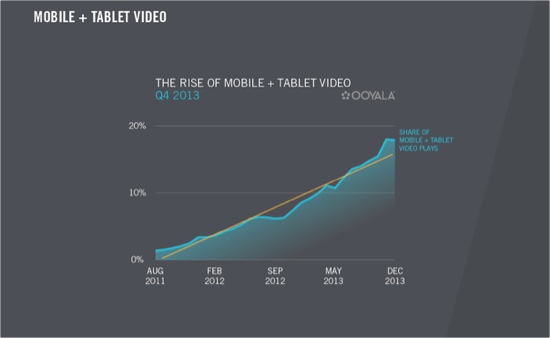
And in time for March Madness, the report indicates that mobile viewers are three times as likely to watch live sports on their mobile devices than video-on-demand content. Sports also dominates mobile viewing time, with longform sports content (10+ minutes in length) accounts for almost two-thirds of all mobile viewing time. Turner Sports concurs, indicating in a recent press release that mobile (smartphone and tablet) viewing of its NCAA men's basketball streams was up 71% in the tournament's first two weeks. Turner said the tournament had generated more than 64 million live video streams - 13.5 million hours - over that period, already eclipsing the 49 million lives streams for the entire 2013 tournament.
The Ooyala report is based on measuring the online viewing habits of more than 200 million Internet users in some 130 countries.
Sources - Half of All Video Views Could Be Via Mobile/Tablet By 2016, Sports Is Big Driver, Vidblog
Ooyala Gloval Video Index Q4 2013 report
Thursday, February 6, 2014
The State of Video Streaming: Sports
NBC and the BBC hit it big by streaming every moment of every event at the 2012 London Olympics, and currently plan on doing the same this year for the Sochi Winter Olympics (as long as the Russian government doesn't block things). The breadth and success of those 2013 Olympic efforts prompted a lot of audience trying and sampling.
And then there's the runaway success of Netflix and its brethren.
All of this showed promise of a spurt in the use of video streaming for watching sports - which is being confirmed by the latest Adobe Digital Video Benchmark report.
 The 2013 4th quarter report shows that sports video streaming has gone up 640% increase over the previous year.
In addition:
Adobe Digital Index Benchmark Report, Q4 2013, Adobe
And then there's the runaway success of Netflix and its brethren.
All of this showed promise of a spurt in the use of video streaming for watching sports - which is being confirmed by the latest Adobe Digital Video Benchmark report.
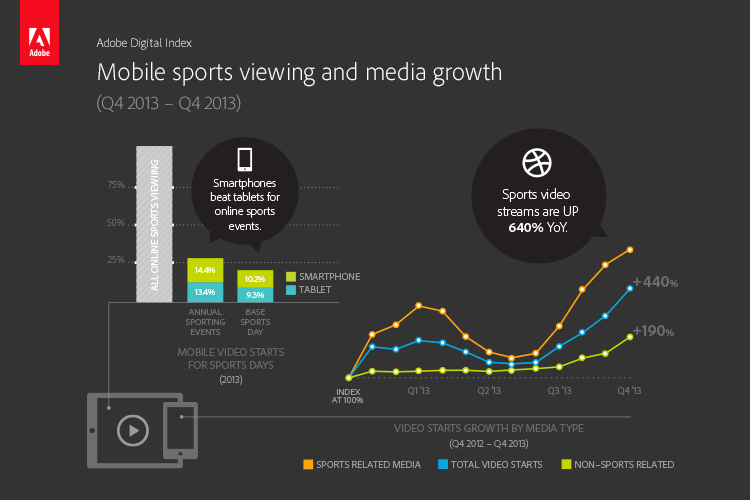 The 2013 4th quarter report shows that sports video streaming has gone up 640% increase over the previous year.
 In addition:
- 37% of TV Everywhere content streams are for sporting events
- More than a quarter of video streaming for major annual and bi-annual events are accessed by mobile devices.
- Such special events see twice the mobile sports streams than the average
- Watching sports streams on mobile is up 73% over the last year
- Most mobile viewing for big events is on smartphones
Campbell Foster, director of product marketing for Adobe Primetime, the company’s TV publishing infrastructure platform for service providers, said the data back up what many other industry observers have noted about sports: It is engagement viewing that fans don’t want to miss, so they use whatever device they can to watch.Sources - Adobe research finds mobile sports viewing driving huge growth in digital video, Mobile Sports Report
Adobe Digital Index Benchmark Report, Q4 2013, Adobe

Tuesday, September 24, 2013
New ratings low in sports

not a single, solitary Nielsen household tuned in for as long as a few minutes in any given quarter-hour to watch the Astros lose to the Indians for their 105th defeat of the year.Sure, there were excuses - the NFL's Houston Texans were on TV at the same time, the game was carried only on a regional cable sports network, it was against Cleveland, who isn't doing all that well this year, and the Astros are really, really bad this year (Sunday's game was the 9th loss in a row, and the 105th of the season). The ratings were also from the Houston overnights, which are based on a fairly small sample of homes (Nielsen reports having 851 metered households in the Houston market). But even against the Texas A&M/Alabama college football game, they pulled a few viewers, earning a 0.04 rating.
 Apparently, turnout in Cleveland wasn't that great either. (The Cleveland Indians has the lowest percentage of tickets sold in Major League Baseball - the pic is from that Sunday game).
Not the kind of record any sports team wants to set.
Source - New low for Astros: 0.0 TV Rating, Houston Chronicle
Tuesday, April 30, 2013
Baseball goes live - in Europe
The U.S.'s MLB (Major League Baseball) is now streaming two games a day to Europe and other markets. Just not to the games biggest fan markets (US, Canada, Japan, South Korea, and Taiwan).
 The games are available through MLB's YouTube channel, which will also have highlight clips from in-season games two days after they're played and a large archive of "Baseball's Best Moments." MLB's been streaming games live for a while now, but only as part of MLB TV's premium package (available in US for around $130/yr) - the move is part of their effort to expand the sport's fan base into new markets.
Source - MLB starts to stream games live on YouTube... outside of the US and Canada, GigaOm

Source - MLB starts to stream games live on YouTube... outside of the US and Canada, GigaOm
Tuesday, April 2, 2013
Social Media Week Infographic: Sports Fans
From Catalyst Fan Engagement Study (2012)

Source - Sports Fans: How They Play in Social Media (Infographic), CoSIDA.com

Source - Sports Fans: How They Play in Social Media (Infographic), CoSIDA.com
Monday, April 1, 2013
HBO Go to add live sports?
HBO Sports head Ken Hershman, speaking at the Harvard Sports Law Symposium that his network was "actively pursuing the idea of putting live streaming sporting events on HBO Go." When is another question - one person attending the conference said the goal was to have live streaming sports by the end of this year, while other press reports have HBO indicating that they have no intentions of adding live sports to HBO Go "anytime soon." HBO's chief executive Richard Plepler also contributed to the uncertainty of HBO Go's focus when he speculated that the streaming service might someday be offered as part of a bundle with high-speed internet access.
Adding live sports would be the draw that could provide the demand for a higher-priced HBO Go as a stand-alone streaming service - but the long-term viability will depend more on the cost of carriage rights - and for now, the highly competitive cable sports market is driving up carriage fees. So while live sports is something that's worth looking into for the programmers at HBO Go, it may be some time before the numbers make it a viable business decision - at least for more popular sports.
Source - HBO Go planning to add livestreaming sports in 2013, VentureBeat
Adding live sports would be the draw that could provide the demand for a higher-priced HBO Go as a stand-alone streaming service - but the long-term viability will depend more on the cost of carriage rights - and for now, the highly competitive cable sports market is driving up carriage fees. So while live sports is something that's worth looking into for the programmers at HBO Go, it may be some time before the numbers make it a viable business decision - at least for more popular sports.
Source - HBO Go planning to add livestreaming sports in 2013, VentureBeat
Thursday, March 7, 2013
Ready for Fox Sports 1?

“We are not trying to beat ESPN,” (News Corp. COO) Carey said. “Sports is a big, huge arena. We’ve proven we can do some interesting and exciting things. We can enlarge the category and bring a new dimension to it. The key to success for us is to build an attractive business that resonates with consumers."Source - News Corp. To Launch Fox Sports 1, MediaDailyNews
Monday, March 4, 2013
Cable Fee Blame Games Begin
If recent news stories are any indication, it's time for The Cable Fee Blame Games to begin.
 It's no surprise that cable (and other multichannel provider) subscription rates are going up. Programming license fees keep rising, the number of channels increase, and the last round of retransmission consent negotiations didn't go well for the multichannel industry. And the increases look to be even higher this year - perhaps enough that the industry is looking for others to blame. Many licensing deals require system-wide carriage of top channels, and are often sold in conjunction with new or less-valuable channels. So now some cable execs are talking about possibly breaking the basic tier into mini-bundles, even as public interest groups raise the prospect of a la carte pricing.
It's come to the point where Cablevision launched an anti-trust suit against Viacom, accusing it of forcing the cable MSO to carry (and pay for) less popular Viacom cable networks in order to get MTV and Nickelodeon.
And now the broadcast networks are talking about wanting to get big license fees from multichannel distributors, either directly or indirectly, by grabbing a big share of increased retransmission consent fees for affiliates. Some of the amounts I've been hearing are unreasonably and exorbitantly high - but between what the broadcast nets are talking, and sports channels passing through sky-rocketing coverage rights fees, coming jumps could be as high as $25-$50 a month, as they can't afford not to have high-demand content in an increasingly competitive environment. Thus, cable needs to try to put the blame for big rates increases elsewhere.
Here's some other recent headlines and highlights.

It's come to the point where Cablevision launched an anti-trust suit against Viacom, accusing it of forcing the cable MSO to carry (and pay for) less popular Viacom cable networks in order to get MTV and Nickelodeon.
"Without the 'take it or leave it' requirements of bundled programming packages at a wholesale level, cable companies could tailor smaller and lower-priced packages that could offer flexibility and have great appeal to specific interests and audiences," said Charlie Schueler, spokesman for Cablevision.Other multichannel providers are experimenting with partial unbundling. Verizon's offering a basic mini-bundle that drops expensive sports channels and knocks $15 off monthly fees. Mediacomm has been advocating a hybrid model with the most expensive channels offered a la carte on top of a basic bundle.
And now the broadcast networks are talking about wanting to get big license fees from multichannel distributors, either directly or indirectly, by grabbing a big share of increased retransmission consent fees for affiliates. Some of the amounts I've been hearing are unreasonably and exorbitantly high - but between what the broadcast nets are talking, and sports channels passing through sky-rocketing coverage rights fees, coming jumps could be as high as $25-$50 a month, as they can't afford not to have high-demand content in an increasingly competitive environment. Thus, cable needs to try to put the blame for big rates increases elsewhere.
Here's some other recent headlines and highlights.
- Cable One is going public with what it says is AMC's demand for a 520% increase in license fees. AMC has seen significant gains in viewing due to a number of successful original series.
Cable One claims AMC is demanding 520% increase in license fees, FierceCable - Dish Network gets $4.86 million jury award from ESPN, after alleging it wasn't getting the "best licensing rates" its contract provided. That's about 3% of the damages Dish claimed. Don't expect anybody's rates to go down.
Jury orders ESPN to pay Dish Network $4.86 million, FierceCable - In 2012, Mediacom Broadband average video subscription revenues up 12%, subscribers down 7%. Mediacom LLC saw average video sub revenues up 10%, subscribers down 7%.
Mediacom Broadband increases average video subscriber revenue by $14 in 2012, FierceCable
Tuesday, February 26, 2013
Battle for Sports Rights Hits Home (Hard)

The other primary factor pushing the bidding wars is the fact that sports is one of the few remaining TV programming sources reliably delivering live audiences.
Simply put, sports ratings not only remain robust in the face of declining tune-in for almost everything else, but they are one of the few commodities TV viewers insist on watching live, which removes (or seriously diminishes) the impact of delayed DVR viewing.As a result, sports is widely seen as the one thing you've got to have - as a network and as a multichannel provider. Combine absolute demand with growing competition and the price keeps rising.
The result? The NFL will get $2 billion a year out of its multi-network deals (a figure up 70% from the last round of deals). The Los Angeles Dodgers signed a $7 billion deal with Fox, while the Lakers got $2 billion in its latest deal. ESPN will be paying $470 million a year to air the new college football playoff games, on top of the billions it's paying for the top Bowl games. Major League Baseball's latest deal will generate $12.4 billion from three sports networks. NBC paid $1.8 billion for the London Olympics, and $4.38 billion for the US rights for the next four biennial events. The rising cost of sports broadcasting rights is felt internationally, particularly for big events. Telco BT (British Telecom) is making headlines with its recent deals to air matches from top soccer leagues across Europe and its purchase of ESPN's UK and Ireland channels (BT's building a telco cable service, supplemented by broadband net access, in competition with satellite service BSkyB).

Of course, skyrocketing sports rights aren't the only thing driving multichannel subscription prices higher. A SNL Kagan study identified two other factors - the fact that broadcast stations are now getting real money for retransmission fees, and the explosion of channels now carried by digital providers.
The surcharges and rising fees are driving another round of calls for mandating "a la carte" pricing from multichannels. Which, while it sounds good, is actually very bad economics for subscribers as well as networks and multichannel providers (discussed briefly in this post).
Sources - Cablevision to Inplement $2.98 Sports Surcharge, Multichannel
Rising fees for sports rights 'indispensable' and 'unsustainable', Sports Business News
BT ups ante against BSkyB with ESPN deal, The Telegraph
Kagan study outlines program cost drivers for MVPDs, RBR.com
Changing the game: Outlook for the global sports market to 2015, Price Waterhouse Cooper white paper
Thursday, February 21, 2013
ESPN Rates and Revenues Update
Terms of Time Warner Cable's 2010 deal with ESPN are coming out, and are reaffirming it's dominance among cable network revenue producers. The information came to light when revealed in court earlier this week as part of the Dish vs. ESPN lawsuit, and reflect the contract terms from September, 2010. While the terms may have changed or been renegotiated, it's unlikely that the rates have been reduced.
 Under the 2010 agreement, the affiliation fee for ESPN would reach $5.40 per Time Warner subscriber per month by the middle of 2013, reaching $7 per subscriber (per month) in 2017, and $8 around 2020. Looked at in terms of annual fee inflation, ESPN's price would increase about 6.5% annually. Dish sought information about Time Warner's deal with ESPN because it's supposedly the lowest rates for ESPN carriage rights. In other words, that's the minimum and the costs for other multichannel providers may well be higher.
ESPN currently reaches about 100 million U.S. TV households, almost all through some multichannel service that's paying for the rights to carry ESPN. Applying those per sub monthly fees over a year for 100 million subs, and you quickly generate some serious cash. The math suggests that ESPN will earn at least $6.5 billion from subscription fees this year, at least $8.4 billion in 2017, and around $9.6 billion by the end of the decade. And those numbers don't include earnings from advertising or what's generated by the other ESPN brands. ESPN clearly generates a lot of revenues and cash flow, even within the huge Disney empire. In fact, these suggest that the analyst's assumption in the previous post (2011 revenues just under $4 billion) are on the low side.
ESPN is the golden goose of TV, the gift that keeps on giving, the stock you wish you'd bought 40 years ago. (Pardon the cliches).
At this point, the only thing that seems likely to dramatically change ESPN's revenues track is if the FCC mandated that multichannel video program distributors offer access only through a la carte pricing - that is, consumers would have to order and pay for each network/channel separately. At $5.40 per month, that would push ESPN's price to $64.80 a year - but if ESPN wanted to keep their revenues level, the subscription price under a la carte would need to be much higher, to compensate for those choosing not to subscribe to ESPN, and to make up for lower advertising revenues resulting from the smaller audience reach. That's the downside to a la carte pricing - you wouldn't have to "pay" for channels and networks you don't want, but you'd have to pay a lot more for the channels you do want. Not even ESPN is that valuable - so such a move would almost certainly result in a sizable and significant decline in revenues.
Source - ESPN Set To Pass $7 Sub Fee In 2017, TVBlog

ESPN currently reaches about 100 million U.S. TV households, almost all through some multichannel service that's paying for the rights to carry ESPN. Applying those per sub monthly fees over a year for 100 million subs, and you quickly generate some serious cash. The math suggests that ESPN will earn at least $6.5 billion from subscription fees this year, at least $8.4 billion in 2017, and around $9.6 billion by the end of the decade. And those numbers don't include earnings from advertising or what's generated by the other ESPN brands. ESPN clearly generates a lot of revenues and cash flow, even within the huge Disney empire. In fact, these suggest that the analyst's assumption in the previous post (2011 revenues just under $4 billion) are on the low side.
ESPN is the golden goose of TV, the gift that keeps on giving, the stock you wish you'd bought 40 years ago. (Pardon the cliches).
At this point, the only thing that seems likely to dramatically change ESPN's revenues track is if the FCC mandated that multichannel video program distributors offer access only through a la carte pricing - that is, consumers would have to order and pay for each network/channel separately. At $5.40 per month, that would push ESPN's price to $64.80 a year - but if ESPN wanted to keep their revenues level, the subscription price under a la carte would need to be much higher, to compensate for those choosing not to subscribe to ESPN, and to make up for lower advertising revenues resulting from the smaller audience reach. That's the downside to a la carte pricing - you wouldn't have to "pay" for channels and networks you don't want, but you'd have to pay a lot more for the channels you do want. Not even ESPN is that valuable - so such a move would almost certainly result in a sizable and significant decline in revenues.
Source - ESPN Set To Pass $7 Sub Fee In 2017, TVBlog
Tuesday, November 13, 2012
Infographic - Social Media and Sports
Among the tidbits of information -
- NBA Finals tops Twitter and Facebook mentions (at 19.13 million), followed by Euro2012 (11.9 million) and UEFA Champions Finals (7.3 million)
- Other US championships didn't do as well - Superbowl (5.9 million), NHL Playoffs (3.3 million), MLB All-Star game (0.8 million)
- More than 350 former and current NBA players use Twitter - all told, the NBA generates 260 million Facebook likes and Twitter follows.
- The NHL's Pinterest site generated a lot of fan comment - most of it negative - "from people pissed off that the NHL would focus on updating their Pinterest page" rather than resolving the labor dispute that's already cost fans 200 games.
Wednesday, September 19, 2012
Sports Fans Moving Online

The growing importance of the Internet as a source for sports information is reflected in other survey results.
- 35.1% of sports fans report going online at least once a day for sports-related reasons (the share jumps to 66.8% for tthose who self-identify as dedicated fans
- 34.7% of younger sports fans (18-34) report they frequently use social media to comment on or share sports content (that stat drops to 15% for the 35-54 demographic and 5% for those over 55)
- 31.6% of sports fans use tablets for sports, and 45.7% report using smartphones to access online sports content
- 35.7% report using mobile devices to access online sports content while they watch sporting events on TV
- while casual fans reflect the general population in terms of demographics, those identifying themselves as devoted sports fans skew heavily male (79.0%), more educated (50.6% having at least a college degree), and higher income (43.7% are in high income households).
I think that TV's larger screen will keep it the predominant and preferred source for watching sporting events live. On the other hand, the Internet offers access to a wide range of sports content and information beyond that, in a format that's easily searchable, available any time and almost everywhere, can be interactive and social, and is readily customizable to the user's specific preferences as a sports fan. The Internet's already overtaken TV, cable, and newspapers as the preferred source for news (for many of the same reasons). It probably won't be long before we see the same shift in preference for sports information (if perhaps not as quickly for watching live sporting events).
Now the methodologist in me will note that the survey sample targeted U.S. online users, not the general population, so some inflation of the online numbers should be expected in the survey's findings. On the other hand, with more than 80% of US adults online, the differences between online adults and the general population are becoming minimal.
Source - Sports Fans Turn More to Web, Social Media, OnlineMediaDaily
Monday, August 13, 2012
NBC leaves Olympics viewers outraged but satisfied.
NBC's coverage of the London Olympics Closing Ceremony left at least two groups of viewers outraged.
The first group ran afoul of NBC's online efforts - NBC streamed the Closing Ceremony live (using a generic English language feed), but made the decision to delay its television coverage to US prime time, filling the afternoon broadcast feed with Olympic replays and commentary. Purists wondered why they didn't go ahead and put the live Ceremonies on the main NBC television feed, and then do a replay (or highlights of the Olympics show) in prime time.It was a business decision, of course, but one that led directly to the second, much more significant problem. NBC apparently thought that its Olympics audience would be a great place to preview a new Fall sitcom about veterinarians. Originally set to come on after the closing ceremonies, NBC pulled a "Heidi" by deciding to interrupt the closing ceremonies to keep "Animal Practice" in its scheduled time slot. In doing so, they cut out a number of performances.
The Twitter-sphere exploded, with “#NBCfail” and “#closingceremonies” trending worldwide, after NBC cut out performances by Ray Davies, Kate Bush, The Who and the Muse in favor of a commercial-free airing of “Animal Practice.”A spokesman for NBC, in acknowledging earlier social media complaints, said that NBC was paying attention - while still managing to blame viewers.
“I still don’t understand, it’s a tape delay, so can’t you do the math in advance? Why do you need to cut off the closing ceremony? #nbcfail,” wrote Raj Sarkar on Twitter.
“Some of the criticism I think was fair and we took note of it and learned from it,” Lazarus said, “but I think in general a lot of it came from people who weren’t fully aware of all of the things we were doing.”While there were some issues with the tape delays, the at times interminable chatty hosts and feel-good stories, and the choices of what events to cover on which channel, NBC's ratings, online and on TV, surpassed those of the 2008 Beijing Olympics, and a Pew study reported that about three-quarters of Americans watching the Olympics this year were generally satisfied with the TV coverage.
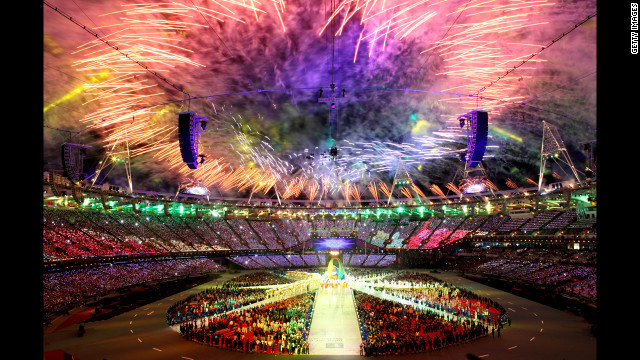
In any case, 2016 should be better - Rio is closer in time. And if NBC continues this year's trend of streaming all events, more of us will be able to control what we end up watching through our selection of which streaming feeds to send to our screens, rather than relying on NBC's sometimes problematic choices.
Sources - NBC enrages Olympics viewers one last time, Poynter
Viewers outraged after NBC cuts away from Olympics closing ceremony, World Sport News (from CNN)
Following A Multiscreen Olympics
Some Big Data metrics from Google illustrate the complementary nature of TV viewing and use of online and mobile devices.

The graph looks at the spikes in searches for Paul McCartney, who concluded the Opening Ceremony with a rendition of "Hey Jude."
 Meanwhile, a Pew study suggests that Americans are increasingly using "second screens" to supplement their TV viewing. When it comes to the Olympics, some 80% of respondents indicated they had watched some of the Games on TV (23% watched live coverage), while 17% reported following the Games online, and 12% said they used social media to follow the Games. Respondents also rated the quality of coverage from the various sources positively, and at about the same level.
Source - Olympics-related search spikes reveal close tie between first, second screens, Broadcast Engineering.
Americans augment Olympics TV viewing with social networks, online video, finds Pew, Broadcast Engineering

The graph looks at the spikes in searches for Paul McCartney, who concluded the Opening Ceremony with a rendition of "Hey Jude."
"One of the significant things to note about the spikes Google saw in online searches for the former Beatle is their timing. Spikes were detected concurring with the performance by those searching in Europe. In the United States, where NBC delayed the ceremony spikes in searches for the former Fab Four member synced up with the East Coast and Pacific replay of the performance."Google also reported that at times, searches from mobile devices outpaced those from laptops or desktops. In Japan, 55% of searches were from mobile devices; Great Britain (46%), Australia (45%) and Korea (36%) were the other countries with high mobile shares.

Source - Olympics-related search spikes reveal close tie between first, second screens, Broadcast Engineering.
Americans augment Olympics TV viewing with social networks, online video, finds Pew, Broadcast Engineering
Tuesday, August 7, 2012
NBC's Online Olympics Numbers

- There were more than a billion page views of NBC's online Olympics coverage (combined for all devices and apps)
- 7.6 million devices have been registered for "TV Everywhere" access (people who are getting NBC's cable channels through cable or DBS can register mobile devices to stream live coverage)
- More than 102.6 million streams have been viewed - 46 million were live streams of events. That amounted to 13.2 hours of video streaming in total
- 39.1 million people have accessed NBCOlympics.com on computers, 6.8 million through the mobile website version, 8.7 million through the NBC Olympics Live app (smartphones and tablets), and 3.1 million through the NBC Olympics app.
- The "Most-Clicked" athletes - Gabby Douglas (18+ million), Michael Phelps (7 million), followed by gymnasts McKayla Maroney (6 million), Jordyn Wieber (5.9 million), and Aly Raisman (3 million)
Source - 1,117,011,735 Page Views for NBCOlympics.com, Fierce Cable
Monday, August 6, 2012
Olympics huge success for BBC Online
The early results are in, and suggests that the BBC's online video efforts for the 2012 London Olympics will be a huge success for the once doughty broadcaster. BBC reported that there were 1.7 million iPlayer requests for opening ceremony coverage, 7.8 million "browsers" globally (5.8 million in the UK), and 8.3 million globally (6.1 million in the UK) on Sunday. By the end of the weekend, more than 1.15 million BBC Olympics apps had been downloaded.
 The head of product for BBC Sports reported that interest during the opening weekend exceeded expectations -
Source - London Olympics Already a Record-Setter for BBC, Digital Spy
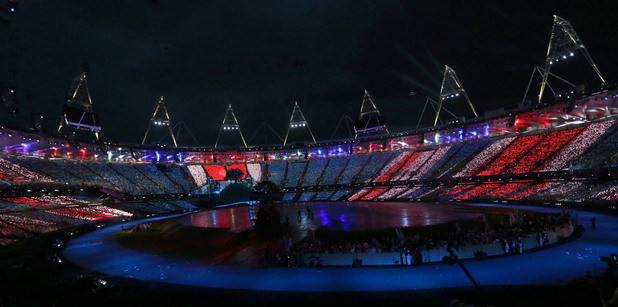
"Just after 3pm on Saturday afternoon we had all our encoders in action playing 24 live video streams of sporting action across desktop, mobile tablet, connected TVs and Red Button
"And Sunday was the busiest day ever on the BBC Sport site - with 6.1 million unique browsers in the UK and 8.3 million worldwide."
Source - London Olympics Already a Record-Setter for BBC, Digital Spy
Subscribe to:
Posts (Atom)