In previous posts I've explained why bundling can be a good marketing and pricing strategy, particularly for certain types of information goods, and why a la carte strategies can be appropriate for networks with certain characteristics and in markets where access can be easily restricted. I've also made the case that in the early years of cable and multichannel video distribution, bundling was arguably the optimal marketing strategy for system operators, as well as for audiences. Technological advances and the explosive growth in market competition over the last decade or two, on the other hand, have opened the door for the effective use of a la carte marketing of video networks. The remaining core question is whether shifting to a la carte is a good strategy for video distributors, networks, and audiences. I'll try to address that issue in this post.
One of the problems with much of the current discussions of forcing a shift to a la carte marketing is that it's largely based on overly simple, and occasionally inaccurate assumptions.
The one I've already addressed is the argument that bundling forces consumers to pay for channels they don't want. The problem with that argument is that a consumer's decision to purchase a bundle of networks from a multichannel distributor is not based on a network by network consideration of value, but on the simpler issue of whether the consumer feels that the aggregated expected value of the channels he or she does want is greater than the price of the bundle; from that perspective, whether the distributor includes unwanted "costly" channels is irrelevant. ("costly" in the sense that the distributor pays for carriage rights).
A second major assumption (unstated but underlying most discussions) is that the a la carte price for a network would be close to what multichannel distributors pay for carriage rights as part of bundle. The problem with that assumption is that it oversimplifies the market forces at play, and ignores the economic impact of unbundling. For many of the 800+ cable networks available in the U.S., going a la carte is likely to lead to a pricing death spiral.

The problem is that while cable networks in aggregate (i.e. bundled) have been quite successful in attracting audiences (gathering 50-70% of viewing overall (a bit less in primetime), all but a handful of networks attract less than 1% of audience viewing (averaged daily viewing). Of course, some programming draws significantly higher audiences, and demand for networks may be even higher. Still, most cable networks are likely to attract substantially smaller number of subscribers as an a la carte offering than the potential audience obtained as part of a bundle.

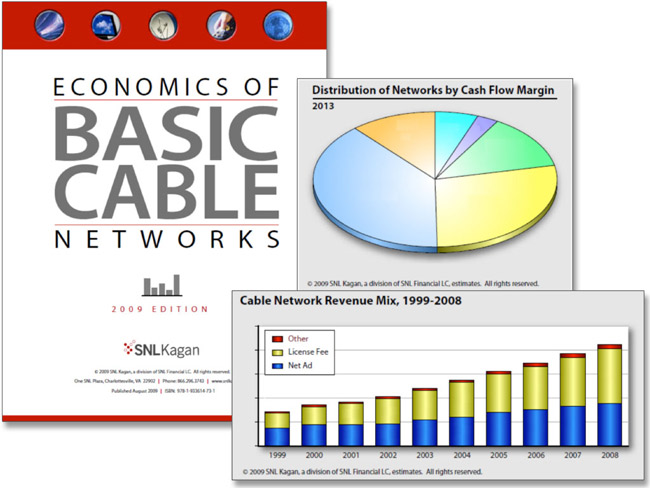
For example, the total daypart audiences for ad-supported cable networks in the last quarter showed that only 8 cable networks had overall total day ratings of 1 or higher. Weekly primetime numbers for top networks can be 2-3 times higher, and certain episodes or events (primarily but not exclusively sports) can draw ratings of 10-15. Actual demand for a channel marketed a la carte is likely to be higher than that (as it's aggregating across shows and over time), but is also likely to be highly price-sensitive. Even if a cable network could get a 50% buy-in rate as an a la carte offered at the current bundled carriage rate, that would result in a 50% decline in subscription revenues for the network. (That's one reason pay-tv network subscription prices are in the $15/mo range, while carriage rates for cable networks top out around $5/mo, and most are under a dollar.)
However, that's not the only impact of shifting to a la carte. Most cable networks are also supported by advertising. While a network would likely keep most of its core viewing as an a la carte offering, it would lose the occasional or drop-in viewers, which would have some negative impact on revenues. More critically, though, is the fact that many national advertisers prefer to buy spots on networks that have a potential reach of 80-90% of the national population. Few cable networks are likely to reach that goal as an a la carte service without significantly discounting subscription prices.

Unbundling cable networks is likely to have significant negative impact on revenues for all but a few channels. Those where losses are small are likely to be channels with established record of high-value content, and a fairly broad audience base. Those channels whose value lies in a narrow niche are likely to find that unbundling will drastically cut their revenues, forcing them to choose between significantly hiking a la carte prices or cutting back on programming costs. Either of those responses put the network on a potential death spiral where demand (and revenues) continue to shrink as networks try to cope through price hikes or cost-cutting in content.
There is one additional implication of shifting from bundling to a la carte. Multichannel video distributors face significant costs in building and maintaining their distribution infrastructure. Those costs need to be recouped through subscription fees. When the subscriptions are for bundles with a large number of, the per-channel distribution costs are fairly low. If consumers shift from a large number of channels to only those they are willing to pay for separately (the goal of a la carte), then those distribution costs would have to be paid for separately, or split among the smaller number of channels subscribed to. In the first instance, that would mean that a multichannel distributor may place a surcharge on access, regardless on how many or which networks are subscribed to. The alternative is to split distribution costs across the channels; meaning networks would have to pay for their distribution, or add distribution costs to their a la carte prices. In either case, that's more negative pressure on revenues and demand.
The upshot is that unbundling will result in significantly lower subscription numbers for most, if not all, cable networks. The lower buy rates will negatively impact both subscription and advertising revenues compared to the current bundling market option. If networks need to maintain current revenue levels, they're likely to have to significantly boost the a la carte pricing, or drastically cost the price (and consumer value of) their content. Either strategy could easily result in a death spiral of declining audiences leading to price-highs and cost-cutting, leading to falling demand and audiences, etc. until the network proves to be no longer economically viable.
The "death spiral" problem is aggravated by the fact that there is a new TV distribution system available. Online video delivery is becoming widely available as broadband Internet access increases. Over 70% of Internet users already watch online videos, and streaming services like Netflix, Hulu+, and Amazon offer access to a vast archive of current and older TV and movie content. The TV consumer faced with the issue of whether to purchase, say, Turner Classic Movies channel is not only thinking about whether that channel is worth purchasing, but the value of TCM vs. AMC vs. USA vs. CNN vs. a Netflix subscription and a plethora of free online content.

Already several million US adults have become "cord-cutters", dropping some or all of their multichannel distribution services in favor of accessing their TV and movie content through online streaming services. If unbundling drives channel prices up and forces consumers to be more rational in their purchasing of subscriptions to access cable networks, this could trigger a move of consumers to online video. That move may well be followed by a move by networks finding a less costly - and more flexible - distribution system that allows more viewer interaction, better usage metrics, and greater capacity for price differentiation.
If unbundling is bad for most cable networks, it's got to be good for consumers, right? After all, a lot of the political push argues that it's in the consumer interest. The reality here is that unbundling is likely to result in consumers paying higher prices for significantly fewer channels. The problem is that bundling acts as a form of cross-subsidization as well as a form of risk aggregation. When value is uncertain, aggregation through bundling spreads that risk - moving the the consumer from "I'm not sure that program/network is worth the price charged" to "It's likely something in the bundle is worth the price." Bundling spreads distribution costs across more networks, reducing per-channel costs. And from the consumer perspective, buying a bundle of channels you're not sure you want while getting those you do essentially subsidizes access to those added channels. Previous efforts to remove subsidies in cable (the 1992 Cable Act) actually increased prices for most cable subscribers, rather than reducing them, as the politicians and interest groups pushing for the Act claimed. In telecommunications, cross-subsidies usually are based on high-demand & high-value services subsidizing low value and low demand services. In this case, it's ESPN subsidizing The History Channel; not the other way around.
Even if the subscription prices of channels don't increase, consumers are likely to reduce the number of channels they will subscribe to. Rather than "bundling forcing consumers to buy channels they don't want," unbundling means that consumers will be able to
not buy the channels they don't want. Audience research shows that for most consumers, almost all of their viewing is confined to 5-10 channels. Another factor suggesting reduced channel access can come into play when there are multiple channels or networks in a content niche. If the consumer perceives overlapping value across related niche channels, then the purchase decision is based not on the total value of the additional channel, but the added value that channel is likely to generate above that available in channels already in the a la carte subscription basket. That makes it much less likely that the consumer will purchase complementary channels, or multiple channels within a content niche. At least not without some significant cross-subsidy of channel prices.
So rather than having access to 100s of channels via bundling, it's likely that most Americans would scale back to 5-10 channels, perhaps with occasional video-on-demand purchase of high-value content. Gone would be the opportunity for serendipity and the opportunity to sample and establish value for innovative networks and programs. Thus, unbundling, along with the removal of possible subsidies, is likely to negatively impact general social welfare. In fact, that's the long-established argument for public broadcasting.
To illustrate, a consumer who has a low to moderate interest in news is much more likely to subscribe to a single news source than to subscribe separately to multiple news networks offered a la carte. It's generally given that relying on multiple news and information sources is more valuable than relying on a single source - but a la carte models reduce the likelihood of multiple subscriptions, as the added value of additional news sources decreases as the number of sources goes up. (When content overlaps, the consumer will base a purchase decision on the added value the additional channel will bring, rather than the full value of the channel. Thus further decreasing demand for multiple channels within a niche). I'm sure that most liberals would be upset if Fox News Channel was the only cable news channel subscribed to, just as most conservatives would worry if MSNBC was the only cable news network many people subscribed to.
In addition, the impact of increased costs will hit lower income groups
more than others. Lower income groups are likely to cut off a la carte
subscriptions once their separate subscriptions reach a point where the
channels provide a threshold level of content, particularly if the addition of other channels provide minimal incremental value.

So, a complete unbundling and a shift to a pure a la carte marketing approach is likely to have a significant negative impact on all but the biggest high-value cable networks, and be particularly problematic for networks with content of lessor or unknown value, and those targeting small niche audiences. It's quite likely to increase access costs to consumers (both on a per-channel and aggregate level), and result in their reducing access to networks and content of low or uncertain perceived value. Not only is this a negative consequence for the consumer, but the reduction in access brought by a pure a la carte marketing approach is quite likely to have meaningful negative social impacts as well.
It would hurt multichannel distributors as well, impacting the cost and profitability of their multichannel video services, and accentuating their competitive disadvantage as a TV distribution system vis-a-vis online streaming. The eventual certainty of competitive disadvantage in that field has been recognized by the industry, and is one reason why much of their focus is shifting from multichannel video distribution to becoming a digital telecommunication access point and service provider.
Let me end by saying that a look at the likely impacts of a shift from pure bundling to pure "a la carte" model for multichannel video distribution suggests that there will be serious negative consequences for most groups in the market. But it's not necessary to completely shift from one extreme to another. The growth of video-on-demand (VOD) is demonstrating that a la carte can be a viable option for some networks. The explosion of carriage fee rates for some networks - regional and nation sports networks in particular - suggests that splitting related niche networks and channels into separate mini-bundles, possibly with some a la carte options, would be appropriate and even have a positive impact on consumers and networks, letting the high costs of those channels be born more directly by those that see that value. (And also hopefully bringing bundle prices back down to where multichannel access, and the social values associated with maximal access, are maximized.)
The market and technology is a a point where a la carte marketing of networks and channels is viable, and where it makes sense for some types of channels. The same can be said for the intermediate strategy of offering various mini-bundle mixes of channels, programs, and services. However, there are still a large number of channels, networks, and services where bundling remains the optimal approach, from consumer, network, distributor, and social perspectives. It's pretty clear that rushing into a overly simplistic "bundling is corporate evil so a la carte must be consumer-friendly" assumption is not a reasonable foundation for policy in this area. This is an area where an incremental approach that considers what marketing approach is best within a specific context; where consideration is given to the type of content and its content as well as audience interest, social welfare, and the values inherent in having the content accessible and used. That's the approach most likely to result in positive outcomes.