Showing posts with label Nielsen. Show all posts

Monday, January 27, 2014

Nielsen offloads LinkMeter project


When Nielsen acquired Arbitron, one potential regulatory roadblock was Arbitron's LinkMeter and its Project Blueprint collaboration with comScore and ESPN.  The Project was an effort to develop a cross-platform audience measurement system to compete with Nielsen's independent efforts in that area.   With some fearing that Nielsen would just shutter this potential competition, the FTC indicated that Nielsen would need to commit to market the LinkMeter technology to all comers in order to have the merger pass anti-trust review.

Nielsen seems to have gone one step further, announcing recently that it will divest itself of the LinkMeter system by selling it to comScore - one of the original collaborators and Nielsen's strongest competition in online media metrics.  The move should keep the efforts to develop a consensus crossplatform metric competitive for the time being.

Source -  Nielsen Finalizes Agreement To Sell Arbitron LinkMeter To comScore, Fulfills, FTC Antitrust Order,  Media Daily News

Monday, September 23, 2013

FTC clears Nielsen-Arbitron deal

The FTC has approved Nielsen's acquisition of former audience metrics rival Arbitron, after securing an agreement that Nielsen will continue the "Portable People Meter" (PPM) project, and license its use to others (notably competitor comScore).  The PPM project was originally a joint project of Nielsen, Arbitron, and comScore, and there was some concern that Nielsen would try to freeze out comScore.  ComScore and Nielsen are also involved in the competition to develop industry standards for online video metrics.
“In the event that an FTC-approved third-party elects to agree to licensing terms and other requirements, Nielsen would make available for license Arbitron PPM and related data as well as software and technology currently being used in the ESPN project for the sole purpose of cross-platform measurement for up to eight years,” Nielsen said in its statement.
While that wording sounds awfully restrictive, other language from the FTC indicated that comScore would clearly get that initial license.

With the FTC's approval, Nielsen's acquisition of Arbitron is expected to close Sept. 30.

Source -  FTC Clears Nielsen-Arbitron Deal, comScore Retains PPM License,  MediaDailyNews


Tuesday, September 17, 2013

Nielsen- VOD/DVR use expands, changing TV habits`

Nielsen's latest "Cross-Platform Report" notes that 60% of US TVHH have VOD (Video On Demand) capabilities through set-top boxes and access through video streaming services.  Nielsen suggests that ease of use and increased programming options have made VOD and increasingly viable option for TV viewing.
The report shows that while traditional TV viewing (live on TV sets) remains the source of most viewing, audiences are increasing their use of both DVRs and VOD for time shifting programs and supplementing their viewing options.  The report also suggests that DVR and VOD uses are developing unique niches, with DVR time-shifting primarily used for general dramatic series, and VOD used primarily for watching movies.

The full report finds that younger demographic groups are more likely to make use of VOD, as are families with kids, and households with incomes above $100,000.  There's no real difference in use between households with DVRs and those without, but those with high speed Internet connections are much more likely to use VOD.

If you look at how different age groups use different devices for watching video content, those 50+ report the highest amount of traditional TV viewing (over 40 hrs/week), while the 25-49 age groups do the most time-shifted viewing (3+ hrs/wk) and spend the most time on the internet on computers (6+ hrs/wk).  The 18-34 age group averages the most time watching video on the Internet (about 1.3 hrs/wk).

Looking at different race/ethnic groups, Blacks watch the most "traditional" TV, averaging more than 200 hrs/month.  They also spend the most time watching videos using DVD/BluRay players (6 hrs/month), game consoles (7+ hrs/month), and rank second to Asians in time watching video content through the internet (9 hrs/month).  Asians spend the least time watching video content on traditional TVs (86 hrs/month), yet spend the most time accessing the internet via computers (35 hrs/month) and watching videos through the internet (12 hrs/month).  Whites watch the most time-shifted video content, averaging 12 1/2 hrs/month.

Sources - Q2 2013 Cross-Platform Report: Viewing on Demand, Nielsen Newswire
Viewing on Demand: The Cross-Platform Report September 2013, Nielsen research report

Wednesday, May 8, 2013

Redefining U. S. TVHH Universe

When Nielsen announced it was expanding its TV household sample to include homes that had no separate TV set, but could access TV programming via computers or other devices, it was clear that there would be two follow-up changes.  First, that at some point Nielsen would include online viewing in their ratings measures.  Second, that Nielsen would redefine its definition of TV households (TVHH) to include households watching TV programs online.
  Nielsen's latest numbers on the national TV audience has taken that second step, redefining its viewing audience measures.  Specifically, Nielsen's counting you as a potential viewer if you have a working TV set, or a broadband Internet connection and a monitor/display capable of displaying TV programs.
  Under the new definition, Nielsen reported the 2013/2014 U.S. TV household Universe Estimate at 115.6 million (up 1.2%), and the total number of TV viewers (2 and older) at 294 million (up 1.6%).  The gain comes after two years of declining viewing universe numbers, but is still less than the 2010/2011 Universe Estimate of 115.9 million homes. 
  In announcing the new metrics, Nielsen indicated that three factors contributed to the gain - real changes in population; updated formula for calculating penetration across demographics; and the expanded definition of a TV household.  They did not indicate how much of a contribution each factor made.

Sources -  Nielsen Reverses Decline in U.S. TV Homes, Variety
Nielsen Estimates 115.6 Million TV Homes in the U.S., Up 1.2%,  Nielsen press release

Thursday, March 7, 2013

Nielsen/Arbitron deal edges closer

Nielsen's purchase of Arbitron is still not official - the FTC has yet to formally sign off on whether the merger would be anti-competitive.
  But the deal edged a bit closer as a Federal Court 2011 ruling in an anti-trust suit brought against Nielsen was upheld in appeal.  The 2011 decision found that while Nielsen was a monopoly in the US TV ratings business, it wasn't behaving in an anti-competitive manner.  That finding was just confirmed on appeal.

“Neither party disputes that Nielsen exercises monopoly power over the television audience measurement services industry, both nationally, for the United States as a whole, and for all 210 markets.”
However, the court ruled that on the specific allegations of the suit - that Nielsen had acted to prohibit other audience measurement services from entering the Miami market - that there was no evidence of specific anti-competitive behavior.  If such evidence had been forthcoming, it would likely have had a significant impact on the FTC's ruling of whether the Nielsen-Arbitron deal would be anti-competitive.

  Another factor in Nielsen's favor is that while Nielsen and Arbitron had once been fierce competitors in the U.S. TV and Radio ratings business, there is limited direct competition between the two today.

From 1978-1989 as Arbitron went head-to-head with Nielsen in the local TV ratings business, 60% to 80% of clients subscribed to both, the appeals court said. Those days are long gone -- Arbitron pulled out of that arena in 1993 -- much to the dismay of many in the advertising business.
As such, the purchase of Arbitron is seen primarily as a way for Nielsen to expand into additional areas of audience behavior measurements, and not as a means to remove a rival.  If that perception holds true, the FTC could still approve the deal, even if Nielsen is technically a monopoly.


Source -  Confirmed: Nielsen Is A Monopoly -- But Court OK With ItTVBlog

Monday, February 25, 2013

Neilsen Redefines "TV"

If you've been paying attention to the evolving media landscape, changing audience behaviors, and debates over measuring viewing (or listening, reading, etc.), you knew this was coming.
  According to press reports, Nielsen's been telling it's clients that it's changing its definition of TV.  Since it's beginning, the Nielsen ratings universe has been based on TVHH - households with a working TV set, and measured viewing as occurring on TV sets.  Certainly definitions that made sense when the only way to watch TV programming (and ads) was through a television set tuned to a broadcast.  The definitions endured through the rise of cable (and DBS), VCRs, DVDs, etc.  While greatly expanding viewing options, you still needed the TV set as the display. 
  The digital revolution started changing that - you could connect TV tuners to computers and watch on the computer's display; TV content went online, and broadband diffusion made high quality streaming viable; DVRs fulfilled the VCR's promise of time-shifting, and mobile looks to fulfill the promise of place-shifting.  Time-shifting increased to the point where Nielsen and the networks had to find a way to count that audience, and continued growth of time-shifting ignited the current debates over what time period gets added in to the live viewing.  Still, however, the feeling was that the key component of TV was the larger TV screen - and that remained the foundational definition.
  For now, the TV set remains the foundation, but Nielsen will start looking at internet-connected TVs and viewing via internet streaming.  Nielsen's basic shift is that they will start including internet-only TV households in its sample, and start tracking viewing via streaming.  At this point, the proportion of (zero TV profile) households - those that don't watch TV over traditional (terrestrial broadcast, multichannel bundlers) channels - is small, but growing.  Nielsen estimates that when the new sample ratings kick in this coming fall (2013), the impact will initially be small (around half a ratings point), but as the "zero TV" segment grows, Nielsen wanted to be in a position to capture shifting behaviors.
   For advertisers concerned that these new delivery systems aren't carrying the original broadcast commercials - inflating the numbers reached and their costs - Nielsen indicated that, for now, the extra viewing will be captured separately, and specifically won't be included in the C3 ratings that form the basic currency in network/advertising rate-setting.  (C3 counts live viewing plus time-shifted viewing within three days).

The move should be welcomed as a step in coming to grips with the shifting media-audience ecosystem.  And help foster recognition of shifting media usage patterns, and the need to distinguish between viewing of content and viewing of ads.  It's been apparent that DVRs and new distribution channels have made it difficult to sustain the assumption that viewing a program equates with viewing the ad.  That's always been a questionable assumption, but now, viewing on other channels, through VOD, through streaming - all of which don't necessarily carry the same set of embedded advertising - is at the point where advertisers are pushing back at the networks and Nielsen.  This latest move should help solidify the distinction, and push for multiple metrics to met various needs.
  Still, there's a potentially bigger evolutionary force out there - the impact of mobile and the facilitation of place-shifting.  This move doesn't address that issue - the metrics still focus on content consumed on the TV set.  According to Brian Fuhrer, senior vice president-national & cross-platform product leader at Nielsen, wireless broadband is enabling new viewing alternatives - smartphones, tablets, even wireless gadgets connected to TVs.  Nielsen's looking at that, and how that would further redefine "TV."  I'd like to see that come quickly, but dealing with how to best measure and greatly expanded set of viewing options, as well as the continuing explosion in available "TV" content, poses a number of issues that will need to be resolved.  Nielsen indicates it's working towards that, as are a number of Internet-metrics players.  It'll be an interesting race - and one that shouldn't necessarily go to the quickest, the biggest, or the traditional dominant force.  Getting it right is critical to get a true reflection of changing patterns.

Source - Nielsen Redefines 'Television,' Will Include Internet-Only Connected Sets, HouseholdsMediaDail News
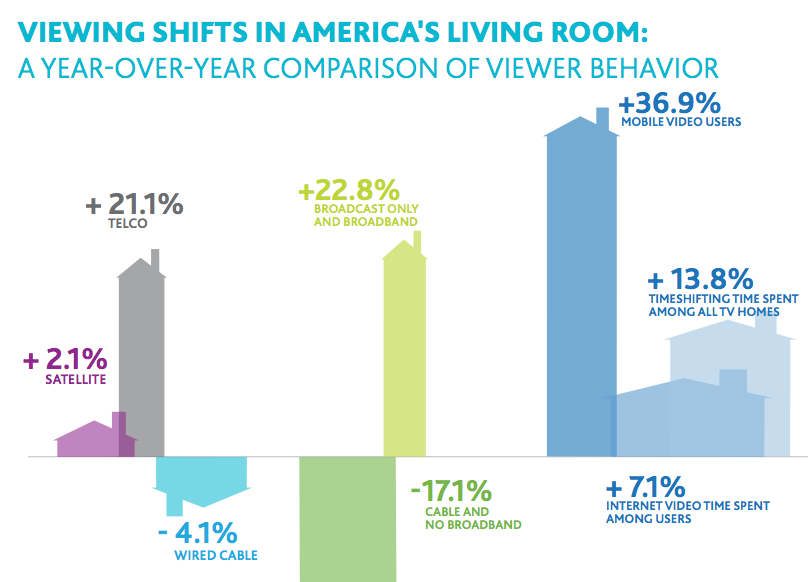
America's Living room: More Internet, less wired cable, VatorNews (older story, source of graphics)

Wednesday, January 9, 2013

Nielsen US Consumer Media Usage Infographic

Officially, it's a report - but basically it's two infographics.


Some highlights:
  • TV still dominates in terms of time used
  • Among US TVHH, 86% have DVD player, 75% have HD sets, 56% have game cousoles, 52% have digital cable (33% have DBS (sat), 47% have DVR
  • 76% are active Internet users
  • Only 4% have a smart TV connected to the Internet, but 56% watch online videos
  • 56% of mobile subscribers have smartphones
  • 17% of "connected" users have an eBook reader
  • 16% of TVHH have tablets
  • 20% of the time people spend using computers is on social media/blogs - the next highest usage category is online games, at 8%, followed by email, at 7%.
  • Mobile device users spend the most time texting (14%) and on social networks (10%).  Almost half (46%) of consumers use mobile devices to access social media.
  • YouTube continues to dominate online video, with 136 million unique users in the U.S. - while Yahoo! and Vevo have just under 38 million unique users. 
Source -  Nielsen U.S. Consumer Usage Report, Nielsen  (may require registration)