Showing posts with label media business; business plan. Show all posts

Tuesday, August 12, 2014

Case-Study- the Philadelphia Papers Long Fall

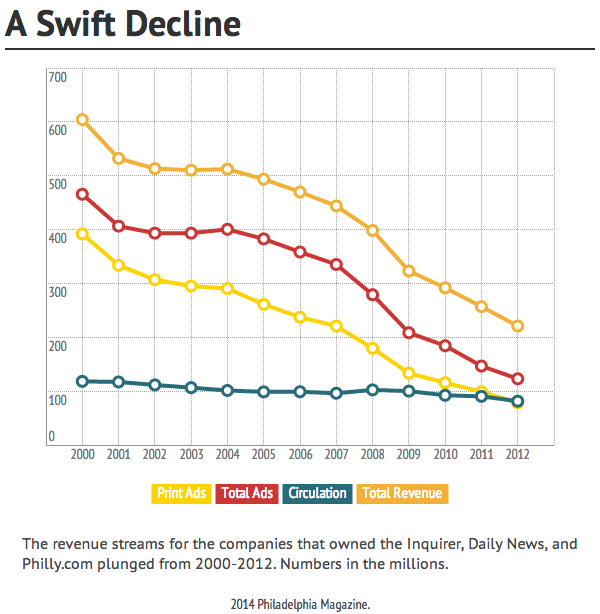
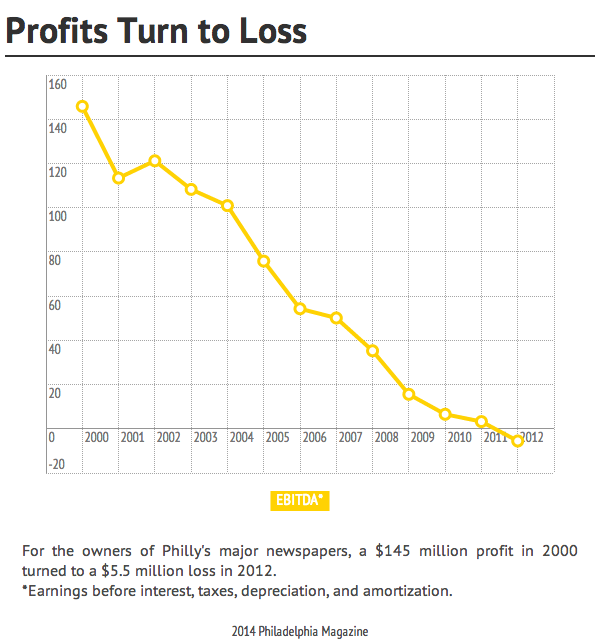
A good piece by Joel Mathis on the decline and fall of the Philadelphia Inquirer and Daily News.  Working from a financial report, he tracks the progress from being a reliable cash cow to bankruptcy in a little over a decade.

A large chunk of the problem was the same faced by most large urban dailies in the U.S. - a big drop-off in advertising revenues as one industry after another found better alternatives online.  It didn't help that this was followed by the recession - which hit all advertising revenues hard.

But when the industry started to recover after 2010, the loss of advertising continued to fall by double digits for the two Philly papers.  The fact that the papers changed ownership 4 times in 12, and the lack of consistent business strategies, didn't help either.

A look at the numbers suggests some other factors at work. 
    • Like most media facing revenue declines, the papers owners tried first to just cut costs.  But in Philly, it seems, the focus was on cutting staff (labor costs went from $243 million in 2000, to $135 million in 2012).  That's more than just trimming dead wood - it's the kind of cuts that will necessarily have an impact on quality.
    • Those deep cuts can also be seen circulation losses.  Circulation fell from a high of 374,000 (2002) to 166,000 in the last audit - a loss of more than half their readership.  Such losses necessarily impact the value of advertising in the papers, accelerating ad revenue declines.
    • Circulation revenues also declined, but much more slowly than circulation losses.  This suggests that the papers tried cutting subscription discounts and/or hiking prices.  Increasing costs to readers while reducing the value of the product also feeds into the negative feedback loop for circulation.
Thus the various manager's plans created a near "perfect storm" of negative feedback.  Initial shifts in advertising categories prompted cost-cutting,  That led to a focus on cutting staffing, which impacted the value of the news product.  Declines in product value led to circulation losses, which were exacerbated by cost increases.  Massive circulation losses reduced the value of advertising, which gave advertisers even less of a reason to return to the papers as the recession ended.

There's one other interesting aspect to tease out.  Note that there's a large, but shrinking, difference between print ad revenues and total ad revenues.  That would include digital advertising, which hasn't grown much.  It also includes preprint advertising (i.e. inserts) - and for a while it seemed that the papers were doing well with that revenue category.  However, large circulation losses make inserts less valuable, and by 2012 it seems that the Philly papers had lost that advertising sector to competitors as well.

Sources -  "The Long Fall of the Philly Newspapers,"  PhillyMag.com
It turns out the 2000s were not a good decade for The Philadelphia Inquirer and Daily News,  Nieman Journalism Lab

Tuesday, December 10, 2013

Free vs Pirates

There's no question that online content piracy is a problem.  There's some question about how big a problem (in terms of impact on content sales), and growing problems with regard to how to best combat it (copyright enforcement becoming increasingly problematic).

The growing problem with enforcement is that making and distributing digital copies is easy and dirt cheap - and the solutions being offered in policy debates increasingly degrade both digital systems, network security, and individual privacy.  Perhaps its time for a different approach.

A new paper (and forthcoming book chapter) for the National Bureau of Economic Research suggests that a more effective anti-piracy strategy might be to reduce the economic incentives for pirates.  Using new online data sources, and tracking the impacts of natural experiments when large amounts of content were either removed from online markets or made available to them, the study found that having content online significantly reduces online piracy.  Making content widely (and inexpensively) available online can reduce piracy by 10-20%; removing content, or making it significantly more expensive, can increase piracy by a similar margin.  Making distribution of pirated content more difficult and expensive (in this case by shutting down Megaupload.com) increased online content sales by 5-10%.

These results are of a piece with a number of studies that link pricing and marketing strategies with the prevalence of online piracy.  A study for the WIPO found that while online piracy of broadcast signals was rampant, it occurred overwhelmingly under two circumstances: when the content was not legally distributed in the area, or when pricing was set at Western levels (making it unaffordable in poorer areas).  Similarly, a wide range of marketing studies have found that having free or minimal price options minimizes incentives to search out illegal versions.  Those studies also found that content creators can maintain sales and profit levels through the increased volume of legal access, and by engaging in content versioning. 
   Versioning refers to the ability to market different versions of the core content,  For example, music can be made available free online in a low-resolution option, with standard (CD-quality) resolution for a modest price, and in a higher-fidelity version (perhaps with some affiliated goodies) for a higher price.  Versioning has a long tradition in book publishing (hardcover vs. paperback), records (45s vs LPs vs CDs vs DVD-As, etc.), and online radio & video (lower quality streaming for free, but high quality streams requiring subscriptions).

What this suggests is that content creators have an alternative to trying to force digital distribution systems to follow the analog copyright metaphor - particularly when those efforts criminalize their potential audience and markets.  Instead of trying to regulate digital markets to fit traditional business models, they can explore the potential that digital offers for new and increasingly lucrative business models.

Source -  Want to Fight Off Content Pirates? Just Stream Your Show for Free, BloombergBusinessweek
Understanding Media Markets in the Digital Age: Economics and Methodology, NBER Working Paper No. 19634
Monetizing digital media: Creating value consumers will buy, EY.com

Thursday, December 5, 2013

"Unbundling" warnings

A study by Needham & Company media analyst Laura Martin cautions that a full unbundling of cable networks could result in a loss of up to 60% of TV advertising revenues, 124 cable channels would end broadcasting, and up to 1.4 million industry jobs could be lost.  The numbers sound extreme at first, but aren't out of the range of possibility - particularly with the rapid expansion of alternative video content delivery options.

As discussed in the earlier "Bundling vs. A la Carte" series of posts, (see here, here, and here), bundling cable networks works to expand potential audience reach, encourages sampling of channels and content, and permits occasional viewing.  A consequence of full unbundling for most cable nets would be a significant decline in audience, which will result in a big drop in advertising revenues that may or may not be countered by increased subscription/licensing payoffs.  For some, it may result in a death spiral of trying to hike subscription fees to recoup lost advertising, which will further shrink audiences, advertising revenues, as well as subscription revenues.

Currently, advertising counts for about 60% of TV/cable network revenues, and unbundling will undoubtably push the shift to greater reliance on licensing and subscriptions as a mechanism for funding content creation.  How sustainable that is for the 500+ TV programming networks remains uncertain.  Some high-demand high-value content will thrive, but many low-demand, limited and variable value content may not.  And certainly, I'd expect competition to shrink as many viewers are unlikely to want to pay separately for multiple channels in a genre.

As Martin notes,
“All content companies benefit from TV bundling, as well as from new digital platforms that are driving record free cash flows from content creation globally."
I hope that she's equally correct when she concludes that "(b)ecause consumers lose so much value through unbundling, we expect no policy change in the U.S.”  However, I'm a bit more skeptical that U.S. policy is driven more by economics and consumer interests than it is by outside special interests and politics - particularly those that provide campaign talking points..

Source -  Cable Unbundling Puts Majority of TV Ad Revs,  Media Daily News

Monday, November 18, 2013

Forbes for sale; Is digital success fluke or future?

Forbes Media has announced that it is up for sale.  The move was first announced in a memo to employees last Friday.  Forbes CEO and President Mike Perlis said the decision to pursue a sale came after several initial "serious" offers had been made.
Forbes magazine has seen the same downturn in print advertising as its competitors, with a 12.3% decline in the number of ad pages over the first three quarters of 2013.  However, it's been more successful than most of its print competition in growing its digital side. Digital circulation at Forbes.com has more than doubled over the last three years, and digital earnings currently account for about half of total revenues for the parent firm.
One analyst indicated that potential buyers needed to ask 2 basic questions.  First, was the rapid growth in digital revenues driven by its aggressive branded-content emphasis in combination with its unpaid-blogger strategy? Second, if that's the case, why is Forbes up for sale?

Print media has been losing value in recent years, and increasing distribution costs and declining ad print ad sales have imperiled traditional print business models.  Many recent print sales (Washington Post, Boston Globe, Newsweek, Maxim) were at levels 80-90% below peak valuation.  In contrast, some of the early numbers suggest Forbes could go for only 20-25% below peak valuation.  That does suggest that Forbes Media may have been more successful in developing its digital side and business model.  That includes cost savings by ditching professional journalists in favor of unpaid bloggers (the Huffington Post model), and their pioneering "native advertising" Brandvoice program.  Native advertising is a bit controversial for its combination of interactive targeting and using ad content that mimics their editorial content.  The combination makes the Forbes.com more of a bazaar than a traditional journalistic outlet.
One critic suggests that the noise and choice of the bazaar will start to wear on the traditional passive news consumer and thus will be, in the long term, unsustainable.  And knowing that, current Forbes leadership is looking to exploit their short term success.  On the other hand, perhaps the bazaar is a much more comfortable venue for the younger Internet generations - after all, its really not that different from the Wild West of the Web.  Younger Internet users are used to having access to an abundance of content, interactivity and targeting, evaluating the value of content, and even seeking to place their own content for wider access.  If that's the case, Forbes Media may be positioning itself to take advantage of the changing audience interests and behaviors of younger media consumers.


Sources -  'Forbes' Placed On The Auction Block,  MediaDailyNews
Running For The Exit,  Garfield at Large blog, MediaPost.com

Friday, November 8, 2013

CNN to refocus away from news

After a year of falling ratings culminating in last week's foray into 5th place among cable news networks, CNN has announced another programming shift.  CNN, rather than ditching the programming guru responsible for the precipitous fall (Jeff Zucker) , is telling analysts and investors that it is committed to Zucker for the long-term and is committed to shift programming investments towards "unscripted" shows from outside producers (e.g., travel, food), panel talk programs, and what it's billing as "immersive nonfiction programs."
  Instead of the recent promises of "record profits" that never seemed to be realized, CNN and top Time Warner execs (corporate owners of CNN) are now talking about "programming investments" and warning that CNN isn't likely to see any income growth for years to come.
“Financially, we don't break out network by network, but I will tell you directionally, CNN’s operating income this year is down, and that is because of proactive decisions by [CNN president] Jeff Zucker and the new team there to try and invest in the programming in many, many dayparts,” (Time Warner C.F.O. John) Martin said.
The executives gave the traditional nod to what had been CNN's core focus - breaking news, but also gave no commitments on maintaining the staffing and scheduling necessary to be competitive in that area.  CNN's last major breaking news performance (election coverage last Tuesday) was a distant third behind Fox (which pulled more viewers than all of the other cable news networks combined) and MSNBC.
  Time Warner seems to be signalling that CNN will try to follow CNBC's shift to more of an entertainment focus in search of an audience.  As such, CNN, the first full-time news network, may well become the first of the cable news networks to abandon an emphasis on news programming.

Sources -  CNN on spending spree to rebuild channel; Zucker gets 'multi-year' runway to growth,  Capital New York

Thursday, October 31, 2013

NY Times Financials- Digital giveth and taketh

The NY Times Company third quarter financial report for 2013 suggests a mixed result from the rise of their digital paywall operations.
   First, the good news - overall revenues are up, fed by circulation increases.  Third quarter subscription revenues from all digital sources (paywalls, apps, etc.) were up 29% from a year ago, although digital circulation revenues contribute just slightly more than 10% of total revenues. 
  The not so good news comes from looking a bit deeper.  Despite adding $10 million in digital paywall revenues, total revenues were up only $6 million.  The press release did not break out print circulation revenues separately, yet the overall numbers suggest that the increased prices for print subscriptions imposed earlier this year aren't enough to fully compensate for continuing declines in print circulation.  The continued decline in print readership is also reflected in the 1.6% decline in print advertising.  What is surprising is that digital advertising revenues at the Times also fell - and at a faster rate (3.4%) despite digital circulation increases.  The release tries to attribute this to "secular trends" - but digital advertising revenues (overall) showed 18% gains in the first half of this year.  Granted, the fastest gains were in areas other than traditional display ads.  A more credible analysis is that the Times is not getting its share of a growing online advertising market, most likely because it's not pursuing more lucrative online advertising options (and the paywall does make some of those difficult, if not impossible, to implement), and the overall readership loses resulting from the paywall restrictions. 

  In the short term, the NY Times is maintaining revenues growth through expanding its digital circulation and circulation revenues.  The problem is that digital circulation gains will be increasingly less likely to keep pace with declining print circulation and advertising revenues.  That the Times is also showing declines in digital advertising revenues will exacerbate the central problem of the Times' continued focus on a traditional print daily newspaper business model.  Which is that the digital side is just not big enough to continue to make up the losses from a significantly more expensive print operation.
  The NY Times Co., by selling off most of its assets outside its core news operations, has managed to stave off the huge losses experienced by many of its peer brethren, at least for now.  But it is likely to have to eventually face the serious question of whether its current business model (and particularly its really high administrative overhead) will sustain operations over the long term.

Source -  The New York Times Company Reports 2013 Third-Quarter Results,  New York Times Companypress release

Tuesday, October 29, 2013

Knight on Nonprofit News- Stumbling to viability

The Knight Foundation has just released a study of 18 nonprofit news organizations, looking at what progress has been made in terms of creating a viable economic model.  They looked at the news outlets' ability ability to serve their audience by creating unique and relevant content that held value for both readers and communities (social value creation); their ability to convert social value to economic value by growing multiple revenue streams; and whether they were developing a organizational capacity that would allow the continued adaptation and innovation required in an ever-evolving news marketplace.

While perhaps (and understandably) overly optimistic, the report suggests that the most successful nonprofit news organizations share certain traits:
  • Keep questioning assumptions - don't assume you know what your audience wants and needs. Keep track of who your audience is, and what they care about - they're changing, and your organization needs to follow.
  • Pursue both niche and need - successful organizations identify underserved niches in their market and target them; while balancing those with more general news and informational needs.  "(The) answer to 'who is your audience?' is never 'everyone.'"
  • Serve, don't just publish - they realize that their business isn't publishing news and advertising, but developing relationships with their audience that are rich in information and connections.
  • Invest beyond content - follows the previous point - to be successful they need to be more than just a source for news stories, and have that a core component of their business plan and operations.
  • Measure what matters - and it's not the traditional news metrics of readership.  Exploit the data-rich environment of online metrics.
  • Move to where your audience is - how people obtain and consume news is changing. The sustainable news organization needs to recognize that, and follow.  Don't expect the audience to conform to your preferences.
  • Strive for diversity in funding, and build partnerships.  News alone won't keep news organizations economically viable over the long term.  Look for ways to build relationships with readers and sponsors that can lead to revenue streams into the future.  Having multiple revenue streams also helps to keep the organization independent and flexible.
Actually, this is good advice for all news organizations.  The media environment is changing, news consumption patterns are shifted, and the news biz today is hyper-competitive.   Those who continue old patterns and habits will find the market and audiences passing them by.

Sources -  Finding a Foothold: How NonProfit News Ventures Seek Sustainability,  Knight Foundation Report.

Tuesday, October 22, 2013

Bundling vs. A La Carte in TV Markets - History

Yesterday, I provided some insights from economic theory of information in terms of when bundling can be preferable to "a la carte" marketing of TV channels and networks by multichannel video distributors.  The essence was that bundling is actually the optimal strategy for the context of early cable systems and consumers, and has some ancillary social benefits as well.  "A la carte" offerings (in economics terms single-use pricing), may work well in other conditions, and the TV marketplace and distribution technology is moving towards those conditions.

Today I want to explore that transition through a historical look at TV market economics, and how that has shifted over time.  Tomorrow I'll look at what going to a la carte will mean for today's networks/channels, multichannel distributors, and TV consumers, from a business/economics perspective.  To start, let's look at how networks generate revenues from a historical perspective.

  In the U.S., the predominant revenue source for stations, networks, and distributors comes from a mix of audience-based sources.  For broadcast stations and networks, the primary revenue source comes from advertising, and the amount of revenues an advertisement generates is based on the audience attracted.  Historically, broadcast stations who were network affiliates were also paid a fee for carrying network programming, but the amount was, again, based largely on the station's potential audience.  Early cable systems were basically redistributors of TV station signals, and the cable system's revenues were tied to the number of subscribers it could attract (i.e. audience size). 
  When cable networks and channels emerged, they followed one of two basic business models - looking for advertising for revenues, or a subscription-based approach.  The subscription model, Pay TV, used a strategy of offering new, and high-value, content not otherwise available to TV viewers in the market, and revenues were directly audience-based (i.e., the number of subscribers).  Ad-supported cable networks were miniatures of the broadcast network business model, with revenues based on their ability to attract and retain audiences.  These soon discovered that having a focused programming strategy (call it targeting, filling a niche, or branding) gave them a competitive advantage over broadcast networks for the audience segments that valued that type of content more highly.  The broadcast networks offered such content occasionally, but the cable network could be a place where viewers could find it all of the time.  Targeting also had an advantage in the sense that advertising on niche networks were more valuable for those advertisers who wanted to reach that audience segment.  Now there are a few cable networks where the revenues come from sources other than subscription fees or advertising (PBS, C-SPAN, shopping channels, religious networks), but those are still indirectly audience-based in the sense that the funding is based on their programming being able to reach an audience. Bundling allowed cable systems to combine and aggregate the niche audiences by taking advantage of the different mix of high-value networks across audience segments.  Bundling increased the value of, and demand for, the bundled mix of networks, allowing cable systems to increase both subscription fees and the number of subscribers.

Revenues are only one side of the business model - the other are the costs of operation.  For broadcast stations, networks (broadcast and cable), and cable systems, there are two basic costs - the cost of the programming and content, and the cost of distributing that cost to audiences.  The distribution costs for stations is tied to transmission capability, and increasing signal reach is costly.  For networks, they need to find a mix of broadcast stations and/or cable systems to distribute their content for them.  In the early stages of TV, that meant paying stations or cable systems for carriage, with the larger the potential audience pool the more valuable the distribution channel.  Distribution costs for cable systems were substantially different - cable operators face the very high fixed costs of building out the physical distribution network, with very low variable costs.  For them, the key was not building raw audience numbers, but in increasing the percentage of homes past that subscribed.  That brought the marginal costs per subscriber down to affordable levels.
  Turning back to programming costs, there is a general rule of thumb that programming costs correlate with audience popularity (i.e., are more likely to have a high value to some set of consumers).  Historically, broadcast TV markets were constrained in terms of both the number of competitors and in their ability to reach viewers in the market - so the only area open for competition within the market was in terms of the programming content offered.  Competition tended to drive programming costs up.  When cable sought entry, they needed to compete with the existing broadcasters, and the way they could was to offer signals and content that was not easily available otherwise.  In the early years, that meant paying to bring new channels, networks, and content into their market.  There was the added incentive that bringing in more valued networks and programming content increased the perceived value of the cable subscription bundle and allowed cable systems to increase subscription fees.

Things changed as technology opened markets and the newer networks began to establish their value in the TV marketplace.  As TV markets expanded in terms of viewing options, three things happened.  First, cable networks largely went niche.  They didn't have the resources to compete head-to-head with the broadcast networks for general interest programming and audiences.  Going niche let them access lower-cost programming options, yet benefit from the higher advertising value of their audience segment with some advertisers.  As multiple niche networks pulled off segments of the general interest audience, viewing of the big broadcast networks dwindled, impacting their ability to generate advertising revenue.  The third result is that some of the niche networks developed their brand identities and established their value to the point where having those networks as part of your channel bundle became essential for cable systems.  That let those channels switch from having to pay for coverage, to having cable systems pay for their network signals.  They had established such a strong expectation of value for their content among a large enough segment of audience, that carriage was mandatory.

The shift in viewing and advertising impacted revenue growth for broadcasters and networks, yet competition drove programming costs ever higher.  As a result, everyone started looking for new revenue streams - and carriage fees looked like a viable option.  However, as more stations and networks sought to take advantage of this potential revenue stream, those costs were passed on to multichannel video subscribers, increasing the costs of the bundle.  In most cases, the added revenues were not used to increase the value of the programming offered (and thus the value of the network to the viewer), but as a replacement for lost advertising revenue.  Increasing price without increasing value will inevitably reduce demand for the network, and lower demand results in smaller audiences - particularly in ever-more competitive TV markets. 
  One factor compounding this is the growth of online video options, many of which combine access to high value content with pricing models well below those available from multichannel video distributors.  Another is the fact that eventually the value of carriage fees will ultimately be captured by the owners of the content rather than its distributors (the fee depends on the ability of the copyright owner to limit access rather than any unique aspect of the distribution channel).  Finally, as competition in the marketplace advances to the point where most content is available over multiple sources and viewing options, stations, networks, and distributors are finding that having sole access to high-value content is a critical form of competitive advantage.  This is the reason why so many networks and distributors are focusing on delivering unique content (not available elsewhere), and why bidding wars are escalating for reliably high-value programming like sports and major cultural events.


From an economic perspective, what this means is that in an increasingly competitive TV marketplace, players are increasingly looking for carriage rights fees as a revenue source, and towards developing a (niche) brand that emphasizes high-value content as a way of increasing demand and value for their outlet.  The bidding wars for high-value content drive programming costs higher, and unique content increases the value of the station/network to distributors, allowing stations/networks to try to increase carriage fees collected from distributors, in part to cover the increased programming costs.
  Increasing carriage fees mean that the cost of existing bundles is increasing.  If the fee increase isn't matched by increased perceived value of the bundle, that will eventually lead to a reduced demand for the bundle.  If the multichannel distributor persists in the bundling tactic, eventually price increases will hit a point where the cost of the bundle exceeds the bundle's perceived value by a sufficient number of consumers to trigger a fall in subscriptions.  There are increasing indications that we're nearing that point in the U.S..  In particular, there's a growing awareness that the bidding wars for sports rights among a growing number of sports-niche channels is driving big jumps in carriage fees and forcing many multichannel distributors to start thinking about pulling sports networks from the basic bundle, and marketing them as a mix of mini-bundles of sports channels and/or a la carte offerings.
  Establishing a reliable brand - in other words establishing a more consistent level of expected value for content - is critical from a consumer demand perspective.  As mentioned yesterday, a key advantage of bundling for consumers is that the consumer can mitigate for highly variable and uncertain expected value for content by aggregating across multiple channels and over time.  When value is uncertain, it depresses the likelihood of purchase.  Aggregating across multiple options means that instead of wondering whether a single program or channel is worth purchasing, the consumer only needs to consider the likelihood that among the bundled options is enough value to justify the purchase.  So, if offered a la carte, the consumer's decision shifts to the question of whether they'll receive value in excess of the price they pay for that specific content or channel.  This works best when the content is known, high-value, and where such value is relatively consistent across the content offered.  That's pretty close to the goals of branding.
  Changing technologies are also enabling the other key feature needed for single-use pricing to work - the ability to collect payments and restrict access to the content/network to those purchasing. The growth in pay-per-view and video-on demand offerings from multichannel distributors amply illustrates the technological capacity to offer networks on "a la carte"basis.  The growth in niche branding and the success of many channels in building brand value among audience segments similarly demonstrates that, for some networks or channels at least, viewers may have a sufficiently developed idea of the expected value of a network and its programming options to facilitate "a la carte" purchase decisions.  The continuing evolution of the TV marketplace looks to be providing a context where single-use pricing models may be viable and practical. 

In essence, the transition from broadcast local markets for TV to global, digital, highly competitive marketplace is leading to a situation where bundling is becoming less optimal, and a la carte network marketing is becoming increasingly viable, at least for some networks and channels.  While much of the clamor for a switch is politically motivated, the reality of the current TV marketplace is that the ability of multichannel distributors to engage in "a la carte" marketing models for (some) networks is becoming increasingly practical.  Additionally, the growth in carriage rights fees is making the idea of a single basic bundle increasingly unaffordable and unsustainable as a marketing approach.  The disparity between the growing bundle price and the online video distributors' significantly lower prices is causing many TV viewers to re-evaluate their TV viewing habits and shifting their viewing preferences to lower-cost alternatives.  (A phenomenon known as cord-cutting.)

While the early technology and market structure of TV program delivery provided a viable foundation for developing and supporting bundling as a marketing and pricing strategy for cable, the evolution of the TV marketplace (and technologies) is reaching a point where a la carte marketing strategies are becoming practicable.  And for some (but by no means all) networks, a la carte marketing structure might be preferable.

But is switching to a full a la carte marketing model a good idea?  A lot of that depends on what will be the longer-term impact of a switch, particularly if competition, and programming costs, continue to escalate.  I'll address that next.
Monday, October 21, 2013

The Hidden Issues of Bundling vs A la carte marketing - theory

The presumed "debate" over bundling vs a la carte marketing and pricing models for multichannel and online video delivery seems to be heating up over the last year, and looks to become an increasiningly critical question with the rapid increase in rights fees for channels and programs. (For  those not up on the jargon, bundling refers to the approach by cable and other multichannel distributors to offer packages of channels at a set price to consumers, while "a la carte" means that channels are offered, and priced, seperately).

The problem is that some of the criticisms of bundling are misleading and problematic, and almost none have taken a look at the downstream implications of a switch to a full "a la carte" model.

Taken in extremis, the critical argument is that bundling is a nefarious (possibly illegal) strategy employed by the giant multichannel operators to force subscribers to pay for channels that they don't want.  There's several problems with that position.  First, bundling is a well-established marketing and pricing strategy in information economics that is, in some contexts, socially optimal and can maximize consumer welfare.  For example, newspapers are bundles of news stories, features, ads, etc., as are magazines, and even TV networks.  In a slightly different way, Netflix and Hulu are bundlers, offering access to a range of content offerings for a fixed monthly fee.  On the other end of the continuum is what the media industry is calling "a la carte", or in economic terms, single use pricing models. (There is actually a wide continuum of options between a single bundle and single unit pricing models, but I'll focus on the extreme cases).

The field of information economics has long indicated that bundling is a valid pricing/marketing strategy, and in fact can be socially optimal under certain conditions - when the bundled offerings have uncertain or highly variable value to consumers, and when the consumers cannot be easily differentiated.  This is important, because when the audience can be easily differentiated, then the supplier can charge some more than others for the same set of goods.  When it can't, then the social surplus (the difference between what a consumer gets in value above the price paid) goes to the consumer.  When the supplier can differentiate access, then they get to capture some or all of that consumer surplus through differential pricing.
  There are two other important social advantages with bundling - it allows consumers to sample and establish values for content (which gives unknown, low-interest, and/or low-value content the potential to establish a market), and it allows the benefit of serendipity (finding important or valuable content unexpectedly).
  As for the argument of forcing people to pay for channels they don't want, that's hogwash.  When content is bundled, consumers base their purchase decision on their individual aggregated expectation of value.  That is, consumers look at the likely content offerings, and aggregate their expected values for the content they want.  If their aggregated value is higher than the price, they buy; if not, they are free to not buy the bundle.  The advantage of bundling is that it can accommodate a wide range of value choices and ways to hit that aggregate value target - for one consumer, access to sports channels and content may create that aggregated value, to another, it may be a combination of access to news, science, and history channels; to another, it could be PBS, Nickelodeon, Cartoon Network and Disney.  In all of these cases, the consumers base their purchase decision on getting the content they want, and everything else just comes along with the bundle.  No one is forcing anyone to "pay for" channels they don't want.  Bundling can also be looked at as the high-value channels cross-subsidizing low-demand channels.

In the early days of cable and multichannel distributors, the content was pretty clearly the kinds of new channels and content that makes bundling the best strategy, for distributors as well as consumers.  It was also a good strategy for the various cable networks/channels - enough so that in the early days most paid cable operators to get into that basic bundle.  Getting into the bundle was particularly important for networks/channels that used advertising as a primary revenue source - being included in the basic bundle gave them access to the largest potential audience, while letting those in the audience sample their programming without added cost and letting networks build the demonstrable audience base that provided value to advertisers.  And the payments from channels to cable operators helped to subsidize the price of the bundle, again helping them grow the market.  Another advantage of bundling is that, in maximizing potential audience, it spread distribution fixed costs (which tend to be quit high among multichannel distributors) over larger numbers of subscribers and reducing the per-subscriber cost of distribution.

However, the cable/multichannel market has changed, increasingly moving away from the type of content that bundling is the optimal strategy for.  Most networks have now established their expected value to consumers. In addition, technology now permits greater ability to control which channels are accessible by which subscribers, allowing more differential marketing options.  Technology has also expanded video delivery options, some of which face significantly lower costs. The most significant shift, though, is in the rights fees paid for content.  Rather than subsidizing the price of the bundle, the shift to the multichannel distributor paying rights fees, and the rapid rise in the amounts of those fees, are pushing the price of the bundle to a level where consumers are taking a second look at their willingness to pay.  Particularly when the Internet is providing a range of content alternatives at substantially lower prices.

The industry and market may be approaching the point where offering a single bundle, or a few tiers with dozens of networks/channels, may not be the best marketing strategy for either the multichannel distributor or the TV consumer.  But are we at a point where a pure "a la carte" strategy is optimal for either the distributor or consumer of TV networks?

The economics of information suggests that single-unit pricing (pure "a la carte") works best when there is a group of consumers that has established a reliable, and relatively high, set of expected value for the specific set of content - and where distribution of that content can be restricted to only those consumers.  The technological capabilities for differentiation are increasingly there.  Further, some channels/networks that have done a good job of establishing a relatively high set of expected values for their content through branding (ESPN, Nickelodeon, Disney, etc.),  at least for some portions of the audience.  For those, going a la carte, or minibundling (a small group of networks with similar content or brands), may be marketing/pricing strategies worth exploring.  However, for other channels, going a la carte alone may not be a viable option.
   For example, during the recent CBS/TimeWarner rights fee squabble, TimeWarner offered to let CBS market its network "a la carte" at whatever price it wanted.  An offer that CBS rejected out of hand, suggesting that it felt that going solo might not be a great business strategy at this time.

The CBS reaction points to another issue, which I'll address more fully in a separate post; that most networks/channels get funding from multiple sources, some of which are tied to audience size.  The problem with going "a la carte" is that consumers would then apply their purchasing logic to the individual sets of channel(s) being offered separately.  That is, TV consumers will pick which channels they'd be willing to pay the market price for, and which they wouldn't - and viewing habits suggest there are few channels that wouldn't face huge drops in audience if they went a la carte, particularly if the price was more than minimal.  With  the potential of significant declines in audience-based revenue streams, that could create a pricing death spiral for many channels.

Let me close this piece by referring back to the social side-benefits of bundling.  With bundling, the consumer retains most of the consumer surplus value, instead of it going to the distributor (with minibundling) or the network (with a la carte).  Bundling maximizes consumer access to the broad range of content choices; giving new content and channels the opportunity to establish value with consumers, and allowing for viewers to benefit from serendipity or to access the occasional content a channel might present.  Finally, bundling maximizes potential audience for channels, allowing them to benefit from audience-based revenue sources, and lower per-subscriber distribution costs.

Bundling can be a reasonable and consumer-friendly pricing strategy in theory, at least in some circumstances.  Still, circumstances can change, and there are also other economic issues to consider.

Thursday, October 10, 2013

Financial Times to cut print in favor of digital

According to a report in the New York Times, The Financial Times (FT) is planning to stop printing regional editions and produce only a single global print version of its daily newspaper.  A memo to employees calls for them to shift their primary focus to the FT's online site.
“Journalists will publish stories to meet peak viewing times on the Web rather than old print deadlines,” the memo stated. “This will require a change in mind-set for editors and reporters, but it is absolutely the right way forward in the digital age.”
The memo also indicated that the website has more people subscribing to it than all of the current print editions, and stressed the need to remain competitive as news consumption is shifting to desktops, smartphones, and tablets.  There was no immediate indication of job cuts or layoffs, but the memo did suggest that employees would need to make "informed choices" about their careers.

Source -  Financial Times to Consolidate Print Editions,  New York Times

Thursday, September 26, 2013

Lloyd's List to end print run after 280 years

Lloyd's List, arguably the world's oldest continuously printed newspaper, has announced plans to become totally digital by the end of the year.  The paper started providing shipping news in 1734, and remains a preeminant source of shipping news, data, and analysis.

Between the rising costs of printing and mailing, a reader survey that showed that less than 2% of readers relied on the print version, and the increased opportunities for innovation offered by digital, it was an easy business decision. Even so, ending such a long tradition is difficult

In commenting on the move, Lloyd's List editor, Richard Meade, harkened back to the first days of the paper, when it was a notice pinned to the wall of a London coffee shop and noting that today its readers can still sit in coffee shops and access the paper through smartphones and tablets - in a sense maintaining tradition while expanding access, opportunity, and increasing their ability "to provide news and market intelligence for the shipping industry... in the format our customers want and need."

Source -  Lloyd's List to go all-digital,  Informa

Tuesday, April 16, 2013

The Coming TV Revolution: Can Over-the-Air Free Broadcasting survive?

A number of trends are coming to a head - and may quickly and radically transform the TV (and other video media) landscape

  Broadcast TV has remained the primary force and driver throughout myriad technological advances - coax birthing cable; VCRs facilitating time-shifting and opening new choices for viewing; satellites transforming signal distribution and leading to an explosion of networks; computer gaming providing an alternative use for TV sets; digital networks & the Web opening the market (especially at broadband speeds); mobile and the "TV Everywhere" potential; social media prompting new levels of engagement; among others.  All these have opened the market to competition, and the explosion of choice has led to shrinking audiences and falling revenues - even with TV ad spot prices increasing.
  Still, the big networks remained the top draws in programming, grabbed the lion's share of national ad revenues, and remained, through its public broadcast outlets, more or less universally accessible.

  That's starting to change.  The audience share for the Big 4 broadcast networks has been falling for almost a half century.  This winter saw one of the Big 4 networks' entire schedule outperformed by Spanish-language broadcaster Univision in the key 18-49 demographic.  In the Winter sweeps, a cable show (A&E's Walking Dead) outperformed every broadcast network regular scripted series program.  If you exclude big sporting events and reality programs, most of the Big 4's current prime time schedule was outperformed by cable TV reality programs (Duck Dynasty, Swamp People) and WWE Pro Wrestling.  That's not a position of strength in the market.

  And then there's the impacts of DVRs and other viewing alternatives. This last ratings year is seeing most scripted programs experiencing significant time-shifting - from 15% to as high as 50% of a shows audience coming from time-shifting - whether through DVR replay, access through Video on Demand offerings, or streamed from network online sites. The shift isn't stopping with broadcasting either; recent studies show that more people are watching Nickelodeon's programming via NetFlix streaming than are watching the network itself.  TV viewing habits seem to be changing.
  Alternative viewing creates problems for an industry dependent on advertising - particularly when a sizable portion of value comes from being able to target times and specific audiences.  One problem is counting those who delay viewing.  That problem's been around since VCRs, although it's really grown significant only recently.  Nielsen's tried to keep pace by developing multiple ratings measures - the original live viewing ratings while introducing new ratings measures that also include delayed viewing within various time-frames.  However, the industry hasn't settled on how to best capture online streamed viewing, so much of that remains unmeasured.  Even with better measures of delayed viewing, much of it occurs through devices that allow users to fast forward through ads or skip them entirely; and VOD and streaming services don't necessarily include the same ads as aired in the original broadcast.  As such, the expanded ratings may capture the additional program viewing, but aren't really helpful in measuring advertising's reach, or adding value to the live ad spots.
  Then there's cord-cutting and the zero-TV homes.  Those terms address different impacts of the rise of online video streaming.  "Cord-cutting" refers to the growing phenomenon of people dropping some or all of their multichannel feeds and relying on a combination of over-the-air broadcasting and online streaming to provide their TV content.  Research suggests around 1 in 10 multichannel subscribers have dropped some or all of their multichannel service (the vast majority dropped pay or more costly advanced tiers while keeping basic service), with another 5-10% considering the move.  While cord-cutting may become a significant problem for those services that are dropped, you would think that it would help broadcasters as the primary source of live TV.  "Zero-TV" homes take things a step further; the term doesn't refer to those without a TV set and who never watch - rather it refers to those who get their TV and video content entirely from non-traditional TV channels.  Primarily from online streaming, online downloads, and recorded home videos (movies and TV programs).  While initially only a small portion of the U.S. TV audience, Nielsen recently announced that it will start including those households in their sampling, and will eventually integrate their viewing into its TV ratings system.  Initial studies suggest as many as 5 million USTV homes fall into the "Zero-TV" category.
  Declining audiences are also evident in drop-offs in advertising revenues.  TV's aggregate share (broadcast and cable) of national ad dollars has fallen below those for online advertising.  Advertising revenues for cable networks surpassed those for broadcast networks a couple of years ago.  At best, TV ad revenues have diminished long term potential.  TV ad revenues, like all advertising media, took a hit in the recent recession, and growth rates have slowed behind other advertising outlets, resulting in a shrinking share of volatile advertising dollars.  TV businesses, like newspapers and cable firms before them, are seeking new revenue streams.
  One potential new revenue source is licensing.  The jump in retransmission fees in the latest round of negotiations, the success of cable and DBS in getting consumers to pay for TV, and the more recent success of online streaming services like Netflix, Hulu, and Amazon Prime, have amply demonstrated the potential value of licensing as a revenue source.  TV and video firms are starting to look in that direction for revenues to replace advertising losses.  In fact, broadcast networks are already scrambling to grab a share of retransmission fees from local broadcasters, creating problems for many local stations.

All of this helps set the stage for the major networks knee-jerk reaction to two innovations fostering the "TV Everywhere" concept: Dish's Hopper with Slingbox, and Aereo.

  Dish's Hopper started as a DVR-type service with two particular twists: it would automatically record every network prime-time program, instead of only those selected by the viewer; and it included technology that allowed viewers to skip all commercials during replay.  To handle the volume of the entire prime-time schedule, much of the program storage would be in Dish's cloud rather than in the subscriber's set-top box.  These factors were enough to get most of the major broadcast firms to challenge Dish in court, trying to prevent its implementation.  Then came another innovation when Dish announced the integration of Slingbox technology, which allows viewers to stream content received at home to Internet-connected devices anywhere.
  With the first announcement of the Hopper service, major networks sought to challenge the legality of the service and technology, largely on copyright and intellectual property grounds, and seeking an injunction that would prevent Dish from implementing and offering the service.  In particular, CBS, and its CEO Les Moonves, not only reacted negatively, but badly.  After the Dish Hopper with Slingbox was voted "Best of Show" at the last CES (Consumer Electronics Show) by C/Net (owned by CBS) editors, Moonves' office ordered them to remove the device from consideration, and to not report any more news or information about the technology or service.  (This was after promising C/Net complete editorial autonomy).  Moonves also threatened to pull CBS off the Dish DBS system if they didn't stop promoting the commercial skip function.  (Revealing also his ignorance of DBS operations and rules: first, Dish doesn't carry the network, they carry local broadcast stations which are CBS affiliates and FCC rules prohibit network interference with local station operations; second, unlike cable, local station carriage rules state that if a satellite service carries any local station, it must carry all local stations in that market.)

  Aereo's technology allows users to access local broadcast signals through the Internet.  It's primarily a place-shifting technology (like Slingbox), rather than a time-shifting technology (DVR, Hopper).  As such, it's impact is to expand the potential audience for local broadcasters, so it's less clear why broadcast networks and station groups would be in opposition to a technology that would only expand their reach and their audiences for advertisers.  Still, a number have joined forces to file a lawsuit aimed at prohibiting the service, again mostly on copyright grounds. (I've speculated it's just because they want to grab a share of Aereo's subscription fees).  A number of the broadcast networks, Fox publicly, have threatened to pull their programming from over-the-air distribution if Aereo and similar "TV Everywhere" technologies are allowed to continue.

  The central question in the two lawsuits is whether the services fall under the guidelines established in the 1984 Betamax case.  In that landmark case, the Court ruled that technologies that technically could be used for copyright violations were legal if they also had substantial non-infringing uses (primarily under "fair use" exemptions).  Among the specific qualifying "fair" uses were time-shifting and/or place-shifting legally acquired content for private use - key features of the challenged services.  Initial rulings in the two cases with respect to seeking preliminary injunctions to ban the services while the case was in progress went against the network/broadcaster groups.  Both judges found that the services had viable "fair use" arguments that would need to be addressed more fully in court, and thus denied the petition for a preliminary injunction.  A Fox spokesman went a bit overboard reacting to one of the rulings:
"the court has ruled that it is OK to steal copyrighted material and retransmit it without compensation."

  This has resulted in an interesting dynamic - Hopper's commercial skipping currently only applies to the the broadcast networks' prime time recordings, and Aereo only redistributes over-the-air broadcast signals.  In other words, those technologies pose issues only for broadcasters. Thus, the renewed interest in "going cable."  It's not a totally new idea for the networks - as early as the 1990s networks looked at cable network licensing fees and thought about grabbing a share of that revenue stream.
  However, it would only work if they abandoned over-the-air broadcasting fully, which would have serious impacts on their own advertising revenues (resulting from the reduced reach and audiences) and the profits from their owned-and-operated local stations (which typically cover losses from network operations). Multichannel coverage has expanded to around 90%, which can qualify as "national" coverage, but there's also the question of whether multichannel operators, and viewers, would be interested in paying for programming that has been proudly touted as free throughout its history (particularly at the price the broadcast networks think they're worth (which is in the range of $10-25 dollars per subscriber per month). 
  Frankly, if they can't draw significant audiences for "free" content, it's not clear why viewers would be willing to pay heavily for it.  Even if the broadcast networks settle for an additional $50 per month per subscriber (for the Big 4 broadcast networks), that would be a huge jump in cost for multichannel subscribers.  It seems likely that a lot more people will drop those channels or services (if possible) with such a price hike.  Multichannel distributors are already moving sports channels into separate tiers (with much smaller reach) in response to concerns over $5-10 monthly subscription increases driven by skyrocketing sports licensing fees.  These jumps are also fueling talk about implementing "a la carte" pricing models (where subscribers pay only for pre-selected channels).  Big price increases would clearly drive demand down (shrinking potential audience), and economic research on "a la carte" also suggests "a la carte" pricing results in huge declines in demand, and thus audiences. And further significant drops in audience would clearly result in sizable drops in advertising value and revenues.
  The move would also significantly impact local broadcasting, removing a large amount of a station's most popular programming, which would also have to be replaced.  Studies suggest that losing a network affiliation can cost a broadcast station as much as 75% of its value, and could result in half to two-thirds of local TV broadcasters running significant losses and most likely ceasing operations.  Including those owned and operated by the networks parent companies.  Are those companies willing to write off some of their most profitable assets in the hope that they can pull big bucks as a cable network? 
  Then consider the PR nightmare of viewers facing price jumps of $50 or higher a month, just to access what they've always been told is "free TV".  And then consider how Congress and the FCC would react to something that would significantly damage (and possibly kill off) free over-the-air broadcasting). 
  The reaction really seems overblown, particularly when considering that the actual economic impact of these new technologies and services is likely to be minimal.  Sure, commercial-skipping may reduces the value of ad spots, but those aren't being counted now anyway.  In addition, keeping programming accessible longer, and available over more devices in more places actually increases the potential for viewing. The net impact of these technologies on the financial bottom line is likely to be minimal.

Source -  Tech upstarts threaten TV broadcast modelIT Business Net

Edits - had to clean up some language and missing phrases. Added a la carte issue

Monday, April 15, 2013

Paywalls - Private Boom, Public Bust

A large-scale global survey of "high-end decision makers" suggests the end of the open Web will come quickly.  The survey, from pricing consultant Simon-Kucher & Partners, found that the content executives expected that 90% of online content was likely to be behind a paywall within three years.  Two-thirds of media companies indicated that they expected to introduce fees for most of their online content within the next few years.  A quarter of media companies indicated that the move would significantly increase their profit margins at the expense of the public.


Paywalls, by imposing costs, deflate demand.  Even if we're talking online about commercially produced content, restricting access will have a meaningful detrimental impact on access to, and use of, content.  That not only impacts the media companies that create and/or distribute content, but impacts individuals, society, and the public sphere as well.  In an increasingly information-driven economy and society, restricting access to information (or even information about information) is not in the public interest.  And the impact of paywalls would be significantly more problematic when thinking about journalism, science, educational and cultural content.  And if the fees are high enough, that will encourage individuals to shift their focus to the 10% that will likely remain free - the propaganda and unchecked and unfiltered content that critics already rail against.  Shifting almost all content behind paywalls will also create a new digital divide - this one expressly between the rich and the poor.  It also won't make advertisers in paywalled media happy.
   If the Web had grown up behind paywalls, users may be more accepting of fees - but we've had generations used to free content, and they're likely to resist being asked to pay for things they're used to getting for free.  The 'free for all" culture has already contributed to the rise of political movements in some European countries.  Pushing a new digital divide for higher profits isn't likely to be widely welcomed.

Source -  90% of online content to be held behind paywalls in three years media company survey suggestsThe Drum


Tuesday, March 5, 2013

Cable MSOs grow Business sector

Cable MSOs are shifting their focus to providing broadband access, as well as TV.  Between licensing costs, growing competition, and the prospect of cord-cutting, most of the big MSOs are losing subscribers and seeing shrinking profit margins on the TV side - while margins and subscribers for broadband services continue to do well.  The big MSOs are also entering the business services markets.
  They've had some hard lessons to learn along the way, from the higher expected standards for reliability and quality of service, to the different needs and focus of business customers.  In the business world, having a big data pipe wasn't enough.  So MSOs upgraded and refocused business lines, and established separate sales and service staff dedicated to business services.  Now, the big 5 MSOs offer various flavors of Gigabit Ethernet services, along with a range of other business services.  Other wholesale services for business include wireless backhaul, voice and video traffic, and leased private networking across locales.
  • Cox provides Ethernet and other wholesale services to 200,000 business customers in 38 markets, and reported earnings of $1.48 billion in 2012
  • Time Warner has announced a $25 million expansion of its fiber network in New York business districts, and offers business services in 29 states.  Q4 2012 business operations brought in $515 million
  • Charter is the only one of these five providing Layer 3 VPN services at this point, and reported business revenues of $168 million in 2012.  Its active in 11 markets
  • Cablevision's Lightpath business operations has focused on public and health sectors as well as business in the New York metro area.  It's developed distinctive service bundles for the education, healthcare, and government sectors, and reported $81.8 million in Q4 2012 revenues.
  • Comcast only launched its business services division in 2010, making a splash by purchasing two local business networking firms (Cimco & NGT Telecom). The investment's paying off, with business services being Comcast's fastest growing segment, with operations in 20 markets and a reported $660 million in Q4 2012 revenue.

Source -  Cable MSOs: A phoenix rising in the Ethernet industry,  FierceTelecom

Wednesday, February 27, 2013

Goin' Mobile: News from the Mobile World Congress

There's some interesting reports coming out in connection with this week's Mobile World Congress (WMC) in Barcelona.
Cisco's been downgrading earlier estimates of the rate of growth of mobile data traffic (from over 70% annual rate of growth, to 66% - details in this post).  Cisco's report mentioned a number of factors, from the spread of tiered pricing in mobile data plans, to declines in sales of mobile-connected laptops.  But underlying these is an interceding behavioral change - users and operators are managing data traffic better, shifting high-usage traffic to WiFi and off-loading it to wired networks (about a third of mobile data traffic was shifted and offloaded to wired nets in 2012).  This is helping to flatten demand and peak load demands.  Between business, home, and free hotspots, WiFi usage is changing the mobile data value chain - offering users a low-cost but somewhat location-limited alternative for low-value and/or high-content apps and data streams.  What's a bit amazing is how quickly and widely users have recognized the value differential and adapted to tiered data plans - 98% of iPhone users also use WiFi, as do 89% of Android smartphone users. Consumer usage patterns are beginning to shift, with mobile data usage increasingly focused on high-value, high-immediacy, and highly-localized apps and uses.
  The shift is actually good news for mobile operators.  The ability to offload via WiFi as a low-cost alternative is helping to improve data traffic flows and reduce peak demand levels; this will slow demand for in-network capacity upgrades.  The low-cost WiFi option, in the meantime, provides a place where users can explore new apps and uses, allowing them to establish values for new apps, as well as exploit relatively low-utility markets like entertainment content, gaming, and social media.  Now, mobile operators can focus on identifying, marketing, and siphoning off the high-value apps.  Doing so will help operators better monetize their mobile bandwidth.
  And doing so may well become critical. It's becoming more and more apparent that data is on its way to becoming the dominant revenue stream for mobile operators.  The problem is particularly acute in Europe.  There, major mobile operators are seeing their voice and SMS revenues falter.  Growing competition within mobile, as well as low-cost alternatives (IP telephony, online conferencing, social media) in an increasingly connected world, are shrinking margins.  While average revenues per user has risen 25% over the last five years in the U.S., it's actually fallen by 15% in Europe.
  Swisscom's CEO, for example, has publicly predicted that their voice and SMS revenues will just about disappear within three years.  The European mobile market is seriously overcrowded (100 operators, compared to 6 in the U.S.), and heavily regulated.  That, and the poor economic conditions have resulted in four years of declining revenues have hit margins, and company valuations, hard.  European telco stocks are trading at half the earnings multiple of U.S. mobile operators.  And this has hurt their ability to raise the $800 billion the GSMA trade group has estimated is needed to upgrade to 4G by 2016.
For Bernstein analyst Robin Bienenstock the problem is European telcos have no confidence that investing in networks to offer superior service than rivals will pay off.
"So they don't invest, they just cut costs and tweak pricing, locking themselves in a vicious cycle of selling an increasingly commoditized service," she said.
"If you are an American consumer, especially in a big city, there has been a tangible improvement in what you're being offered on mobile speeds, whereas for Europeans, there has been a deterioration in quality."
  Successfully negotiating the shift to data, and building out 4G's mobile broadband services, looks to be critical for mobile markets.  Where data-focused and 4G systems are well on the way (U.S., several Asia-Pacific markets), operators are establishing that the demand (and monetizable values) for data-based mobile apps is there, and showing the potential for rapid growth.  With their early success, and the dismal forecast for older cellular services (voice, SMS) in Europe, it's expected that European mobile operators will use the WMC to push EU regulators to get out of the way and give them a viable shot to grow the mobile broadband market.  Good luck with that.

Sources -  Improved traffic distribution indicates that operators are managing assets more effectively, Telecoms.com
Divide between European and US telcos widens, TelecomEngine
Cisco Visual Networking Index: Global Mobile Data Traffic Update, 2012-2017, Cisco white paper
Understanding today's smartphone user: Demystifying data usage trends on cellular and Wi-Fi networks, Informa white paper.

Wednesday, February 20, 2013

How big a deal is ESPN?

An earlier post on the DISH-ESPN conflict over rights fees got me wondering... Just how big a deal is ESPN?
  Some online checking suggests its quite a big deal for corporate owner Disney.  One financial analyst called ESPN "Disney's Reliable Cash Cow."  His look at Disney's annual reports suggests that the ESPN networks represent about 43% of Disney's operating income.
  According to the annual report, Disney's Media Networks business segment contributes about 46% of total revenues.  The next biggest sector, Parks & Resorts, contributes 29%.  Media Networks also reports the highest operating margin at 38%; in contrast, Parks & Resorts posts a 10% operating margin.  So looking at operating income, 67% comes from Media Networks.
  Looking within the Media Networks segment, Broadcasting networks account for 15% of operating income, and Cable networks 85%. comments from Disney executives and notes in the 2011 annual report suggest that ESPN accounts for roughly three quarters of Cable networks revenues.  If that same proportion holds true for operating income, that means that ESPN accounts for roughly 63% of Media Networks operating income, or about $3.93 billion (43% of total operating income of $9.13 billion).  Since the Cable Networks has an operating margin of 41% (much higher than any other Disney business segment), the estimates above are likely on the low side.
  And the Cable Networks and ESPN numbers are growing, with operating margins improving year-to-year, affiliate fees growing 9%, and advertising revenues up 14% (driven mainly by higher ad rates on ESPN's channels). Not to mention growing audience numbers.
This trend should continue. ESPN has contractual agreements with the world's greatest sports events, including NFL, NBA, and MLB games, Wimbledon, the Indy 500, NASCAR, college sports, and cricket. And to put the icing on the cake, ESPN recently renewed its contract to get the rights to 17 Monday Night Football games every year between 2014 and 2021. ESPN's great live sports and unmatched coverage should continue to reward Disney investors over the next decade.
That suggests ESPN will continue to be a reliable source for revenues, even with rapidly increasing rights fees for major sports that are resulting from the increasing competition from new & emerging sports cable networks.  (Fox, NBC, and CBS are all making major investments in content for their increased number of sports cable networks.)

Source - ESPN: Disney's Reliable, Cash CowThe Motley Fool

Wednesday, January 9, 2013

The (Absurdly) High Cost of Textbooks

This morning I explained why I wasn't requiring a textbook (much to their relief) - it's absurd price ($160 in paperback on Amazon, more for the Kindle version). Then I see a link to a good graphic on price increases over time that accompanies a short piece on The Atlantic website.

There's a lot of reasons given for high textbook prices - higher than normal production costs, limited demand, the need for sturdier versions (i.e. hardcover vs. paper) to bear up under studying and note-making.  But most don't hold up in a digital media marketplace.  What does is the forced demand generated from us professors requiring our students to buy them.

Enter the open educational resources (i.e. textbooks & related materials) initiative, as discussed in a recent Slate/Future Tense piece.  The piece discusses the efforts of academic publishers to sue a online open-access "publisher" out of the market.  Not for plagiarism or copyright violation, but for ordering topics/chapters similar to how they're presented in their textbooks. Absurd, right?
(I did a post on the Free Text Movement and some of our efforts here at UTK several weeks ago)

The Slate piece suggests that academic publishers are likely to follow the path of the printed encyclopedia (and the wooly mammoth).  There's  a good chance of that if they follow the strategy of trying to litigate their competition out of the market.  But that's not the only strategy available - several (MIT Press and Oxford University Press most notably) are putting out reasonably priced trade versions for some specialized textbooks, and smaller university presses are testing open-access online publishing.
I'm going to try to write a text for my class, and offer it though our Tennessee Journalism series.  It's more work, but gives us authors the ability to add multimedia and online features, and the advantage of rapid updating, and gives our students cheap alternatives.  (And as a full professor, I'm not as concerned about it qualifying as peer-reviewed research).

Traditional academic publishers could try embracing the opportunities of online and on-demand publishing, rather than trying to retain the old monopolistic business model.  They still have significant value as gatekeepers and guarantors of peer-reviewed quality - and may be able to make up in reduced costs and increased demand most of revenues now based on high per-unit profit margins in shrinking markets.  Just like most traditional media have had to do in recent years.  There's a lot of downside for business models based on litigation, and not much of a long-term future.


Sources -   Why Are College Textbooks So Absurdly Expensive?, The Atlantic
Never Pay Sticker Price for a Textbook Again, Slate/ Future Tense
The college textbook bubble and how the "open educational resources" movement is going up against the textbook cartel,  AEIdeas blog (source for graphic)

Thursday, December 6, 2012

Netflix in the News - Still out to change the (TV) world

Earlier this week, Netflix and Disney announced a deal that will bring Disney and affiliated studio content to Disney.  But the big news was that Netflix will become the primary pay-TV outlet for future features.
  Older Disney fare had been available on Netflix through its deal with Starz, but that deal expired earlier this year.  Now, older content from Disney, Walt Disney Animation Studios, Pixar Animation, Marvel Studios and Disneynature will be available shortly, while new feature films will become available on Netflix when they move into the pay TV window (typically six months after the initial theatrical run ends. A spokesman for Disney indicated that content from Lucasfilm will be included once its acquisition is finalized, while noting that DreamWorks, while it uses Disney for theatrical distribution, will honor its current deal with Showtime as a pay-TV partner.  High profile direct to video releases (Tinker Bell, cartoon series, and shorts built on feature film characters) will come online in 2013.

  The deal prompted a piece in GigaOm by Janko Roettgers, who sees the strategy of going directly to content producers and distributors for streaming rights (rather than acquiring them as secondary rights from pay TV networks), along with other recent moves, as building a platform that could transform traditional TV.
Netflix doesn’t just want to compete with traditional pay TV networks like HBO, Showtime and Starz – it wants to change television forever. The company envisions a future for TV in which old-fashioned things like ratings, schedule and recaps simply don’t matter anymore.
 Roettgers interviewed Netflix's Chief Content Officer, Ted Sarandos, about the Disney deal and other recently announced deals - and what was behind the moves.  One of the moves is the decision to produce original content - last year Lillyhammer led the way, and two highly-anticipated TV series are set to launch February with original content.  One, a return of Arrested Development has been generating a lot of media buzz and fan chatter since the series' relaunch on Netflix was first announced.  The other series slated for February debut is House of Cards. But these days, a lot of channels (beyond the traditional broadcast networks) are airing traditional programming in the hunt for bigger and better ratings.
   Where Netflix is changing the game is in terms of its scheduling strategy - releasing all of a season's episodes at the same time.  Sarandos argues that ratings, and thus worries about scheduling, are irrelevant from Netflix's perspective (and business model).  Unlike commercial networks, a program's value is not determined by its ability to attract large simultaneous audiences.
   “The most difficult thing in linear television is the pressure on the time slot,” Sarandos said.  Some content works well on what he termed linear television (content is offered as a linear sequence of programs) - like sports, news, and talk.  “The immediacy of Jon Stewart…. lends itself to linear business models.”  However, he suggested that scripted content is different - it has a longer shelf life, and it comes closer to giving viewers the flexibility in viewing options they want (as seen in DVR behaviors), while avoiding scheduling conflicts and losing audiences if the network shifts the air times.  In addition, program creators like the ability to build storylines over episodes without having to recap the previous episode.
  Netflix's on-demand and subscription business model, he noted, is based on building the value of available content, and the choice and flexibility an on-demand model provides to its subscribers.  Thus, success for Netflix is not built on the popularity of any single film, content, or episode, but in providing access to programming that at least some of their subscribers want to watch. 
  In addition, Netflix learned from Amazon the value of developing a recommendation system that personalizes the service.  (They even had an open challenge/contest to develop a better systems).  A more formal differentiation is coming in its new "Just for Kids" interface - that allows parents to provide their kids with family-friendly programming.
  As that Netflix business model (programming strategy) continues to prove itself, it may transform TV viewing, if not TV markets.  Sarandos wasn't shy when asked about the future of TV -
“It’s gonna look nothing like we’re seeing today.”

Source -   How Netflix wants to change television forever,  GigaOm

Tuesday, December 4, 2012

NewsCorp. Splits, Drops The Daily

Murdoch's News Corporation announced that it will be separating print and audio-visual (film and video) operations.

  Current newspaper and publishing operations will retain the News Corp. name under the leadership of current Dow Jones editor in chief Robert Thomson.
  Current TV and film businesses will be shifted to a new corporate entity to be called "The Fox Group."  The Fox Group will be led by Rupert Murdoch as CEO, and Chase Carey as President and COO.
  As part of the move, the grand experiment (or bastard stepchild) that was The Daily - an only news outlet available on Apple's iPad, will be shut down.
“At Fox Group, what began with the acquisition of a modest film studio over 25 years ago has grown into one of the world’s most successful media companies of all times, defying conventional wisdom at every turn by pursuing excellence in creativity and innovation,” said Murdoch in a statement. “Fox Group is perfectly positioned to deliver even more inspiring stories that engage audiences through film, television, sports and digital platforms, driving not only financial results but a lasting imprint on the millions of people who enjoy our various services, in every corner of the world.”
Murdoch's note to staff stressed his vision of making the world a better place through storytelling as being at the heart of his vision for NewsCorp., but coming to the realization that the kinds of storytelling used by traditional print news (and other print outlets) was different from the kinds of storytelling undertaken by entertainment media.  As such, separating the two would help each to pursue their own path to excellence.

It could work out.  What it's sure to do, though, is rekindle arguments about Fox News Channel (is it news, or is it entertainment?)

Source -  News Corp. Splits Into Two: Fox News Now Part of 'Fox Group'TV Newser

Tuesday, November 27, 2012

Twitter and Social TV

  Several recent management moves suggests that Twitter's trying to be the social complement to TV - becoming the playground for fans to comment, providing instant feedback to networks and program producers, and (finally) providing an opportunity to engage audiences and make TV viewing both a lean-back and lean-forward activity.

  The roots of Social TV arguably lie elsewhere in the dim pre-History of the online world.  Certain programs have always had a strong fan base, and the rise of email listserves, Usenet newsgroups, and BBSs (computer bulletin board systems) offered the more tech-savvy of those an outlet for connecting and sharing thoughts and comments with one another.  With the rise of the Web, many of these sites and efforts migrated to fan websites, and some program producers were savvy enough to start their own official fan sites.  Among the range of available sites, fans could find chatrooms for realtime interactions, archives of program info and materials, and opportunities to share their own fan fiction and fan art with others.  And when their favs were threatened with cancellation, a platform to energize and motivate the fan base to offer their support.

  The rise of social media provided an alternative mechanism for fan interaction - and opened the way for less tech-savvy fans to join in.
  Rather than just passively absorbing TV fandom, Twitter seems to have recognized the potential of marrying their system to fan interest and activity.  They also saw an opportunity to monetize that by working with media and program creators to package fan comments and interactions into useful feedback, and providing the program/media side with the opportunity to add value to their content by engaging audiences and fans. Several years ago, Twitter started hiring people to help foster media partnerships (Chloe Sadden as director of media partnerships, Fred Graver as head of TV partnerships (US), and Dan Biddle as head of broadcast partnerships (UK)). 
“Twitter had tremendous foresight in the very early days to start working with TV networks, to get them to care about using Twitter hashtags and the Twitter social platform to engage their fans. We’re seeing the fruits of that labour right now. When TV networks do call-outs, it’s almost always about Twitter. That didn’t happen by accident,” says Tom Thai, marketing director at Bluefin Labs. 
Last month, former News Corp President and COO Peter Chernin joined Twitter's Board of Directors.  A recent feature article on C21Media commented on the move:
What he brings to Twitter is undoubtedly what the tech company so desperately craves – ever closer relations with the worlds of traditional media and advertising...
  The article stresses the addition of Chernin as the latest in a series of mostly organic evolutionary steps.
 It quotes Tony Wang, head of Twitter UK:
“Social TV is becoming the way people engage with programming anyway, regardless of what the broadcaster is doing,” he says, downplaying the significance of Twitter’s very active scheme of promoting industry ‘best practice.’ Twitter has become the “global water cooler."
Wang noted that studies suggest that as much as 80% of young viewers (under 25) are using a second screen while watching TV, and almost three quarters of those are using social media to comment on the programs they're watching.  A recent TV Guide study suggested that 70% of viewers have seen a social comment about some show, and 17% started to watch the program because of those comments.  Also, 31% indicated that social comments encouraged them to continue watching.
  Twitter's Fred Graver calls Twitter the new TV Guide -
“Our goal is to get people closer to what they care about and the easier it is for people to find programming that they like or the easier it is maybe for them to supplement the programme they’re watching on-air, that’s a great thing.”
Whether organic or directed, the important thing here is that Twitter doesn't see their partnership with TV and media merely in terms of increasing Twitter users and traffic.  To mangle an old phrase, there's gold in them thar hills of Tweets.  Wang emphasized the focus on the value of being able to make use of the information in those tweets and links -
“The more interesting value proposition is not so much recreating what viewers have been able to find on Twitter already, it’s aggregating the data and making interesting visualisations out of it, surfacing patterns or peaks and making that data digestible to both broadcasters and mainstream audiences. We’re seeing a lot more third-party specialists in this space and we think that’s an exciting opportunity....
For more than two years now we’ve been telling developers not to reproduce that consumer experience but rather focus the innovation further up the stack – by thinking about taking that data, making it interesting, visualised and consumable by broadcasters, at least in the broadcast space.”
As the article notes
Twitter’s contribution to the conversation around TV – and indeed the entire spectrum of human chatter – cannot be disputed, but the company, despite its fluffy-feathered image, is a commercial beast like any other. At the end of the day, it comes down to money and making profit for the investors that have supported it to the tune of hundreds of millions of dollars.
Partnership with media outlets and content producers looks to be one way that Twitter's generating recoverable value.  Still, for it to be successful, the media side also needs to see the value and benefits of engaging viewers through Twitter.  I've done a couple of posts on the value of Twitter for news (here, or here) and Social TV more generally (here, here, and here), but here's a nice visual from Seth Ghuniem at WiredSet that outlines how networks and program producers can use Twitter to promote viewing and engagement.


Source  -  Sailing on the Social TV River,  C21Media
Social TV: On-Air / Online Best Practices - Twitter,  WiredSet