Showing posts with label politics. Show all posts

Wednesday, October 2, 2013

US Govt closes "free" online sites

The Obama administration orchestrated a shutdown of existing Federal websites and social media accounts on Tuesday, except those in support of the Affordable Care Act (Obamacare).  And many of those were incomplete, riddled with errors, or crashed (allegedly because of unexpectedly high demand).  Oh yes, and President Obama's Twitter account, which proclaimed "Despite the effort of extremists in the House of Representatives, @Obamacare is not shut down."  (to be fair, the President's Twitter account is actually run by his political action committee, which isn't supposed to be federally funded).


While I understand that the people running the sites and creating accounts may be considered "non-essential" personnel - and thus no new content could be added - that doesn't explain why people wouldn't be allowed to access existing or archived materials on sites.  Apparently the servers hosting the sites were considered essential, as people easily reached pages blaming lack of further access on the government shutdown.  So it would seem that the administration went out of the way to deny access to Federal online sites and services for political purposes.

Oh, and somebody should tell the PR folks handling the spin that Twitter and Facebook are free.  As in no cost to open, use and maintain.  At least the CDC had the sense to say that the shutdown might limit updating or responses, while keeping their accounts active.  Most others just pulled the plug to deny public access to "the most transparent administration in history."

Source -  Facebook and Twitter Federal Accounts Go Silent; Web Sites Shut Down,  Online Media Daily

Sunday, June 9, 2013

MSNBC: "Not a News Network"

MSNBC's recent ratings tumble (down 20% from last year) brought out an interesting response from the channel's President, Phil Griffen.  He suggested that MSNBC really didn't do breaking news, saying "Our brand isn't that."

So what is the brand?  The network's tagline identifies it as "The Place for Politics," with a heavy skew towards left-wing and "progressive" political talk.  Which kind of explains why its coverage of the 2012 Presidential race went 90/10 for Obama in terms of stories, and 99% of its Romney coverage was negative (according to Pew's analysis).

Perhaps they'd do better with real news.

Source -  Devoted to Politics, MSNBC Slips on Breaking News, New York Times

Wednesday, May 29, 2013

Research: "Audience Interactivity and Participation"

The EU has been funding academic research into the transformation of media, audiences, and their social implications under the COST Action ISO906 initiative.  One of the working groups has published some initial findings on audience participation and interactivity in media.  The white paper, "Audience Interactivity and Participation," summarizes interviews with practitioners in several areas - televised political programs, action theater, crowdfunding in music, fan production and interactivity in content, and a highly-interactive visitor's center associated with the EU Parliament.

Overall, the various interviews suggests some awareness of, and interest in, the potential that information technologies provide for promoting interactivity and participation in what had traditionally been unidirectional mass media.  Thoughtful, if not terribly innovative or insightful - yet worth a read.

Source -  "Audience Interactivity and Participation,"  Working Group 2, COST Action 906

Wednesday, May 1, 2013

Lobbyist to head FCC?

President Obama will nominate Tom Wheeler to become Chairman of the FCC, replacing Julius Genachowski.  Wheeler has acted as an informal advisor to the President in recent years, in addition to being a major fundraiser for Obama's campaigns and a paid lobbyist for the cable and wireless industries (both of which face serious regulatory issues from the FCC).
  As some public interest and industry groups commented, at least Wheeler has come real-world experience in the field, as a venture capitalist helping fund tech-based startups and stints with cable trade association NCTA and wireless (cellular) industry trade group CTIA.
"Tom Wheeler is an experienced leader in the communications technology field who shares the president's commitment to protecting consumers, promoting innovation, enhancing competition and encouraging investment," said an anonymous White House official who leaked the news yesterday.
  That certainly is the hope - but the appointment could also signal a return to the "industry-captured" FCC and the revolving door habits of top FCC officials leaving for lucrative industry jobs; or as an extension of the Chicago-style crony capitalism embraced by this administration.  At least Genachowski's immediate payoff is being filtered through the Aspen Institute think tank.
  As for candidate Obama's promise to keep lobbyists out of his administration, that expired long, long ago.

Source -  Obama to nominate Tom Wheeler as FCC chairman: official,  Digital Producer Magazine

Monday, March 25, 2013

Social Media Week Infographics: Good for Democracy?

Next week is Social Media Week here at the University of Tennessee, Knoxville, College of Communication & Information.  For our part, we'll be reposting some infographics and taking a look at some of the more recent research reports.


Infographic 1 - Are Social Media Good For Democracy? (Courtesy Knight Foundation)


Source - Are Twitter and Facebook Good for Democracy? (Infographic),  AllTwitter

Edits -  I jumped the gun with this post - so edited to reflect my poor sense of time.

Thursday, February 7, 2013

Slow start for Millennials

A major new study of Millennials (18-29 age group) in the U.S. and civic participation has some good news and some very bad news.

  • Roughly half voted in the 2012 U.S. Presidential race, significantly less than the previous two Presidential elections (the report indicates that level is consistent with voting levels in the 1970s and 1980s
  • Millennials lead the nation in terms of civic use of social media, but continues to decline for almost all other (traditional) indicators of civic engagement and civic participation.  The study's report asserts that media often portrays Millennials as apathetic, lazy, and disengaged from their local communities, labeling these as misconceptions. 
      Immediately afterwards, though, the study concludes that - "many Millennials remain alienated and disempowered"; use news media less; are less likely to volunteer to help local community groups;  has voting turnout that's "one of the lowest youth turnout rates in the world"; that the most cited reason for not voting was "Washington being broken" (43%); Millennials were almost twice as likely to not trust their neighbors, and significantly less likely to exchange favors with neighbors than older populations; less likely to discuss current events with others (either online or in person); less likely to volunteer in their community; that those aged 22-25 are particularly "disengaged"; are 40-60% less likely to become a civic leader or voice (depending on marital status and having kids) than older people; and much less likely to participate in civic service activities.
      It raises the question of whether the so-called media stereotypes really are that wrong.
  • Interestingly, it's Millennials in the urban Northeast that are the least likely to engage in civic service activities
  • For Millennials, having a college education (or better) is a better predictor of socio-economic status than income.
  • While the official unemployment rate for Millennials is 9.7% (about 20% higher than the national average), the report indicates that only 63% of all those under 30 are employed. The remaining 27% are "out of the labor force" (students, stay-at-home parents or caregivers, those who have given up looking for work, etc). 
      However, the study also reports that almost a third of the "employed" are only working part-time. That means the aggregate employment numbers are: 43.5% employed full-time, 19% employed part-time, 9.7% unemployed and looking for jobs, and 27% unemployed but not looking for work.  The study notes that unemployment for younger Millennials (under 25) runs twice the national average (around 16%), and up to 4 times national average for Hispanic and Black youth.
Reading the language of the report, you can see the spin that the sponsors (civic groups trying to promote civic engagement) are trying to put on the numbers, which really aren't very supportive.  That is, unless you're an organization seeking funding to promote greater civic engagement.

Sources -  "Millennials" Play a Central Role in our Nation's Civic Health, but Who are They?, press release, National Conference on Citizenship
Millennials Civic Health Index, for downloadable study report.

Note; Infographic comes from a different study, and was added to provide additional background.


Tuesday, November 6, 2012

Personal Prognostications

For those trying to follow the US Presidential campaign and election outside the U.S. (and for many inside the US), I predict that the election results will be a surprise.  Here's why -
  1. The polls are likely to be wrong - and not by just a bit, either.  There are two major problems that I've mentioned before.  First is the rapid fall in participation rates for surveys, and the high likelihood that there is significant response bias in samples, and thus samples may not be random, and in that sense may not be generalizable to the larger population. The second is the variation in sample definitions and turnout models that pollsters are increasingly using to weight their samples.  Most use 2008 turnout as a basis - but 2008 turnout was atypical.  It differed from the 2004 turnout, the 2006 turnout, and the 2010 turnout - and not consistently.  I think that 2012 turnout will end up being significantly different that 2008 - and thus actual voting will be very different from that suggested by polling.
      There's also two other factors playing a role - increased early voting, and skewed responses to candidate preference questions.  Most polls don't make an effort to sample early voters - and if those differ from models or election-day turn-out, that can contribute to the difference between predicted polling results and actual vote counts.  There are several theories that can account for survey respondents not being honest about their preferences - spiral of silence and social desirability responses for two.  If these are in play, they suggest that support for President Obama may be overstated.
  2. Gaps in media coverage.  If U.S. political coverage is biased, international coverage of US political campaigns are really biased.  The latest study of election coverage from Pew shows more favorable coverage of President Obama and his campaign, than the coverage they give to Governor Romney and his campaign = at least until the last few weeks.  International coverage of the election is limited, and somewhat delayed in terms of presenting changing storylines - they're likely to have not yet stressed recent trends and changes. 
      US election coverage isn't that great to begin with - there's little discussion of issues, and issues are framed by coastal "elite" attitudes - which are not, for the most part, shared in what's termed "flyover country."  The main U.S. news outlets don't cover the issues that most people are concerned about, while giving significant coverage to issues they think are important, but aren't important to most people.  On what most of what media call "hot-button issues," they tend to think that most people share their opinion, while in fact, most don't.  Gay marriage, abortion on demand, free contraceptives, "green" energy support, and Obamacare are not winning issues among the general electorate, despite being labeled so in much campaign coverage.
      But the most critical lapse/gap is the media's jumping onto President Obama's early campaign focus of trying to paint Governor Romney as a radical money-grubbing extremist.  The Obama campaign's attempts at character assassination were over-the-top, and largely repeated uncritically in press coverage.  The campaign should have known that even if somewhat successful early on, there's the possibility of recoil if people later see that the caricature doesn't fit - as happened with the first Presidential debate.  There, Romney was seen unfiltered; he turned out to be not some frothing-at-the-mouth radical extremist with no ideas (as he had been largely portrayed), but rather a rational and reasonable man with real ideas and not totally unreasonable proposals.  And frankly, a lot of people see Romney's business success as a sign that his economic policies are more likely to be effective than Obama's turned out to be.
      Another big media miss is the failure to grasp the rise and enthusiasm of what could be called the "Anybody but Obama" voter block.  The opposition of this block is not based on racism, despite what most coverage infers - but objection to specific policies and political maneuverings of President Obama and the Democrats in Congress, and fear about the direction the country seemed to be taking.  To them, Romney may not be their preferred candidate, but they will enthusiastically vote against Obama.  How big is this crowd? Democratic primaries in several states saw 30% or more of voting Democrats vote against President Obama.  Many Congressional Democrats also stayed away from their national Convention, to avoid being linked with President Obama.  This group isn't really organized, but there is an overlap between them and the rise of the Tea Party (they share many of the same policy concerns).
  3. The shift in enthusiasm.  One of the biggest gaps (or misses) in coverage this time around is the shift in enthusiasm.  It started with the rise of "Tea Party" movement, which has turned out to be a real transformative political movement, despite mainstream news attempts to trivialize it.  They were not racists, and they weren't traditional single-issue activists - and they were smart enough to move from rallies and protests to working within the electoral process.  A lot of media coverage has assumed that a lack of Tea Party rallies means the movement is dead - but it really isn't. The energy and enthusiasm of the movement has shifted to influencing candidate choices, get-out-the-vote efforts, and actions against voter fraud.  Its impact will show up in voter turnout.
      The shift can be seen in the shift in newspaper endorsements, and the disillusion of more radical supporters of Obama about his failure to achieve his promises.  It can be seen in campaign event turn-outs, with Obama and his surrogates speaking in small venues, and then not even filling them; while Romney and his surrogates have overflow crowds in larger venues.  (For example, Obama drawing half the expected crowd (15,000 of an anticipated 30-35 thousand) for a rally in liberal Madison, Wisconsin - compared to Romney's overflow crowd at Red Rocks amphitheater, near liberal Denver, Colorado).
      It can be seen in the shifting makeup of early voting, which is showing significant increases in early voting by registered Republicans, and significant declines in early voting totals by registered Democrats, compared to 2008.  In several "battleground" states, the shift in early voting makeup is larger than Obama's voting edge in 2008.  There is a real and growing shift in enthusiasm within the American electorate - and that's not being talked about much.  But it is likely to have a significant impact on election results (and isn't included in most polling results).
I was overseas for the 1992 and 2000 Presidential elections.  If current coverage of US politics and elections are anything like they were then, it's quite likely that this blog's international readers have seen much coverage of these factors.  And thus may be surprised that the results aren't a landslide in support of President Obama.  Don't be surprised if it's close, or even if Romney wins.  There's a lot going on in American politics that media aren't telling you (for whatever reason).

Monday, November 5, 2012

Pew on US Election Coverage, Social Media

One of the things that the Pew Center for Excellence in Journalism does is to track news coverage of major events, such as the U.S. Presidential election. Their recent report tracks coverage from the two conventions up to the last Presidential Campaign debate (Oct. 21).
  Slightly more than half of mainstream media coverage for Obama (D) was "mixed" - with stories having some combination of positive and negative elements.  For the rest, 19% were rated as positive and 30% rated as negative, for a difference of -11 points.  Mainstream coverage of Romney was more partisan - 47% classified as mixed, 15% positive, and 38% negative (for a partisan difference of 23%).  Now there's a lot that could be spun from the numbers, and the way that Pew categorized coverage. 
  Pew generally does a good job with research, and the report they released provides far more description and detail than news stories tend to report.
  For example, Pew broke down coverage before and after the first debate.  Prior to the first debate, coverage of Romney was pretty consistently negative (11% of stories were coded as clearly favorable) - arguably following the NY Times editorial written prior to the Republican convention that branded everything that Republicans would say during their convention as lies (without bothering to wait for them to speak - now that's truly "responsible" journalism).  In contrast, coverage of Obama was twice as likely to be positive (22%) during that period.  After the first debate, though, the coverage was somewhat reversed - Romney getting positive treatment in 20% of stories, and Obama 13%.
  Pew also differentiated "horserace" stories - those primarily discussing who is leading - from all others, and interestingly, found that in more substantive stories, coverage was more equal, although still overwhelmingly negative - for Romney, 14% of stories were positive, 55% negative; for Obama, 15% of stories was positive, 53% negative.  Pew also looked at how some specific media outlets covered the candidates.  Liberals tend to label Fox news as partisan; conservatives tend to find mainstream media uniformly liberal, with MSNBC an extreme case.  Pew looked separately at the two cable networks, as well as CNN.  On CNN's coverage of Obama, 18% was positive, 21% negative; for Romney,11% of CNN coverage was positive, 36% negative.  Compared to the overall coverage,  that was slightly more favorable towards Obama.  Presidential campaign coverage on Fox was substantially different - only 6% of Obama coverage was favorable vs. 46% negative; for Romney, 28% was favorable while only 12% was negative.  Still, the greatest outlier was MSNBC, whose coverage of Obama was 39% favorable and 15% unfavorable; but that paled by comparison to their coverage of Romney, which was only 3% positive and 71% negative.

  One can clearly make the case that Fox's coverage differs from most of the media coverage examined in the Pew study - and that is part of their programming strategy.  That alone, though, isn't enough to label them as "objectively" partisan, only in contrast to other media outlets.  The most prevalent story tone of the coverage on the three cable networks was "mixed."  Where tone was present, Fox clearly differed from CNN and MSNBC in being more likely to carry a positive Romney story (and a negative Obama story) while the others were more likely to carry a positive Obama story (and negative Romney story).  One could understandably spin that as partisan (at least relative to most coverage).  Still, I'd argue that for rabid partisanship, Fox pales in comparison to MSNBC- which overwhelmingly spun Romney coverage as negative (a whopping 71% of all coverage) and only managed to treat Romney favorably in 3% of their coverage of him and his campaign.  And the network wasn't just overtly and overwhelmingly anti-Romney - they were twice as likely to put a positive spin on their coverage of Obama and his campaign as CNN and the rest of the media included in the Pew study.
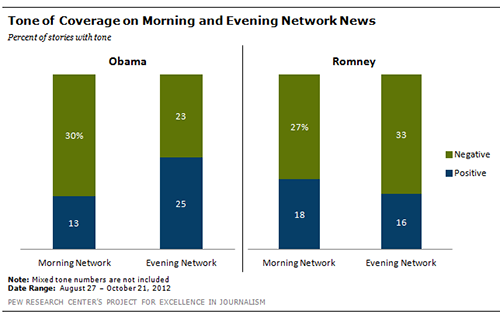
  Pew also looked at coverage of the candidates by the major broadcast networks, and found a significant difference in the tone of their coverage between their morning news-talk programs and their evening newscasts. Coverage on the morning shows was mostly mixed, but when there was a tone, it was more negative for Obama (13% positive vs. 30% negative) than it was for Romney (18% positive, 27% negative).  The evening newscasts, in comparison, gave Obama much more favorable coverage (25% positive, 23% negative) than it gave Romney (16% positive, 33% negative).  Among the three broadcast networks newscasts, ABC provided significantly more positive Obama coverage (27%) than the other networks (CBS 17%, NBC 16%) or was provided to Romney (ABC 18%, CBS 15%, NBC 18%).
  Pew found that newspaper coverage of Obama in this election cycle was much more positive than what newspapers provided in the 2008 race.  In 2008, Pew found newspaper coverage to be somewhat balanced - 70% mixed, 12% positive, 18% negative.  This time around, newspaper coverage is much more positive - with 45% of Obama coverage positive, 28% mixed, and 28% negative.  Newspaper coverage of Republican candidates, in contrast, was overwhelmingly negative this cycle - 69% of Romney coverage was negative, while 25% was mixed and only 6% positive.
  As for social media, the tone is overwhelmingly negative.  On Twitter, more than half of political tweets are negative (and a higher percentage of Romney comments being negative than Obama comments), while positive candidate tweets hovering around 20% over this period.  Negative comments also dominate on Facebook, but Facebook does have a somewhat higher percentage of positive comments (rising from 20% to around 30%).
  The Pew study found that both campaigns had similar amounts of coverage - Obama was a significant in 69% of the political stories included in the sample, and Romney was a significant figure in 61%.  They also found that there's been less focus on "horserace" coverage in this election (compared to 2008) - which would be a good sign if that meant that there would be more coverage of issues.  However, there wasn't - coverage of policy & issues (22%), the candidates' public record (6%), and even personal matters (4%) remained about the same.  Instead, two new types of political coverage gained prominence in 2012 - non-election coverage (coverage related to a candidate's existing duties), and coverage of voting issues (voter fraud, voter ID law coverage, absentee voting for the military, etc.) - each category accounting for 9% of campaign coverage.
  And yes, the economy is still the predominant issue in this election - when policy issues were covered.  Overall, 9.8% of all campaign coverage was focused on the economy (although down from 15.2% of coverage in 2008).  Within the 22% of issue coverage, the economy accounted for about half.  Two thirds of issue coverage focused on domestic policy issues, and one-third on foreign policy issues.  Interestingly, many of what media often framed as "hot-button social issues" - abortion, same-sex marriage, immigration, energy, religion, and race - ended up with very little coverage, or traction within the electorate.  The same was true in coverage of foreign policy issues.  Despite a lack of coverage by many of the major media outlets, the Benghazi attack and related issues dominated foreign policy political coverage (about three-quarters of it- 5% of all coverage, making it the second most covered issue in this election cycle).  Iran, Iraq, China, Afghanistan, Syria - even the continuing Israeli-Palestinian conflict - received minimal coverage as political issues.

  Partisans from each side can find things in this report that they can use to support claims of media bias.  That's likely to be true whenever "media" are diverse rather than monolithic.  Democracies are supposed to like diversity in media voices, so one of my personal disappointments in this election cycle is the increased efforts both in the political world and the media world, to try to silence alternative voices and perspectives.  Another disappointment is what I see as a continuing decline in the quality of "political" coverage - where only 1 in 5 stories address "issues" at all, and probably less than half of those address serious issues seriously.
  Journalism used to proudly proclaim its role as the "fifth estate" - the purveyors of critical information about government and political activities that citizens and voters need in a democracy.  They also proudly proclaimed their role as agenda-setters - providing a focus on important issues, as well as the information the public needed to take a stand.  I'm not seeing a lot of support for either in this report.

Sources -  Winning the Media Campaign 2012, press release from Pew
Winning the Media Campaign 2012,  full Pew Center for Excellence in Journalism report

Thursday, October 11, 2012

Media General sells last newspaper

Media General has completed its divestment of its newspaper chain with the sale of the Tampa Tribune to Revolution Capital Group for $9.5 million.  Media General will not focus on its digital and broadcast properties. The first step in ridding itself of the print division caused a stir with the sale of most of its newspapers to Warren Buffet's Berkshire Hathaway last May (see this post).
  Media General looks to get a short-term boost this year, with it's TV stations in key battleground states of Ohio, Florida, Virginia and North Carolina.  Other stations are in markets with tight Senate races.
"Our Virginia, Rhode Island and Ohio stations are also benefiting from hotly contested Senate races," Media General Chief Executive Marshall Morton said in a statement.
In the latest quarterly report, the company upped its estimate of revenues from political advertising to around $58 million (up from earlier estimates of $50M.    Despite the optimism, Media General reported that corporate staffing has been slashed in half in the last four months, and its share price dropped 4% after the news on the sale of the Tampa Tribune broke.

Source -  Media General sells last newspaper; sees  strong election ads on TV,  Reuters

Friday, October 5, 2012

More wall-busting in news.

Wouldn't you know it - after I do a post on the disappearing distinctions between news and advertising, I hear about a truly egregious case.  Take a look at the following screen capture from the online Washington Post -
On the webpage with their news coverage of the Presidential debate Wednesday is a twitter feed from the Obama campaign's "Truth Team," in full spin mode.  Has the Post wiped clean the old line between news and opinion? Has the Post abandoned objectivity and publicly jumped on the Obama bandwagon?
  Well, in this case - not blatantly.  Regular readers of the Post's online edition may have noticed that that upper right third spot on the Post's website is for reserved for advertising.  And if you look real close at the grey bar over the Obama campaign logo, you'll see in tiny grey letters against a marginally lighter grey background the word "Advertisement."
  Ask the Post and they'll tell you the Obama campaign bought the online ad spot.  The Post has every right to sell that spot, and the campaign has every right to buy it.  But did anyone at the Post even consider that letting a third of their debate coverage page be content fed directly from a campaign might give the appearance of a conflict of interest or favoritism?  Particularly as the campaign's content isn't reviewed by the Post, is tied to the Post's content, and where the ad's formatting of their content mimics the Post's own twitter feeds and fact-checking efforts.
  I don't know who was responsible, or whether they even considered how it would look; but at least some on the news side thought selling significant online ad space on newspaper websites to political campaigns was considered sufficiently newsworthy to do a story on another Obama campaign buy on a newspaper's home page.  The Obama campaign bought out most of the landing page for the Columbus Dispatch, with the ad's message tied to the lead story (at least at the time of the screen capture below) on the start of early voting.
At a minimum, these illustrate the collapse of the wall between editorial content and advertising.  The ads are substantial and atypical - significantly larger than the typical ads incorporated in the webpage layout and format.  They are also tied directly to the news content of that page.
  Twenty years ago, editors strenuously objected to selling large ads promoting products that were the focus of editorial reporting (or reviews) - and at a minimum insisting they had to be separated from the content to avoid the appearance that advertising support may have influenced coverage.  Within the last few years news organizations have openly supported a campaign to require that bloggers who write about products or services publicly reveal any direct or indirect payments received (advertising, in-kind products, etc.) related to the things they post about.  Today, the VP of Dispatch Digital, which runs the online edition of the Columbus Dispatch, welcomed similar buys from all campaigns.

  Do these, and similar instances, mark the end of the solid wall between advertising and editorial content?  Should we be even more concerned that the advertising in question is political advocacy, and is co-located with "news" coverage of the same topics?  I've been around long enough to have witnessed myriad ethical debates focusing on avoiding the smallest hint of an appearance of outsider influence on editorial content.  Its tough economic times for newspapers, and for many the ability to grow online revenues is important.  Still, I'd argue that maintaining the underlying value of a news outlet as an honest and reliable source of news and information is even more critical to keeping the outlet valuable to news consumers and long-term success in the news market.  Intermingling news, opinion, entertainment, and advertising hurts the "news" brand - and as long as these outlets see their business and focus as "news," they need to be concerned about actions and innovations with potentially negative consequences.  These two exemplars from the Washington Post and Columbus Dispatch, for example - while the ad revenues may help financially, their brands as news outlets have suffered, if only from the questions the over-the-board, atypical, efforts raise about the appearance (or possible reality) of influence.  At a minimum, the apparent lack of even minimal concern about possibility of outside influence on news content makes one wonder if the outlets remain concerned with, or supportive of, traditional journalistic norms of independence and objectivity.
  As I've said in previous posts, Americans' trust of news media is falling - precipitously. And if news media and outlets want to retain the traditional news brand and imprimatur of journalism, they need to at least stop doing things that damage their credibility with news consumers.  Like employing the new "native formats" by integrating political coverage with direct campaign advocacy.

  For the record, unlike broadcasters, there is no Federal requirement that newspapers (print or digital) sell advertising space to candidates and their campaigns, or at some minimum cost basis.  Still, with some recent interpretations of campaign finance laws, if they don't give the same opportunity to all other candidates, sell advertising to candidates and campaigns at costs below their normal rates, or charge candidates differently, some or all of the differences can be interpreted as campaign contributions to the favored candidate.  That will create problems for the online news site.

Source -  Obama Twitter feed takes over WaPo's website,  Washington Examiner

Tuesday, September 25, 2012

Election 2012: Is TV Relevant?

A recent post on MediaPost's TV Board blog suggests that television is becoming increasingly irrelevant in elections.  In it, Gary Holmes points to the minimal impact of the two major party conventions on surveys of candidate preference and the large declines in audience size.  While the decline in viewing isn't good, he turns to the demographic mix of convention coverage audiences for an explanation.  On each convention's final night, more than half of the TV audience was aged 55 or older; and more critically, those 18-34 made up only 15% of Democratic primary viewers, and 11% of Republican primary viewers.  News channels and shows skew older anyway, but not as extremely as live election event coverage seems to.  TV news and political coverage of the conventions just don't seem to be reaching uncommitted or swing voters in the electorate.
  History suggests that the audiences for the coming Presidential debates won't attract many of that segment of the electorate either - the debate audiences will most likely continue to primarily attract the older, committed partisans of the candidates, looking to score the hits like a prize fight judge.  And afterwards, there's likely to be a lot of punditry about disinterested and lazy publics failing to devote their attention to these "serious" debates.  However, I'll suggest that its increasingly rational for people looking for reliable information on which to base their vote to ignore the live coverage of the upcoming Presidential debates.  History shows that modern televised Presidential Debates rarely offer rational  discussion of the issues and positions. Rather, they're all about the candidates getting their pre-scripted talking points in (rather than providing meaningful answers to the actual questions asked), and the moderators doing their best to trigger "gotcha" moments about trivialities (rather than addressing and exploring the substantial candidate differences on critically important and pressing issues).  Modern debates don't have much impact unless a candidate makes a grievous error - which will be massively covered in the following weeks.
  Well, then, what about political advertising, slated to reach stratospheric levels this year?  The trouble with having a lot of political advertising is that you have a lot of political advertising.  TV stations and networks will be awash in multiple airings of attack ads - but ads, and particularly political ads, can quickly reach a saturation point beyond which they have little, if any, positive impact.  (Personally, I identify most of them in the first few seconds and immediately change channels - particularly attack ads)
Anecdotal evidence from the last few weeks might even suggest a backlash.  In the last few weeks, mainstream news media, television in particular, have trumpeted multiple claims that Romney "gaffes" have ended his campaign, a plethora of Obama campaign attack ads (labeled misleading and dishonest by fact-checkers) and additional buys for a PAC ad blasting Romney that even the Obama campaign said was dishonest and inappropriate.  And the result of this avalanche of all this negativity from television on Romney's support and approval levels?  National tracking polls show him picking up support from voters, to the point that he's come from several percentage points down, to being tied with (or slightly leading) Obama.
  But the money's been raised, and will be spent.  Attack ads will flourish and will likely to become really dirty and dishonest as the election nears (when the folks running campaigns calculate that it's too late for preposterous claims to be challenged effectively).  But by then, one hopes, a lot of people will have already tuned them out - and perhaps even tuned out the channels, stations, and programs they appear on (I predict a big increase in delayed viewing, as DVR let you quickly skip the nastyness).  And television, in terms of news coverage and live coverage of political events will become even less relevant.
  I do think that TV could correct the trend if it wanted to - but when media think partisanship and conflict drives ratings and profits, it doesn't seem likely.  So to the American electorate - let's make TV irrelevant in elections.  Maybe then the TV's incentives will shift to providing objective reporting and analysis instead of the current incentives to uncritically repeat partisan talking points.

Source - Is Television Becoming Irrelevant to the Election?TV Board, a MediaPost blog

Tuesday, September 18, 2012

Local TV big winner this election cycle

A report from Moody's Invester Service predicts that the winner of the November elections will be...

Local Broadcast Television Stations

Moody predicts that when it's all said and done, $2.8 billion will be spent for political advertising on local TV, which will account for 9% of all local TV ad revenues.  Moody suggests that the heaviest spending will come in October, and will be heavily targeted at markets in swing states.  It also notes that which states are considered as "swing states" could vary as the campaigns continue and and the opinions of the electorate shift.
  Wells Fargo analyst Marci Ryvicker concurred, noting that the top markets for political ad spending has already shifted several times over the last few months.  She also upped her prediction for total political ad spending this cycle to $5.2 billion, as August's political ad expenditures were 77% higher than July's total.

Political advertising has always given a boost to local TV ad revenues, despite FCC rules mandating that stations provide them at their lowest rates.  But as regular ad revenues stagnate or fall in a weak economy, and as political campaign spending has exploded, the regular injection of political funds can become a critical (if transient) source of station profits.  And that's not necessarily a good thing.

Source - Local TV Stations the Real Winners This ElectionTV Spy blog

FCC backs off Internet tax plan

The FCC has now formerly abandoned a proposal from earlier this year to increase funding for broadband Internet access support by placing a tax on that same broadband service.
  The roots of this issue originate with the Universal Service Fund (USF), and a move by the FCC to shift funds from the USF to help subsidize broadband internet access.  Funds for the USF come from a monthly service charge (tax) on landline and wireless phone services, and was initially designed to help provide affordable basic phone service throughout the nation.  Last year, the FCC took $4.5 billion from the USF to subsidize broadband Internet through a new fund, called the Connect America Fund (CAF)  However, with people shifting to email, texting, IP telephony and other online options, contributions to the USF are declining and would not reach the levels the FCC wanted for further support broadband Internet access.
  In April, the FCC proposed a number of ideas for "reforming" the USF contribution system - releasing a Request for Comment document.  (This is the first formal step in the FCC's rulemaking process and doesn't commit the FCC to any specific action).  Among the ideas for additional funding sources were a fee (tax) imposed on broadband Internet service, taxing text messages, and shifting the USF contribution to a flat fee per line, rather than a tax on interstate phone revenues.  The summer saw plenty of public comment.  A few large Internet players (who would likely get some of the added funds) supported the idea; while comments from the public, and from a range of public interest groups grew increasingly negative as news of the proposed new taxes spread.  The public outcry (followed by Congressional "outrage") over a possible fee (tax) on broadband Internet service in particular has now reached the point where the FCC has dropped the idea - as "politically toxic."
  An indication of how negative the public reaction was to a new broadband Internet tax is that no one at the FCC will admit to suggesting the idea - Democrats claiming it was pushed by Republicans, and Republicans suggesting that FCC Chairman Julius Genachowski's strong support for expanding broadband subsidies and access (and a number of prior public statements) is behind the push for new funding sources.  Playing the blame game, particularly during a heated election cycle, can be fun, but the basic concept of expanding the USF from basic telephone access to Internet access or broadband Internet access has been floating around for decades.  And the FCC, by transferring USF funds to the Connect America Fund last year has at least informally redefined Universal Service to include broadband Internet access.  What the current kerfuffle is about is how and where to raise additional funds to support the expanded definition.

  But the blame game is fun, so here's my take.  The specific proposals most likely came from FCC staff, who were charged with finding ways to increase USF/CAF funding.  It is true that the sole Republican commissioner at the time supported looking for ways to expand the funding base, as did at least one Republican senator.  But so did the Democratic commissioners, and Democratic congress members on the FCC oversight committees.  In addition, FCC chairman Genachowski has long been a very vocal proponent of the development and expansion of broadband Internet access.  So basically everyone thought looking for additional funding sources was a good idea; yet it seems likely that none of these major players made a specific recommendation for a broadband Internet tax.  Under that kind of directive to search for additional funding options, staffers are usually tasked with coming up with as many different proposals as they can, so that policymakers have a range of options to consider.  It often starts with ideas for new fees for related services that aren't already taxed.  Normally these ideas and proposals are pre-screened to remove those proposals that aren't politically, legally, or economically feasible - but in this case they either didn't, or they missed a few.
  However, if you need to lay the blame on either Republicans or Democrats, I'd give the edge to the Republican Commissioner Robert McDowell over Chairman Genachowski (D).  When the public concern over the proposal first surfaced, his initial reaction was to question whether the FCC had the legal authority to impose the tax.  In contrast, spokesmen for Genachowski said that the Chairman was skeptical that the tax on broadband Internet services would work, but floated the various proposals to judge public reaction - and afterwards blamed Republicans.  In addition, these kinds of policy proposals always come through the Chairman's office and with his (or one of his staffers') approval.  So the buck stops at the Chairman's office - they're at least responsible for the decision to include the various digital IP service fees/taxes in the formal request for comments, if not for coming up with the specific proposals themselves or supporting any one specific proposal.

Source -  FCC backpedals from Internet tax, Hillicon Valley blog, the Hill
 

Friday, September 14, 2012

A Primer on "cherry-picking" stats

Most people treat numbers as real and reliable - and in most circumstances they are.  But they can also be used to be purposefully misleading, or picked through to find whatever set of numbers makes the best case for a given circumstance.  It's just part of "How to Lie With Statistics."
  The professional association of pollsters, AAPOR, knows well how this is done in the selective reporting of polls, and has guidelines for what information people really need to provide when making arguments based on polling results - guidelines that are for the most part ignored in journalistic reporting.  "Cherry-picking" results can be as problematic, particularly when only a pre-selected set of results is reported.  It's quite natural for someone who wants to use stats to support their argument to pick among the myriad variations of numbers and results those that best support their position.  And, regrettably, its quite natural for journalists to accept those numbers, or at most just verify their accuracy, rather than wondering why that particular set of numbers was used and looking at the larger picture and whether the cited results accurately reflect the underlying reality.
  There's an interesting video out that illustrates the potential issues of cherry-picking.  (While this particular one dissects an Obama campaign claim, cherry-picking is an almost universal tendency).


  Journalists in this increasingly competitive news market don't always have the luxury of time to critically evaluate every claim, even with the access to information and analysis that the Internet offers.  So when should they wonder if a claim's an accurate reflection of the larger reality?  As the video points out in its conclusion, one dead give-away is if the claim is very precisely phrased, or uses ranges or measures which don't seem to be the typical usage.    In the video's example, picking "27 months" and "7 years" as the time periods to consider.  Another is when different terms are used for the stats being provided.  In another case I recall, it was comparing "new jobs" (only those created - not considering those ending or lost) to "gains in employment" (comparing net job increase - newly created jobs minus jobs lost).
   When journalists run into these, it might be useful (not to mention enlightening) to look a bit deeper into the claims and measures.  At the very least, though, they need to be careful to use exactly the same phrasing in their reporting of the claim - even though it may make for better headlines to generalize that narrowly defined claim into statements like "Obama's created more jobs than Bush did."  Because that broader statement is not even "technically" accurate, and is easily refuted. Misinterpretations of that sort, intentional or not, can raise questions about the competence or fairness of the reporter and news organization. That kind of error or sloppiness may contribute to the public's growing mistrust of news media, and might possibly be a contributing factor to its decline.

edited to fix typos in title and body.
 

Wednesday, September 12, 2012

Pew - Social Networks and Politics

A recent report from the Pew Research Center Internet & American Life Project suggests that campaign and policy-related information shared on Social Network Services (SNS) can have a modest role in influencing user's views and political involvement.  The study, based on surveys conducted early this year, asked social network users their thoughts about politics and social media.  While the full study is worth a read, here's a few highlights -
  • Social networks are not heavily used for political content.  84% of users indicated that they don't really post about politics on SNS, and 59% said that their friends don't either.  Only 6% indicated that their posts are mainly about politics, and another 10% said they had posted something about politics recently.
  • Roughly a quarter of respondents indicated that political content on SNS was at least somewhat important in terms of finding others with similar political views, discussing or debating political issues with others, and recruiting others to get involve in politics. More than a third (36%) felt that social networking sites were at least somewhat important in terms of keeping up with political news.
  • Self-identified Democrats were significantly more likely to indicate that social network sites, and political content on those sites, were important sources and tools.  Self-identified Republicans and Independents had very similar views about the importance of politics on social networks.  Blacks and younger adults were also slightly more likely to indicate that politics on social media was at least somewhat important and useful.
  • Perceptions about the impact of political messaging on social networks was low and mixed.  When asked about the impact of SNS political content, 25% indicated that they were likely to become more politically active, while 9% indicated they were likely to become less involved.  Only 16% felt that political messages on social media had ever changed their views about a political issue. Interestingly, 18% of users indicated that they had blocked, unfriended, or hidden someone because of that person's political postings. 
  • The use of social media for political content and discussion seems to be correlated with an individual's willingness to talk a lot about politics with their friends and family.
     
  The key finding here, however, is that the vast majority of users felt that political content shared via social media was not very important to them, and had minimal, if any, impact.  Still, the report concludes that "those who are quite politically attuned use social networking sites differently and get more out of them."


Sources - Social Networks and Politics, Research Brief from the Center for Media Research.
Politics on Social Networking Sites, research report from the Pew Research Center Internet & American Life Project.

Sunday, September 9, 2012

Convention coverage Ratings - Impact of Web and Social Media?

I suspect that pretty much everyone's aware that both the Republican Party and the Democratic Party held their national conventions recently and formally confirmed the nomination of their chosen candidates for the Presidency of the United States.
  You've also probably heard a variety of complaints about the coverage - there were plenty to go around, whatever your political preference.  Now, though, the audience ratings numbers are out - and there's some really bad news for traditional media.  First, let me say that there are a lot of stories focusing on the drop in ratings, or on the fact that Obama's speech had higher ratings than Romney's - and that there are a lot of conflicting numbers.  I'll be discussing the Final Night numbers for each convention, using Nielsen's Persons aged 2 or older.
  Since they went first, let's look at the numbers for the Republican's big night, when Romney gave his acceptance speech.  Nielsen reports that the nine broadcast and cable channels combined that night to draw an average of 30.3 million viewers - and that was down about 22% from the ratings for the 2008 Convention's final night.  While both liberals and conservatives won't be surprised to find that Fox News Channel had the highest viewership, they should be concerned.  Fox averaged 9.1 million viewers, or more than 30% of all convention viewers that night- more than twice the audience of any of the big broadcast networks.  They also had the smallest drop in audience from 2008 at 2%  ABC attracted 4.4 million, CBS's viewership fell by more than half, to 2.4 million;  and NBC's audience also dropped by more than half, to 3.9 million; and that was following strong lead-ins from their regular entertainment programming (the broadcast networks only covered the 10-11 pm (Eastern) hour).  CNN's audience also dropped by half, to 2.3 million.  MSNBC had 1.9 million.
  The Democratic National Convention drew more viewers than the RNC this year.  Total viewership for the closing night was 35.7 million, also down from 2008 levels (about 7%).  NBC was able to attract the most viewers for Obama's acceptance speech, gaining an audience of 7.4 million.  CNN came in second, with 5.6 million; MSNBC had 4.5 million; ABC 4 million; CBS had 3.3 million,; and Fox News had 2.9 million viewers that night.  All of the broadcast and cable news networks saw significant declines, with the exception of MSNBC, whose ratings were up slightly from its 2008 DNC coverage. Compared to 2008 DNC coverage, NBC was down 5%, CBS was down 31%, and ABC was down 50%.

  There are several (non-partisan) things that stand out.  First, that over the 6 nights of convention coverage, Fox News had the highest average audience (5.3 million), beating NBC's 5 million.  (ABC averaged 3.7 million, CBS averaged 3.4 million, CNN averaged 3.1 million and MSNBC average 3.0 million).  This reflects a long term trend of the decline in the preeminence of the broadcast networks for news, but in many cases the losses are extreme (losing a third to half or more of previous audiences).  Are the broadcast networks losing their stature and importance as a source of news?  Are their other factors at work.  Well, it could be that American audiences aren't interested in largely pre-scripted public relations efforts - where real news only happens if someone goes off-script.
  Several critics though to blame the rise of DVRs - since their audience numbers don't show up in the overnight ratings.  Personally, I'm doubtful that most people would bother to record political convention coverage (unless they wanted to compare how different networks covered the conventions.  On the other hand, having DVRs might ease concerns about missing favorite programs enough to convince some to watch live coverage on the cable nets, and the recorded programs later.

  The most likely candidate for shifting viewing habits is the boom in online video access and use.  A growing number of viewers watch recorded - and live - video content online.  2012 may be a milepost year in this, as similar to the Summer Olympics, every minute of both conventions were streamed live by multiple outlets. C-SPAN set up convention hubs for both conventions, each offering live streams and more than 100 hours of video content.  All of the news networks and PBS also offered significant online access to the conventions, as well as related content.  There were more than 2.5 million views of RNC speeches and activities on YouTube, and top DNC speeches also garnered significant viewing online.
  An associated milepost for this year could be the rise of social TV - people are getting comfortable with the idea of engaging in social media while watching TV.  Both conventions generated million of Tweets (more during the DNC), but that was only one dimension.  There also seems to be substantial growth in, and use of, online video.  C-SPAN set up convention hubs for both conventions, each offering live streams and more than 100 hours of video content.  All of the news networks and PBS also offered significant online access.  And many individuals captured and reposted their favorite parts, and sometimes also their own comments, on the various Web2.0 options.  There were more than 2.5 million views of RNC speeches and activities on YouTube according to an early RNC release, and top DNC speeches also garnered significant viewing.

  With myriad sources and outlets, it's more difficult to get solid numbers, but I wouldn't be surprised that more people watched, or were exposed to, the conventions online, than watched it on some of the traditional TV news channels.

Sources -  Over 6 Days of the RNC and DNC, Fox News Channel Had the Most-Watched Convention CoverageTV by the Numbers blog
Democratic Convention on pace to trump GOP in social media, LostRemote
Republican Convention Sets Social Media Bar for Democrats,  Mashable

Monday, August 27, 2012

Local TV News Tops Cable for Voters

A TVB analysis of Nielsen Media Research data from last spring suggests that local early and late news audiences in the top 10 US markets are a closer match for "American Voters" than are the audiences for any of the major cable news networks.  As such, they suggest that advertising on local TV news may be a better deal for political advertisers.
It’s long been established that television remains the most effective and influential medium for political campaigns to reach voters and hard data shows that local broadcast news viewership is far more in line with today’s voting population than the national cable news networks,” said Steve Lanzano, TVB president.
I'm not really surprised by the argument - local news audiences tend to reflect, more or less, market demographics, while the cable news channels target different audiences.  Fox, CNBC and MSNBC are fairly honest about it, but CNN tilts older and a bit liberal as well.  Besides, the demographic mix of actual voters has fluctuated in the last two major election cycles (and I suspect further shifts in 2012) - so it's a bit like trying to match a moving target.
  Then again, a lot of political advertising is targeted, and for those ad buys it may be better to find an outlet that matches up with the target population rather than going for a broad reach.  Placing local ads on highly targeted cable nets (news or other) is one of the better advertising buys for highly targeted campaigns.

Local TV news will get a lot of needed revenues from political advertising revenue this year, in either case.

Source -  Local TV News Tops Cable In Reaching Voters,  TVNewsCheck
TVB Report available here

Wednesday, August 22, 2012

Newsfail - From Watchdog to Lapdog

There are a lot of reasons behind the continuing decline of the big media outlets in the U.S.
  You can point to structural issues in the evolving news marketplace - the explosion of competition and substitutes that has splintered audiences; the rise of a superior medium for classified advertising (online); the shrinking news cycle and the shift in focus from accuracy to primacy (that is, being the first with a story has become more important than being accurate).
   You can point to shifting audience preferences - newspaper readership has been declining with each new generation of readers; the rise of TV news, then cable for immediacy and impact; the rise of online news and alternative information sources that allowed news consumers to find the news and framing that suited their preferences, (challenging and dismantling the gatekeeping role of major news outlets and directly challenging its orthodoxy and calling it to task for its errors).
   You can point to a plethora of bad management decisions on the part of once-dominant monopolistic media firms - such as selecting a morning show host with limited experience to anchor a major TV news program; of emphasizing entertainment values over news values (emphasis on the "gotcha" moment, promoting controversy and opinionated contrived conflict over reasonable discussion, hiring for name recognition outside of journalism - or directly from political staffs. etc.), reducing the size of staffs actually producing the product (news) while enlarging management and trying to maintain monopolistic profit levels.  And one glaring recent example - the New York Times hiring as its CEO someone whose media experience is with a European public service broadcaster (the BBC) and offering him a package that could amount to $8+ million in salary and benefits for his first 16 months on the job - when the business he will be CEO of is on track to lose more than $600 million in 2012.
   And you can point to changes in the journalistic process - with shrinking staffs and emerging alternative media forms pushing reporters to cover more, with multiple media, and produce multiple versions of stories; with the emphasis on primacy rushing story production; with the near-disappearance of mid-level copy editors and fact-checkers from newsroom staffs; and with a decline in beat reporting that has contributed to the emergence of a cohort of generalist reporters who often lack the background knowledge and experience to inform their coverage and challenge inaccuracies when they confront them.
   To us old guys, the "profession" of journalism seems to be less investigative and analytical than "reporting" - and in a bad sense.  Too much of modern journalism seems to consist of taking information fed to them from one source, finding one or more other sources to fill out the story's frame, and regurgitating it while adding their own opinions.  And it seems increasingly biased.
   Now, "bias" claims can be controversial, particularly for a profession that has historically embraced standards of accuracy and objectivity.  But any process of selection, including news gatekeeping, embodies bias of one form or another.  News frames and formats, standards and norms - all embody some degree of bias.  Some kinds of bias are good and welcome - such as standards of accuracy, or news values that suggest major corruption in local government is a more important story for local news outlets than a report of a car accident halfway around the world.  But as major news outlets increasingly seek and embrace entertainment values as ways to differentiate their content and remain competitive, and as opinion becomes more widely integrated into mainstream news, major news media damage their value as "news" outlets, and are increasingly seen as less accurate, and less trustworthy.  It's no wonder that trust in news outlets continues to fall.
   Bias doesn't have to be limited to full-blown cheerleading for one side or another - it can happen in the selection of what news to cover, it is evident in what claims are accepted and which are rejected or treated with suspicion, and it can be seen in terms of what sources a reporter goes to, or in whether a reporter honestly seeks sources or information that challenge positions and critically evaluates the positions, or just looks for one source to "confirm" them.
But the most problematic aspect is that people tend to judge bias not on some objective standard, but relative to their own views - and if those views are widely shared among their peers it is an easy jump to the conclusion that it must be right and reasonable.
   The shift to opinion, the increased perception of bias (even dishonesty) of major news media in the U.S. has become increasingly obvious over the last decade - particularly in national political coverage.  And the rise of blogging has contributed to the lack of trust - by allowing true experts the outlet to publicly comment on, and challenge if needed, stories written by generalists lacking critical background knowledge and the experience to recognize problematic aspects of stories.  And there has also been an increase in self-criticism and recognition of failings by journalists (or at least, those "mea culpas" are more widely reported within the blogosphere).
  For example, within the last week we have Jake Tapper of ABC criticizing recent coverage -
"We are spending a lot of time in the last few weeks, those of us in the political world, political journalists and also politicians, talking about things other than the economy... [A] lot of people are hurting out there. I’d like to see more action taken and more emphasis given to this issue.”
Mark Halperin, senior political analyst for Time, put it more succinctly when discussing the Romney tax return "story":
"I think the press still likes this story a lot, the media is very susceptible to doing what the Obama campaign wants, which is to focus on this,..
“Do voters care about it? I don’t think so,” he added, concluding that “The economy is still top, front, and center. The Medicare debate’s important. I think [Romney's tax returns is] mostly something that the press and insiders care about. It’s an important issue about transparency, but there are other bigger issues in the campaign, I think.”
And the concern goes back to the 2008 Presidential campaign, which saw the rise of "JournoList" an online listserve that pushed certain storylines with a strong liberal perspective.  A study by the Pew Reseach Center at the time found a strong slant - then Senator Obama received much more coverage than other candidates, and coverage of Obama had 1.4 positive stories for each negative whereas coverage of McCain had 3.5 negative stories for each positive.
"Sometimes I saw with story selection, magazine covers, photos picked, [the] campaign narrative, that it wasn’t always the fairest coverage.,, I have said before… [that I] thought the media helped tip the scales. I didn’t think the coverage in 2008 was especially fair to either Hilary Clinton or John McCain," Tapper said. 
After the 2008 election, the Washington Post's ombudsman admitted that he felt that the Post's coverage was slanted, and probably worth 10-15% shift in voting to Democrats. It was a perception shared by voters - one post-election poll found that
"a majority of voters (51%) say most reporters have tried to help Barack Obama win the presidency. Just seven percent (7%) think they tried to help John McCain.”
 And it's the perception of voters and news consumers that matters - as it forms the basis for determining how much trust people place in media, and their evaluation of the value of the news being presented.

Sources -  Tapper: Media Failing CountryThe Weekly Standard
Mark Halperin: The Media Is Very Susceptible to Doing What the Obama Campaign Wants, Mediaite
Media Bias in the 2008 U.S. Presidential Election and the Effect of the BlogosphereRed State

Friday, July 27, 2012

Sorry State of Political Coverage

A recent NY Times report and some comments from the Washington Post's ombudsman suggest that the old professional journalism standards regarding political coverage are being abandoned.
  The Times report suggests that many top news organizations have agreed to give campaigns and politicians veto power over an important aspect of their reporting - what statements can be quoted and attributed by name.
Most reporters, desperate to pick the brains of the president’s top strategists, grudgingly agree. After the interviews, they review their notes, check their tape recorders and send in the juiciest sound bites for review.
The verdict from the campaign — an operation that prides itself on staying consistently on script — is often no, Barack Obama does not approve this message.
Quote approval is standard practice for the Obama campaign's various operations, including most strategists and midlevel aides.  The same applies for many cabinet positions and Congressional staff.  As for the Romney campaign, they insist on quote approval for interviews with Romney's family members. 
  The Times piece suggests that despite concerns about the practice, most reporters and news organizations comply - major papers like the New York Times and Washington Post have publicly acknowledged their acquiescence, as have both Reuters and Bloomberg news agencies.  Many more reporters and organizations interviewed for the piece did not want their acceptance of the practice on the record.
“We don’t like the practice,” said Dean Baquet, managing editor for news at The New York Times. “We encourage our reporters to push back. Unfortunately this practice is becoming increasingly common, and maybe we have to push back harder.”
  The report argues that
Under President Obama, the insistence on blanket anonymity has grown to new levels... Reporters who have covered the Obama presidency say the quote-approval process fits a pattern by this White House of finding new ways to limit its exposure in the news media. 
 The piece suggests that one reason for quote approval is that some senior Obama campaign representatives aren't always careful in their choice of words -
Jim Messina, the Obama campaign manager, can be foul-mouthed. But readers would not know it because he deletes the curse words before approving his quotes. Brevity is not a strong suit of David Plouffe, a senior White House adviser. So he tightens up his sentences before giving them the O.K.
The Obama campaign declined to make Mr. Plouffe or Mr. Messina available to explain their media practices. “We are not putting anyone on the record for this story,” said Katie Hogan, an Obama spokeswoman, without a hint of irony.
   At a time when candidates insist that "they didn't say that" or that they were quoted "out of context," giving them, or their representatives, the power to kill quotes, insert new (more 'correct') context into a quote, or remove attribution to hide their identity (and providing deniability) would seem to be a clear dereliction of journalistic duty.

  The other issue has emerged from a situation at the Washington Post.  It began with an article alleging that Romney may have "outsourced" jobs while at Bain Capital, and included several specific claims that were attributed to an Obama campaign spokesman.  The Post's in-house fact checker originally gave the story 3 out of 4 Pinnochio's - arguing that while every specific allegation included in the article was false, that Romney still might have outsourced jobs. (The Post did acknowledge that the specific claims were in fact not accurate, but still "stood by" their discredited story)  Later, the same "fact checker" gave a pass to an Obama PAC ad for repeating the discredited claims, by arguing that they had accurately reported the story's claims - which he knew to be false, having already "fact checked" them. 
  That's where the Post's ombudsman, Patrick Pexton, comes in.  A number of readers asked about the apparent ethical discrepancy between finding an article (and its "facts") to be misleading and false, but not finding a political ad using that story's claims to be equally false or misleading.  Following what seems to be normal practice for newspaper ombudsmen (who seem to see their job as defending their paper rather than applying some objective or ethical standard), Pexton acknowledged that the specific allegations did not support the "outsourcing" claims, but also defended the Fact Checker's autonomy in judging political ads and claims.  When criticism increased, the two jointly announced that the Washington Post's new official policy was that they would no longer 'Fact Check' Post articles, or any political ad or claim that cited a Post article as source.
  As might be expected (at least by anyone with a background in ethics or journalistic norms and practices), the new policy was not well received by critics.  The Post's supposed arbiters of accuracy and ethics in politics and political coverage decided to finesse a serious issue by purposely ignoring it.  Moreover, they did so in a way that provided campaigns (and reporters and editors) a blueprint for how to mislead and slander with (apparent) impunity.  Any claim, no matter how ridiculous or outrageous, that makes it into a Post article will purposely remain unexamined and unchallenged by the Post's self-proclaimed vaunted Fact-Checking operation.
  The policy may give campaigns and politicians the appearance of impunity, and it may prevent other cases of apparent double standards from happening - but in doing so, the policy puts the news organization at considerable risk. I hope the Post's lawyer gets to these two quickly, and explains how publicly proclaiming that possible falsehoods will not be checked for validity or accuracy, intentionally and as a matter of policy, can be argued in court as showing "a reckless disregard for truth" - one of the standards for actual malice that can place news organizations at risk for libel judgments, even against public figures.  It should be interesting, and enlightening, should someone pursue a libel claim against the Post for publishing one or more of the myriad slanders that emerge during political campaigns in an article, particularly if the "Fact Check" implicitly supports the slander by failing to challenge it then, and allows the damage to compound as others repeat the libel or slander as being under the imprimateur of the Washington Post

Sources -  Latest word on the Trail? I Take That BackNew York Times

Sunday, May 13, 2012

Egypt tunes in for first televised presidential debate

The televised Presidential Debate has a long history in the U.S. - long enough that's it's risking becoming relegated to cable channels.
  There was a much better audience response to Egypt's first televised presidential debates, according to a story from MSNBC.
The spectacle of politicians being questioned in public was riveting. “It’s the birth of democracy in Egypt,” smiled Arafa Abu Al Fadel, a 36-year-old production manager at Egyptian state TV. “We have seen this in France or Europe. It gives us a chance to see the candidates, it gives us a chance to choose … I am now confused, but that is a good thing!”
  The debate was carried live by three private satellite stations.

Source -  Egypt's first televised presidential debates thrills viewers,  WorldNews on MSNBC