Showing posts with label First Amendment. Show all posts

Thursday, September 25, 2014

The Future of Political Reporting Isn't

Three quick stories about government and politicians trying to control coverage.

The NYTimes reporter assigned to cover the Clintons, reports that one particular press aide at the Clinton Global Initiative was not only assigned to escort her to the restroom, "she waited outside the stall in the ladies' room."  Waiting at the restroom door in a crowded venue to escort her back to wherever the Clintons had gone I can almost understand.  But outside the stall door?  Seems more intimidating than helpful (or perhaps fearful that the reporter would slip a story past the normal review channels).  When Hilary's standard contract for giving speeches was leaked, it specified no press coverage or photography after a brief introduction (some speculated it was because she didn't want it to come out that she kept repeating the same speech to group after group). And the behavior isn't unique, the last few election cycles have provided a number of stories of press aides for Democratic candidates speaking at "fundraisers" of locking reporters in closets or restrooms.

Lack of press access at the White House has been a continuing drama over the last few years, to the point where the White House Correspondents' Association (WHCA) and major news organizations have filed a number of formal complaints about the lack of access to supposedly public events for both reporters and press photographers.  (My favorite was when a White House  ceremony promoting "transparency" was closed to the press).
The latest twist, though, is that the White House has started reviewing pool press reports before sending them out, and have insisted on the pool reporter making changes.  (The White House press office manages the email list of reporters and organizations that get the pool reports, and does the actual emailing.)
“The independence of the print pool reports is of utmost importance to us,” said Christi Parsons, a Los Angeles Times reporter who is the WHCA’s new president. “Our expectation is that the White House puts out the pool report and asks questions later.”
The issue is even more troubling given the fact that coverage of White House and Presidential events are increasingly restricted to the pool reporter.  Parsons added that she was assured this summer that the White House wouldn't meddle, but subsequent incidents show a White House still reviewing and insisting on changes (delaying release of the pool report by as much as a day).  Things have gotten to the point where the WHCA is investigating how it could manage pool report distribution itself, removing the White House press office from the process.

The third news item wasn't about the White House or political coverage explicitly, but still reflects a disturbing trend.  The US Forest Service (USFS), whose signs and statements keep telling us that the national forests and parks they oversee belong to us (the people of the U.S. and the world), seem to be taking another in a lengthy series of steps to restrict "our" use of "their" resources.  In this case, the USFS is proposing a new permanent rule to require media to get a permit to film and shoot photographs in national parks and forests.  The problem is that the USFS wants to make two significant changes to the existing rules.  First, to remove the exemption for "breaking news situations."  Second, to expand the USFS's authority to deny permits based on the nature and purpose of the project.  A spokesman for the National Press Photographers Association framed the issue succinctly: "What if they deny you a permit because they don't like the story you're working on?"  Steve Bass, head of Oregon Public Broadcasting, has a history of working with USFS on permits.  He understands that officials want to limit the impact large commercial shoots can have on the land, but cautions:
"Does the government get to decide what's newsworthy and what's not newsworthy? It's my understanding of the First Amendment that they don't get to decide that."

And that's the problem with all of these. Government and politicians have always sought to control news coverage.  Historically, the press pushes back, under the protection of the First Amendment.  Will they do so against politicians and agencies they favor as strongly as they do against politicians and agencies they don't like?

Sources - The Clinton team is following reporters to the bathroom.  Here's why that matters, Washington Post
Reporters say White House sometimes demands changes to press-pool reports, Washington Post
Forest Service wants media to obtain permits; move alarms First Amendment advocates, Montana Standard

Sunday, June 9, 2013

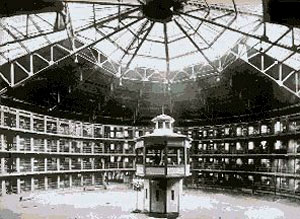
Panopticon - American Style

The myriad (and growing) surveillance leaks of the past few weeks put me in mind of Foucault's thoughts on panoptic surveillance.

  The idea of the Panopticon traces back to the work of Jeremy Bentham in the 18th century.  Bentham coined the term to describe a design for prisons where every inch of every cell was under constant surveillance by prison authorities; yet prisoners would not know when, or if, they were actually being watched.  Bentham held that unverifiable surveillance was an efficient and economic exercise in state power, while providing the state with a viable mechanism for discipline and control.

French philosopher Michel Foucault used the idea as a metaphor for the modern state's mechanism for control and punishment.  Under Benthan's unverifiable surveillance, individuals are never sure whether or not they are being watched, or by whom.  As a result, Foucault argues that individuals are "trained" to resist any impulse of misbehavior or "abnormality" for fear of being caught, uncertain whether such a display is safe or not.  Also, as more and more information is gathered on individuals and their behaviors, Foucault argued, people become "objects of knowledge" to state authorities - whose actions can be tracked, examined, catalogued, examined, compiled, and acted on - if that is in the interest of the state.  Foucault argues that this gives hegemonic authorities great power - to identify, track, and punish those whose behaviors lie outside the state's idea of "normal" - and allowing the state to "humanely rehabilitate" those of their citizens who stray from the path of enlightenment (or at least what the hegemonic authorities think is appropriate).

I had originally put Foucault's social theories among those critical theorists who had interesting ideas and insights, but whose insistence on the prevalence of a powerful hegemonic state authority seemed unrealistic.  Then came the leaks and the leaks about the state's response to leaks.

First there were the revelations of the Department of Justice intercepting and tracking phone calls and emails of journalists who broke and wrote about various "leaks" that weren't seen as beneficial to the current administration.  Then came the Guardian's story about the state's downloading of all call information from one of the US's largest operators - Verizon.  The FISA warrant was notable for its breadth - instead of looking for individual records, or those meeting certain behavior patterns or posing identifiable threats, the NSA sought, and obtained, permission to gather all records for everybody - who called whom, where calls originated and terminated, and length of the call.  Also included were customer records, emails, and Internet activity routed through Verizon's system.  Further, all of this was supposed to occur without any notice being given to the individuals being surveilled.  A perfect example of the concept of panoptic "unverifiable surveillance."  [For those of you on other networks, Verizon's just the one the published the warrant for - it's a safe bet that similar warrants have been granted for most, if not all, telecommunications operators in the US.]

If that level of unverifiable surveillance wasn't bad enough, there was PRISM.  The Prism project actually consists of a number of different efforts with a common goal - to gather, copy, and analyze all electronic communication.  There's a physical basis in the form of a large complex for data storage and analysis, and it's known that other aspects involve collecting the information running through various checkpoints on the Internet, ostensibly from, and with the cooperation of, major Internet players (who have subsequently vociferously denied any cooperation with, or even awareness of, the program).  The Guardian reported that one of these programs, called "Boundless Informant," collected more than 3 billion pieces of information from U.S. computer networks last March (2013), and that the intercepts do include specific information such as IP addresses.  All for a program that is supposed to be limited to foreign communications.
  Whether it is focussed terror-related intelligence or a broad and comprehensive surveillance of all electronic communications - including those of its citizens remains a bit unclear.  But NSA testimony to Congress has shifted - from insisting that it does not collect any type of data on large numbers of American citizens, to that the NSA had not "wittingly" (purposely) collected data on large numbers of Americans, to tightly parsed denials that the NSA could, in fact, "physically" collect very specific bits of information (the kinds of things that you can't tell from online communications).  And in a classified slideshow the Prism folks use to market their activities to other agencies, they clearly suggest that they can deal with most all forms of electronic communications.

Welcome to the world of unverifiable surveillance.  But the Foucault conception of panoptic discipline also requires the ability to take all that surveillance data and use it to identify outliers - those who stray from social normality.  And that brings us to the data analysis side of Prism, and the developing field of data mining.  One of the things that data mining is good at is identifying outliers - individual cases that vary significantly from the vast muddle in the middle that we can consider typical or normal.  In other words, we're becoming very, very good at treating people as "objects of knowledge", and being able to recognize and identify outliers.

Finally, the Obama administration has amply demonstrated its interest in disciplining those who stray from the enlightened path, and not necessarily through humane rehabilitation.

Maybe Foucault's fears are more realistic and immediate than I originally thought.