Showing posts with label circulation. Show all posts

Tuesday, August 12, 2014

Case-Study- the Philadelphia Papers Long Fall

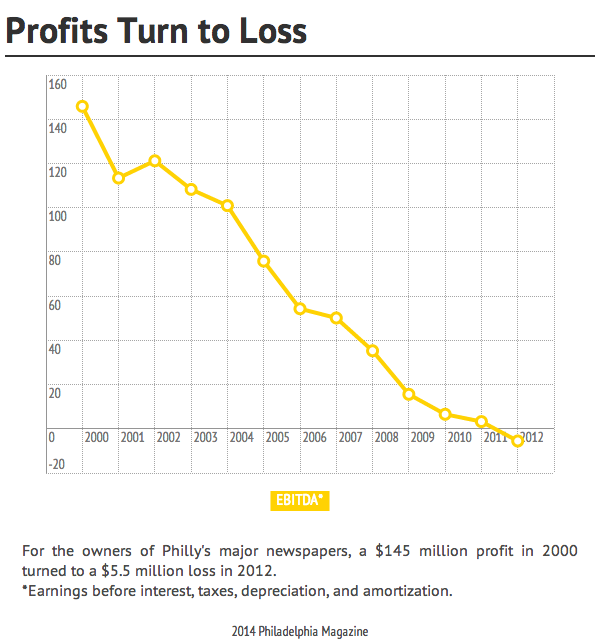
A good piece by Joel Mathis on the decline and fall of the Philadelphia Inquirer and Daily News.  Working from a financial report, he tracks the progress from being a reliable cash cow to bankruptcy in a little over a decade.

A large chunk of the problem was the same faced by most large urban dailies in the U.S. - a big drop-off in advertising revenues as one industry after another found better alternatives online.  It didn't help that this was followed by the recession - which hit all advertising revenues hard.

But when the industry started to recover after 2010, the loss of advertising continued to fall by double digits for the two Philly papers.  The fact that the papers changed ownership 4 times in 12, and the lack of consistent business strategies, didn't help either.
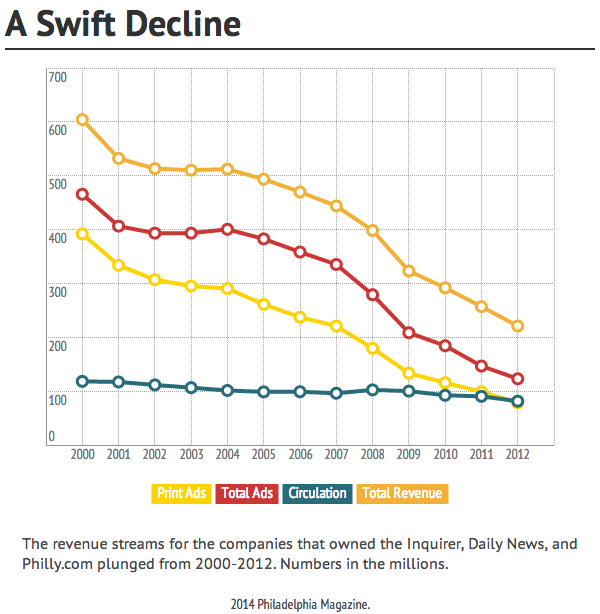
A look at the numbers suggests some other factors at work. 
    • Like most media facing revenue declines, the papers owners tried first to just cut costs.  But in Philly, it seems, the focus was on cutting staff (labor costs went from $243 million in 2000, to $135 million in 2012).  That's more than just trimming dead wood - it's the kind of cuts that will necessarily have an impact on quality.
    • Those deep cuts can also be seen circulation losses.  Circulation fell from a high of 374,000 (2002) to 166,000 in the last audit - a loss of more than half their readership.  Such losses necessarily impact the value of advertising in the papers, accelerating ad revenue declines.
    • Circulation revenues also declined, but much more slowly than circulation losses.  This suggests that the papers tried cutting subscription discounts and/or hiking prices.  Increasing costs to readers while reducing the value of the product also feeds into the negative feedback loop for circulation.
Thus the various manager's plans created a near "perfect storm" of negative feedback.  Initial shifts in advertising categories prompted cost-cutting,  That led to a focus on cutting staffing, which impacted the value of the news product.  Declines in product value led to circulation losses, which were exacerbated by cost increases.  Massive circulation losses reduced the value of advertising, which gave advertisers even less of a reason to return to the papers as the recession ended.

There's one other interesting aspect to tease out.  Note that there's a large, but shrinking, difference between print ad revenues and total ad revenues.  That would include digital advertising, which hasn't grown much.  It also includes preprint advertising (i.e. inserts) - and for a while it seemed that the papers were doing well with that revenue category.  However, large circulation losses make inserts less valuable, and by 2012 it seems that the Philly papers had lost that advertising sector to competitors as well.

Sources -  "The Long Fall of the Philly Newspapers,"  PhillyMag.com
It turns out the 2000s were not a good decade for The Philadelphia Inquirer and Daily News,  Nieman Journalism Lab

Monday, March 3, 2014

Print readership for newspapers - Half-full, or Half-empty?

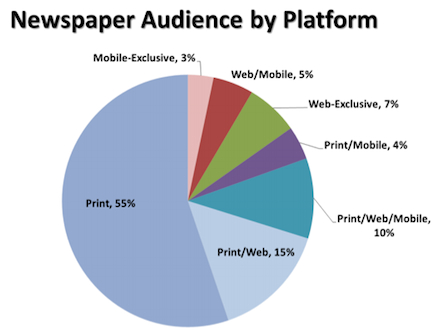
A recent study by the Newspaper Association of America (NAA) trade group reported significant growth in digital and mobile readership, yet also proudly proclaimed that 54% of newspaper audiences only read their local newspaper through its print edition.  Overall, the NAA reported circulation gains of about 3%. Also reported was the fact that print circulation has fallen to 71% of total circulation (75% of Sunday circulation), down from 85% the year before (a 20% decline).  The size of this year's shift, it should be noted, may be coming from a change in AAM reporting, which lets publishers decide whether subscribers of both the digital and print editions get counted as print subscribers or as digital subscribers.  With most ad revenue growth in digital, they may be choosing to emphasize those numbers.

One interpretation of the more than half of circulation remaining print-only is that there's still a significant role for print editions.  Another is that almost half of readers don't ever access their local newspaper digitally.  Newspaper readership is not only in general decline - it seems to be splintering, with older readers sticking with print, and younger readers shifting their news consumption to online and mobile sources.  The NAA report said that 30% of readers use a combination of print and digital sources, and 15% only use digital.  According to the NAA report,
"a closer examination of the elements, supported by readership data, does confirm a steady transition to digital reach among newspapers and a healthy print readership base for readers and advertisers."

A deeper look showed an industry in widespread decline.  Almost all of the circulation gains were by the five largest U.S. newspapers, and predominantly from increased digital circulation.  A breakdown by circulation showed aggregate circulation losses in all other segments.  The report notes that most smaller papers are posting print circulation declines smaller than seen in some of the biggest urban dailies.  Smaller, perhaps, but declines nonetheless.

From an economic perspective, it's clear that there is a strong and rapidly growing digital market for news.  News organizations, whether newspapers, broadcast networks and local stations, magazines and radio would be well-served to develop easily-accessible online delivery systems for the news they produce (mobile apps in particular).  The audience is going there, and frankly, the distribution costs are minimal compared to traditional media.  However, there remains a sizable portion of news consumers who remain loyal to traditional media formats - particularly for their traditional local news sources.  Local news organizations need to still consider that audience segment before going all-digital.

Source - NAA: 'Print only' still more than half of newspaper audience even as digital grows, Poynter