Showing posts with label DVR. Show all posts

Monday, January 6, 2014

IRTS - Poltrack confirms shifting audience habits

The second speaker today was David Poltrack, Chief Research Officer, CBS.  He confirmed trends he hinted at at an earlier IRTS.  With new devices and new delivery channels, people's viewing patterns are changing.  Some highlights:

  • This year, 94% of their large tracking sample are "connected."  Less than 10% of US TVHH only watch TV on home TV sets.
  • Delayed viewing is accounting for large and growing portion of viewing and ratings - not just for the big prime time series but in all day parts.
  • Streaming, VOD, and mobile are all seeing big increases in TV viewing.
  • Non-live viewing not only large share of total viewing, but showing some differentiable habits developing.
  • Broadcasters, advertisers, ratings services are trying to develop better metrics.
  • Streaming-only big series draw audiences similar to big pay-TV series, prime time broadcast series.
  • Second screen usage up to 67% for some demographics
  • Email, texting, and chatting is most frequent activity.  Gaming is second (20% of  USTVHH is playing Candy Crash while watching TV.
Basically, the audiences are becoming more active, and programmers and networks are trying to figure out how to reach them.

Tuesday, September 17, 2013

Nielsen- VOD/DVR use expands, changing TV habits`

Nielsen's latest "Cross-Platform Report" notes that 60% of US TVHH have VOD (Video On Demand) capabilities through set-top boxes and access through video streaming services.  Nielsen suggests that ease of use and increased programming options have made VOD and increasingly viable option for TV viewing.
The report shows that while traditional TV viewing (live on TV sets) remains the source of most viewing, audiences are increasing their use of both DVRs and VOD for time shifting programs and supplementing their viewing options.  The report also suggests that DVR and VOD uses are developing unique niches, with DVR time-shifting primarily used for general dramatic series, and VOD used primarily for watching movies.

The full report finds that younger demographic groups are more likely to make use of VOD, as are families with kids, and households with incomes above $100,000.  There's no real difference in use between households with DVRs and those without, but those with high speed Internet connections are much more likely to use VOD.

If you look at how different age groups use different devices for watching video content, those 50+ report the highest amount of traditional TV viewing (over 40 hrs/week), while the 25-49 age groups do the most time-shifted viewing (3+ hrs/wk) and spend the most time on the internet on computers (6+ hrs/wk).  The 18-34 age group averages the most time watching video on the Internet (about 1.3 hrs/wk).

Looking at different race/ethnic groups, Blacks watch the most "traditional" TV, averaging more than 200 hrs/month.  They also spend the most time watching videos using DVD/BluRay players (6 hrs/month), game consoles (7+ hrs/month), and rank second to Asians in time watching video content through the internet (9 hrs/month).  Asians spend the least time watching video content on traditional TVs (86 hrs/month), yet spend the most time accessing the internet via computers (35 hrs/month) and watching videos through the internet (12 hrs/month).  Whites watch the most time-shifted video content, averaging 12 1/2 hrs/month.

Sources - Q2 2013 Cross-Platform Report: Viewing on Demand, Nielsen Newswire
Viewing on Demand: The Cross-Platform Report September 2013, Nielsen research report

Tuesday, April 16, 2013

The Coming TV Revolution: Can Over-the-Air Free Broadcasting survive?

A number of trends are coming to a head - and may quickly and radically transform the TV (and other video media) landscape

  Broadcast TV has remained the primary force and driver throughout myriad technological advances - coax birthing cable; VCRs facilitating time-shifting and opening new choices for viewing; satellites transforming signal distribution and leading to an explosion of networks; computer gaming providing an alternative use for TV sets; digital networks & the Web opening the market (especially at broadband speeds); mobile and the "TV Everywhere" potential; social media prompting new levels of engagement; among others.  All these have opened the market to competition, and the explosion of choice has led to shrinking audiences and falling revenues - even with TV ad spot prices increasing.
  Still, the big networks remained the top draws in programming, grabbed the lion's share of national ad revenues, and remained, through its public broadcast outlets, more or less universally accessible.

  That's starting to change.  The audience share for the Big 4 broadcast networks has been falling for almost a half century.  This winter saw one of the Big 4 networks' entire schedule outperformed by Spanish-language broadcaster Univision in the key 18-49 demographic.  In the Winter sweeps, a cable show (A&E's Walking Dead) outperformed every broadcast network regular scripted series program.  If you exclude big sporting events and reality programs, most of the Big 4's current prime time schedule was outperformed by cable TV reality programs (Duck Dynasty, Swamp People) and WWE Pro Wrestling.  That's not a position of strength in the market.

  And then there's the impacts of DVRs and other viewing alternatives. This last ratings year is seeing most scripted programs experiencing significant time-shifting - from 15% to as high as 50% of a shows audience coming from time-shifting - whether through DVR replay, access through Video on Demand offerings, or streamed from network online sites. The shift isn't stopping with broadcasting either; recent studies show that more people are watching Nickelodeon's programming via NetFlix streaming than are watching the network itself.  TV viewing habits seem to be changing.
  Alternative viewing creates problems for an industry dependent on advertising - particularly when a sizable portion of value comes from being able to target times and specific audiences.  One problem is counting those who delay viewing.  That problem's been around since VCRs, although it's really grown significant only recently.  Nielsen's tried to keep pace by developing multiple ratings measures - the original live viewing ratings while introducing new ratings measures that also include delayed viewing within various time-frames.  However, the industry hasn't settled on how to best capture online streamed viewing, so much of that remains unmeasured.  Even with better measures of delayed viewing, much of it occurs through devices that allow users to fast forward through ads or skip them entirely; and VOD and streaming services don't necessarily include the same ads as aired in the original broadcast.  As such, the expanded ratings may capture the additional program viewing, but aren't really helpful in measuring advertising's reach, or adding value to the live ad spots.
  Then there's cord-cutting and the zero-TV homes.  Those terms address different impacts of the rise of online video streaming.  "Cord-cutting" refers to the growing phenomenon of people dropping some or all of their multichannel feeds and relying on a combination of over-the-air broadcasting and online streaming to provide their TV content.  Research suggests around 1 in 10 multichannel subscribers have dropped some or all of their multichannel service (the vast majority dropped pay or more costly advanced tiers while keeping basic service), with another 5-10% considering the move.  While cord-cutting may become a significant problem for those services that are dropped, you would think that it would help broadcasters as the primary source of live TV.  "Zero-TV" homes take things a step further; the term doesn't refer to those without a TV set and who never watch - rather it refers to those who get their TV and video content entirely from non-traditional TV channels.  Primarily from online streaming, online downloads, and recorded home videos (movies and TV programs).  While initially only a small portion of the U.S. TV audience, Nielsen recently announced that it will start including those households in their sampling, and will eventually integrate their viewing into its TV ratings system.  Initial studies suggest as many as 5 million USTV homes fall into the "Zero-TV" category.
  Declining audiences are also evident in drop-offs in advertising revenues.  TV's aggregate share (broadcast and cable) of national ad dollars has fallen below those for online advertising.  Advertising revenues for cable networks surpassed those for broadcast networks a couple of years ago.  At best, TV ad revenues have diminished long term potential.  TV ad revenues, like all advertising media, took a hit in the recent recession, and growth rates have slowed behind other advertising outlets, resulting in a shrinking share of volatile advertising dollars.  TV businesses, like newspapers and cable firms before them, are seeking new revenue streams.
  One potential new revenue source is licensing.  The jump in retransmission fees in the latest round of negotiations, the success of cable and DBS in getting consumers to pay for TV, and the more recent success of online streaming services like Netflix, Hulu, and Amazon Prime, have amply demonstrated the potential value of licensing as a revenue source.  TV and video firms are starting to look in that direction for revenues to replace advertising losses.  In fact, broadcast networks are already scrambling to grab a share of retransmission fees from local broadcasters, creating problems for many local stations.

All of this helps set the stage for the major networks knee-jerk reaction to two innovations fostering the "TV Everywhere" concept: Dish's Hopper with Slingbox, and Aereo.

  Dish's Hopper started as a DVR-type service with two particular twists: it would automatically record every network prime-time program, instead of only those selected by the viewer; and it included technology that allowed viewers to skip all commercials during replay.  To handle the volume of the entire prime-time schedule, much of the program storage would be in Dish's cloud rather than in the subscriber's set-top box.  These factors were enough to get most of the major broadcast firms to challenge Dish in court, trying to prevent its implementation.  Then came another innovation when Dish announced the integration of Slingbox technology, which allows viewers to stream content received at home to Internet-connected devices anywhere.
  With the first announcement of the Hopper service, major networks sought to challenge the legality of the service and technology, largely on copyright and intellectual property grounds, and seeking an injunction that would prevent Dish from implementing and offering the service.  In particular, CBS, and its CEO Les Moonves, not only reacted negatively, but badly.  After the Dish Hopper with Slingbox was voted "Best of Show" at the last CES (Consumer Electronics Show) by C/Net (owned by CBS) editors, Moonves' office ordered them to remove the device from consideration, and to not report any more news or information about the technology or service.  (This was after promising C/Net complete editorial autonomy).  Moonves also threatened to pull CBS off the Dish DBS system if they didn't stop promoting the commercial skip function.  (Revealing also his ignorance of DBS operations and rules: first, Dish doesn't carry the network, they carry local broadcast stations which are CBS affiliates and FCC rules prohibit network interference with local station operations; second, unlike cable, local station carriage rules state that if a satellite service carries any local station, it must carry all local stations in that market.)

  Aereo's technology allows users to access local broadcast signals through the Internet.  It's primarily a place-shifting technology (like Slingbox), rather than a time-shifting technology (DVR, Hopper).  As such, it's impact is to expand the potential audience for local broadcasters, so it's less clear why broadcast networks and station groups would be in opposition to a technology that would only expand their reach and their audiences for advertisers.  Still, a number have joined forces to file a lawsuit aimed at prohibiting the service, again mostly on copyright grounds. (I've speculated it's just because they want to grab a share of Aereo's subscription fees).  A number of the broadcast networks, Fox publicly, have threatened to pull their programming from over-the-air distribution if Aereo and similar "TV Everywhere" technologies are allowed to continue.

  The central question in the two lawsuits is whether the services fall under the guidelines established in the 1984 Betamax case.  In that landmark case, the Court ruled that technologies that technically could be used for copyright violations were legal if they also had substantial non-infringing uses (primarily under "fair use" exemptions).  Among the specific qualifying "fair" uses were time-shifting and/or place-shifting legally acquired content for private use - key features of the challenged services.  Initial rulings in the two cases with respect to seeking preliminary injunctions to ban the services while the case was in progress went against the network/broadcaster groups.  Both judges found that the services had viable "fair use" arguments that would need to be addressed more fully in court, and thus denied the petition for a preliminary injunction.  A Fox spokesman went a bit overboard reacting to one of the rulings:
"the court has ruled that it is OK to steal copyrighted material and retransmit it without compensation."

  This has resulted in an interesting dynamic - Hopper's commercial skipping currently only applies to the the broadcast networks' prime time recordings, and Aereo only redistributes over-the-air broadcast signals.  In other words, those technologies pose issues only for broadcasters. Thus, the renewed interest in "going cable."  It's not a totally new idea for the networks - as early as the 1990s networks looked at cable network licensing fees and thought about grabbing a share of that revenue stream.
  However, it would only work if they abandoned over-the-air broadcasting fully, which would have serious impacts on their own advertising revenues (resulting from the reduced reach and audiences) and the profits from their owned-and-operated local stations (which typically cover losses from network operations). Multichannel coverage has expanded to around 90%, which can qualify as "national" coverage, but there's also the question of whether multichannel operators, and viewers, would be interested in paying for programming that has been proudly touted as free throughout its history (particularly at the price the broadcast networks think they're worth (which is in the range of $10-25 dollars per subscriber per month). 
  Frankly, if they can't draw significant audiences for "free" content, it's not clear why viewers would be willing to pay heavily for it.  Even if the broadcast networks settle for an additional $50 per month per subscriber (for the Big 4 broadcast networks), that would be a huge jump in cost for multichannel subscribers.  It seems likely that a lot more people will drop those channels or services (if possible) with such a price hike.  Multichannel distributors are already moving sports channels into separate tiers (with much smaller reach) in response to concerns over $5-10 monthly subscription increases driven by skyrocketing sports licensing fees.  These jumps are also fueling talk about implementing "a la carte" pricing models (where subscribers pay only for pre-selected channels).  Big price increases would clearly drive demand down (shrinking potential audience), and economic research on "a la carte" also suggests "a la carte" pricing results in huge declines in demand, and thus audiences. And further significant drops in audience would clearly result in sizable drops in advertising value and revenues.
  The move would also significantly impact local broadcasting, removing a large amount of a station's most popular programming, which would also have to be replaced.  Studies suggest that losing a network affiliation can cost a broadcast station as much as 75% of its value, and could result in half to two-thirds of local TV broadcasters running significant losses and most likely ceasing operations.  Including those owned and operated by the networks parent companies.  Are those companies willing to write off some of their most profitable assets in the hope that they can pull big bucks as a cable network? 
  Then consider the PR nightmare of viewers facing price jumps of $50 or higher a month, just to access what they've always been told is "free TV".  And then consider how Congress and the FCC would react to something that would significantly damage (and possibly kill off) free over-the-air broadcasting). 
  The reaction really seems overblown, particularly when considering that the actual economic impact of these new technologies and services is likely to be minimal.  Sure, commercial-skipping may reduces the value of ad spots, but those aren't being counted now anyway.  In addition, keeping programming accessible longer, and available over more devices in more places actually increases the potential for viewing. The net impact of these technologies on the financial bottom line is likely to be minimal.

Source -  Tech upstarts threaten TV broadcast modelIT Business Net

Edits - had to clean up some language and missing phrases. Added a la carte issue

Friday, March 15, 2013

Monday, January 14, 2013

DVR, VOD changes TV viewing

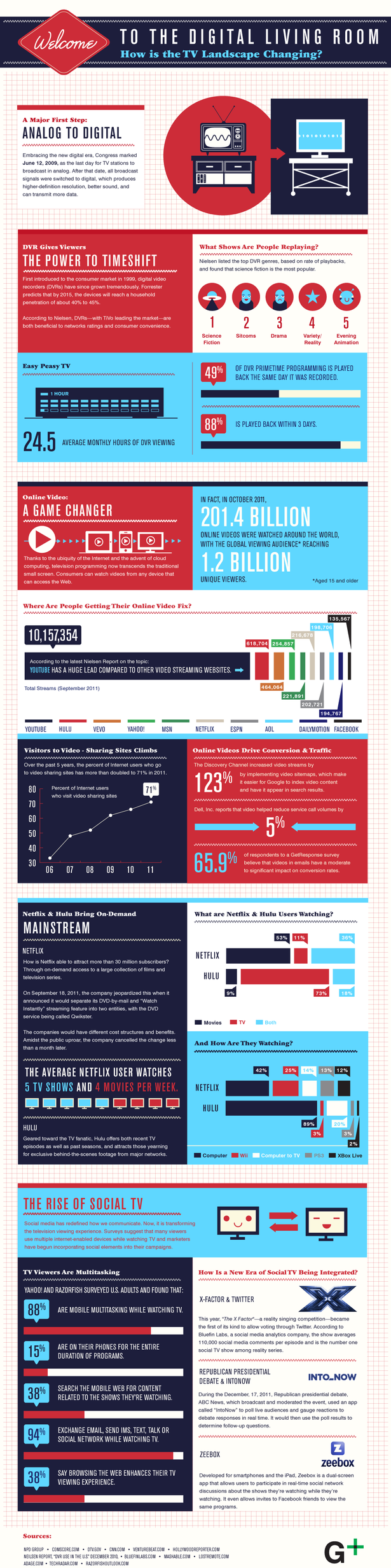
Recent consumer research from Leichtman Research Group (LRG) shows that more than half of homes getting their TV from a multichannel video programming delivery service (i.e., cable, DBS, telco cable) have and use DVRs to record and watch TV programming, while only 4% of households without MVPDS (that is, rely on over-the-air broadcast stations and/or internet streaming for their TV programming).  Since about 90% of homes get MVPDS programming on at least one TV, that's a lot of U.S. TV households with DVR capability.  And 43% of DVR homes have DVR access to two or more TV sets in their home.
  In addition, the survey found that 70% of cable digital subscribers have used its VOD (video on demand) service to watch TV programs (compared to 58% in 2007 and 25% in 2004).  In addition, more than half (51%) of the MVPDS subscribers also subscribe to Netflix, the top on-demand Internet video streaming service.

  So now that DVRs, VOD, and on-demand Internet video streamers and other technologies that shift control over viewing time and conditions to audiences are fairly widespread, how do consumers like and use them?  What do consumers think about having the power to watch TV programs when and where they want?  LRG surveyed some 1300 U.S. households, and the LRG report concluded that:

“... the percentage of all TV households in the US with a DVR has... doubled over the past five years, and... expanding to more TV sets in the home... consumers are increasingly integrating DVR, VOD and On-Demand TV viewing into their TV viewing patterns... ”
More specifically,
  • People really like having DVRs, with an overwhelming majority giving the service strongly positive ratings (8-10 ratings where 10 is excellent).  In addition, people prefer (give higher positive ratings) when they have DVR access on multiple TV sets (81% top ratings) than when they have DVR access from only one TV (71%).
  • More than half of digital cable (59%) and Telco video (64%) subscribers have used their VOD service within the last month.
  • More than a quarter (26%) of Netflix subscribers watch "Instantly" on a daily basis, and more than half (59 watch a movie or TV program "Instantly" at least weekly.
  • More than two-thirds of VOD users strongly agree with the idea that having both VOD and DVR makes their TV service better.
  • 79% of Netflix "Watch Instantly" users watch movies and TV programs on a TV set (as opposed to a computer screen or mobile device).
These reported results certainly suggest that most viewers like having more control over their TV viewing in the form of DVRs, VOD, and Internet video streaming services - and that having those tools helps to improve their perception of the value of their TV delivery service.  What's in the press report doesn't really get too much into changing behaviors, but a spate of current research is clearly establishing and increase in time-shifting viewing - enough to start a debate about what that means for TV advertising, and how to best measure and incorporate that viewing into ratings.


Source  -  The DVR Impacting TV Viewing and SatisfactionResearch Brief

Friday, October 12, 2012

Timeshifting's Ratings Impact

When I recently posted some comments on the cable/broadcast battle to claim supremacy, I noted that same-day timeshifted viewing had grown significantly.  The Hollywood Reporter also noted the change in their review of the start of the Fall 2012 season.  With DVRs (digital video recorders) in about 46% of US TV households, younger viewers in particular seem to be actively embracing the potential to adapt their TV viewing to there own lifestyles, rather than shifting their daily habits to watch TV.
  To back this up, the piece compared ratings for this season among young adults (18-49) that combined live viewing with three days worth of delayed viewing with the traditional ratings based on live viewing.  In aggregate, the 18-49 audience for the four networks primetime premiere week (excluding sports and Saturday) was 41% larger when you included those who timeshifted and watched the program within three days. 
  The article also provided some more specific comparisons in terms of viewing of returning series - NBC's Revolution L+3 viewing was up 50%, making it the most timeshifted program in NBC's history ; CNS's Vegas was 28% higher with timeshifing; ABC's Modern Family added 33% to its rating when including delayed viewing.
  Now, that's just a few, so I went back to the TVB study to crank out some more numbers on the level of timeshifting we're seeing so far this Fall.  The ratings are for the previous week and for the 35-54 demographic, and the report reported delayed or timeshifted viewing within one day of the original airing.  Thus the numbers aren't directly comparable to those above.  The report also reported viewing only for the top primetime programs.  I'll list the programs and the share of one day timeshifted audience
Modern Family 32%;; Big Bang Theory 31%; Grey's Anatomy 28%; NCIS 25%; How I Met Your Mother 31 %; Survivor: Philipines 29%; 2 Broke Girls 26%; New Girl SPL 40%; Voice (Tues) 20%; Once Upon a Time 24%; Amazing Race 21 29%; Mike & Molly 25%; Revenge 25%; Two and a Half Men 20%; New Girl 29%; The Middle 22%; NCIS: Los Angeles 16%; Office 33%; X-Factor (Wed) 19%
The quantitative side will note that this is anecdotal and a limited nonrandom sample, so don't take the precise numbers as gospel.  Still, the numbers show a significant level of timeshifted viewing.
Another caveat was the point made by David Poltrack, chief research officer at CBS - that timeshifting during premiere week may also be driven by people wanting to sample new programs.
From the network perspective, that's good news, "because sampling is what it's all about."

  It seems that DVRs and timeshifting have caught on, at least with some demographic groups,  The levels are high enough to make a strong case for networks and advertisers to put more of an emphasis on using ratings measures that include at least some delayed viewing.  The might also consider the long term impact of delayed viewing on program scheduling strategies.

Source -  DVRs Dramatically Altering Fall TV Battleground, The Hollywood Reporter
Seasons of Premiers: Fall Broadcast and Summer Cable, TVB report

Editted to fix bad link for Hollywood Reporter source. (17Oct2012)

Tuesday, September 18, 2012

CBS threatens to pull stations off Dish

Les Moonves, the President of CBS has publicly threatened to pull CBS-owned stations from Dish Network carriage if Dish continues with plans to offer an option that would remove commercials from its new Hopper DVR service.  A key feature of the Hopper service is that it will automatically record all prime-time programming from the Big Four networks and offers subscribers the option to activate the AutoHop feature, which will automatically drop ads and other non-programming content from the playback.
"Hopper cannot exist," Moonves said Wednesday at the Bank of America Merrill Lynch Media, Communications & Entertainment Conference in Beverly Hills, Calif. "We cannot produce episodes for $3.5 million apiece and have the people at Dish say they will pull out the commercials. We will not be on Dish. We will go elsewhere," he added.
CBS is also part of the Big Four networks' legal challenge that charges Dish with copyright infringement.  The case joins a number of others that question whether a number of new digital services operate under "fair use" guidelines or run afoul of one or more intellectual property rights.

  The move could impact on CBS audiences and ratings, if its viewers don't have alternative ways of receiving the signals of the pulled stations.  It could also encourage Dish viewers who want to keep access to CBS programming to shift to an alternative service.  CBS-owned stations tend to be in the largest markets, where competition for multichannel video services is high, so viewers should have options.  Both CBS and Dish are likely to experience some negative impact in the short run, while the legal case is in the early stages.  The real impact will come if another major network or station owner follows CBS' lead.

Read more: CBS threatens to pull stations from Dish over Hopper dispute - FierceCable

Wednesday, May 30, 2012

Broadcasters Sue Dish over ad-skipping

One of the most basic business strategies in hyper-competitive markets is to provide some extra bit of added-value to the common base product.  US DBS provider Dish is trying that, with an upgrade to their DVR service that lets viewers skip the ads in recorded TV programs.
  For the last few weeks, Dish has offered a service that provides subscribers access to the last eight days of prime-time broadcast network programming.  Included in the service is "Autohop" technology, which identifies and skips inserted commercials.  Dish hoped to make the service somewhat network/advertiser-friendly, by turning on the Autohop feature at least a day after the initial program airing, allowing the program to be included in ratings measurements.
  That may not be enough, however.  As Nielsen seeks to include delayed or shifted program viewing, the networks fear that Dish's ad-stripping may hurt ad revenues.
  The actual legal strategy, though, is based on evolving standards of "fair use" and copyright.  Courts have repeatedly sustained the fair use rights of individuals to time and place shift legally acquired content. The networks, though, are arguing that the recording is not done by the individual, but by Dish; also, it is an action that is commercially beneficial to Dish.  As such, they contend that Dish's actions are not covered by traditional fair use standards.  It's an argument that has some merit, as well as a precedent - an early competitor to Tivo as a stand-alone DVR offered a similar service, only to lose that copyright challenge.
 
Source - Broadcasters sue Dish over ad-skipping DVR service,  Broadcast Newsroom

Monday, July 11, 2011

DVRs in half of homes by 2016

Analysis from MagnaGlobal predicts the percentage of US TV homes that also have DVRs will reach 50% in 2016 (up from roughly 33% in 2011).  Even more homes will have access to Video-on-Demand, at 58% of TV homes in 2016 (up from 46% last quarter).  Finally, they predict that in 2016, the percentage of homes totally reliant on the Internet for media consumption will reach 15%.
These all reflect a transition to a different model of TV use and consumption that seems to be emerging - a movement from a purely passive audience to one that is increasingly in control of their media consumption.

Source: "Report: DVR Households to Hit 51.3% In 2016", Broadcasting & Cable.

Tuesday, March 8, 2011

TV's Changing Behavior- DVR Penetration and Use grows

Revised projections from a Magna Global study suggests that both DVR (Digital Video Recorder) and VOD (Video on Demand) penetration in the US will reach 50% by 2016. 
In the meantime, a recent Nielsen study suggested that DVR use added 2.3 ratings points to total day usage, and 7.9 ratings points for primetime programing (in DVR homes).  More importantly, it showed that DVR viewers did watch commercials on their DVRs.  Nielsen also reported that current DVR penetration varied by ethnicity (40.3% White, 35.4% Asian, 30.3% African-American, 29.8% Hispanic), and income.

Source: "Play It Again, Sam," Research Brief form the Center for Media Research