Showing posts with label broadband. Show all posts

Tuesday, March 10, 2015

The end of big bundles? Going "a la carte" via OTT

OK, first let me take care of clarifying the terminology.

Assembling big (often 50+ channels) bundles of cable networks has been the primary strategy of multichannel video service providers (cable, DBS, telco cable, etc.) for the last couple of decades. Keeping bundles big helps minimize transaction costs for the bundler, while offering maximal potential audience reach for advertisers, and maximizing the viewer's ability to browse and discover the value of channels and their content.  On the other hand, critics complain that it "forces consumers to purchase channels they aren't interested in."  That's not necessarily true, as purchase decisions are based on the aggregate perceived value of the bundle, not the "costs" of undesired channels (see here for more detailed analysis).
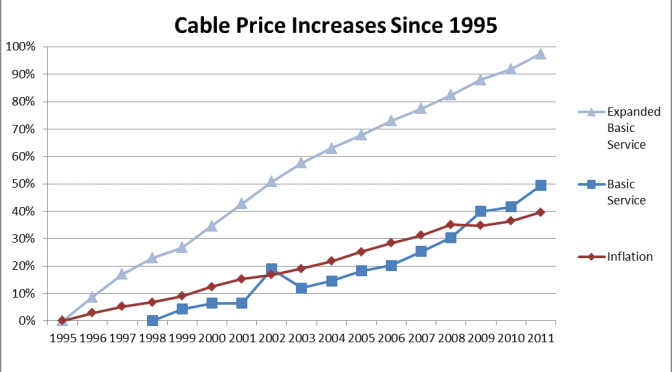
Still, as the networks and local stations seek to increase licensing fees from multichannel providers, those costs are passed on to the consumer in the form of higher bundle prices.  Bundle subscription costs are rising rapidly, and may be nearing a threshold point for many subscribers - the point where their perceived value of the bundle is less than the subscription price.  We're seeing the beginning of this in the rise of cord-cutters - those replacing paid multichannel access with a combination of online and free over-the-air TV sources.

However irrelevant, the claim of paying for unwanted channels is a major theme for those who would prefer to force multichannel services to unbundle channels and offer them to consumers in small focused bundles (like the various Discovery channels), or individually (i.e. "a la carte").  This may seem to be a good deal for consumers - until you realize that going a la carte will, in most cases, reduce audience reach numbers significantly.  One study (discussed here) forecast that forced unbundling could result in a loss of 60% of advertising revenues for cable networks, and result in more than 100 channels going out of business.  And since cable networks would need to significantly increase their a la carte prices to recapture some of those losses, going a la carte would also likely result in higher total costs for cable network access for most consumers.

Meanwhile, some multichannel video providers are finding that the increased licensing demands made by some networks are crossing that value threshold, and are dropping channels, or in one case offering to provide the channel - but only as an a la carte service.  The networks have so far been smart enough to realize that either option is a net loss for them, but the gleam of a licensing El Dorado of unlimited wealth keeps them trying to push licensing fees ever higher.  Viacom, and its package of networks, is the latest battleground, with their channels being dropped by a number of mid-range and smaller cable systems unwilling to cave into their licensing demands.  As one analyst noted,
“The stage is set... As consumers are less interested in large bundles, somebody is going to get hurt in the process by asking for too much.”
If multichannel service providers remained the only option for access, the impact on the industry would be bad enough.  However, they're facing rapid growth in the ability of broadband internet connections to provide access to high-quality TV streams to mobile devices and wired connected devices.  The term OTT (over-the-top) refers to these alternative sources of video and TV content. Both the diffusion and use of these technologies for TV viewing are growing rapidly (see here and here).  Combined with increased time-shifting of programs and place-shifting, audience TV viewing habits are clearly changing.  For cable networks, going online for their content distribution - either as single channels or as a part of a more limited (and much less expensive) bundle offered online - is an increasingly viable supplement, and potential substitute, for traditional delivery media.

The viability of online TV delivery has been a significant component of the "TV Everywhere" marketing push.  The initial conceptualization, though, saw "TV Everywhere" as a way of achieving multichannel services beyond the household's TV sets - and not as a substitute or replacement for those services.  That was one reason for the rapid reaction to the Aereo service.  One would think that local stations and networks would be eager to extend their range of service via mobile as a way of enhancing (or at least maintaining) audience reach.  However, it seemed that the industry hated the notion of a video service that paid no licensing fees; and the courts bought that argument.

More recently, the industry has seen several TV networks pursue the option of offering their programs and content online. The WWE initiated a very successful online subscription service last year, and many of the Pay TV networks have announced plans for providing online access channels separate from multichannel provider subscriptions.  HBO, in particular, is scheduled to provide a separate online channel called HBO Now starting April 12, 2015.  A research report released in January by Park Associates suggested that HBO Now could generate an additional 15 million subscribers.  More critically for multichannel providers, half of those interested in HBO Now said they'd not only be likely to drop HBO pay channels, they'd drop the whole multichannel pay service (about 7 million subscribers).  That's still a big win for HBO, who not only would likely net an added 8 million subscribers, but would not have to split the subscription fee with the multichannel provider.

In addition, CBS has been offering an online video service since last fall, and it is thought that ABC, NBC, and ESPN are considering taking their online video channels public (currently access is limited to subscribers of some of the largest multichannel providers).  Most cable networks provide some access to their content, but not to live streams of the channel.

Still, it's likely that the new DishTV service, Sling-TV, may unleash the deluge.  Sling-TV is an OTT service that bundles a number of the most popular cable networks as a minibundle at a very low subscription price ($20/mo. for about 20 channels), and supplements that with targeted minibundles (sports, movies, children, etc.) at $5 a pop.  The service combines live streams of the network, as well as on-demand access to the previous week's programs. Sling-TV has managed to sign up some 100,000 subscribers in its first month, despite being initially limited to those with a Roku OTT box.

The Sling-TV service could well force the big multichannel services to start unbundling.  It offers an intriguing alternative for those who would be satisfied with a lesser selection of channels.  And even for those viewers who place high value on channels not included in the Sling TV packages, the price contrast between the "big bundle" options ($50-$150+ on new subscriber deals) and Sling-TV will prompt consumers to reconsider if their demand for favorite channels will justify the price differential (and to wonder how the costs of channels they don't want inflate bundle prices).

The big multichannel providers have been shedding TV subscribers slowly, but consistently, for years.  Now that viable and less costly OTT and online video options are coming available, expect the decline in pay TV subscribers to increase, particularly for major MSOs and multichannel providers.

Sources - Updating: HBO Now The Big Test for Cord Cutters?, Online Video Daily VidBlog
Sling TV notches 100,000 users in a month, TechHive
Seventeen percent of U.S. broadband households are likely to subscribe to an OTT HBO service, Parks Associates report.
Provider's Dispute with Viacom Highlights Skirmish Over the Cable Bundle, New York Times

Friday, January 30, 2015

FCC sets new "Broadband" standard at 25 Mbps

Yesterday the FCC formally approved a long-awaited increase in its definition of what counts as "Broadband" Internet connectivity.  The Commission, in giving formal approval to release its annual report on the status of broadband, gave implicit approval to that reports change in what it considers to be broadband service.  The old standard was 4 Mbps downstream and 1 Mbps upstream - while the new standard is 25 Mbs downstream and 3 Mbps upstream.
Critics have long argued that the FCC's 4 Mbps standard was outdated - it was established well before video streaming usage exploded, and 4 Mbps isn't sufficient bandwidth to stream a TV signal uninterrupted by delays.  The industry itself established an informal standard of 20 Mbps as needed for broadband connectivity to homes years ago.  That level of bandwidth was based on the ability to live stream 2-3 separate video streams to multiple devices, while leaving enough capacity for second screen data and other Internet usage.  The EU is using the 20 Mbps standard for its policy goal of achieving universal broadband access.
The definition of minimum broadband standards is critical to determination of access and availability of broadband to consumers, as well as determining whether there is effective competition in broadband markets.  Its been thought that the FCC continued to use its 4 Mbps standard to inflate national availability numbers to seem more on a par with availability numbers in other countries.  While that may have been a minor concern, its more likely that they stuck with 4 Mbps because that was the data capabilities of 3G cellular services and the small satellite-based data services.  Inclusion of 3G cellular and satellite data coverage provided both near-universal accessibility, and competition to wired (land-based) cable and telecomm providers for about 90% of Americans.
 The new 25 Mbps standard basically excludes those (but is within 4G cellular standards), and reflects the reality that 17% of the U.S. population doesn't have access to data services meeting the new standard.  More critically, from a policy perspective, is that exclusion of satellite data services (which currently don't provide services at that speed yet) leaves large swaths of rural America without "broadband" access.  The new report determines that 53% of rural population (63% of those living on tribal lands) won't have access to data services meeting the new standard for broadband.  Similarly, applying the new standard in considering whether there is effective competition for broadband service providers means that only 37% of Americans have access to two or more broadband services.  Excluding 3G service providers is the primary cause for the drop in "competition." Also, not all of the "4G" services being offered in the U.S. meet the formal international standards - some peak out at 21 Mbps downstream, which qualifies as broadband under EU standards (20 Mbps) but not the new US standard (25 Mbps).
 While the standard for "broadband" in the U.S. certainly needed changing, whether it should be at 20 or 25 Mbps is somewhat debatable in the short term.  In the long term, there's already discussion of what the next standard should be (mostly centered for now at 50-100 Mbps).  Give it a few years, and we'll need to redefine "broadband" again anyway.

Sources -  FCC Says Broadband Now Means Speeds Of 25 Mbps,  OnlineMediaDaily

Monday, February 17, 2014

Comcast pursues Time Warner

Several suitors have been pursuing Time Warner over the last few months.  It looks like Comcast is the likely winner, offering to purchase the second-largest cable operator for $45 billion.

But the deal is more about broadband than cable.  The addition of Time Warner broadband customers would give Comcast more than 33 million broadband subscribers and what amounted to $18 billion in subscription revenues in 2013.  That's about half of current broadband subscribers.  And broadband revenues are growing faster than cable video, with higher profit margins (around 90 percent).  The cable side, in fact is in trouble, losing customers and facing and increasing profit squeeze.

The deal is also about positioning Comcast for the future and the likely radical transformation of the video signal delivery business.  Local stations and cable networks keep pushing licensing fees higher and higher in search of revenues to replace stagnant (although still quite large) TV advertising dollars.  And then there's the continuing advances in IP video streaming, and changing audience habits.   Comcast is one of the few TV companies doing R&D - in fact, they have the largest R&D presence in the industry - and much of that effort is geared towards positioning the firm for the developing IP streaming, digital broadcast innovations (such as Aereo and multicasting), and mobile video explosions.

Those under 25 are spending less time watching traditional live TV - considerably less.  Delayed viewing and consumption of IP-video streams from an increasing variety of high-quality online video services (i.e. Netflix), as well as gaming, are eating up an increasing share of viewer's attention.  Advances in mobile, in the meantime, are creating new opportunities for TV viewing - although delays in implementing "TV Everywhere" has slowed cable's ability to tap into that new market.  Experts are now expecting a major transformation in TV viewing, even while unsure just what kind of TV market will eventually emerge from the growing chaos.

I'd be remiss, though, if I didn't point out the regulatory roadblocks in the way of the merger.  After all, the deal would combine the two largest cable system operators in the U.S., each of whom also owns a wide range of other media outlets, including broadcast networks, cable networks, film & video production and distribution outlets, publishing, etc.  Both are often listed among the world's 10 largest media conglomerates.  While there's not a lot of direct competition between the two cable and broadband operations (they're more local monopolies, increasingly challenged by telco and broadband operators like AT&T, Verizon, and Google), media is an area where just being large is considered problematic.  More problematic on an anti-competitive basis would be many of the other media components, which are arguably more directly competitive with one another.  And then there's the issue of Comcast's data caps and their interference with (slowing down) of unaffiliated video streaming services - the one glaring anti-competitive behavior fueling Network Neutrality debates. There's lots of reasons the deal might not be approved and consummated.

Even if the FTC doesn't knock the deal down in terms of sheer size and concentration, there will need to be a lot of negotiations and deals to meet the antitrust concerns of all the various markets and media elements in play.

(Let me also point interested readers to Ken Doctor's analysis of the deal and the fundamental issues confronting cable systems like Comcast and Time Warner Cable.  The Newsonomics of Comcast's deal and our digital wallets)

Sources -  If Comcast buys Time Warner, TV could change forever,  GigaOm
The Comcast-Time Warner Cable merger is not a marriage made to last, The Guardian

edited to add last graph and link (2/17/14)

Tuesday, December 3, 2013

Streaming goes Prime-Time in U.S.

Two recent industry research reports point to the growing acceptance of, and preference for, the use of online streaming sources by TV audiences.
“Viewing habits are quickly evolving and connected TV is going mainstream,” according to Eric Berger, EVP of digital networks, Sony Pictures Television and general manager, Crackle.
The research is based on a survey of 1200 younger adults (18-49) conducted by Frank N. Magid Associates.  Their key finding is that online streaming is now viewers' second choice of viewing source (still trailing live TV).  The study found that access to online video streaming was near universal (96%), and more than half (54%) had access through "connected" TVs - either smart TVs, through attached gaming consoles, separate OTT devices, or connected video players.

The trend seems to be reflected in current trends in the cable/multichannel industry. Cable companies in the U.S. are seeing a surge in broadband-only customers (foregoing the primary TV service) - to the point where many are publicly rebranding as broadband services, which can also deliver TV (see earlier post here).  Research from the Leichtman Research Group is showing a decline in pay-TV subscribers, combined with increasing broadband subscriptions.  Their recent report shows major cable operators with 48.7 million broadband subs, and telcos growing more rapidly with 35.9 million (45% of which have access through fiber).  Average broadband speeds are also on the rise, with average bandwidth for broadband connected homes in the U.S. just over 20 Mbps.


As Cablevision CEO Jimmy Dolan told the Wall Street Journal in August: “Ultimately over the long term I think that the whole video product is eventually going to go to the Internet.  I’m not willing to cede that position now, and I’ve got a lot of customers that buy my video product…[but] the handwriting is on the wall, particularly when you look at young customers.” - See more at: http://videomind.ooyala.com/blog/telcos-cable-operators-see-broadband-subscriber-numbers-skyrocket-0?mkt_tok=3RkMMJWWfF9wsRousqzNZKXonjHpfsXx7OglWK6g38431UFwdcjKPmjr1YEITcN0aPyQAgobGp5I5FEMTrfYWbFrt6cPXg%3D%3D#sthash.gsljDRjn.dpuf
Source -  Streaming goes prime time with connected TV prime destination, RapidTVNews
The U.S. now has over 83 million broadband subscribers, GigaOm
Cable Companies See Jump in Broadband-Only Customers,  DSL Reports

Wednesday, October 9, 2013

Prospective milestone: Online video devices outnumber people by 2017

A report from the Broadband Technology Service at IHS predicts that the explosive growth in smartphone and tablet ownership will result in over 8 billion Internet-connected video devices in the world by 2017.  The projected world population in 2017, in contrast, is 7.4 billion.
“In practice, ownership of Internet-connected hardware will be concentrated among users whose homes are equipped with broadband connections,” said Merrick Kingston, senior analyst for Broadband Technology Service, in a press release.
“We’re quickly approaching a world where the average broadband household contains 10 connected, video-enabled devices. This means that each TV set installed in a broadband-equipped home will be surrounded by three Internet-connected devices.”
The growth in 4G mobile services will fuel expansion of basic levels of broadband access, particularly in rural areas and in developing countries.  That's also a key component in the expansion of online video access.

Source - More Internet Video Hook Ups Than People in the World by 2017, VidBlog

Tuesday, June 4, 2013

Goin' Mobile - Speeds and Content

Some quick notes on the expanding mobile broadband/online video front -

The last leg in mobile broadband for most people will be their home, office, or public WiFi loop.  Telecomm research from the Dell'Oro Group note that the wireless LAN market (i.e. WiFi) grew 17% in 2012.  But even more significantly, the new 802.11ac standard, which offers speeds up to 1 Gigabit/second data rates will be increasingly available on hardware devices this year - contributing to a convergence of wired and wireless data speeds.

There's a massive data speed war in Japan, with multiple operators offering 1 Gbps services over fiber-to-the-home (FTTH) networks, and one operator announcing the rollout of the Nuro 2Gbps FTTH residential service.  So-Net's initial pricing for 2Gbps runs around $50 a month, significantly lower than competing 1 Gpbs services. Meanwhile, Japan telco NTT is said to be working on a 10Gbps residential network, to be available in a few years. 1 Gbps networks are popping up sporadically in the U.S. and Western Europe - Google's test markets offer 1 Gbps data plus multichannel video at around $100-150, and independent 1 Gbps network operators are pricing their services at $200-250 per month.  For most potential residential subscribers, there is little noticeable difference between 2 Gbps and 1 Gbps top data speeds, or for that matter 100 Mbps (corrected  from Gbps) speeds, so there is minimal incentive to switch to ultra-broadband services - aside from bragging rights, and price.  So many analysts are cautious about the rush to ultra-fast broadband, wondering if the cost of upgrading network speeds is recoverable from residential subscription fees.

On the content front, research from ABI is predicting substantial growth in use of the movie industry's UltraViolet "content locker" initiative.  Ultraviolet offers those with accounts online access to selected movies they've purchased on home media and registered with the service.  Ultraviolet currently has 6-8 million accounts; ABI estimates that the global market is likely to reach 65 million users (100 million if several major movie distributors join the program).  What's holding up growth at the moment, the report concludes, are consumer attitudes about trust and usability.
Consumers don’t yet trust the concept, with most still opting for subscription and digital content rental services such as Netflix and Hulu. “The ease of accessing and storing digital video libraries must approach that of digital music,” noted ABI practice director Sam Rosen.

Sources -  Wireless LAN Market on Fire,  CableFAX Tech
Broadband operators must beware the dangers of FTTH 'speed race',  telecoms.com
ABI: UltraViolet Could Radiate 65 Million Accounts… or More,  CableFAX Tech

Edited to correct typo in broadband speeds in middle story.

Thursday, April 11, 2013

Google Targets Austin; AT&T too

With plenty of fanfare, Google announced that Austin, TX will be the next test market for its Gigabit data/video network.  Google indicated that it hoped that it will be providing its Gigabit network to consumers starting in 2014.  Google's already built a Gigabit network in Kansas City, offering data speeds three times faster than its nearest major competitor (Verizon) offers in a few markets, and thirteen times faster than AT&T's current fastest standard offering.
   AT&T, who currently provides its U-Verse data/video service in Austin, responded by committing to upgrading their network to Gigabit speeds, as part of their Project VIP broadband expansion efforts - if it can get the same terms and conditions from local authorities that they will offer Google. 
"AT&T is making the point that they could make a lot more investments in many of their communities, absent the regulatory burdens which every community puts on providers," said Raymond James analyst Frank Louthan.
City officials indicated that Google wasn't getting the kinds of special deals in Austin that they had negotiated in Kansas City.  The only Austin "deals" that have been made public call for Google to connect some 100 public facilities to the Gigabit network, as well as offer free low bandwidth (5 Mbs) Internet service (for at least seven years) to anyone paying a one-time construction/connection fee (the amount for Austin residents was yet to be determined, but was $300 in Kansas City).
  There are two other Gigabit speed networks currently providing residential service in the US - one in Chattanooga, TN, the other in the San Francisco Bay area - but those are significantly more expensive (around $250-300 a month, without digital video) than Google's KC rates ($120 a month).  And if AT&T and Verizon start building competitive Gigabit networks, the competition should help keep prices low.

Source -  Google, AT&T target Austin for high-speed internet,  TelecommEngine.com

Monday, April 1, 2013

Milestone: UK 4G coverage hits 50%

More than half of UK's population is now within the coverage area of 4G wireless broadband service.

EE (stands for Everything Everywhere) is currently the sole provider of 4G mobile service in the UK.  They got a jump on other mobile service providers by repurposing their existing spectrum for 4G service, rather than bidding in the new 4G spectrum auctions.
“With these major milestones of 50 towns and cities and 50 per cent of the population, we’re remaining ahead of our schedule to equip UK consumers and businesses with 4G," (EE) chief executive Olaf Swantree said.
The company is hoping to get 70% coverage of the UK by the end of 2013, and 98% coverage by the end of 2014.

The expansion of 4G is doubly significant, as it's data speeds qualify as mobile broadband, making its fast roll-out and widespread coverage also impacting on broadband digital divide issues.

Source -  4G mobile broadband coverage extends to 50pc of UK, The Telegraph

Tuesday, February 19, 2013

Internet speeds up in U.S.

  The FCC report indicated that the average subscriber speed in their sample was 15.6 Mbps in September, 2012 - an increase of 20% over the previous six months.  In addition, the FCC's volunteer (i.e. nonrandom) sample reported access speeds up to 75 Mbps, well into the range considered fast broadband.  While the nonrandom nature of the sample means that we shouldn't extrapolate reported results onto the general U.S. population, there's still strong indication that speeds are increasing, and broadband access is expanding.
   The focus of the FCC study is to examine whether internet access providers consistently reach the data speeds they advertise.  Cable companies did well, with average speeds reaching 99% of advertised speeds - but fiber optic providers actually exceeded advertised rates by 15% (average speeds were 115% of advertised speeds).  In contrast, more than half of older DSL providers had average speeds less than 90% of those advertised.  I should note that DSL is well on its way to becoming a legacy technology, largely unable to match the bandwidth and data speeds of fiber optic based wireless access providers (be they cable or telco fiber networks).  As such, I would not be surprised that DSL would occasionally deliver subpar performance.
  While the focus of the report was on wireline Internet access, the FCC did consider one wireless technology - satellites.  The report noted that a new generation of satellites offer significantly higher access speeds and improved performance.  They note that the new ViaSat-1 Ka-band satellite hosts more bandwidth than all other Ka-, Ku-, and C-band satellite data services in North America, combined.  As a result, satellite data services can provide 12 Mbps service to all areas of the U.S.  In fact, the FCC report shows that satellite data subscribers regularly achieve higher download speeds than advertised.  That satellite data services are offering broadband speeds is critical to goals of achieving universal broadband access, as it provides an option for rural areas unlikely to see wireline network expansion for years to come.

  The big news of the report, though, is that speeds are ramping up, and consumers are following,  At least 10% of subscribers in each of the April 2012 service tiers reported moving to a higher-speed service.  The movement is highest at the low end, with almost half (46%) of the sample with 1 Mbps or slower service in April 2012 moving to a higher-speed service.  A subset of the FCC sample also tracked data traffic, and found a correlation between service plan speeds and data traffic generated.  It's unclear whether that pattern is driven by greater speeds encouraging more data use, high data users migrating to faster service plans as they come available, or some combination of those and other factors.
  The graph of cumulative distribution of data traffic suggests some other interesting results.  First, that 10% of cable and fiber subscribers in that subsample generated at least 160 Gb of data traffic a month, as do 5% of DSL subscribers.  And that was after the researchers excluded users in the sample with very high consumption profiles, and subscribers of some very fast services with low subscription rates.  That is, you had those levels even after excluding the really high data traffic cases.  The other interesting result is the Satellite cumulative distribution curve.  The shift from a general curve to the two plateaus illustrates one of the current limitations of satellite data services - that their service plans tend to have fairly low monthly caps on traffic (beyond which costs go up substantially, or service is restricted).
  The FCC concluded that bandwidth speeds are continuing to advance, while actual performance showed some improvement, in terms of Internet access providers generally meeting their advertised standards.  Findings that were consistent with previous reports. Still, speeds are expected to continue to increase; In their conclusions, they note that a number of cable and fiber access providers are offering 100 Mbps or higher data plans in selected areas, and Google's 1 Gbps service in Kansas City.  The report also indicated that they plan on addressing one significant gap in their current approach, by taking a look at mobile broadband services.  With 4G offering the potential for high speed mobile broadband, and the FCC's recently announced goal of developing a new national mobile broadband service. the mobile segment will likely be an increasingly important segment of the broadband access market.

  As always, the report has a lot more detail, and if you want to check how your technology/provider grades out, go there.

Sources -  Web Users Pick Up Speed, ISP's DSL Service SketchyOnline Media Daily
2013 Measuring Broadband America: February Report,  FCC report