Showing posts with label gaming. Show all posts

Sunday, November 11, 2012

Big Data and Gamification

How can you make sense of Big Data, the reams (or gigabytes) of data that's generated with online activity?  One new approach seeks to make it all a game - of sorts.  Gamification is the term being used for the application of gaming principles to non-game applications - such as Big Data analysis and tracking.
  Badgeville is a new start-up that's marketing gamification apps designed to measure and influence user activity on Web and mobile sites.  For example, Badgeville borrows tools from social games to better understand users and to spur desired user behaviors. For example, gamification techniques could assign points for specific actions, recognize achievements, create user contests to unlock awards, and provide real-time notifications when users perform a designated activity.  CEO Kris Duggan explains:
"A lot of people are talking about big data -- collecting data and profiling users, all these kinds of things. But they don't really know what to do with that data, and they don't know how to make it actionable... We track all users and what they're doing," he explained. "This allows us to understand what behaviors users are performing, and what motivates their behaviors."
  Such things can be very useful for media and information apps, particularly those that seek to use their websites and mobile apps to engage with and build audiences.  Games or game-like apps can be very attractive means of audience engagement.  Getting more info on user attitudes and behaviors will likely be even more important, allowing companies to better target audiences in a crowded and increasingly competitive market.  A number of big media firms (NBC, Washington Post, Fox)are already working with Badgeville - hopefully we'll get some idea of how effective ramification can be for media outlets.

Source  -  Big Data and Gamification - Good Partners?  Information Week

Wednesday, October 31, 2012

Disney goes gaming

Its not quite the blockbuster of the Lucasfilm deal, but Chris Kohler has a good piece in Wired about Disney's renewed interest in gaming and its impact on the media giant's other operations.  He notes that you're starting to see videogame characters joining the iconic pantheon of classic Disney characters.
  Of course, Disney's involvement in videogaming isn't exactly new.  Disney began licensing some of its characters for use in videogames some thirty years ago, and had established its own in-house gaming unit in 1988.  However, as Kohler notes, those efforts were aimed at bringing existing characters into the gaming market rather than creating new characters.  Even 2010's hit Epic Mickey brings back Oswald the Lucky Rabbit, Mickey's precursor.  Disney lost the rights to Oswald quite early, which led to his creation of Mickey Mouse and contributing to Disney's famous (or infamous) emphasis - bordering on obsession - on keeping and maintaining IP rights.
  Enter Swampy, an alligator and leading character in Disney's successful smartphone game app Where's My Water.


In addition to the success of the game app, Swampy's entered Disney's merchandising efforts. 
“This is maybe the first time in Disney’s history where we have a character that was created solely for a videogame product that is now branching in other directions,” says Disney Interactive Media Group vice president Bill Roper.
Roper hopes that the unit's Originals group can produce new worlds and characters that can tradition into other markets - shows for the Disney Channel, animated features, and more -
“There’s been discussions about, can we have Swampy be a walkaround character somewhere? For example, in Orlando in the water parks?”
  It doesn't hurt that Disney's next big animation release, Wreck-It Ralph, is a nostalgic paen to classic arcade games (trailer).  I'd look for a lot more gaming characters and worlds cross over to other markets.

Source - How Videogames are Changing Disney, Wired.com

Thursday, September 27, 2012

"Cable" to enter Gaming markets

It's not a totally new idea - using cable systems to stream videogames.  Sega tried it with Time Warner and TCI in the 1990s with the Sega Channel - subscribers to the channel could download games into a blank cartridge to play on their game consoles.  However the cost of a monthly subscription and the reusable blank cartridge were high compared to the cost of games, which limited demand.  The addition of low cost videogame rentals at major video rental outlets effectively killed the experiment as players quickly embraced the low cost option.
   Time Warner looks to be testing the gaming market again, this time with partners AT&T and Verizon.   This time, however, instead of partnering with existing videogaming platforms, the plan is to develop a cloud-based gaming platform, with game play processing in the cloud and the display platform integrated within the cable box.  This could save the consumer the cost of purchasing stand-alone gaming platforms (and repurchasing them every 3-5 years for upgraded technology).  The new system would combine the networks high-speed data connections and cloud computing to shift most game action processing to the Cloud, removing the need for increasingly complex local processing units like Playstation, Wii, and Xbox.  Shifting processing to the cloud would also reduce the need for avid gamers to regularly upgrade to new consoles (and new versions of favorite games re-engineered for the new consoles).  The three home distribution networks hope to introduce their new gaming system next year, after upgrading data transmission, cloud-based game processing, and set-top box video processing technologies.
  The videogaming market is huge, generating an estimated $24.1 billion in sales last year.  And while hardcore gamers still focus on consoles for gaming play, a growing portion of casual gamers have been shifting their focus to gaming apps on smartphones and tablets.  This shift is reflected in a 39% drop in videogame hardware sales over the last year.  Further development of cloud-based gaming options could enable the most complex and intricate hard-core games to be played on TV screens - even on tablets and smartphones - without the need for consoles, cartridges, and discs.  That would likely significantly disrupt the current console-based business model - with hardware (consoles) being sold near cost, and profits generated from operating system royalties from sales of game discs and cartridges.
   Developing and implementing a cloud-based gaming system would seem to have benefits for consumers, content providers, and carriers.
With cloud gaming, consumers will be able to avoid buying Sony’s PlayStation 3, Microsoft’s Xbox 360 or Nintendo’s Wii, and play using generic controllers connected to their set-top box or TV. Some carriers are looking at software that turns smartphones into controllers, (representatives) said.
Working with a single online cloud-gaming operating system would have clear benefits for game producers, who could avoid excessive royalty payments to console developers, and save the costs of having to adapt games for multiple platforms.  As for cable operators and carriers,
“It makes perfect sense why they would want to go after this market,” said (Mitch) Lasky, who was previously an executive at Electronic Arts. “Streaming games use a ton of bandwidth and really benefit from good networks. But it’s a gnarly execution problem they’re trying to solve.”
  Cloud-based gaming systems are already being tested and deployed in a number of markets around the world.  Playcast, based in Israel, currently has deals with telecommunication networks in South Korea, Singapore, France and Portugal for a subscription cloud-based gaming service featuring Activision gaming titles.  Another firm, CiiNOW, is running multiple trials in Europe.  Its CEO, Ron Haberman, commented that
“If there was ever a service that fit network providers, it’s this one... 2013 is going to be when we see big commercial offerings.”
  Cable giants Comcast and Cox also indicated an interest in offering videogaming services, although declining to provide details.  Meanwhile, Sony's hedging its gaming future - purchasing cloud-gaming company Gaikai for $380 million in July.

  Cable and other multichannel operators are losing subscribers, so have been searching for new revenue sources.  Gaming is a big market; the introduction of reliable, high-quality, cloud-based gaming that would equal or surpass the gaming experience offered by dedicated consoles would likely profoundly reshape gaming markets by offering significant benefits and savings for players, game-creators, and network operators and access-points.  The only likely loser would be console manufacturers.  It's a good thing that those big conglomerates (Sony, Microsoft, Nintendo) are likely to be pitted against other big conglomerates (AT&T, Time Warner, Verizon) - with both sides having deep pockets, consumers are likely to benefit while the alternative gaming structures battle it out.
 

Sources -  Xbox Challenged as Cable Plots to Make Consoles Obsolete,  Bloomberg.
Sony buys cloud gaming company Gaikai for $380m,  the guardian

Tuesday, September 18, 2012

Nintendo joins screens wars

Nintendo will soon enter the video streaming marketplace, with the launch of their newest game platform - the Wii U gaming console.
  The new console will include an application, called TVii, that Nintendo says can be used to navigate live TV programming through the included touchscreen game controller.  The company indicated that it had reached deals with Tivo (allowing the device to access content on Tivo DVRs) and streaming services from Netflix and Amazon, among others.  Nintendo didn't indicate any specific deals for accessing live programming from cable and satellite providers. (Microsoft has deals with Comcast and Verizon FiOS allowing access to some live programing through apps on its Xbox 360 game console).
  Nintendo joins an already crowded program access marketplace, where game consoles, OTT boxes, BlueRay disc players and connected TVs competing to be the device used to access video programming.  As for programming services, a recent quote from Time-Warner Cable CEO Glenn Britt sums it up nicely -
"If somebody wants to use the interface that comes with one device or another, that's fine. We're going to continue to have ours. If there's a better one--as long as they buy video from us--I don't care."
Source - Nintendo challenges cable IPGs with TVii user interface - FierceCable

Thursday, April 26, 2012

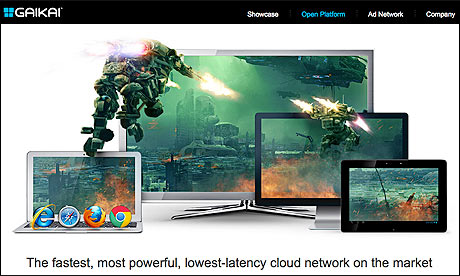
Gaikai brings gaming to the Cloud

Post contributed by Jamison Lanum -

For those unfamiliar with the rise of cloud-gaming, here's the rub -
   Streaming content from the Cloud may not seem like such a big deal anymore. Netflix does it. Hulu does it. However, streaming video games is an entirely different animal to tame. High-end video games typically require a dedicated gaming pc that can run between $800 and $1200 and even higher.  This platform is needed because the data loads and throughput of games can run orders of magnitude greater than simple video, and speed and responsiveness is often critical.

    Companies like Gaikai have installed a massive network infrastructure that allows them to stream (that's right) high-end video games over the internet. Gaikai has this hardware and network in place on their own service, allowing customers to play games on lower-end machines without sacrificing performance.  Now it needs to show off these capabilities to potential users.
   Taking their service to Facebook is a huge step for the company, offering access to hundreds of millions of users around the world, many of whom are already playing simple games on Facebook. While Gaikai is only set up for streaming game demos at this time, full games are on the horizon. Partnering with Facebook seems to be a good marketing strategy, as long as the service delivers the full video gaming experience.

Source -  Gaikai brings its cloud gaming to Facebook, launches beta applicationEngadget

BJB - edited for style

Tuesday, April 17, 2012

No optical drive for nex-gen console?

Post contributed by Jamison Lanum -

  According to Shawn Knight, writer at techspot.com, Microsoft's next video game console may not support the world's most popular physical format:discs.
"Microsoft is reportedly telling partners that the next Xbox, tentatively dubbed the Xbox 720, will not include an optical disc drive. The briefings are said to be released under what one source claims is the strictest NDA they have ever encountered, according to an exclusive article from MCV."
While many have thought this would happen eventually, I don't think this shift was expected so soon. While this is still speculation at this point, I think it's important to take a look at a few issues that could arise if this is in fact true. Not having an optical drive presents many problems for the customer and may even drive some away. 
  • If there isn't an optical drive then games will have to be downloaded over the internet. This will require owners to also have a fast internet service. The only other option is to have a sort of download kiosk that gamers can go to with removable storage to download the games then take them back to their console. This does not sound like a solid alternative.
  • Even though 1TB drives are becoming more affordable, more storage would be needed if Microsoft kept storage local (in the device). The alternative would be to tap into the cloud. Companies Onlive and Gaikai have both proven the cloud can handle storage and also reduce the hardware requirements needed in the physical console. This, once again, would require the customer to have access to high-speed internet. In more rural parts of the country, customers would probably be out of luck. 
  • Backwards Compatibility - One thing gamers demand of consoles is the ability to play their older games on the newer one they just dropped a pretty penny on. With no optical drive, there is no feasible way to make this happen. I'm sure Microsoft and other companies would make older games available for download, but a price tag would certainly be attached. 
  • No Used Games - No physical copy of the game means you can't take it to a second-hand seller like GameStop and trade it in to get another game. No longer will these stores be able to offer customers slightly used games at discounted rates. Microsoft and others could develop a system where each game can exchange hands x-amount of times, but financially it doesn't make sense for them to do so. 
BJB - This is a continuing reflection of the continuing transition to online access for content (see prior post on streaming vs disc for movies).  Although I'll agree that it might be a bit early to drop drives and force users to go that route.
(I reformatted the above slightly).

Source -  Source claims Xbox 720 will ship without optical drive, Techspot

Monday, April 16, 2012

The surprising draw of 'Draw Something'


Post submitted by Reanna Mortensen

  Many smart phone users are utilizing an application called Draw Something. This game, which has the same play at your own pace as Words with Friends, is a mix of Pictionary and a bit of Hangman. It was developed by OMGPop and has 35 million users after only being released for two months.
   The game is played with two players. It can be connected to a social network to find other people you know that play the game. However, random games can be created also. Instead of competing against each other, the two players must work together to draw pictures. At the beginning of each round, one player is given three different words to choose to draw, from easy to hard. They must then doodle whatever word they chose. The other player has to guess the word using the letters they are given. If the word is guessed correctly, then both players are awarded coins based on the difficulty of the word. This cycle continues. The user of the application can have many games going at once. Sometimes easy words such as pizza or phone come up, but there are also harder ones to illustrate such as Adele or Twitter. The correct clues must be given for the other player to be able to guess the word.
    It seems that this app is so popular because it is leisurely. Also, there are no other games like it out there. One must have a phone with a touch screen to be able to draw the pictures with their finger or stylus.


Thursday, April 12, 2012

Nintendo Sets Launch Date for Wii U

Post contributed by Sheena Hunley -


According to an email obtained by WiiUDaily from a Japanese retailer, Nintendo has set a launch
date for the Wii U - the North America launch of the new gaming platform is currently set for November 18, 2012.
  Nintendo releasing the Wii U in November comes as no surprise, as it makes the new system available for the Christmas rush.
  Nintendo's Wii U will be able to produce full HD graphics, but the biggest innovation is its tablet controller with a color LCD touchscreen. Although the idea of the Wii generation being able to support HD graphics is appealing to some,developers who spoke with Games Industry International project it will not have the same level of computing power as its main competitors, the Xbox 360 or the PS3. Overall, the developers said it's a great attempt to modernize Nintendo's Wii, but some doubt the console is capable of “keeping up” with current state-of-the-art in gaming. So, we will have to wait and see if the Wii U will meet its production goals, and how it prices what seems to be an incremental update. And how Microsoft and Sony will react to this  new generation of Nintendo (price cuts anyone?).

Source - Wii U's release date leaked by retailer - rumor  Games Industry International

BJB -  Edited copy, added graphic and link.

Monday, March 26, 2012

Sony adds flexibility to PS3 platform

Basic post contributed by Rachel Cade: -


Photo Editing on PlayStation 3?

You read that right. Sony announced today that it will launch photo editing software for the PlayStation 3 this week.  The software, called “PlayMemories Studio,” is launched in anticipation of the cloud component called “PlayMemories Online” which will be launched in the upcoming months.  The software allows users to manipulate photo stills directly on their gaming console.
   The software will be launched Tuesday in the US at the PlayStation Store and will retail for $18. There is a 30-day free trial available.


----------------------

With internet connectivity, significant processing power and storage capacity, top gaming platforms have the power to engage in a lot of computer activities.  Traditionally, two limitations have limited development in this regard: first, the lack of a recording output option (not included in most platforms to discourage piracy of gaming software; and second, the limitations of game controllers as an interface (instead of mouse and keyboard).  The combination of the photo suite with coming Cloud external storage for the manipulated images addresses the first issue.  Hopefully, some creative options for interface will help with the second.
  Still, this announcement reflects the continued convergence of digital media across platforms and uses.
--Ben Bates

Wednesday, February 8, 2012

Top Tech Predictions: A View from Broadcasting/Gaming

Matt Ployhar's posted his list of Top Technology Predictions for 2012 on the Broadcast Newsroom blog.
  1. Voice and Artificial Intelligence - from cars to smartphones to games to TVs - look for voice-controlled systems to move to more and more digital systems.
  2. Cloud Services - look for more and more content to be stored in, and delivered through, Clouds.
  3. Tablet Mania Wears Off - here I disagree - Ployhar doesn't see tablets as replacements for PC, and thus diffusion will slow.  I agree that they aren't a full PC/laptop replacement, but a supplement - but that's why I see tablet adoption to continue to boom, as a basic tool for surfing, media consumption, and gaming.
  4. Smarter TVs - Ployhar hopes for an integrated TV/PC/Gaming platform with input devices built-in.  I see smarter, in terms of integrating WiFi and Internet connectivity, but Ployhar's forgetting that all-in-one systems lock you into the system, and limit piecemeal replacement as technology advances.  (Also, what about all that legacy hardware/software, and who gets to win the gaming platform battle?)
  5. China lifts it's ban on gaming consoles - who wouldn't want access to the world's largest market?
  6. E3 News - isn't it time for a new generation of consoles and gaming platforms?
  7. Google goes Big in 2012 - look for continued integration of Google's various platforms and services.
  8. Time for that Big Deal in Gaming - Will 2012 see one leader buying out another?
  9. The World's Still Flat - Globalization & Economic Climate remain mostly stable
Looking it over, this list is about half wish (at least in terms of will something seen as mostly inevitable happen in 2012 or after), and half seeing where trends are likely to go.  And a couple that I don't think are realistic from an economic/market perspective, but interesting nonetheless.

Source -  Top Technology Predictions for 2012BroadcastNewsroom.com

Wednesday, August 24, 2011

Is News or Gaming Top App?

Research from analytics firm Localytics, based on data on usage provided by firms using their analytical platform, has found that gaming apps are used the most frequently (counting separate sessions), but that users spend much more time on news apps than most other types of apps. In fact, users spend more than two and a half times as long on news apps than on other apps (on average). Because of this time differential, and the fact that news apps use in terms of number of sessions also places among the top 3, they conclude that news apps are the most "engaging." 
  • In terms of number of sessions per app per month, the top app genres are gaming, news, and music.
  • In terms of the average length of app sessions, top app types are news, music, health and fitness, and reference apps
Focusing on iPad users, Localytics concluded that news apps generate long interactions with apps and users, and that iPad users seemed to prefer playing short, casual games rather than in-depth time-consuming ones. Sports apps, they found, were used mainly to check scores than to delve into sports news and stories.  The report concluded that "these levels of interaction do have an important message to app marketers: Know your audience and pick the right type of app to generate the most engagement possible."

That's good advice for any media content or service provider.

Source - App Popularity: Gaming or News?  Online Media Daily

Monday, July 11, 2011

Apps - "Free" generates more revenue than "Paid" - Updated

Recently, Apple announced that more than 15 billion apps have been downloaded, generating more than $2.5 billion in revenues for app developers.  Until recently, about 60% of the revenues have come from "paid" apps, especially games.  The other 40% came from "free" apps - or at least apps that didn't charge for initial download.  Most of that other 40% was a result of a revenue model termed "freemium" apps - and a quiet validation of Chris Anderson's Free model.  In a "freemium" app, users can download the basic app for free, and the developer gets revenues from a smaller proportion of users who might pay for higher-level access or make in-app purchases.
A new study by Flurry shows that in the last six months, revenue from free-to-play game apps has overtaken the revenues generated by paid game apps.  Last month, the split was 65% of revenues from "free" game apps, and 35% from paid game apps.  Considering that over 90% of free game users don't contribute anything towards revenues, that's pretty impressive.And a reminder that when thinking about the millions of potential users online, it may make more sense to seek to exploit a small segment willing and able to pay for additional value, than to seek revenues from simple access from the general public by putting a price on content or basic subscriptions.

Source: "'Free' Apps Drive More Revenue Than Paid", Online Media Daily

Update: 
Another article suggests there's even more value in games. Analysts at Gartner predict online gaming revenues to rise to more than $28 billion in 2015 (from an estimated $12 billion this year). including a significant increase in revenues from in-game ads and sponsored content.  Total consumer spending on hardware, software, and videogame play is expected to reach $75 billion this year.
Source: "In-Game Advertising On Rise, Consumer Spend to Hit $75B", Online Media Daily

Tuesday, March 8, 2011

3D handheld gaming?

From Andrew Starnes:

Gaming is a very popular among today's youth and even some adults. The next phase in portable gaming technologically is right around the corner. The Nintendo 3DS will hit stores later on this year and if the software of this gaming system lives up to the hype, it will be an incredible device. The main problem, that this article points out, is will the 3D technology work correctly and can Nintendo make games effectively in 3D? I believe that Nintendo can accomplish this task because they have led revolutionary advances in gaming technology before. This 3D will be an incredible advancement for gaming abilities because it will not require gamers to use glasses that other systems currently use. This means it will be more user friendly for people because some people don't like how the glasses feel or their apparel appeal. If this gaming system is perfected, then I will think about getting one of these because the layout, graphics, and design really appeal to me. I know people that are really excited about this release and there is a lot of buzz online.

Source: "Nintendo's 3-D Gadget Faces Software Hurdle." Wall Street Journal-Asia Technology