Showing posts with label job-hunting. Show all posts

Monday, January 20, 2014

We're Number One! - but that's not good

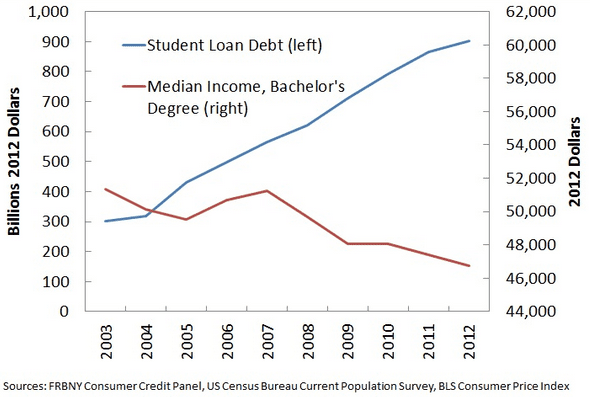
A recent study of the Return on Investment (ROI) of college degrees by Salary.com has some bad news for many college graduates.  With student loans in the U.S. now passing $1 trillion, median incomes falling, and unemployment levels for recent liberal arts graduates running 2-3 times national average, its a good time to re-examine college education as an investment in future earnings.  Of course, there's a lot of other reasons to go to college and to choose a particular career - primarily that you love working in that field - but it's smart to also consider the economics as well.

To calculate the ROI of degrees, they calculated the average cost of liberal arts degrees from public universities ($37,343) and private four-year colleges ($121,930), and then used their data on 30 years of salary data to calculate the median (half above, half below) salary for jobs requiring that degree and compared it to the median salaries for those with only a high school education.  They then looked at how much of the costs would be repaid from the salary gains from having the degree, over 30 years (discounted for inflation, etc.).  Of course, these estimates are projections (educated guesses) and averages (medians), meaning half will do better, but half will do worse.  As the ads say, "your mileage may vary."

The report lists 8 liberal arts majors whose earnings gains typically won't surpass the costs of education, even after 30 years - particularly if you go to a private college or university.  Included are sociology, fine arts, education, religious studies/theology, hospitality/tourism, nutrition, and psychology.

Ranked #1 in the report is Communications.  The post lists three typical job tracks: News Reporter with a median salary of $37,393 (ROI public college 58%, private college 17%); Marketing Coordinator with a median salary of $50,355 (ROI public 79%, private 23%); and Copywriter with median salary of $52,549 (ROI public 82%, private 24%).  Of course, that's all if you work in the field.  Job surveys consistently show only half of media and journalism majors working in the field within several years after graduation.  And job opportunities for editors are plummeting (see previous post).  Opportunities are better, and salaries higher, in fields such as advertising, public relations/marketing, and corporate communications, but not by a lot.

The main point of this is that these are fields you shouldn't go into for the money.  Yes, there are always those that reach the top and grab the big bucks - but most don't.  If you're going to major in communications or any of the other listed fields, do it because it's something you enjoy and are good at.  If so, and you put in the hard work to get ahead, you may just pay off your student loans and the full cost of your education.
[It's interesting to note that many of what are regularly considered the "best" journalism programs in the U.S. are at private universities and/or are graduate programs (Masters-level) that add to the costs of education.  Most of their students aren't likely to come remotely close to recouping those costs - at least not if they stay in the field.]

Source -  8 College Degrees with the Worst Return on Investment,  Salary.com


Tuesday, January 14, 2014

Jobs Trend - Editor Out, Content Marketing In

The publishing industry is among the latest feeling the impact of the digital transformation tsunami.  This has a lot of industry professionals thinking about changing careers.  Max Kalehoff, writing in OnlineSPIN, suggests that the growing demand for people with writing and editing skills in the marketing industry is attracting interest from those in the print publishing world.
These career-changers are coming from all sides of publishing, including editorial, sales, research and circulation, and from all levels of experience, from the C-suite down to college students whose only internships were in publishing. Some of them work at the world’s largest publishers facing restructuring, while others are in relatively stable roles at niche publishers and see an opportunity to redeploy their talents.
The change is also being seen in the job postings on job websites and retrieved through search engines.  The number of postings containing the key words "Publishing" or "Editor" has plummeted to half the level of four years ago. 
On the other hand, postings using "Content Manager" keywords have doubled over the same time period, and currently outnumber postings using either "Publishing" or "Editor".
Use of the "Content Strategist" keyword was negligible four years ago, but today there are more job postings for "Content Strategist" than "Editor."

With more conduits for content, there is an increasing need for those who find creative ways to identify, publicize, and promote new uses for content.  In other words, "content strategists" and "content managers."  Kalehoff suggests there's growing opportunity within the marketing field for people who "command written words and storytelling," and with "skills in syndication and audience building."  As the media world becomes increasingly multiplatform, there will be opportunity for those who can develop and exploit these new channels for content distribution, whether within traditional publishing, or within marketing.

Source -  Publishing Industry's Turbulence Create Surge of Talent for Marketers,  OnlineSPIN

Monday, April 29, 2013

Newspaper Reporter - 2013's Worst Job?

The annual Jobs Ratedreport from Career Cast is out.
The best job - actuary.  The top twenty are notable as all requiring math, engineering, biomedical/health, or advanced degrees.
The worst job - Newspaper Reporter.  And it's the only one in the bottom 10 that expects a college and/or graduate degree.  It's a career with a negative job growth rate (-6%), and where half of full-time reporters earn $36,000/yr or less.
Ever-shrinking newsrooms, dwindling budgets and competition from Internet businesses have created very difficult conditions for newspaper reporters.
Consumers can access online news outlets almost anywhere thanks to technological advancements, which are threatening the existence of traditional print newspapers. As a result, the number of reporter jobs is projected to fall 6% by 2020, according to the U.S. Bureau of Labor Statistics (BLS), while average pay is expected to continue its decline.
And its not only the decline in available jobs and the low pay.  Much of the industry's job losses have been in the bigger papers - severely limiting opportunities for career advancement.  In addition, it's also a high-stress career, with tight deadlines and the need to work in all conditions.
"I covered crime, so when breaking news happened, I had to be there. And when editors called at night with questions, I had to take the calls," says Rochelle Gilken (who traded her job as reporter for a position in media relations for a local utility).
Lest you think that Career Cast's rating is a fluke, Kiplinger listed three news-related jobs among its "Ten Worst Jobs for the Future": Printing Press Operator (10-year job growth -16%); Desktop Publisher (Job growth -15%); Journalism Reporter (Job Growth -7%).  For reporters, they recommend possible alternative careers in public relations (more demand, higher salaries, better hours) or broadcast news analyst (better pay and projected 10-year job growth is +10%).
  The Jobs Rated report does have other media related jobs among the 200 they related.
  • Web Developer comes in at #24.
  • Technical Writer, #60
  • Film/Video Editor, #138
  • Author (fiction or non-fiction). #156
  • Publication Editor, #168
  • Photographer, #172
  • Broadcaster, #184
  • Photojournalist, #188

Slate's Will Oremus puts an interesting spin on the situation:
The only thing I can say in defense of my beleaguered profession is that, for a certain sort of person—a cynical yet stubbornly idealistic person who holds facts dear and simply can’t abide bullshit—all the trade-offs can be worth it, at least until the bills pile up so high that it’s no longer tenable.

Sources -  Newspaper Reporter Beats Out Lumberjack, Soldier as "Worst Job of 2013",  Slate
Jobs Rated 2013: Raaking 200 Jobs From Best to Worst, Career Cast
10 of the Worst Jobs for the Future, Kiplinger

Tuesday, June 26, 2012

Advice from young journalists

I've been a fan of Susannah Breslin's Pink Slipped blog on ForbesWomen, which often features stories and advice on how to survive in the modern journalism job market.  About a year ago, she offered young female journalists an opportunity to be paid for contributing a blog post/article.  Last week, she reached out to the six finalists to find out what they've learned in the year since, and what advice they might have for other young would-be journalists beginning their careers.  Here's the quips Breslin pulled out, but the whole set of replies and post are worth a read.
  • "There is no zenith" - as you reach your goals, keep setting newer and higher ones.
  • "Change as you go" - be willing to adapt to take advantage of opportunities.
  • "Have your bags packed" - take measured risks, and be ready to move (there's generally more and better opportunities available elsewhere)
  • "Be the Jack Kerouac of the digital age" - "forget the path you have been sold and make your own"
  • "Everyone has their own parents' basement to move out of" - get out of whatever rut you're in.
  • "I must always demand what I want in order to get where I want" - (from a young Muslim woman in the Middle East) - don't wait for opportunities to present themselves; make your own opportunities and learn how to sell your ideas.
Source -  Six Young Female Journalists, One Year Later, Forbes

Wednesday, April 11, 2012

Tips for Media/Journalism resumes

I ran across an interesting post on IT resumes that had some interesting ideas that would also be applicable to those entering the media/journalism job markets.
  The basic piece of advice I give is to remember that a resume is a promo/teaser for you, and your ability to do the job you're applying for.  About the worst think you can do is to flood the job market with a standard bland resume - you need to emphasize the skills and experience you have that the prospective employer is looking for.  Almost as bad is to try to make yours look flashy in order to stand out, but with that same generic bland overview.
  If you're looking for a job where you'd be producing content (news, photos, videos, websites), have examples of your best work available - but don't clog their physical mailbox with it.  Create an online portfolio someplace, and add hyperlinks or even screen captures to the resume.  Also consider sending the resume via email attachment, if that's an option, where the embedded links take them to your portfolio.
  Think about using social media as a place to emphasize your skills - LinkedIn has some powerful resume templates, and is considered to be the more professional of social media sites.  Facebook's timeline feature may be helpful as well.  (Although you might want to make sure your account is employer-friendly).  A lot of companies are using Twitter and other social networks for recruiting (89% in 2011), and media and news organizations are added Twitter and social networking skills to their wish lists. If you don't have accounts, consider getting some started.
  On Twitter, there's some interest in "twesumes", reducing the resume to 140 characters or less.  Even if you don't use it, the exercise in paring a resume to 140 characters is a good exercise in focusing on what you can offer a specific prospective employer.
  If the job wants someone with web or graphics skills, consider using those skills in creating a resume - by creating a resume in the form of an infographic, a profession-oriented personal website (not the pics from Spring Vacation) that can also serve as a portfolio, an online slide show, video resume (with examples of your work).  Think innovatively, on how you can illustrate your skills in cutting edge applications, such as coming up with an Instagram resume (doesn't just list your abilities, but illustrates how well you can apply them).
  Personnel directors stress knowing about a firm's background and tailoring your resume accordingly.  "The first thing is to really understand your audience," advises one, "even if you do not know the exact person it's going to, it's helpful to understand the company."  The people hiring "like candidates [to] cite examples of their work, either through hyperlinks or screenshots ... If you've built or created a site or application, a company will want to see your work. Sometimes that's just as important as the resume itself."
  However, there's a fine line between standing out and looking silly - so make sure that what you present looks good and provides the information needed.  While the focus for many media/news entry level jobs is on skills, remember that you're also promoting yourself, and your ability to learn and grow beyond that first job.  If you have a professional history (even if it's as a volunteer or intern), provide it.  When appropriate, use it to show professional growth.  Make the application personal, by customizing the resume to the job, if possible, and if not, by using the cover letter to stress how your background fits their needs.
  Humor's fine, if you have the skills and experience to back it up (and that the details of those skills and experience also comes through). Aesthetics are also important; a post on Mashable notes that "resumes that visually feel like they will take a long time to read usually get put aside."  This is particularly true when a lot of that content is not relevant to the job at hand.
   Now just throwing a graphic on a resume or using humor to grab attention and stand out won't necessarily set your resume apart in a good way. "There has to be some thought behind the message you want to send. When incorporating design elements, remember to keep on task and consider the reader’s first impression."
  In sum, tailor your application (cover letter and resume) to the job and organization, and where appropriate, let the resume and online portfolio demonstrate your skills and abilities - particularly those they are looking for.
  And make sure to proof things before sending them out.  Errors can be deadly in this context.

Sources - 9 Tips: Make Your IT Resume Stand OutInformation Week
9 Dynamic Digital Resumes That Stand Out From the Crowd, Mashable.com