
Showing posts with label PR. Show all posts
Showing posts with label PR. Show all posts
Wednesday, January 28, 2015

Tuesday, April 1, 2014

Monday, January 20, 2014
We're Number One! - but that's not good
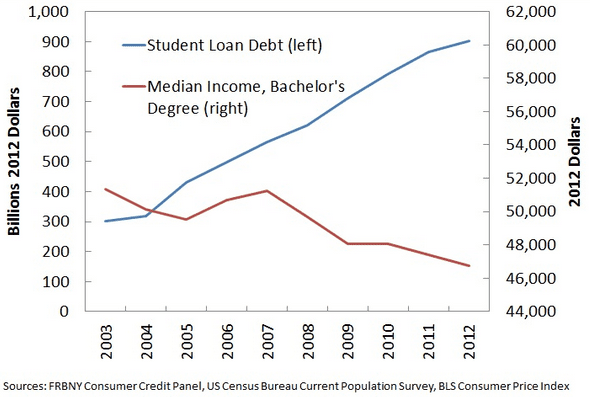 A recent study of the Return on Investment (ROI) of college degrees by Salary.com has some bad news for many college graduates. With student loans in the U.S. now passing $1 trillion, median incomes falling, and unemployment levels for recent liberal arts graduates running 2-3 times national average, its a good time to re-examine college education as an investment in future earnings. Of course, there's a lot of other reasons to go to college and to choose a particular career - primarily that you love working in that field - but it's smart to also consider the economics as well.
To calculate the ROI of degrees, they calculated the average cost of liberal arts degrees from public universities ($37,343) and private four-year colleges ($121,930), and then used their data on 30 years of salary data to calculate the median (half above, half below) salary for jobs requiring that degree and compared it to the median salaries for those with only a high school education. They then looked at how much of the costs would be repaid from the salary gains from having the degree, over 30 years (discounted for inflation, etc.). Of course, these estimates are projections (educated guesses) and averages (medians), meaning half will do better, but half will do worse. As the ads say, "your mileage may vary."
The report lists 8 liberal arts majors whose earnings gains typically won't surpass the costs of education, even after 30 years - particularly if you go to a private college or university. Included are sociology, fine arts, education, religious studies/theology, hospitality/tourism, nutrition, and psychology.
Ranked #1 in the report is Communications. The post lists three typical job tracks: News Reporter with a median salary of $37,393 (ROI public college 58%, private college 17%); Marketing Coordinator with a median salary of $50,355 (ROI public 79%, private 23%); and Copywriter with median salary of $52,549 (ROI public 82%, private 24%). Of course, that's all if you work in the field. Job surveys consistently show only half of media and journalism majors working in the field within several years after graduation. And job opportunities for editors are plummeting (see previous post). Opportunities are better, and salaries higher, in fields such as advertising, public relations/marketing, and corporate communications, but not by a lot.
The main point of this is that these are fields you shouldn't go into for the money. Yes, there are always those that reach the top and grab the big bucks - but most don't. If you're going to major in communications or any of the other listed fields, do it because it's something you enjoy and are good at. If so, and you put in the hard work to get ahead, you may just pay off your student loans and the full cost of your education.
[It's interesting to note that many of what are regularly considered the "best" journalism programs in the U.S. are at private universities and/or are graduate programs (Masters-level) that add to the costs of education. Most of their students aren't likely to come remotely close to recouping those costs - at least not if they stay in the field.]
Source - 8 College Degrees with the Worst Return on Investment, Salary.com
Monday, June 3, 2013
Journalism or Press Release?
Thanks to the Sunlight Foundation, press critics have a new tool to find out. They've developed, and released, a new tool called Churnalism, where press reports are compared to an archive of U.S. government, corporate, and other promotional content. It's based on a similar project in the U.K.
"The tool is, essentially, an open-source plagiarism detection engine," web developer Kaitlin Devine explained to me. It will scan any text (a news article, e.g.) and compare it with a corpus of press releases and Wikipedia entries. If it finds similar language, you'll get a notification of a detected "churn" and you'll be able to take a look at the two sources side by side.Not everything the tool detects will be a problem - quotes, for example, are likely to be identified by the tool. In fact, Devine noted that science news scores poorly in Churnalism checks because technical and scientific language is often "so specific that it becomes very hard to reinterpret."
In the current environment of "journolists" and the repeated repetition of talking points, this is not likely to help the image that journalists like to portray of their field - of independence and skepticism. But it will confirm for many, I suspect, how limited and poor original reporting is among news organizations.
Source - Is It Journalism, or Just a Repackaged Press Release? Here's a Tool to Help You Find Out, The Atlantic
Subscribe to:
Posts (Atom)