A post on the NAB's TechCheck blog tries to make the argument that what has been a slow adoption of HD-Radio (formerly known as Digital Radio) is poised to take off, largely as a result of its inclusion in car radios. The industry sees greater inclusion of HD-Radio recievers within the growing options of what the auto industry is now calling the "center console" (previously, car radio). iBiquity digital, the trade group behind HD-Radio, states that some 28 auto makes now offer HD Radio (9 only as an option, 13 as an option on some vehicles and standard equipment on others, and 6 hi-end brands include it on all vehicles sold in the U.S.). The auto industry estimates that HD Radios will be installed on about 20% of the cars shipped this year. In addition, a J.D. Power survey touts HD Radio as the most likely "emerging" technology that consumers will add when purchasing a new vehicle.
There's a bit of hype in the post - 20% penetration in new models is not a huge number, particularly when looking at the entire number of autos consumers use. In addition, most new models are replacements for older ones, with the result that the actual user base growth is likely to be significantly slower that what's suggested. Then, consider that many of the new "center consoles" are likely to contact connections for digital music players and/or the Internet and you start to realize that you're adding direct competition (and for many consumers preferred substitutes) and its likely that the actual growth of HD Radio audiences from car installs is likely to be slower than the post and its accompanying graphic (see above) suggest. (Another problem with the graphic is that it shows the number of "vehicle lines" and brands, not the number of vehicles sold, or audience for HD Radio).
The post is right that it's a good sign that manufacturers are offering HD Radio in vehicles - you need the tech out there for people to sample and decide what value they place on HD Radio services, and whether it will have a role in their listening repertoire. But in an increasingly competitive media environment, will their be enough additional value to HD Radio, compared to alternatives, to attract the audiences necessary to supplant FM or Satellite Radio, or challenge other digital music delivery systems for the dominant listening alternative? A few years ago, many of the same arguments about availability in autos was made for Satellite Radio (Sirius/XM), and diffusion and adoption of that outlet has stalled. I'm not ready to declare that HD Radio has hit critical mass yet.
Source - HD Radio Automotive Penetration Grows, Radio TechCheck
This blog is affiliated with a course at the School of Journalism & Electronic Media at the University of Tennessee, Knoxville. I'll try to use it to share relevant news and information with the class, and anyone else who's interested.
Showing posts with label critical mass. Show all posts
Wednesday, July 18, 2012
Tuesday, June 28, 2011
E-Reader ownership doubled since Christmas
There are very few innovations where the point that critical mass was achieved can be pinpointed as clearly as it can for eBooks. Critical mass refers to the point where there are sufficient devices to encourage production of content, and their is sufficient content available to encourage acquiring the eReader devices to access the content. For eBooks, last fall saw a significant expansion in the range and variety of eReaders available, along with the reduction in costs and prices to open up demand. Sales of eReaders boomed during the Christmas season, and has continued to grow. One report had global eReader sales in the last quarter of 2010 topping 5 million, almost double that of the previous quarter. A new report from the Pew Internet & American Life Project found ownership of eReaders in the U.S. grew from 6% in November 2010, to 12% in May 2011. Between the growth in eReader availability and Amazon's leadership in offering free eReader apps for a range of computers, smartphones, and tablets, critical mass in display devices was clearly reached at some point during last Fall's Christmas season.
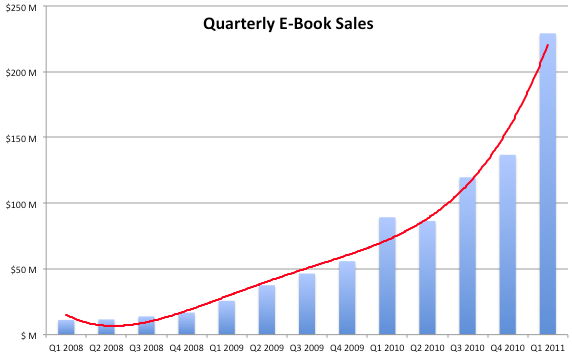
Critical mass for content was also likely reached around the last quarter of 2010, with Amazon doubling the number of eBook titles offered (with over 800,000 titles available in December, 2010, and the entry of other large eBook stores (Apple's iBook (selling 100 million books in its first year), and Barnes & Noble). The final indicator of critical mass is the explosion in eBook sales. As of last February, eBook sales in the US had tripled from the previous year, becoming the number one format among those recognized by the Association of American Publishers. The value of eBook sales in the US was being forecast to grow from around $300 million in 2009 to $2.7 billion in 2013. eBook sales are on a pace to surpass $1 billion this year.
Updated: To fix formatting issue with second graphic
Sources: "e-Reader ownership doubles in six months." Pew Internet & American Life report.
Also check out the eBooks tag in this blog's Labels cloud.
Subscribe to:
Posts (Atom)