Showing posts with label Internet. Show all posts

Tuesday, February 24, 2015

Is FCC violating process again with Net Neutrality action? Or just being Shortsighted and Stupid?

The first two FCC attempts to impose some "network neutrality" rules were vacated by the Federal Courts because the rulemaking was based, in large part, on imputed authority that the FCC did not statutorily have (see earlier post here), further supported by evidence that the FCC had violated its own procedures for rulemaking.  At the time of the second Court decision, many policy folks (myself included), commented that if the FCC wanted to move forward with Net governance and regulation, the best approach was to base a claim for regulatory authority under Title II of the Communication Act - which does cover telecommunication networks.
With the FCC deciding that it will issue a rulemaking addressing Network Neutrality this Thursday, without publicly releasing the actual rules being considered, the FCC would again be clearly violating the spirit, if not the letter of its own (statutory) rules on due process.
The FCC, when considering new rules and regulations, is supposed to undertake a multistage process that starts with a public Notice of Inquiry, a period to allow public (and industry comment), then a Notice of Proposed Rulemaking that outlines the proposals, followed by more opportunity for public comment.  Normally, if the FCC wants to consider substantive changes to proposed rules and regulations, it posts a Further Notice outlining the changes, and offers an additional period for public comment.
Tom Wheeler, the current head of the FCC, argues that the FCC has already gone through several NOIs, NPMs, and public comment periods.  However, the proposed regulatory framework for those appears to be totally different from what is to be acted on this week.  While the FCC doesn't have to refile Further Notices for every little change in the rules, because the proposals that had been discussed are substantially different from those to be voted on, this case clearly violates the both the spirit of the rulemaking process in that it hasn't allowed any time for public review and comment on what seems to be a wholly different set of rules and arguments than what had been previously proposed and discussed.  In addition to tossing claims of being "transparent" onto the growing dustheap of broken promises of transparency by this administration.  (In fact, as a Senator in 2007, Obama called the FCC's attempt to pass rules without full public disclosure and opportunity for public comment "irresponsible.")  Furthermore, the FCC is supposed to be an independent regulatory authority, not one that would toss aside several years of proposed rulemaking and public discussion to (allegedly) adopt - in full and without review, discussion, or amendment - a plan written by political operatives in the White House.

Regardless of the ethics of the current Chairman's behavior, and the potential authority Title II provides for regulating telecommunication networks, bringing the Internet under Title II is not necessarily reasonable or appropriate - in large part because of the statutory language in the 1934 Communication Act and the 1996 Telecommunication Act.
The 1934 Communication Act gave the FCC regulatory authority in two areas: Title I dealt with radio transmissions (including broadcasting), and Title II dealt with, basically, telephone networks.  More specifically, it was designed to deal with the existing local monopoly wired, switched, telephone system.  (The FCC was granted oversight of cable systems - redefined as multichannel video delivery services - by the 1984 Cable Act).
With the rise of the first use of wired telecommunications for computer communications in the late 1950s and 1960s, the FCC examined the question of whether computer networks should be regulated under Title II.  They reached a conclusion that it would not fall under Title II for several reasons: the computer network (later expanded to information) services typically did not own and run the actual wired networks they employed, but rather leased lines from telephone companies (the separation of service from network is explicit in FCC definitions of those terms.
There is a hard and fast statutory line separating the information services that utilize telecomm networks, and the telecomm-based distribution networks that deliver those services.  The current language would seem to explicitly exclude Information Services from falling under Title II. Also, on the technological side, the developing computer networks and information services used quite different technologies than telephony, and so the part of Title II that deals with technical standards would be largely irrelevant (if not applied) and inappropriate (if applied).  But most importantly, the FCC felt that trying to set standards and apply Title II regulation to computer networks and information services would restrict developments and innovations by imposing a governance structure that favored certain uses over others.

The main philosophy of Title II's network regulatory approach is that networks should act as common carriers (a regulatory philosophy borrowed from railroads and freight services). The essence of common carrier status is that the network should not discriminate among its users - that they shouldn't give favored treatment to one user over another. 

 One of the widespread fallacies in Network Neutrality discussions is that common carriers can't treat users differentially (thus everyone should have the same rate for internet connectivity). Actually, there's a long history of permissible differential treatment, as well as a long history pointing out the social benefits that can be acheived through appropriate cross-subsidies. Telecomms can treat users in different localities differently, and more critically, can differentiate on the basis of level of service. All they need to do is show that the costs of providing a particular type of network connection are different (a content-neutral rationale). The FCC has even allowed differential treatment for certain general classes of services (911, toll-free numbers, added-charge numbers). Furthermore, the 1996 Telecommunications Act removed many aspects of telecomm regulation from FCC oversight.
 In addressing the Title II approach, policymakers and pundits need to recognize that i) Title II is largely limited to telecommunication network operators, and the existing statutory language is not readily, or easily, extendable to Information Services and most ISP operations; ii) many of the aspects of the 1934 Act that regulators want to rely on for the new Internet rules have been superseded by the 1996 Act; and some issues are addressed by other laws and statutes (for example, copyright and privacy laws that expressly address ISPs, Information Services, and digital network operators). Many of the areas and concerns that Network Neutrality proponents are primarily concerned with may not be covered by a simple extension of Title II regulatory authority to the Internet.

While Title II can be a better foundation for asserting regulatory authority, just claiming that "We've changed our minds, information services and ISPs fall under Title II" is not likely to pass judicial review - because what they do doesn't fit the existing statutory language. Doing a sweeping assertion of authority is what got the FCC in trouble in previous attempts, and going the Title II route without serious review - if the action isn't quickly overturned - is going to create a virtual minefield of implementation problems and legal challenges - with the FCC and the Courts having to then decide which of the 100+ pages of telephone regulations should apply to the Internet, its backbone network providers (who already effectively act as common carriers anyway), ISPs (many of which are a mix of network operators and information services), and the Information Services that provide the content and services to users.  Should Universal Service apply to ISPs? Should ISPs be subject to the specific taxes applied to telephony (including one designed to help retire the Spanish-American War debt - which was paid off about 100 years ago - but still shows up on your telephone bill). Should the FCC's authority over pricing in the Internet apply only to interstate and international connections (the only price authority the FCC has over telephone rates under Title II in the 1934 Act, and which was sunseted out in the 1996  Act - leaving the FCC without statutory authority to regulate telecomm (ISP) rates and services)?

In other words - going the Title II route really needs extensive discussion of the proposed rules and policies to work out the problems and kinks that would be associated with that approach.  But the current FCC Chair and Democratic Commissioners seems determined to take the easy and quick approach of simple proclamation and promulgation of a massive set of new regulations, rather than doing the smart thing of working out the details and gaining some consensus from the various stakeholders that would be impacted by the new rules.  Or even considering if there is really any need for a massive overhaul and imposition of governmental (possibly politicized) oversight and control of a significant, and efficient major sector of the economy, and an increasingly vital source of information by both private and public sectors.

As I said with the last two FCC attempts at grabbing Internet oversight - this is too important, and too critical, to take short cuts.  If the FCC is going to do this, they need to do it the right way - with true transparency and plenty of opportunity for the public to point out the problems and pitfalls that always comes with trying to set uniform rules for very complex systems.  And first asking the most important question - do we really need to impose any kind of regulatory structure on the an efficient, innovative, and highly flexible Internet and Information Services sectors?

Monday, March 24, 2014

Web@25 - Graphics version

From Web Turns 25: 10 Graphics to See,  Information Week -


 Visualization of Website traffic
 Social networking through Facebook
 Web Health around the world
(Access, openness, content, empowerment)

Tuesday, March 11, 2014

Pew's Web@25 Studies

The Pew Research Center has released a series of reports on the history, status, and future of the Internet, in conjunction with the 25th Anniversary of the World Wide Web.

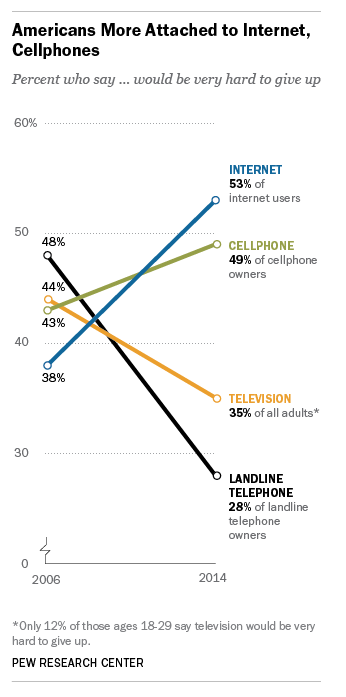
The Web at 25 in the U.S. looked at a range of surveys looking at how the Internet is used by people, and their views of the Internet and the content and services it offers.  Over the 25 years of the Web, internet usage among U.S. adults has grown from 14% to 87%.  90% of those surveyed earlier this year indicated that the Internet has been beneficial for them, while 76% indicated that they thought the Internet had been good for society.  In fact, the Internet is the technology that people are least willing to give up.  In fact, a range of digital and mobile technologies have become an integral, and crucial, part of people's lives.

And while press coverage and political discussions often focus on the more negative aspects of the Web, most users (76%) report that they've been treated well (kind or generous) in their online interactions, two-thirds (67%) felt that online communication has strengthened their relationships with friends and family, more than half (56%) indicate they've witnessed online groups coming together to help people or to solve a community problem.  In contrast, only 25% report ever been treated badly or have ever abandoned a site or service because it's gotten ugly (users attacked or discussions becoming virulent).

Digital Life in 2025 summarizes the predictions of a group of key experts.  Most agreed on the key technological trends - that the Internet will become even more ubiquitous, integrated, and immersive; that the Web will increasingly integrate tags, sensors, apps, and intelligent agents to facilitate people's ability to use online content and services.  They also widely agreed that the digital network economy will disrupt 20th century business models.  This can be beneficial, creating the potential for fostering awareness and understanding, building relationships, and promoting collaboration and social group action.  On the other hand, the same potential can provide opportunities for abuse.  But the biggest threat is the possibility that nations (or other organizations) could co-opt the network, restricting and limiting the Web's potential through imposed regulations and structured access - turning the Internet into an instrument of political and social control rather than an open marketplace.

The choices we make today - our willingness to trade freedom for security, diversity for the safety of conformity, and privacy for convenience - will go a long way to determining what kind of internet we'll have in the future, and whether it remains a social good, or a mechanism for control.

Sources -  What the Internet of 2025 Might Look Like,  WSJ.com
The Web at 25 in the U.S.,  PewResearch Internet Project report
Digital Life in 2025,  Pew Research Internet Project report

Tuesday, January 14, 2014

FCC's Net Neutrality Rules Vacated - Are They Needed?

A Federal appeals court has vacated the FCC's most recent attempt to impose "Net Neutrality" rules, ruling that the FCC overstepped its formal authority in creating the rules in the first case.  While some public interest groups expressed shock and outrage, the ruling was hardly unexpected.  After all, the Federal courts had made essentially the same ruling on the FCC's first set of "Net Neutrality" rules, which the FCC promptly ignored in pushing forth the second set, using essentially the same argument despite some language changes.

So what does this mean?  Well, the special interest group "FreePress" says this could be the end of the Internet as we know it.  But what the end of the current "Net Neutrality" rules (which were largely stayed and unenforced during court proceedings) means is that we're back to the Internet as we know it - the goal of the rules was to change how the Internet worked, after all.  But "FreePress" is right in its call for the FCC to do it right the next time - to actually work within its existing authority, or to seek additional authority from Congress if needed, rather than creating a regulatory framework by administrative fiat (sadly a widespread habit within this administration).

As I've posted before (here and here), I've been skeptical of the need for the currently expressed vision of "Network Neutrality" as preventing ISPs, operators, etc. from discriminating against content (thus sticking it to the "evil" and "greedy" cable and telecomm operators).  Under the historic common carrier regulatory framework for telecommunications, operators could not refuse to offer services or discriminate among users on a content basis.  But the FCC had identified ISPs as information services, which were not subject to common carrier regulation.  While common carrier status was, strictly speaking, a basis of telephone FCC regulation and not computer communications (or information services), I think the common carrier argument is easily extensible since the two networks are essentially converged today.  Redefining ISPs as telecomm common carriers may well take some time and a fair bit of legal wrangling - but would provide the regulatory authority that the FCC needs to prevent unfair discrimination in service.

That may not be enough for some Net Neutrality proponents, who would like to also prevent operators from offering additional services (guaranteed speeds, etc.) at different prices.  That's more problematic in my mind, limiting exploration and diffusion of new services and content - not to mention making it impossible to cross-subsidize services and enable additional infrastructure investment, things that have helped users.

And you also have to worry about the end game of absolute equality - which inevitably can be achieved only at the lowest common denominator.  Do we want a rule that insists that all ISPs and telco operators can only offer one level of service at low prices - at whatever speeds are universally available in the national grid?

So FCC, if you're going to push for Internet regulatory authority and actually try to regulate normal operations, please try to do so correctly.  With proper authority, and with due consideration of that the actual impact of your regulations will be (rather than the political goals you hope to achieve).

Sources -  Verdict: Net Neutrality is Dead... for now,  FreePress.net
Federal appeals court strikes down net neutrality rules, Washington Post

Thursday, December 5, 2013

Infographic: Internet Usage facts

From Staff.com, 7 Shocking Stats Trends in the Internet.

For me, they're not so shocking (and have been reported here before), but still it's a nice graphic.

And the last one about Hollywood is my favourite.

Tuesday, December 3, 2013

Milestone: China dominates Internet use

According to the latest official numbers from the China Internet Information Center, more than 590 million people in China use the Net (more than twice the number of US Internet users).  While the number of users is huge (more than the populations of almost every other country), penetration is still modest, with about 44.1% of Chinese adults having Internet access.  Interestingly, almost 80% access the Internet from their mobile phones - a factor that's also fostering rapid gains in penetration.

Source -  China has more internet users than any other country,  Pew Research Centers FactTank

Wednesday, October 2, 2013

US Govt closes "free" online sites

The Obama administration orchestrated a shutdown of existing Federal websites and social media accounts on Tuesday, except those in support of the Affordable Care Act (Obamacare).  And many of those were incomplete, riddled with errors, or crashed (allegedly because of unexpectedly high demand).  Oh yes, and President Obama's Twitter account, which proclaimed "Despite the effort of extremists in the House of Representatives, @Obamacare is not shut down."  (to be fair, the President's Twitter account is actually run by his political action committee, which isn't supposed to be federally funded).


While I understand that the people running the sites and creating accounts may be considered "non-essential" personnel - and thus no new content could be added - that doesn't explain why people wouldn't be allowed to access existing or archived materials on sites.  Apparently the servers hosting the sites were considered essential, as people easily reached pages blaming lack of further access on the government shutdown.  So it would seem that the administration went out of the way to deny access to Federal online sites and services for political purposes.

Oh, and somebody should tell the PR folks handling the spin that Twitter and Facebook are free.  As in no cost to open, use and maintain.  At least the CDC had the sense to say that the shutdown might limit updating or responses, while keeping their accounts active.  Most others just pulled the plug to deny public access to "the most transparent administration in history."

Source -  Facebook and Twitter Federal Accounts Go Silent; Web Sites Shut Down,  Online Media Daily

Tablets to top PCs by 2015

A new report from IDC (International Data Corp.) says that the  number of tablets shipped globally will pass the number of PCs shipped in the final quarter of this year.  In 2013, they call for tablet sales to gain 27%, while PC sales fall 10%.  IDC research analyst Megha Saini indicated that the emergence of lower-priced devices and trade-in programs will be a major game changer in the connected devices marketplace.  The report also indicated that the smartphone market rebounded in 2013 after a slowdown in growth rates last year, and that new larger smartphones, or 'phablets', is likely to eat into small tablet sales over the next couple of years, slowing the rate of growth in that sub-market.

Source -  IDC: Tablet Shipments Will Top Total PC Shipments Annually By 2015,  MSPMentor


Tuesday, October 1, 2013

China tackles news apps

Regulators in China's State Internet Information Office have issued a new ruling designed to shut down mobile news apps that don't get their content pre-approved by government regulators.  The move is part of China's campaign to curb "online rumours" and unfettered social media.  In September, China's top court and prosecutor ruled that people will be charged with defamation if online rumors they create are visited by more than 5000 users, or reposted more than 500 times, and subject to prison terms of three years.  Of course, no precise definition of rumor was provided, nor was there any limitation of state agents boosting views or reposts.  The announcement calls for authorities to close down all mobile apps that refuse to "rectify" their gatekeeping in order to "maintain order of news dissemination on the mobile internet."

The apps under challenge include Zaker and Chouti, both of which re-publish content from non-official sources - including from Western media like the New York Times (whose articles have been blocked in China).  According to news accounts outside China, press freedom lawyers and activists called the latest move a significant (but crude) expansion of state power to regulate Internet content in line with its oversight of traditional media.  As such, it's likely to be seen as a significant blow to those relying on microblogs and social media for unfiltered news and information.

Source -  China threatens closure of mobile news apps amid Internet crackdown, Yahoo! News Canada

Tuesday, September 17, 2013

New from Pew - 63% of cell phone owners use them to access net

The Pew Internet & American Life Project has just released results from a survey of cell phone owners.  They show that 60% of cell phone owners access the internet through their phones, and 52% use their phones for email.  Taken together, almost two thirds (63%) do one or another, and are classified by Pew as "cell internet users."  Within the 56% of U.S. adults with smart phones, usage rates hit 93%.


In terms of demographics, age and usage are negatively related, with younger age groups being more likely to be "cell internet users."  Having at least some college education is also related to use of cell phones for internet access, and income is also positively related to cell internet usage.  Cell phone users living in rural areas were less likely to use their phones for internet access - while the survey didn't specify, at least some of this may be related to the lower cell data speeds in many rural areas.
  There was, in addition, a small gender effect with men reporting higher usage (65%) than women (60%).

This survey also found meaningful differences between race/ethnic groups - with Blacks reporting the highest rate of adoption (74%), followed by Hispanics (68%), with Whites trailing at 59%.  This pattern has been found fairly consistently in mobile device usage studies in the U.S., and is often attributed to the argument that the mobile devices often serve as the only (or the least expensive) Internet connection point available.  (That is, more limited use of laptops and desktops connecting to wired Internet services in the home.)

While a third of cell internet users reported going online mostly through their phones, more than half (53%) have indicated that the phone was a secondary contact point, with another device serving as their primary online connection.  And remember that more than a third of cell phone owners (37%) reported that they do not access the internet through their cell phones.
  Taking a closer look at those who use their cell phones as their primary internet access point, we find some interesting demographic differences.  First, there was no gender difference, and location differences (urban vs. suburban vs rural) were minimal.  There were age differences, along the same lines of general usage (i.e. higher use among younger age groups).

It gets more interesting when you look at race/ethnicity, income, and education.  Along the lines of the argument that mobile devices may be the most viable internet access point for poor and minority users, White cell internet users had the lowest likelihood of reported their phones as their primary internet access point (27%).  Interestingly, though, the level of cells as primary device was among Hispanics (at 60%), rather than Blacks (at 43%). 
  The relationship between usage of cell phones as primary internet connections with both education and income were negative, with lower income groups and those with no college being the most likely to report their cell phones as their primary internet connection.  This would seem consistent with the idea that mobile devices can be a cheaper and more convenient way of accessing the net for the less advantaged.

Sources -  Cell Internet Use 2013, Pew Research Center
Cell Internet Use 2013, full research report from Pew Research Center

Tuesday, August 13, 2013

Online News Use continues Rise

Two recent studies, one in the U.S. and one in the U.K., are indicating that at least half of adults go online for news.  The two differ in methodology and in how use is measured, so I'll discuss them separately.

The U.K. study comes from the Office for National Statistics, and looks at Internet Access by individuals, and within households.  The survey found that Internet access in Great Britain continues to grow and diffuse: 73% of adults report using the Internet daily, 53% now access the Internet from mobile phones.  83% of households report having Internet access, and 42% had land-based broadband Internet connections.
  More than half of adults (55%) reported "reading or downloading online news, newspapers or magazines" on a daily basis, more than doubling the rate reported in 2007 (20%).  That change in usage was the biggest of the services reported. 
"In 2013, with reports of decreased physical newspaper readership, there has been media interest in how people will access the news in the future," said the ONS.
The survey also found that more than half (52%) of those UK adults have purchased reading materials online had done so through digital forms such as eBooks.  A substantial number also reported buying eBooks for the readers in their family.
  Usage among young adults (16-24) was greatest for leisure or recreational activities: 93% engaged in online social networking daily, 60% accessed wikis, 55% downloaded software, and 40% made phone or video calls over the Internet.  People in the 25-34 age group, on the other hand, had the highest use of regular activities like sending emails (89%), getting information on goods and services (i.e. shopping) (77%), and engaging in online banking (76%).  The highest growth in reported Internet usage was among older users, where daily use for seniors (65+)grew from 10% in 2006 to 38% in 2013 and reported daily use among those 55-64 grew from 37% in 2006 to 68% in 2013.

The U.S. numbers come from the Pew State of the News Media 2013 report.  In a survey conducted in 2012, Pew asked U.S. adults where they had gotten news "yesterday."  Respondents were allowed to cite multiple sources.  Half (50%) of respondents reported getting news from digital sources.  The only form used more was "TV" at 55%, but that number combined local and national broadcast news with cable news.
Pew does provide some further breakdowns - in 2012, 39% of respondents reported getting news online from mobile devices "yesterday."  That would still be the second highest platform usage, but when combined with other online access portals the use jumps to 50%.  About one in five respondents (19%) reported getting news from social media, while 16% reported getting news from email feeds and 8% said they'd listened to a news podcast.  There is an age break in online news usage - only 43% of those 50-64 reported getting news from online sources "yesterday", compared with 60% daily usage from those under 50.
  The other point that the Pew report makes is that online news use is the only format that has not been consistently trending downward over the last 20 years.  "TV" daily use has dropped from a high of 71% in 1994 to 55% in 2012.  Newspaper usage has dropped from a high of 57% in 1991 to 29% in 2012.  And radio as a daily news source has dropped from 54% in 1991 to 33% in 2012.  Yes, that's right - more American adults report getting their news from radio than report getting news from newspapers.

Not so good news for legacy formats, but still somewhat optimistic about news usage overall.

Sources -  More than half of Britons access news online, The Guardian
Statistical Bulletin: Internet Access - Households and Individuals, 2013, ONS.gov.uk
Digital: As Mobile Grows Rapidly, the Pressures on News Intensify, Pew Research Center
The full Pew report on The State of the News Media 2013 is available here.

Sunday, June 9, 2013

Panopticon - American Style

The myriad (and growing) surveillance leaks of the past few weeks put me in mind of Foucault's thoughts on panoptic surveillance.

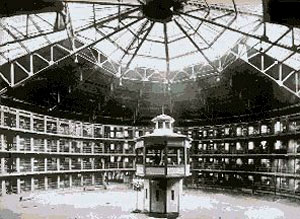
  The idea of the Panopticon traces back to the work of Jeremy Bentham in the 18th century.  Bentham coined the term to describe a design for prisons where every inch of every cell was under constant surveillance by prison authorities; yet prisoners would not know when, or if, they were actually being watched.  Bentham held that unverifiable surveillance was an efficient and economic exercise in state power, while providing the state with a viable mechanism for discipline and control.

French philosopher Michel Foucault used the idea as a metaphor for the modern state's mechanism for control and punishment.  Under Benthan's unverifiable surveillance, individuals are never sure whether or not they are being watched, or by whom.  As a result, Foucault argues that individuals are "trained" to resist any impulse of misbehavior or "abnormality" for fear of being caught, uncertain whether such a display is safe or not.  Also, as more and more information is gathered on individuals and their behaviors, Foucault argued, people become "objects of knowledge" to state authorities - whose actions can be tracked, examined, catalogued, examined, compiled, and acted on - if that is in the interest of the state.  Foucault argues that this gives hegemonic authorities great power - to identify, track, and punish those whose behaviors lie outside the state's idea of "normal" - and allowing the state to "humanely rehabilitate" those of their citizens who stray from the path of enlightenment (or at least what the hegemonic authorities think is appropriate).

I had originally put Foucault's social theories among those critical theorists who had interesting ideas and insights, but whose insistence on the prevalence of a powerful hegemonic state authority seemed unrealistic.  Then came the leaks and the leaks about the state's response to leaks.

First there were the revelations of the Department of Justice intercepting and tracking phone calls and emails of journalists who broke and wrote about various "leaks" that weren't seen as beneficial to the current administration.  Then came the Guardian's story about the state's downloading of all call information from one of the US's largest operators - Verizon.  The FISA warrant was notable for its breadth - instead of looking for individual records, or those meeting certain behavior patterns or posing identifiable threats, the NSA sought, and obtained, permission to gather all records for everybody - who called whom, where calls originated and terminated, and length of the call.  Also included were customer records, emails, and Internet activity routed through Verizon's system.  Further, all of this was supposed to occur without any notice being given to the individuals being surveilled.  A perfect example of the concept of panoptic "unverifiable surveillance."  [For those of you on other networks, Verizon's just the one the published the warrant for - it's a safe bet that similar warrants have been granted for most, if not all, telecommunications operators in the US.]

If that level of unverifiable surveillance wasn't bad enough, there was PRISM.  The Prism project actually consists of a number of different efforts with a common goal - to gather, copy, and analyze all electronic communication.  There's a physical basis in the form of a large complex for data storage and analysis, and it's known that other aspects involve collecting the information running through various checkpoints on the Internet, ostensibly from, and with the cooperation of, major Internet players (who have subsequently vociferously denied any cooperation with, or even awareness of, the program).  The Guardian reported that one of these programs, called "Boundless Informant," collected more than 3 billion pieces of information from U.S. computer networks last March (2013), and that the intercepts do include specific information such as IP addresses.  All for a program that is supposed to be limited to foreign communications.
  Whether it is focussed terror-related intelligence or a broad and comprehensive surveillance of all electronic communications - including those of its citizens remains a bit unclear.  But NSA testimony to Congress has shifted - from insisting that it does not collect any type of data on large numbers of American citizens, to that the NSA had not "wittingly" (purposely) collected data on large numbers of Americans, to tightly parsed denials that the NSA could, in fact, "physically" collect very specific bits of information (the kinds of things that you can't tell from online communications).  And in a classified slideshow the Prism folks use to market their activities to other agencies, they clearly suggest that they can deal with most all forms of electronic communications.

Welcome to the world of unverifiable surveillance.  But the Foucault conception of panoptic discipline also requires the ability to take all that surveillance data and use it to identify outliers - those who stray from social normality.  And that brings us to the data analysis side of Prism, and the developing field of data mining.  One of the things that data mining is good at is identifying outliers - individual cases that vary significantly from the vast muddle in the middle that we can consider typical or normal.  In other words, we're becoming very, very good at treating people as "objects of knowledge", and being able to recognize and identify outliers.

Finally, the Obama administration has amply demonstrated its interest in disciplining those who stray from the enlightened path, and not necessarily through humane rehabilitation.

Maybe Foucault's fears are more realistic and immediate than I originally thought.

Wednesday, May 8, 2013

Syria goes off Net

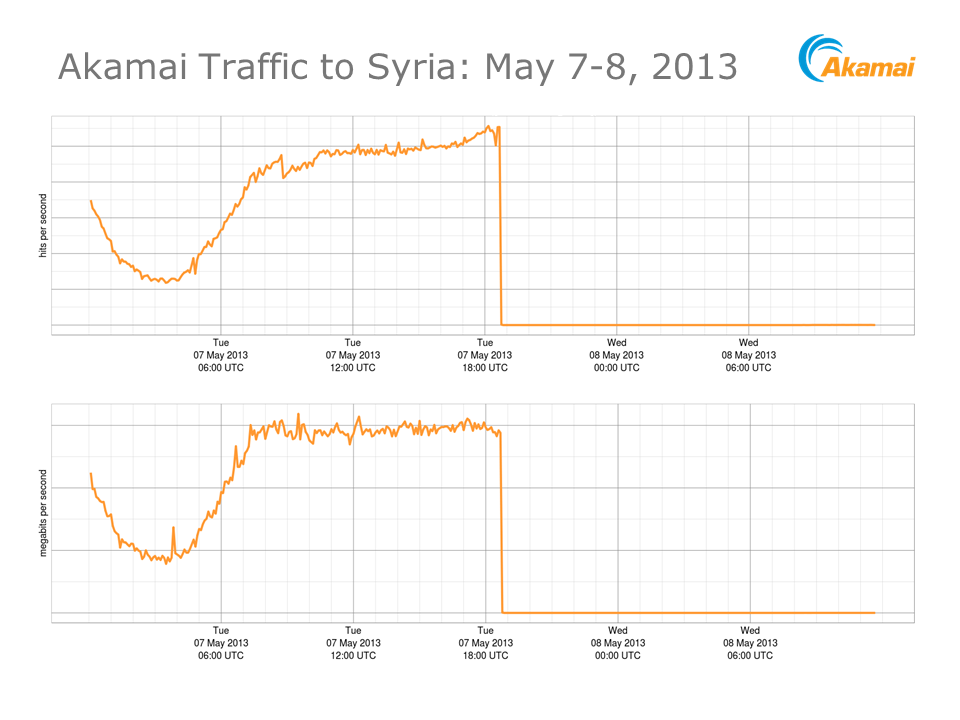
For a period of about 19 hours yesterday, Syria's Internet connection was out.
   Net security experts said the blackout occurred after both of the top-level domain name servers for Syria became unreachable,  It was unclear what the cause of this outage was.  There have been similar outages over the past few years, whether due to the government shutting the servers down, problems with the physical networks serving Syria, internal infrastructure failures, or attacks from rebel groups.
   The connection was restored the following day, and Syria officials blamed the outage on a "fault in optical fiber cables."  Net experts, though, noted that there are 4 different conduits for Internet traffic in and out of Syria, and that the Internet is designed to reroute traffic if there is a blockage.  The chance for a total blackout resulting from a problem with a single conduit would be embarrassingly small. 
"In the middle of the chaos and tragedy of civil war, why is anyone surprised when the Internet stops working?" (one Internet security expert) said. "Isn't it actually more shocking and noteworthy that the Internet in Syria actually functions pretty well 360 days out of the year?" .
Sources -  Syria Back Online After Internet Blackout, Information Week
Syria back online after latest Internet outage,  c/net

Tuesday, April 30, 2013

Did You Know? - Email Privacy

In the U.S., the Electronic Communications Privacy Act (ECPA) currently allows law enforcement agencies can subpeona two broad classes of emails without having to show probable cause or obtain a warrant - any email that's been opened by its recipient, and any email that's at least 180 days old.
  Now this might not have made waves when the ECPA was initially passed in 1986, but some recent high-profile email snooping has brought the practice to light.
While ECPA was designed to balance people's privacy rights with the needs of law enforcement agencies investigating crimes, privacy rights groups have accused the Department of Justice of taking an overly broad interpretation to ECPA, based on the agency's reading that old emails aren't subject to protection under the Stored Communication Act.
After the Ninth Circuit Court of Appeals, which covers the western United States -- including California -- ruled that the Stored Communications Act did apply to emails, the Justice Department advised investigators that when accessing emails more than 180 days old without using a warrant, they should do so outside the court's jurisdiction. 
When the US Justice department starts advising law enforcement to ignore the law (as long as they don't get caught in the Ninth Circuit), that's ringing the privacy alarm bells and asking for added legislative and judicial oversight.

One reaction is the Leahy-Lee ECPA Amendments Act, which was approved by the Senate Judiciary Committee last week.  The bill would require law enforcement to obtain warrants in order to access stored online communications and content (including documents, pictures, and other information stored in the cloud).
"I have long believed that our government should obtain a search warrant -- issued by a court -- before gaining access to private communications," Senate Judiciary Committee Chairman Patrick Leahy (D-Vt.) said...
I'm hopeful for speedy passage through Congress, and a Presidential signature.  But Congress has had trouble getting online and privacy laws right, and one has to wonder whether this President would be willing to reign in his own Dept. of Justice.  Given this administration's track record of ignoring laws and court rulings it doesn't like, I'm not so positive about the eventual outcome.

Source -  Email Without A Warrant? Senators Not SoldInformation Week

Thursday, April 11, 2013

Mobile Ad Spending Doubles in UK

Analysts predicted that mobile-directed advertising expenditures would increase as penetration of smartphones and tablets continued, and 4G cellular service - with its high-speed broadband data connections - was implemented.  What they didn't expect was the pace of the increase.  A new report by PwC for the UK Internet Advertising Bureau indicates that mobile ad revenues increased 148% in 2012.
  The report indicates that online advertising by UK firms increased 12.5% last year, to £5.42bn.  Mobile ads were first separated out in 2009, and accounted for about 1% of online advertising at that time.  In 2012, mobile ad revenues accounted for nearly 10% of all online ad expenditures.
"In the last 6 months, 20 more of the UK's top 100 advertisers have produced mobile-optimised websites; 4G mobile ultra-broadband is enabling a new era of richer content consumption with tablets predicted to outsell PCs in 2013," (Internet Advertising Bureau Research & Strategy director Tim) Elkington said.
In 2012, mobile video ads brought in £13 million, and mobile display contributed £150 million.  Overall, however, the display ad share of digital advertising revenues fell to 24% - and analysts suggest display's share will continue to fall as advertisers start taking advantage of rich media, interactivity, and targeting:
PwC Senior Manager Anna Bartz said the advertising market is shifting toward story telling and integrated campaigns which give greater prominence to video and display formats with a higher degree of interactivity with the target audience.  "Over the past two years, the digital advertising revenue model has also changed from an emphasis on direct response to being more about branding and awareness."
   It's good to see the advertising industry starting to take advantage of the new opportunities that the Internet, social media, and mobile systems provide.

Source -  UK mobile ad spending more than doubles in 2012: report, CBR


.

Tuesday, March 19, 2013

The Internet, Big Data, and the Surveillance State

In a recent opinion piece for CNN, Bruce Schneier proclaimed: "The Internet is a surveillance state."

The Internet's never been secure or private - by design.  It's design goals were to be open and shared - to make it universally accessible, flexible, and adaptable.  And for those who remember the DARPA (defense-related) roots, even there the primary goal was survivability rather than security.  There's a reason the military's never relied on it.
  Sure, there are things you can do to make Internet use somewhat more private - use encryption, route through anonymizers, etc.  But still, every bit of data carries addresses, and all that flexibility and sharing requires that basic information on users and connected devices be readily available.  Add the fact that every data packet travels public routes where they can be duplicated, and ISPs and servers regularly back-up content and messages, and you realize that the Internet is a very public place.  As for encryption, industries trying to rely on encryption for copyright protection (as well as governments) have found that every encryption system is beatable, given enough brains, computing power, and time.  That many governments seek to restrict the use of encryption technology is a matter of laziness and cost rather than a fear of totally private communications.
  For a long time, the sheer volume of Internet traffic provided a bit of privacy protection for common users - searching through the volume of packets and files, identifying and matching traffic through multiple sites, etc. was just too problematic.  But if you had the resources, you could often break through whatever privacy/security roadblocks used (if any).  Schneier offers three recent illustrations -
  • the Chinese military hackers that have been attacking U.S. and European government, military, and commercial sites, were identified in part as they accessed their Facebook accounts through the same networks and hardware used for the hacking.
  • a leader of the LulzSec hacker collective was identified and arrested, reportedly because he slipped up and once logged into an IR chatroom in the clear - without masking his IP address as was his normal practice.
  • Paula Broadwell, who had an affair with then CIA Director David Petraeus, was identified despite only logging into the anonymous email account created and used for the affair from public internet sites.  The FBI reportedly identified her by matching hotel and service receipt records from the times of the emails, and finding hers was the one name in common.
Schneier's point is that Internet traffic is widely tracked, and not only by governments and counter-espionage organizations.  Google does it on everything running through one or another of their sites.  Google also tracks and records websites and content for its search engines.  Blogger.com, for example, lets me know who's visited this blog, where you're from, what OS you're running, and how you found me.  Apple tracks user behaviors on iPhones and iPads.  Facebook tracks its members and their behaviors, and backs up their content and submissions.  They've also admitted tracking their members non-Facebook activities, and using cookies to track online behaviors of non-members who visit Facebook pages.  Pretty much every commercial site builds profiles of users and customers.  And metrics firms collect and track data (anonymized, they say) on users and their Internet behaviors in terms of data traffic flows..

Now if all these were separate, private, and secure, they may be seen by many as the acceptable cost for the services and benefits provided by the Internet and various online services.  Even if they were shared, it might not be so bad, if it would take significant time and effort to try to link things together (particularly if you're looking for patterns in behavior).  If "surveillance" was too costly or inconvenient to be used regularly or for trivial purposes.
However, that's increasingly not the case, due to technology advances and the rise of Big Data.  If you haven't heard the phrase before, Big Data refers to a range of programs and techniques for trolling extremely large data sets (such as online tracking data) to tease out and identify patterns and links.  With Big Data to help, the sheer volume of online data is no hindrance.  Automated systems can scan millions of emails in real time looking for key words or phrases.  Automated systems can match online searches, or the use of certain apps, to purchasing behaviors and location data from mobile devices to send users a coupon for a nearby store or restaurant.  And data storage costs keep falling.  (And while not exclusively Internet, facial recognition software and the myriad private and public video cameras can be used to track a person's movements).
  As Schneier puts it,
This is ubiquitous surveillance: All of us being watched, all the time, and that data being stored forever. This is what a surveillance state looks like, and it's efficient beyond the wildest dreams of George Orwell.
Nor does there seem to be an easy solution, or a means of opting out.
There are simply too many ways to be tracked. The Internet, e-mail, cell phones, web browsers, social networking sites, search engines: these have become necessities, and it's fanciful to expect people to simply refuse to use them just because they don't like the spying, especially since the full extent of such spying is deliberately hidden from us and there are few alternatives being marketed by companies that don't spy.
So, Schneier concludes, welcome to an Internet without privacy; welcome to the Internet surveillance state.  While public interest groups try to raise concerns about privacy, and individuals rant, the public doesn't seem to mind - as long as Amazon and Netflix make good recommendations, YouTube lets you know about the latest "cute kitty" viral video, and social media don't charge fees.  The Internet was never truly private in the first place, and isn't likely to ever significantly shift in that direction.  In part because one of the significant public values of the Internet comes from the lack of privacy and the ability to find and make connections.  What international and national regulatory moves there are are about giving governments more control over the Internet, and more access to the information it transmits and generates.  Which means even fewer real privacy protections.

  If that worries you - and it should - you could go offline.  But in a modern global information society, that comes at a high cost.  Or you could try to level the playing field, as David Brin suggests in The Transparent Society - let us, as citizens, have the same access to surveillance of government activities as the government has over our activities.  Make government truly transparent, rather than settling for "transparency" being defined as giving people access to information the government wants to provide them.  Turn the cameras around, open records, and let the public see what government actually does, rather than only what the government claims it's doing (true or not).  Or hoping that an (increasingly scarce) honest and aggressive press will investigate and report, and do the monitoring for them.

Sources -  The Internet is a surveillance stateCNN Opinion
David Brin's Transparency website

Edit - fixed some typos

Saturday, March 9, 2013

Infographic: Online Content Creation

It's always a bit overwhelming to think about how much information is added to, and available through, the Internet.
This infographic provides numbers per minute.


From Pinfographics page on Pinterest.

Tuesday, February 19, 2013

Traffic updates from Cisco

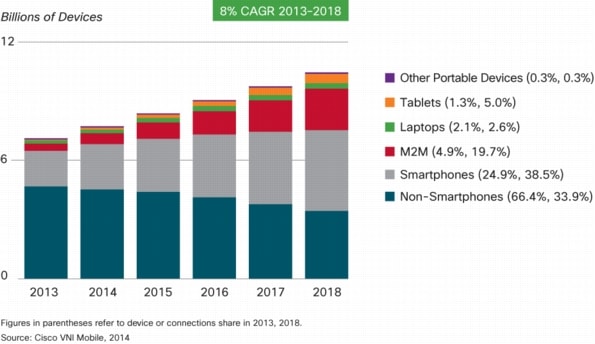
Cisco's Global mobile and visual data traffic reports and forecasts are out for 2012 and beyond, and the key finding is that they've significantly lowered their forecast data traffic growth rates in some key areas from their 2011 forecasts.  They attribute the revision to several fundamental shifts in usage patterns in 2012.
  Now data traffic is still growing rapidly across the globe, and mobile data traffic grew 70% in 2012.  In fact, Cisco notes, last year's mobile data traffic (885 petabytes per month) was twelve times the entire global data traffic in 2000 (75 petabytes per month).  Last year was also the first that saw mobile video traffic account for half of all mobile data traffic.  Last year also saw mobile data connection speeds doubled - avg. download speeds for smartphones were just above 2 Mbps, for tablets, average connection speeds were near 3.7 Mbps.  And data traffic is still projected to grow exponentially, just at a slightly lower rate.
  2012 also saw the number of mobile-connected tablets increase 250%, reaching 36 million, and the number of 4G mobile subscribers approached one percent of all mobile connections.  Still, even with that low early penetration, 4G mobile subscribers generated 14% of all mobile data traffic.  These high-end mobile devices all push mobile data traffic higher, so that continued diffusion will continue to drive continued rapid growth in mobile data traffic.
  As for the changes, they're attributable to shifts in usage patterns driven by pricing strategies interacting with improved mobile devices.  The report notes that the growth rate for mobile-connected laptops has slowed, as users move to smartphones and tablets as their primary mobile devices.  The report also notes that the rise of mobile devices has shifted some use from wired connections to mobile, and particularly WiFi wireless connections.  In particular, Cisco indicated that 2012 saw "higher than expected tablet usage on WiFi."  Finally, 2012 saw the widespread implementation of tiered and capped mobile data plans from mobile operators.  The new plans and caps also pushed a lot of mobile traffic to WiFi home nets connected to fixed network providers.  The report suggested that about a third of all data traffic generated by mobile devices was offloaded to the fixed network, rather than remaining on the user's mobile service.  To the extent that shifting data usage was a strategic goal (to prevent overloading of older, low bandwidth mobile services, this can be interpreted as attempts to make more efficient use of the current mix of data services and access technologies.
  Another way of looking at this is that consumers are becoming smarter - shifting some uses to mobile devices for convenience and 24/7 accessibility, shifting high-data-traffic usage to cheaper and free access points, and shifting emerging usage patterns as mobile service plans evolve to usage-based pricing.

  Lost in all this is the transformation of mobile service business model.  The foundational services of voice and SMS are experiencing declining revenues as users shift to free IP Voice and conferencing services, and the fact of declining costs continues to drive price competition among competitors. 
Swisscom’s CEO believes that the company’s voice and SMS revenue will be gone within three years. If we strip away these declining revenue streams, we’re left with the future of an operator’s business, namely internet/data connectivity.
  Thus, finding the best options for monetizing data carriage is becoming critical for mobile and wireless operators.  The growing number of Internet users and rapidly rising demand for a wide range of Internet services and content suggests that there's a growing market for online content and services that can be tapped.  The still rapid growth in mobile and mobile video data traffic, as seen in the latest Cisco report amply reflects continuing demand.  The report also suggests that usage patterns are still evolving, and can be influenced by pricing strategy.  Understanding the motives and behaviors of users, particularly in response to pricing changes and strategies, will be vital for long-term business success, either as a access provider or content and service provider.

Sources -  Improved traffic distribution indicates that operators are managing assets more effectivelytelecoms.com
Cisco Visual Networking Index: Global Mobile Data Traffic Forecast Update, 2012-1027, Cisco press release.
Cisco Visual Networking Indes: Global Mobile Data Traffic Forecast Update, 2012-2017.  Full report from Cisco.

Monday, February 11, 2013

Goin' Mobile- Global Stats

I was doing some data collection for a piece on broadband last week, and ran across some interesting statistics, courtesy of the ITU.  All results are for 2011.
  • Globally, there's almost five times the number of mobile/cellular subscriptions (5.972 billion) as there are fixed-line telephone subscriptions (1.204 billion).  The ratio is higher in developing areas than in developed areas.
  • For (basic) broadband subscriptions, the differential is less, although there are still more active mobile broadband subscriptions (1.1 billion) than fixed-line broadband subscriptions (589 million).
  • In developed countries, ICTs and Web access are widespread.  Looking at households, 74.2% have computers, and 70.3% have Internet access.  Among individuals, 70.2% are Internet users, about half have mobile broadband subscriptions, and a quarter have fixed-line broadband subscriptions.
  • Penetration in developing countries is much lower (with wider variations in reported levels).  On average, fewer than one in four households have a computer, and about 1 in 5 have Internet access.  Regional differences in household ownership of computers ranges from 6.4% in Africa to 31% in Arab states, to 75.3% in Europe (somewhat fewer homes have Internet access).  The proportion of Internet users run from 12.4% in Africa to 68.4% among Europeans.
Source:  Key ICT indicators for developed and developing countries and the world, ITU (2012)