
Showing posts with label social-TV. Show all posts
Showing posts with label social-TV. Show all posts
Thursday, April 3, 2014

Wednesday, April 2, 2014

Wednesday, April 3, 2013

Friday, March 15, 2013
Infographic: Shifting TV Landscape
The data's a bit old (2011), but this infographic gives a good quick review.

Source - How the TV landscape is changing: infographic, Econsultancy.com
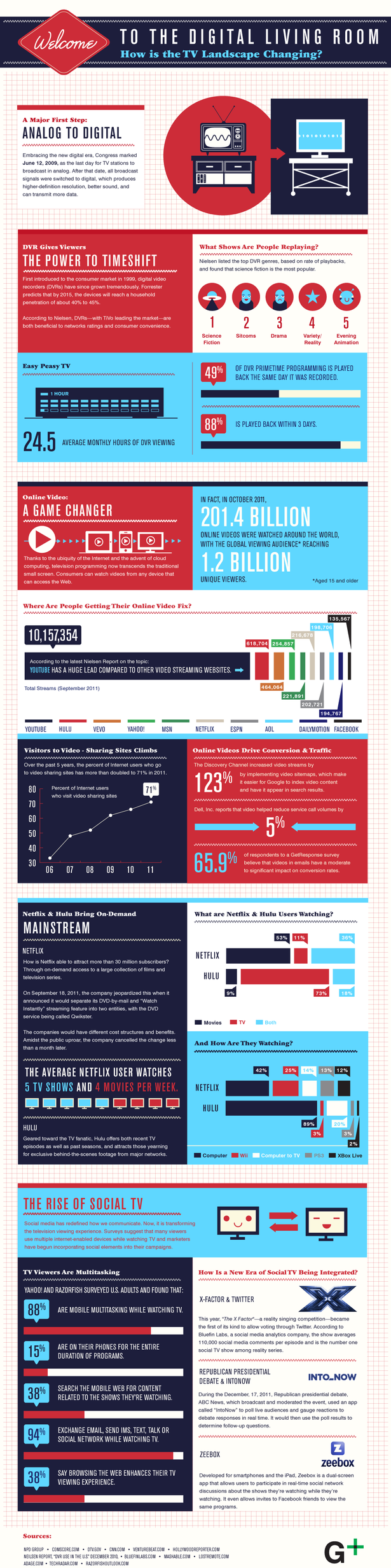
Source - How the TV landscape is changing: infographic, Econsultancy.com
Thursday, March 14, 2013
CBS takes shows mobile

The free (but ad-supported) app allows users to watch full shows streamed in HD, and includes live social feeds for fans to chat with one another. The network indicated that most daytime and late-night programming will be available within 24 hours of initial broadcast, but prime-time programs will normally be available only after 8 days. It also seems that for now, at least, not all programs will be available through the app.
Source - CBS holds Big Bang Theory, The Mentalist from iPad app, FierceCable
Tuesday, November 27, 2012

Twitter and Social TV

Several recent management moves suggests that Twitter's trying to be the social complement to TV - becoming the playground for fans to comment, providing instant feedback to networks and program producers, and (finally) providing an opportunity to engage audiences and make TV viewing both a lean-back and lean-forward activity.
The rise of social media provided an alternative mechanism for fan interaction - and opened the way for less tech-savvy fans to join in.
Rather than just passively absorbing TV fandom, Twitter seems to have recognized the potential of marrying their system to fan interest and activity. They also saw an opportunity to monetize that by working with media and program creators to package fan comments and interactions into useful feedback, and providing the program/media side with the opportunity to add value to their content by engaging audiences and fans. Several years ago, Twitter started hiring people to help foster media partnerships (Chloe Sadden as director of media partnerships, Fred Graver as head of TV partnerships (US), and Dan Biddle as head of broadcast partnerships (UK)).
“Twitter had tremendous foresight in the very early days to start working with TV networks, to get them to care about using Twitter hashtags and the Twitter social platform to engage their fans. We’re seeing the fruits of that labour right now. When TV networks do call-outs, it’s almost always about Twitter. That didn’t happen by accident,” says Tom Thai, marketing director at Bluefin Labs.Last month, former News Corp President and COO Peter Chernin joined Twitter's Board of Directors. A recent feature article on C21Media commented on the move:
What he brings to Twitter is undoubtedly what the tech company so desperately craves – ever closer relations with the worlds of traditional media and advertising...The article stresses the addition of Chernin as the latest in a series of mostly organic evolutionary steps.
It quotes Tony Wang, head of Twitter UK:
“Social TV is becoming the way people engage with programming anyway, regardless of what the broadcaster is doing,” he says, downplaying the significance of Twitter’s very active scheme of promoting industry ‘best practice.’ Twitter has become the “global water cooler."Wang noted that studies suggest that as much as 80% of young viewers (under 25) are using a second screen while watching TV, and almost three quarters of those are using social media to comment on the programs they're watching. A recent TV Guide study suggested that 70% of viewers have seen a social comment about some show, and 17% started to watch the program because of those comments. Also, 31% indicated that social comments encouraged them to continue watching.
Twitter's Fred Graver calls Twitter the new TV Guide -
“Our goal is to get people closer to what they care about and the easier it is for people to find programming that they like or the easier it is maybe for them to supplement the programme they’re watching on-air, that’s a great thing.”Whether organic or directed, the important thing here is that Twitter doesn't see their partnership with TV and media merely in terms of increasing Twitter users and traffic. To mangle an old phrase, there's gold in them thar hills of Tweets. Wang emphasized the focus on the value of being able to make use of the information in those tweets and links -
“The more interesting value proposition is not so much recreating what viewers have been able to find on Twitter already, it’s aggregating the data and making interesting visualisations out of it, surfacing patterns or peaks and making that data digestible to both broadcasters and mainstream audiences. We’re seeing a lot more third-party specialists in this space and we think that’s an exciting opportunity....As the article notes
For more than two years now we’ve been telling developers not to reproduce that consumer experience but rather focus the innovation further up the stack – by thinking about taking that data, making it interesting, visualised and consumable by broadcasters, at least in the broadcast space.”
Twitter’s contribution to the conversation around TV – and indeed the entire spectrum of human chatter – cannot be disputed, but the company, despite its fluffy-feathered image, is a commercial beast like any other. At the end of the day, it comes down to money and making profit for the investors that have supported it to the tune of hundreds of millions of dollars.Partnership with media outlets and content producers looks to be one way that Twitter's generating recoverable value. Still, for it to be successful, the media side also needs to see the value and benefits of engaging viewers through Twitter. I've done a couple of posts on the value of Twitter for news (here, or here) and Social TV more generally (here, here, and here), but here's a nice visual from Seth Ghuniem at WiredSet that outlines how networks and program producers can use Twitter to promote viewing and engagement.

Source - Sailing on the Social TV River, C21Media
Social TV: On-Air / Online Best Practices - Twitter, WiredSet
Friday, October 19, 2012
Twitter and News and TV
In a recent interview, Twitter CEO Dick Costolo talked a bit about what he saw as Twitter's role in the expanding media marketplace.
He suggested that the services most important social impact is disintermediation - in providing users with an avenue to information, news, and opinion that is not filtered through the dominant media lens.
 Costolo went on to say that he thought that Twitter was more of a complement to existing media than a substitute or replacement for it. When asked whether he thought people used Twitter more as an echo chamber, Costolo suggested that his hope was that Twitter gave everyone a voice, and gave followers the potential to sample the full spectrum of opinions and perspectives - but it is the followers choice to use Twitter for enlightenment (seeking alternate perspectives) or self-affirmation (seeking support for one's own thoughts).
As for advertising and revenues, Costolo didn't give figures, but did note that "the origin and future of Twitter is mobile," and the mobile advertising market is robust and growing. As for the company's future, Costolo noted that
 Some commentators took his use of the NBC Olympics coverage as an example of the complementarity nature of Twitter to suggest a focus on developing Twitter as a major force in Social TV (through the "Second Screen"). Dave Morgan's take, as outlined in a post on the Online Spin blog, is that the design of the Twitter service, and current usage patterns tied to big news events, shows that a real-time social Web service can add value to an important live news event being passionately followed by millions of citizen journalists and millions more readers, viewers, reviewers and analysts. "It gives me hope yet for the development of the kind of powerful digital Fourth Estate that many folks thought the Internet could support," Morgan quipped.
Morgan rightfully cautions that that such use isn't necessarily the best or dominant aspect of Social TV and/or Second-Screen application - just an interesting and potentially useful one for news and journalism to note and try to take advantage of.
And I, like Morgan and Costolo (with less specificity), see "the intersection between media like television and web services will be ... wide and deep and diverse." "Control" is probably not the best word to describe that relationship.
For more of Costolo's comments, check the interview transcript at the source below.
Source - Twitter CEO Dick Costolo on Jack Dorsey, ad revenue, going public, Marketplace Tech
Twitter Clear Early Leader To Control TV's 'Second Screen', Online Spin
He suggested that the services most important social impact is disintermediation - in providing users with an avenue to information, news, and opinion that is not filtered through the dominant media lens.
(W)ith Twitter, people want to know what everyone else thinks and we're getting this inside-out, multi-perspective view of what's going on right now as it happens from everybody else that's watching the same thing we're watching. So I think the major transition for society has been one of from a single point of view in a filtered way to a multi-perspective, inside-out, unfiltered view of what people think of the event.
As for advertising and revenues, Costolo didn't give figures, but did note that "the origin and future of Twitter is mobile," and the mobile advertising market is robust and growing. As for the company's future, Costolo noted that
(Looking) down the road for Twitter, we would like to be a company -- a service -- that is used by billions of people around the world in every country in the world because we feel that the power of Twitter is that it brings people closer to each other, to their governments, to their heroes, etc. So that is absolutely our overriding goal for this service. I think the only thing standing in between that goal and where we are today is our own ability to execute against that vision.

Morgan rightfully cautions that that such use isn't necessarily the best or dominant aspect of Social TV and/or Second-Screen application - just an interesting and potentially useful one for news and journalism to note and try to take advantage of.
And I, like Morgan and Costolo (with less specificity), see "the intersection between media like television and web services will be ... wide and deep and diverse." "Control" is probably not the best word to describe that relationship.
For more of Costolo's comments, check the interview transcript at the source below.
Source - Twitter CEO Dick Costolo on Jack Dorsey, ad revenue, going public, Marketplace Tech
Twitter Clear Early Leader To Control TV's 'Second Screen', Online Spin
Wednesday, October 10, 2012
Execs Identify "Mega Media Trends"
Big industry trade meetings often have panels where top executives talk about the trends they see in the industry. The recent panel at Ad Week featured Josh Sapan (AMC Networks(, Tim Armstrong (AOL), and Laura Lang (Time Inc.). So what did they see in their future?
- "OTT & TV: Frenemies by Necessity" - in TV's "Golden Age" if you were watching one program, that precluded you from watching whatever else was on at the time so channels were "enemies" - doing their best to capture audiences from one another. However, with the growing range of viewing and program delivery options, it's no longer a zero-sum game. "TV content being available outside of the ecosystem “turns things that we used to consider our foes into friends by necessity,” said Sapan. In fact, when content plays on OTT platforms like Netflix and Amazon Prime, the data indicates that ratings actually increase during the next season."
- "It's All About Mobile" - Tablets and mobile devices will be major game changers, allowing audiences new content access and consumption options. Time's Lang predicts we'll see a profound shift in how people consume content, which means content needs to be able to tell their stories “with no primary platform in mind.” In a similar vein, Dan Rosensweig of digital textbook publisher Chegg predicted that "he education field will be completely disrupted by technology, and that 'content creators and technology will come together to create interactive learning.'”
- "Growth of Closed Networks" - AOL's Armstrong sees online media trying to create "walled gardens" - trying to keep consumers by closing off networks. You can see some of this in the redesigned news websites discussed in a previous post. Personally, I think they'll try, but find that consumers will gravitate to more open networks if they're available.
- More products will incorporate digital technology that can be interfaced with media use and used to individualize marketing and advertising messages.
- "Social TV" - with screens increasingly individualized, some consumers will seek to go social to maintain contact with others. And that goes double for hardcore fans of programs. For example, AMC's Sapan noted that "after realizing that viewers wanted to continue the conversation after (The Walking Dead) season ended, (AMC) created an entire show devoted to that precise theme: “The Talking Dead.”
Any other forecasts for Mega Trends out there?
Source - 5 Mega Media Trends From AMC Nets, AOL and Time Inc. Top Brass, CableFAX
Thursday, September 27, 2012
A Gaggle of Social TV / Second Screen Reports

A study from consumer research group GfK MRI found that 63% of tablet owners report watching TV while they use their tablets in the previous week. And they did so a lot - 41% of total TV viewing time was spent with tablet in hand. The focus on tablet use behaviors is interesting, because most of the studies to date focus on what people are doing while watching TV.
So what were they doing online while watching TV time? 34% were posting on social media; 25% visited websites or used apps tied to the show they were watching (a show's site or app, the network's site, or a fan site); 21% were looking up information about the show; 16% watched video clips about the program; 11% were voting in a show's content or event; and 9% were actively participating in a live chatroom. As for the TV advertising, the study found that 28% looked up more information about a product advertised on the program on their tablets - and more importantly, 12% reported that they later purchased that product.
As for which screen was primary. 36% reported being true multitaskers, with equal focus on TV screen and tablet. Another 36% indicated that their primary focus was on the tablet, and only 28% said their primary focus was on the TV's bog screen.
Source - Multiscren TV-Tablet Viewing Soars, MediaDailyNews
Research from Forrester suggest that people are watching video in new ways. with multitasking (watching TV while also doing something else) is quickly becoming the new norm. Forrester found that 74% of US viewers regularly multitask, a significant jump from last year's 58%. Their report uses this result and the boom in digital video devices and services to argue that traditional audience rating measures are becoming outmoded and incomplete. Digital captures so much more information about its users, while Nielsen and other ratings services are struggling to develop ways to count the viewing that occurs through the myriad potential second screens.
Forrester says GRPs no longer provide complete coverage for marketers because they only measure age and gender in a world of digital detail, are a backward-looking metric, and face digital video platforms that can already target audiences beyond the basic.Source - Study: In Growing Digital Media World, GRPs Still Important, MediaDailyNews
Ericsson ConsumerLab's latest annual TV and Video study concluded that Social TV is rapidly becoming a mainstream, mass-market phenomenon. The study looks at TV and video trends world-wide, based on thousands of interviews and data from online activities collected from consumers in 14 countries. The found that 62% of their sample combine social media activities with TV viewing on a weekly basis; up from 44% last year. Women were slightly more likely to do this than men (66% vs. 58%), and a quarter (25%) of respondents reported engaging in more narrowly defined Social TV activities - using social media to share their thoughts about the program they were watching at the time.
Other relevant report highlights - two-thirds report using laptops or mobile devices for TV viewing; 60% reported using on-demand services to get programs they wanted to watch each week; and over half the sample want the ability to choose their own video content. The desire to control both the selection of content and the viewing experience (time, location, device, and quality) is reflected in the video characteristics consumers were most willing to pay for - improved technical quality (HD or higher), the ability to control the viewing experience (time-shifting, on-demand), access to recent movies. Interest in paying more for personalized content jumped from about 22% to nearly 30% in the last year. Despite their interest, consumers reported that a variety of technical and regulatory barriers had limited their TV watching outside the home.
An Ericsson spokesman concluded,
”As the number of screens and services increase, people are eagerly looking for an easy-to-use, aggregated service that can bring everything together. It should allow consumers to mix on-demand and linear TV including live content, facilitate content discovery, leverage the value of social TV and provide seamless access across devices.”Sources - Social TV becoming a mass-market phenomenon, says Ericsson, InformationWeek
TV and Video: An analysis of evolving consumer habits, 2012, Ericsson ConsumerLab report.
Networked Insights has developed an interesting Network Executive's Social TV Survival Guide that identifies the major lifecycle segments of television, and discusses how social media and social TV can help the producers and programmers.

Industry observer Simon Dumenco of Advertising Age describes social TV this way: “Millions of people are now partaking of the ‘dual-screen’ experience -- watching TV while using a smartphone (or tablet) to share their thoughts about what they’re viewing and to ’check in’ to shows. The result: a massive and rapidly expanding real-time focus group (and promotional force).Source - How social media affects the TV lifecycle, Lost Remote

Social TV interactions have exploded in the last year, according to a white paper by media research firm Trendrr. They found that that last June set new records for social TV activity, with more than 81 million social interactions generated from 5500 telecasts that they tracked. That was a 681% increase from June 2011, and a 15% increase from the previous month. Interestingly, recent growth was fed by social activity tied to cable programs (up 45% from May), while social interactions tied to broadcast network programs fell 18%. In June, more than two-thirds of social TV activity was related to cable programs. I'll note that June's not a big month for new broadcast programs or episodes, which are much more likely to generate social interaction than repeats. Broadcasting's share of social TV activity should rebound this fall with the start of the new seasons.
Source - Social TV interactions skyrocketed 171% this year, Lost Remote

Sources - Tablet Adoption Explodes, study reveals key usage patterns, Lost Remote
A Portrait of Today's Tablet User Wave II, an Online Publishers Association report.
Wednesday, September 26, 2012
TV, Media Execs Embrace Multi-Platform Distribution
A recent survey of broadcasters and media executives found that three out of four believe that online, social, and mobile platforms are driving audiences to watch more television content.
The Avid broadcast survey interviewed more than 200 "executives and decision-makers from leading broadcast and post and professional organizations in Europe and North America," who were asked questions about where they thought their businesses were headed, and the role and impact of a variety of digital delivery platforms.
Two thirds of the media organizations indicated that they were optimistic about their future, despite declining audiences and revenues in many traditional media operations. The optimism was more than wishful thinking - it was linked to the belief that new digital distribution platforms would offer "unprecedented" opportunity for business growth. The researchers identified three drivers for continued growth - increased audiences, multiplatform distribution (MPD), and revenues growth potential from both advertising and audience payments.
As noted above, 74% of respondents agreed with the statement that the Internet (digital video delivery) will also drive viewers to more traditional linear media (Broadcast, Cable, Satellite). As for fears of digital options further fragmenting their markets, more than half (55%) of the executives felt that current economic uncertainty was a bigger threat. They also felt that current and emerging digital video delivery options gave them entry into new and expanded markets - an entry that could be exploited in a variety of ways. 85% of respondents said that multiplatform distribution was critical to capturing new markets and their growth potential.
One largely undeveloped opportunity is the ability to access and exploit existing content archives. Respondents felt that, on average, 40% of existing archives could be monetized (potentially profitable) - but at this point they felt that only a fourth of their archives were accessible. Expanding access could make more valuable content readily available. The survey found that 83% of respondents felt that all premium video services would be available online, as a means of increasing accessibility and market size. Almost tw0-thirds (63%) also felt that MPD opened a new market for professional content. But most critically, the media executives seemed to be recognizing the full range of opportunities that multiple digital platforms offer - not only access new and expanded markets, but potential to add value to their content streams by customizing them to specific platforms and individual customers. Adding value increases demand generally, and if high enough, it can justify direct payments from consumers.
Survey participants also thought that moving towards an emphasis on exploiting content assets, by expanding accessibility or adding value through customization, could also be beneficial on the operations/cost side. When asked about the potential effects of an increased emphasis on asset-based workflows, 75% felt it would increase business efficiency and the bottom line, and two-thirds (67%) felt it would enable new business models. More specifically, 79% felt that implementing asset-based workflows would enhance operational agility, 69% indicated it would enable better automation, and 62% thought it would largely solve the problem of increasing content volume.
Exploring new business models and markets opens the way for new growth opportunities at a time when the traditional broadcast model appears static or in decline. The media executives recognize this, and are looking for their future growth to occur in other areas: 85% see growth potential in multi-platform services; 78% look to new markets and increased audiences for growth; 71% feel those increased channels and audiences will lead to increased advertising revenues; and 70% see growth from audience direct revenues (fees/sales). There's also a general recognition of the potential of the Cloud; almost all respondents indicated they were already using the Cloud (24%) or exploring how to use the Cloud in their future operations (75%)
For me, the survey results confirm that today's broadcasting and media executives now recognize the fundamental market transformation that digital has brought - they no longer see themselves as monolithic "broadcasters" relying on long-established revenue streams. They have recognized that they're primarily purveyors of content in an increasingly competitive market; that the source of their value is content and not merely a signal; and they should seek and embrace multiple mechanisms for exploiting their content and the multiple revenue streams available. While the various MPD options have yet to show they can fully replace losses in traditional revenue streams, early efforts suggest that when fully developed, the added revenues from multiple streams and operational savings could provide the basis for broadcaster survival into the future.
Sources - Multiple Digital Platforms Boost TV Viewing, Research Brief blog
To request research results, go to Avid/Ovum The Future of Digital Media Survey
The Avid broadcast survey interviewed more than 200 "executives and decision-makers from leading broadcast and post and professional organizations in Europe and North America," who were asked questions about where they thought their businesses were headed, and the role and impact of a variety of digital delivery platforms.
Two thirds of the media organizations indicated that they were optimistic about their future, despite declining audiences and revenues in many traditional media operations. The optimism was more than wishful thinking - it was linked to the belief that new digital distribution platforms would offer "unprecedented" opportunity for business growth. The researchers identified three drivers for continued growth - increased audiences, multiplatform distribution (MPD), and revenues growth potential from both advertising and audience payments.
As noted above, 74% of respondents agreed with the statement that the Internet (digital video delivery) will also drive viewers to more traditional linear media (Broadcast, Cable, Satellite). As for fears of digital options further fragmenting their markets, more than half (55%) of the executives felt that current economic uncertainty was a bigger threat. They also felt that current and emerging digital video delivery options gave them entry into new and expanded markets - an entry that could be exploited in a variety of ways. 85% of respondents said that multiplatform distribution was critical to capturing new markets and their growth potential.
One largely undeveloped opportunity is the ability to access and exploit existing content archives. Respondents felt that, on average, 40% of existing archives could be monetized (potentially profitable) - but at this point they felt that only a fourth of their archives were accessible. Expanding access could make more valuable content readily available. The survey found that 83% of respondents felt that all premium video services would be available online, as a means of increasing accessibility and market size. Almost tw0-thirds (63%) also felt that MPD opened a new market for professional content. But most critically, the media executives seemed to be recognizing the full range of opportunities that multiple digital platforms offer - not only access new and expanded markets, but potential to add value to their content streams by customizing them to specific platforms and individual customers. Adding value increases demand generally, and if high enough, it can justify direct payments from consumers.
Gary Greenfield, CEO and chairman of Avid, says "... media organizations worldwide are moving from addressing homogenous audiences to delivering personalized experiences... this change in the relationship between broadcasters and their audiences... forces a change in business models... “More than three-quarters of those surveyed (78%) thought that within the next ten years, most of the content delivered would be customized for individual viewer preferences. 70% felt that most content would also be optimized for the particular device viewers are watching the content on.
Survey participants also thought that moving towards an emphasis on exploiting content assets, by expanding accessibility or adding value through customization, could also be beneficial on the operations/cost side. When asked about the potential effects of an increased emphasis on asset-based workflows, 75% felt it would increase business efficiency and the bottom line, and two-thirds (67%) felt it would enable new business models. More specifically, 79% felt that implementing asset-based workflows would enhance operational agility, 69% indicated it would enable better automation, and 62% thought it would largely solve the problem of increasing content volume.
Exploring new business models and markets opens the way for new growth opportunities at a time when the traditional broadcast model appears static or in decline. The media executives recognize this, and are looking for their future growth to occur in other areas: 85% see growth potential in multi-platform services; 78% look to new markets and increased audiences for growth; 71% feel those increased channels and audiences will lead to increased advertising revenues; and 70% see growth from audience direct revenues (fees/sales). There's also a general recognition of the potential of the Cloud; almost all respondents indicated they were already using the Cloud (24%) or exploring how to use the Cloud in their future operations (75%)
For me, the survey results confirm that today's broadcasting and media executives now recognize the fundamental market transformation that digital has brought - they no longer see themselves as monolithic "broadcasters" relying on long-established revenue streams. They have recognized that they're primarily purveyors of content in an increasingly competitive market; that the source of their value is content and not merely a signal; and they should seek and embrace multiple mechanisms for exploiting their content and the multiple revenue streams available. While the various MPD options have yet to show they can fully replace losses in traditional revenue streams, early efforts suggest that when fully developed, the added revenues from multiple streams and operational savings could provide the basis for broadcaster survival into the future.
Sources - Multiple Digital Platforms Boost TV Viewing, Research Brief blog
To request research results, go to Avid/Ovum The Future of Digital Media Survey
Friday, September 21, 2012
Shazam Expands to TV
For a while now, Shazam has offered an app that lets users tag the music they're listening to, as an aid in identifying songs and artists, keeping track of preferences, sharing music through social networks, and previewing and purchasing music. Shazam claims it connects 250 million people from 200 countries, in 33 languages, making it "the world's largest media engagement company.
Now Shazam has announced its entry into the world of TV.
 Shazam works by using an archive of "sound fingerprints" to identify songs and programs; once something is tagged, Shazam identifies the content, and then offers access to other content and activities linked to it. Shazam has partnered with some specific TV shows and programming in the past, but full entry into TV was delayed while the company built up a library of "sound fingerprints" for TV and movie programming.
Tagging a program will identify the program if it's in the archive. Among the additional options for users tagging a show, can be things like accessing cast information and celebrity news, playing trivia, and engaging with other viewers on social media. And harkening back to Shazam's origins, it can also be used to identify the music being used within a TV program.
Shazam and similar apps seem like they'd be useful tools for active listeners and viewers, and for those who are looking for ways to engage with content and/or with friends and other fans of programs. But ultimately the key will be how well a particular app can correctly identify tagged program content, and the quality of the value-added extras offered through the app. It will likely be a while before its clear how successful these "companion" apps will be.
Source - Shazam Wants to Dominate the TV Market, and Here's How, The Wrap / promaxBDA daily brief
Now Shazam has announced its entry into the world of TV.
Shazam's chief revenue officer, Doug Garland was quoted as proclaiming “Now you can tag any show and what you’ll get back is a rich experience that gets you more engaged with TV programming, more invested with the show.“

Tagging a program will identify the program if it's in the archive. Among the additional options for users tagging a show, can be things like accessing cast information and celebrity news, playing trivia, and engaging with other viewers on social media. And harkening back to Shazam's origins, it can also be used to identify the music being used within a TV program.
“You’ll see people engage with a show while its on air, but I don’t necessarily think it’ll be in a way where you distract them from the show,” Garland said. “It’s a buzz tidbit, a mini content snack. You get more invested in the show the next time you watch.”The rise of "second-screen" and social TV viewing has created new opportunities for program producers, networks, and advertisers to provide a range of additional content or activities to interested viewers. Shazam, and similar services, offers a delivery system. And among "companion" apps, Shazam has scale and reach - currently adding an additional 2 million users a week, and a user base that generates around 10 million new tags a week.
Shazam and similar apps seem like they'd be useful tools for active listeners and viewers, and for those who are looking for ways to engage with content and/or with friends and other fans of programs. But ultimately the key will be how well a particular app can correctly identify tagged program content, and the quality of the value-added extras offered through the app. It will likely be a while before its clear how successful these "companion" apps will be.
Source - Shazam Wants to Dominate the TV Market, and Here's How, The Wrap / promaxBDA daily brief
Wednesday, September 19, 2012
Boom in TV Tweeting - Impact of Social TV

The writers at Covert Affairs added a scene to the season's final episode to specifically address continuing fan questions about the eyesight of a major character. When Vampire Diaries had one of the vampire characters violate the "unwritten law" that vampires can't enter a dwelling without an invitation, there was an immediate flood of comments and questions seeking an explanation. The comments kept coming well into the next season before writers finally provided an explanation in a later episode. The record for per-viewer social TV commenting is cable program Pretty Little Liars, which received on comment for every one and a half viewers for an episode this August (1.6 million comments).
Program producers note that the huge number of comments over a month are primarily produced by a much smaller number of active social TV users. July's 75 million social media comments, for instance, were produced by about 8 million viewers (out of 113 million TV households in the U.S.). Some consider it important to keep the support of fans who are the most active social media commenters. Matt Corman, creator and executive producer for Covert Affairs put a positive spin on the situation - "Fans who watch the show can become grass-roots organizers for the show... In politics they say don't ignore your base." Others like the chatter, but would rather it not come while watching the program. Brad Falchuk, creator and executive producer for Glee (the show with the highest average commenting last year) quipped "I would love to do an episode that was so amazing you got fewer Tweets."
You can also see the growing importance of social TV - commenting on and discussing TV programs on social media - in the rise of analytics firm Fizziology, which is monitoring pre- and post-premiere social buzz for a number of this fall's slate of programs. Fizziology's big winners - Fox's The Mindy Project, NBC's The New Normal and ABC's 666 Park Avenue. NBC is using social metrics to complement traditional ratings research, as a means of indicating viewer passion and involvement. For example, NBC's Go On generated significantly higher ratings that The New Normal, but The New Normal generated more than two and a half times more social buzz - with many of the commenters starting to quote the show's characters. At this point, however, the value and precision of social metrics is unsettled - at best they can be a reflection of viewer interest, attention, and involvement that can be combined with traditional viewership metrics to gauge public awareness and interest.
That can be good enough for some in the industry. NBC used the social buzz around the London Olympics to support increases in cross-media advertising deals.
"It was a really bright, shining example of how social could fuel ratings," said Peter Naylor, NBC Universal's exec VP-digital media sales. "People were really, really concerned about social being a spoiler, but it actually worked as an accelerant, and when we sold advertising packages, we made sure that for all the windows, all the platforms" -- most notably the NBC Olympics Live Extra app, which offered live streams of more than 3,500 hours of content -- "we associated marketers with those platforms."Executives at CBS note that social buzz can drive traffic to its online sites.
"As we push stuff onto Twitter and Facebook -- a clip or a photo or a comment made by talent from one of our shows -- we can see that large portions of the traffic to our sites are being driven by leads generated that way," said Marc DeBevoise, senior VP-general manager at CBS Interactive. "And, of course, more traffic to our sites drives more revenue."
 As social buzz reflects audience engagement, it supports the ability to develop highly targeted social TV initiatives, such as Lexus building on the social buzz surrounding USA Network's Suits, and its affluent viewers, to combine Lexus sponsorship of the program with its social-gamification program "Suits Recruits." American Express partnered with Glee, a show with strong social buzz and viewer involvement to promote their Members Project campaign - "a feel-good charitable initiative with the tagline 'Everyone can help change the world for the better, one step at a time.'" The potential of using social buzz to support highly targeting marketing and advertising efforts can be particularly beneficial for smaller niche networks - one example is the partnership of Hyundai with AMC's The Walking Dead.
With most TV viewing research showing continuing increases in social TV viewing (where the second online activity relates to the program being watched) and two-screen viewing (where the online activity is focused elsewhere), its clear that a significant portion of the TV viewing audience will be active online and during viewing. Comments about TV programs on social media services can provide insights into these more active viewers' attitudes about, and engagement with, programs (but not reliable quantitative measures; not yet anyway). Still, those insights can be valuable for some network executives, program producers, and marketers and advertising - helping to evaluate how programs and viewer engagement can match up at meet specific desired goals. We're seeing the beginning of that, with the likelihood that much more will be coming.
Sources - When Twitter Fans Steer TV, Wall Street Journal
Networks Track Social Buzz for Fall Shows, AdWeek
Wait, Who's Actually Making Money Off Social TV?, AdAge
Friday, September 7, 2012
Social TV - Which screen is First?

Still, the dominant means of watching TV content remains the TV set, while mobile devices permit consumers to interact with others while doing so, and to watch TV when they're away from their sets.
Together, this research underscores how deeply habits are changing, and how essential it is for programmers and marketers to capture the TV viewer not only on the “first screen” but also on the screen they use for interaction -- the mobile one in most cases.The changing TV consumption landscape is raising new questions about how, where, and when people use "TV." One of the more interesting is a comment from Ogilvy’s Chief Digital Officer, Brandon Berger -
“We have this idea that the TV is the first screen, but where is the activity occurring? It’s occurring on the tablet or the mobile device, so which one is the priority screen?”So are the changing patterns of use related to social TV merely an incremental evolution of traditional TV uses & gratifications, or are we witnessing the start of a transformational revolution in how people relate to - and use - media and information services? Something to think about.
Sources - More Than 60 Percent of Consumers Use Social Media While Watching TV, VidBlog
Ericsson Report - TV and Video: An analysis of evolving consumer habits
Friday, August 3, 2012
Milestones: A Million for Viggle
Viggle is a "TV check-in" mobile app that has accumulated a million registered users since its launch last January. If you're a two-screen TV viewer, you can use Viggle while you're watching to "check-in" and verify your TV watching habits - and have that record of viewing earn rewards. Viggle uses your mobile device to identify the program you're currently watching, and if it's on one of more than 140 channels registered with Viggle, it notes your viewing activity. Watch long enough and you can earn points that can earn a variety of awards. Points can also be earned while watching certain video clips, playing games, or participating interactively with trivia games and live polls associated with some programs. There is also a suite of social media options, whose use may also generate points for viewers.
To date, Viggle users have checked in to more than 63 million TV shows and, on average, spend 86 minutes per session within the app, according to the startup. Points have been redeemed 905,000 times for items including movie tickets, music, and gift cards through Best Buy, Amazon, Fandango, Hulu Plus, iTunes, and others.Viggle gets paid by networks, program producers, and advertisers for "check-ins", and has a second potential revenue stream from its ability to collect individualized viewing records. It's also recently released a developer kit that can allow networks and program producers to develop program-specific widgets that would allow viewers to interact with programs and other viewers in real-time - engaging viewers and audiences. Viggle indicated that such third party widgets could also be used to generate revenues.
Source - TV App Viggle Hits 1M Users, MediaPostRaw blog
Monday, July 9, 2012
Study: Social TV Promotes Engagement
One of the side effects of the explosion of media choices is the new reality that unless you can keep the consumer's interest, they can easily switch their focus to alternatives. One of the key issues for media outlets in the future will be how can they track and maintain people's interest in their product - that is, can they keep people engaged.
It's been thought that engagement is a pressing problem for broadcasting - that viewing or listening behaviors are traditionally passive. In an era when there were few outlets, differentiated product, and largely habitual viewing/listening, this wasn't a big issue - outlets could thrive on sharing largely habitual audiences. But as channels and new media outlets joined the market, merely splitting that audience yielded fewer and fewer viewers and listeners and smaller revenues. And then came online video, streaming services, connected devices, and mobile devices, which not only offered more choice, but facilitated a shift in consumption patterns from passive and habitual to a more active media content consumer. Mobile and social media are showing themselves to be a disruptive entry in the media content marketplace, with many studies showing their widespread use during TV viewing in particular.The question is whether such "second screen" behavior complements TV viewing, or a substitute for it, pushing the TV signal into the viewer's background, or replaces traditional TV on the big screen. My guess, and what early studies seem to suggest is that it's more likely to be a substitute, at least for traditional content designed for passive viewing.
Some video broadcast channels and programmers, however, see an opportunity to take advantage of second screens and social media as complements to their programming that allow greater involvement and engagement of a growing active audience. "Social TV" is the name for such efforts, where TV content purposely tries to incorporate added online content accessible through mobile devices or encourages viewer participation in social media related to the program.
A new study released by the Time Warner Research Council suggested that, for Social TV programs at least, second screen and social media use while watching TV can result in a more engaged audience, augmenting their use of TV rather than distracting from it.
"The most important overall finding is to understand that people use media to optimize their levels of interest and excitement," said Jack Wakshlag, chief research officer at Turner Broadcasting, a Time Warner unit that collaborated with the research council, sibling Warner Bros. and the research companies Innerscope and Ipsos. "When they find something engaging on the TV, they pay attention. When their interest wanes, in the absence of a second screen they could change the channel, get up, read a magazine, etc. With a second screen that allows live social engagement, they have more reason to stay on-channel with their friend."The study used biometric monitoring and eye-tracking to look at viewing interest and behaviors of a sample of 128 young adults in an experimental setting. The experiment asked participants to watch specific TV programs under various viewing conditions (alone, watching with a friend, using various social media. The study found a statistically significant increase (30%) in the level of viewer engagement when using social media or watching with a friend, than under the condition of watching alone with no access to social media. The study also found a smaller, but still statistically significant, increase (20%) in engagement when people used connected devices to access co-viewing apps designed to deliver added content or a platform for real-time conversation. The study also found that viewers tended to respond to audio cues in the TV program or commercials, even while online. This suggests a level of cognitive engagement with TV content even when viewers' primary focus is elsewhere. There was also some evidence that study participants "appreciated" advertisers associated with co-viewing apps.
The study and its results, while very limited, does suggest that TV outlets, channels, and programming sources can take some proactive steps to build audience involvement and engagement in an increasingly competitive media marketplace. Steps that could make their content and channel more valuable to a potential audience, as well as to advertisers.
Source - Social TV Keeps Viewers Engaged When Minds Might Wander, Study Says, AdAge Media News
Monday, June 4, 2012
Is Tumblr for TV?
In a lengthy post on Lost Remote, Nathan Edelsburg recalled his earlier post on how TV could utilize the Tumblr microblogging and social network service to generate social buzz, as well as to get a glimpse at audience reactions to their content. Now, with Tumblr passing the milestones of 50 million blogs and 20 billion blog posts, he took another look at where Tumblr fits into the emerging social TV landscape.
Tumblr itself is partnering with the creative people in the TV industry, according to Tumblr's Director of Partnership Development, Rachel Webber. The goal of partnerships is to "help them translate the really great things they do every day and the stories they want to tell to a form that resonates with the Tumblr audience." Pointing to successes like HBO's Game of Thrones site (dedicated to fan art) and BBC America's Doctor Who blog (collects and redistributes fan fiction and fan art), Webber talked about the opportunity to connect with fans, and foster greater engagement with them. But she also warned that Tumblr was different, with a strong focus on creativity and interaction, rather than a straightforward promotional site.
The whole post is worth a read, but my uptake is that Tumblr is most effective at fan engagement - particularly with the active fan who explores a program's universe and creatively contributes to it.
Source - How TV can leverage Tumblr for social buzz and analysis, Lost Remote
Tumblr itself is partnering with the creative people in the TV industry, according to Tumblr's Director of Partnership Development, Rachel Webber. The goal of partnerships is to "help them translate the really great things they do every day and the stories they want to tell to a form that resonates with the Tumblr audience." Pointing to successes like HBO's Game of Thrones site (dedicated to fan art) and BBC America's Doctor Who blog (collects and redistributes fan fiction and fan art), Webber talked about the opportunity to connect with fans, and foster greater engagement with them. But she also warned that Tumblr was different, with a strong focus on creativity and interaction, rather than a straightforward promotional site.
The whole post is worth a read, but my uptake is that Tumblr is most effective at fan engagement - particularly with the active fan who explores a program's universe and creatively contributes to it.
Source - How TV can leverage Tumblr for social buzz and analysis, Lost Remote
Friday, April 27, 2012
More Briefs: Milestones and Stats
Some more brief notes from various research reports
- ComScore is reporting that Amazon's Fire tablet now accounts for more than half of all Android OS tablets. In second place is the Samsung Galaxy with 15% of the market.Source - Kindle Fire Claims More Than Half Android Tablet Market, Online Media Daily
- Research from Accenture suggests the effort to push the social TV concept is working - 64% of their sample of U.S. Consumers remember seeing social media symbols on TV programming, and a third used social media when seeing the symbols.
"Social media and social networking are exploding across television screens as networks use social media to enable audiences to interact directly with related content for a richer viewing experience," said Robin Murdoch, Accenture's global Internet segment managing director.
Source - TV-driven social media interaction popular among U.S. viewers, says survey, Broadcast Engineering - A post on the TVNewsCheck blog reports on the growing integration of social media in local broadcast news operations in the U.S. “Social media is indeed the more effective, efficient means of
engagement,” says Jaime Spencer, a VP at Frank N. Magid Associates.
Source - Status Of Social Media Rising At TV Stations, TVNewsCheck - A Sandvine report indicates that Netflix's streaming traffic has grown by 30% over the last six months. Looking at Netflix's impact in other ways, Netflix streams account for about one-third of capacity infrastructure costs for broadband providers, 32.9% of Internet traffic during primetime hours, and 24.4% of total Internet traffic volume. YouTube is the second largest source of peak traffic, accounting for 13.8% of downstream traffic. Looking at mobile data traffic, YouTube is the largest single source of video traffic in every region of the globe; it accounts for 23.4% of daily traffic on mobile networks.
Source - Netflix Streaming Traffic Grew 30% In Last Six Months: Study, Multichannel News - Half (53%) of online video viewers in an Accenture survey felt there were too many ads during shows. They were also often frustrated with the time it takes to buffer or start online videos. When asked what they'd be willing to pay for, top responses were reduced ad loads (35%) and higher quality content (35%). Accenture summarize: "there appears to be a point at which the trade-off between free content and frequency of commercials becomes unpalatable."
Source - Half of Online Video Viewers Say There Are Too Many Ads, VidBlog - A story in the LA Times reported that Microsoft indicated that U.S. consumers now use their Xbox Live service more for entertainment purposes than for multiplayer gaming. The general manager for Xbox Live entertainment and advertising told attendees at a conference on digital content that "When Xbox Live started 10 years ago, what it was all about was multiplayer gaming. Now, Xbox Live really is an all-in-one entertainment platform." He added that Microsoft had struck more than 50 content deals in recent months.
Source - VideoDaily Roundup: Xbox Live Usage Outstrips Multiplayer Gaming in U.S., Online Media Daily - There's been significant consolidation in China's Web video advertising market. Last month, China's top video site Youku bought out the #2 site, Tudou Holdings for a reported $1 billion. Subsequently, Tencent Holdings, Sohu.com (#3), and Baidu (#4) announced that they would join forces in offering video services.
Source - VideoDaily Roundup: Xbox Live Usage Outstrips Multiplayer Gaming in U.S., Online Media Daily - A report by analytics firm Distimo calls Instagram "a new kind of social network -- one that is build from an app."
The report argues that both the size of Instragram's international user base and the increasing number of mobile applications integrating the service set it apart from the typical social media service. Over the last year, U.S. downloads increased sevenfold, and shares from Instagram to Twitter increased twelvefold.
Source - Distimo: Instagram's growth heralds 'a new kind of social network' Fierce Mobile Content

Friday, April 13, 2012
Local TV on Pinterest
 There's an interesting post on Lost Remote (a site focusing on social TV) looking at what some local TV stations are "pinning" on their Pinterest sites. The post suggests that, for now, there are five basic approaches to content - Food and Recipes, Behind the Scenes promos, Pets/Animals, Weather, and News.
For now, stations seem to be experimenting with various foci, but do seem to increasingly see Pinterest as another social media system that can be used to build relationships with viewers. The Pinterest approach seems to offer some interesting opportunities for both promotion and disseminating news and information.
Sources - What local TV newsrooms are pinning on Pinterest, Lost Remote
Great Ideas from Newsrooms Using Pinterest, Kim Wilson social media strategy for the journalism business blog (List of stations using Pinterest)
Wednesday, April 4, 2012
Social TV and Fandom
A new TVGuide.com poll looked at how TV viewers combine their viewing with Twitter, Facebook, and other social media. In a March 2012 online survey, they asked about the reasons they engaged in "Social TV" activity. The most common responses in 2012 were keeping their favorite shows on air (78%), informing friends of what shows they watched (61%). When watching major live TV events, more people engaged in Social TV activity to find out what others were saying about the event (69%) than wanted to share their own thoughts (33%). And reflecting other studies of mobile and tablet use, a large proportion (40%) of Social TV users did so while watching TV, although the activity could also occur before (53%) or after (95%) the program as well.
There was no mention in the article as to whether the survey samples were random or even representative, so treat the numbers as indicators rather than generalizable facts.
Source - Social TV Fans Driven By Desire To Keep Shows On The Air: Survey, Multichannel News
There was no mention in the article as to whether the survey samples were random or even representative, so treat the numbers as indicators rather than generalizable facts.
Source - Social TV Fans Driven By Desire To Keep Shows On The Air: Survey, Multichannel News
Subscribe to:
Posts (Atom)