Showing posts with label news magazines. Show all posts

Wednesday, September 4, 2013

Milepost - The Economist notes 170th anniversary.

British news magazine (newspaper) The Economist is marking the 170th anniversary of the first edition, published Sept. 2, 1843.  One way it's doing so is by explaining itself through a series of blog posts under the rubric of "The Economist explains."

Among the posts -
  • How does The Economist choose what to cover? (a fairly standard gatekeeping/editorial process)
  • Why does The Economist call itself a newspaper?  (they see themselves as trying to be more comprehensive in coverage than most magazines, so they call themselves a "comprehensive weekly newspaper for the world")
  • Is The Economist left- or right- wing?  (It claims to be neither, but is pro-free enterprise and pro-individual freedom.  A sort of libertarian perspective, although they prefer the label "classically liberal")

Not as big a splash as Vanity Fair, but then again it's not a centenary. But 170 years is not a milepost to ignore.

Source -  How does The Economist choose what to cover?,  The Economist explains


Tuesday, August 6, 2013

Print News Fire Sales: Post, Globe, Newsweek (again)

Three big sales over the weekend in the news field.

First was the report that the New York Times sold The Boston Globe to the owner of the Boston Red Sox baseball team, for $70 million.  Considering that the Times bought the Globe for $1.1 billion in 1993 (before the newspaper business started crashing), that's quite a loss in value.  A 93% drop in value in 20 years.  But a look at some of the details makes it look even worse.  The sale of the Globe includes a couple of small regional papers and related real estate holdings; estimates place the value of the real estate alone at nearly $70 million.  More critically, the sale did not include pension liabilities of $100 million, which the Times will retain.  As such, what the Times got won't even cover its existing pension liabilities for the Globe's employees.
   From the viewpoint of the Times, they got rid of a distraction and a drain on corporate resources.  The Globe lost about half its readership in the last ten years, and reportedly, its advertising revenue fell a further 10% in the first half of this year.  This may help the Times in their stated goal of refocusing on building the primary Times brand and growing online revenues.  And it helps a bit with those pesky pension liabilities.
   It's also been reported that the Times turned down three higher bids for the Globe.

Newsweek has another owner, as well.  The Washington Post sale of Newsweek for $1 was one of the first of the news media fire sales.  After that initial sale to Sidney Harman in 2010, ownership shifted to Barry Diller through a partnership, and the Newsweek staff and brand was integrated into online news site The Daily Beast.  Ownership later terminated the print version, refocusing Newsweek as a semi-regular focused section within the Daily Beast website.  Portents of another sale surfaced when Diller publicly indicated that acquiring Newsweek was a mistake, and its merger into the Daily Beast a failure.
   Last weekend, IBT Media, publisher of online global news site International Business Times, agreed to acquire the Newsweek brand.
"We are thrilled to welcome this iconic brand and global news property into our portfolio. We believe in the Newsweek brand and look forward to growing it, fully transformed to the digital age," said Etienne Uzac, the co-founder and CEO of IBT Media in a press release.
Terms of the deal were not announced at the time, but Newsweek was starting to tap into growing online ad revenues as a digital publication, and continued to bring in revenue from licensing its brand outside the U.S. The internationally recognized brand of Newsweek should have a positive impact on IBT brands.

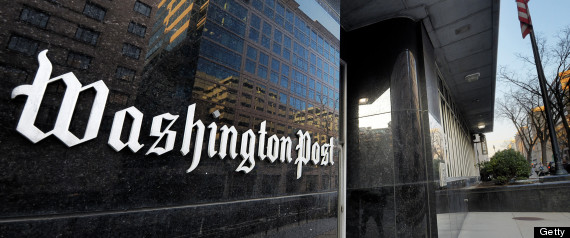
Then came yesterday's unexpected blockbuster - the sale of the Washington Post to Jeff Bezos, founder and CEO of Amazon.  The announced price of $250 million certainly tops recent newspaper sales, but is also significantly less than what the Post was worth ten to twenty years ago (one analyst indicated that just 10 years ago, the Post would have been worth $2 billion).  From a financial "multiples" perspective, the announced price is less than half of the Post's 2012 revenues of $582 million; conversely, it's 5 times annual losses.  Both multiples are significantly outside industrial norms (I used to do broadcast M&A evaluations, where prices were more typically 3-5 times annual revenues, or 8-12 times annual profits).
   Furthermore, unlike most recent deals, the sale is limited to the newspaper, the Post website, some suburban papers and affiliated publications, and two printing shops.  It does not include the Post's current building or other DC area real estate, other Post Co. owned media (broadcast stations, online magazines Slate and The Root, and the international magazine Foreign Policy), or other Post Co. properties.
   As such, it does seem that Bezos may have paid a bit of a premium for the Post - for the prestige and influence of one of the U.S.'s preeminent media outlets.  As for the parent Post Co., it gets to shed that portion of its business that's been a significant drain on the company's profits and had little indication of a rapid return to profitability. As for Bezos, he announced that Post ownership will fall under a new holding company (Explore Holdings) separate from Amazon, and that current editorial and management staff will continue in place after the sale is finalized (at some point in the next two months).  Since most analysts don't see much opportunity for a quick turn-around in profits for the Post, that's probably the smart move at this time.

In all three cases, sales to innovative, accomplished, and successful businessmen may be the best move for organizations facing radical transformation of their traditional markets.  They're likely to be more willing to explore and exploit new markets, and/or developing opportunities for added revenues.  At least their focus won't be on trying to hold onto past glories.


Sources -  7 things to know about The Boston Globe's sale to John Henry, Poynter
Newsweek Magazine Sold to IBT Media, The Daily Beast
Washington Post sale: Details of Bezos deal,  Washington Post

Monday, March 18, 2013

Pew 2013 State of the News Media Report released

The Pew Research Center's Project for Excellence in Journalism has released its annual "State of the News Media" report for 2013.  I'll try to take a closer look at some of the components over the next week or two, but here's some highlights from the overview.

Resources for newsrooms continue to decline.  Estimated cuts for 2012 put full-time professional news staff numbers under 40,000 in the U.S., the lowest employment level since 1978 (and down 30% from its peak in 2000).  This contributed to shifts in news coverage - sports, weather, and traffic reports account for 40% of local news program content.  On CNN, the number of produced news packages in 2012 were half that of five years ago.  Across the cable news networks, live coverage of news events fell 30%, while interview segments rose 31%.  The sole remaining news magazine, Time, cut 5% of its staff earlier this year.

Pew interprets this as resulting in "a news industry that is more undermanned and unprepared to uncover stories, dig deep into emerging ones or to question information put into its hands."  In fact, they suggest, this fall has been noticed by news consumers.  A recent survey found that 31% of respondents had indicated that they had stopped using a news source because it no longer provided the amount and quality of news they expected and wanted.

Source - The State of The News Media 2013 Report, Pew Research Centers.

Edit - fixed some typos, phrasing (19/3/2013)

Monday, January 14, 2013

Traditional, Print News on the Skids

Newsweek is dead - it delivered its final print issue at the end of last year.  It will technically continue as a digital-only affiliated with the Web-based Daily Beast.  Its death as a competitive newsweekly was hardly unexpected - the journalistic quality of its content, and its paid circulation, had been crumbling for years, particularly after the Washington Post firesaled the weekly for a buck a few years ago.

Time - the remaining "real" newsweekly magazine, is said to be planning to lay off as many as 700 staffers.  First, though, came a memo in which Time CEO Laura Ling cancelled the annual 3% across-the-board raises for the staff.  Now sources in the company are telling the New York Post that the company is looking to cut $100 million in costs, as a result of declining advertising revenues.  That would mean laying off about 10% of its workforce (500-700 positions).

Rumors of layoffs are also flying around the New York Times.  New York Magazine is reporting that up to 39 top-level staffers will be offered "buyouts" - and likely terminated anyway if they don't take them.
  Last month, shortly after welcoming a new, and extremely well-paid, CEO, Times publisher Arthur Sulzberger, Jr., told all of the newspaper's divisions to identify possible cost savings as an attempt to deal with rapidly declining ad revenues.  The one division that seems to have been spared is the highly opinionated Editorial section (opinion).  In addition, the NY Times' new CEO (see posts here and here) is talking about "reshaping the organizations' contours - including taking advantage of "branding initiatives" (i.e., "news" content tied to commercial opportunities).  If the coming layoffs in senior editorial staff isn't enough of a hit on traditional news values, the thought that resources are shifting to opinion and commercialized content is a further indication of the decline of traditional news in what had been an elite newspaper.

And now the venerable Associated Press (AP) wire service is selling sponsored Tweets on its Twitter feed, as it searches for new revenue sources.  AP's being dropped by some newspapers, and facing increased competition online.
Lou Ferrara, the AP managing editor overseeing its social media efforts, (said) in a statement (that) "As an industry, we must be looking for new ways to develop revenues while providing good experiences for advertisers and consumers. At the same time, advertisers and audiences expect AP to do that without compromising its core mission of breaking news."
In addition, the AP has cut a deal with a posh DC restaurant to print AP dispatches, along with advertising, on diners' receipts.
According to the press release, the news receipts have several advantages over smartphones, namely that they provide access to the news “without people becoming absorbed in their devices as at the same time contributing to table conversation and interaction.”
The sponsored content is labeled as such, and the AP says it will be handled only by non-editorial staff, as it "hopes" to maintain the traditional dividing line between news coverage and advertising that had served the newspaper industry well.  Good luck, since the newspaper industry's been broaching that "clear dividing line" a lot lately (see this post).


Sources -  Time Inc. CEO Lang Grinches Staff, New York Post
Time Inc. Prepares For LayoffsMedia Jobs Daily
Major Shakeout Looms for Top New York Times Editors,  New York Magazine 
AP's Twitter to Begin Displaying Sponsored Tweets,  Mashable
Old Ebbitt to hand out Associated Press stories on customer receipts, Wachington Post Capital Business blog. 

editted - to add last source.